
Human Computer Interaction Lecture 12 Design Rules Design




- Slides: 10
Human Computer Interaction Lecture 12 Design Rules
Design Rules Designing for maximum usability – the goal of interaction design • Principles of usability – general understanding • Standards and guidelines – direction for design • Design patterns – capture and reuse design knowledge
Types of Design Rules • Principles – abstract design rules – low authority – high generality • Standards – specific design rules – high authority – limited application • Guidelines – lower authority – more general application
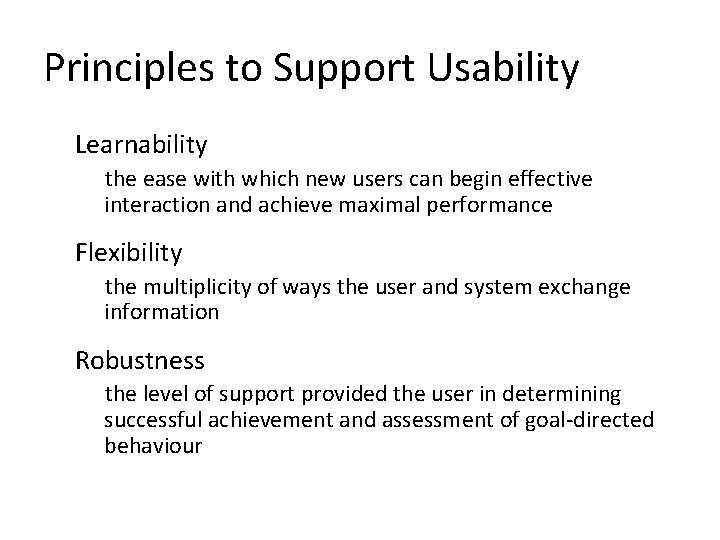
Principles to Support Usability Learnability the ease with which new users can begin effective interaction and achieve maximal performance Flexibility the multiplicity of ways the user and system exchange information Robustness the level of support provided the user in determining successful achievement and assessment of goal-directed behaviour
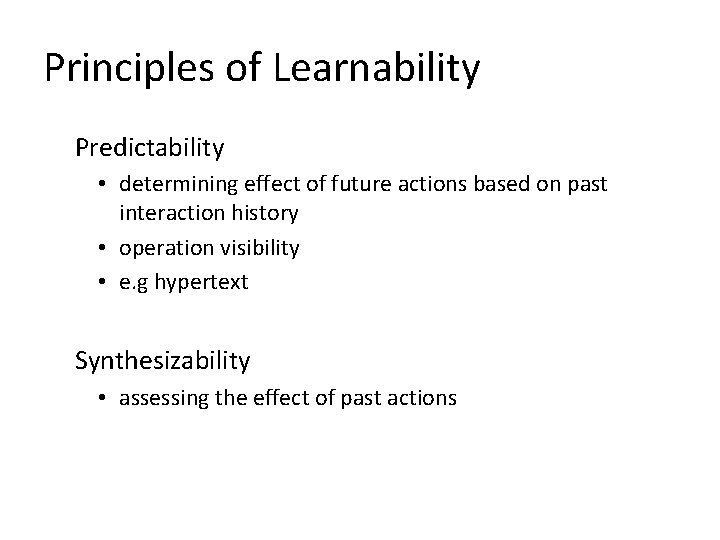
Principles of Learnability Predictability • determining effect of future actions based on past interaction history • operation visibility • e. g hypertext Synthesizability • assessing the effect of past actions
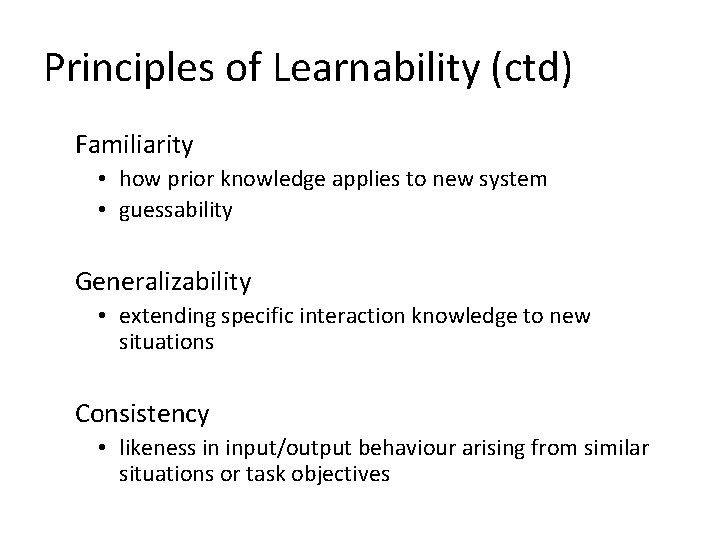
Principles of Learnability (ctd) Familiarity • how prior knowledge applies to new system • guessability Generalizability • extending specific interaction knowledge to new situations Consistency • likeness in input/output behaviour arising from similar situations or task objectives
Principles of Flexibility Dialogue Initiative • freedom from system imposed constraints on input dialogue Multithreading • ability of system to support user interaction for more than one task at a time Task Migratability • passing responsibility for task execution between user and system (Spell-checking)
Principles of Flexibility (ctd) Substitutivity • allowing equivalent values of input and output to be substituted for each other. • E. g repeating name in a text field Customizability • modifiability of the user interface by user (adaptability) or system (adaptivity)
Principles of robustness Observability • ability of user to evaluate the internal state of the system from its perceivable representation. • For example system busy state Recoverability • ability of user to take corrective action once an error has been recognized
Principles of robustness (ctd) Responsiveness • how the user perceives the rate of communication with the system • Stability Task Conformance • degree to which system services support all of the user's tasks • task completeness; task adequacy