
Human Body Systems Structure and Function The student
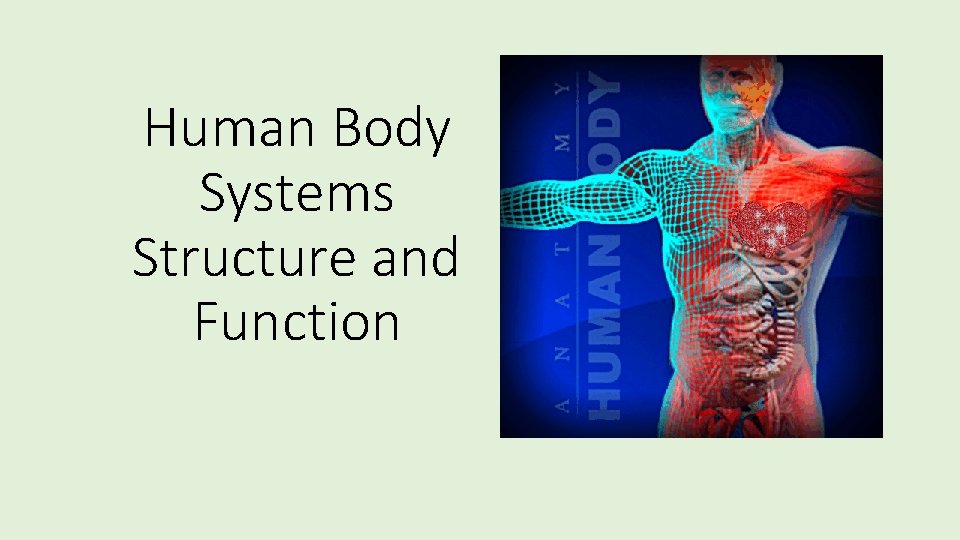
Human Body Systems Structure and Function
**The student is expected to identify the main functions of the systems of the human organism. *Including • The Skeletal • The Muscular • The Digestive and Excretory • The Respiratory • The Circulatory • The Integumentary and Nervous • The Endocrine, Immune and Reproductive

The Skeletal System. protects and holds organs in place. provides a structural support for the body and its muscles. . stores minerals. . contains resources to generate new blood cells.
Organs of this system include: Bones and Joints. Bones are hard, white, and mainly composed of a mineral compound called calcium phosphate. . Bone arrangement of the skeleton is to provide a wide range of functions including; . supporting delicate, soft organs, and anchoring muscles. . protecting the brain, lungs, and heart. . inside of the bones is bone marrow, the jelly-like substance where red and white blood cells form.
. Backbone provides structure, which enables you to stand up straight. . Skull acts as a hard, safety helmet protecting the brain. . Vertebrae surround your spinal cord. . Rib cage protects the heart and lungs.
Fun facts about the Skeletal System: • The human body’s longest bone is the femur, which is about 25% of your height. • There are 230 joints in your body. • 52 out of the 206 bones in the skeletal system are in both feet.
The skeletal system also includes the flexible connections between bones, known as joints. 1. Ball and socket joint…located at the shoulder and hips. 2. Hinge joints…located at the elbows, knees and the fingers…work like the hinges on a door.
3. Pivot joints…located in your neck and the two bones of your lower arm. 4. Saddle joint…located at the base of the thumb 5. Gliding joints…located between the bones of your hands and feet. 6. Immovable joint…located in the skull and the pelvis.
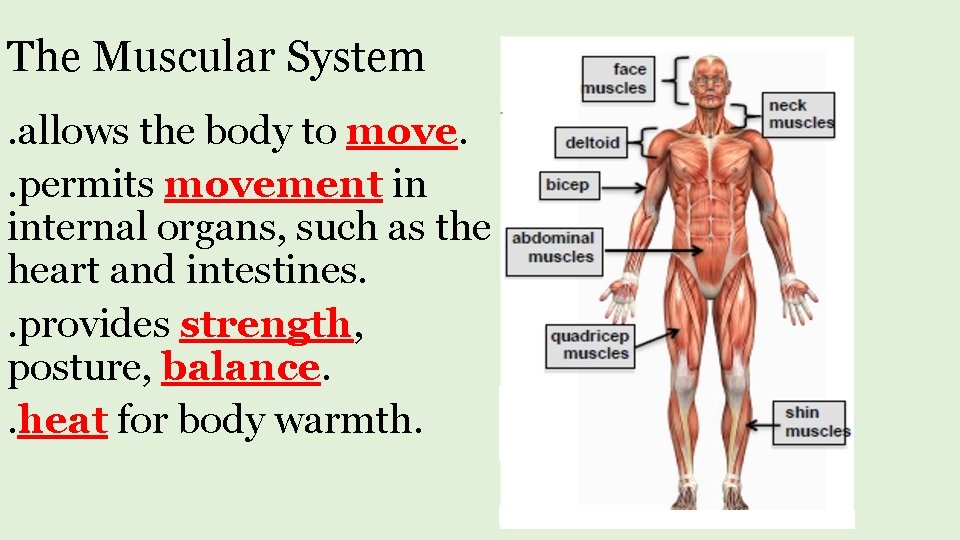
The Muscular System. allows the body to move. . permits movement in internal organs, such as the heart and intestines. . provides strength, posture, balance. . heat for body warmth.
Organs of this system include: . Muscles (three types): • Skeletal- (voluntary) • Smooth- (involuntary) • Cardiac- (involuntary). Ligaments, and tendons.
. There approximately 639 skeletal muscles in the body. They make up about 40% of body weight. Smooth muscles make up the walls of hollow organs, specifically in the digestive, circulatory, respiratory, and reproductive systems. . Cardiac muscle is the heart’s muscle tissue.
Ligaments and tendons are strong, fiber-like connections. . assist in efficient physical movement and stability. . Ligaments connect bones to other bones. Tendons connect muscles to bones.

Fun facts about the Muscular System: • More than 30 facial muscles create smiles and frowns, among other expressions. • Scientists estimate the eye muscles move more than 100, 000 times a day. • The largest muscle in the body is the muscle in the buttocks, the gluteus maximus.
Some of the body’s muscles are “voluntary, ” meaning the muscles work because you specifically tell them to. **You have control of these muscles. Some of the body’s muscles are “involuntary, ” meaning the muscles work automatically. Moving them does not involve any thought. **You do not have control over these muscles.
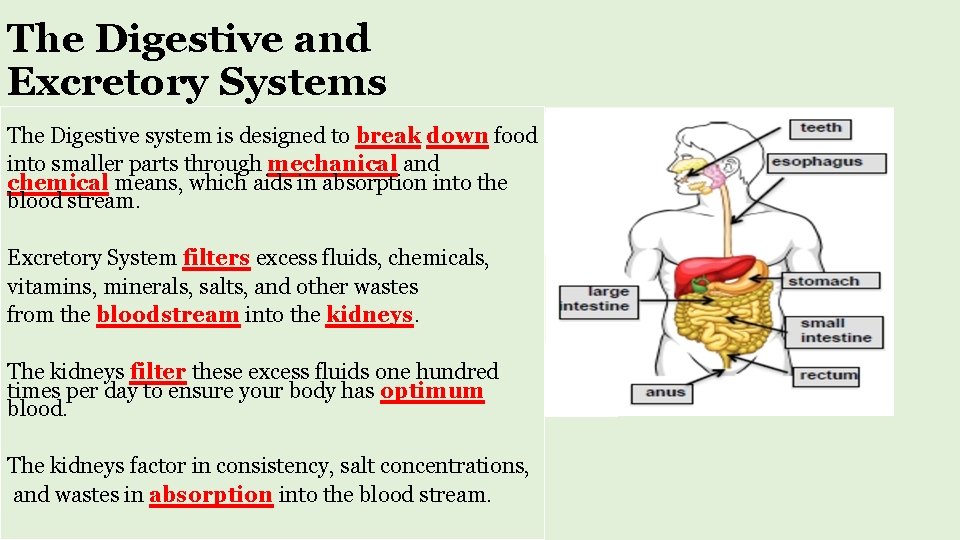
The Digestive and Excretory Systems The Digestive system is designed to break down food into smaller parts through mechanical and chemical means, which aids in absorption into the blood stream. Excretory System filters excess fluids, chemicals, vitamins, minerals, salts, and other wastes from the bloodstream into the kidneys. The kidneys filter these excess fluids one hundred times per day to ensure your body has optimum blood. The kidneys factor in consistency, salt concentrations, and wastes in absorption into the blood stream.
Organs of the Digestive System include: . Mouth. Salivary glands. Esophagus. Stomach. Small intestine. Large intestine. Rectum
. Teeth in the mouth mechanically chew food. . Salivary glands produce saliva teaming up with teeth to further break down food into smaller components. . Esophagus muscles push the smaller food particles into the stomach. . The stomach is where hydrochloric acid chemically breaks down food and destroys most microorganisms
. After an hour or two of digestion in the stomach, a thick liquid called Chyme is formed. . Chyme then passes through the small intestine. . Here up to 95% of nutrients are absorbed. . Finally, it passes through the large intestine, where it excretes from the body through the rectum and anus.
Fun Facts about the Digestive System: • Together, your large and small intestines measure about 25 feet long. • It takes about three hours for food to move through the intestines. • The large intestine sometimes holds food for up to two days. • The average human’s digestive system processes about 50 tons of food in a lifetime.
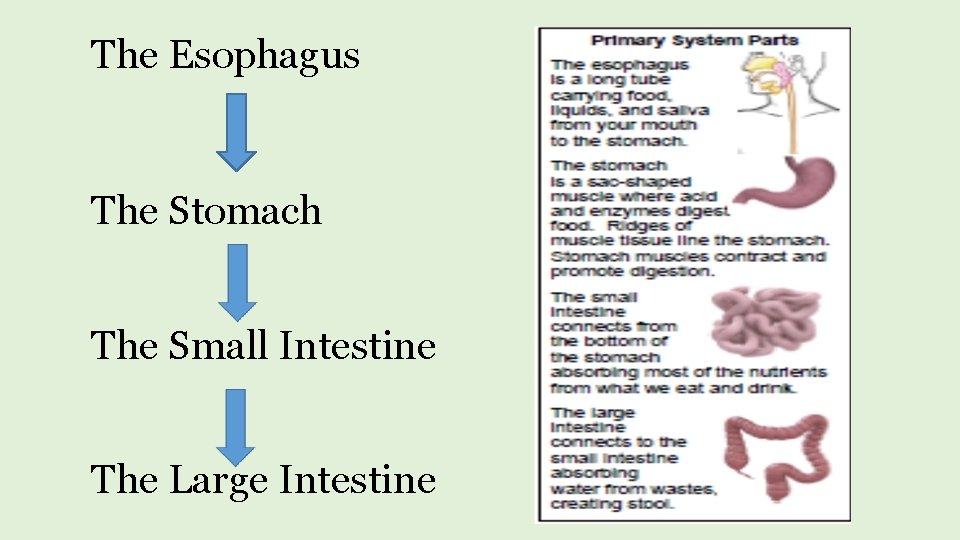
The Esophagus The Stomach The Small Intestine The Large Intestine
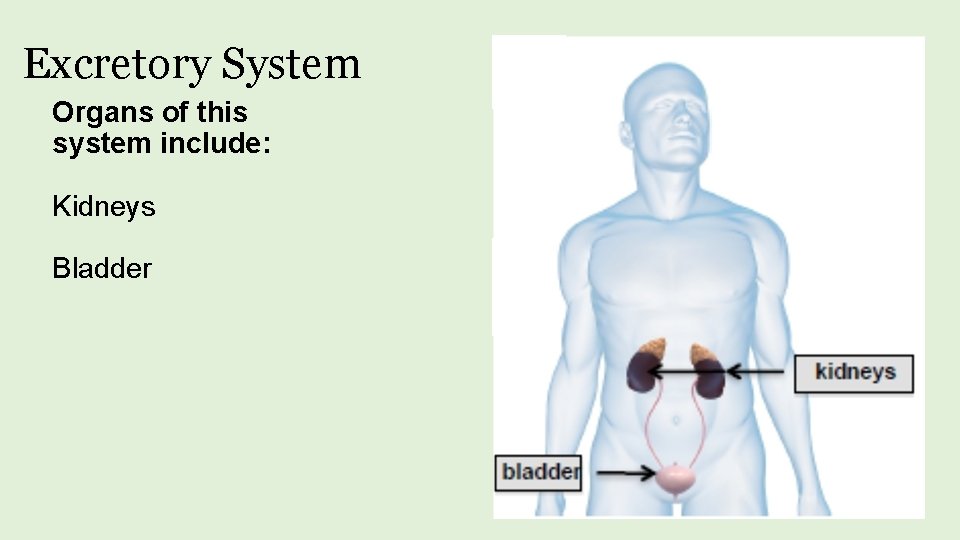
Excretory System Organs of this system include: Kidneys Bladder
. Waste collects in the center of the kidneys. . It is processed into urine and forced down through tubes into a stretchy pouch called the bladder. . When the bladder becomes full, it sends a signal through the nervous system to your brain. . The bladder then signals your body to release the urine through the urethral opening.
Fun facts about the Excretory System: • Inside the kidneys are millions of tiny structures that filter out liquids and wastes. • About 440 gallons of blood flow in and out of the kidneys every day. • Your bladder can hold about one pint of urine.
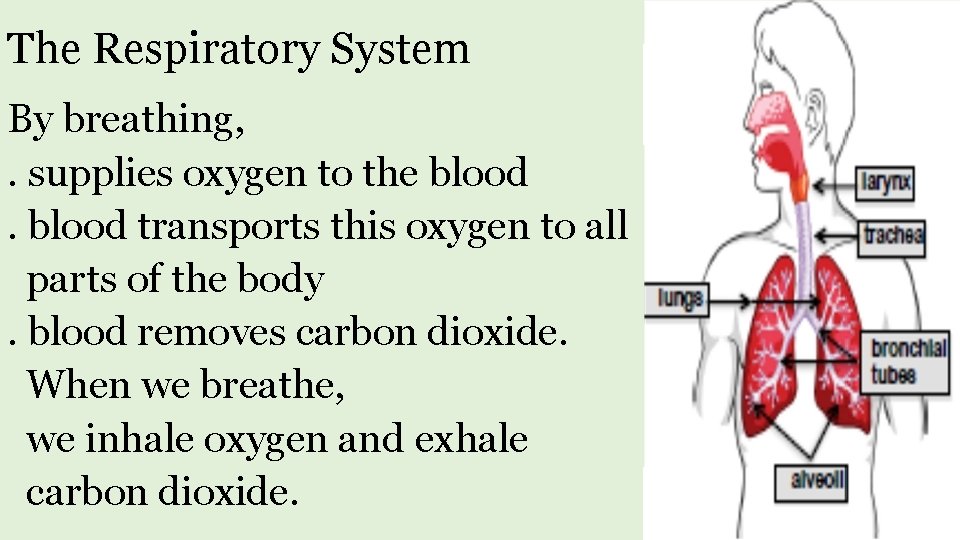
The Respiratory System By breathing, . supplies oxygen to the blood transports this oxygen to all parts of the body. blood removes carbon dioxide. When we breathe, we inhale oxygen and exhale carbon dioxide.
Organs of this system include: 1. Airways include: . Larynx. Trachea. Bronchial tubes 2. Diaphragm 3. Lungs 4. Alveoli
Respiration is achieved through the mouth, nose, trachea, lungs, and diaphragm. * First…. Air enters the body through your nose or mouth. Then travels through your larynx (or voice-box). Down your trachea (or windpipe) *Finally …. Splits into two bronchial tubes entering your lungs.
. Your lungs, located inside the chest cavity, . Carry oxygen into your body when you inhale. Carbon dioxide out of your body when you exhale. . Within the lungs… thousands of thin bronchial branches with endings composed of millions of alveoli. **This is where the exchange of oxygen and carbon dioxide occurs. .
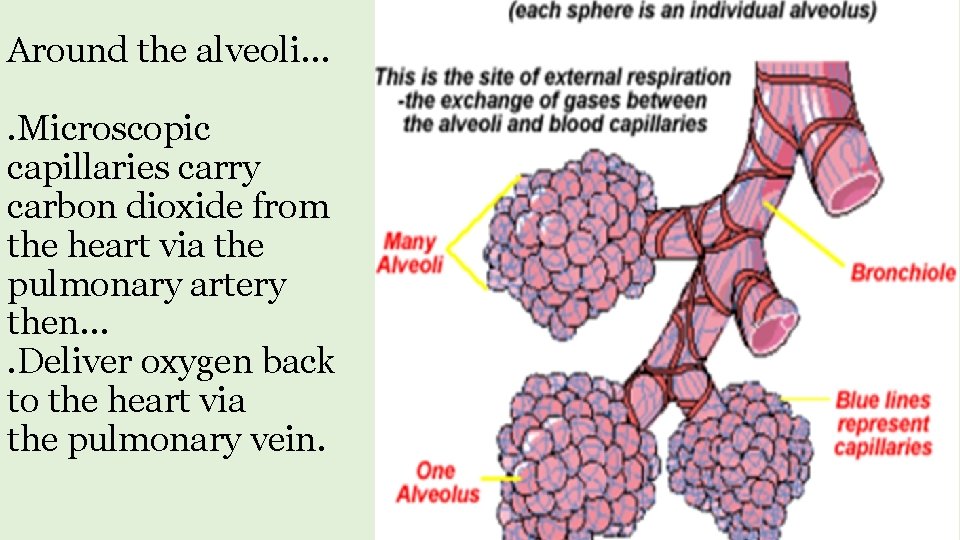
Around the alveoli…. Microscopic capillaries carry carbon dioxide from the heart via the pulmonary artery then…. Deliver oxygen back to the heart via the pulmonary vein.
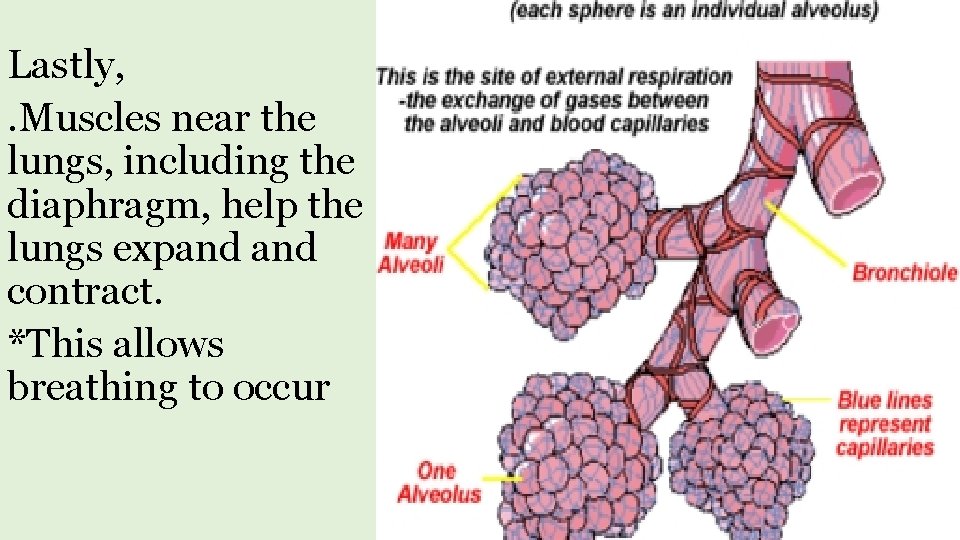
Lastly, . Muscles near the lungs, including the diaphragm, help the lungs expand contract. *This allows breathing to occur
Fun facts about the Respiratory System • There approximately 1, 500 miles of airways within the lungs. • The fastest sneeze on record is 102 miles per hour.
As you breathe out, carbon dioxide is exhaled from your body. When carbon dioxide gas is combined with water it will make an acid called carbonic acid. Bromethymol blue can be used to determine the acidity of a substance. Acidic solutions will have a yellow color. Neutral solutions result in a green color. Basic solutions appear blue.
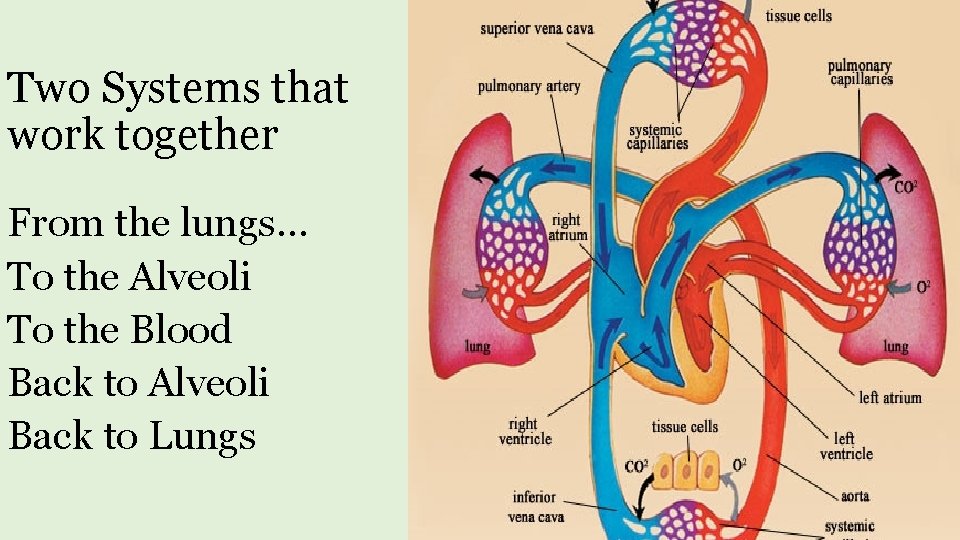
Two Systems that work together From the lungs… To the Alveoli To the Blood Back to Alveoli Back to Lungs
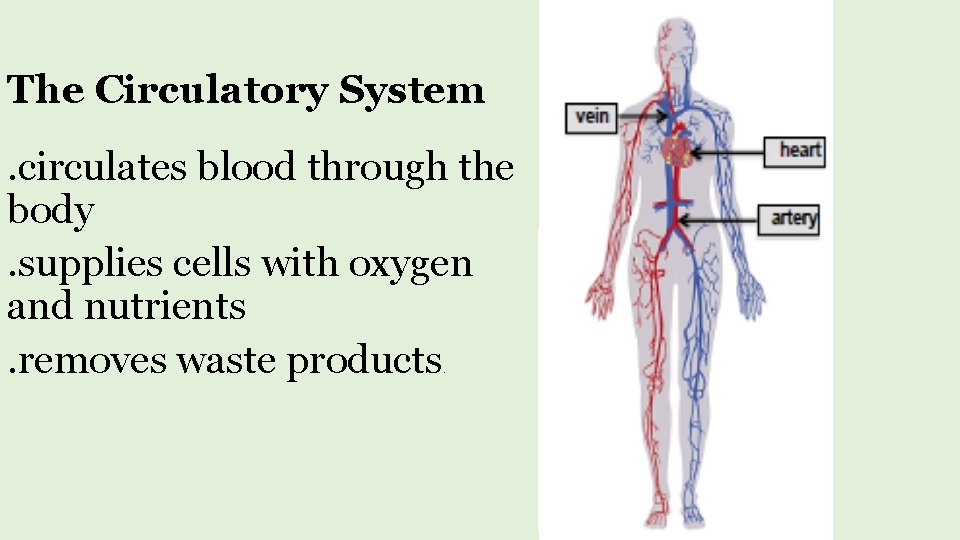
The Circulatory System. circulates blood through the body. supplies cells with oxygen and nutrients. removes waste products.
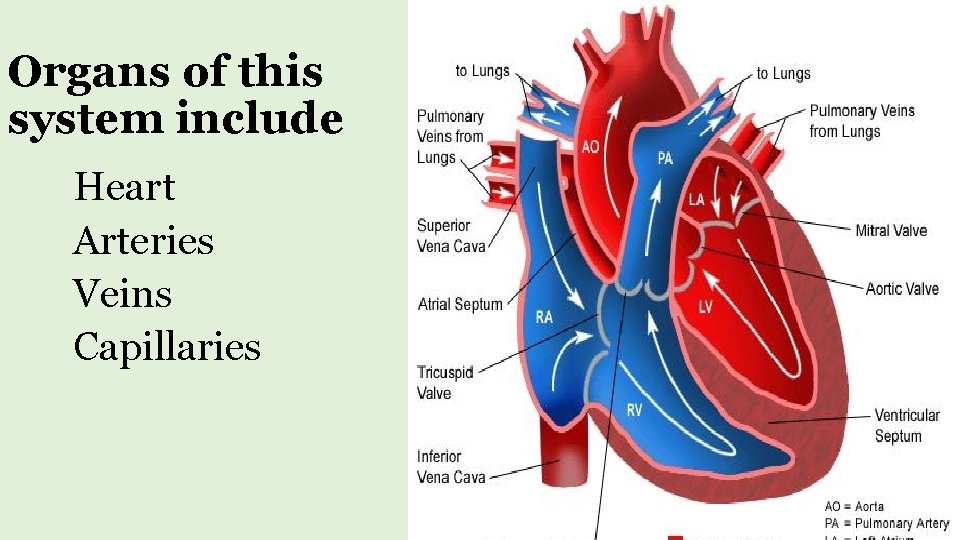
Organs of this system include Heart Arteries Veins Capillaries
The heart is the size of a clenched fist…a powerful muscle. . the heart pumps blood through its chambers to all parts of the body by cycles of contracting and relaxing. . Blood is carried to and from the heart in tubes called arteries and veins. . Arteries carry pumped blood under high pressure away from your heart through progressively smaller branched tubes called capillaries. . Veins are tubes that most commonly carry deoxygenated blood from tissues back into the heart with less force.
With every breath, . oxygen mixes with blood in the lungs. is pumped to all cells in the body through the arteries. . oxygen-depleted blood then returns back to the heart. the process repeats
Fun facts about the Circulatory System: • Your heart pumps about 4, 000 gallons of blood each day. • An average human’s heart beats 30 million times per year. • The sound of a heartbeat is created by the valves in the heart closing as they push blood through its chambers
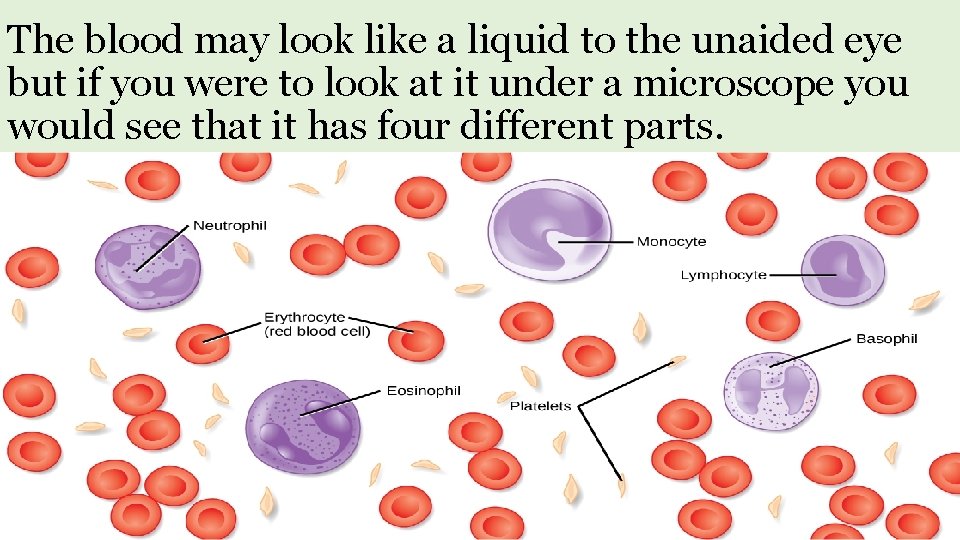
The blood may look like a liquid to the unaided eye but if you were to look at it under a microscope you would see that it has four different parts.
. The red blood cells give the blood its color. their job is to carry oxygen, carbon dioxide and glucose to all cells of the body. . the white blood cells attack invaders such as bacteria. the platelets help stop the blood from flowing out of cuts by creating scabs. . the plasma is the liquid part of the blood and all the other parts float around in it.
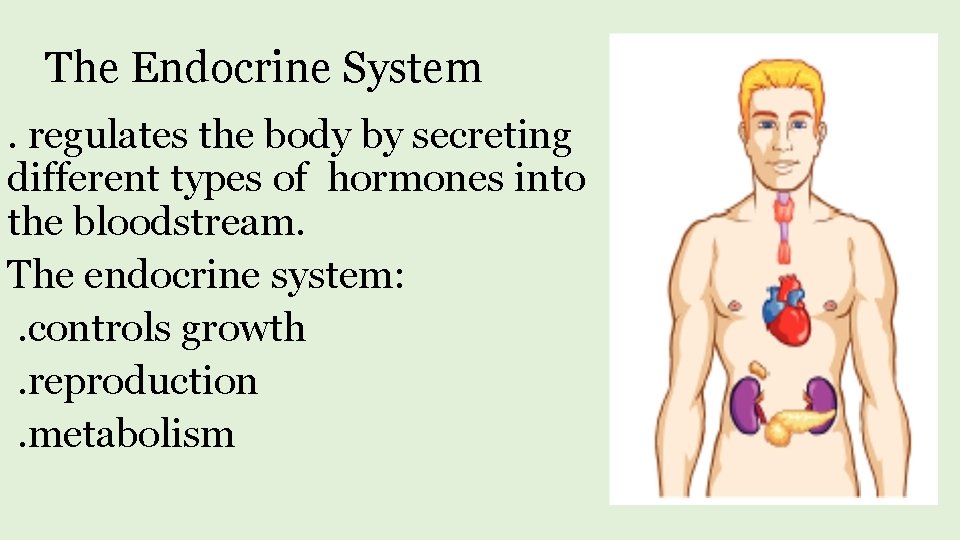
The Endocrine System. regulates the body by secreting different types of hormones into the bloodstream. The endocrine system: . controls growth. reproduction. metabolism
Hormones are chemical messengers released from glands, in response to instructions from the brain. There are over 30 hormones secreted by the endocrine system helping regulate body functions. When a person is frightened or anxious, a hormone called adrenaline releases into the bloodstream. This hormone speeds the breathing and heart rate, transporting more oxygen to the muscles. As a result, the body creates what is known as a “fight or flight” response. The “fight” response is exactly as it sounds. Your body tells you to stay and fight with whatever is causing the scary moment. “Flight” occurs when the body tells you to walk or run away from what has scared you.
Organs of this system include: . Thyroid gland – regulates metabolism. Adrenal gland – secretes the hormone adrenalin for fight or flight response. Pancreas – secretes the hormone insulin to regulate blood sugar. Pituitary gland – called the master gland because it controls the other glands and influences growth and metabolism
Fun facts about the Endocrine System: • Without glands, there would be no sweat, mucus, or chemical juices in your body. • For girls, puberty generally begins sometime between ages 9 -13. . For boys, puberty generally begins between ages 1015. **Puberty begins when hormones from various glands begin to increase
The Reproductive System works closely with the Endocrine System Allows humans to continue as a species. by fertilizing a female ovum with a male sperm through sexual reproduction. Glands and Function. Gonads (part of the Endocrine system) include testes and ovaries– secrete sex hormones
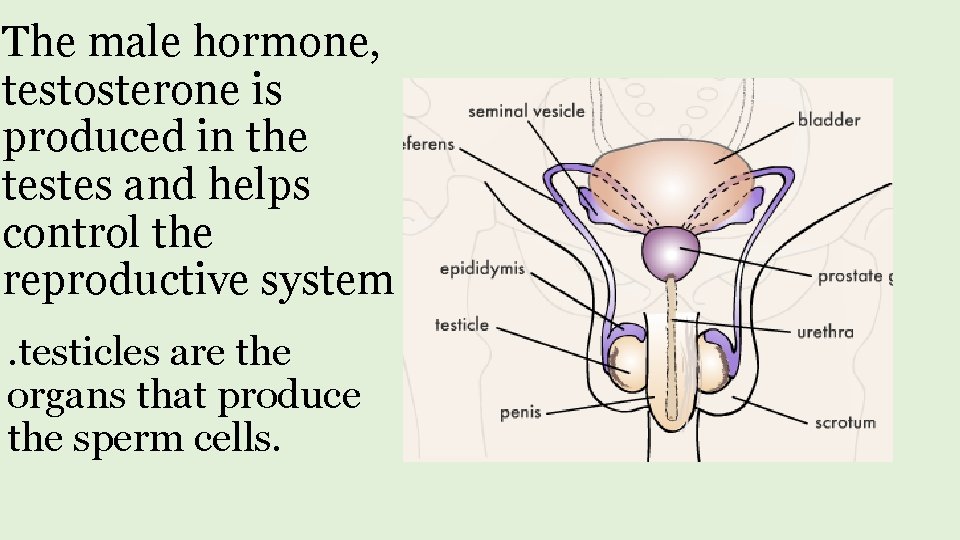
The male hormone, testosterone is produced in the testes and helps control the reproductive system. testicles are the organs that produce the sperm cells.
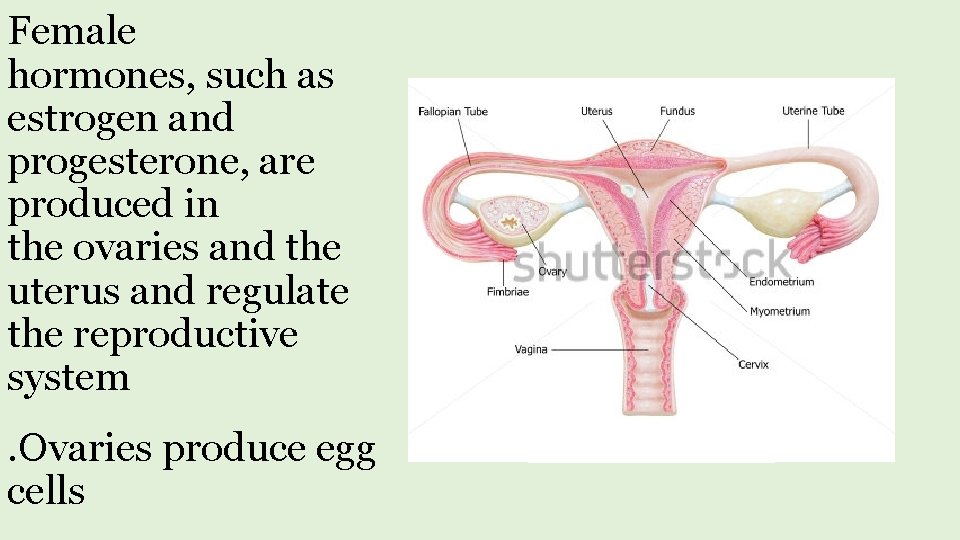
Female hormones, such as estrogen and progesterone, are produced in the ovaries and the uterus and regulate the reproductive system. Ovaries produce egg cells
Fun Facts about the Reproductive System: • The largest cell in the female body is the egg. • A woman never runs out of eggs. At birth she has between 1 and 2 million potential eggs. • About 500 million sperm mature every day in a healthy male.

It takes 9 months for a fertilized egg to develop and grow into a baby. During that time the fetus grows from about the size of a grain of sand into a 6 -7 pound baby. The baby not only grows in length but also in weight.
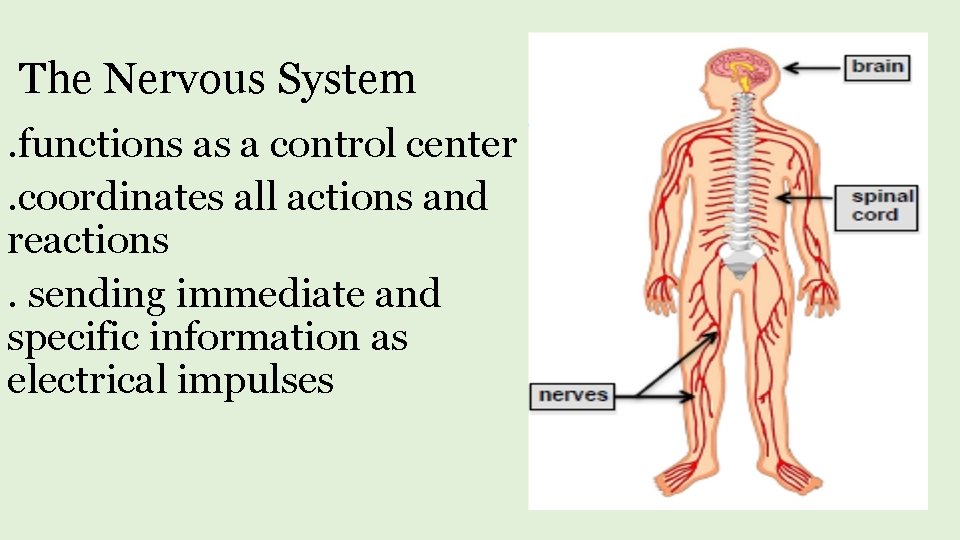
The Nervous System. functions as a control center. coordinates all actions and reactions. sending immediate and specific information as electrical impulses
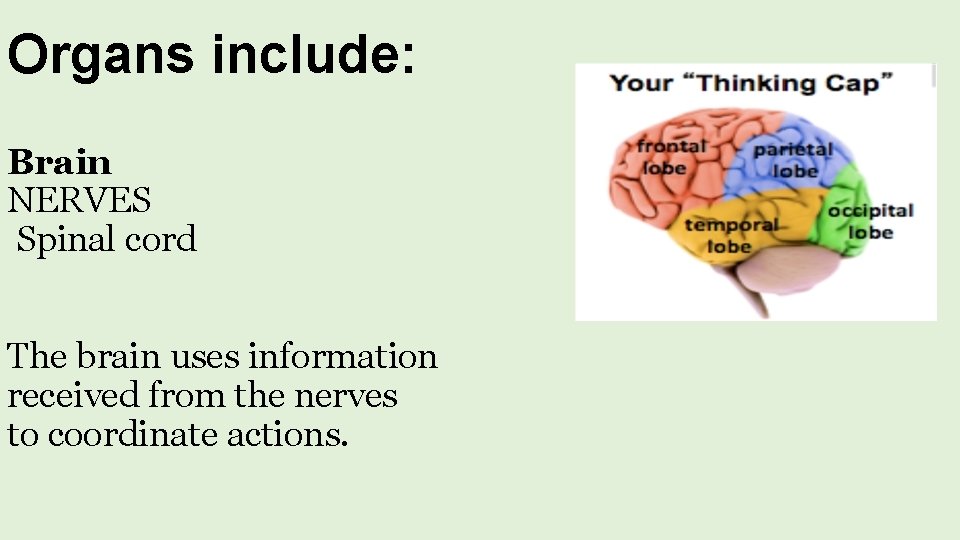
Organs include: Brain NERVES Spinal cord The brain uses information received from the nerves to coordinate actions.
Thin threads of nerve cells, called neurons, carry messages throughout the body. Sensory nerves carry these messages to the brain through the spinal cord, Motor nerves carry them from the brain to all of the various muscles and glands.
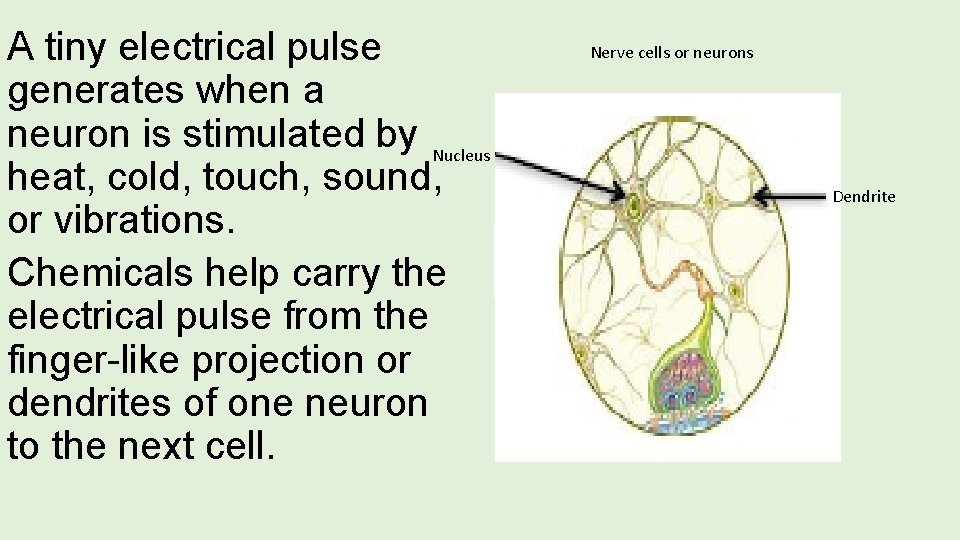
A tiny electrical pulse generates when a neuron is stimulated by Nucleus heat, cold, touch, sound, or vibrations. Chemicals help carry the electrical pulse from the finger-like projection or dendrites of one neuron to the next cell. Nerve cells or neurons Dendrite
Fun facts about the Nervous System: • There are more nerve cells in the human brain than there are stars in the Milky Way. • The left side of the human brain controls the right side of the body and vice-versa. • As we get older, the brain loses a gram of brain mass per year.
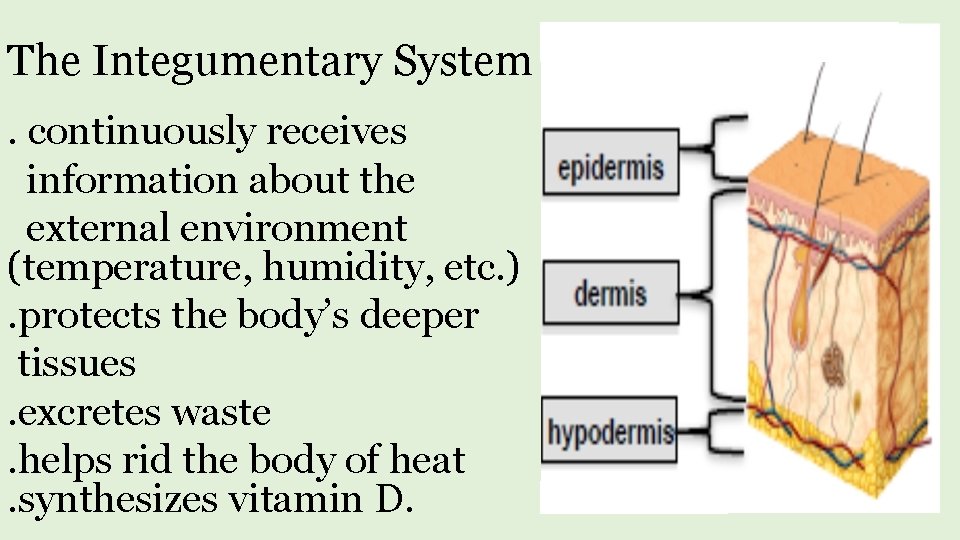
The Integumentary System. continuously receives information about the external environment (temperature, humidity, etc. ). protects the body’s deeper tissues. excretes waste. helps rid the body of heat. synthesizes vitamin D.
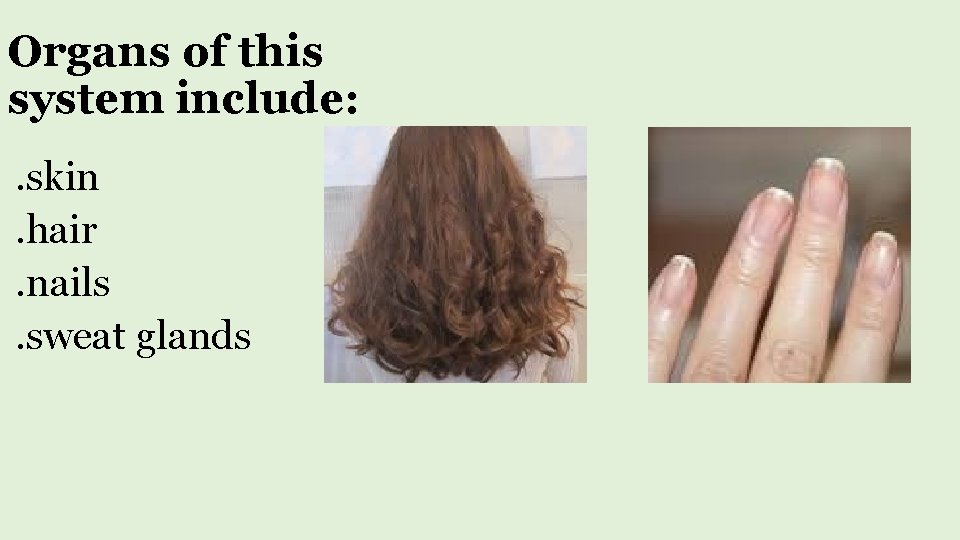
Organs of this system include: . skin. hair. nails. sweat glands
Skin functions include; excreting wastes, regulating temperature, waterproofing and protecting deeper tissues. Skin also serves as the sensory receptor attachment site, so that the body can detect pain, sensation, pressure, and temperature. Additionally, it synthesizes vitamin D from sunlight, which aids in metabolizing calcium in the body.
There are three layers of the skin 1. The epidermis is the visible outer layer where new skin cells form. . Finger nails function to protect the surrounding soft tissues of the fingers from injuries. 2. The dermis contains oil and sweat glands. . the sweat glands secrete sweat when the body is too warm, which cools the skin surface and body. . oil glands moisten the skin and hair and add flexibility. 3. The hypodermis helps the body stay warm and anchors the skin to all tissues beneath it. . hypodermis is mainly composed of fat, which also helps the body stay warm.
Fun facts about the Integumentary System: • You lose about 30, 000 to 40, 000 dead skin cells every minute. • The skin is the largest organ in the human body.
The Integumentary System works very closely with the Nervous system. The sensory receptors on the dermis gather information about what is affecting the skin and sends the information to the brain. If something is not right, the brain is alerted and the body takes action.
There are two types of sensory receptors: touch receptors and pain receptors. 1. Touch receptors are very sensitive and respond to the slightest contact. There about 500, 000 touch receptors in the human body, and they are found in areas such as the fingers, tongue, and lips. 2. Pain receptors are not as sensitive. They do not react, unless there is a very strong stimulus or pain. There are 3 to 4 million pain receptors scattered all over the body. That tells you how important they are!

The End
- Slides: 61