
Human Biology Sylvia S Mader Michael Windelspecht Chapter
Human Biology Sylvia S. Mader Michael Windelspecht Chapter 12 Muscular System Lecture Outline Part 3 Copyright © The Mc. Graw-Hill Companies, Inc. Permission required for reproduction or display. 1
12. 2 Skeletal Muscle Fiber Contraction What role does ATP play in muscle contraction and rigor mortis? • ATP is needed to attach and detach the myosin heads from actin. • After death, muscle cells continue to produce ATP through _______ and muscle cells can continue to contract. • When ATP runs out, some myosin heads are still attached and cannot detach, causing rigor mortis. • Rigor mortis and body ______ may be used to estimate time of death. 2
12. 3 Whole Muscle Contraction Terms to describe whole muscle contraction • _____ – a nerve fiber and all of the muscle fibers it stimulates • ______ – a single contraction lasting a fraction of a second • ______ – an increase in muscle contraction until the maximal sustained contraction is reached 3
12. 3 Whole Muscle Contraction Terms to describe whole muscle contraction • _____ – maximal sustained contraction • ______ – a continuous, partial contraction of alternate muscle fibers causing the muscle to look firm 4

12. 3 Whole Muscle Contraction Physiology of skeletal muscle contraction Force Copyright © The Mc. Graw-Hill Companies, Inc. Permission required for reproduction or display. contraction period relaxation period latent period Stimulus Time a. tetanus Force summation fatigue Stimuli Time b. Figure 12. 9 The three phases of a single muscle twitch and how summation and tetanus increase the force of contraction. 5

12. 3 Whole Muscle Contraction Where are the fuel sources for muscle contraction? Stored in the muscle – Glycogen – Fat • In the blood – Glucose – Fatty acids Copyright © The Mc. Graw-Hill Companies, Inc. Permission required for reproduction or display. 60 Percentage of energy expenditure • muscle triglycerides plasma fatty acids blood glucose muscle glycogen 50 40 30 20 10 0 0 Figure 12. 10 The sources of energy for muscle contraction. 1 2 Exercise time (hr) 3 4 6
12. 3 Whole Muscle Contraction What are the sources of ATP for muscle contraction? • Limited amounts of ATP are stored in muscle fibers. • Creatine phosphate pathway (CP) – ____ way to acquire ATP but only sustains a cell for _______; builds up when a muscle is resting • Fermentation – fast-acting but results in _______ build up • Cellular respiration (aerobic) – not an immediate source of ATP but the best _____ source 7
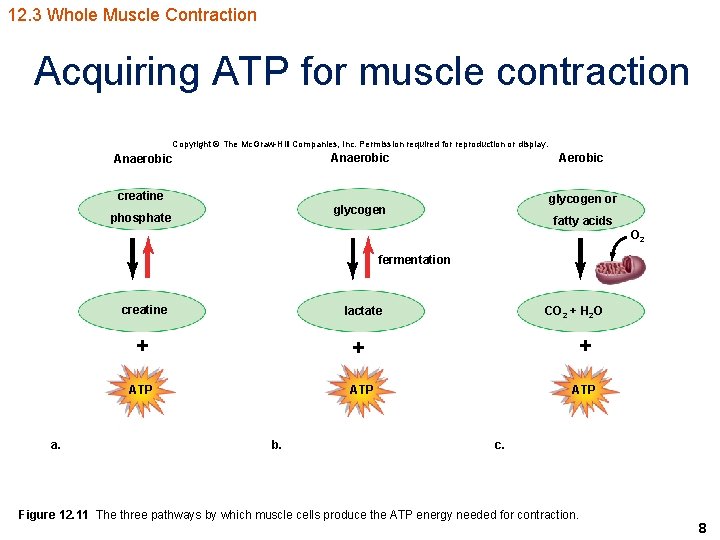
12. 3 Whole Muscle Contraction Acquiring ATP for muscle contraction Copyright © The Mc. Graw-Hill Companies, Inc. Permission required for reproduction or display. Anaerobic Aerobic creatine glycogen or glycogen phosphate fatty acids O 2 fermentation creatine lactate + + + ATP a. CO 2 + H 2 O ATP b. ATP c. Figure 12. 11 The three pathways by which muscle cells produce the ATP energy needed for contraction. 8
12. 3 Whole Muscle Contraction Muscle fibers come in 2 forms Fast-twitch fibers • • • Rely on CP and fermentation (anaerobic) Adapted for strength Light in color Few mitochondria Little or no myoglobin Fewer blood vessels than slow-twitch 9
12. 3 Whole Muscle Contraction Muscle fibers come in 2 forms Slow-twitch fibers • • • Rely on aerobic respiration Adapted for endurance Dark in color Many mitochondria Myoglobin Many blood vessels 10
- Slides: 10