
Human Biology Sylvia S Mader Michael Windelspecht Chapter
Human Biology Sylvia S. Mader Michael Windelspecht Chapter 16 Reproductive System Lecture Outline Part 2 Copyright © The Mc. Graw-Hill Companies, Inc. Permission required for reproduction or display. 1
16. 2 Male Reproductive System Male anatomy: Penis • Penis – This organ is used for sexual intercourse and urination. • Glans penis – Tip of the penis, usually covered by foreskin, that is intensely sensitive. – ______ is the removal of all or part of the foreskin. – Erectile dysfunction (impotency) occurs when the erectile tissue does not expand enough to compress the veins. 2
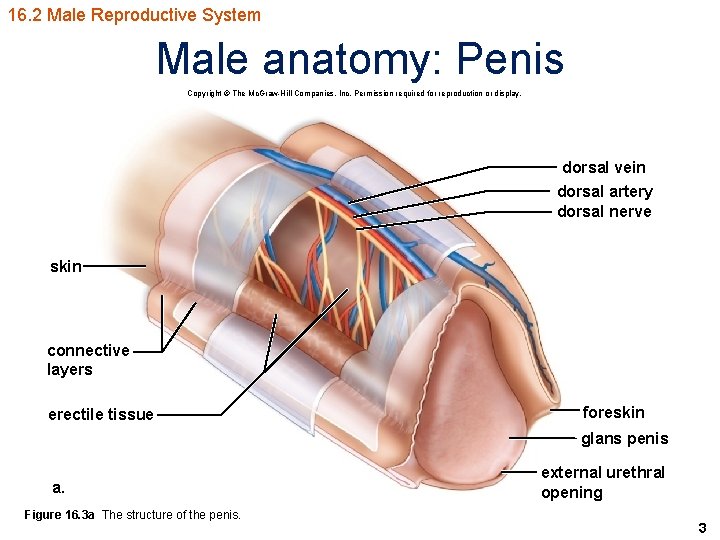
16. 2 Male Reproductive System Male anatomy: Penis Copyright © The Mc. Graw-Hill Companies, Inc. Permission required for reproduction or display. dorsal vein dorsal artery dorsal nerve skin connective layers erectile tissue foreskin glans penis a. Figure 16. 3 a The structure of the penis. external urethral opening 3
16. 2 Male Reproductive System Hormonal regulation in males • Gonadotropin-releasing hormone (Gn. RH) – secreted by the thalamus to control release of other hormones • ____________ (FSH) – promotes the production of sperm • ____________ (LH) – controls the production of testosterone • Testosterone – important for normal development and functioning of the male reproductive organs 4
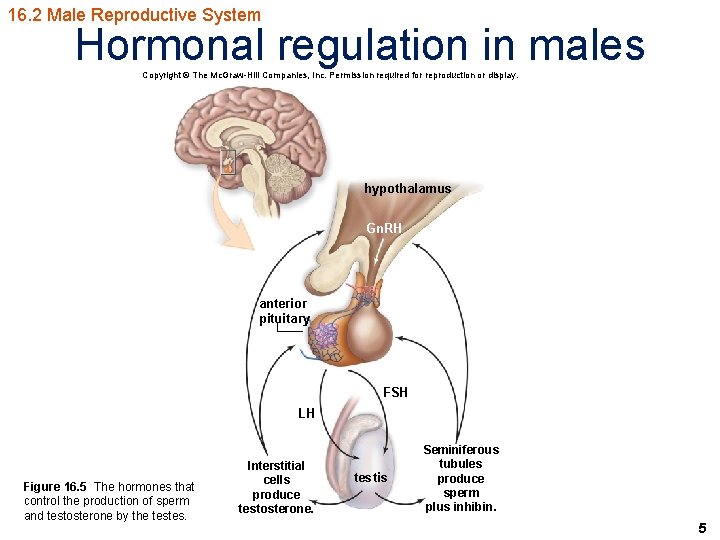
16. 2 Male Reproductive System Hormonal regulation in males Copyright © The Mc. Graw-Hill Companies, Inc. Permission required for reproduction or display. hypothalamus Gn. RH anterior pituitary FSH LH Figure 16. 5 The hormones that control the production of sperm and testosterone by the testes. Interstitial cells produce testosterone. testis Seminiferous tubules produce sperm plus inhibin. 5
16. 3 Female Reproductive System Female anatomy • Genital tract – Ovaries – Oviducts – Uterus – Cervix – Vagina • External genitals (vulva) – Labia major – Labia minor – Mons pubis – Clitoris 6
16. 3 Female Reproductive System Female anatomy: Genital tract • ____ – produce eggs and sex hormones • ____ – move eggs and normal site of fertilization • _______ – normal site of implantation and fetal development • _______ – opening to the uterus that can dilate during childbirth • Vagina – birth canal and the copulatory organ of the female 7
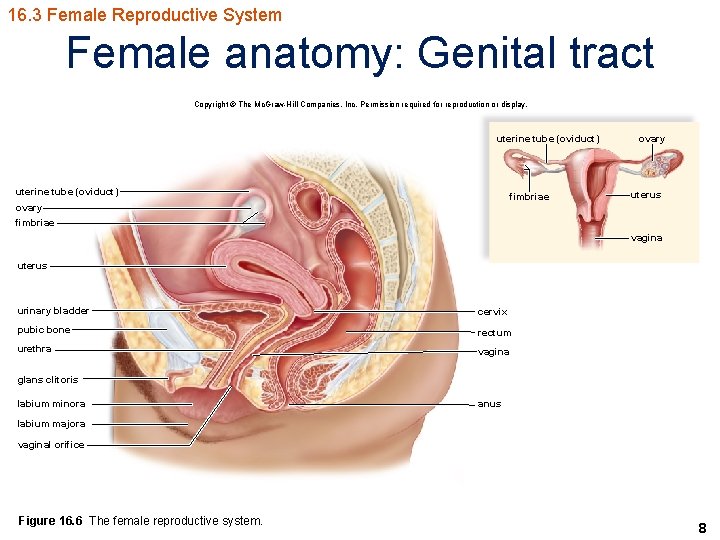
16. 3 Female Reproductive System Female anatomy: Genital tract Copyright © The Mc. Graw-Hill Companies, Inc. Permission required for reproduction or display. uterine tube (oviduct) fimbriae ovary uterus vagina uterus urinary bladder cervix pubic bone rectum urethra vagina glans clitoris labium minora anus labium majora vaginal orifice Figure 16. 6 The female reproductive system. 8
16. 3 Female Reproductive System Female anatomy: External anatomy • Labia major – 2 large folds of fatty skin • Labia minor – 2 small folds just inside the labia major that contain the openings to the urethra and vagina • Mons pubis – fatty skin covered in coarse hair • Clitoris – erectile organ and site of intense sexual feeling 9
16. 4 The Ovarian Cycle The ovarian cycle: The ovary • An ovary contains many _____, each containing an immature egg (oocyte). • At puberty a female has 300, 000 -400, 000 follicles. • During the lifetime of a female, only _____ follicles mature. 10
16. 4 The Ovarian Cycle The ovarian cycle: The ovary • One follicle matures each month from puberty until _______ (end of ovarian and uterine cycles). • _____ is the monthly release of an oocyte from the ovary when a follicle ruptures. 11
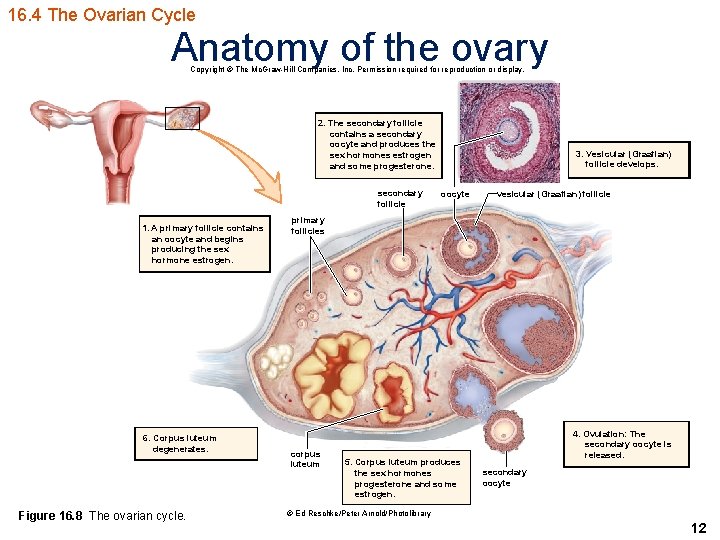
16. 4 The Ovarian Cycle Anatomy of the ovary Copyright © The Mc. Graw-Hill Companies, Inc. Permission required for reproduction or display. 2. The secondary follicle contains a secondary oocyte and produces the sex hormones estrogen and some progesterone. secondary follicle 1. A primary follicle contains an oocyte and begins producing the sex hormone estrogen. 6. Corpus luteum degenerates. Figure 16. 8 The ovarian cycle. 3. Vesicular (Graafian) follicle develops. oocyte vesicular (Graafian) follicle primary follicles corpus luteum 5. Corpus luteum produces the sex hormones progesterone and some estrogen. 4. Ovulation: The secondary oocyte is released. secondary oocyte © Ed Reschke/Peter Arnold/Photolibrary 12
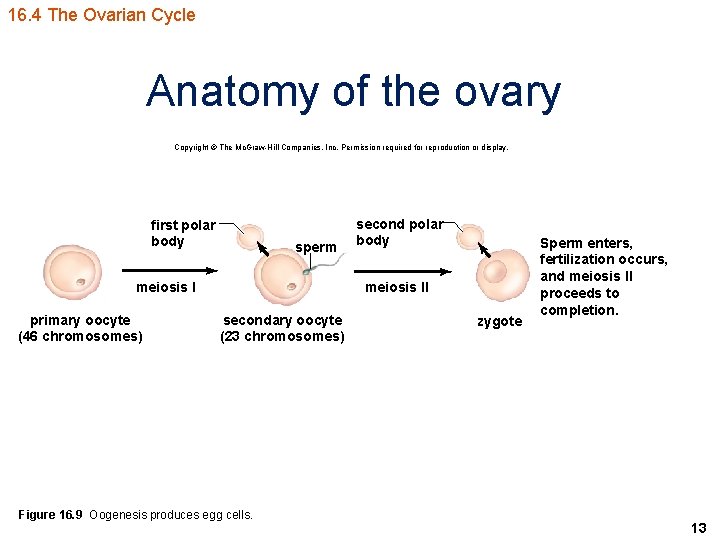
16. 4 The Ovarian Cycle Anatomy of the ovary Copyright © The Mc. Graw-Hill Companies, Inc. Permission required for reproduction or display. first polar body sperm meiosis I primary oocyte (46 chromosomes) second polar body meiosis II secondary oocyte (23 chromosomes) Figure 16. 9 Oogenesis produces egg cells. zygote Sperm enters, fertilization occurs, and meiosis II proceeds to completion. 13
16. 4 The Ovarian Cycle The ovarian cycle • This is the formation and release of an immature egg. • It is controlled by Gn. RH from the _________ 14
16. 4 The Ovarian Cycle The ovarian cycle • 2 phases - ______ phase - FSH promotes the development of a follicle that secretes estrogen. - An estrogen spike leads to a surge in LH and ovulation around day 14 in the 28 -day cycle. - _____ phase - LH promotes the development of the corpus luteum that functions to secrete progesterone. - When pregnancy does not occur, menstruation begins. 15
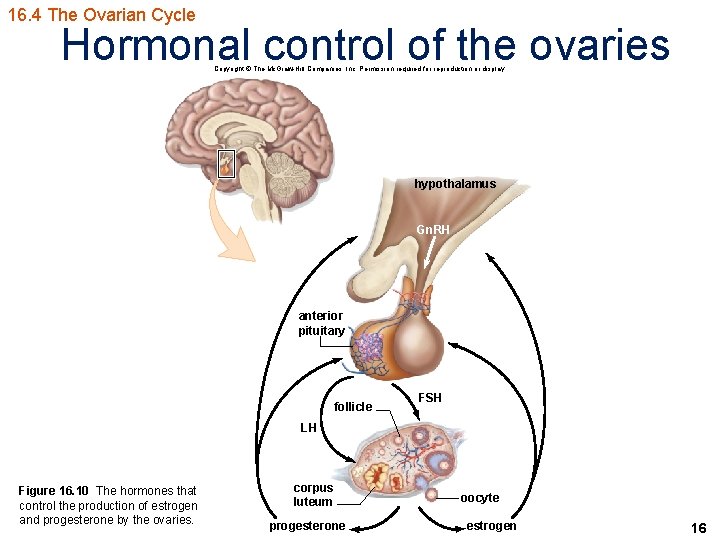
16. 4 The Ovarian Cycle Hormonal control of the ovaries Copyright © The Mc. Graw-Hill Companies, Inc. Permission required for reproduction or display. hypothalamus Gn. RH anterior pituitary follicle FSH LH Figure 16. 10 The hormones that control the production of estrogen and progesterone by the ovaries. corpus luteum progesterone oocyte estrogen 16
- Slides: 16