
Human Behavior Ch 1 1 What is Psychology
Human Behavior Ch. 1 -1 What is Psychology?
Brooke Ellison • • Accident at 11 years old. Paralyzed from the neck down. Went on to graduate from Harvard. Did not dwell on situation
Psychology • Not limited to studying abnormal behavior. • Scientific study of behavior and mental processes. • Thoughts, feelings, and actions. • Pg. 4 is a list of associated psychology fields.
Developmental Psychology • Study physical, mental, social, and emotional growth and change. • From prenatal to old age. • Subgroups include: – Child, adolescent, and life-span psychologists. • Would study how Brooke managed with the challenges of adolescence.
Physiological Psychology • Study the biological basis of human behavior, thoughts, and emotions. • Neuropsychologists – Brain and Nervous system • Biological psychologists – Body’s chemistry • Behavioral geneticists – Explore heredity • Would like to study how they can help Brooke once again send messages to the muscles of her body.
Experimental Psychology • Conduct research on basic psychological processes = learning, memory, sensation, perception, thinking, motivation, and emotion. • Why can some achieve more in athletics, arts, and so on. • Would be interested in how Brooke processes and remembers information.
Personality Psychology • Study the differences among individuals in traits like sociability, conscientiousness, self-esteem, etc… • Like to study Brookes personality traits, did they always exist or were they due to her accident. Will they change as she gets older?
Clinical and Counseling Psychology • 50% of psychologists • Clinical – Interested in the diagnosis, causes, and treatment of psychological disorders (depression). • Counseling – Interested in the problems of “normal” everyday adjustments (career choices) • Divide time between treatment and research • Would monitor Brooke and anyone else who had a difficult time with her accident. Such as her sister Kysten.
Social Psychology • Study how social influences are exerted and the effects they have. • Would study how stereotypes of handicapped people would affect the way in which Brooke was treated.
Industrial and Organizational (I/O) Psychology • Apply principles of psychology to the workplace. • How to train personnel, improve productivity, and working conditions.
Enduring Issues • What do all fields have in common? • 5 enduring issues are evident in all: – Person-Situation – Nature-Nurture – Stability-Change – Diversity-Universality – Mind-Body
Person-Situation • To what extent is behavior caused by internal processes (emotions). • To what extent is behavior caused by external factors (incentives).
Nature-Nurture • Is a person shaped by: – Heredity (genes) – Environment (experiences)
Stability-Change • Are our characteristics: – Permanent and fixed – Change in predictable and unpredictable ways
Diversity-Universality • We are all human • Yet we all have differences • What differences exists between: – Men and women – Racial or ethnic groups – Or a particular society
Mind-Body • How the mind and body connect. • Experiences (thoughts and feelings) • Biological processes (activity in the nervous system)
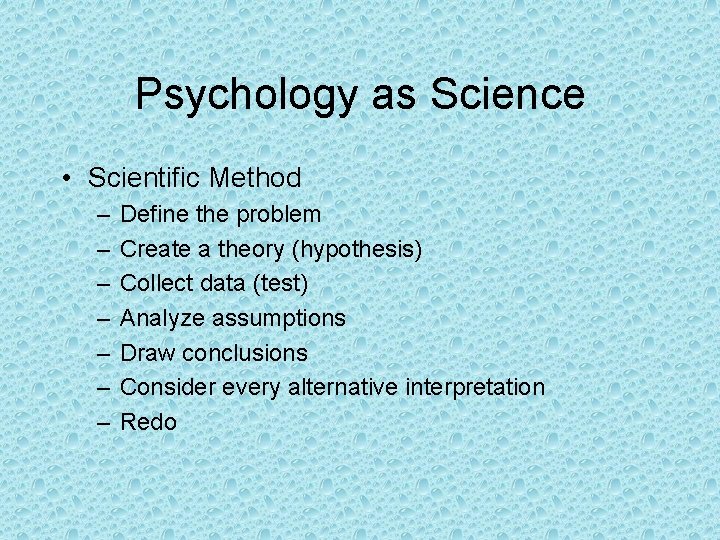
Psychology as Science • Scientific Method – – – – Define the problem Create a theory (hypothesis) Collect data (test) Analyze assumptions Draw conclusions Consider every alternative interpretation Redo
- Slides: 17