
Human Anatomy and Physiology Lecture 1 Systems and

- Slides: 30
Human Anatomy and Physiology Lecture 1 Systems and Orientation From Marieb CHB 2014 Copyright © 2009 Pearson Education, Inc. , publishing as Benjamin Cummings
The Human Body—An Orientation Anatomy § Study of the structure and shape of the body and its parts Physiology § Study of how the body and its parts work or function Copyright © 2009 Pearson Education, Inc. , publishing as Benjamin Cummings
Levels of Structural Organization Smooth muscle cell Molecules Cellular level Cells are made up of molecules Atoms Chemical level Atoms combine to form molecules Tissue level Tissues consist of similar types of cells Smooth muscle tissue Epithelial tissue Smooth muscle Blood tissue vessel (organ) Connective tissue Organ level Organs are made up of different types of tissues Cardiovascular system Organismal level Human organisms are made up of many organ systems Organ system level Organ systems consist of different organs that work together closely Copyright © 2009 Pearson Education, Inc. , publishing as Benjamin Cummings Figure 1. 1
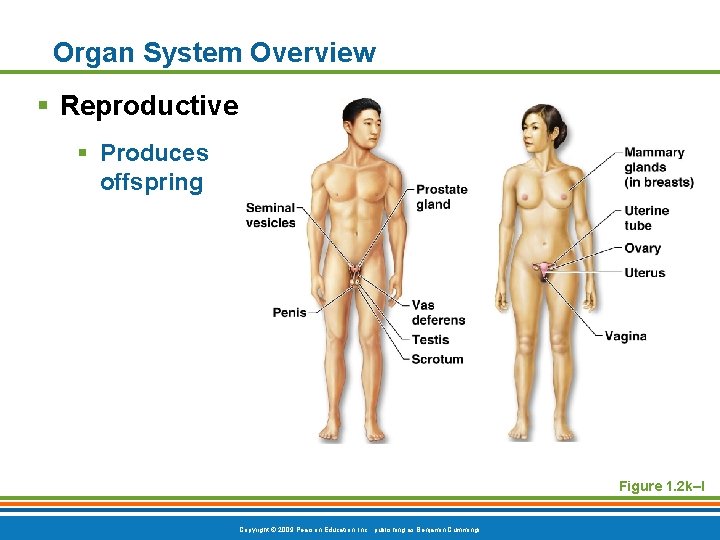
Organ System Overview § Reproductive § Produces offspring Figure 1. 2 k–l Copyright © 2009 Pearson Education, Inc. , publishing as Benjamin Cummings
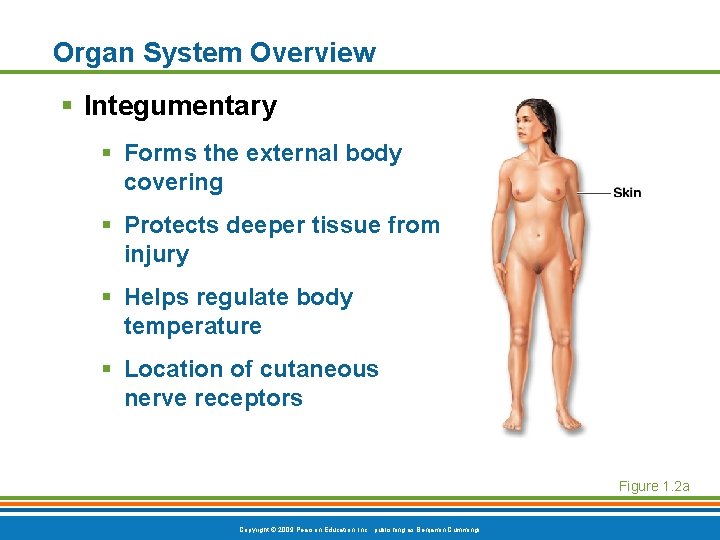
Organ System Overview § Integumentary § Forms the external body covering § Protects deeper tissue from injury § Helps regulate body temperature § Location of cutaneous nerve receptors Figure 1. 2 a Copyright © 2009 Pearson Education, Inc. , publishing as Benjamin Cummings
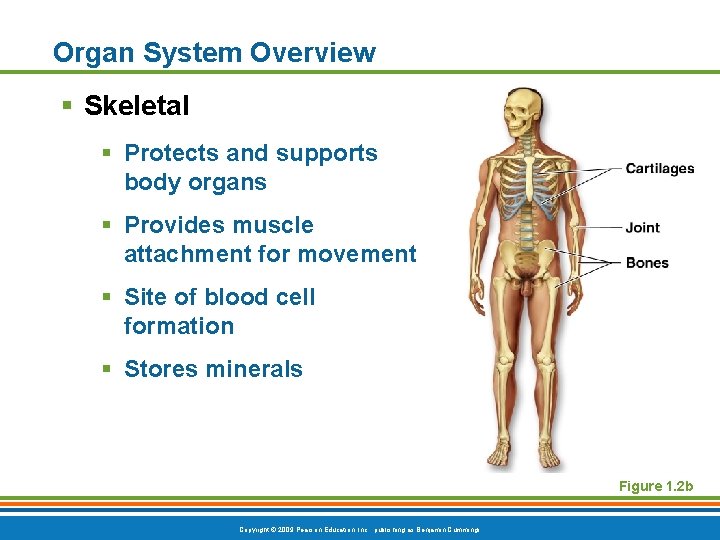
Organ System Overview § Skeletal § Protects and supports body organs § Provides muscle attachment for movement § Site of blood cell formation § Stores minerals Figure 1. 2 b Copyright © 2009 Pearson Education, Inc. , publishing as Benjamin Cummings
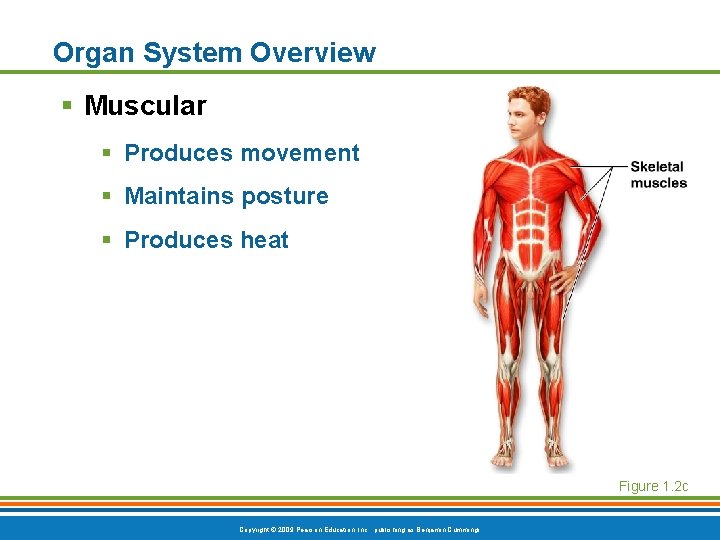
Organ System Overview § Muscular § Produces movement § Maintains posture § Produces heat Figure 1. 2 c Copyright © 2009 Pearson Education, Inc. , publishing as Benjamin Cummings
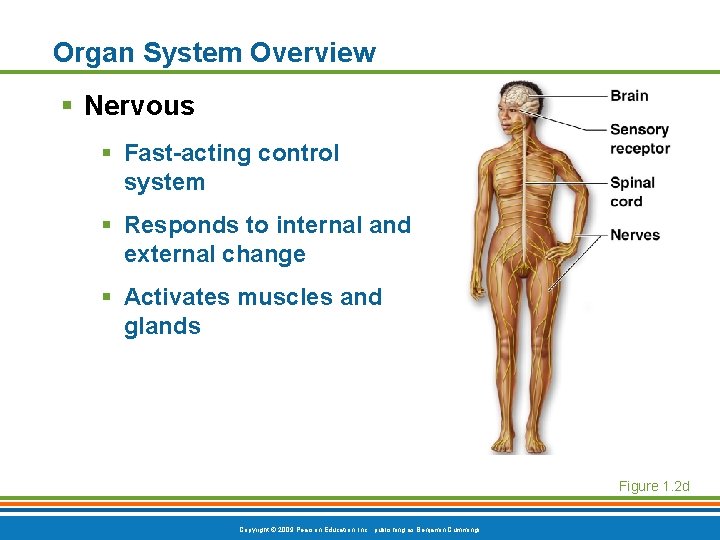
Organ System Overview § Nervous § Fast-acting control system § Responds to internal and external change § Activates muscles and glands Figure 1. 2 d Copyright © 2009 Pearson Education, Inc. , publishing as Benjamin Cummings
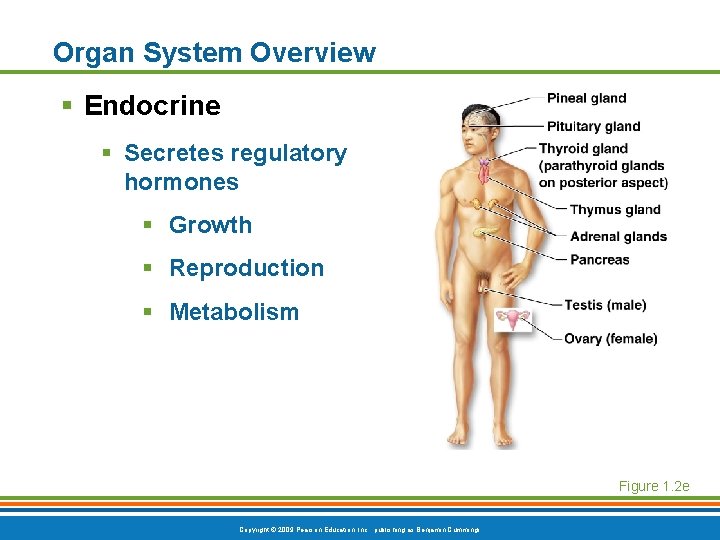
Organ System Overview § Endocrine § Secretes regulatory hormones § Growth § Reproduction § Metabolism Figure 1. 2 e Copyright © 2009 Pearson Education, Inc. , publishing as Benjamin Cummings
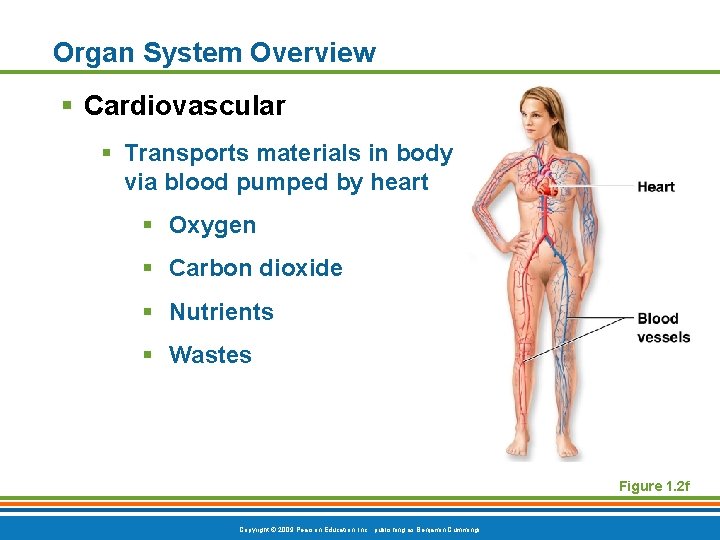
Organ System Overview § Cardiovascular § Transports materials in body via blood pumped by heart § Oxygen § Carbon dioxide § Nutrients § Wastes Figure 1. 2 f Copyright © 2009 Pearson Education, Inc. , publishing as Benjamin Cummings
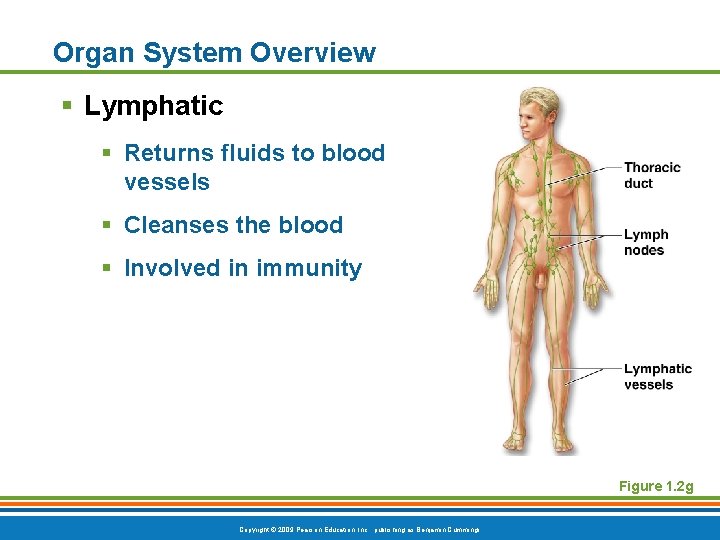
Organ System Overview § Lymphatic § Returns fluids to blood vessels § Cleanses the blood § Involved in immunity Figure 1. 2 g Copyright © 2009 Pearson Education, Inc. , publishing as Benjamin Cummings
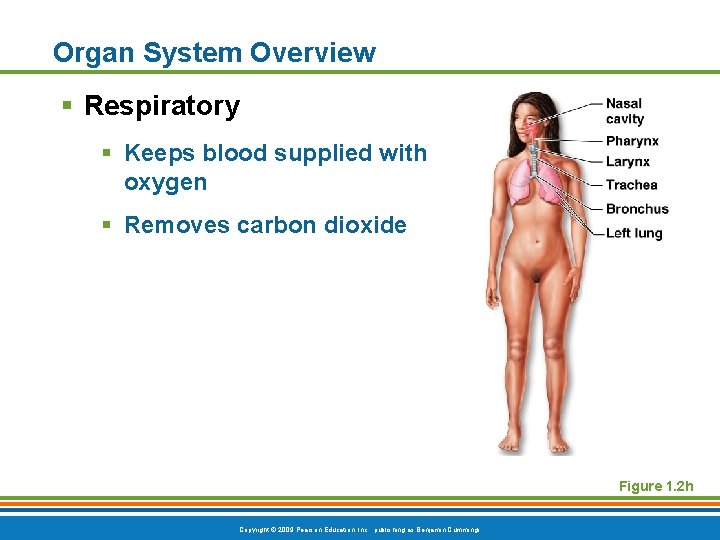
Organ System Overview § Respiratory § Keeps blood supplied with oxygen § Removes carbon dioxide Figure 1. 2 h Copyright © 2009 Pearson Education, Inc. , publishing as Benjamin Cummings
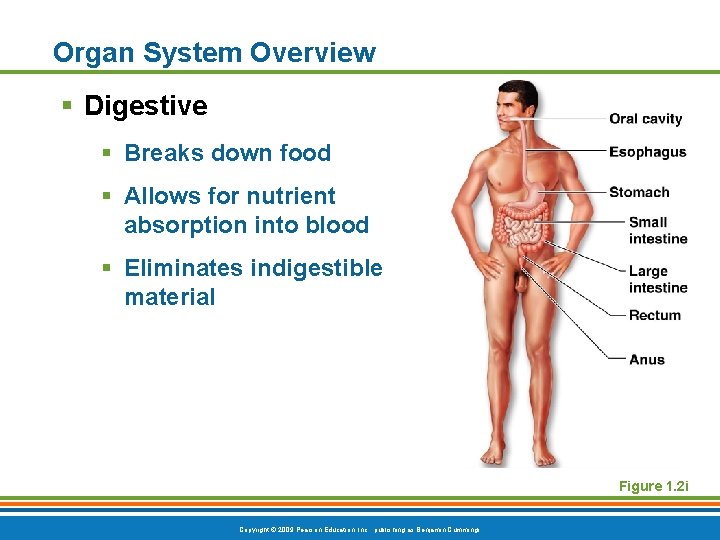
Organ System Overview § Digestive § Breaks down food § Allows for nutrient absorption into blood § Eliminates indigestible material Figure 1. 2 i Copyright © 2009 Pearson Education, Inc. , publishing as Benjamin Cummings
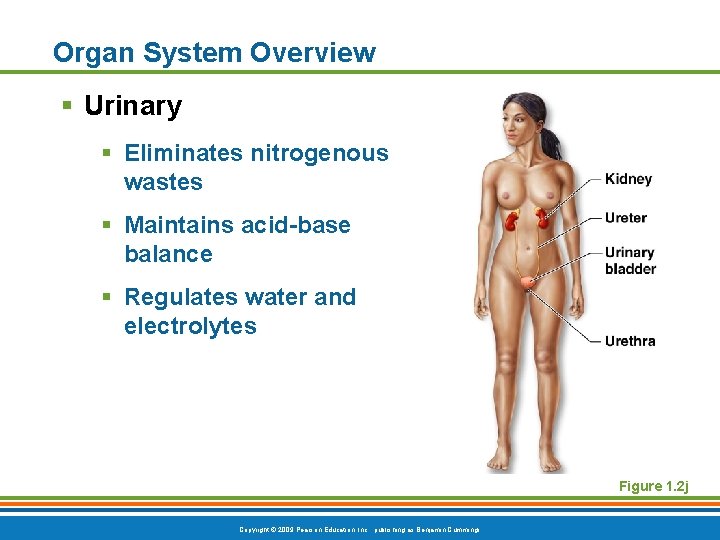
Organ System Overview § Urinary § Eliminates nitrogenous wastes § Maintains acid-base balance § Regulates water and electrolytes Figure 1. 2 j Copyright © 2009 Pearson Education, Inc. , publishing as Benjamin Cummings
The Language of Anatomy § Special terminology is used to prevent misunderstanding § Exact terms are used for § Position § Direction § Regions § Structures Copyright © 2009 Pearson Education, Inc. , publishing as Benjamin Cummings
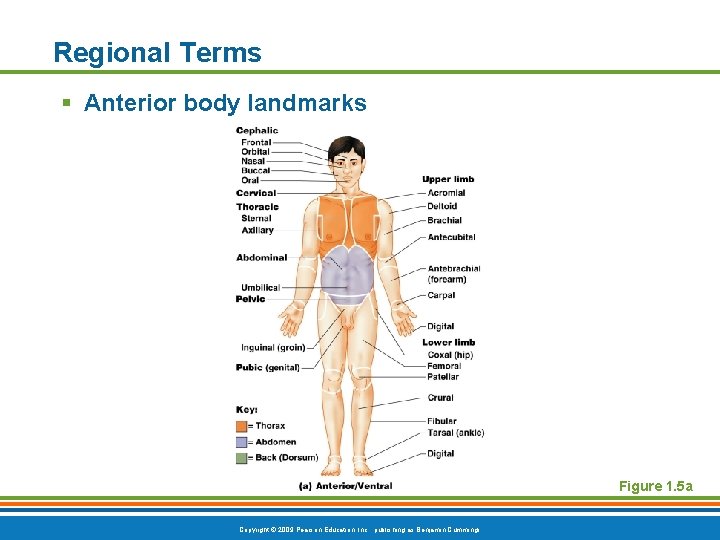
Regional Terms § Anterior body landmarks Figure 1. 5 a Copyright © 2009 Pearson Education, Inc. , publishing as Benjamin Cummings
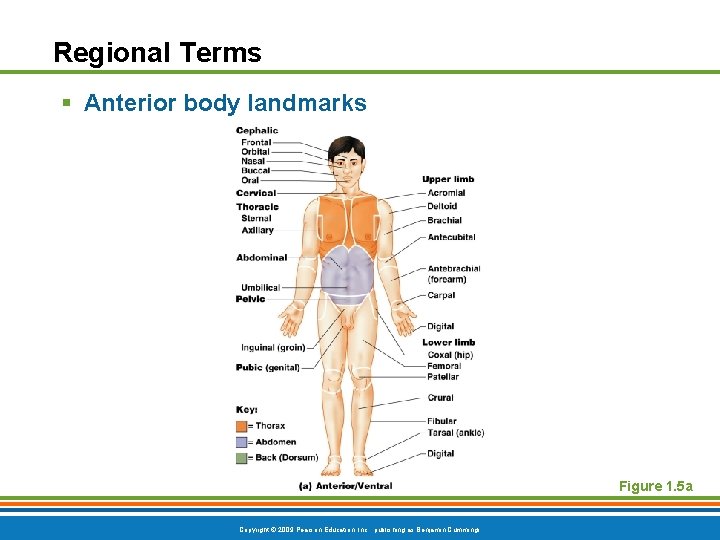
Regional Terms § Anterior body landmarks Figure 1. 5 a Copyright © 2009 Pearson Education, Inc. , publishing as Benjamin Cummings
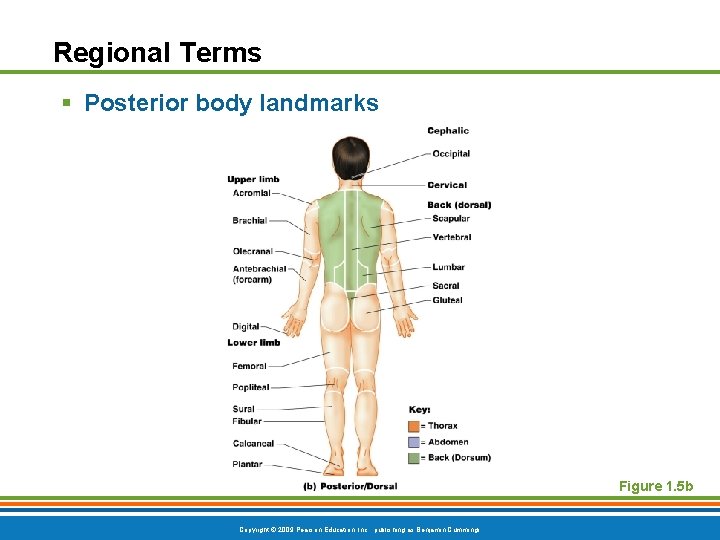
Regional Terms § Posterior body landmarks Figure 1. 5 b Copyright © 2009 Pearson Education, Inc. , publishing as Benjamin Cummings
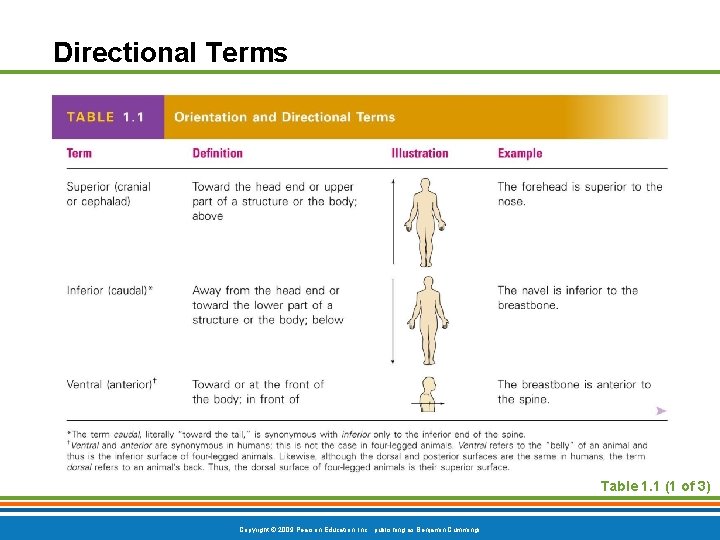
Directional Terms Table 1. 1 (1 of 3) Copyright © 2009 Pearson Education, Inc. , publishing as Benjamin Cummings
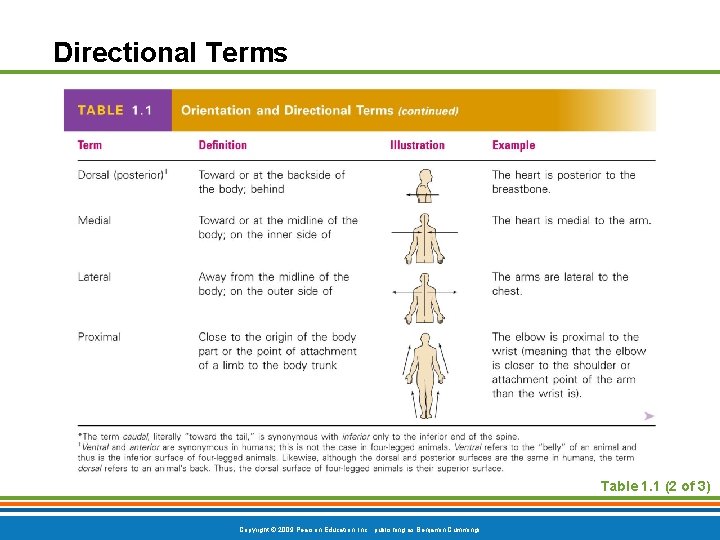
Directional Terms Table 1. 1 (2 of 3) Copyright © 2009 Pearson Education, Inc. , publishing as Benjamin Cummings
§ Stopped here 9/10 8/19 Copyright © 2009 Pearson Education, Inc. , publishing as Benjamin Cummings
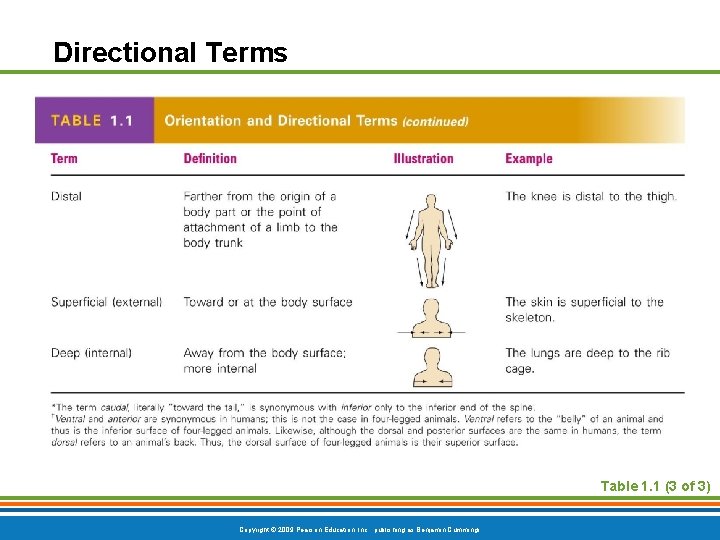
Directional Terms Table 1. 1 (3 of 3) Copyright © 2009 Pearson Education, Inc. , publishing as Benjamin Cummings
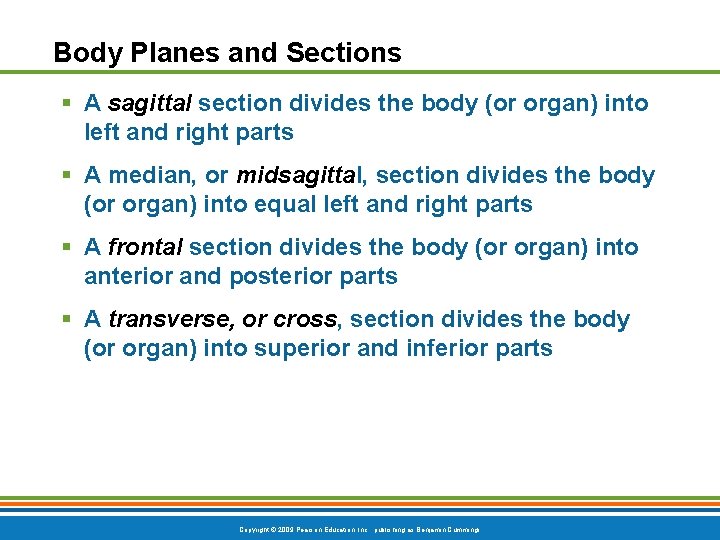
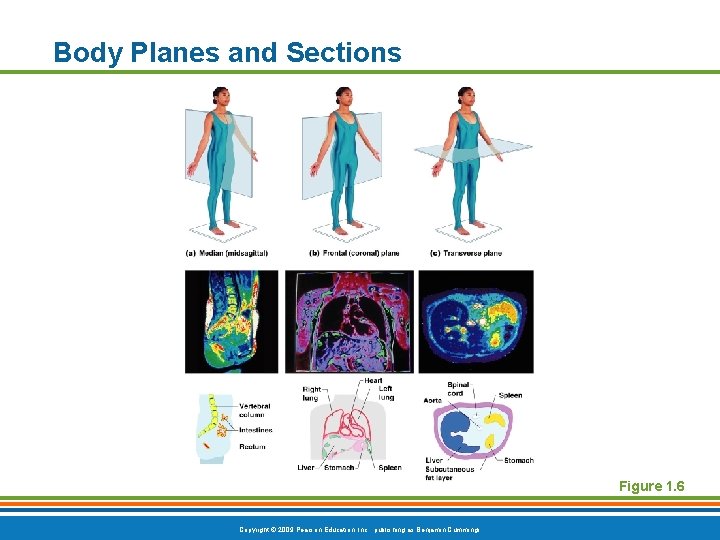
Body Planes and Sections § A sagittal section divides the body (or organ) into left and right parts § A median, or midsagittal, section divides the body (or organ) into equal left and right parts § A frontal section divides the body (or organ) into anterior and posterior parts § A transverse, or cross, section divides the body (or organ) into superior and inferior parts Copyright © 2009 Pearson Education, Inc. , publishing as Benjamin Cummings
Body Planes and Sections Figure 1. 6 Copyright © 2009 Pearson Education, Inc. , publishing as Benjamin Cummings
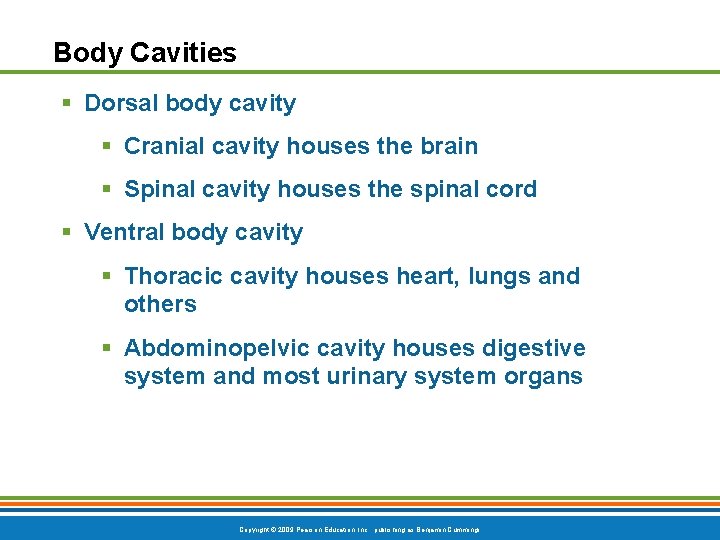
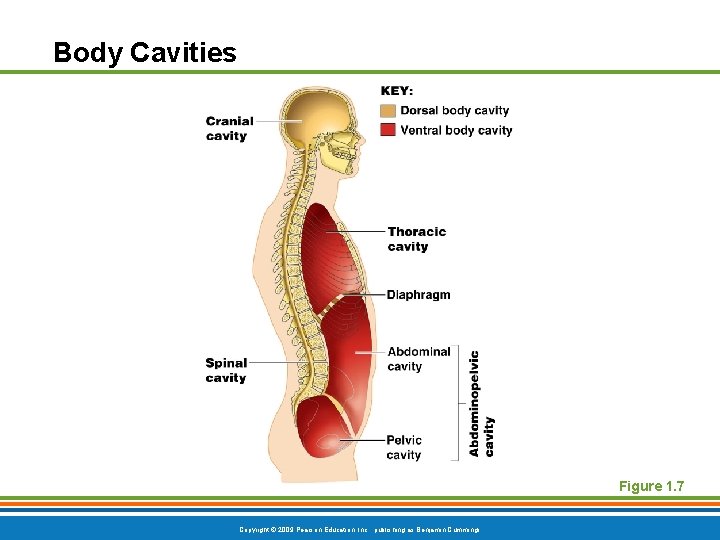
Body Cavities § Dorsal body cavity § Cranial cavity houses the brain § Spinal cavity houses the spinal cord § Ventral body cavity § Thoracic cavity houses heart, lungs and others § Abdominopelvic cavity houses digestive system and most urinary system organs Copyright © 2009 Pearson Education, Inc. , publishing as Benjamin Cummings
Body Cavities Figure 1. 7 Copyright © 2009 Pearson Education, Inc. , publishing as Benjamin Cummings
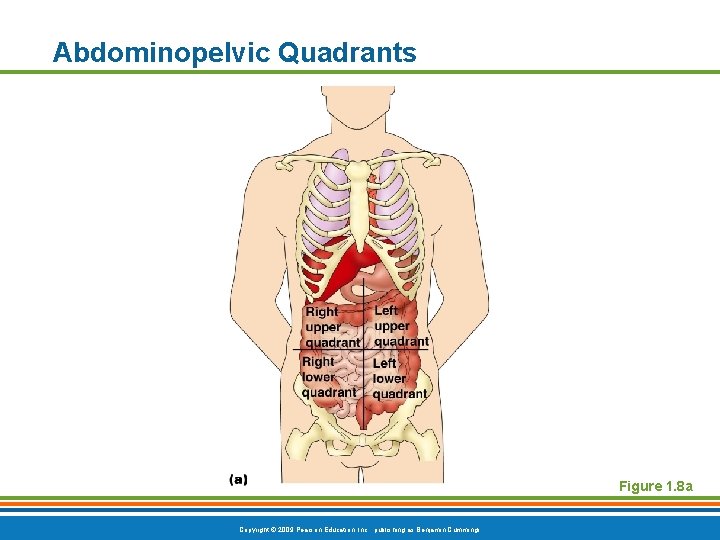
Abdominopelvic Quadrants Figure 1. 8 a Copyright © 2009 Pearson Education, Inc. , publishing as Benjamin Cummings
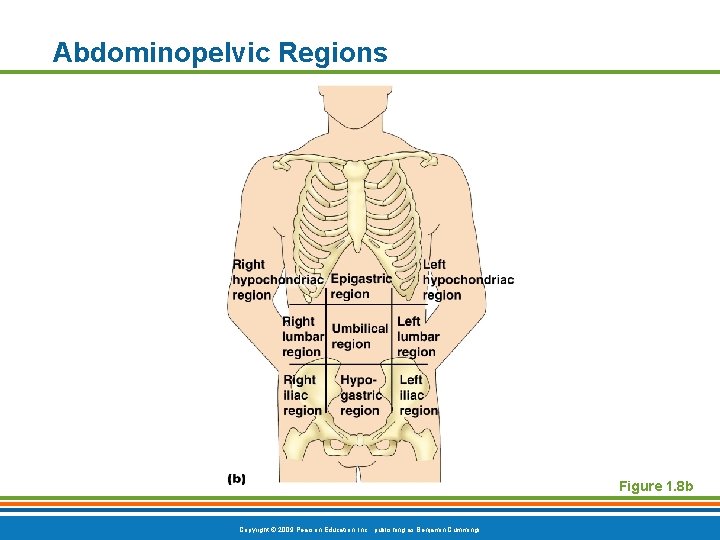
Abdominopelvic Regions Figure 1. 8 b Copyright © 2009 Pearson Education, Inc. , publishing as Benjamin Cummings
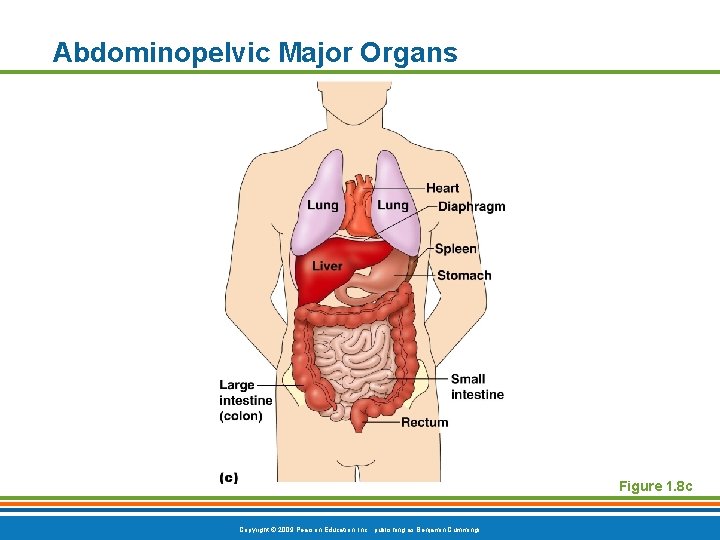
Abdominopelvic Major Organs Figure 1. 8 c Copyright © 2009 Pearson Education, Inc. , publishing as Benjamin Cummings
Reflection and Review 1. List the three major body planes. 2. List 5 major body systems. 3. Clarify the following pairs: proximal: distal medial: lateral superior: inferior dorsal: ventral superficial: deep Copyright © 2009 Pearson Education, Inc. , publishing as Benjamin Cummings