
Human Adjustment John W Santrock Chapter 9 Adult

- Slides: 53
Human Adjustment John W. Santrock Chapter 9: Adult Lifestyles Mc. Graw-Hill © 2006 by The Mc. Graw-Hill Companies, Inc. All rights reserved.
2 Chapter Outline The Diversity of Adult Lifestyles The Family Life Cycle Parenting Mc. Graw-Hill © 2006 by the Mc. Graw-Hill Companies, Inc. All rights reserved.
3 Learning Objectives 1. Discuss diversity of adult lifestyles and how they affect people’s lives 2. Describe the family life cycle 3. Discuss parenting and how it affects children’s adjustment Mc. Graw-Hill © 2006 by the Mc. Graw-Hill Companies, Inc. All rights reserved.
4 THE DIVERSITY OF ADULT LIFESTYLES Single Adults Living Alone Cohabiting Adults Married Adults Divorced Adults Remarried Adults Gay and Lesbian Relationships Mc. Graw-Hill © 2006 by the Mc. Graw-Hill Companies, Inc. All rights reserved.
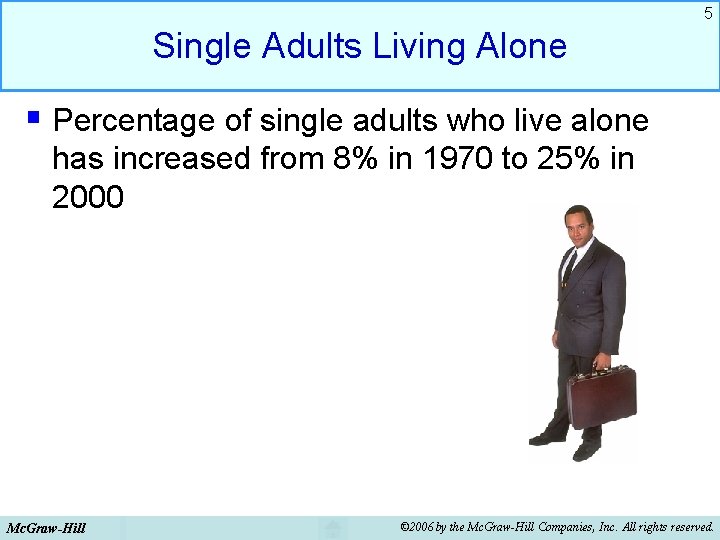
5 Single Adults Living Alone § Percentage of single adults who live alone has increased from 8% in 1970 to 25% in 2000 Mc. Graw-Hill © 2006 by the Mc. Graw-Hill Companies, Inc. All rights reserved.
6 Single Adults Living Alone § Common problems of single adults include: – forming intimate relationships with other adults – confronting loneliness – finding a niche in a society that is marriage oriented Mc. Graw-Hill © 2006 by the Mc. Graw-Hill Companies, Inc. All rights reserved.
7 Single Adults Living Alone § Advantages of being single include: – time to make decisions about one’s life course – time to develop personal resources to meet goals – freedom to make autonomous decisions – freedom to pursue one’s own schedule and interests – opportunities to explore new places and things Mc. Graw-Hill © 2006 by the Mc. Graw-Hill Companies, Inc. All rights reserved.
8 Cohabiting Adults § Cohabitation - living together in a sexual relationship without being married § Percentage of U. S. couples who cohabit before marriage has increased from 11% in 1970 to 60% in 2000 – Cohabitation leads to no differences in marriage or is not good for a marriage Mc. Graw-Hill © 2006 by the Mc. Graw-Hill Companies, Inc. All rights reserved.
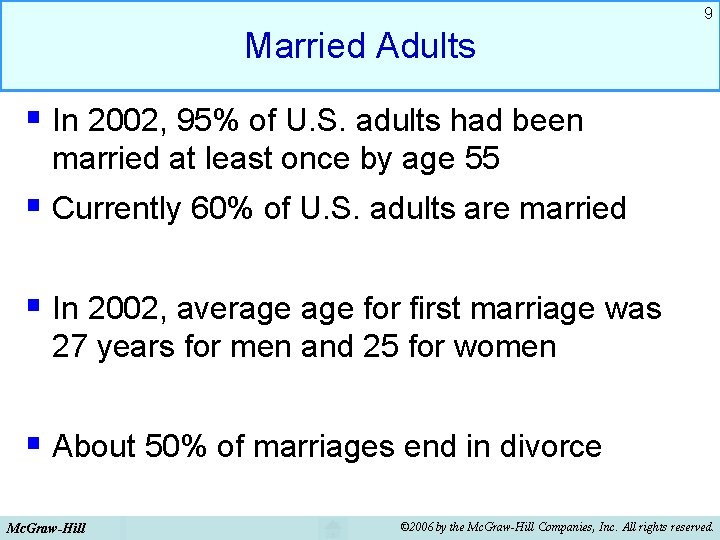
9 Married Adults § In 2002, 95% of U. S. adults had been married at least once by age 55 § Currently 60% of U. S. adults are married § In 2002, average for first marriage was 27 years for men and 25 for women § About 50% of marriages end in divorce Mc. Graw-Hill © 2006 by the Mc. Graw-Hill Companies, Inc. All rights reserved.
10 Finding a Partner § The most described traits desired in a spouse vary around the world § In the U. S. , emotional depth and ability to communicate are viewed as important characteristics of a spouse Mc. Graw-Hill © 2006 by the Mc. Graw-Hill Companies, Inc. All rights reserved.
11 Marital Expectations and Myths § Marriage therapists believe it is important to have realistic expectations about marriage § Myths about marriage include: – Affairs are the main reason people get divorced – Men are not biologically made for marriage – Men are from Mars and women are from Venus Mc. Graw-Hill © 2006 by the Mc. Graw-Hill Companies, Inc. All rights reserved.
Adjustment Strategies for Making Marriages Work 12 1. Establish love maps 2. Nurture fondness and admiration 3. Turn toward each other instead of away 4. Let your partner influence you 5. Solve solvable conflicts 6. Overcome gridlock 7. Create shared meaning Mc. Graw-Hill © 2006 by the Mc. Graw-Hill Companies, Inc. All rights reserved.
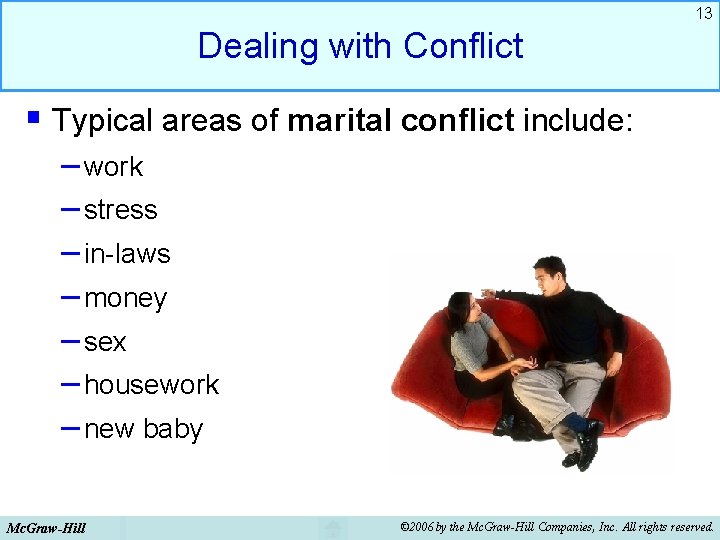
13 Dealing with Conflict § Typical areas of marital conflict include: – work – stress – in-laws – money – sex – housework – new baby Mc. Graw-Hill © 2006 by the Mc. Graw-Hill Companies, Inc. All rights reserved.
14 Dealing with Conflict § John Gottman (1994) - resolving conflicts works best when couples: – start out solving the problem with a soft approach – are motivated to repair the relationship – regulate their emotions – compromise – are tolerant of each other’s faults Mc. Graw-Hill © 2006 by the Mc. Graw-Hill Companies, Inc. All rights reserved.
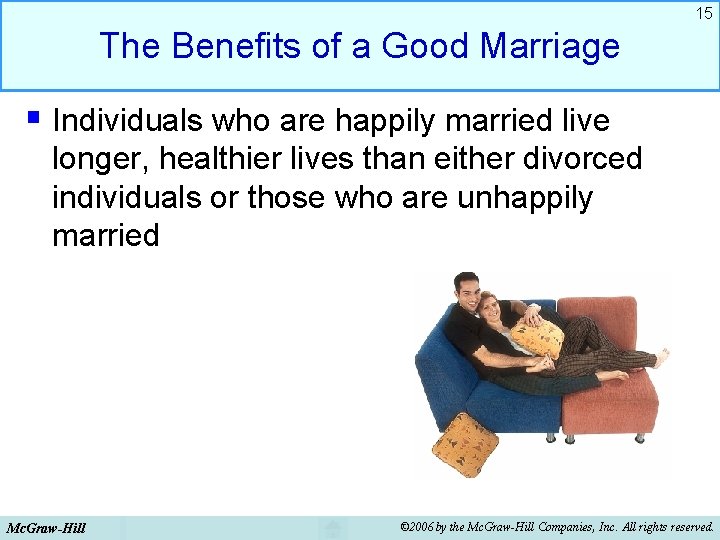
15 The Benefits of a Good Marriage § Individuals who are happily married live longer, healthier lives than either divorced individuals or those who are unhappily married Mc. Graw-Hill © 2006 by the Mc. Graw-Hill Companies, Inc. All rights reserved.
16 Divorced Adults § In the U. S. , the divorce rate increased from the 1960 s through the mid-1980 s but has since been declining Mc. Graw-Hill © 2006 by the Mc. Graw-Hill Companies, Inc. All rights reserved.
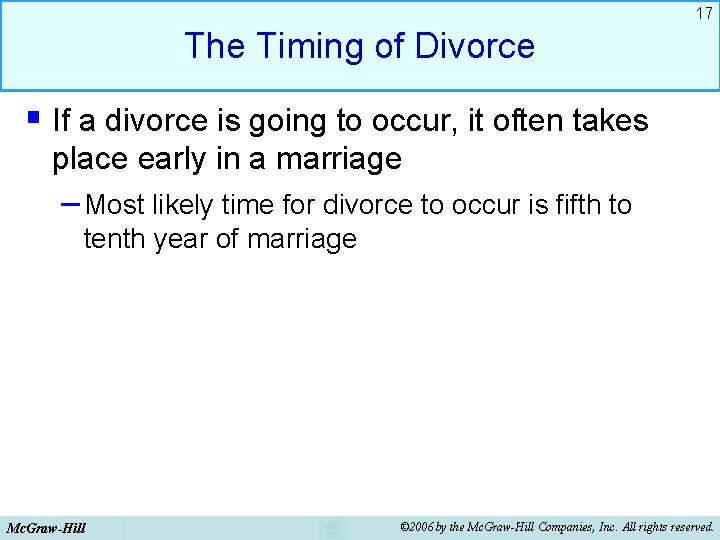
17 The Timing of Divorce § If a divorce is going to occur, it often takes place early in a marriage – Most likely time for divorce to occur is fifth to tenth year of marriage Mc. Graw-Hill © 2006 by the Mc. Graw-Hill Companies, Inc. All rights reserved.
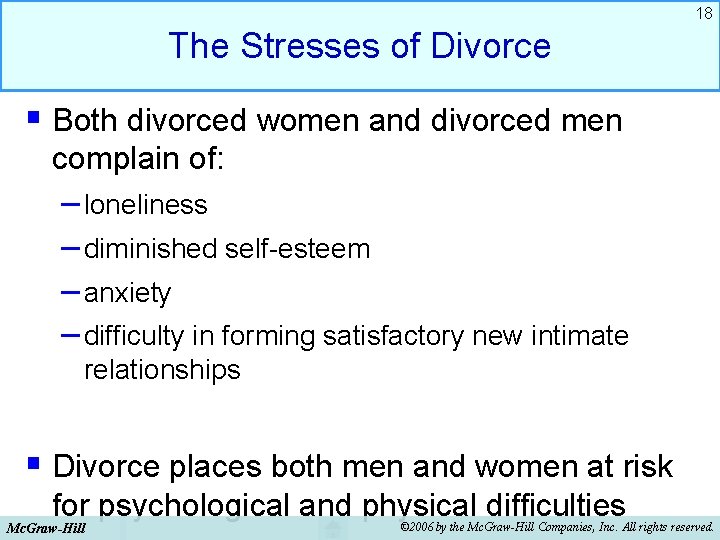
18 The Stresses of Divorce § Both divorced women and divorced men complain of: – loneliness – diminished self-esteem – anxiety – difficulty in forming satisfactory new intimate relationships § Divorce places both men and women at risk for psychological and physical difficulties Mc. Graw-Hill © 2006 by the Mc. Graw-Hill Companies, Inc. All rights reserved.
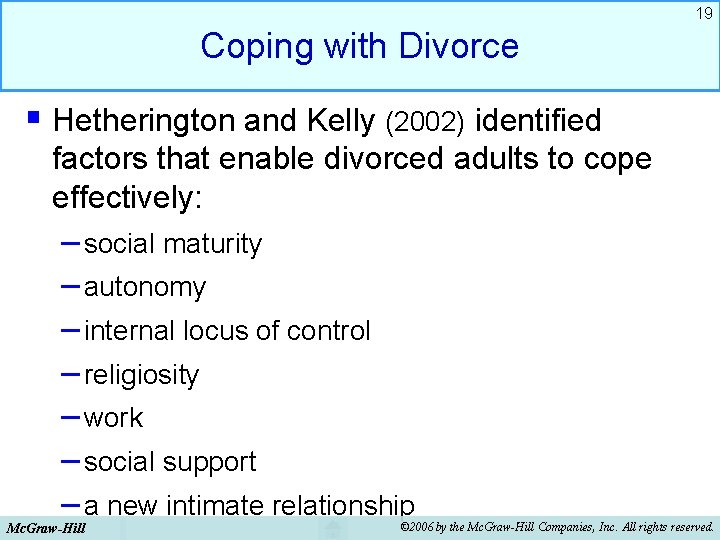
19 Coping with Divorce § Hetherington and Kelly (2002) identified factors that enable divorced adults to cope effectively: – social maturity – autonomy – internal locus of control – religiosity – work – social support – a new intimate relationship Mc. Graw-Hill © 2006 by the Mc. Graw-Hill Companies, Inc. All rights reserved.
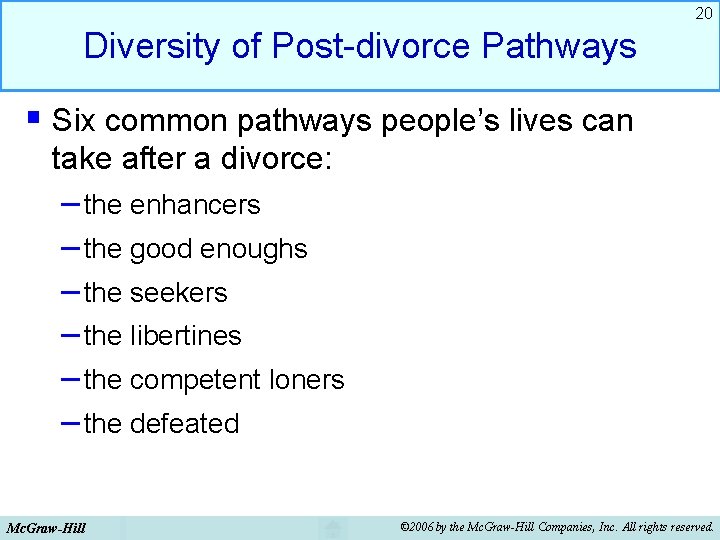
20 Diversity of Post-divorce Pathways § Six common pathways people’s lives can take after a divorce: – the enhancers – the good enoughs – the seekers – the libertines – the competent loners – the defeated Mc. Graw-Hill © 2006 by the Mc. Graw-Hill Companies, Inc. All rights reserved.
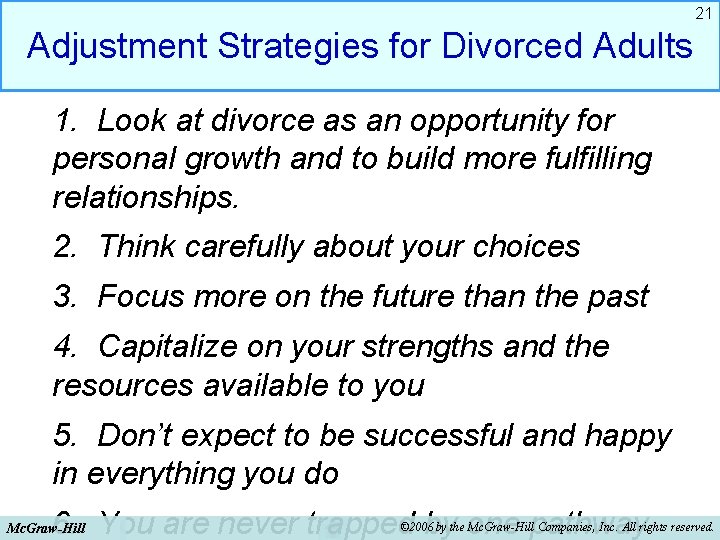
21 Adjustment Strategies for Divorced Adults 1. Look at divorce as an opportunity for personal growth and to build more fulfilling relationships. 2. Think carefully about your choices 3. Focus more on the future than the past 4. Capitalize on your strengths and the resources available to you 5. Don’t expect to be successful and happy in everything you do 6. You are never trapped by one pathway Mc. Graw-Hill © 2006 by the Mc. Graw-Hill Companies, Inc. All rights reserved.
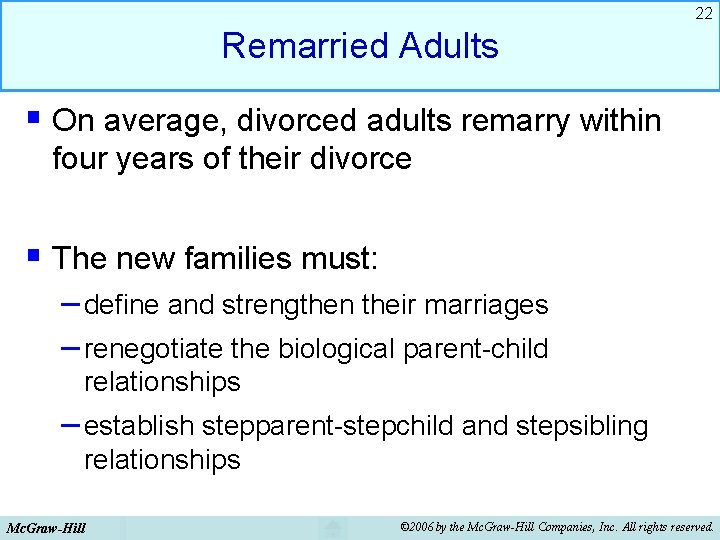
22 Remarried Adults § On average, divorced adults remarry within four years of their divorce § The new families must: – define and strengthen their marriages – renegotiate the biological parent-child relationships – establish stepparent-stepchild and stepsibling relationships Mc. Graw-Hill © 2006 by the Mc. Graw-Hill Companies, Inc. All rights reserved.
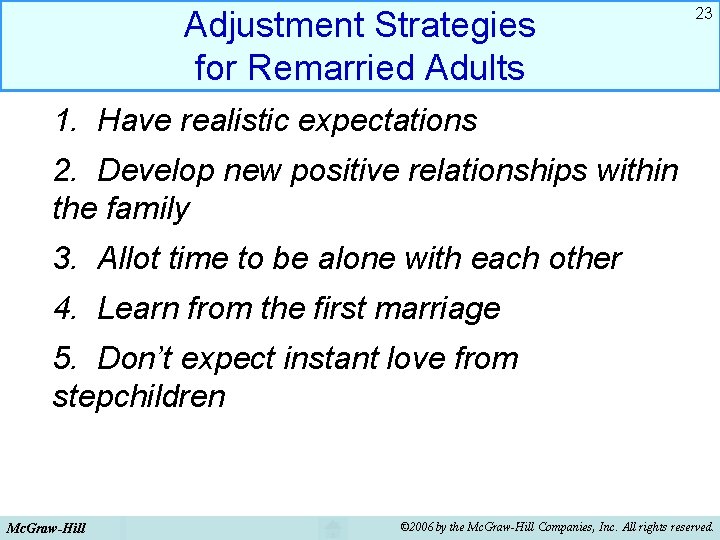
Adjustment Strategies for Remarried Adults 23 1. Have realistic expectations 2. Develop new positive relationships within the family 3. Allot time to be alone with each other 4. Learn from the first marriage 5. Don’t expect instant love from stepchildren Mc. Graw-Hill © 2006 by the Mc. Graw-Hill Companies, Inc. All rights reserved.
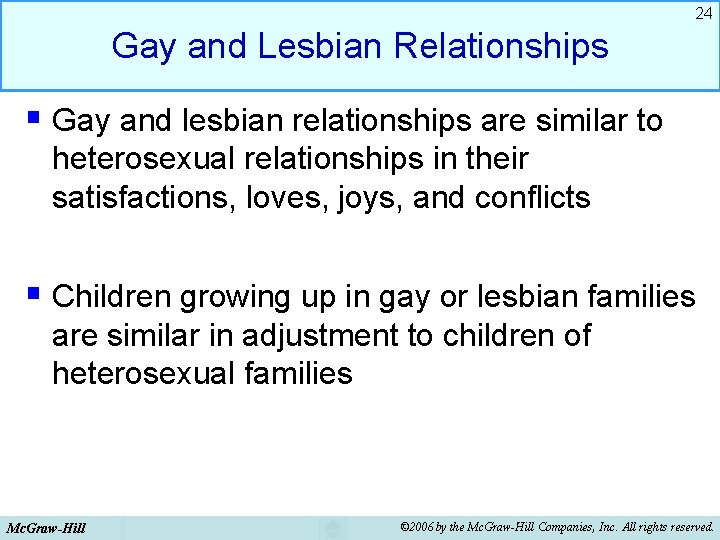
24 Gay and Lesbian Relationships § Gay and lesbian relationships are similar to heterosexual relationships in their satisfactions, loves, joys, and conflicts § Children growing up in gay or lesbian families are similar in adjustment to children of heterosexual families Mc. Graw-Hill © 2006 by the Mc. Graw-Hill Companies, Inc. All rights reserved.
25 Review - Learning Goal 1 – What characterizes single adults? – What are the lives of cohabiting adults like? – What are some key aspects of the lives of married adults? – How is divorce linked with the adjustment of adults and children? – What are the lives of remarried parents like? – What characterizes the relationships of gay and lesbian couples? Mc. Graw-Hill © 2006 by the Mc. Graw-Hill Companies, Inc. All rights reserved.
26 THE FAMILY LIFE CYCLE Leaving Home The New Couple Becoming a Family with Children The Family with Adolescents Midlife Families in Later Life Mc. Graw-Hill © 2006 by the Mc. Graw-Hill Companies, Inc. All rights reserved.
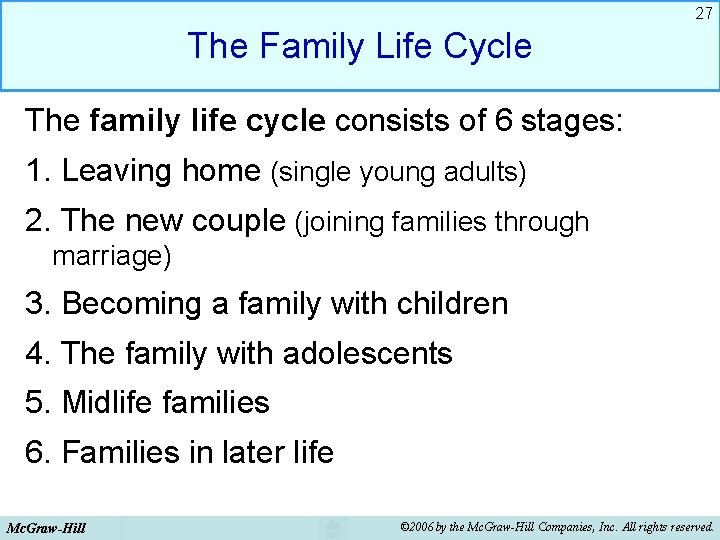
27 The Family Life Cycle The family life cycle consists of 6 stages: 1. Leaving home (single young adults) 2. The new couple (joining families through marriage) 3. Becoming a family with children 4. The family with adolescents 5. Midlife families 6. Families in later life Mc. Graw-Hill © 2006 by the Mc. Graw-Hill Companies, Inc. All rights reserved.
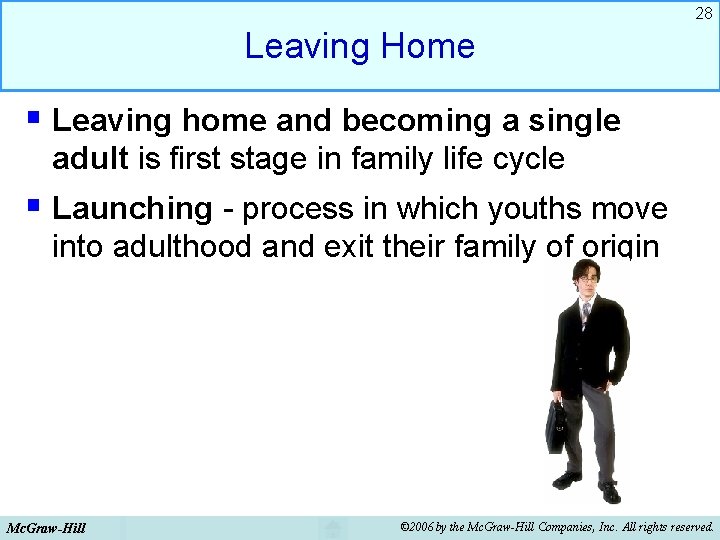
28 Leaving Home § Leaving home and becoming a single adult is first stage in family life cycle § Launching - process in which youths move into adulthood and exit their family of origin Mc. Graw-Hill © 2006 by the Mc. Graw-Hill Companies, Inc. All rights reserved.
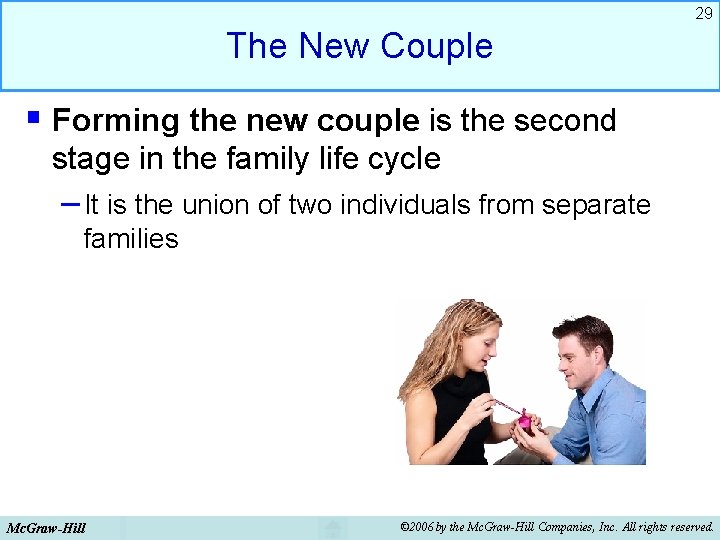
29 The New Couple § Forming the new couple is the second stage in the family life cycle – It is the union of two individuals from separate families Mc. Graw-Hill © 2006 by the Mc. Graw-Hill Companies, Inc. All rights reserved.
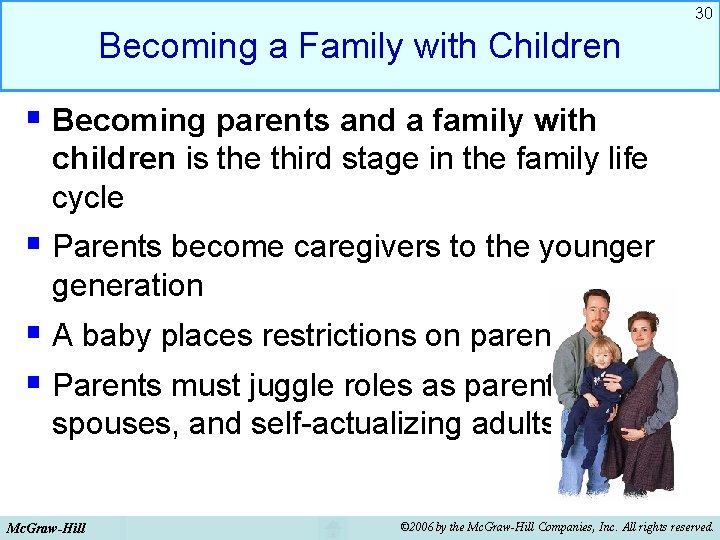
30 Becoming a Family with Children § Becoming parents and a family with children is the third stage in the family life cycle § Parents become caregivers to the younger generation § A baby places restrictions on parents § Parents must juggle roles as parents, spouses, and self-actualizing adults Mc. Graw-Hill © 2006 by the Mc. Graw-Hill Companies, Inc. All rights reserved.
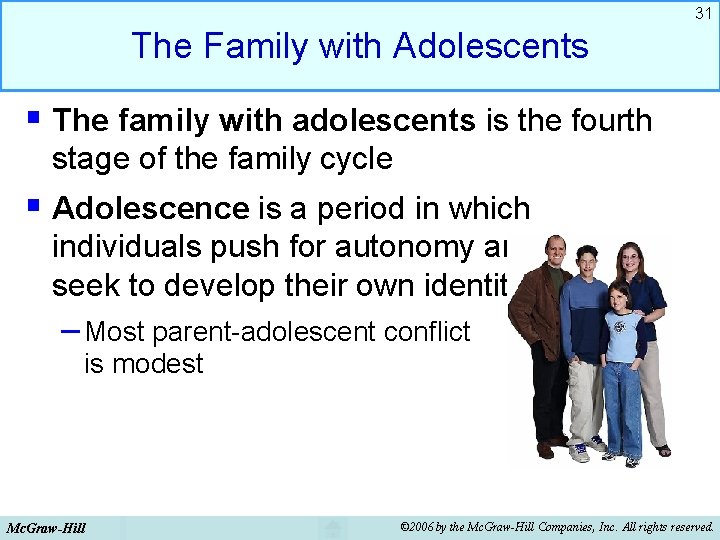
31 The Family with Adolescents § The family with adolescents is the fourth stage of the family cycle § Adolescence is a period in which individuals push for autonomy and seek to develop their own identity – Most parent-adolescent conflict is modest Mc. Graw-Hill © 2006 by the Mc. Graw-Hill Companies, Inc. All rights reserved.
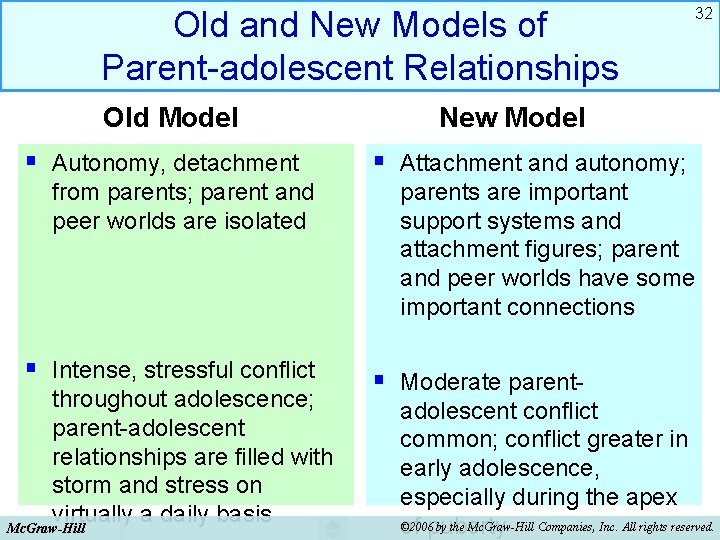
Old and New Models of Parent-adolescent Relationships Old Model § Autonomy, detachment from parents; parent and peer worlds are isolated § Intense, stressful conflict throughout adolescence; parent-adolescent relationships are filled with storm and stress on virtually a daily basis Mc. Graw-Hill 32 New Model § Attachment and autonomy; parents are important support systems and attachment figures; parent and peer worlds have some important connections § Moderate parentadolescent conflict common; conflict greater in early adolescence, especially during the apex © 2006 by the Mc. Graw-Hill Companies, Inc. All rights reserved. of puberty
Adjustment Strategies for Parenting Adolescents 1. Show them warmth and respect, and avoid tendency to be too controlling or too permissive 2. Demonstrate sustained interest in their lives 3. Understand adapt to their cognitive and socioemotional development 4. Communicate expectations for high standards of conduct and achievement 5. Display constructive ways of dealing with Mc. Graw-Hill problems 33 © 2006 by the Mc. Graw-Hill Companies, Inc. All rights reserved.
34 Midlife Families § The family at midlife is the fifth stage in the family life cycle § This is a time of launching children, linking generations, and adapting to midlife changes Mc. Graw-Hill © 2006 by the Mc. Graw-Hill Companies, Inc. All rights reserved.
35 The Empty Nest and Its Refilling § Empty nest syndrome - decrease in marital satisfaction and increase in feelings of emptiness brought about by children’s departure § Most parents eventually experience an increase in marital satisfaction after their children have left home § When adult children return home to live, both parents and the adult children must make Mc. Graw-Hill © 2006 by the Mc. Graw-Hill Companies, Inc. All rights reserved.
36 Intergenerational Relationships § Both similarities and dissimilarities across generations have been reported – Similarity between parents and an adult child is most likely in religion and politics – Similarity is least likely in gender roles, lifestyle, and work orientation Mc. Graw-Hill © 2006 by the Mc. Graw-Hill Companies, Inc. All rights reserved.
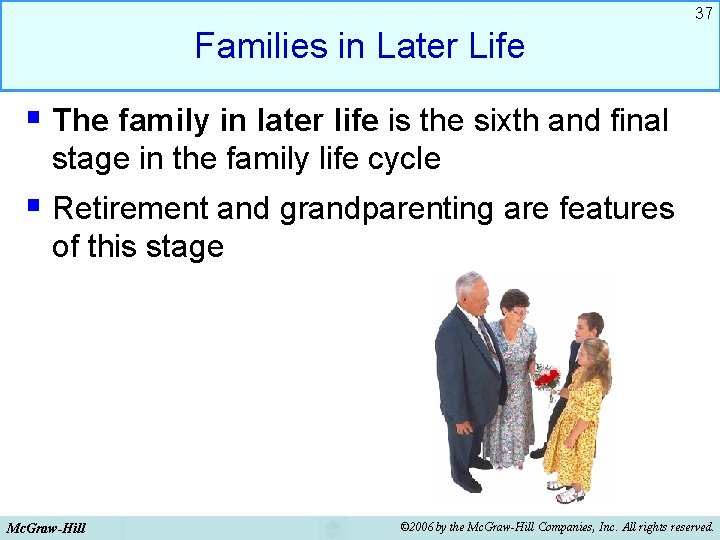
37 Families in Later Life § The family in later life is the sixth and final stage in the family life cycle § Retirement and grandparenting are features of this stage Mc. Graw-Hill © 2006 by the Mc. Graw-Hill Companies, Inc. All rights reserved.
38 Families in Later Life § Marital happiness among older adults depends on each partner’s ability to deal with: – personal conflicts – aging – illness – eventual death Mc. Graw-Hill © 2006 by the Mc. Graw-Hill Companies, Inc. All rights reserved.
39 Review - Learning Goal 2 – What is the first stage of the family life cycle? – What is the stage of finding a partner like? – How can the third stage be characterized? – What is the fourth stage of the family life cycle? – How can the fifth stage be described? – What is the sixth stage of the family life cycle? Mc. Graw-Hill © 2006 by the Mc. Graw-Hill Companies, Inc. All rights reserved.
40 PARENTING Timing of Parenthood Parenting Styles Working Parents Children in Divorced Families Ethnicity and Parenting Child Abuse Mc. Graw-Hill © 2006 by the Mc. Graw-Hill Companies, Inc. All rights reserved.
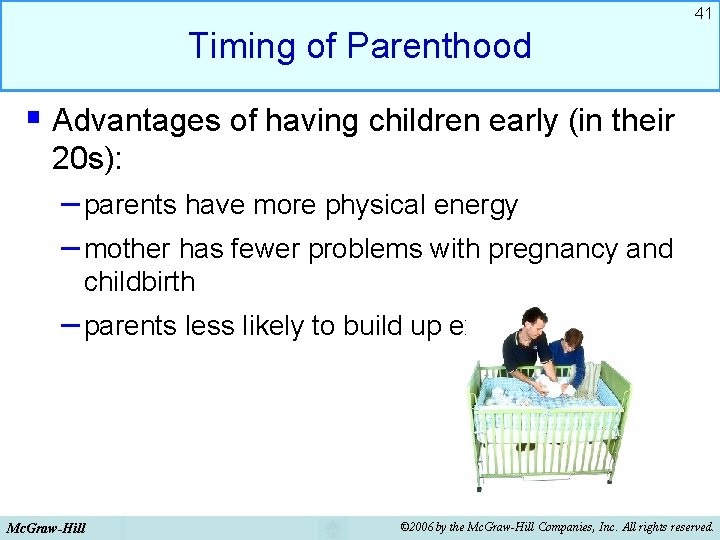
41 Timing of Parenthood § Advantages of having children early (in their 20 s): – parents have more physical energy – mother has fewer problems with pregnancy and childbirth – parents less likely to build up expectations Mc. Graw-Hill © 2006 by the Mc. Graw-Hill Companies, Inc. All rights reserved.
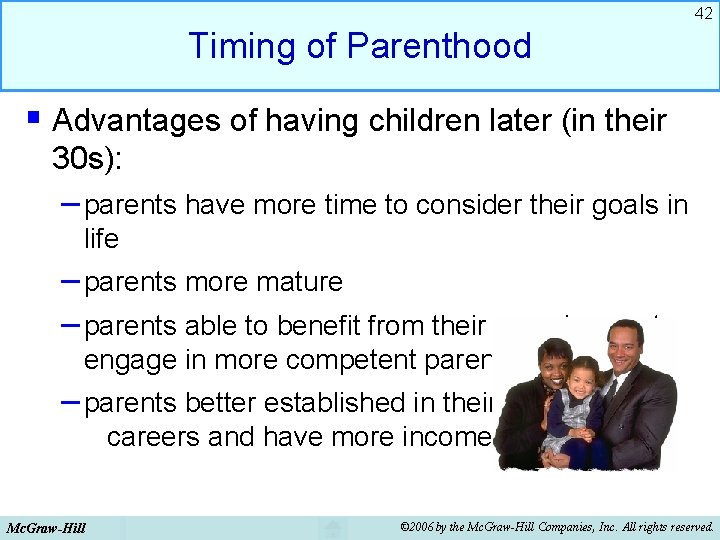
42 Timing of Parenthood § Advantages of having children later (in their 30 s): – parents have more time to consider their goals in life – parents more mature – parents able to benefit from their experiences to engage in more competent parenting – parents better established in their careers and have more income Mc. Graw-Hill © 2006 by the Mc. Graw-Hill Companies, Inc. All rights reserved.
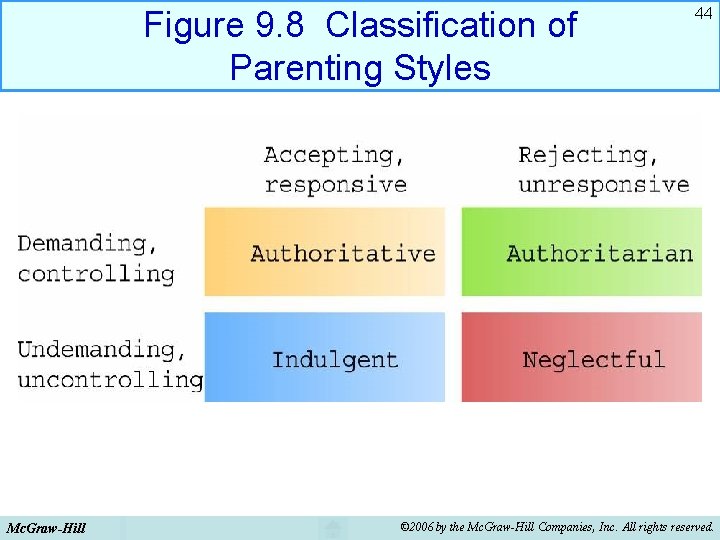
43 Parenting Styles § Diana Baumrind (1971) identified 4 parenting styles: – Authoritarian parenting – Authoritative parenting – Neglectful parenting – Indulgent parenting § Positive links exist between authoritative parenting and the well-being of children Mc. Graw-Hill © 2006 by the Mc. Graw-Hill Companies, Inc. All rights reserved.
Figure 9. 8 Classification of Parenting Styles Mc. Graw-Hill 44 © 2006 by the Mc. Graw-Hill Companies, Inc. All rights reserved.
Adjustment Strategies for Effective Parenting 45 1. Use authoritative parenting 2. Understand that parenting takes time and effort 3. Be a good manager 4. Don’t use physical punishment in disciplining children Mc. Graw-Hill © 2006 by the Mc. Graw-Hill Companies, Inc. All rights reserved.
46 Working Parents § Research finds no detrimental effects of maternal employment on children’s development § When a child’s mother works in first year of life, it can have a negative effect on the child’s later development Mc. Graw-Hill © 2006 by the Mc. Graw-Hill Companies, Inc. All rights reserved.
47 Children in Divorced Families § Children from divorced families show poorer adjustment than children in non-divorced families Mc. Graw-Hill © 2006 by the Mc. Graw-Hill Companies, Inc. All rights reserved.
Adjustment Strategies for Communicating with Children about Divorce 48 1. Explain the separation in a sensitive way 2. Explain that the separation is not the child’s fault 3. Explain that it may take time to feel better 4. Keep the door open for further discussion 5. Provide as much continuity as possible 6. Provide support for your children Mc. Graw-Hill © 2006 by the Mc. Graw-Hill Companies, Inc. All rights reserved.
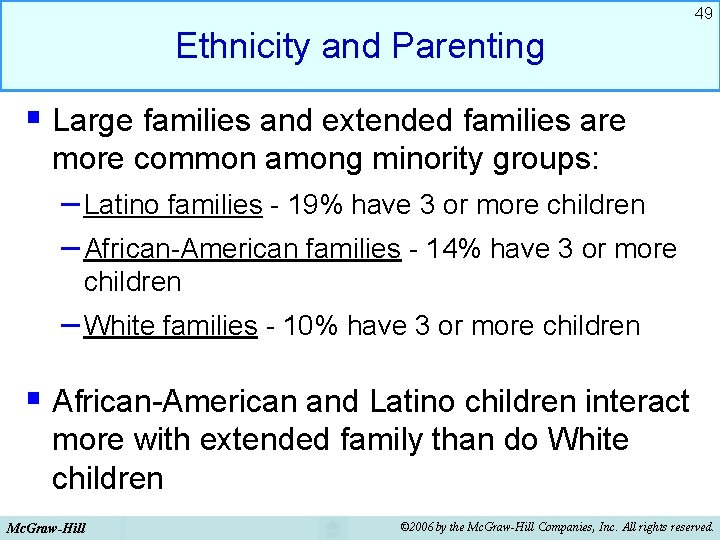
49 Ethnicity and Parenting § Large families and extended families are more common among minority groups: – Latino families - 19% have 3 or more children – African-American families - 14% have 3 or more children – White families - 10% have 3 or more children § African-American and Latino children interact more with extended family than do White children Mc. Graw-Hill © 2006 by the Mc. Graw-Hill Companies, Inc. All rights reserved.
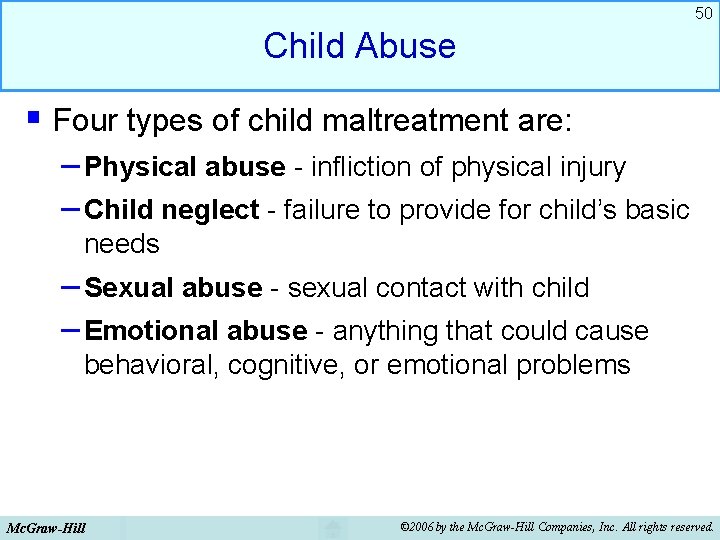
50 Child Abuse § Four types of child maltreatment are: – Physical abuse - infliction of physical injury – Child neglect - failure to provide for child’s basic needs – Sexual abuse - sexual contact with child – Emotional abuse - anything that could cause behavioral, cognitive, or emotional problems Mc. Graw-Hill © 2006 by the Mc. Graw-Hill Companies, Inc. All rights reserved.
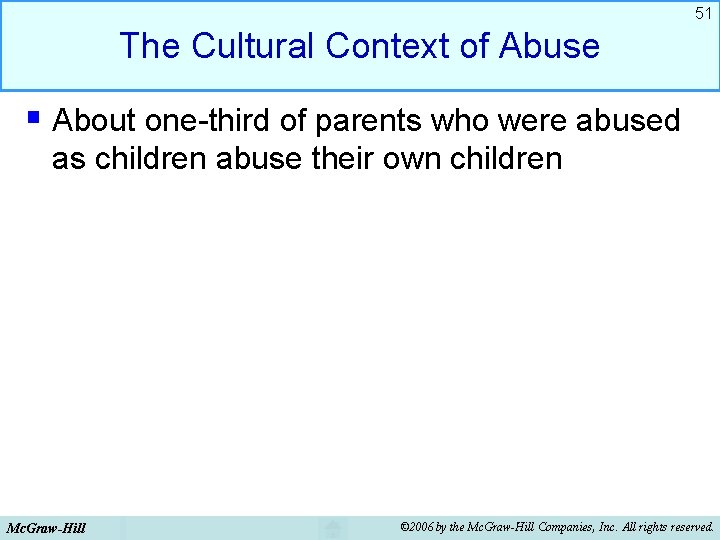
51 The Cultural Context of Abuse § About one-third of parents who were abused as children abuse their own children Mc. Graw-Hill © 2006 by the Mc. Graw-Hill Companies, Inc. All rights reserved.
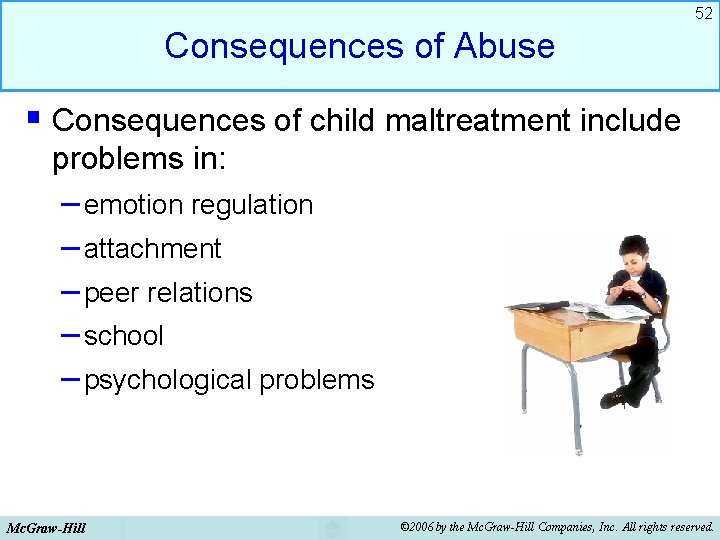
52 Consequences of Abuse § Consequences of child maltreatment include problems in: – emotion regulation – attachment – peer relations – school – psychological problems Mc. Graw-Hill © 2006 by the Mc. Graw-Hill Companies, Inc. All rights reserved.
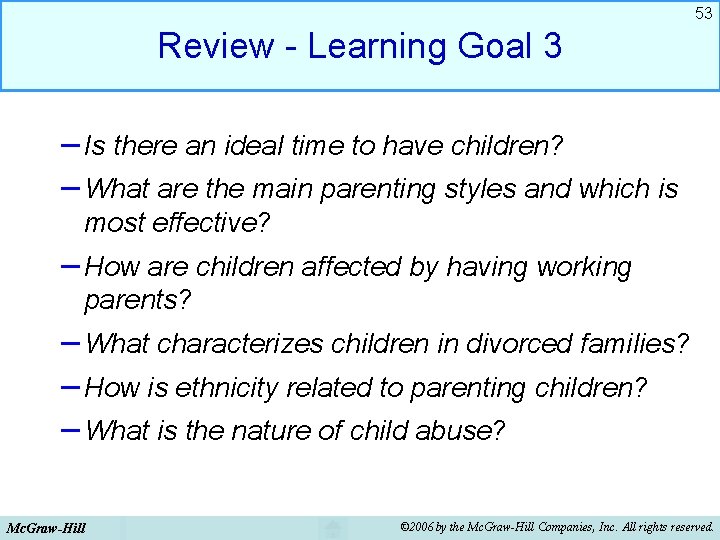
53 Review - Learning Goal 3 – Is there an ideal time to have children? – What are the main parenting styles and which is most effective? – How are children affected by having working parents? – What characterizes children in divorced families? – How is ethnicity related to parenting children? – What is the nature of child abuse? Mc. Graw-Hill © 2006 by the Mc. Graw-Hill Companies, Inc. All rights reserved.