
Human Action Recognition by Representing 3 D Skeletons
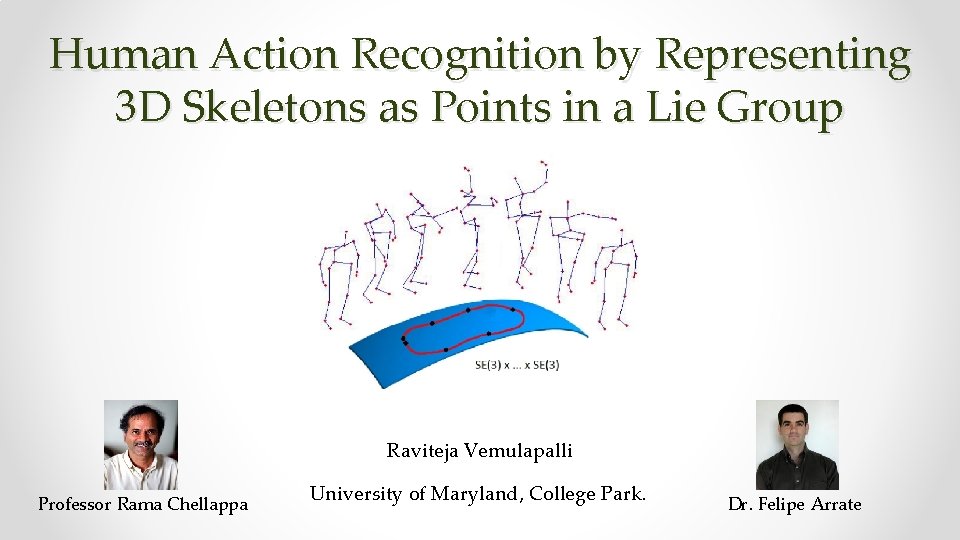
Human Action Recognition by Representing 3 D Skeletons as Points in a Lie Group Raviteja Vemulapalli Professor Rama Chellappa University of Maryland, College Park. Dr. Felipe Arrate
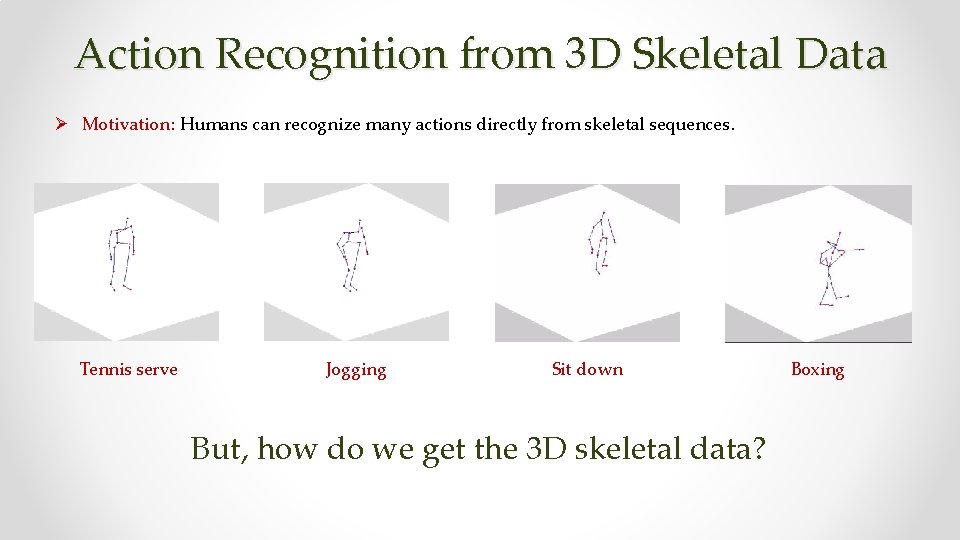
Action Recognition from 3 D Skeletal Data Ø Motivation: Humans can recognize many actions directly from skeletal sequences. Tennis serve Jogging Sit down But, how do we get the 3 D skeletal data? Boxing
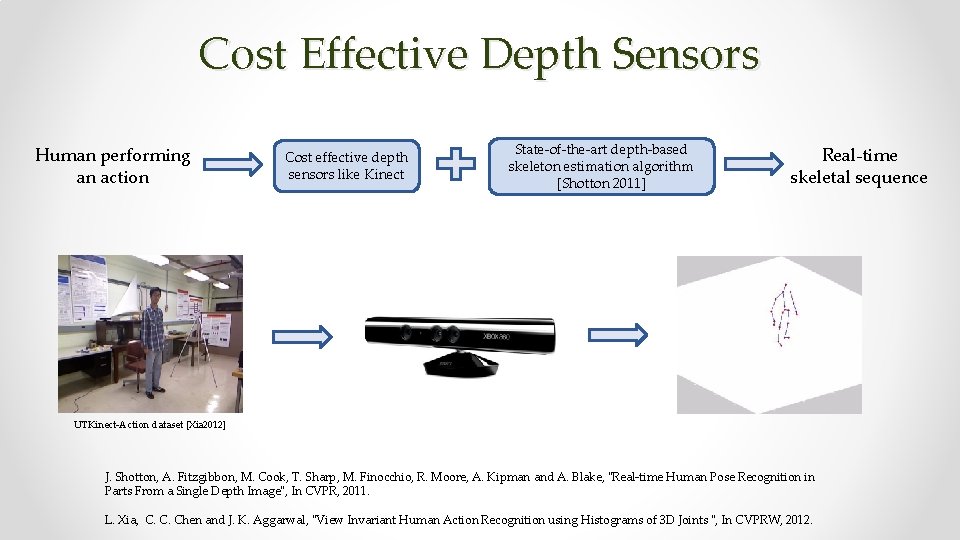
Cost Effective Depth Sensors Human performing an action Cost effective depth sensors like Kinect State-of-the-art depth-based skeleton estimation algorithm [Shotton 2011] Real-time skeletal sequence UTKinect-Action dataset [Xia 2012] J. Shotton, A. Fitzgibbon, M. Cook, T. Sharp, M. Finocchio, R. Moore, A. Kipman and A. Blake, "Real-time Human Pose Recognition in Parts From a Single Depth Image", In CVPR, 2011. L. Xia, C. C. Chen and J. K. Aggarwal, "View Invariant Human Action Recognition using Histograms of 3 D Joints ", In CVPRW, 2012.
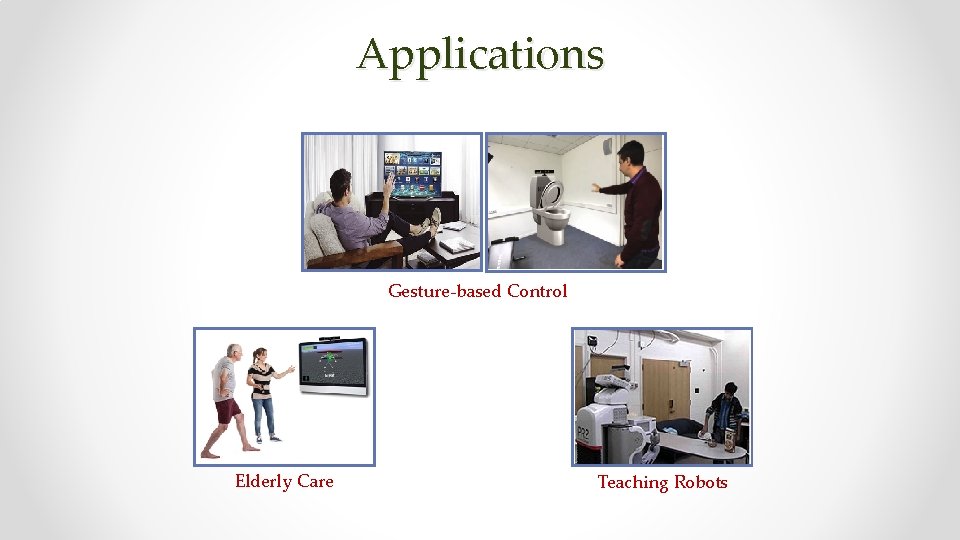
Applications Gesture-based Control Elderly Care Teaching Robots
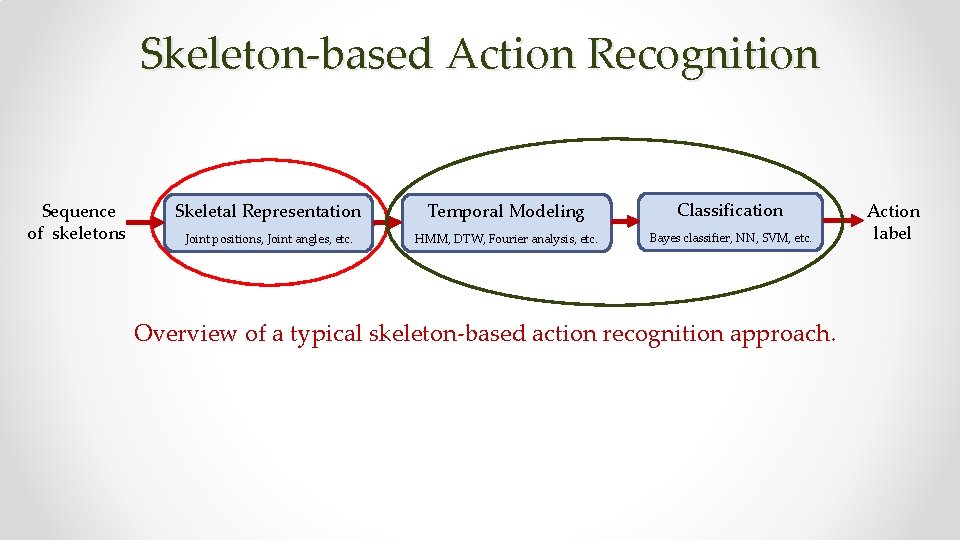
Skeleton-based Action Recognition Sequence of skeletons Skeletal Representation Temporal Modeling Classification Joint positions, Joint angles, etc. HMM, DTW, Fourier analysis, etc. Bayes classifier, NN, SVM, etc. Overview of a typical skeleton-based action recognition approach. Action label
How to represent a 3 D human skeleton for action recognition ?
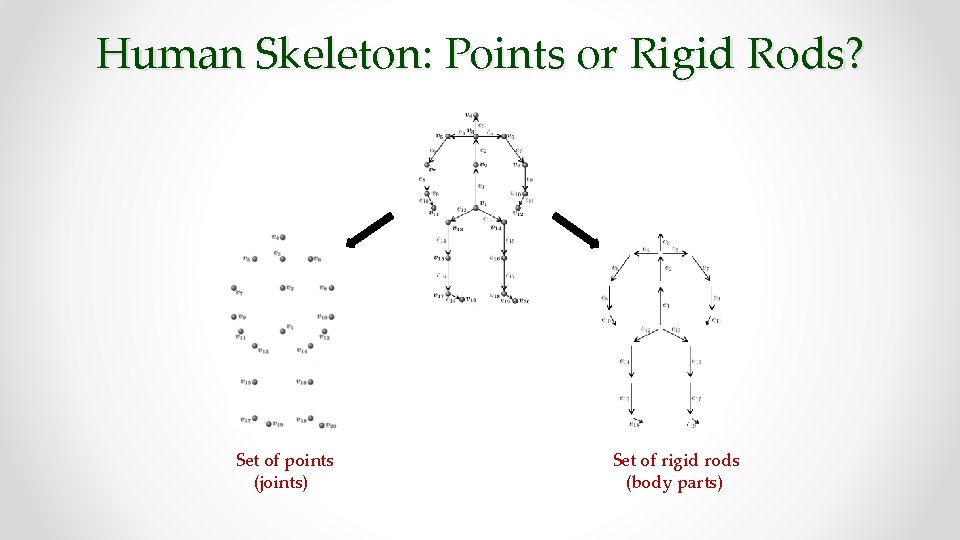
Human Skeleton: Points or Rigid Rods? Set of points (joints) Set of rigid rods (body parts)
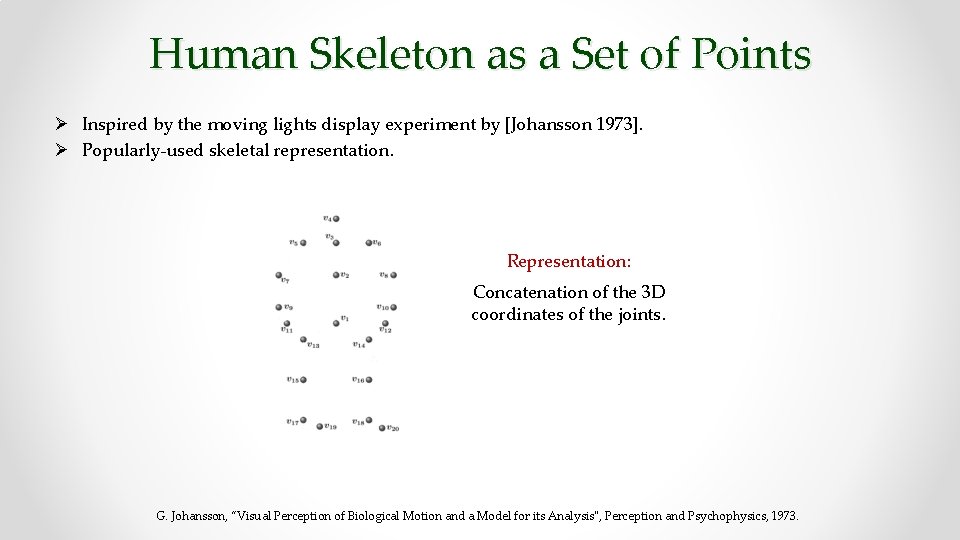
Human Skeleton as a Set of Points Ø Inspired by the moving lights display experiment by [Johansson 1973]. Ø Popularly-used skeletal representation. Representation: Concatenation of the 3 D coordinates of the joints. G. Johansson, “Visual Perception of Biological Motion and a Model for its Analysis", Perception and Psychophysics, 1973.
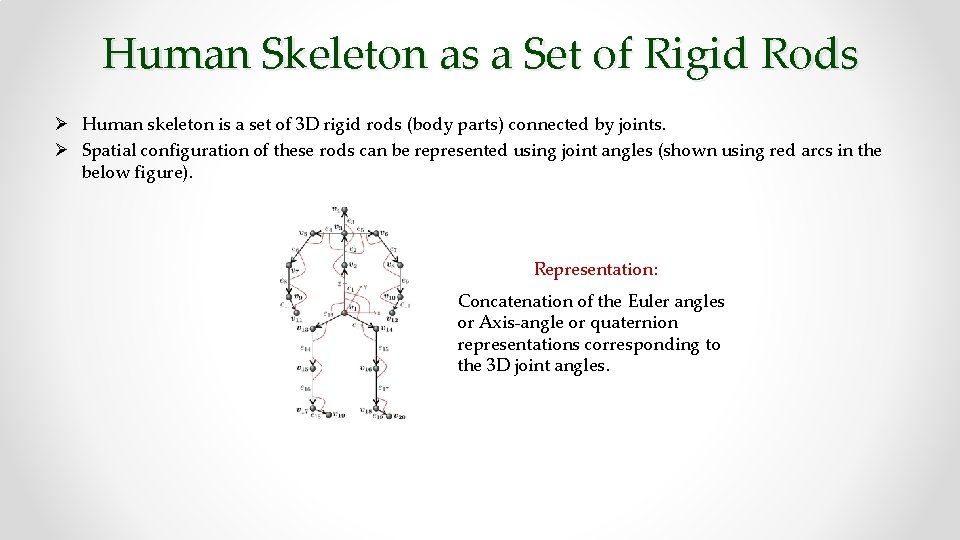
Human Skeleton as a Set of Rigid Rods Ø Human skeleton is a set of 3 D rigid rods (body parts) connected by joints. Ø Spatial configuration of these rods can be represented using joint angles (shown using red arcs in the below figure). Representation: Concatenation of the Euler angles or Axis-angle or quaternion representations corresponding to the 3 D joint angles.
Proposed Representation: Motivation Human actions are characterized by how different body parts move relative to each other. For action recognition, we need a skeletal representation whose temporal evolution directly describes the relative motion between various body parts.
Proposed Skeletal Representation We represent a skeleton using the relative 3 D geometry between different body parts. The relative geometry between two body parts can be described using the 3 D rotation and translation required to take one body part to the position and orientation of the other.
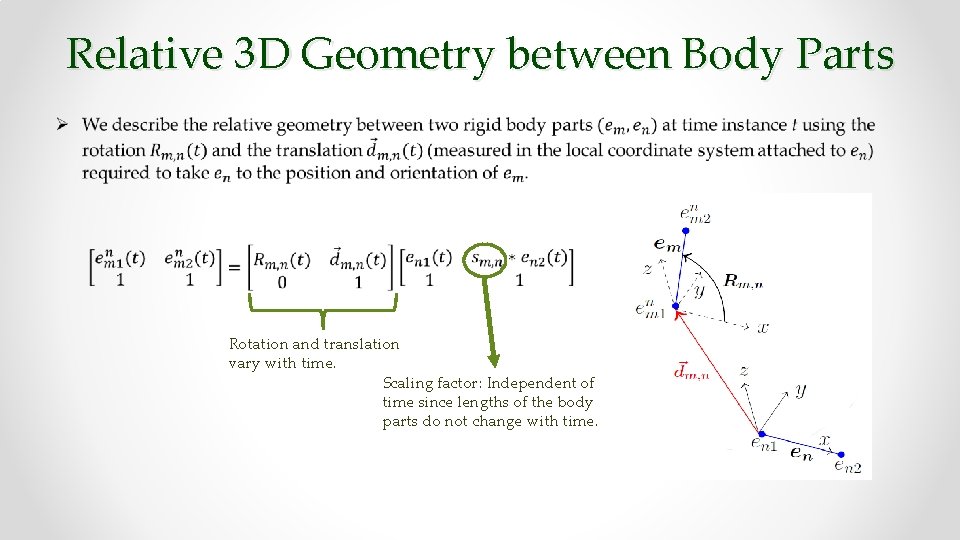
Relative 3 D Geometry between Body Parts Ø Rotation and translation vary with time. Scaling factor: Independent of time since lengths of the body parts do not change with time.

R. M. Murray, Z. Li, and S. S. Sastry, "A Mathematical Introduction to Robotic Manipulation", CRC Press, 1994.
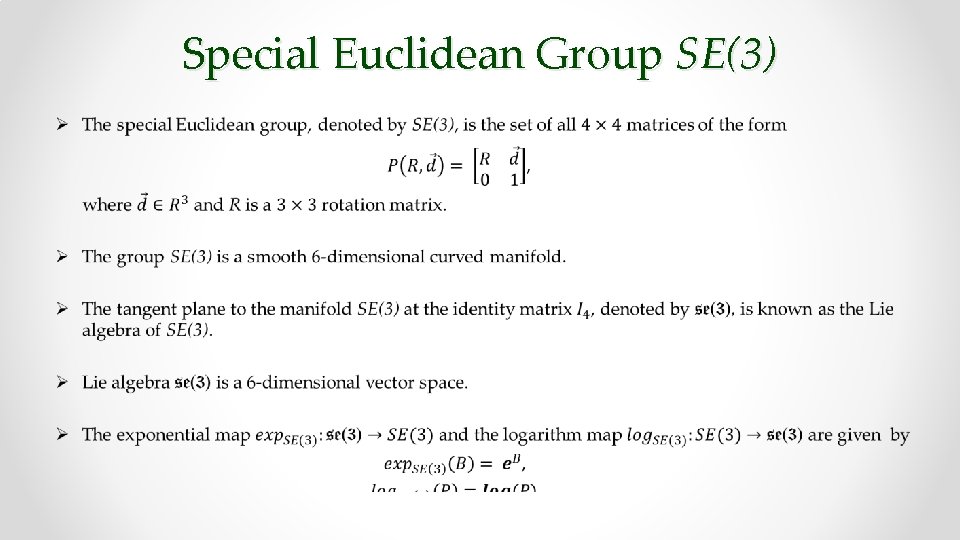
Special Euclidean Group SE(3) Ø
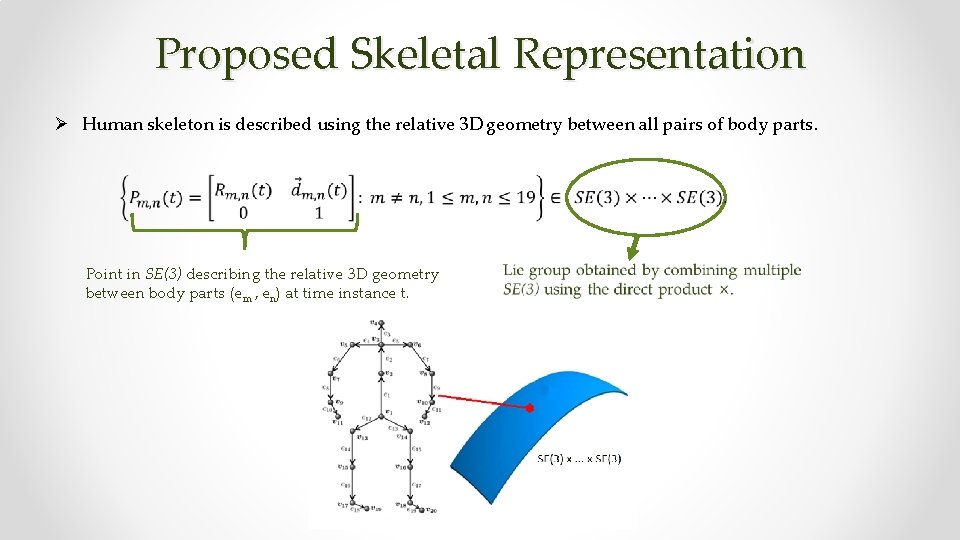
Proposed Skeletal Representation Ø Human skeleton is described using the relative 3 D geometry between all pairs of body parts. Point in SE(3) describing the relative 3 D geometry between body parts (em , en) at time instance t.
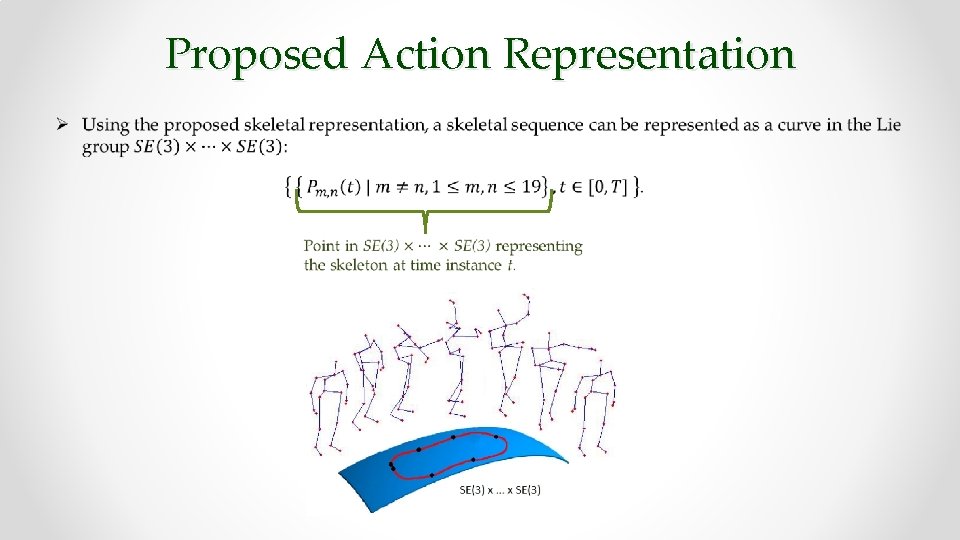
Proposed Action Representation Ø
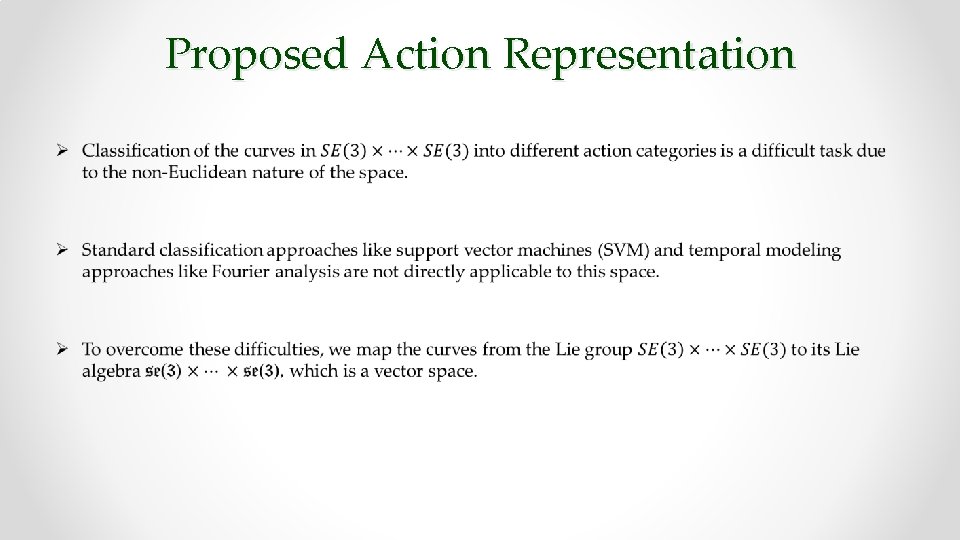
Proposed Action Representation Ø
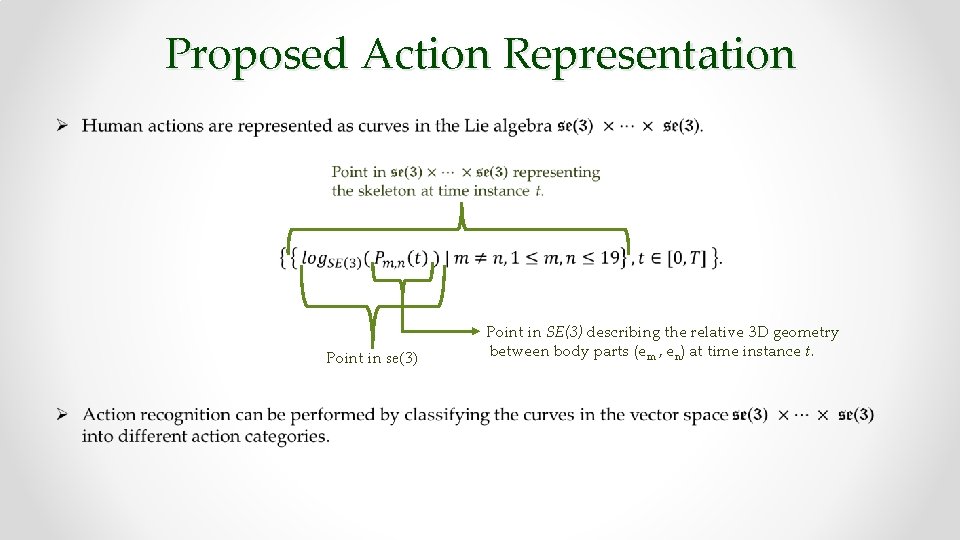
Proposed Action Representation Ø Point in se(3) Point in SE(3) describing the relative 3 D geometry between body parts (em , en) at time instance t.
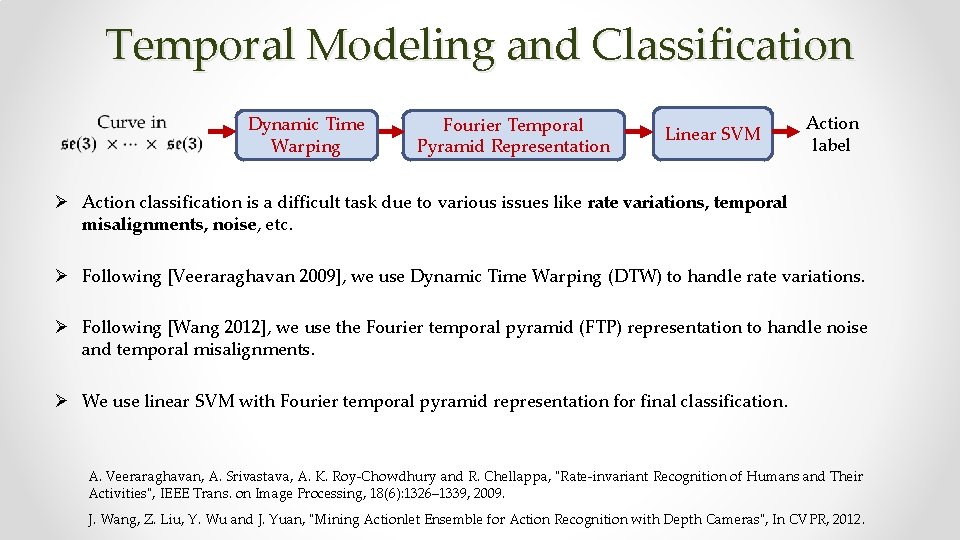
Temporal Modeling and Classification Dynamic Time Warping Fourier Temporal Pyramid Representation Linear SVM Action label Ø Action classification is a difficult task due to various issues like rate variations, temporal misalignments, noise, etc. Ø Following [Veeraraghavan 2009], we use Dynamic Time Warping (DTW) to handle rate variations. Ø Following [Wang 2012], we use the Fourier temporal pyramid (FTP) representation to handle noise and temporal misalignments. Ø We use linear SVM with Fourier temporal pyramid representation for final classification. A. Veeraraghavan, A. Srivastava, A. K. Roy-Chowdhury and R. Chellappa, "Rate-invariant Recognition of Humans and Their Activities", IEEE Trans. on Image Processing, 18(6): 1326– 1339, 2009. J. Wang, Z. Liu, Y. Wu and J. Yuan, "Mining Actionlet Ensemble for Action Recognition with Depth Cameras", In CVPR, 2012.
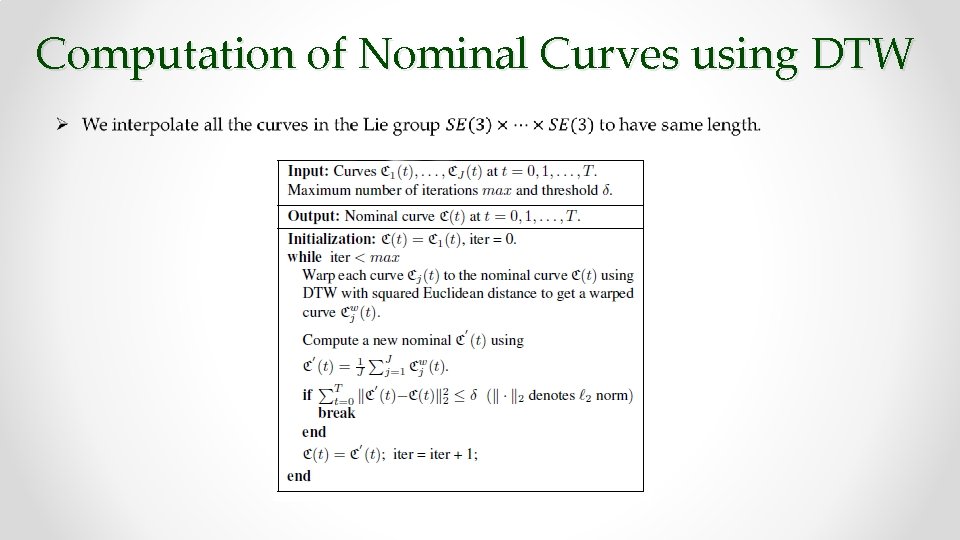
Computation of Nominal Curves using DTW Ø
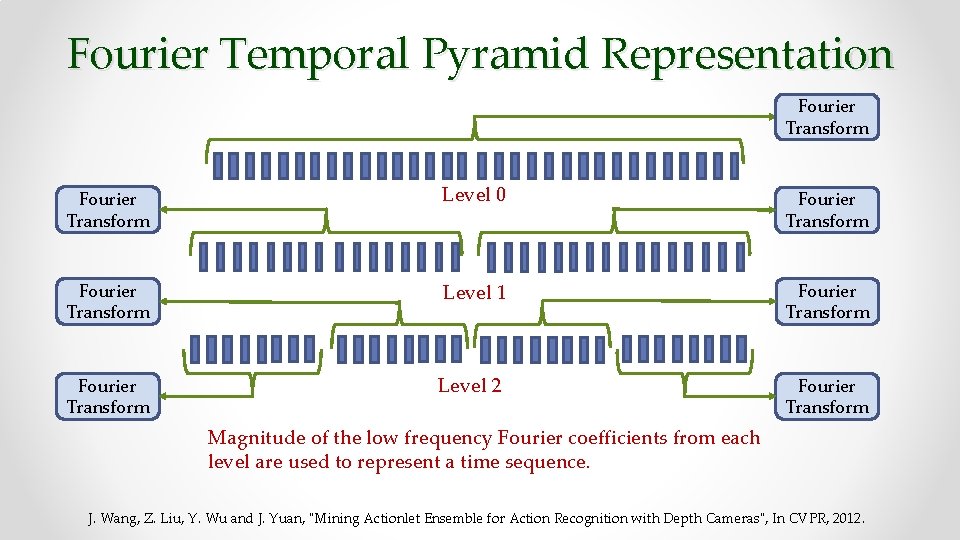
Fourier Temporal Pyramid Representation Fourier Transform Level 0 Fourier Transform Level 1 Fourier Transform Level 2 Fourier Transform Magnitude of the low frequency Fourier coefficients from each level are used to represent a time sequence. J. Wang, Z. Liu, Y. Wu and J. Yuan, "Mining Actionlet Ensemble for Action Recognition with Depth Cameras", In CVPR, 2012.
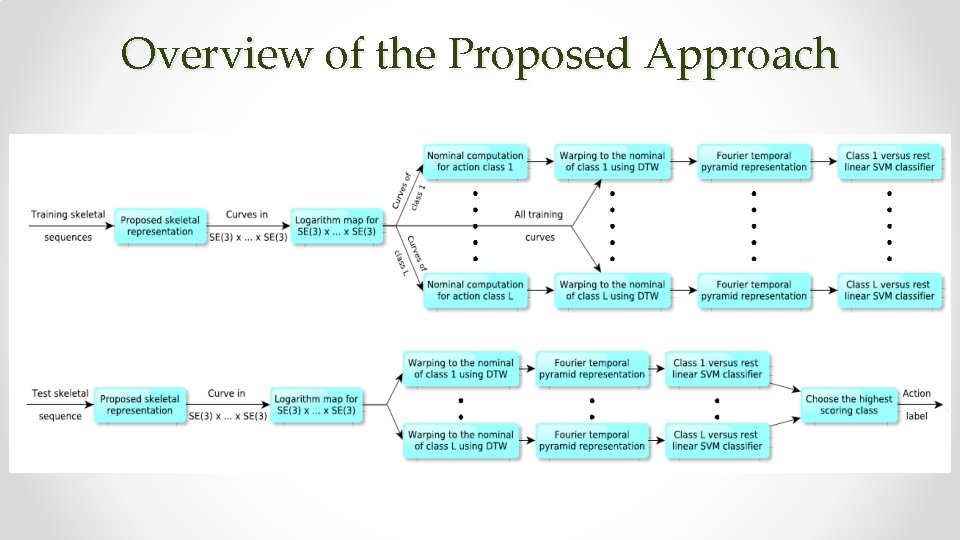
Overview of the Proposed Approach
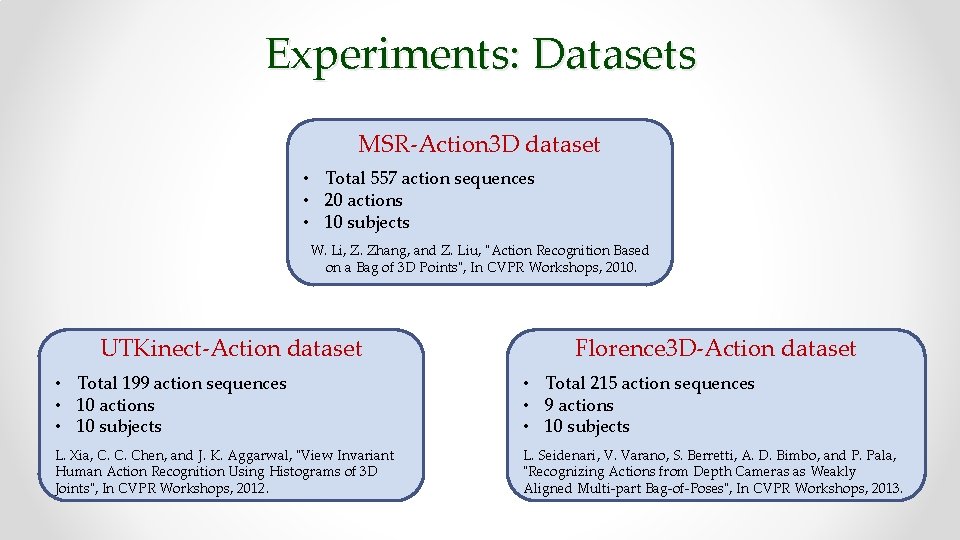
Experiments: Datasets MSR-Action 3 D dataset • Total 557 action sequences • 20 actions • 10 subjects W. Li, Z. Zhang, and Z. Liu, "Action Recognition Based on a Bag of 3 D Points", In CVPR Workshops, 2010. UTKinect-Action dataset Florence 3 D-Action dataset • Total 199 action sequences • 10 actions • 10 subjects • Total 215 action sequences • 9 actions • 10 subjects L. Xia, C. C. Chen, and J. K. Aggarwal, "View Invariant Human Action Recognition Using Histograms of 3 D Joints", In CVPR Workshops, 2012. L. Seidenari, V. Varano, S. Berretti, A. D. Bimbo, and P. Pala, "Recognizing Actions from Depth Cameras as Weakly Aligned Multi-part Bag-of-Poses", In CVPR Workshops, 2013.
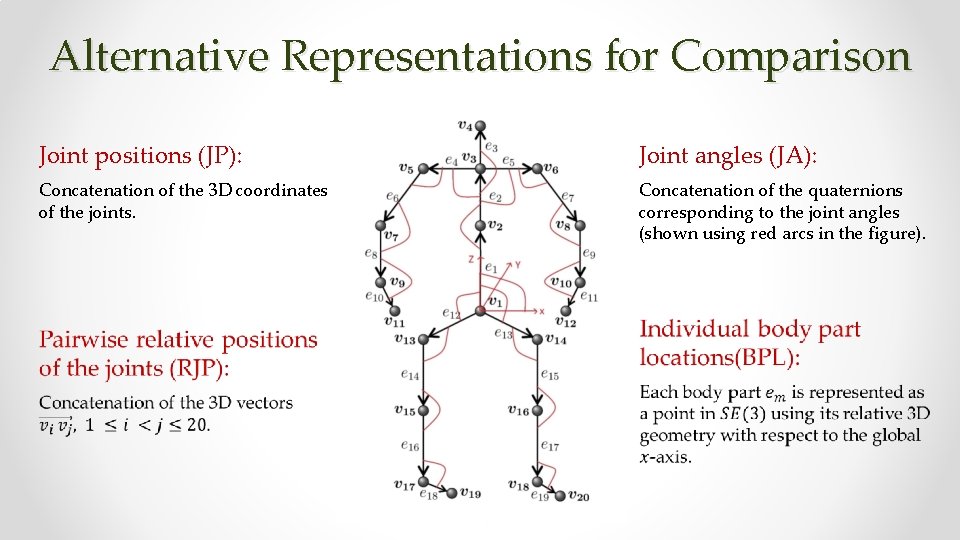
Alternative Representations for Comparison Joint positions (JP): Joint angles (JA): Concatenation of the 3 D coordinates of the joints. Concatenation of the quaternions corresponding to the joint angles (shown using red arcs in the figure).
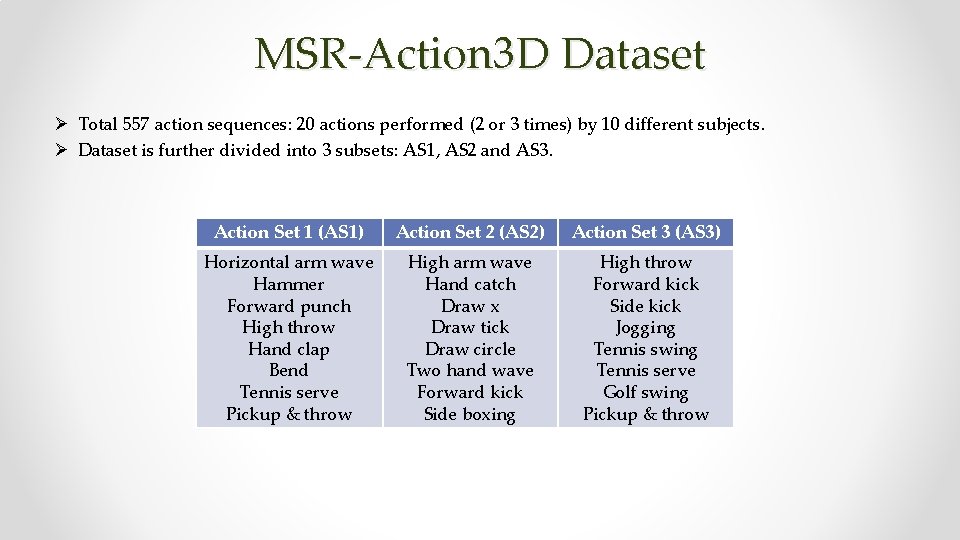
MSR-Action 3 D Dataset Ø Total 557 action sequences: 20 actions performed (2 or 3 times) by 10 different subjects. Ø Dataset is further divided into 3 subsets: AS 1, AS 2 and AS 3. Action Set 1 (AS 1) Action Set 2 (AS 2) Action Set 3 (AS 3) Horizontal arm wave Hammer Forward punch High throw Hand clap Bend Tennis serve Pickup & throw High arm wave Hand catch Draw x Draw tick Draw circle Two hand wave Forward kick Side boxing High throw Forward kick Side kick Jogging Tennis swing Tennis serve Golf swing Pickup & throw
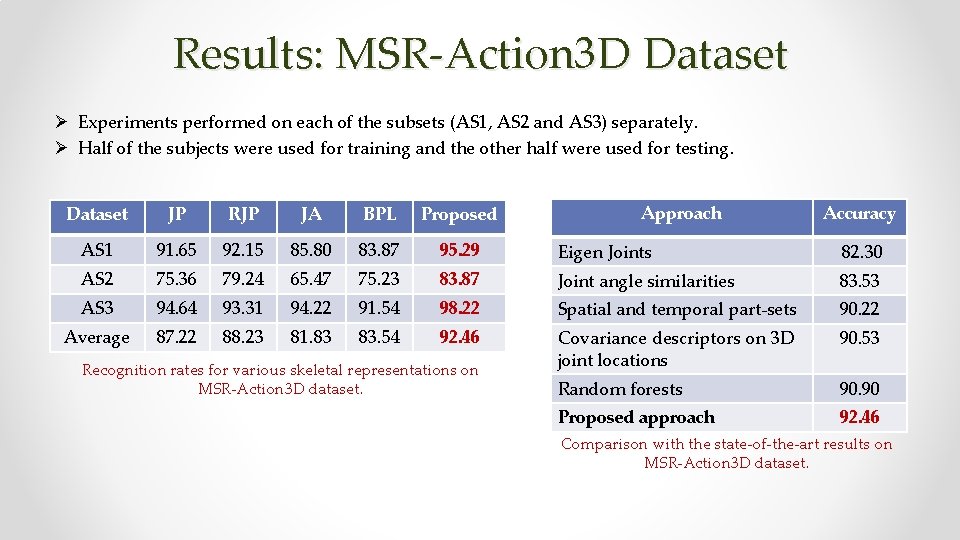
Results: MSR-Action 3 D Dataset Ø Experiments performed on each of the subsets (AS 1, AS 2 and AS 3) separately. Ø Half of the subjects were used for training and the other half were used for testing. Approach Accuracy Dataset JP RJP JA BPL Proposed AS 1 91. 65 92. 15 85. 80 83. 87 95. 29 Eigen Joints 82. 30 AS 2 75. 36 79. 24 65. 47 75. 23 83. 87 Joint angle similarities 83. 53 AS 3 94. 64 93. 31 94. 22 91. 54 98. 22 Spatial and temporal part-sets 90. 22 Average 87. 22 88. 23 81. 83 83. 54 92. 46 Covariance descriptors on 3 D joint locations 90. 53 Random forests 90. 90 Proposed approach 92. 46 Recognition rates for various skeletal representations on MSR-Action 3 D dataset. Comparison with the state-of-the-art results on MSR-Action 3 D dataset.
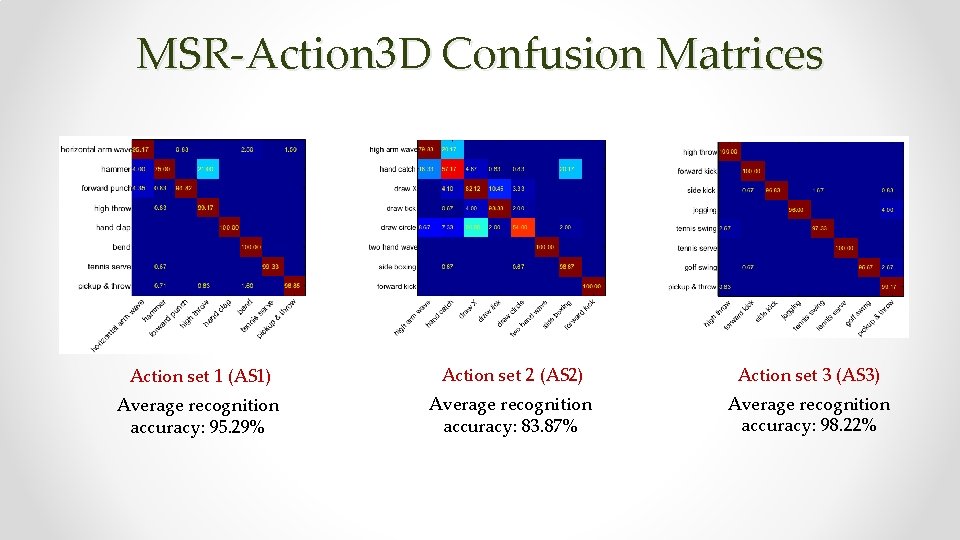
MSR-Action 3 D Confusion Matrices Action set 1 (AS 1) Action set 2 (AS 2) Action set 3 (AS 3) Average recognition accuracy: 95. 29% Average recognition accuracy: 83. 87% Average recognition accuracy: 98. 22%
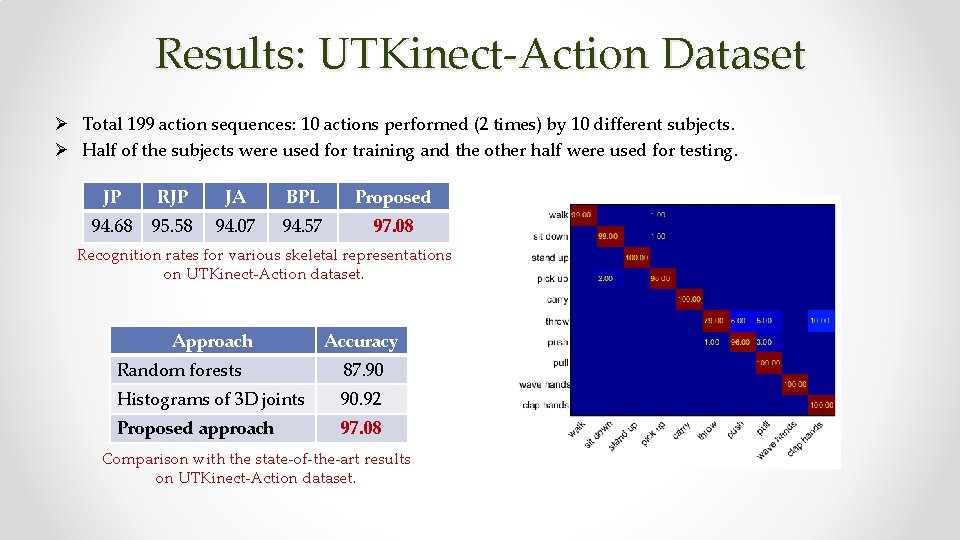
Results: UTKinect-Action Dataset Ø Total 199 action sequences: 10 actions performed (2 times) by 10 different subjects. Ø Half of the subjects were used for training and the other half were used for testing. JP RJP JA BPL Proposed 94. 68 95. 58 94. 07 94. 57 97. 08 Recognition rates for various skeletal representations on UTKinect-Action dataset. Approach Accuracy Random forests 87. 90 Histograms of 3 D joints 90. 92 Proposed approach 97. 08 Comparison with the state-of-the-art results on UTKinect-Action dataset.
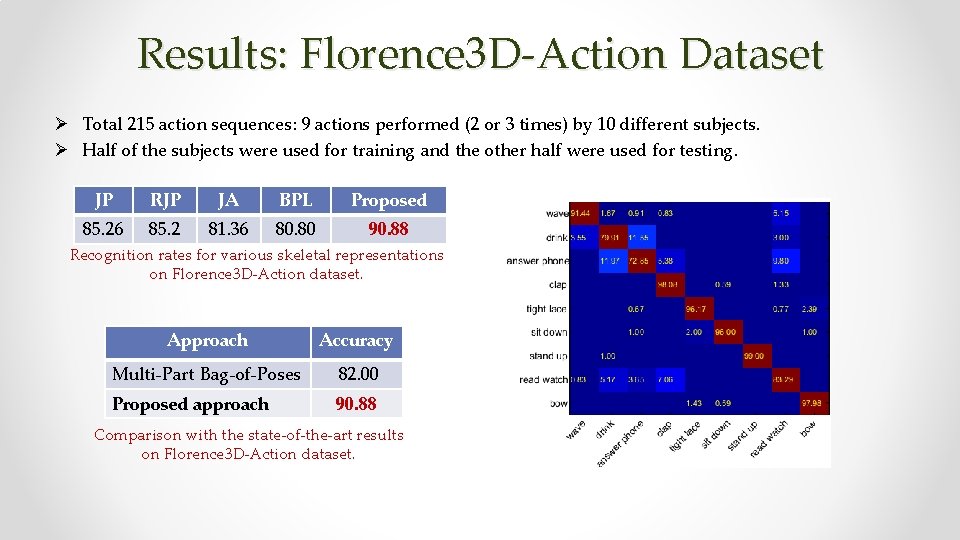
Results: Florence 3 D-Action Dataset Ø Total 215 action sequences: 9 actions performed (2 or 3 times) by 10 different subjects. Ø Half of the subjects were used for training and the other half were used for testing. JP RJP JA BPL Proposed 85. 26 85. 2 81. 36 80. 80 90. 88 Recognition rates for various skeletal representations on Florence 3 D-Action dataset. Approach Accuracy Multi-Part Bag-of-Poses 82. 00 Proposed approach 90. 88 Comparison with the state-of-the-art results on Florence 3 D-Action dataset.
Thank You
- Slides: 30