
Huffman Coding An implementation using C STL part
- Slides: 16
Huffman Coding An implementation using C++ STL (part of the material is due to the work of Mark Nelson, Dr. Dobb’s Journal, January 1996) Gabriele Monfardini - Corso di Basi di Dati Multimediali a. a. 20052006
Why C++ n n No special reason, also C, Java and many more The main advantage of using C++ is the presence of the STL (Standard Template Library) Gabriele Monfardini - Corso di Basi di Dati Multimediali a. a. 2005 -2006 2
What is the STL n n It is a library of templates A template is a class which has a data type that is a parameter (by the way, this data type can be primitive, or itself a class) vector<int>, queue<string> Gabriele Monfardini - Corso di Basi di Dati Multimediali a. a. 2005 -2006 3
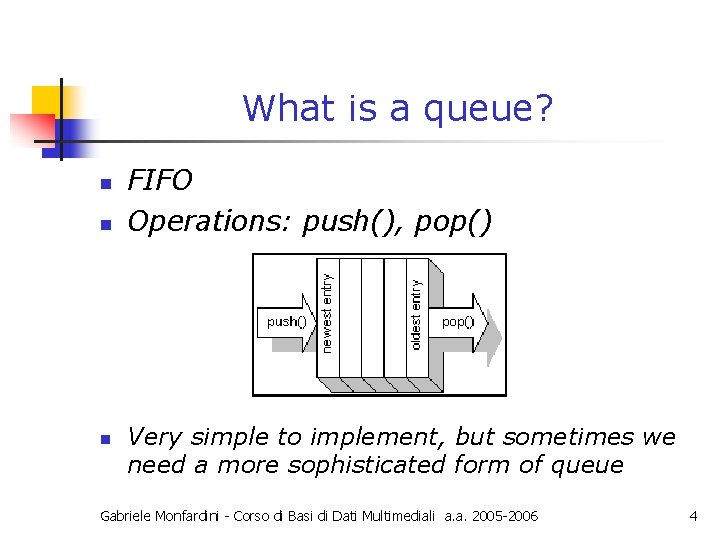
What is a queue? n n n FIFO Operations: push(), pop() Very simple to implement, but sometimes we need a more sophisticated form of queue Gabriele Monfardini - Corso di Basi di Dati Multimediali a. a. 2005 -2006 4
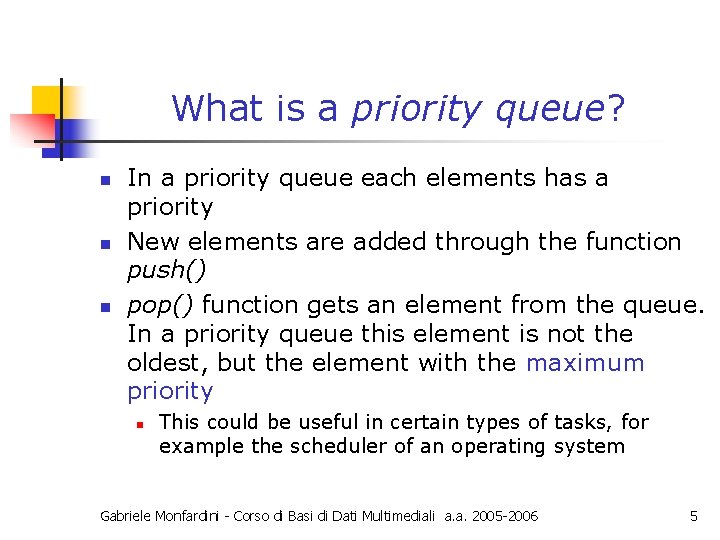
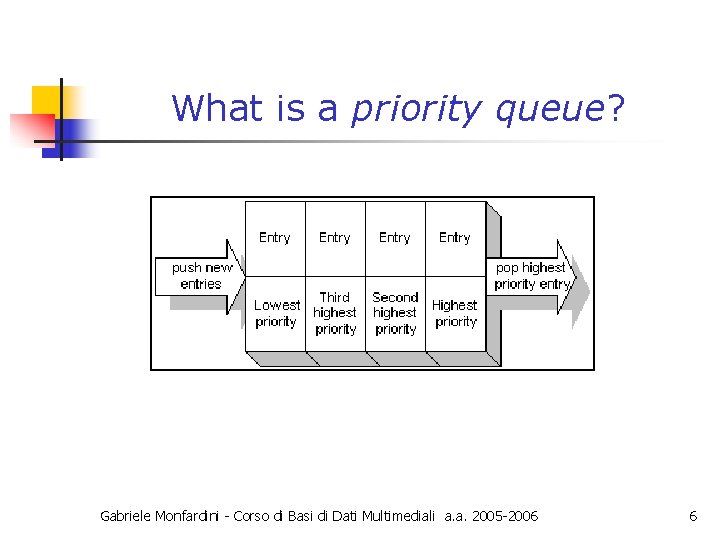
What is a priority queue? n n n In a priority queue each elements has a priority New elements are added through the function push() pop() function gets an element from the queue. In a priority queue this element is not the oldest, but the element with the maximum priority n This could be useful in certain types of tasks, for example the scheduler of an operating system Gabriele Monfardini - Corso di Basi di Dati Multimediali a. a. 2005 -2006 5
What is a priority queue? Gabriele Monfardini - Corso di Basi di Dati Multimediali a. a. 2005 -2006 6
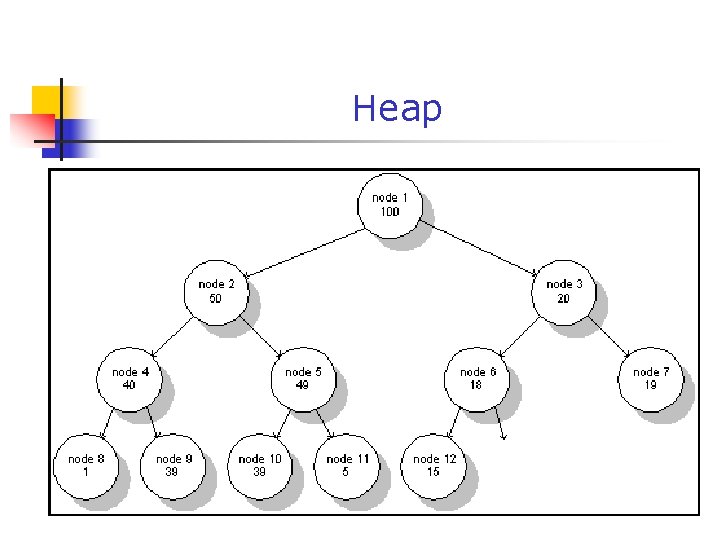
Implementation with a heap n n One efficient implementation of a priority queue uses a heap A heap is a data structure that keeps queue elements in a partially-sorted order. Insertion and extraction can be accomplished in log(N) time, where N is the number of elements Also memory overhead is almost null Gabriele Monfardini - Corso di Basi di Dati Multimediali a. a. 2005 -2006 7
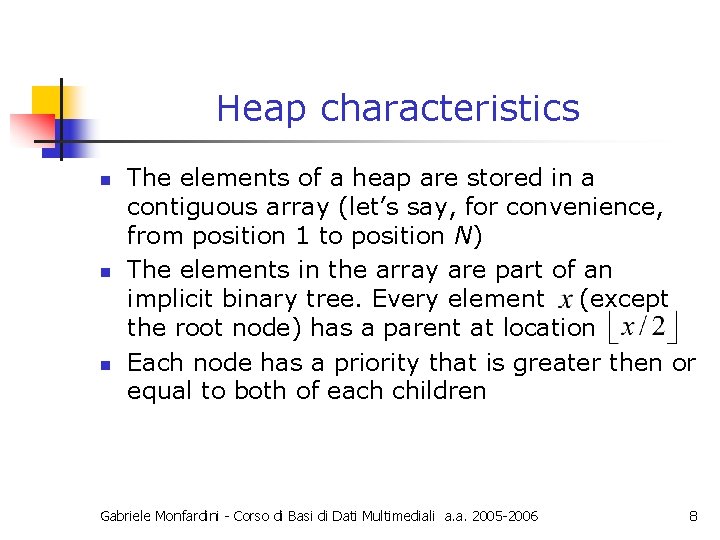
Heap characteristics n n n The elements of a heap are stored in a contiguous array (let’s say, for convenience, from position 1 to position N) The elements in the array are part of an implicit binary tree. Every element (except the root node) has a parent at location Each node has a priority that is greater then or equal to both of each children Gabriele Monfardini - Corso di Basi di Dati Multimediali a. a. 2005 -2006 8
Heap
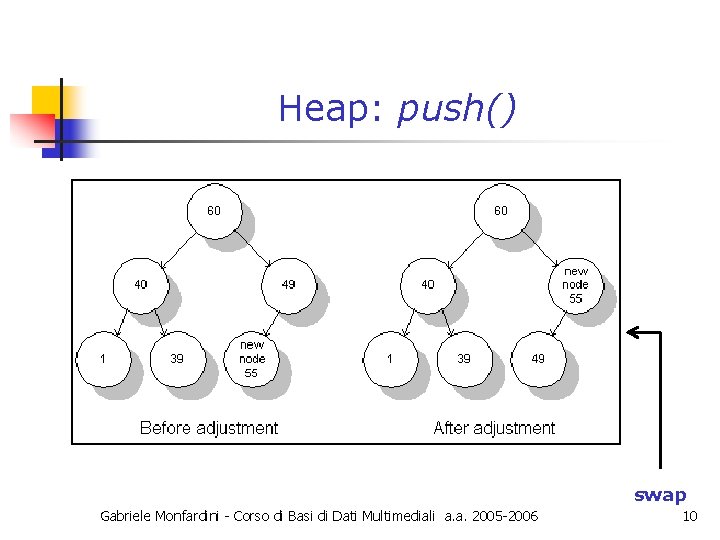
Heap: push() swap Gabriele Monfardini - Corso di Basi di Dati Multimediali a. a. 2005 -2006 10
Heap: pop() n n Something similar also happens when we call the pop() functions. . . Details don’t matter. . . Gabriele Monfardini - Corso di Basi di Dati Multimediali a. a. 2005 -2006 11
STL priority_queue n n It implements a priority queue using a heap We don’t need to remember all the details about heap and resorting because. . . all is automatic Gabriele Monfardini - Corso di Basi di Dati Multimediali a. a. 2005 -2006 12
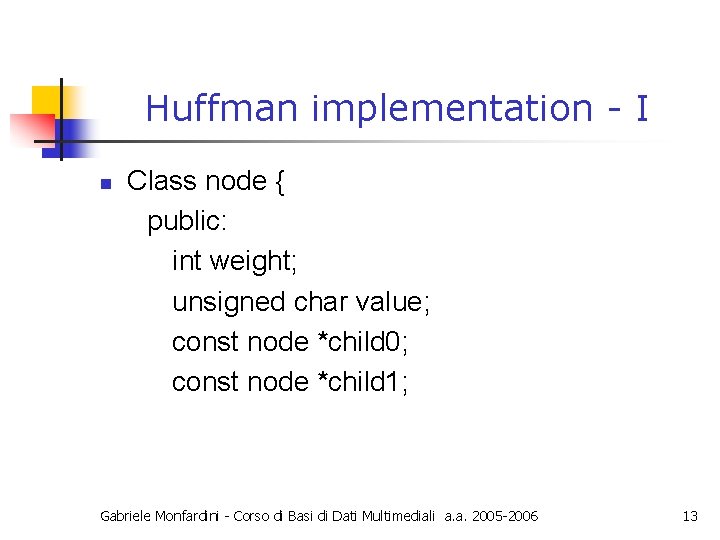
Huffman implementation - I n Class node { public: int weight; unsigned char value; const node *child 0; const node *child 1; Gabriele Monfardini - Corso di Basi di Dati Multimediali a. a. 2005 -2006 13
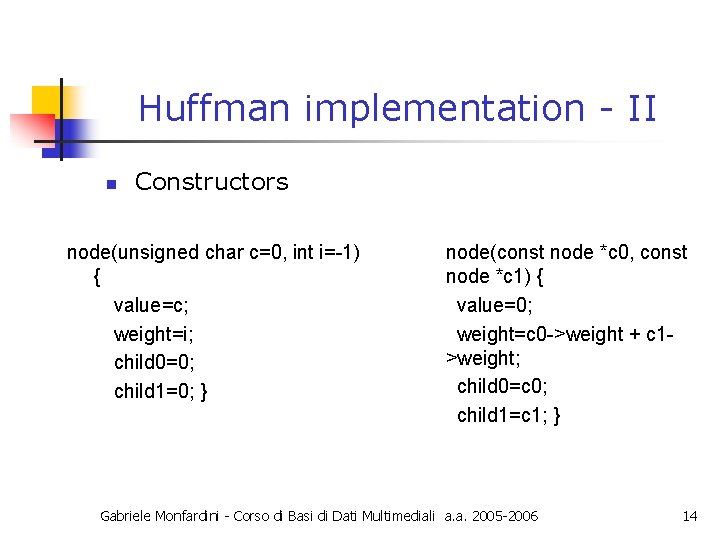
Huffman implementation - II n Constructors node(unsigned char c=0, int i=-1) { value=c; weight=i; child 0=0; child 1=0; } node(const node *c 0, const node *c 1) { value=0; weight=c 0 ->weight + c 1>weight; child 0=c 0; child 1=c 1; } Gabriele Monfardini - Corso di Basi di Dati Multimediali a. a. 2005 -2006 14
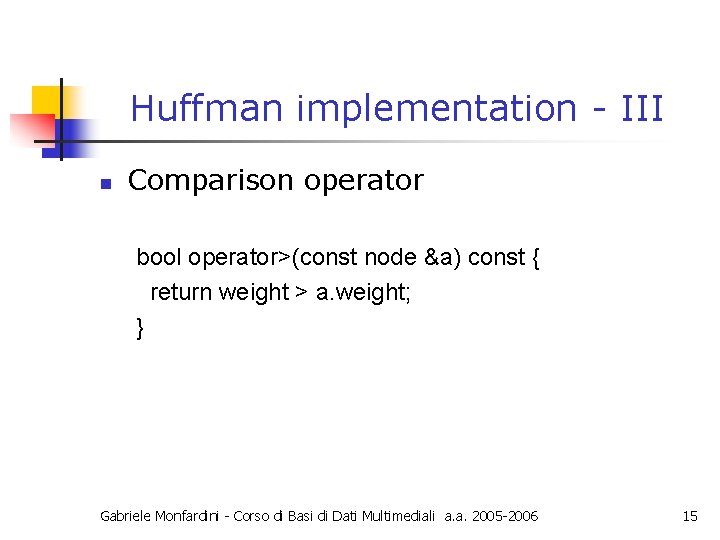
Huffman implementation - III n Comparison operator bool operator>(const node &a) const { return weight > a. weight; } Gabriele Monfardini - Corso di Basi di Dati Multimediali a. a. 2005 -2006 15
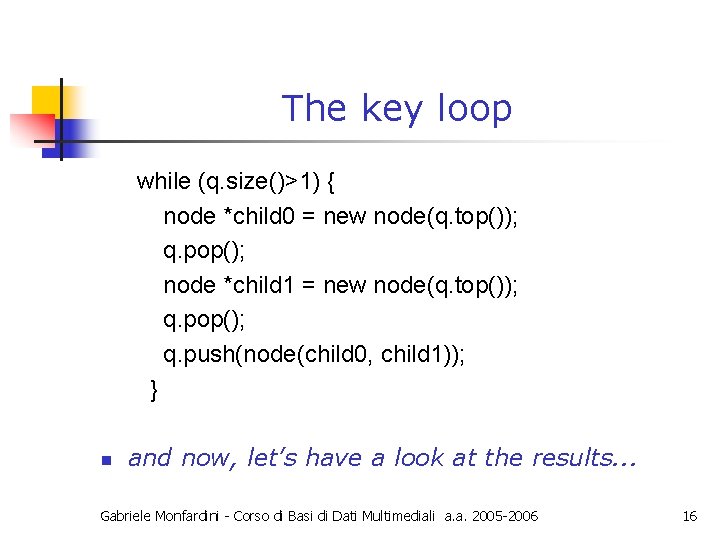
The key loop while (q. size()>1) { node *child 0 = new node(q. top()); q. pop(); node *child 1 = new node(q. top()); q. pop(); q. push(node(child 0, child 1)); } n and now, let’s have a look at the results. . . Gabriele Monfardini - Corso di Basi di Dati Multimediali a. a. 2005 -2006 16