
HUBUNGAN KEUNTUNGAN DAN VALUE CHAIN SISTEM INFORMASI ENTERPRISE

HUBUNGAN KEUNTUNGAN DAN VALUE CHAIN SISTEM INFORMASI ENTERPRISE Program Studi Teknik Informatika Universitas Komputer Indonesia
Definisi dari Daya Saing • Tujuan dari sebuah bisnis adalah menghasilkan keuntungan • Keuntungan didasarkan pada nilai layanan terhadap konsumen Bagaimana bisa sebuah bisnis menjamin sebuah nilai kepada konsumen ? Beberapa hal yang harus diketahui oleh seorang kompetitor : • Berapa banyak produk dan jasa yang ditawarkan? • Siapa yang menjadi konsumen anda? • Siapa yang menjadi kompetitor anda? RNL - 2014 2
Competitive Advantage Untuk memastikan berapa keuntungan yang didapat, sebuah perusahaan wajib memelihara daya saing. • Metode yang digunakan yaitu produk dan jasa yang terjangkau serta berkelanjutan. • Bekerja dengan cerdas • Dapat memerkirakan apakah sistem informasi yang dipakai dapat secara tepat memperoleh keuntungan yang bersaing. • Fokus terhadap pada 3 hal diantaranya HR, Asset (capital) dan teknologi. RNL - 2014 3
Porter Competitive Model (1) • Digunakan untuk mengetahui dan mengevaluasi struktur dari sebuah lingkuan bisnis suatu industri serta ancaman dari persaingan sehingga kita dapat mengetahui secara spesifik kompetitor perusahaan. • Tidak bisa dibuat dan digunakan dalam Sistem Informasi. • Perubahan dari sebuah industri menjadi bagian yang sederhana , sehingga dapat di analisa dan hasilnya bisa dijadikan sebagai masukan. RNL - 2014 4

Porter Competitive Model (2) Potential New Entrants Bargaining Power of Suppliers Intra-Industry Rivalry Strategic Business Unit Bargaining Power of Buyers Substitute Products and Services Included with permission of Michael E. Porter based on ideas in Competitive Advantage: Creating and Sustaining Superior Performance, copyright 1985 by Michael E. Porter. 5
Faktor kunci dari analisa industri • Collecting the data. (pengumpulan data) • Determining which data is important. (Menentukan data mana saja yang penting) • Selecting an appropriate overall approach. (Memilih secara tepat dari semua pendekatan) • Deciding on the logical starting point. (Menentukan secara logis hal apa saja yang harus pertama kali dilakukan) RNL - 2014 6
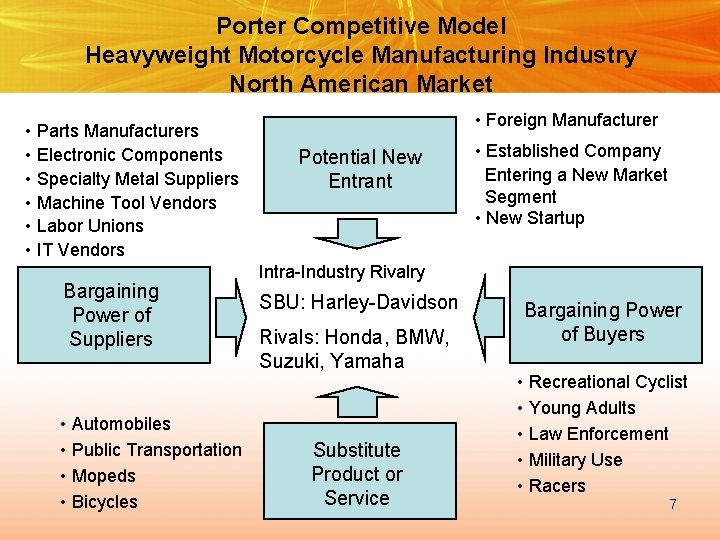
Porter Competitive Model Heavyweight Motorcycle Manufacturing Industry North American Market • Parts Manufacturers • Electronic Components • Specialty Metal Suppliers • Machine Tool Vendors • Labor Unions • IT Vendors Bargaining Power of Suppliers • Automobiles • Public Transportation • Mopeds • Bicycles • Foreign Manufacturer Potential New Entrant • Established Company Entering a New Market Segment • New Startup Intra-Industry Rivalry SBU: Harley-Davidson Rivals: Honda, BMW, Suzuki, Yamaha Substitute Product or Service RNL - 2014 Bargaining Power of Buyers • Recreational Cyclist • Young Adults • Law Enforcement • Military Use • Racers 7
Michael Porter’s Value Chain • Developed by Michael Porter but different from competitive model because it focuses within the company. • Analyzes the cross-functional flow of products or services within an organization that add value to customers. • The Value Chain can be used to determine where IS can strengthen the flow of primary and support activities within an organization. • Every segment of an organization needs IT and IS to be competitive. So this model is essential to visualizing the flow of activities within segments through the use of IS and IT. • Benefit : - Identifies value processes - Identifies areas for cost improvement RNL - 2014 8

Porter’s Generic Value Chain Suppor t Activiti es Primary Activitie s Infrastructure Human Resource Management Technology Development Procurement Inbound Logistics Operations Outbound Logistics Marketing & Sales Service Elapsed Time - Value added time cost Included with permission of Michael E. Porter based on ideas in Competitive Advantage: Creating and Sustaining Superior Performance, copyright 1985 by Michael E. Porter. 9
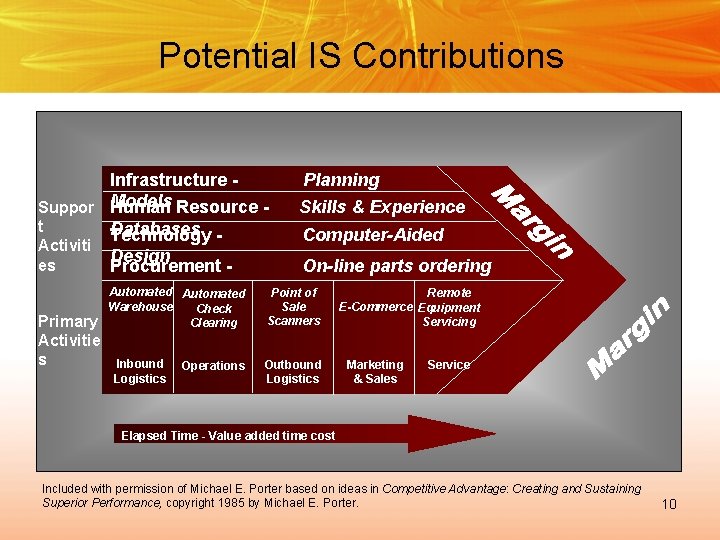
Potential IS Contributions Infrastructure Models Resource Suppor Human t Databases Technology Activiti es Primary Activitie s Design Procurement Automated Warehouse Check Clearing Inbound Logistics Operations Planning Skills & Experience Computer-Aided On-line parts ordering Point of Sale Scanners Outbound Logistics Remote E-Commerce Equipment Servicing Marketing & Sales Service Elapsed Time - Value added time cost Included with permission of Michael E. Porter based on ideas in Competitive Advantage: Creating and Sustaining Superior Performance, copyright 1985 by Michael E. Porter. 10
Primary Activities • Inbound logistics - activities associated with receiving, storing, and disseminating inputs to the products or services • Operations- activities associated with transforming inputs into the final products or services • Outbound logistics - activities associated with collecting, storing, and physically distributing the products or services • Marketing and sales - activities associated with providing a means by which customers can buy produce and the means for inducing them to buy • Service - activities associated with providing service to enhance or maintain the value of the products or services RNL - 2014 11
Support Activities • Procurement - the function of purchasing inputs to firms value chain • Technology Development - the know-how, procedures, or technology embedded in processes that are intended to improve the product, services, and/or process • Human Resource Management - activities involved in recruiting, hiring, training, developing, and compensating all types of personnel • Firm Infrastructure - activities that support the entire value chain (e. g. general management, planning, finance, accounting, legal, government affairs, quality management, etc. ) RNL - 2014 12
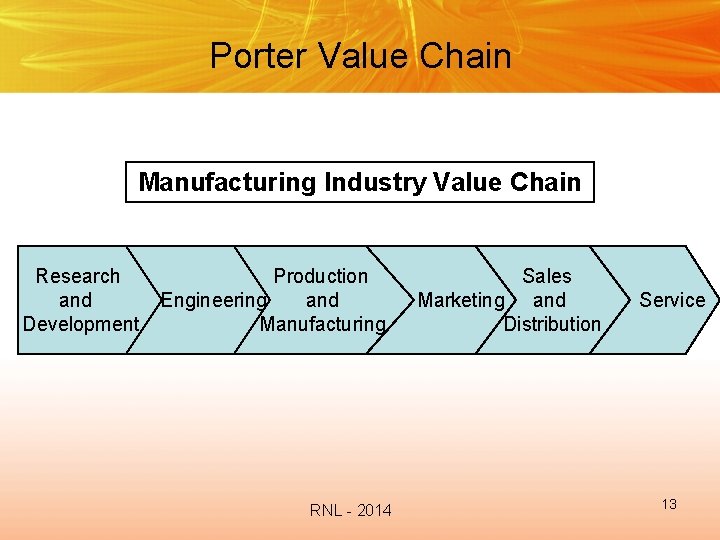
Porter Value Chain Manufacturing Industry Value Chain Research and Development Production Engineering and Manufacturing RNL - 2014 Sales Marketing and Distribution Service 13
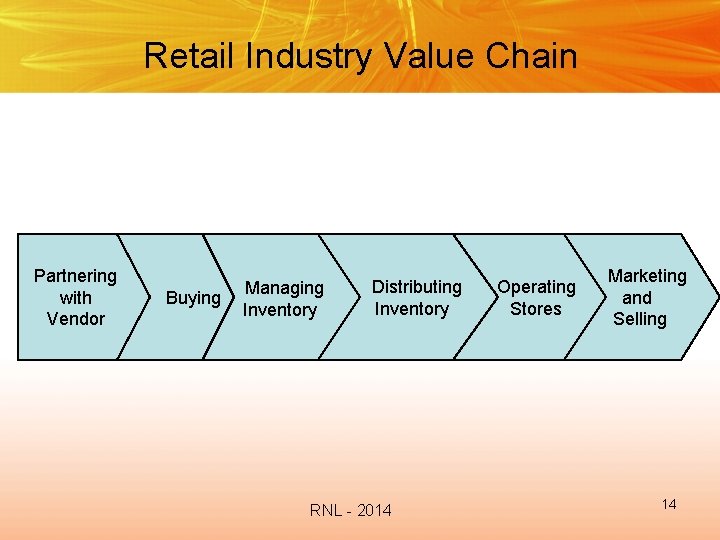
Retail Industry Value Chain Partnering with Vendor Buying Managing Inventory Distributing Inventory RNL - 2014 Operating Stores Marketing and Selling 14

Property and Casualty Industry Value Chain FIRM INFRASTRUCTURE -Financial Policy HUMAN RESOURCE MANAGEMENT -Regulatory Compliance - Legal Agent Training Actuary Training Actuarial Methods Investment Practices TECHNOLOGY DEVELOPMENT - Accounting Product Development Market Research Claims Training Claims Procedures I/T Communications PROCUREMENT • Policy Rating • Underwriting • Investment • Independent Agent Network • Billing and Collections INBOUND LOGISTICS OPERATIONS OUTBOUND LOGISTICS • Policy Sales • Claims Settlement • Policy Renewal • Loss Control • Agent Management • Advertising MARKETING AND SALES SERVICE Included with permission of Michael E. Porter based on ideas in Competitive Advantage: Creating and Sustaining Superior Performance, copyright 1985 by Michael E. Porter. 15
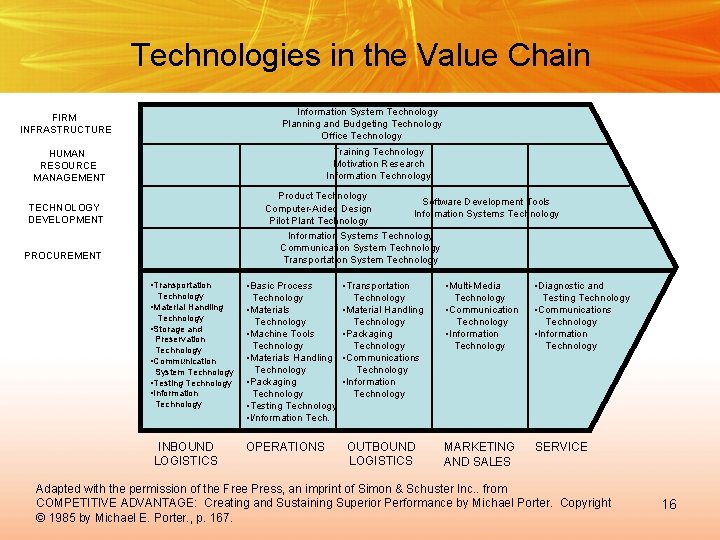
Technologies in the Value Chain Information System Technology Planning and Budgeting Technology Office Technology FIRM INFRASTRUCTURE Training Technology Motivation Research Information Technology HUMAN RESOURCE MANAGEMENT Product Technology Computer-Aided Design Pilot Plant Technology TECHNOLOGY DEVELOPMENT Software Development Tools Information Systems Technology Communication System Technology Transportation System Technology PROCUREMENT • Transportation Technology • Material Handling Technology • Storage and Preservation Technology • Communication System Technology • Testing Technology • Information Technology INBOUND LOGISTICS • Basic Process Technology • Materials Technology • Machine Tools Technology • Materials Handling Technology • Packaging Technology • Testing Technology • I/nformation Tech. OPERATIONS • Transportation Technology • Material Handling Technology • Packaging Technology • Communications Technology • Information Technology • Multi-Media Technology • Communication Technology • Information Technology • Diagnostic and Testing Technology • Communications Technology • Information Technology OUTBOUND LOGISTICS MARKETING AND SALES SERVICE Adapted with the permission of the Free Press, an imprint of Simon & Schuster Inc. . from COMPETITIVE ADVANTAGE: Creating and Sustaining Superior Performance by Michael Porter. Copyright © 1985 by Michael E. Porter. , p. 167. 16
APPENDIX


- Slides: 19