
Hubbles Law and Expansion of Universe Hubbles Law
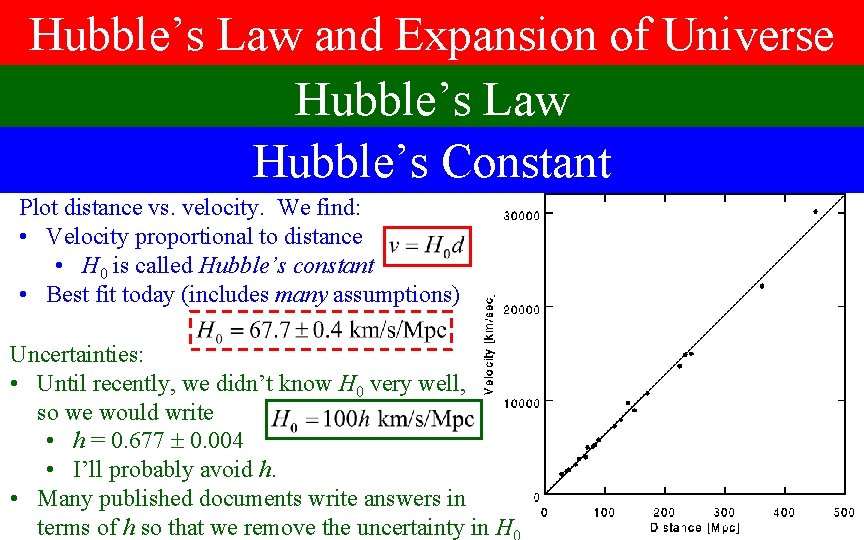
Hubble’s Law and Expansion of Universe Hubble’s Law Hubble’s Constant Plot distance vs. velocity. We find: • Velocity proportional to distance • H 0 is called Hubble’s constant • Best fit today (includes many assumptions) Uncertainties: • Until recently, we didn’t know H 0 very well, so we would write • h = 0. 677 0. 004 • I’ll probably avoid h. • Many published documents write answers in terms of h so that we remove the uncertainty in H
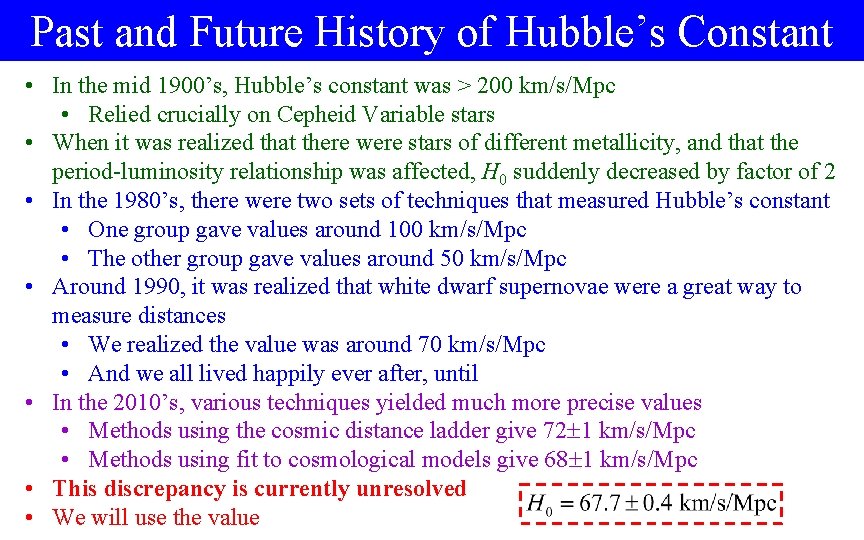
Past and Future History of Hubble’s Constant • In the mid 1900’s, Hubble’s constant was > 200 km/s/Mpc • Relied crucially on Cepheid Variable stars • When it was realized that there were stars of different metallicity, and that the period-luminosity relationship was affected, H 0 suddenly decreased by factor of 2 • In the 1980’s, there were two sets of techniques that measured Hubble’s constant • One group gave values around 100 km/s/Mpc • The other group gave values around 50 km/s/Mpc • Around 1990, it was realized that white dwarf supernovae were a great way to measure distances • We realized the value was around 70 km/s/Mpc • And we all lived happily ever after, until • In the 2010’s, various techniques yielded much more precise values • Methods using the cosmic distance ladder give 72 1 km/s/Mpc • Methods using fit to cosmological models give 68 1 km/s/Mpc • This discrepancy is currently unresolved • We will use the value
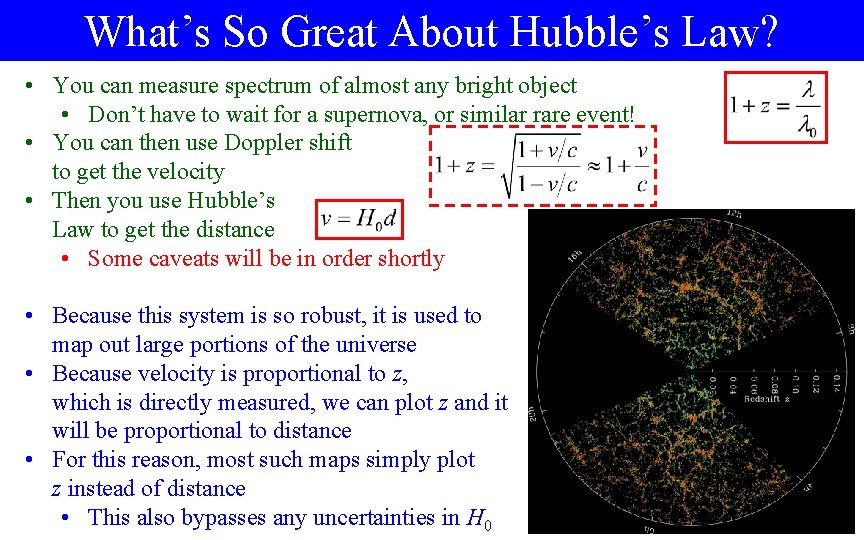
What’s So Great About Hubble’s Law? • You can measure spectrum of almost any bright object • Don’t have to wait for a supernova, or similar rare event! • You can then use Doppler shift to get the velocity • Then you use Hubble’s Law to get the distance • Some caveats will be in order shortly • Because this system is so robust, it is used to map out large portions of the universe • Because velocity is proportional to z, which is directly measured, we can plot z and it will be proportional to distance • For this reason, most such maps simply plot z instead of distance • This also bypasses any uncertainties in H 0
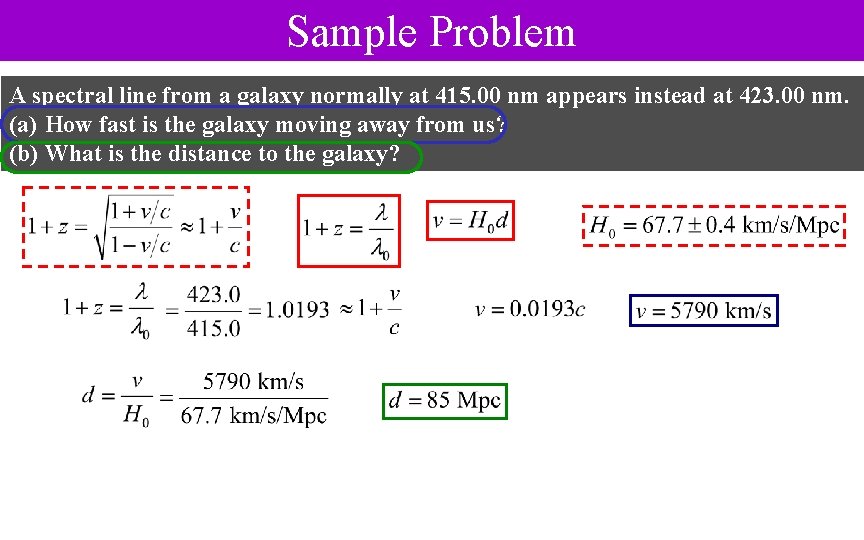
Sample Problem A spectral line from a galaxy normally at 415. 00 nm appears instead at 423. 00 nm. (a) How fast is the galaxy moving away from us? (b) What is the distance to the galaxy?
Failure of Hubble’s Law at Small z Hubble’s Law isn’t perfect. In particular, for low z: • Not everything expands • Galaxies, galaxy clusters, and smaller objects are not necessarily expanding • Galaxy superclusters expand more slowly than Hubble’s Law implies • Objects have extra velocities, called peculiar velocities • Because gravity changes velocities • Typically of order 500 km/s or so • This causes errors, usually random, of magnitude vp /H 0 in the distance • Typically 7 Mpc or so • Poor distance indicator for distances under 50 Mpc or so. • We also have our own peculiar velocity that needs to be compensated for • We know how to do this
Failure of Hubble’s Law at Large z Hubble’s Law isn’t perfect. In particular for high z: • As z gets large (> 0. 2) objects are moving relativistically • Relativistic corrections • Distance gets confusing as well • We are also looking back into the past • Bad: Expansion might not be constant • Good: We can study the universe in the past (!) • Still, higher z corresponds to greater distance • If we can accurately measure distance to some high z objects, we can set up a calibration scale • Bottom Line: Once a calibration is set up at high z, you can use modified Hubble’s Law if you are careful
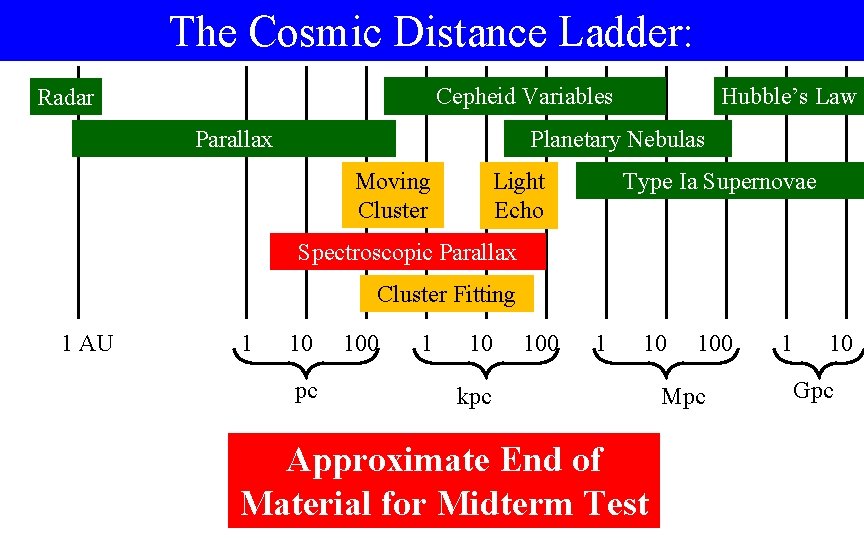
The Cosmic Distance Ladder: Cepheid Variables Radar Parallax Hubble’s Law Planetary Nebulas Moving Cluster Type Ia Supernovae Light Echo Spectroscopic Parallax Cluster Fitting 1 AU 1 10 pc 100 1 10 kpc Approximate End of Material for Midterm Test 100 Mpc 1 10 Gpc
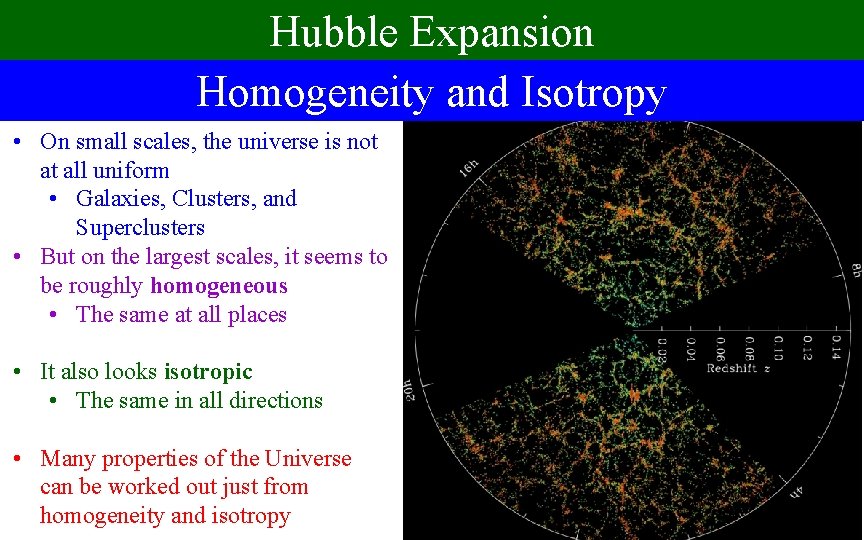
Hubble Expansion Homogeneity and Isotropy • On small scales, the universe is not at all uniform • Galaxies, Clusters, and Superclusters • But on the largest scales, it seems to be roughly homogeneous • The same at all places • It also looks isotropic • The same in all directions • Many properties of the Universe can be worked out just from homogeneity and isotropy
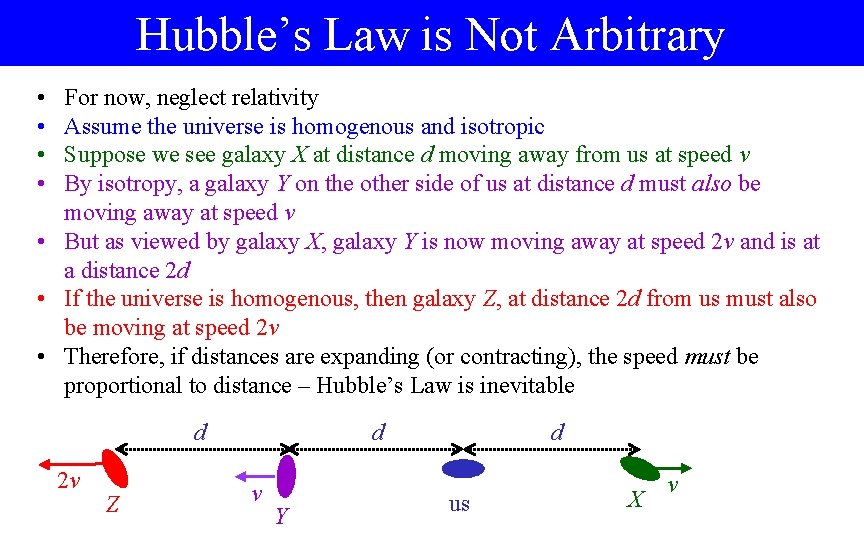
Hubble’s Law is Not Arbitrary • • For now, neglect relativity Assume the universe is homogenous and isotropic Suppose we see galaxy X at distance d moving away from us at speed v By isotropy, a galaxy Y on the other side of us at distance d must also be moving away at speed v • But as viewed by galaxy X, galaxy Y is now moving away at speed 2 v and is at a distance 2 d • If the universe is homogenous, then galaxy Z, at distance 2 d from us must also be moving at speed 2 v • Therefore, if distances are expanding (or contracting), the speed must be proportional to distance – Hubble’s Law is inevitable d 2 v Z d v Y d us X v
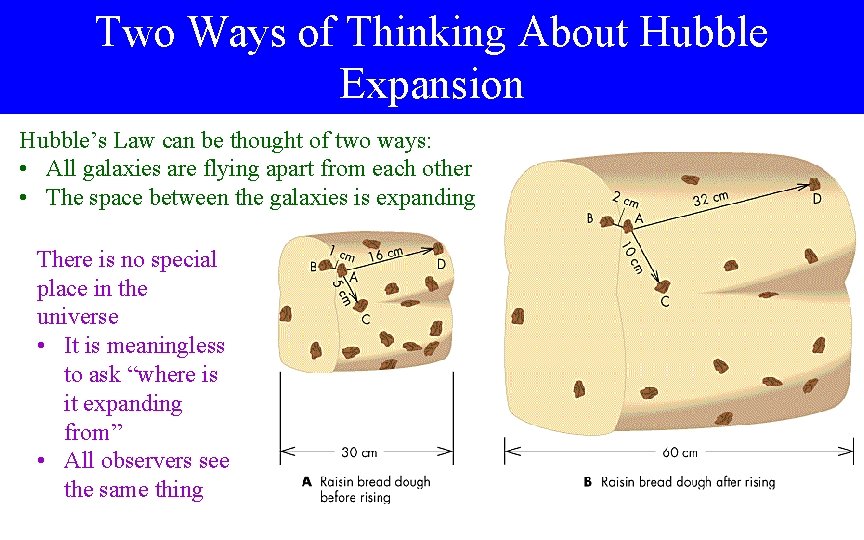
Two Ways of Thinking About Hubble Expansion Hubble’s Law can be thought of two ways: • All galaxies are flying apart from each other • The space between the galaxies is expanding There is no special place in the universe • It is meaningless to ask “where is it expanding from” • All observers see the same thing
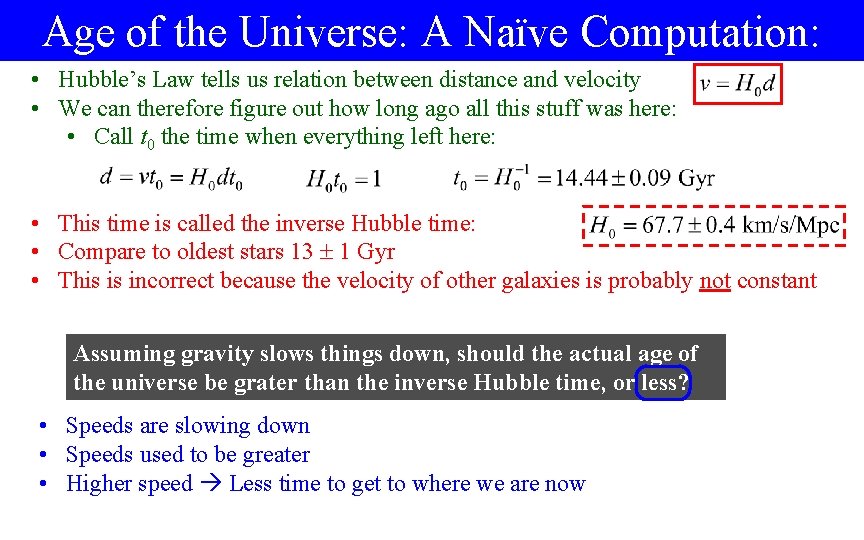
Age of the Universe: A Naïve Computation: • Hubble’s Law tells us relation between distance and velocity • We can therefore figure out how long ago all this stuff was here: • Call t 0 the time when everything left here: • This time is called the inverse Hubble time: • Compare to oldest stars 13 1 Gyr • This is incorrect because the velocity of other galaxies is probably not constant Assuming gravity slows things down, should the actual age of the universe be grater than the inverse Hubble time, or less? • Speeds are slowing down • Speeds used to be greater • Higher speed Less time to get to where we are now
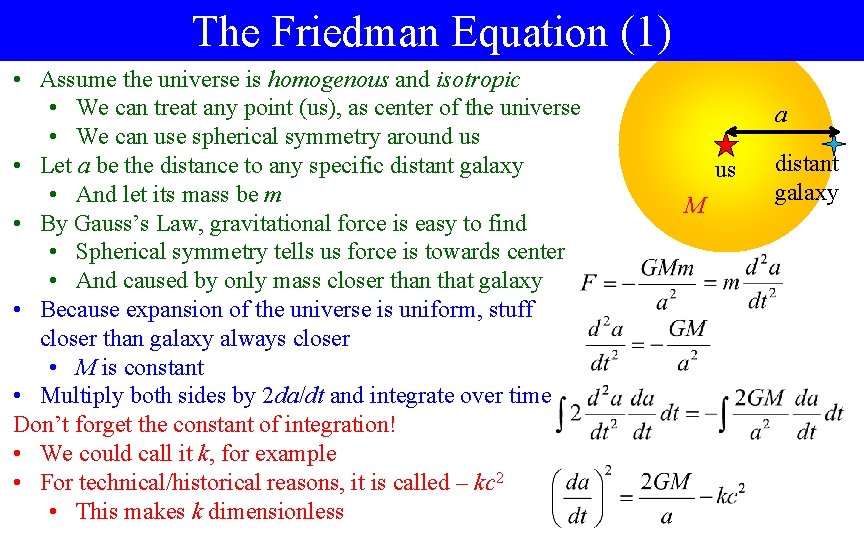
The Friedman Equation (1) • Assume the universe is homogenous and isotropic • We can treat any point (us), as center of the universe • We can use spherical symmetry around us • Let a be the distance to any specific distant galaxy • And let its mass be m • By Gauss’s Law, gravitational force is easy to find • Spherical symmetry tells us force is towards center • And caused by only mass closer than that galaxy • Because expansion of the universe is uniform, stuff closer than galaxy always closer • M is constant • Multiply both sides by 2 da/dt and integrate over time Don’t forget the constant of integration! • We could call it k, for example • For technical/historical reasons, it is called – kc 2 • This makes k dimensionless a us M distant galaxy
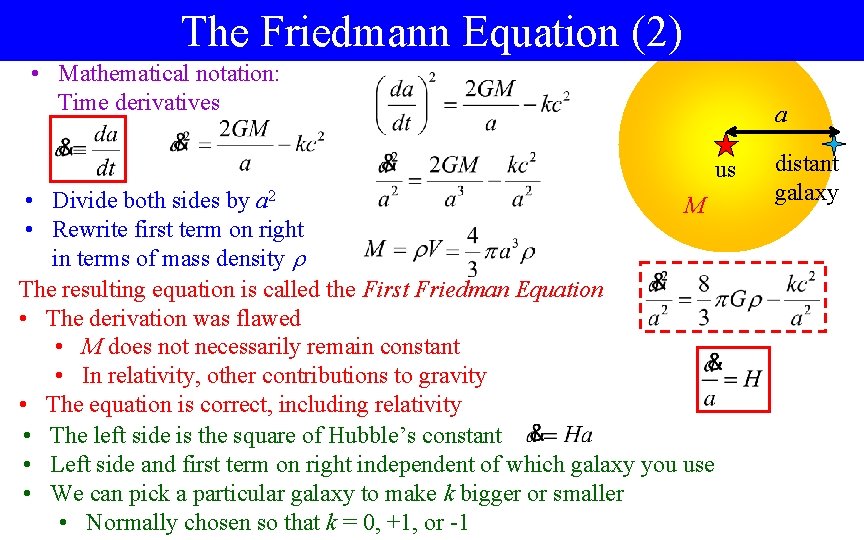
The Friedmann Equation (2) • Mathematical notation: Time derivatives a us • Divide both sides by a 2 M • Rewrite first term on right in terms of mass density The resulting equation is called the First Friedman Equation • The derivation was flawed • M does not necessarily remain constant • In relativity, other contributions to gravity • The equation is correct, including relativity • The left side is the square of Hubble’s constant • Left side and first term on right independent of which galaxy you use • We can pick a particular galaxy to make k bigger or smaller • Normally chosen so that k = 0, +1, or -1 distant galaxy
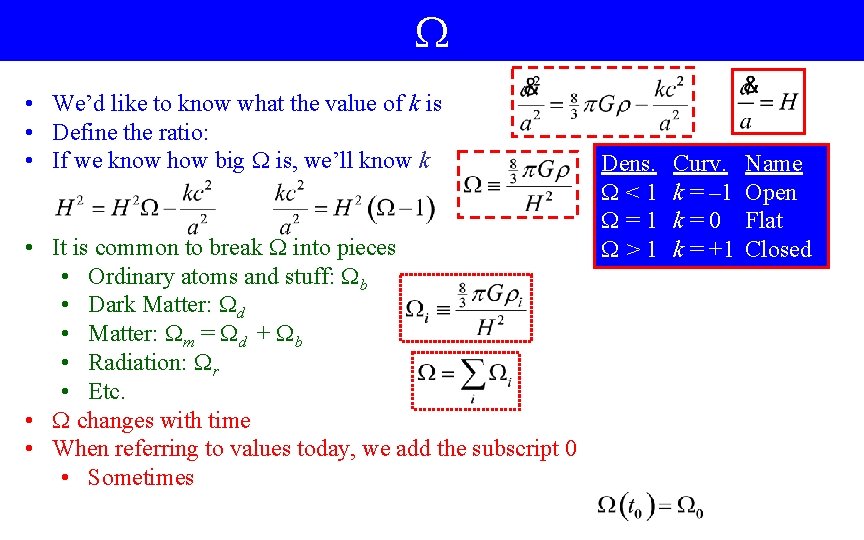
• We’d like to know what the value of k is • Define the ratio: • If we know how big is, we’ll know k • It is common to break into pieces • Ordinary atoms and stuff: b • Dark Matter: d • Matter: m = d + b • Radiation: r • Etc. • changes with time • When referring to values today, we add the subscript 0 • Sometimes Dens. <1 =1 >1 Curv. k = – 1 k=0 k = +1 Name Open Flat Closed
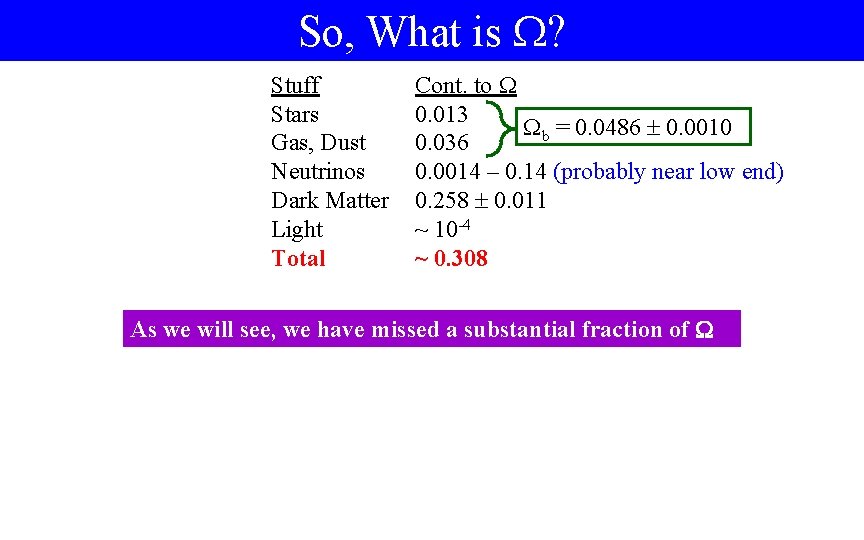
So, What is ? Stuff Stars Gas, Dust Neutrinos Dark Matter Light Total Cont. to 0. 013 b = 0. 0486 0. 0010 0. 036 0. 0014 – 0. 14 (probably near low end) 0. 258 0. 011 ~ 10 -4 ~ 0. 308 As we will see, we have missed a substantial fraction of
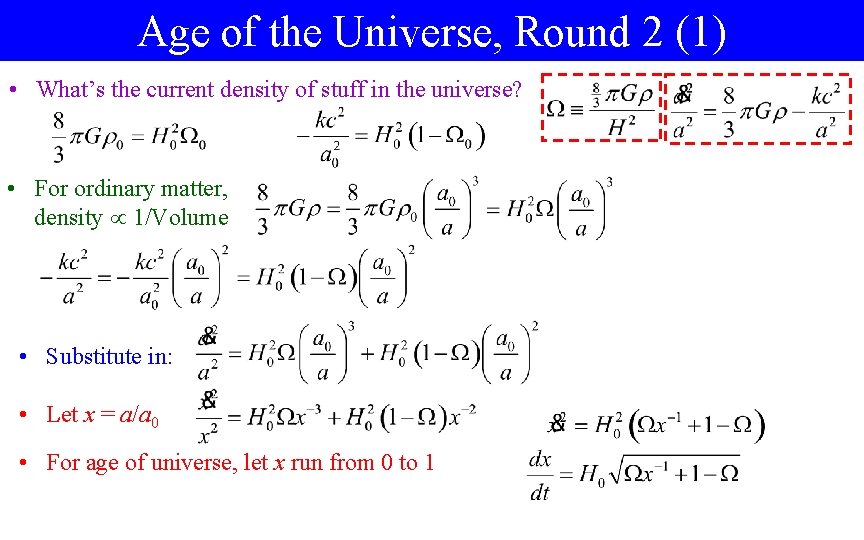
Age of the Universe, Round 2 (1) • What’s the current density of stuff in the universe? • For ordinary matter, density 1/Volume • Substitute in: • Let x = a/a 0 • For age of universe, let x run from 0 to 1
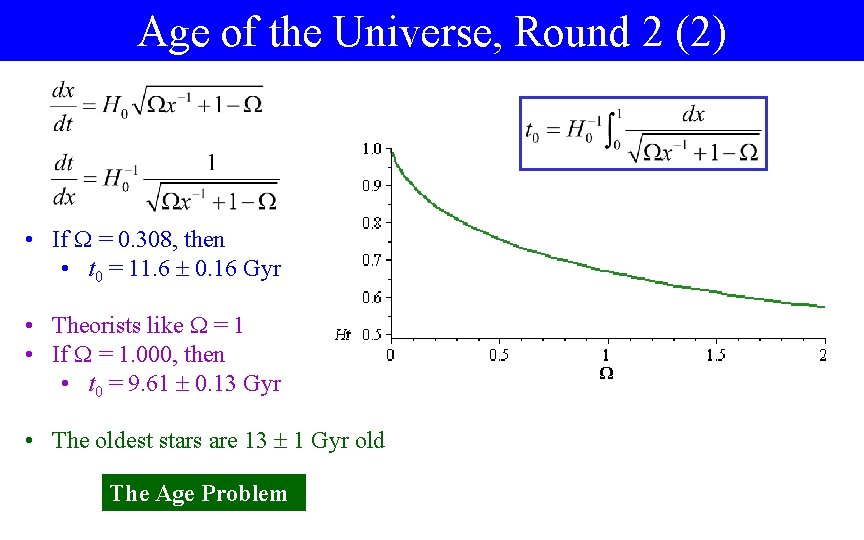
Age of the Universe, Round 2 (2) • If = 0. 308, then • t 0 = 11. 6 0. 16 Gyr • Theorists like = 1 • If = 1. 000, then • t 0 = 9. 61 0. 13 Gyr • The oldest stars are 13 1 Gyr old The Age Problem
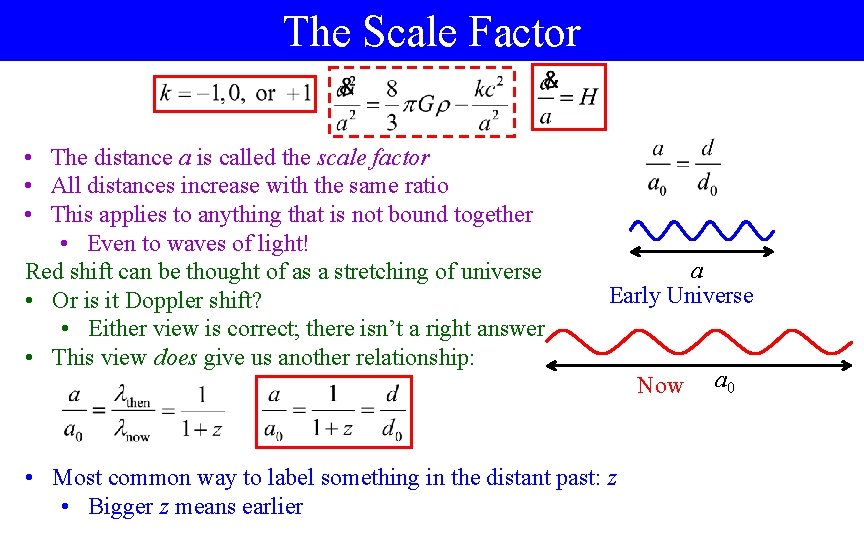
The Scale Factor • The distance a is called the scale factor • All distances increase with the same ratio • This applies to anything that is not bound together • Even to waves of light! Red shift can be thought of as a stretching of universe • Or is it Doppler shift? • Either view is correct; there isn’t a right answer • This view does give us another relationship: a Early Universe Now • Most common way to label something in the distant past: z • Bigger z means earlier a 0
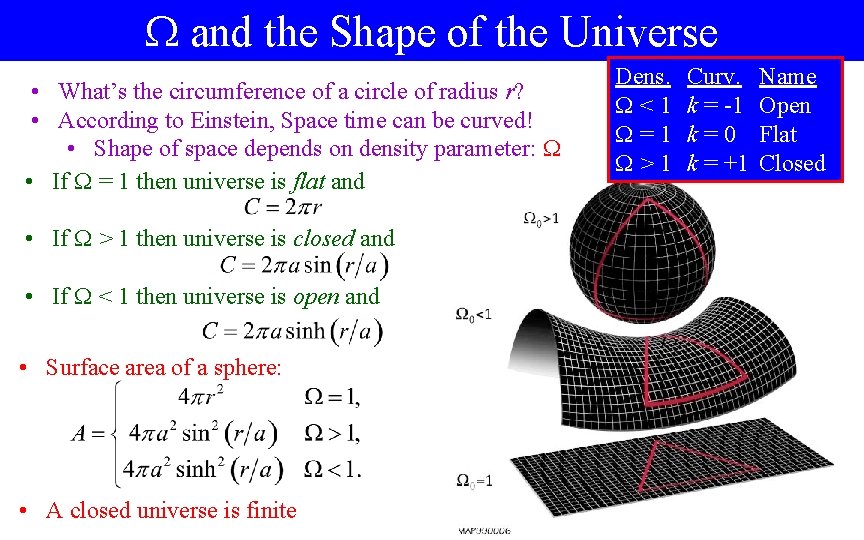
and the Shape of the Universe • What’s the circumference of a circle of radius r? • According to Einstein, Space time can be curved! • Shape of space depends on density parameter: • If = 1 then universe is flat and • If > 1 then universe is closed and • If < 1 then universe is open and • Surface area of a sphere: • A closed universe is finite Dens. <1 =1 >1 Curv. k = -1 k=0 k = +1 Name Open Flat Closed
- Slides: 19