
Huawei Autonomous networks Huawei autonomous networks Anil Rao
![5 Huawei: Autonomous networks Huawei ADN solution overview [1] Figure 3: Huawei’s ADN solution](https://slidetodoc.com/presentation_image_h2/31979022a6571037849b6960eb749c46/image-5.jpg "5 Huawei: Autonomous networks Huawei ADN solution overview [1] Figure 3: Huawei’s ADN solution")
![6 Huawei: Autonomous networks Huawei ADN solution overview [2] ADN has embedded AI at](https://slidetodoc.com/presentation_image_h2/31979022a6571037849b6960eb749c46/image-6.jpg "6 Huawei: Autonomous networks Huawei ADN solution overview [2] ADN has embedded AI at")
![7 Huawei: Autonomous networks Case study [1]: A converged European Tier 1 CSP Converged](https://slidetodoc.com/presentation_image_h2/31979022a6571037849b6960eb749c46/image-7.jpg "7 Huawei: Autonomous networks Case study [1]: A converged European Tier 1 CSP Converged")
![8 Huawei: Autonomous networks Example case studies [2]: A converged Tier 1 CSP from](https://slidetodoc.com/presentation_image_h2/31979022a6571037849b6960eb749c46/image-8.jpg "8 Huawei: Autonomous networks Example case studies [2]: A converged Tier 1 CSP from")
![9 Huawei: Autonomous networks Example case studies [3]: An incumbent operator in Middle East](https://slidetodoc.com/presentation_image_h2/31979022a6571037849b6960eb749c46/image-9.jpg "9 Huawei: Autonomous networks Example case studies [3]: An incumbent operator in Middle East")

- Slides: 16
Huawei: Autonomous networks Huawei: autonomous networks Anil Rao and William Nagy
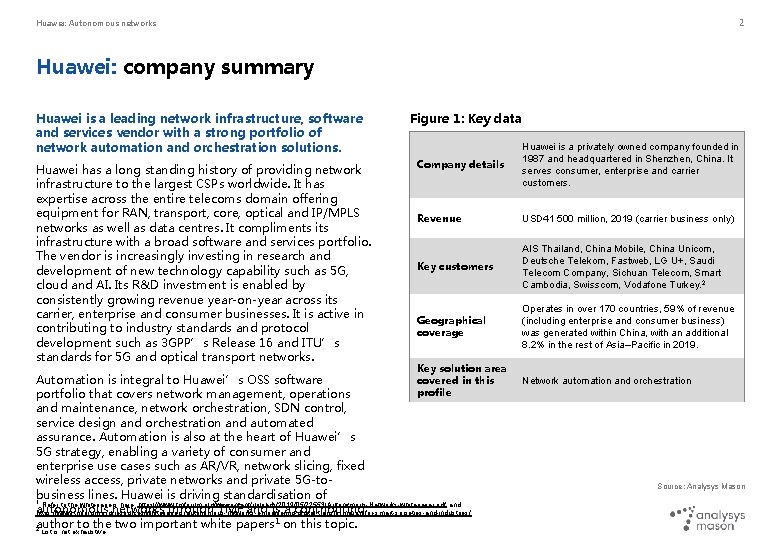
2 Huawei: Autonomous networks Huawei: company summary Huawei is a leading network infrastructure, software and services vendor with a strong portfolio of network automation and orchestration solutions. Huawei has a long standing history of providing network infrastructure to the largest CSPs worldwide. It has expertise across the entire telecoms domain offering equipment for RAN, transport, core, optical and IP/MPLS networks as well as data centres. It compliments infrastructure with a broad software and services portfolio. The vendor is increasingly investing in research and development of new technology capability such as 5 G, cloud and AI. Its R&D investment is enabled by consistently growing revenue year-on-year across its carrier, enterprise and consumer businesses. It is active in contributing to industry standards and protocol development such as 3 GPP’s Release 16 and ITU’s standards for 5 G and optical transport networks. Figure 1: Key data Company details Huawei is a privately owned company founded in 1987 and headquartered in Shenzhen, China. It serves consumer, enterprise and carrier customers. Revenue USD 41 500 million, 2019 (carrier business only) Key customers AIS Thailand, China Mobile, China Unicom, Deutsche Telekom, Fastweb, LG U+, Saudi Telecom Company, Sichuan Telecom, Smart Cambodia, Swisscom, Vodafone Turkey. 2 Geographical coverage Operates in over 170 countries, 59% of revenue (including enterprise and consumer business) was generated within China, with an additional 8. 2% in the rest of Asia–Pacific in 2019. Key solution area Automation is integral to Huawei’s OSS software covered in this profile portfolio that covers network management, operations and maintenance, network orchestration, SDN control, service design and orchestration and automated assurance. Automation is also at the heart of Huawei’s 5 G strategy, enabling a variety of consumer and enterprise use cases such as AR/VR, network slicing, fixed wireless access, private networks and private 5 G-tobusiness lines. Huawei is driving standardisation of 1 Refer to the whitepapers here: https: //www. tmforum. org/wp-content/uploads/2019/05/22553 -Autonomous-Networks-whitepaper. pdf and autonomous networks through TMF and is a contributing https: //www. tmforum. org/resources/whitepapers/autonomous-networks-empowering-digital-transformation-for-smart-societies-and-industries/ author to the two important white papers 1 on this topic. 2 List is not exhaustive. Network automation and orchestration Source: Analysys Mason
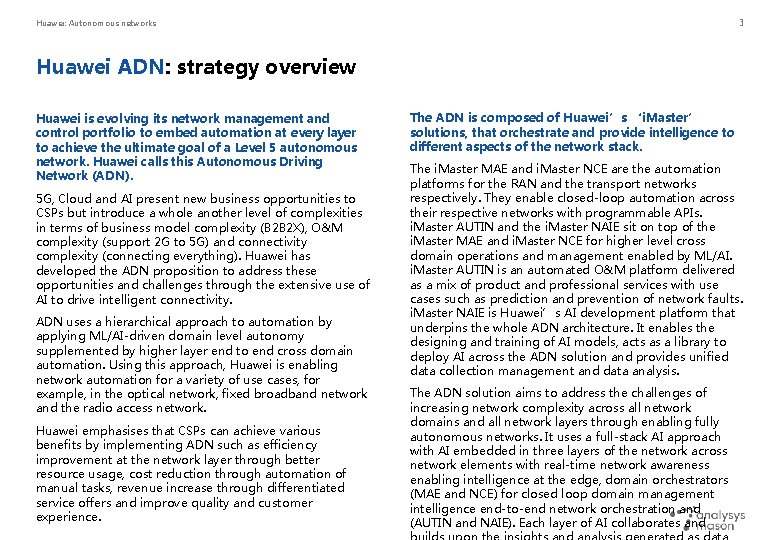
3 Huawei: Autonomous networks Huawei ADN: strategy overview Huawei is evolving its network management and control portfolio to embed automation at every layer to achieve the ultimate goal of a Level 5 autonomous network. Huawei calls this Autonomous Driving Network (ADN). 5 G, Cloud and AI present new business opportunities to CSPs but introduce a whole another level of complexities in terms of business model complexity (B 2 B 2 X), O&M complexity (support 2 G to 5 G) and connectivity complexity (connecting everything). Huawei has developed the ADN proposition to address these opportunities and challenges through the extensive use of AI to drive intelligent connectivity. ADN uses a hierarchical approach to automation by applying ML/AI-driven domain level autonomy supplemented by higher layer end to end cross domain automation. Using this approach, Huawei is enabling network automation for a variety of use cases, for example, in the optical network, fixed broadband network and the radio access network. Huawei emphasises that CSPs can achieve various benefits by implementing ADN such as efficiency improvement at the network layer through better resource usage, cost reduction through automation of manual tasks, revenue increase through differentiated service offers and improve quality and customer experience. The ADN is composed of Huawei’s ‘i. Master’ solutions, that orchestrate and provide intelligence to different aspects of the network stack. The i. Master MAE and i. Master NCE are the automation platforms for the RAN and the transport networks respectively. They enable closed-loop automation across their respective networks with programmable APIs. i. Master AUTIN and the i. Master NAIE sit on top of the i. Master MAE and i. Master NCE for higher level cross domain operations and management enabled by ML/AI. i. Master AUTIN is an automated O&M platform delivered as a mix of product and professional services with use cases such as prediction and prevention of network faults. i. Master NAIE is Huawei’s AI development platform that underpins the whole ADN architecture. It enables the designing and training of AI models, acts as a library to deploy AI across the ADN solution and provides unified data collection management and data analysis. The ADN solution aims to address the challenges of increasing network complexity across all network domains and all network layers through enabling fully autonomous networks. It uses a full-stack AI approach with AI embedded in three layers of the network across network elements with real-time network awareness enabling intelligence at the edge, domain orchestrators (MAE and NCE) for closed loop domain management intelligence end-to-end network orchestration and (AUTIN and NAIE). Each layer of AI collaborates and
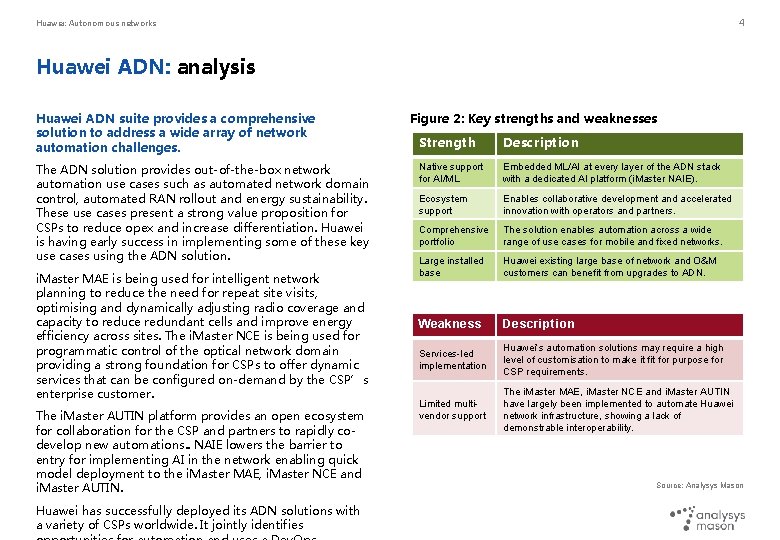
4 Huawei: Autonomous networks Huawei ADN: analysis Huawei ADN suite provides a comprehensive solution to address a wide array of network automation challenges. The ADN solution provides out-of-the-box network automation use cases such as automated network domain control, automated RAN rollout and energy sustainability. These use cases present a strong value proposition for CSPs to reduce opex and increase differentiation. Huawei is having early success in implementing some of these key use cases using the ADN solution. i. Master MAE is being used for intelligent network planning to reduce the need for repeat site visits, optimising and dynamically adjusting radio coverage and capacity to reduce redundant cells and improve energy efficiency across sites. The i. Master NCE is being used for programmatic control of the optical network domain providing a strong foundation for CSPs to offer dynamic services that can be configured on-demand by the CSP’s enterprise customer. The i. Master AUTIN platform provides an open ecosystem for collaboration for the CSP and partners to rapidly codevelop new automations. . NAIE lowers the barrier to entry for implementing AI in the network enabling quick model deployment to the i. Master MAE, i. Master NCE and i. Master AUTIN. Huawei has successfully deployed its ADN solutions with a variety of CSPs worldwide. It jointly identifies Figure 2: Key strengths and weaknesses Strength Description Native support for AI/ML Embedded ML/AI at every layer of the ADN stack with a dedicated AI platform (i. Master NAIE). Ecosystem support Enables collaborative development and accelerated innovation with operators and partners. Comprehensive portfolio The solution enables automation across a wide range of use cases for mobile and fixed networks. Large installed base Huawei existing large base of network and O&M customers can benefit from upgrades to ADN. Weakness Description Services-led implementation Huawei’s automation solutions may require a high level of customisation to make it for purpose for CSP requirements. Limited multivendor support The i. Master MAE, i. Master NCE and i. Master AUTIN have largely been implemented to automate Huawei network infrastructure, showing a lack of demonstrable interoperability. Source: Analysys Mason
5 Huawei: Autonomous networks Huawei ADN solution overview [1] Figure 3: Huawei’s ADN solution architecture Source: Huawei
6 Huawei: Autonomous networks Huawei ADN solution overview [2] ADN has embedded AI at every layer of the stack and includes various levels of capabilities, included as part of the AI inference framework. This framework executes the AI algorithms to make conclusions and perform actions in a closed loop manner. The AI models are themselves generated within the i. Master NAIE service based on extensive data processing and model training. Figure 4: Full stack AI powered ADN The AI stack is structured as three hierarchical layers: . Device AI: enables real time data collection and filtering; execute relevant AI algorithms at the device level to perform real time closed loop and self-healing. This is embedded within the network device. Network AI: enables the data correlation, analysis and application of AI algorithms at the end to end network and service level, enabling autonomy of new use cases such as network slicing. This capability is part of i. Master MAE, i. Master NCE and i. Master AUTIN. Source: Huawei Cloud AI: enables the use of cloud infrastructure for data governance, model training, and creation and lifecycle management of the AI models. This capability is encapsulated in the i. Master NAIE module.
7 Huawei: Autonomous networks Case study [1]: A converged European Tier 1 CSP Converged tier one European CSP 1 Problem This tier one European CSP had been dealing with software defined networks for several years in the data centre and wanted to apply these concepts to its optical network. It needed to differentiate its optical VPN services with improved network functionality and customer experience to provide a state of the art network for enterprise connectivity with on-demand service instantiation. Solution Huawei’s i. Master NCE was deployed as the SDN controller for L 1 -L 2 in the optical backbone network. It was chosen due to the CSP’s strong existing relationship with Huawei with its infrastructure and NMS. The CSP had strong requirements for standard protocol and API compliance, which the Network Cloud Engine addressed along with interoperability with other vendor orchestration solutions. NCE enables automated service adjustment through integrated customer self-service portals. It also provides automated performance and fault management, capacity analytics and on-demand instantiation of point-to-multipoint services with automated capacity optimisation. The NCE feeds northbound integration into a hierarchical controller, which in turn interfaces with the higher layer domain orchestrator. Huawei also supplied its online network planning and capacity management tool, which aggregates all the information coming from the network. The tool, while is in the acceptance process, simplifies new capacity implementation and streamlines planning and fault management. Results The project is still in the early phases with the OSS/BSS integrations yet to be completed but Huawei’s solution has already enabled the CSP to differentiate itself to enterprise customers winning new projects due to the flexibility and agility benefits. The solution enables the enterprise customer to use customer self-service to make on-demand service adjustments. The CSP intends to offer Naa. S services, establishing the interface on the service orchestrator and offering its optical network as a service. The CSP has also been able to autonomously mitigate fibre outages with automatic fault detection and automated traffic routing. 1 Study conducted by Analysys Mason
8 Huawei: Autonomous networks Example case studies [2]: A converged Tier 1 CSP from emerging Asia. Pacific Enabling multi-domain automation across the emerging Asia-Pacific CSP’s network 1 Problem The CSP’s network operation was undergoing digital transformation and needed to increase efficiency across network operations based on NFV/SDN principles as operational complexity increased as well as improving workflow efficiencies to move staff to higher level functions. It simultaneously needed to lower costs and improve customer experience to offset its Opcos’ declining profits. Solution The CSP required its chosen solution to have multi-domain functionality and AI automation. Huawei’s ADN solution was selected because it met these requirements in addition to Huawei’s strong R&D capabilities and knowledge and commitment to network evolution and protocols. The ADN solution was implemented to automate the CSP’s mobile, core, transport, residential broadband MPLS networks. It is intended to address 20 use cases such as throughput optimisation, self-healing and cross domain alerts, with some use cases already validated and some yet to be implemented. The solution primarily manages Huawei equipment already existing in the CSP’s network and has been integrated with other systems such as trouble ticket generation. The solution automatically generates the recommended course of action and with some manual intervention and approvals required in the early stages of the project. Results The CSP has replaced its manual planning procedures with value-based automation. As a result, it has optimised its RAN, demonstrated 5%-10% improved Vo. LTE quality with respect to the packet loss ratio, along with a 10 -15% improvement in throughput with automated capacity optimisation. 1 Study conducted by Analysys Mason
9 Huawei: Autonomous networks Example case studies [3]: An incumbent operator in Middle East Optimising home Wi. Fi for a Middle East incumbent operator 1 Problem 50%-70% of the CSP’s customer complaints were related to poor home Wi. Fi connectivity, which required engineer home visits. The CSP’s operational expenditure and efficiency was under pressure from the resulting truck roll to customer premises. The operator had to optimise its fixed broadband offering across both its fixed line infrastructure and the in home Wi. Fi connectivity to improve its customer’s experience and reduce operational inefficiencies. Solution The CSP selected Huawei, a long time collaborator, to supply the i. Master NCE and e. AI powered Smart. Wi-Fi CPE (home Wi. Fi router). The implementation is still in the Po. C phase with 30 000 access points/routers connected. The i. Master NCE solution was deployed in the CSP’s private cloud with visibility into Huawei’s CPEs. Integration with other vendor CPEs is still in progress as cloud information configuration is required. Huawei's home Wi. Fi router is managed by the NCE providing remote configuration based on service identification (gaming, video streaming, web browsing, etc. ), the number of Wi. Fi routers on the network and signal interference. i. Master NCE enabled SLA visibility across the whole service chain extending the CSP’s vision beyond the gateway into the previously inaccessible access points as well as real-time call logs and network topology. i. Master NCE also empowers customer support agents with simple representation of data and suggested actions to resolve customer incidents. Results The CSP was able to improve its customers’ experience by reducing service latency by up to 70% with its optimisations. The better quality of service reduced customer complaints and the associated truck roll. The implementation of i. Master NCE also accelerated the CSP’s digital strategy as it was able to digitise the management of Wi. Fi. The CSP is seeking to expand the implementation to address use cases such as customer experience management. 1 Study conducted by Analysys Mason
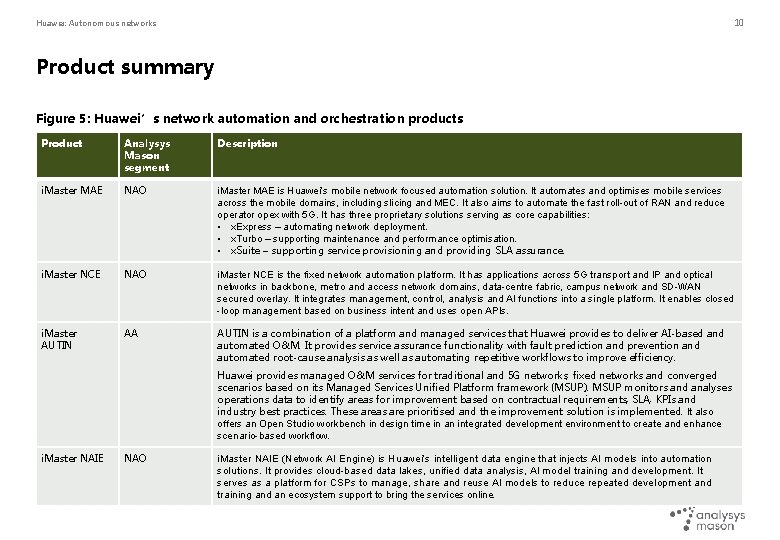
10 Huawei: Autonomous networks Product summary Figure 5: Huawei’s network automation and orchestration products Product Analysys Mason segment Description i. Master MAE NAO i. Master MAE is Huawei’s mobile network focused automation solution. It automates and optimises mobile services across the mobile domains, including slicing and MEC. It also aims to automate the fast roll-out of RAN and reduce operator opex with 5 G. It has three proprietary solutions serving as core capabilities: • x. Express – automating network deployment. • x. Turbo – supporting maintenance and performance optimisation. • x. Suite – supporting service provisioning and providing SLA assurance. i. Master NCE NAO i. Master NCE is the fixed network automation platform. It has applications across 5 G transport and IP and optical networks in backbone, metro and access network domains, data-centre fabric, campus network and SD-WAN secured overlay. It integrates management, control, analysis and AI functions into a single platform. It enables closed -loop management based on business intent and uses open APIs. i. Master AUTIN AA AUTIN is a combination of a platform and managed services that Huawei provides to deliver AI-based and automated O&M. It provides service assurance functionality with fault prediction and prevention and automated root-cause analysis as well as automating repetitive workflows to improve efficiency. Huawei provides managed O&M services for traditional and 5 G networks, fixed networks and converged scenarios based on its Managed Services Unified Platform framework (MSUP). MSUP monitors and analyses operations data to identify areas for improvement based on contractual requirements, SLA, KPIs and industry best practices. These areas are prioritised and the improvement solution is implemented. It also offers an Open Studio workbench in design time in an integrated development environment to create and enhance scenario-based workflow. i. Master NAIE NAO i. Master NAIE (Network AI Engine) is Huawei’s intelligent data engine that injects AI models into automation solutions. It provides cloud-based data lakes, unified data analysis, AI model training and development. It serves as a platform for CSPs to manage, share and reuse AI models to reduce repeated development and training and an ecosystem support to bring the services online.
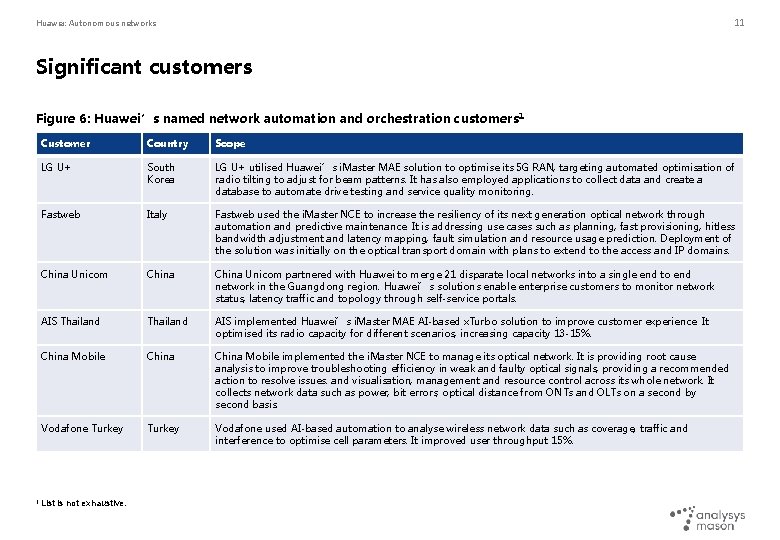
11 Huawei: Autonomous networks Significant customers Figure 6: Huawei’s named network automation and orchestration customers 1 Customer Country Scope LG U+ South Korea LG U+ utilised Huawei’s i. Master MAE solution to optimise its 5 G RAN, targeting automated optimisation of radio tilting to adjust for beam patterns. It has also employed applications to collect data and create a database to automate drive testing and service quality monitoring. Fastweb Italy Fastweb used the i. Master NCE to increase the resiliency of its next generation optical network through automation and predictive maintenance. It is addressing use cases such as planning, fast provisioning, hitless bandwidth adjustment and latency mapping, fault simulation and resource usage prediction. Deployment of the solution was initially on the optical transport domain with plans to extend to the access and IP domains. China Unicom partnered with Huawei to merge 21 disparate local networks into a single end to end network in the Guangdong region. Huawei’s solutions enable enterprise customers to monitor network status, latency traffic and topology through self-service portals. AIS Thailand AIS implemented Huawei’s i. Master MAE AI-based x. Turbo solution to improve customer experience. It optimised its radio capacity for different scenarios, increasing capacity 13 -15%. China Mobile implemented the i. Master NCE to manage its optical network. It is providing root cause analysis to improve troubleshooting efficiency in weak and faulty optical signals, providing a recommended action to resolve issues. and visualisation, management and resource control across its whole network. It collects network data such as power, bit errors, optical distance from ONTs and OLTs on a second by second basis. Vodafone Turkey Vodafone used AI-based automation to analyse wireless network data such as coverage, traffic and interference to optimise cell parameters. It improved user throughput 15%. 1 List is not exhaustive.
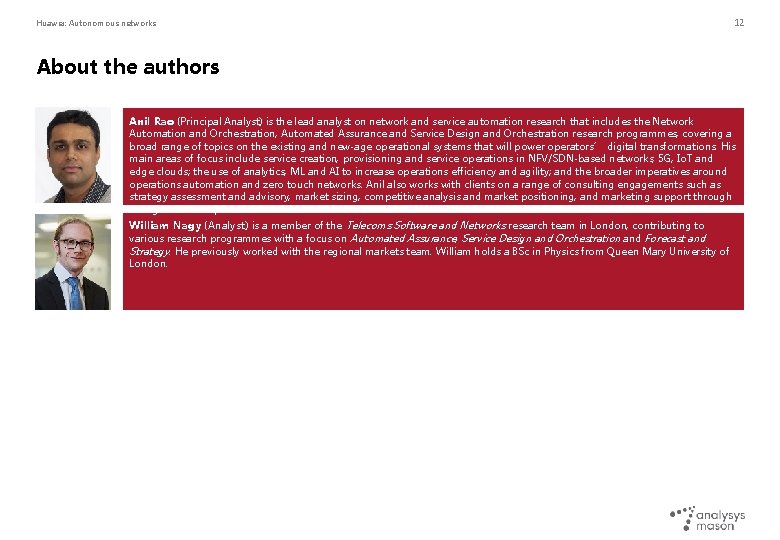
Huawei: Autonomous networks 12 About the authors Anil Rao (Principal Analyst) is the lead analyst on network and service automation research that includes the Network Automation and Orchestration, Automated Assurance and Service Design and Orchestration research programmes, covering a broad range of topics on the existing and new-age operational systems that will power operators’ digital transformations. His main areas of focus include service creation, provisioning and service operations in NFV/SDN-based networks, 5 G, Io. T and edge clouds; the use of analytics, ML and AI to increase operations efficiency and agility; and the broader imperatives around operations automation and zero touch networks. Anil also works with clients on a range of consulting engagements such as strategy assessment and advisory, market sizing, competitive analysis and market positioning, and marketing support through thought leadership collateral. William Nagy (Analyst) is a member of the Telecoms Software and Networks research team in London, contributing to various research programmes with a focus on Automated Assurance, Service Design and Orchestration and Forecast and Strategy. He previously worked with the regional markets team. William holds a BSc in Physics from Queen Mary University of London.
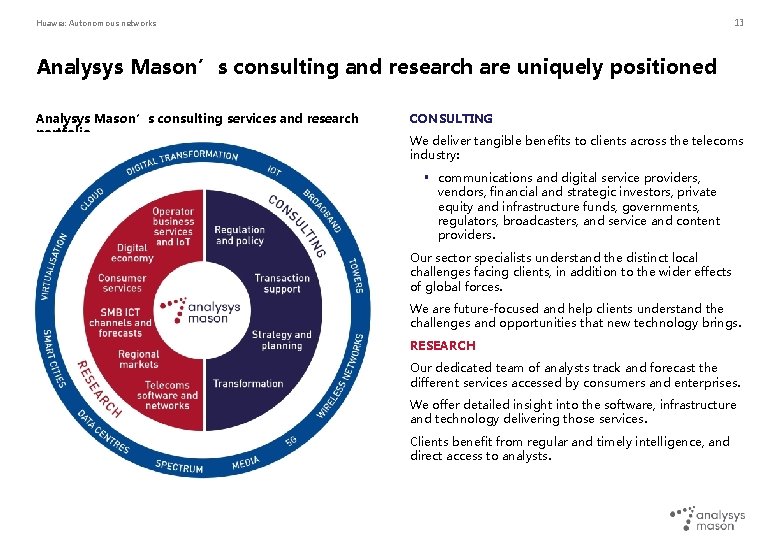
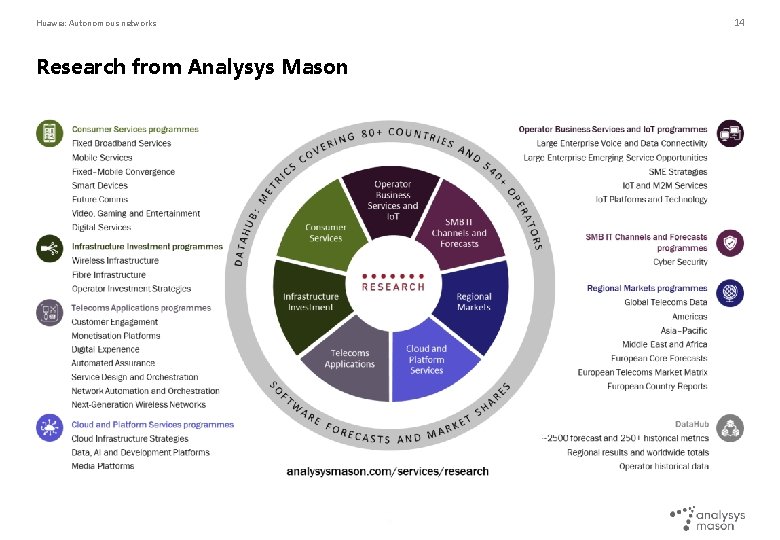
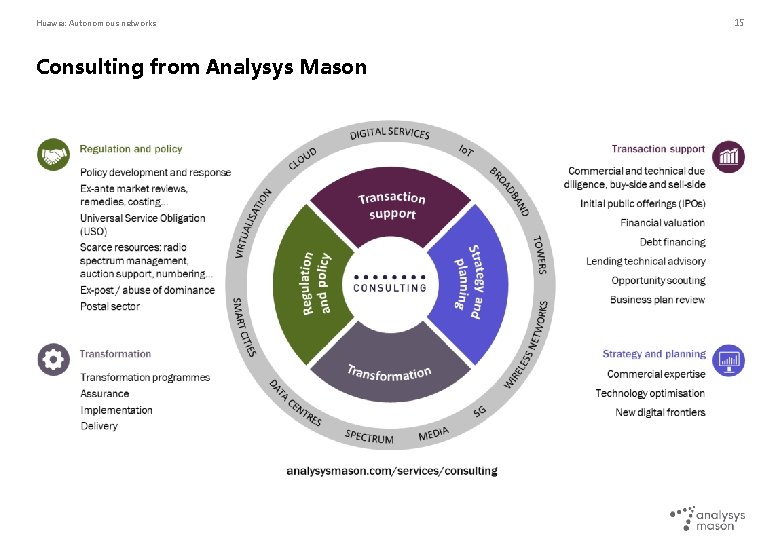
13 Huawei: Autonomous networks Analysys Mason’s consulting and research are uniquely positioned Analysys Mason’s consulting services and research portfolio CONSULTING We deliver tangible benefits to clients across the telecoms industry: § communications and digital service providers, vendors, financial and strategic investors, private equity and infrastructure funds, governments, regulators, broadcasters, and service and content providers. Our sector specialists understand the distinct local challenges facing clients, in addition to the wider effects of global forces. We are future-focused and help clients understand the challenges and opportunities that new technology brings. RESEARCH Our dedicated team of analysts track and forecast the different services accessed by consumers and enterprises. We offer detailed insight into the software, infrastructure and technology delivering those services. Clients benefit from regular and timely intelligence, and direct access to analysts.
Huawei: Autonomous networks Research from Analysys Mason 14
Huawei: Autonomous networks Consulting from Analysys Mason 15
Huawei: Autonomous networks FEBRUARY 2021 PUBLISHED BY ANALYSYS MASON LIMITED IN Bush House • North West Wing • Aldwych • London • WC 2 B 4 PJ • UK Tel: +44 (0)20 7395 9000 • Email: research@analysysmason. com • www. analysysmason. com/research • Registered in England Wales No. 5177472 © Analysys Mason Limited 2021. All rights reserved. No part of this publication may be reproduced, stored in a retrieval system or transmitted in any form or by any means – electronic, mechanical, photocopying, recording or otherwise – without the prior written permission of the publisher. Figures and projections contained in this report are based on publicly available information only and are produced by the Research Division of Analysys Mason Limited independently of any client-specific work within Analysys Mason Limited. The opinions expressed are those of the stated authors only. Analysys Mason Limited recognises that many terms appearing in this report are proprietary; all such trademarks are acknowledged and every effort has been made to indicate them by the normal UK publishing practice of capitalisation. However, the presence of a term, in whatever form, does not affect its legal status as a trademark. Analysys Mason Limited maintains that all reasonable care and skill have been used in the compilation of this publication. However, Analysys Mason Limited shall not be under any liability for loss or damage (including consequential loss) whatsoever or howsoever arising as a result of the use of this publication by the customer, his servants, agents or any third party.