
https www archivesportaleurope net 267 480 175 descriptive
- Slides: 30
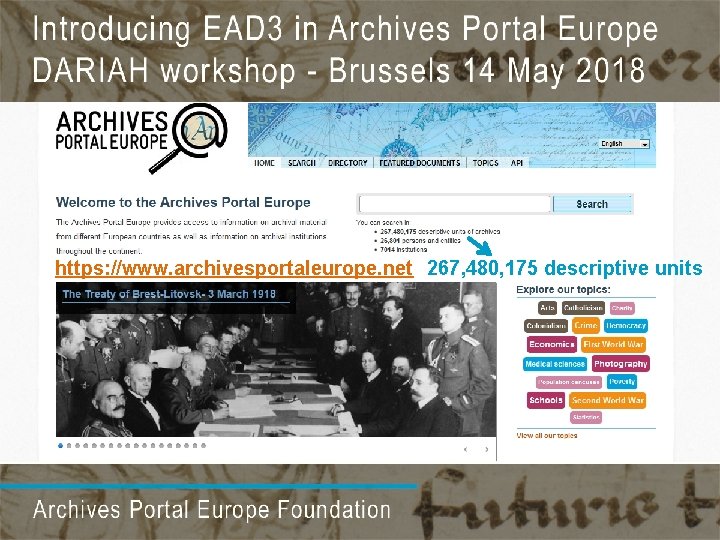
https: //www. archivesportaleurope. net 267, 480, 175 descriptive units
The problem and the solution: Archival material is often described in Finding Aids in a few general sentences, although the documents themselves contain a lot of detailed information, for example on events, persons, places, subjects, etc. For some archives this detailed information is available in archival institutions, but in a variety of formats from handwritten lists, indexes, card systems, word processor or spreadsheet documents, databases, etc. , either made when the material was created or later on by archivists and/or volunteers. The Archives Portal Europe team has developed a concept to publish these so called Additional Finding Aids in combination with their main Finding Aids and suggests the use of the latest version of the EAD standard, EAD 3, as a metadata format for them.
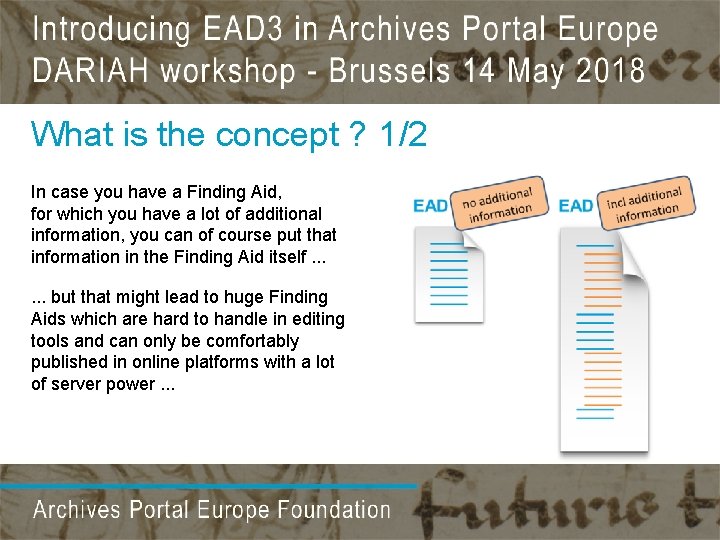
What is the concept ? 1/2 In case you have a Finding Aid, for which you have a lot of additional information, you can of course put that information in the Finding Aid itself. . . but that might lead to huge Finding Aids which are hard to handle in editing tools and can only be comfortably published in online platforms with a lot of server power. . .
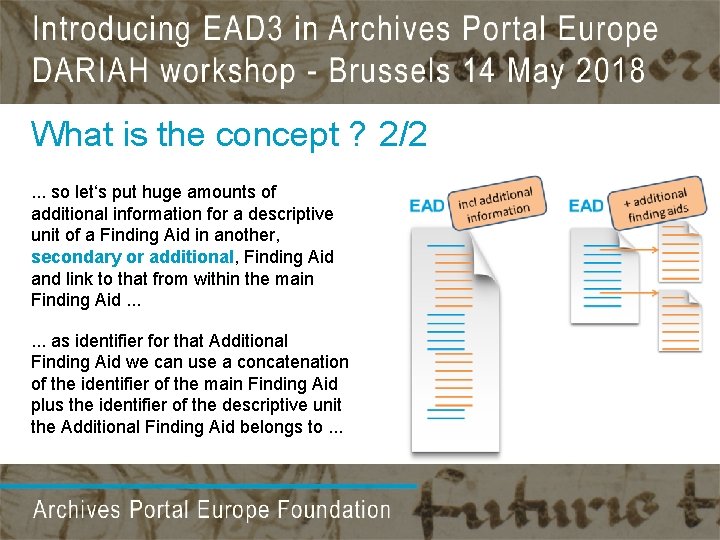
What is the concept ? 2/2. . . so let‘s put huge amounts of additional information for a descriptive unit of a Finding Aid in another, secondary or additional, Finding Aid and link to that from within the main Finding Aid. . . as identifier for that Additional Finding Aid we can use a concatenation of the identifier of the main Finding Aid plus the identifier of the descriptive unit the Additional Finding Aid belongs to. . .
What are the benefits ? • Via using a suitable metadata format for additional finding aid information, this kind of information can easily be aggregated towards and published by portals, which gives end-users one online access point to it • The detailed information of Additional Finding Aids will be available to endusers at the same level as the general information in the (main) Finding Aids, so end-users don’t have to search in different types of information in different sections of websites and portals, so no more separate silos • Via the use of Additional Finding Aids end-users can be pointed precisely to the scans of archival material they are interested in, which is especially useful in case the general description leads to hundreds of scans, so doing research will become more efficient
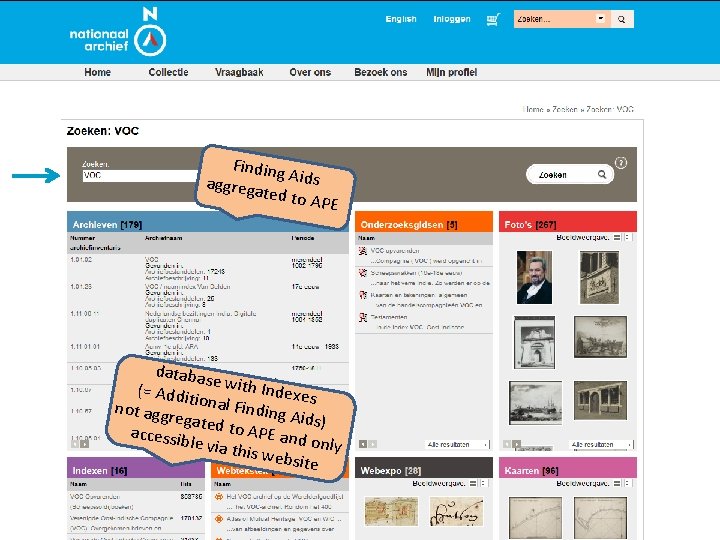
Finding aggrega Aids ted to A PE databas (= Addi e with Indexes not agg tional Finding Aids) regated t o A accessib P le via th E and only is webs ite
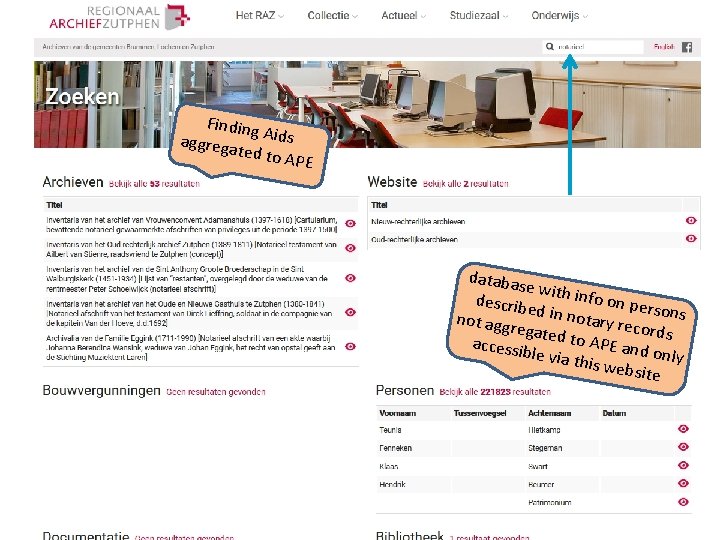
Finding aggrega Aids ted to A PE databas ew describ ith info on per e sons not agg d in notary re cords regated t o A accessib P le via th E and only is webs ite
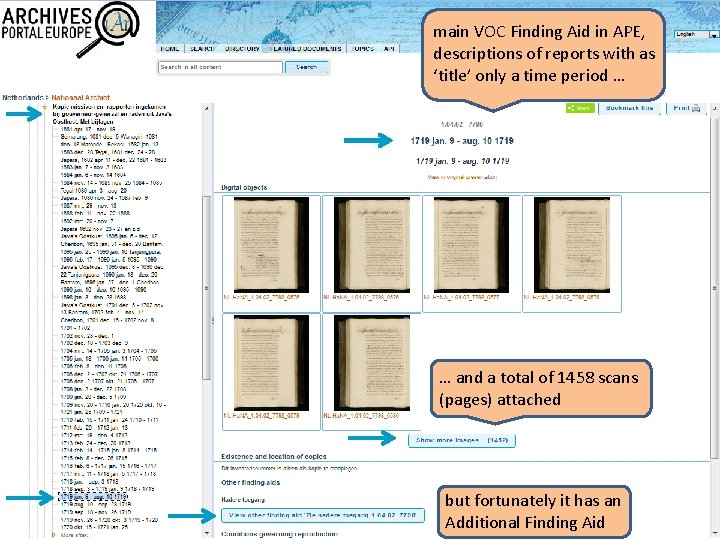
main VOC Finding Aid in APE, descriptions of reports with as ‘title’ only a time period … … and a total of 1458 scans (pages) attached but fortunately it has an Additional Finding Aid
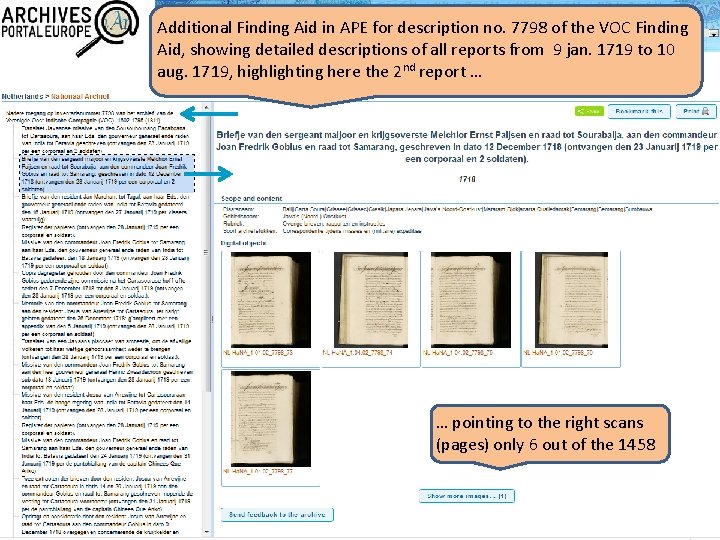
Additional Finding Aid in APE for description no. 7798 of the VOC Finding Aid, showing detailed descriptions of all reports from 9 jan. 1719 to 10 aug. 1719, highlighting here the 2 nd report … … pointing to the right scans (pages) only 6 out of the 1458
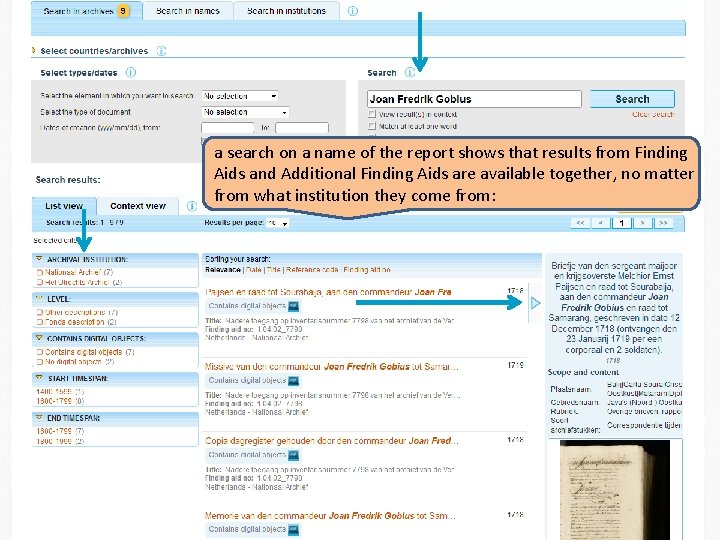
a search on a name of the report shows that results from Finding Aids and Additional Finding Aids are available together, no matter from what institution they come from:
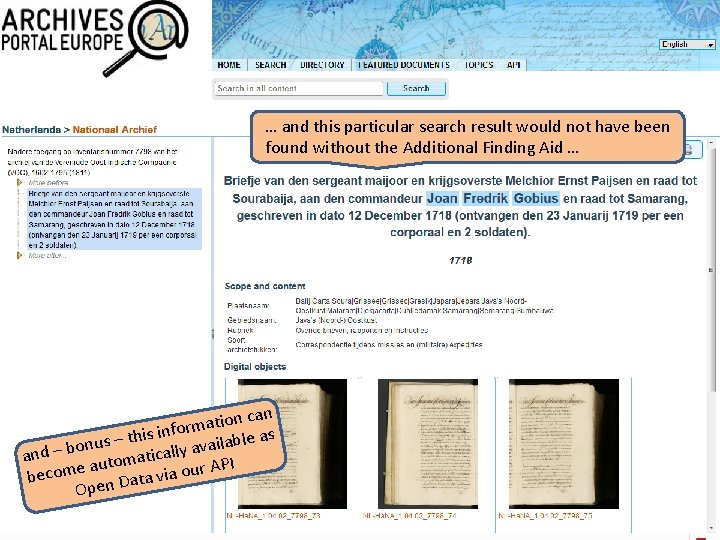
… and this particular search result would not have been found without the Additional Finding Aid … can n o i t a m s infor i h t – ble as s a l u i n a o v a b y and – aticall m o t u a API become n Data via our Ope
Why EAD and why EAD 3 ? • We didn’t wanted to introduce another metadata format, nor use a limited national format, like the Dutch A 2 A, so we were looking for a suitable format with which we (archivists / software suppliers) are already familiar with • We are talking about Finding Aid information, so why not use the metadata format for that: EAD/XML, after all: some archivists already put small chunks of additional finding aid information as an index in the Finding Aids • Within the latest version of EAD, EAD 3, you can tag information on events, persons, places, subjects, etc. in much more detail compared to EAD 2002 and certainly compared to ape. EAD, which is a subset of EAD 2002 • We had to start on the EAD 3 implementation at some point in time anyway
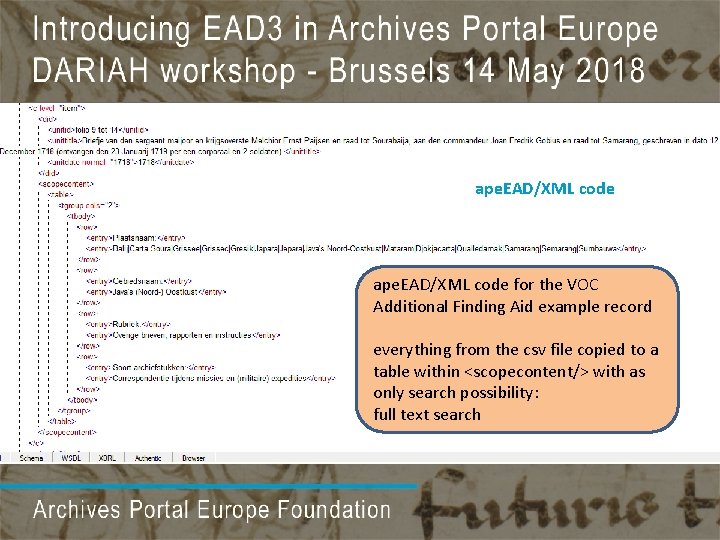
ape. EAD/XML code for the VOC Additional Finding Aid example record everything from the csv file copied to a table within <scopecontent/> with as only search possibility: full text search
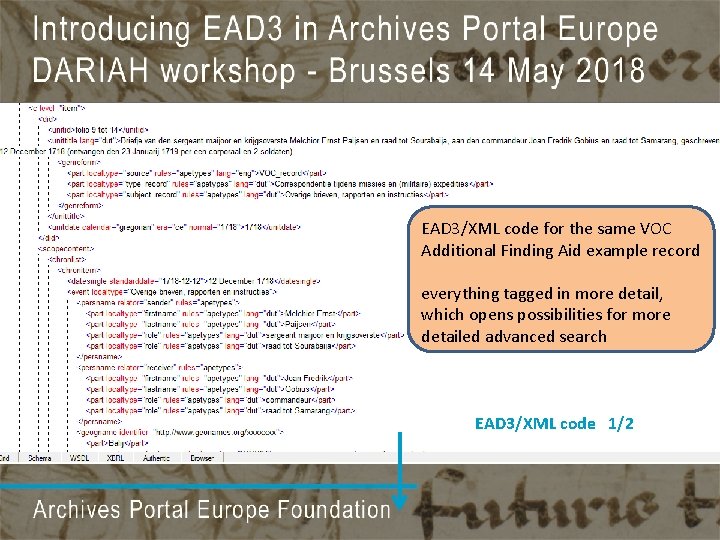
EAD 3/XML code for the same VOC Additional Finding Aid example record everything tagged in more detail, which opens possibilities for more detailed advanced search EAD 3/XML code 1/2
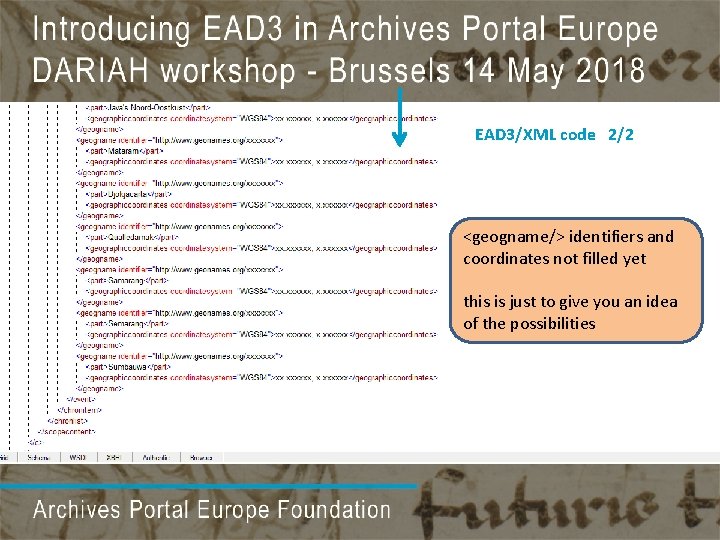
EAD 3/XML code 2/2 <geogname/> identifiers and coordinates not filled yet this is just to give you an idea of the possibilities
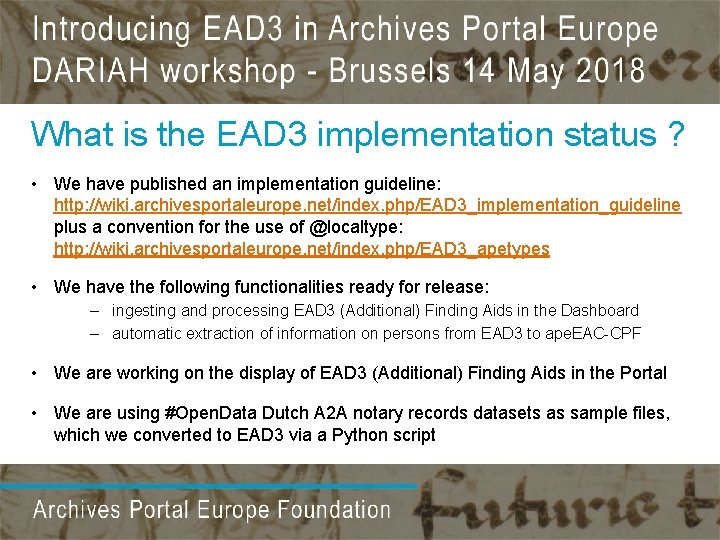
What is the EAD 3 implementation status ? • We have published an implementation guideline: http: //wiki. archivesportaleurope. net/index. php/EAD 3_implementation_guideline plus a convention for the use of @localtype: http: //wiki. archivesportaleurope. net/index. php/EAD 3_apetypes • We have the following functionalities ready for release: – ingesting and processing EAD 3 (Additional) Finding Aids in the Dashboard – automatic extraction of information on persons from EAD 3 to ape. EAC-CPF • We are working on the display of EAD 3 (Additional) Finding Aids in the Portal • We are using #Open. Data Dutch A 2 A notary records datasets as sample files, which we converted to EAD 3 via a Python script
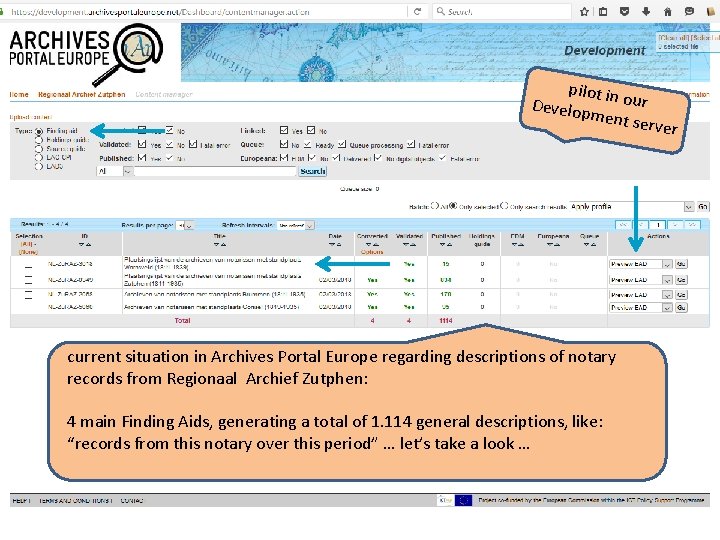
pilot in our Develop ment se rver current situation in Archives Portal Europe regarding descriptions of notary records from Regionaal Archief Zutphen: 4 main Finding Aids, generating a total of 1. 114 general descriptions, like: “records from this notary over this period” … let’s take a look …
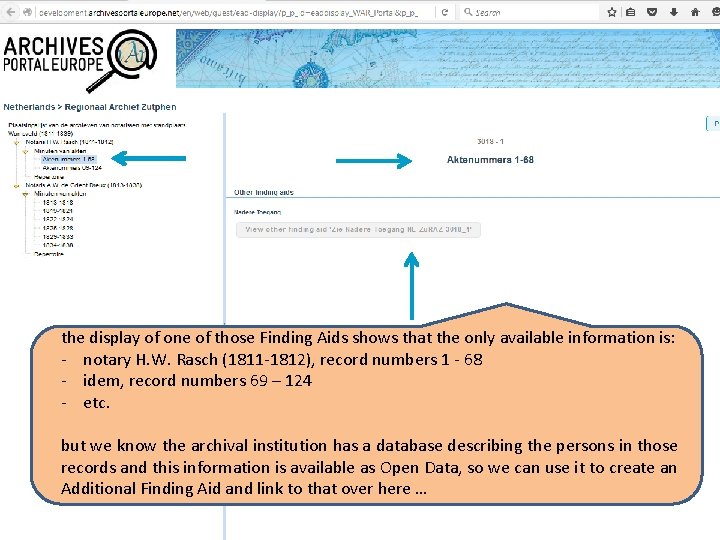
the display of one of those Finding Aids shows that the only available information is: - notary H. W. Rasch (1811 -1812), record numbers 1 - 68 - idem, record numbers 69 – 124 - etc. but we know the archival institution has a database describing the persons in those records and this information is available as Open Data, so we can use it to create an Additional Finding Aid and link to that over here …
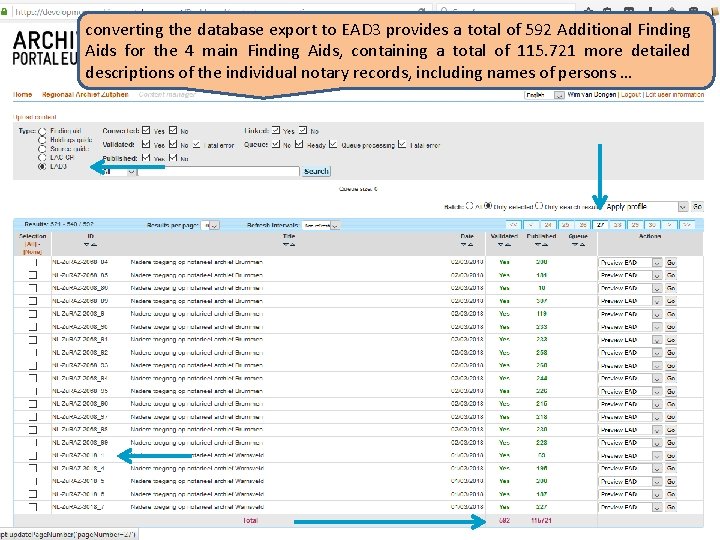
converting the database export to EAD 3 provides a total of 592 Additional Finding Aids for the 4 main Finding Aids, containing a total of 115. 721 more detailed descriptions of the individual notary records, including names of persons …
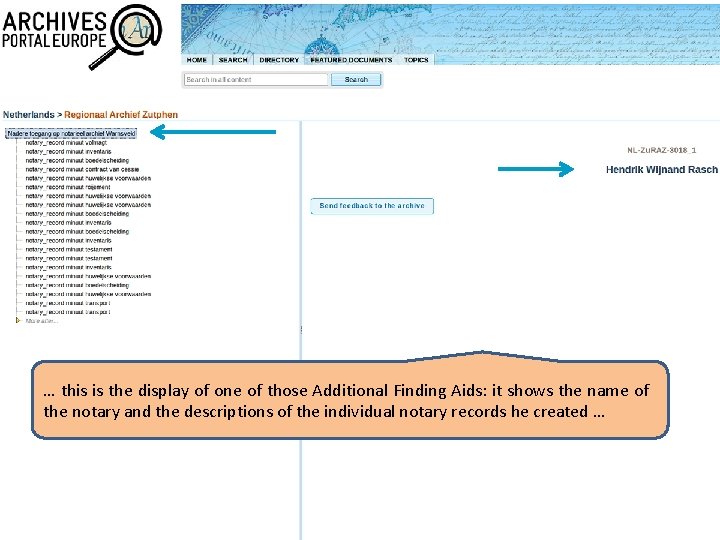
… this is the display of one of those Additional Finding Aids: it shows the name of the notary and the descriptions of the individual notary records he created …
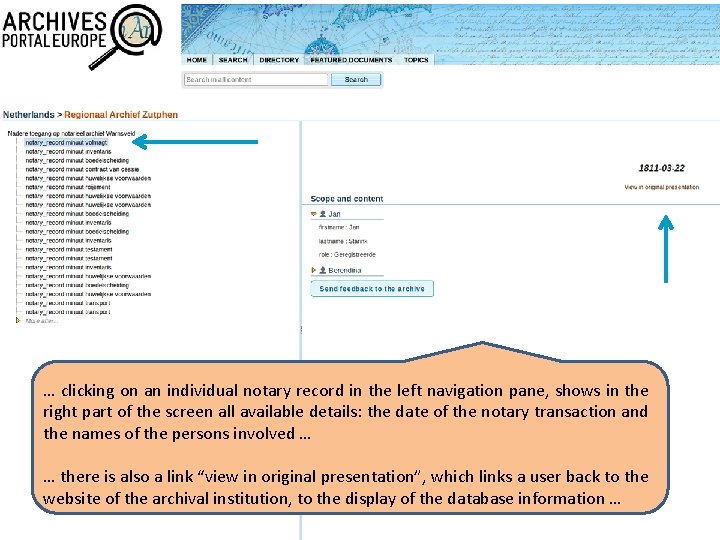
… clicking on an individual notary record in the left navigation pane, shows in the right part of the screen all available details: the date of the notary transaction and the names of the persons involved … … there is also a link “view in original presentation”, which links a user back to the website of the archival institution, to the display of the database information …
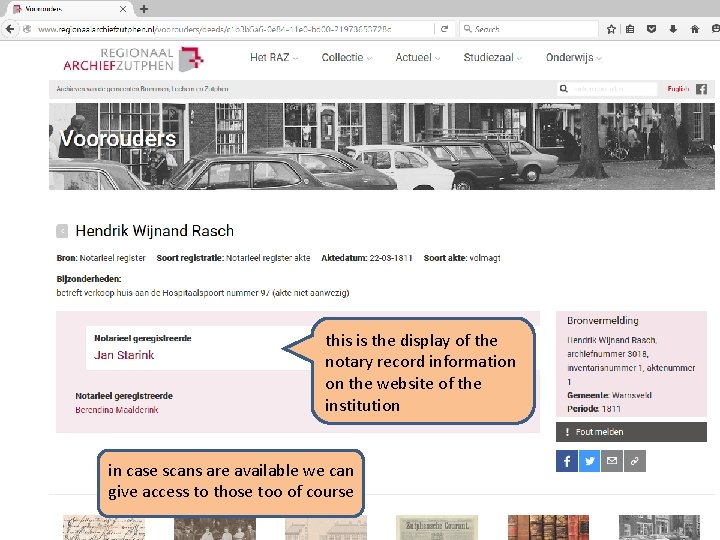
this is the display of the notary record information on the website of the institution in case scans are available we can give access to those too of course
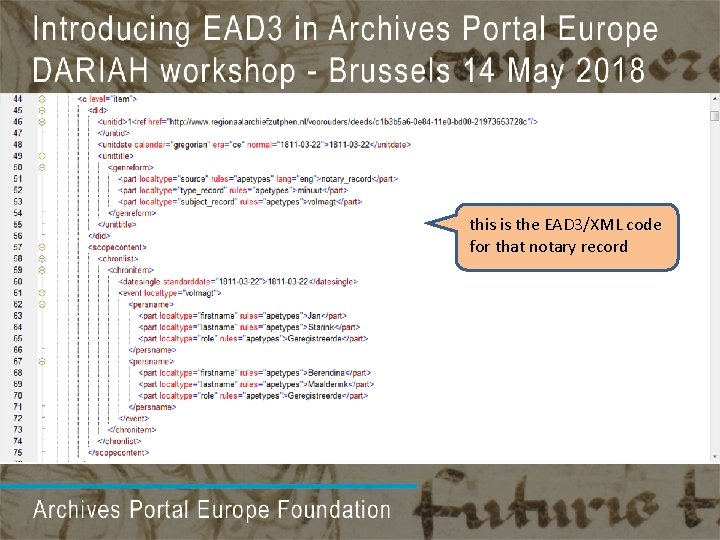
this is the EAD 3/XML code for that notary record
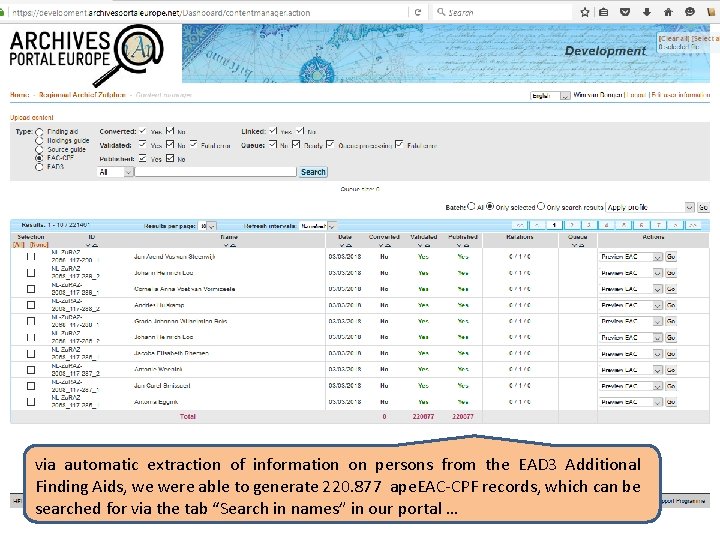
via automatic extraction of information on persons from the EAD 3 Additional Finding Aids, we were able to generate 220. 877 ape. EAC-CPF records, which can be searched for via the tab “Search in names” in our portal …
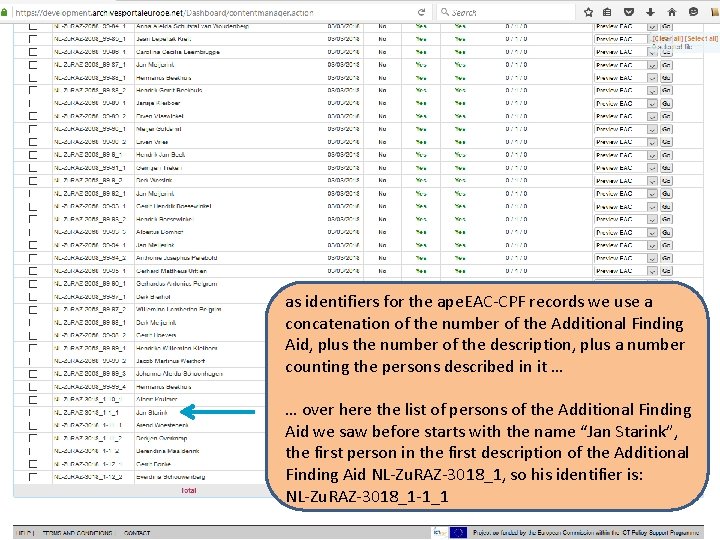
as identifiers for the ape. EAC-CPF records we use a concatenation of the number of the Additional Finding Aid, plus the number of the description, plus a number counting the persons described in it … … over here the list of persons of the Additional Finding Aid we saw before starts with the name “Jan Starink”, the first person in the first description of the Additional Finding Aid NL-Zu. RAZ-3018_1, so his identifier is: NL-Zu. RAZ-3018_1 -1_1
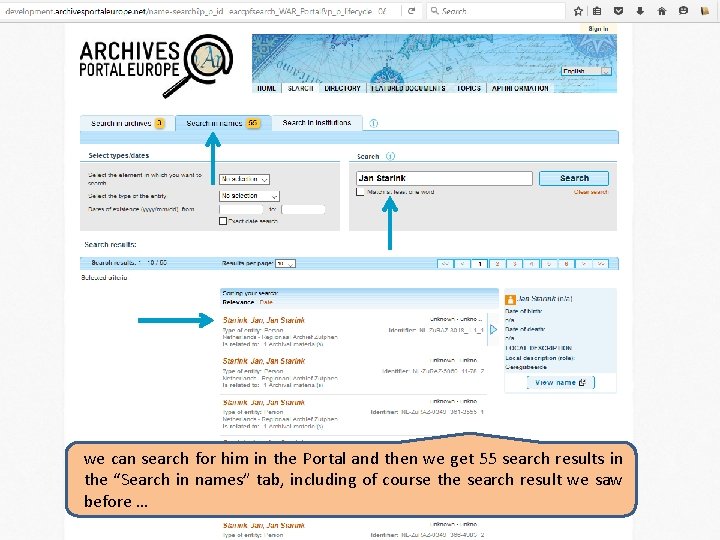
we can search for him in the Portal and then we get 55 search results in the “Search in names” tab, including of course the search result we saw before …
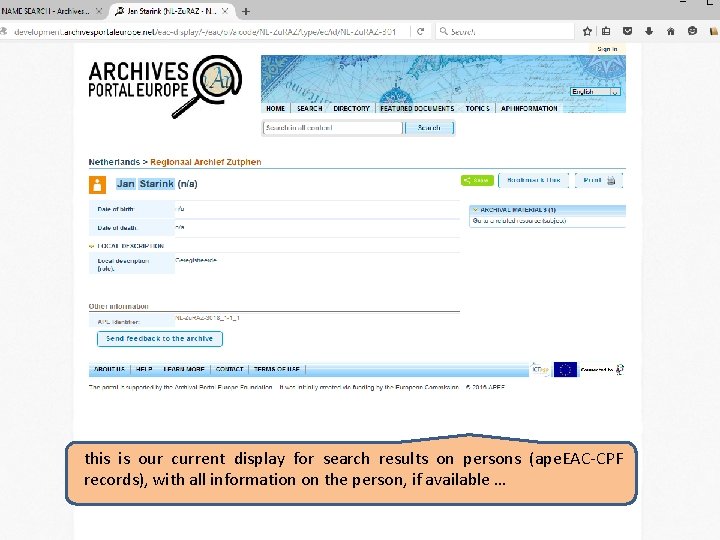
this is our current display for search results on persons (ape. EAC-CPF records), with all information on the person, if available …
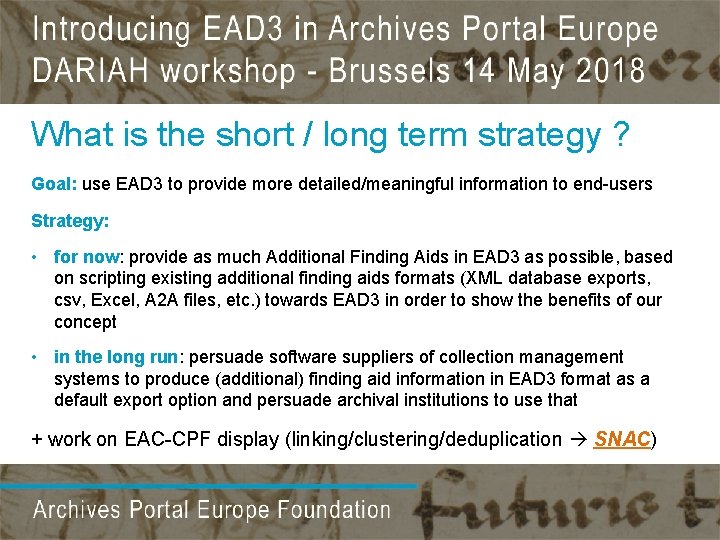
What is the short / long term strategy ? Goal: use EAD 3 to provide more detailed/meaningful information to end-users Strategy: • for now: provide as much Additional Finding Aids in EAD 3 as possible, based on scripting existing additional finding aids formats (XML database exports, csv, Excel, A 2 A files, etc. ) towards EAD 3 in order to show the benefits of our concept • in the long run: persuade software suppliers of collection management systems to produce (additional) finding aid information in EAD 3 format as a default export option and persuade archival institutions to use that + work on EAC-CPF display (linking/clustering/deduplication SNAC)
Thank you for your attention questions? wim. van. dongen@archivesportaleuropefoundation. eu watch the video on our Additional Finding Aid concept: http: //www. archivesportaleuropefoundation. eu/images/videos/afa. html more information on Archives Portal Europe: http: //www. archivesportaleuropefoundation. eu http: //wiki. archivesportaleurope. net