
https resultssoftware comtagcrmforsmallbusiness RELATIONSHIP MARKETING John EGAN Fourth
https: //results-software. com/tag/crm-for-small-business/ RELATIONSHIP MARKETING John EGAN - Fourth Edition PEARSON
Chapter 7 Customer Partnership
Relationship marketing focuses on what you can do for your customers as a company and what you can do with your customer to ensure customer satisfaction. The aim is to treat your customers as valued partners, to establish their needs and develop their loyalty through quality service.
Services The term is used firstly describe those businesses where the greater part of the company’s central offering is intangible. These ‘service industries’ are generally seen to have a number of characteristics that appear to differentiate them from physical goods industries. The characteristics are outlined as:
Special characteristics of services: Intangibility: A ‘pure’ service cannot be assessed in the physical sense. It is an abstraction that cannot be directly examined before purchase. The intangible process characteristics that define services include such factors as reliability, personal care, attentiveness, friendliness and these can only be verified once a service has been purchased and ‘consumed’. Few services are wholly intangible, however, and many include a tangible element (e. g. a concert programme). Intangibility has a number of implications for the consumer, including increased uncertainty and potential risk.
• Inseparability: Products may be produced in one location and sold in another. The production and consumption are, therefore, said to be separable. This is not the case for services, which are produced and consumed at one time and place. This inseparability occurs whether the producer is human (e. g. a doctor) or machine (e. g. an ATM machine). With services, marketing becomes a means of facilitating complex producer– consumer interactions, rather than being merely an exchange medium.
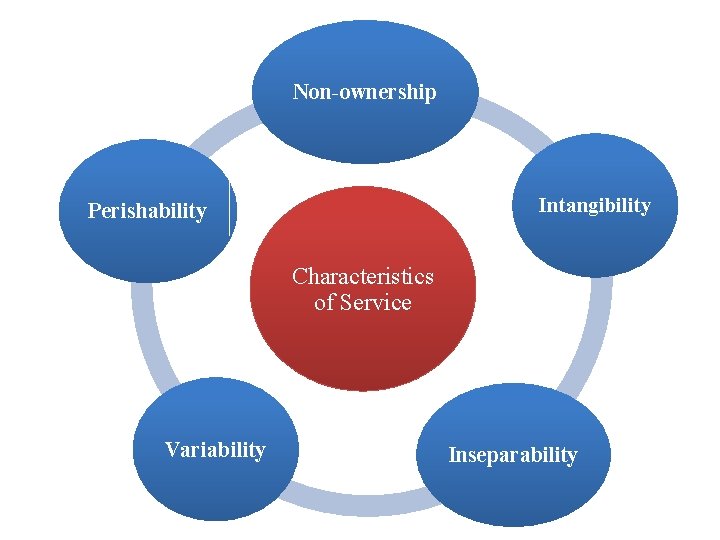
Non-ownership Intangibility Perishability Characteristics of Service Variability Inseparability
• Variability: There are two dimensions to variability. These are the amount the production varies from the norm and the extent it needs to be varied to suit the individual customer. As the customer is usually involved in the production process of a service at the same time as they consume it, it can be difficult to carry out monitoring and control of the production to ensure consistent standards. This is exaggerated in situations where personnel are providing services on a one-to-one basis (e. g. hairdressers) where they must adapt the ‘service production’ to fulfill an individual customer’s needs. • Perishability: Services cannot be stored. For example, if a hotel fails to fill all of its rooms on a particular night, these cannot be ‘carried over’ to subsequent nights. • Non-ownership: The inability to ‘own’ a service relates to the characteristics of intangibility and perishability. Where a service is performed no ownership is transferred from the buyer to the seller. The buyer is merely buying the right to a service process (e. g. a solicitor’s time).
The word ‘service’ is in connection with the phrase ‘customer service’. The definition of customer service is difficult to qualify accurately but the term is generally used to describe those features of the offering or exchange that extend beyond the ‘core’ product or service. The phrase is further seen to imply added value (or, over time, relational benefits) derived as a result of contact between buyers and sellers. Although the two concepts of ‘service industries’ and ‘customer service’ are related they are best approached, from an analytical perspective, separately.
• It is quite natural that the seeds of modern relationship marketing first started to grow in service marketing research. In fact, service marketing started to develop as a discipline because the marketing mix management paradigm and some of its key models fitted service firms’ customer relations badly. • Service firms have in theory always been ‘relationship orientated’ as the very nature of service businesses is relationship based (Grönroos, ibid. ). The reasons behind this are manifold. In service industries a process or performance takes place where the customer is seen to be heavily involved in the creation and delivery. • Service delivery is, therefore, simultaneous with consumption (Johns 1999, p. 963) and indeed may be said to be both defined and co-created with the consumer (Vargo and Lusch, 2004, p. 4). This recognition of a customer’s active involvement in the value-creation process is one which is driving current debate and a reassessment of supplier and customer roles (Gummesson, 2007, p. 137).
• ‘Service encounter’ is such an important part of service delivery that it is frequently called the ‘moment of truth’ (Johns, 1999, p. 965). • Service encounters are interesting phenomena with short-run and long-run effects. In the short-run they are the social occasion of economic exchange in which society allows strangers to interact. . . • In the long-run encounters provide the social occasions in which buyer and seller can negotiate and nurture the transformation of their accumulated encounters into an exchange relationship. The concept of a marketplace-relationship, the mutual recognition of some special status between the exchange partners, is especially interesting in services marketing.
• Contemporary service marketers, therefore, view marketing as an interactive process within a social context where relationship building and management are the vital cornerstones (Grönroos, 1994, p. 5). Indeed, service encounters can be regarded, first and foremost, as social encounters (Mc. Callum and Harrison, 1985, p. 35), the variety of which goes a long way to explaining the problem of variability. • It is this social contact that makes it feasible to envisage creating a relationship with the customer, if both parties (or perhaps either; see Chapter 3) are interested in such an association (Grönroos, 1995, p. 252).
Goods versus services • Products, meanwhile, are more than ever recognized as having intangible attributes. • The traditional view of marketing saw services as the occasion where the producer’s production process and the consumer’s consuming process intersected (Strandvik and Storbacka, 1996, p. 68). • The line between products and services and the dominance of the core product appears to be fast fading.
Customer Service • Customer service is associated with the building of bonds to ensure long-term relationships of mutual advantage to both parties (Christopher et al. , 1991, p. 5). • The provision of high levels of customer service involves understanding what (and how) a customer buys and determining how additional value can be added to differentiate it from competing offers (Clark, 2000, p. 212).
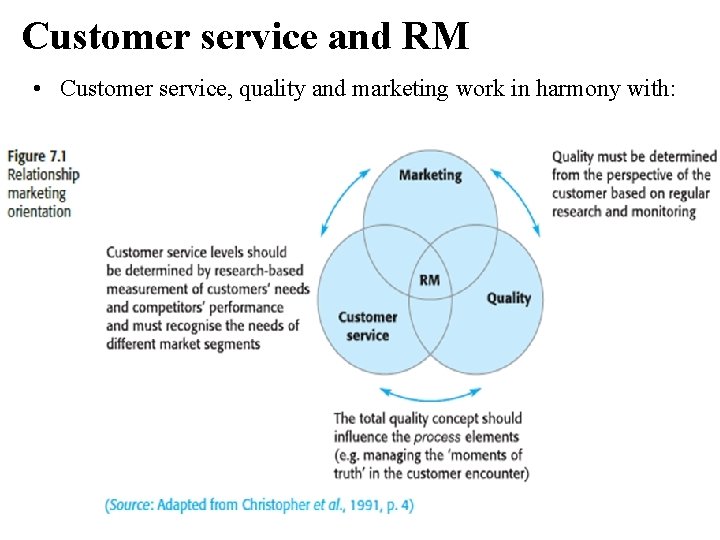
Customer service and RM • Customer service, quality and marketing work in harmony with:
Episodes • The concept of a relationship made up of a series of episodes (some of which are ‘critical episodes’) • Every episode does not carry the same importance or weight in the customer’s evaluation of the relationship. Some [are] routine. . . others [are] ‘critical episodes’. A ‘critical episode’ can be defined as an episode that is of great importance for the relationship. The continuation of the relationship is dependent (both in a negative and positive way) on ‘critical episodes’. . . The definition of ‘critical episode’ is customer specific. . . A routine episode can become critical if, according to the customer, the adequate level of performance is not met. • Specific interactions between customers and the firm’s employees that are especially satisfying or especially dissatisfying (Bitner et al. , 1990, p. 73).
Building customer relationships • Dwyer et al. (1987, p. 15) identified five general phases through which relationships evolve with each phase representing a major transition in how parties regard one another (see Figure 7. 3). The phases are: ■ awareness; ■ exploration; ■ expansion; ■ commitment; ■ dissolution.
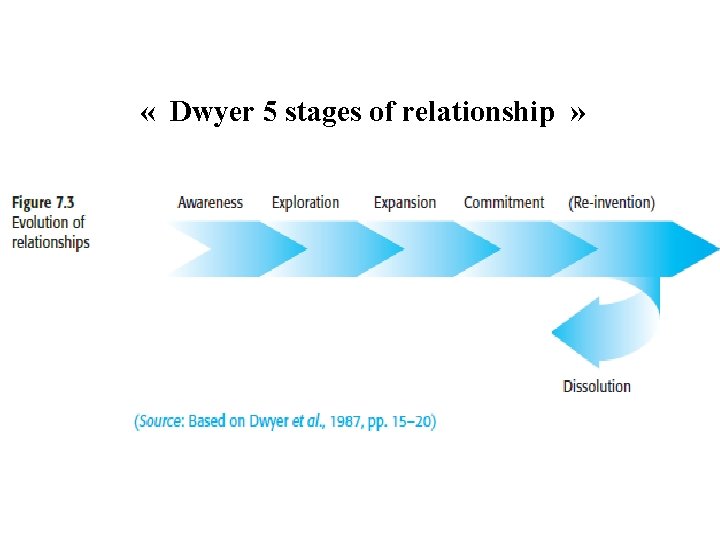
« Dwyer 5 stages of relationship »
• Awareness refers to one party’s recognition that the other party is ‘a feasible exchange party’. Interaction has yet to take place but there may be considerable ‘positioning’ and ‘posturing’ to enhance each other’s attractiveness. • Exploration This refers to the ‘search and trial period’ in the relational exchange. It is in this phase that potential relational partners consider the ‘obligations, benefits and burdens’ of the relationship. Trial purchases may be made but ‘the exploratory relationship is very fragile in the sense that minimal investment and interdependence make for simple termination’ (Dwyer et al. , 1987, p. 16). The exploration phase is conceptualised in five selfexplanatory subprocesses: ■ attraction (i. e. why is this likely to be a worthwhile relationship? ); ■ communication and bargaining; ■ development and exercise of power; ■ norm development (i. e. normalisation of the relationship); ■ expectation development (i. e. what do we want from the relationship? ).
• Expansion refers to the continual increase in benefits obtained by the exchange partners and their increasing interdependence. The critical distinction between this and the previous phase is that ‘the rudiments of trust and joint satisfaction established in the exploration stage now lead to increased risk-taking’ (ibid. , p. 18). • Commitment refers to the implicit or explicit pledge, made by the partners, to continue the relationship. At this stage the benefits include the ‘certainty’ developed from mutually anticipated roles and goals, the ‘efficiency’ established as a result of bargaining and the ‘effectiveness’ that comes from trust.
• Dissolution The possibility of withdrawal or disengagement, while not being relationship development as such, is integral to the model. Dissolution is always an option and will, ultimately, always take place (see the section on customer/supplier dissolution or exit, page 159). Reinventing relationships that have passed their sell-by date may prevent dissolution. As discussed in previous chapters, not all relationships are as complex or as highly motivated as those suggested by the relationship formulation process outlined above. All relationships, however, have some elements that are recognisable in this model.
Customer service failure • Customer service failures test the commitment of an organization's customers (Bejou and Palmer, 1998, p. 11). When such a situation exists, however, it may not be the problem per se that causes a critical episode to develop but the company’s response to that problem (Stewart, 1998 a, p. 9). Every customer will react differently. Each has a propensity to ‘stick to’ or ‘switch’ from the status quo and the magnitude of this propensity will depend on the profile of that individual (Hassan, 1996, p. 4) at any point in time. • Problems may not necessarily lead to long-term dissatisfaction or desertion. Satisfactory response by the supplier may lead to renewed levels of satisfaction or, as is sometimes claimed (e. g. Bejou and Palmer, 1998, p. 11), greater satisfaction than existed prior to the incident.
Customer/supplier dissolution or exit • If the concept of relationship breakdown is examined more closely it may be seen to include three distinct types: ■ dissolution; ■ customer exit; ■ supplier withdrawal.
• Dissolution suggests some form of agreed separation. This can be either where both parties agree that it would be in their best interests to go their separate ways or where one party (usually the more powerful of the two) forms this view and the other acquiesces. This form of agreed separation is most likely, but not exclusively, to manifest itself in business-to-business markets, where higher levels of relationship are observed to develop, rather than in consumer markets, where relationships are less likely to be formally acknowledged or contractually arranged. An example of an exception to this generalization is, for example, a solicitor–client relationship. In the case of most day-to-day commercial relationships there would appear to be little driving or compelling either party to formally acknowledge dissolution.

Customer exit • Customer ‘exit’ has been defined as a ‘term used to denote the economic phenomenon of a customer ceasing patronage of a particular supplier’ (Stewart, 1998 b, p. 235). In more everyday language, it is where the customer decides to end the relationship. • Stewart (1998 b, p. 235) summarises those situations when exit can be expected as: ‘‘where competition prevails and alternatives are available to the customer, who is aware of them and alert to any absolute or relative deterioration in performance. ’’ • Customer ‘voice’ has long been seen as a means of recovering a critical situation (so-called ‘problem recovery’).
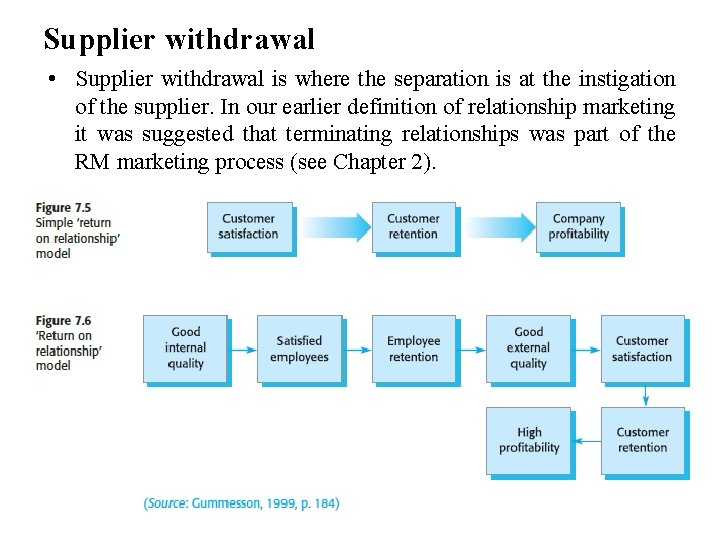
Supplier withdrawal • Supplier withdrawal is where the separation is at the instigation of the supplier. In our earlier definition of relationship marketing it was suggested that terminating relationships was part of the RM marketing process (see Chapter 2).
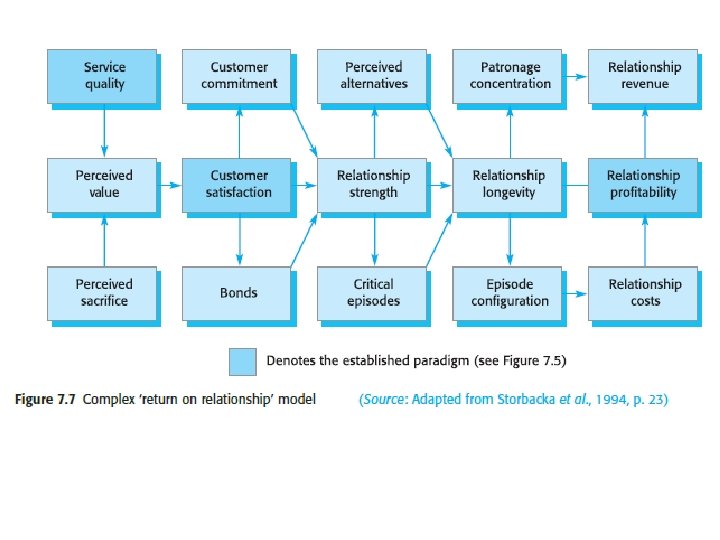
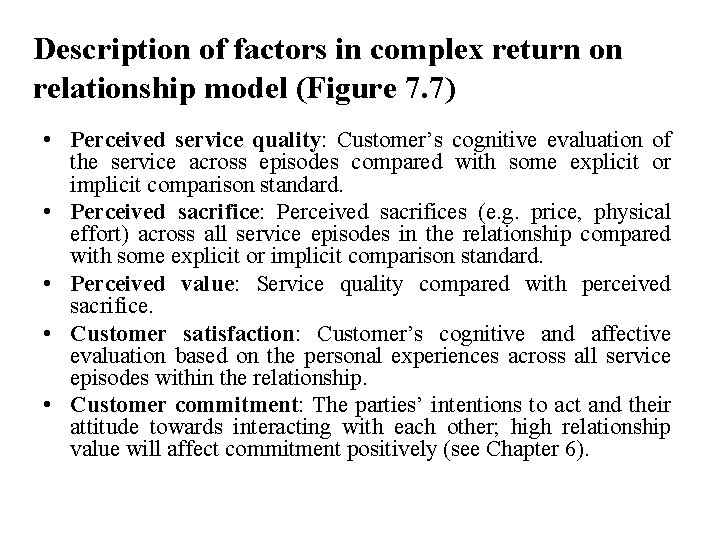
Description of factors in complex return on relationship model (Figure 7. 7) • Perceived service quality: Customer’s cognitive evaluation of the service across episodes compared with some explicit or implicit comparison standard. • Perceived sacrifice: Perceived sacrifices (e. g. price, physical effort) across all service episodes in the relationship compared with some explicit or implicit comparison standard. • Perceived value: Service quality compared with perceived sacrifice. • Customer satisfaction: Customer’s cognitive and affective evaluation based on the personal experiences across all service episodes within the relationship. • Customer commitment: The parties’ intentions to act and their attitude towards interacting with each other; high relationship value will affect commitment positively (see Chapter 6).
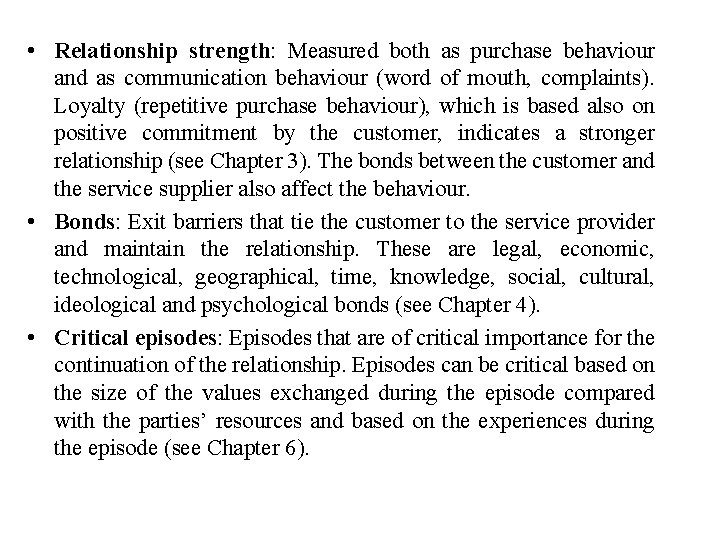
• Relationship strength: Measured both as purchase behaviour and as communication behaviour (word of mouth, complaints). Loyalty (repetitive purchase behaviour), which is based also on positive commitment by the customer, indicates a stronger relationship (see Chapter 3). The bonds between the customer and the service supplier also affect the behaviour. • Bonds: Exit barriers that tie the customer to the service provider and maintain the relationship. These are legal, economic, technological, geographical, time, knowledge, social, cultural, ideological and psychological bonds (see Chapter 4). • Critical episodes: Episodes that are of critical importance for the continuation of the relationship. Episodes can be critical based on the size of the values exchanged during the episode compared with the parties’ resources and based on the experiences during the episode (see Chapter 6).
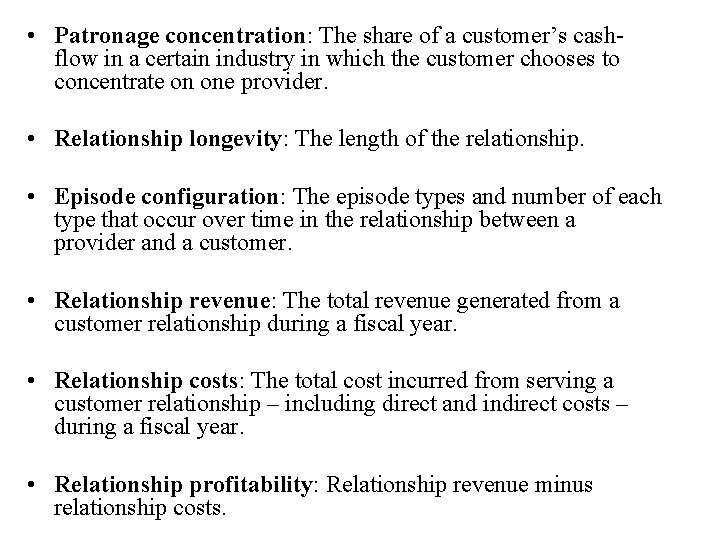
• Patronage concentration: The share of a customer’s cashflow in a certain industry in which the customer chooses to concentrate on one provider. • Relationship longevity: The length of the relationship. • Episode configuration: The episode types and number of each type that occur over time in the relationship between a provider and a customer. • Relationship revenue: The total revenue generated from a customer relationship during a fiscal year. • Relationship costs: The total cost incurred from serving a customer relationship – including direct and indirect costs – during a fiscal year. • Relationship profitability: Relationship revenue minus relationship costs.
Chapter 8 Internal Partnership
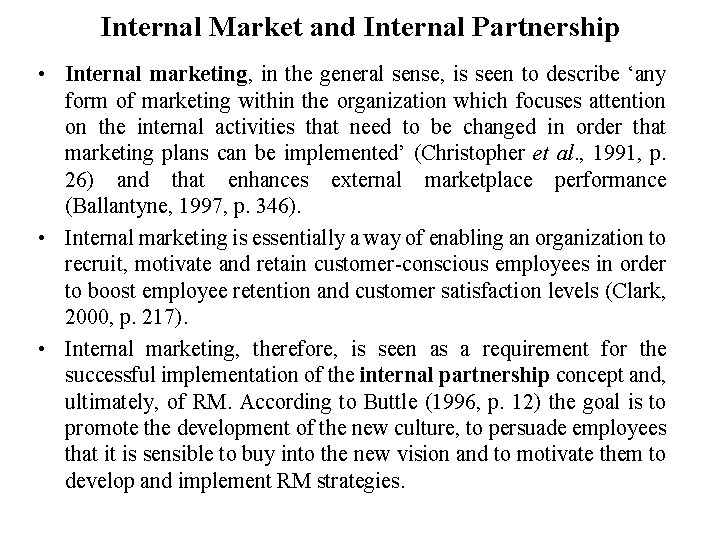
Internal Market and Internal Partnership • Internal marketing, in the general sense, is seen to describe ‘any form of marketing within the organization which focuses attention on the internal activities that need to be changed in order that marketing plans can be implemented’ (Christopher et al. , 1991, p. 26) and that enhances external marketplace performance (Ballantyne, 1997, p. 346). • Internal marketing is essentially a way of enabling an organization to recruit, motivate and retain customer-conscious employees in order to boost employee retention and customer satisfaction levels (Clark, 2000, p. 217). • Internal marketing, therefore, is seen as a requirement for the successful implementation of the internal partnership concept and, ultimately, of RM. According to Buttle (1996, p. 12) the goal is to promote the development of the new culture, to persuade employees that it is sensible to buy into the new vision and to motivate them to develop and implement RM strategies.
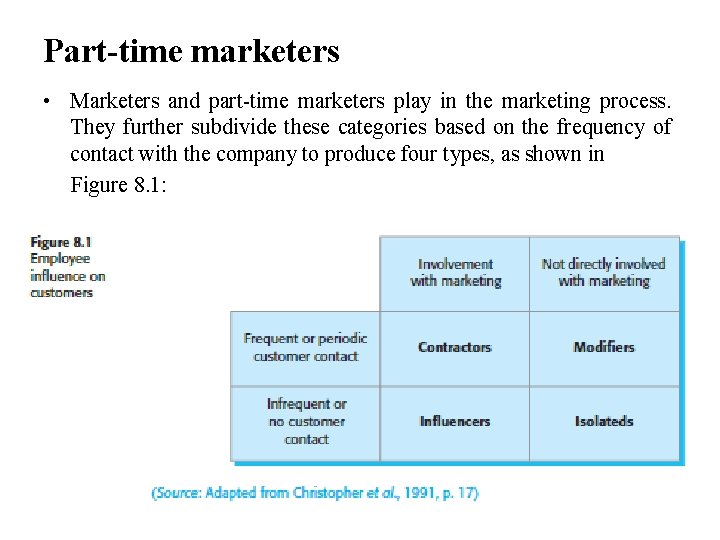
Part-time marketers • Marketers and part-time marketers play in the marketing process. They further subdivide these categories based on the frequency of contact with the company to produce four types, as shown in Figure 8. 1:
§ Contractors: Contractors have frequent or periodic customer contact and are heavily involved with ‘conventional’ marketing activities, including sales and customer service roles. They should be well versed in the company’s marketing strategy, well trained and motivated to serve the customer on a day-to-day basis. They should be recruited based on their potential to respond to customer needs and evaluated and rewarded on this basis. § Modifiers: Modifiers, while not directly involved with conventional marketing activities, have frequent customer contact. This group includes receptionists, accounting staff, delivery personnel, etc. Modifiers should have a clear view of the organization's marketing strategy and the part they play in it. They should be trained in the development of customer relationship skills and monitored and evaluated on this basis.
§ Influencers: Influencers are involved with elements of conventional marketing, but they have infrequent personal contact. They are, however, very much part of the implementation of the organization's marketing strategy. Roles include research and development, market research, etc. A major skill to be nurtured here is ‘customer responsiveness’. Influencers should be evaluated and rewarded according to customer-orientated performance standards. Opportunities to meet customers in a programmed way may be also be valuable. § Isolated: Although these employees have neither regular contact with customers nor regular input into conventional marketing activities, their performance could affect successful fulfillment of the company’s marketing strategy. Included in this category, for example, are staff members from personnel and data processing departments. The appropriate attention should be given to maximizing the impact of their activities on marketing strategy and they should be rewarded accordingly.
Climate and culture • The management of individual encounters is, according to Bitner (1990, p. 69): ‘‘nested within broader management issues of organizational structure, philosophy and culture that also can influence the service delivery and, ultimately, customer perception of service quality. ’’ The foundation of long-term marketing effectiveness. They define these linked concepts as: ■ climate: the policies and practices that characterize the organization (and, in turn, reflect its cultural beliefs). ■ culture: the deep-seated, unwritten system of shared values and norms within the organization (which in turn dictates its climate).
The climate and culture of an organization are dependent on how the employees view that organization and its goals (Hogg et al. , 1998, p. 881). Change within organizations frequently causes concern among employees even if that change will ultimately benefit them in some way. Empowerment lies at the heart of the relationship-based company. An important driver towards empowerment strategies came from the difficulty of non-homogeneity of delivery in service markets and the need for speedy decision-making at the customer interface. Operationalising empowerment ■ information about organizational performance; ■ rewards based on organizational performance; ■ knowledge that enables employees to understand contribute to organizational performance; ■ power to make decisions that influence organizational direction and performance.
Empowerment benefits and cautions Empowerment has a number of perceived benefits. According to Bowen and Lawler (1992, pp. 32– 3), it results in: ■ quicker online response to customers’ needs during service delivery; ■ quicker online response to dissatisfied customers during service recovery; ■ employees feeling better about their jobs and themselves; ■ employees interacting with customers with more warmth and enthusiasm; ■ empowered employees being a great source of service ideas; ■ great ‘word of mouth’ advertising and customer retention.
There also (and inevitably) costs associated with empowerment. These are summarised by Bowen and Lawler (pp. 33– 4) as: ■ higher investment in selection and training; ■ higher labour costs; ■ slower/inconsistent service delivery as individual treatment slows down the operation; ■ poor reaction of customers who see employees negotiating ‘special deals’ or terms with other customers; ■ too many ‘give-aways’ and bad and costly decisions.
Internal marketing implementation Internal strategies requires a three-stage approach: ■ The organization has to demonstrate a commitment to the security and development of its employees that ranks at least equal to that of its shareholders. ■ The organization has to create a structure where functional barriers are torn down. It will have ‘flatter’ organizational levels, empowerment for front-line staff and will focus efforts on the three core value-adding processes of operations, customer support and innovation. ■ Top management must then provide leadership by reinforcing these values and offering a vision of what the organization will become.
‘Process management perspective’ (PMP). PMP, he suggests, is very different from the traditional functionalistic management approach based on ‘scientific management’ principles. RM programme should: ‘‘be considered the firm’s life-blood – percolating through all ranks, departments, functions and assets of the firm – with the ultimate aim of simultaneously offering and gaining value at all levels. The firm’s marketing, management, operations, finance and human resources should constitute nurturing organs assisting the firm to develop, create and nurture the continuous flow of value between the respective stakeholders inside and/or outside the organization. ’’
Marketing Managers will have to work more effectively as team players; proactively putting teams together and co-operating with other functions to enhance the core processes of innovation, order fulfillment and customer service. Functional boundaries in the ‘professional core’ will be seen as irrelevant and general management skills will be much more prized.
- Slides: 43