
http xkcd com894 Neural Networks David Kauchak CS


- Slides: 55
http: //xkcd. com/894/
Neural Networks David Kauchak CS 51 A Spring 2019
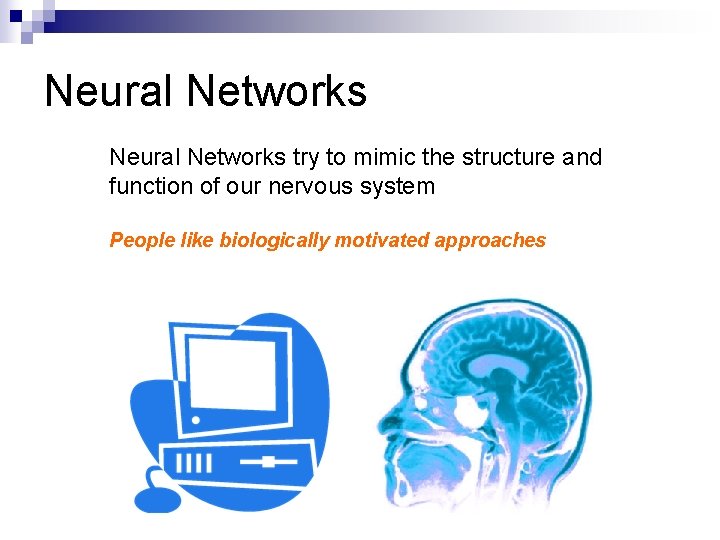
Neural Networks try to mimic the structure and function of our nervous system People like biologically motivated approaches
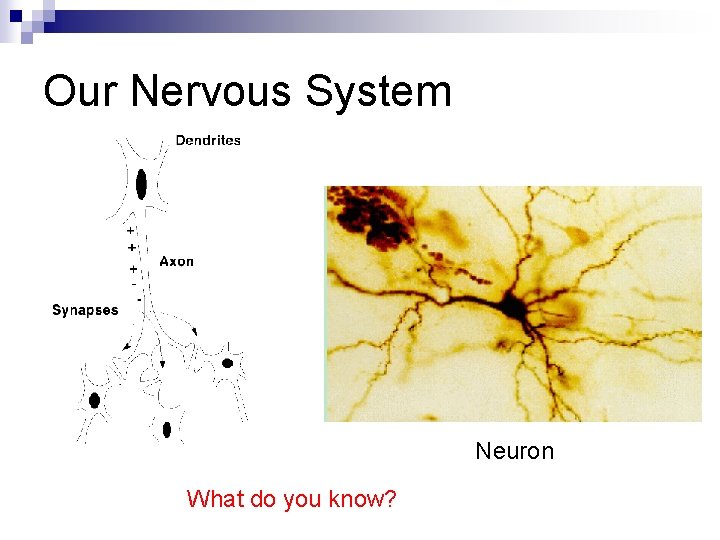
Our Nervous System Neuron What do you know?
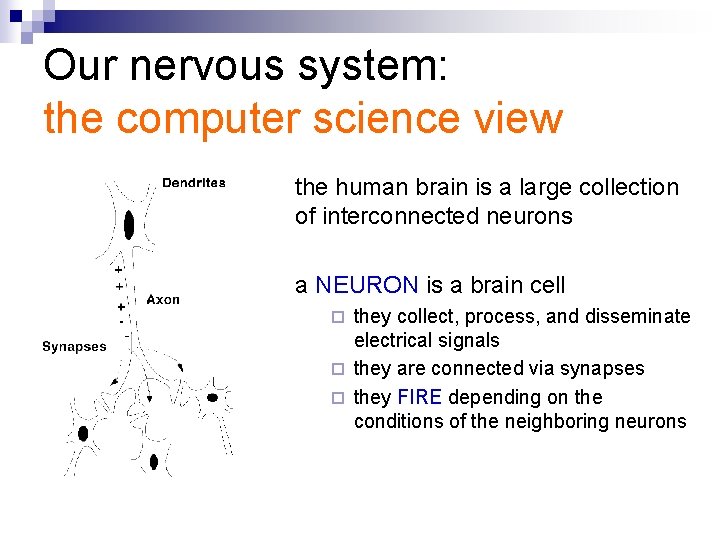
Our nervous system: the computer science view the human brain is a large collection of interconnected neurons a NEURON is a brain cell they collect, process, and disseminate electrical signals ¨ they are connected via synapses ¨ they FIRE depending on the conditions of the neighboring neurons ¨
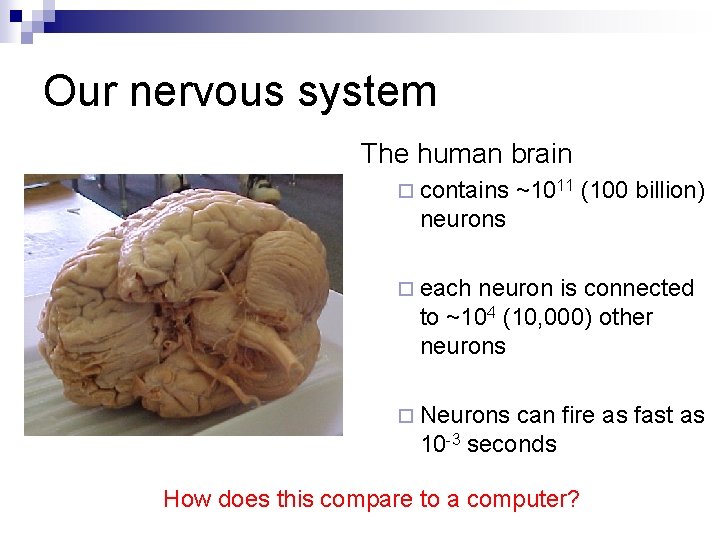
Our nervous system The human brain ¨ contains ~1011 (100 billion) neurons ¨ each neuron is connected to ~104 (10, 000) other neurons ¨ Neurons can fire as fast as 10 -3 seconds How does this compare to a computer?
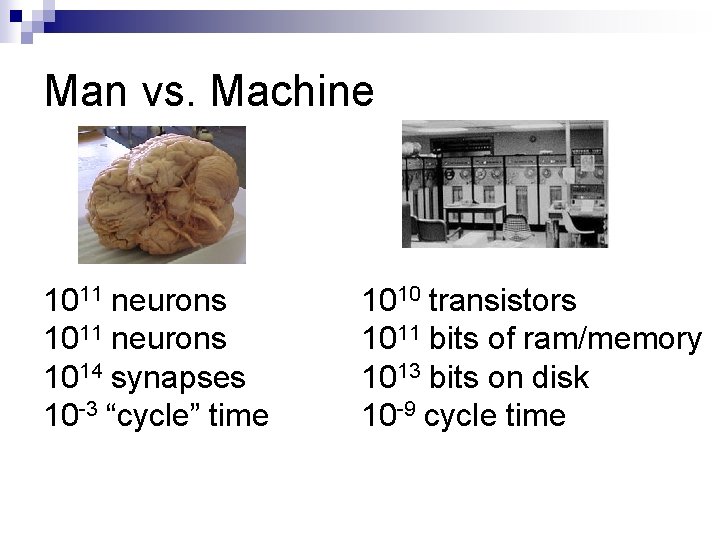
Man vs. Machine 1011 neurons 1014 synapses 10 -3 “cycle” time 1010 transistors 1011 bits of ram/memory 1013 bits on disk 10 -9 cycle time
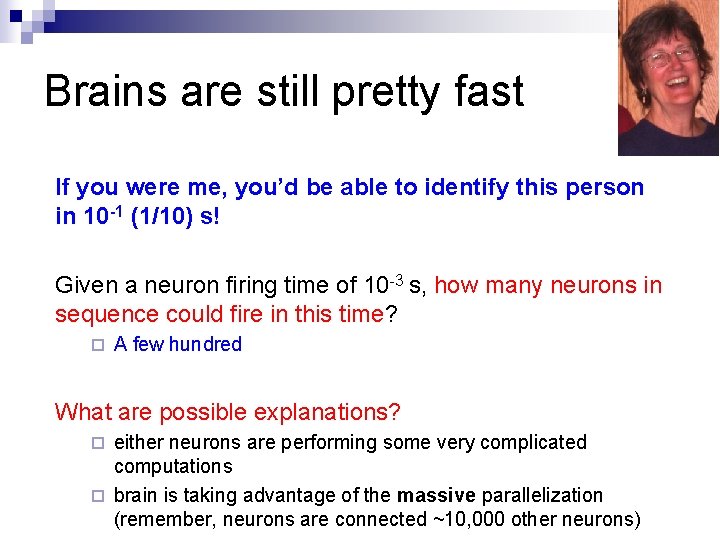
Brains are still pretty fast Who is this?
Brains are still pretty fast If you were me, you’d be able to identify this person in 10 -1 (1/10) s! Given a neuron firing time of 10 -3 s, how many neurons in sequence could fire in this time? ¨ A few hundred What are possible explanations? either neurons are performing some very complicated computations ¨ brain is taking advantage of the massive parallelization (remember, neurons are connected ~10, 000 other neurons) ¨
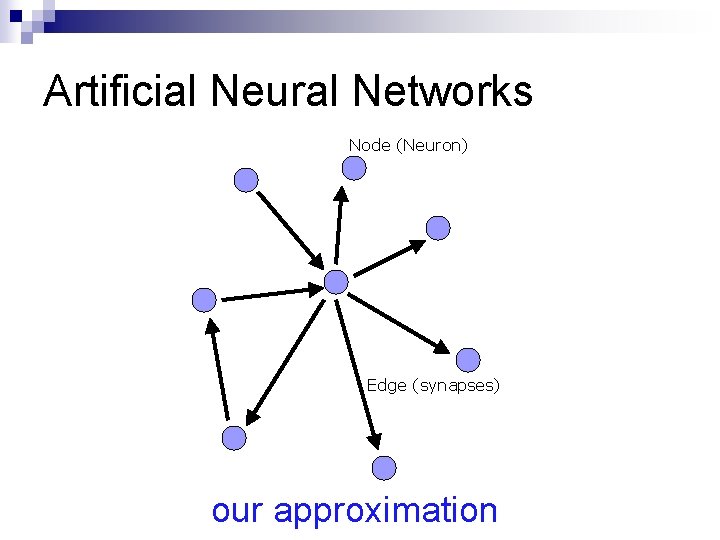
Artificial Neural Networks Node (Neuron) Edge (synapses) our approximation
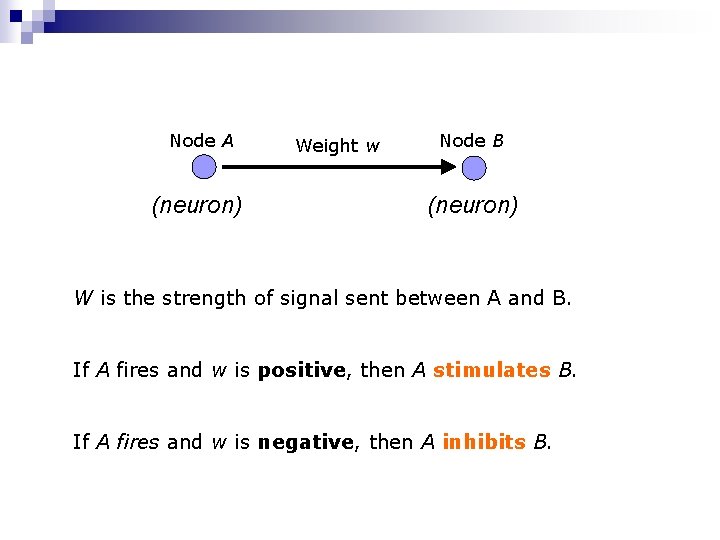
Node A (neuron) Weight w Node B (neuron) W is the strength of signal sent between A and B. If A fires and w is positive, then A stimulates B. If A fires and w is negative, then A inhibits B.
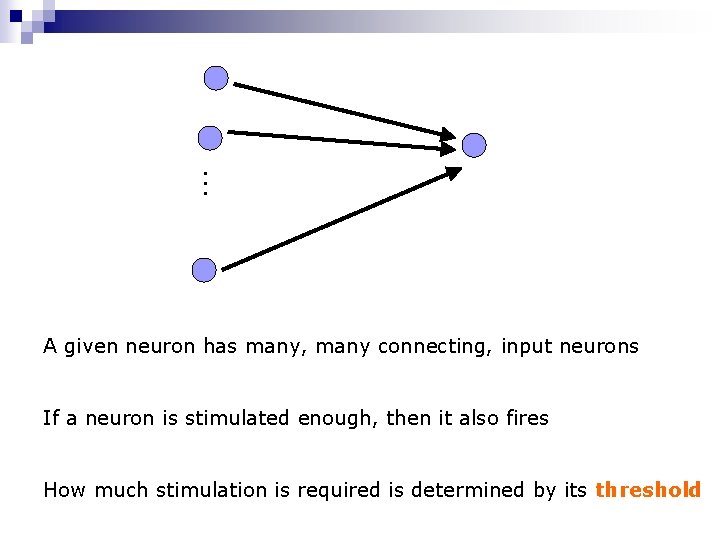
… A given neuron has many, many connecting, input neurons If a neuron is stimulated enough, then it also fires How much stimulation is required is determined by its threshold
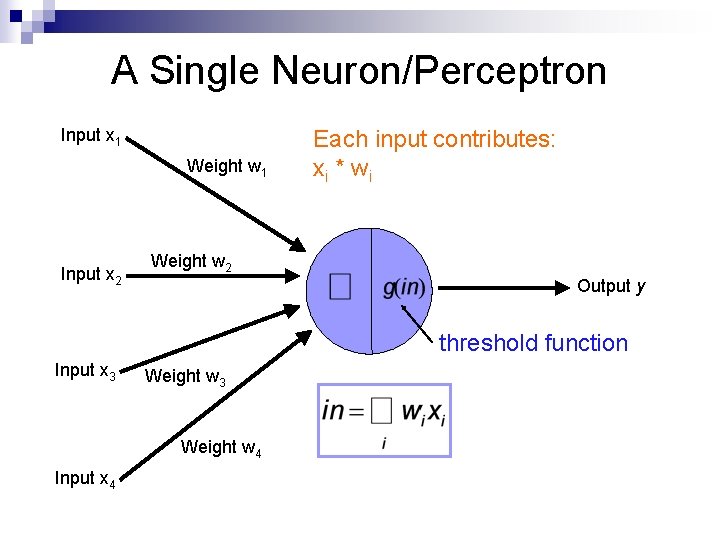
A Single Neuron/Perceptron Input x 1 Weight w 1 Input x 2 Each input contributes: xi * wi Weight w 2 Output y threshold function Input x 3 Weight w 4 Input x 4
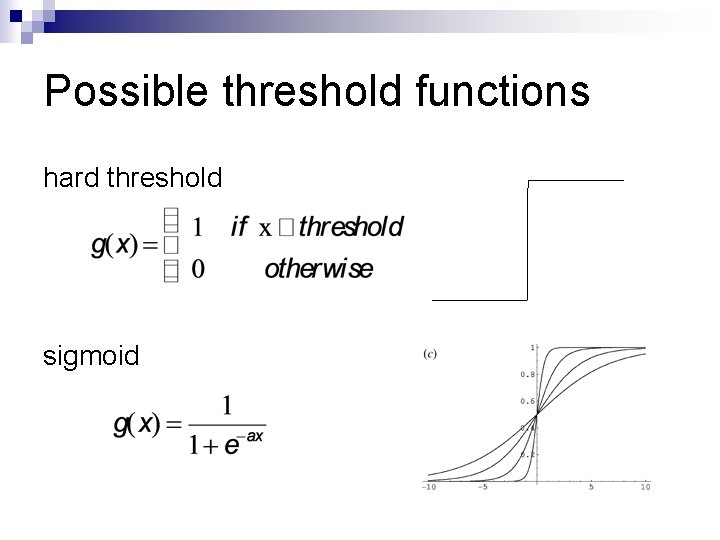
Possible threshold functions hard threshold sigmoid
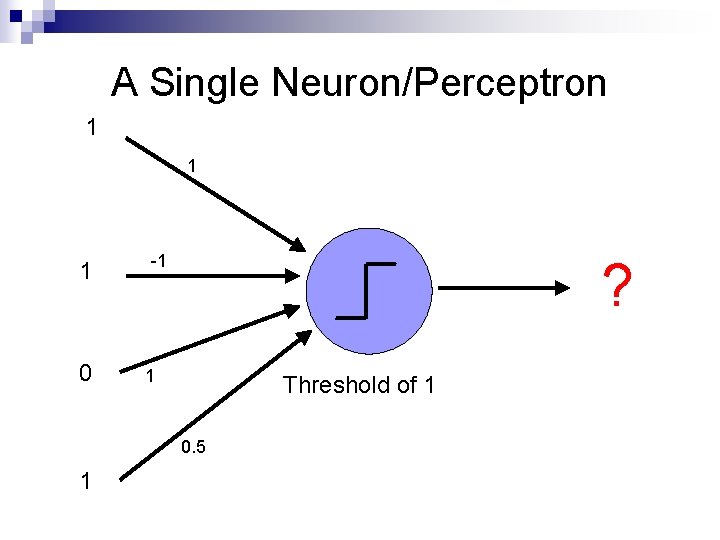
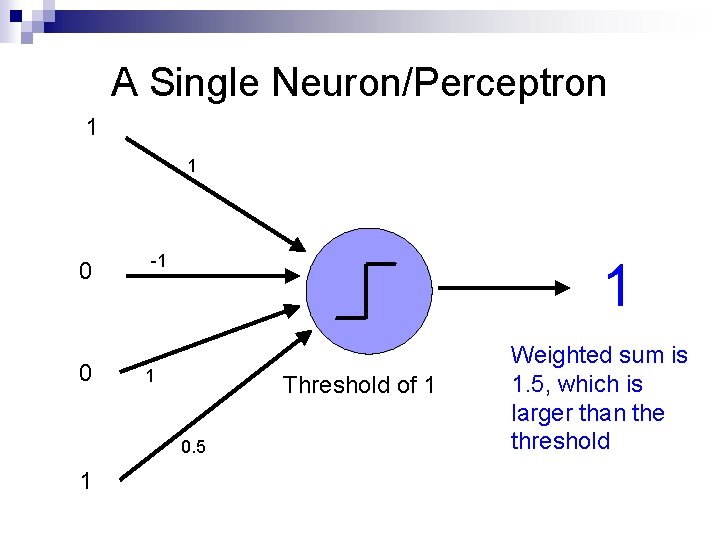
A Single Neuron/Perceptron 1 1 1 0 -1 ? 1 Threshold of 1 0. 5 1
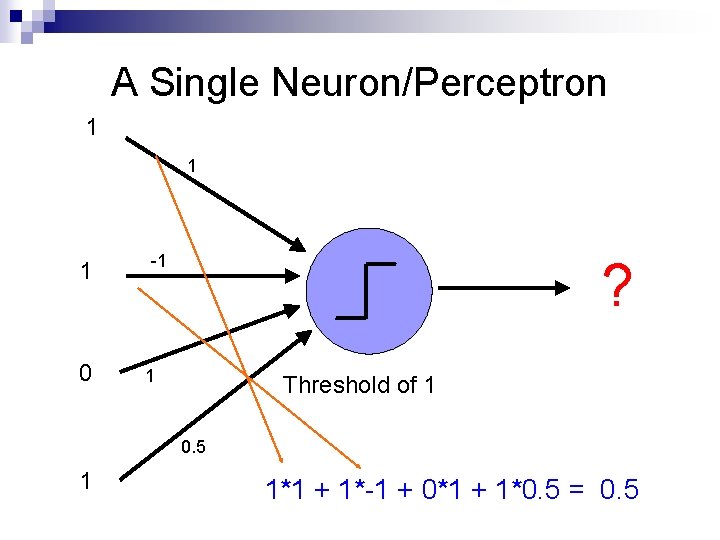
A Single Neuron/Perceptron 1 1 1 0 -1 ? 1 Threshold of 1 0. 5 1 1*1 + 1*-1 + 0*1 + 1*0. 5 = 0. 5
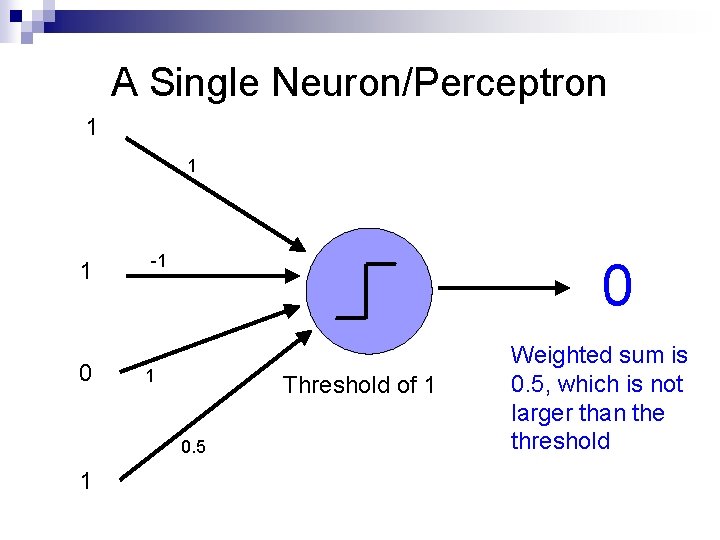
A Single Neuron/Perceptron 1 1 1 0 -1 0 1 Threshold of 1 0. 5 1 Weighted sum is 0. 5, which is not larger than the threshold
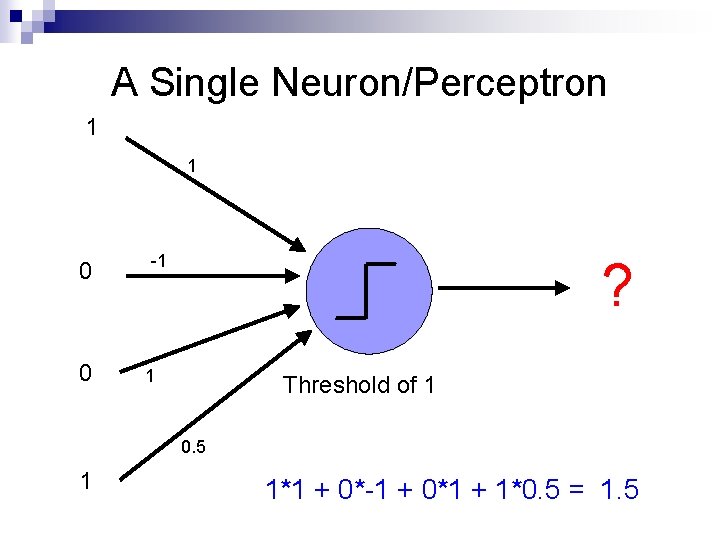
A Single Neuron/Perceptron 1 1 0 0 -1 ? 1 Threshold of 1 0. 5 1 1*1 + 0*-1 + 0*1 + 1*0. 5 = 1. 5
A Single Neuron/Perceptron 1 1 0 0 -1 1 1 Threshold of 1 0. 5 1 Weighted sum is 1. 5, which is larger than the threshold
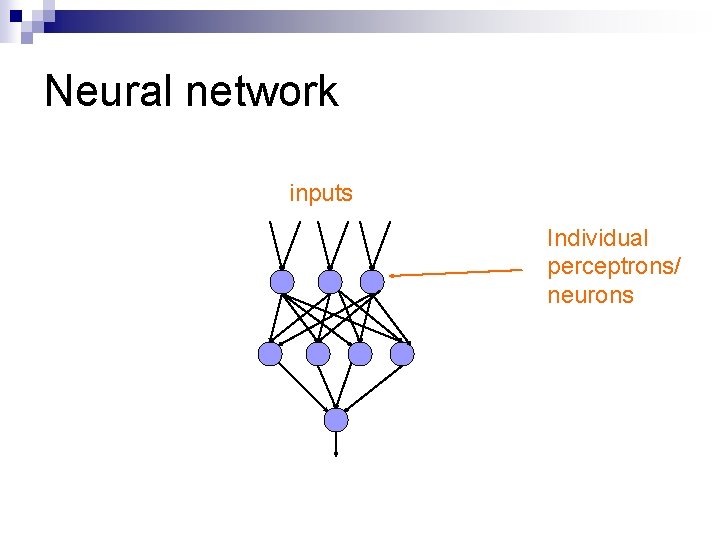
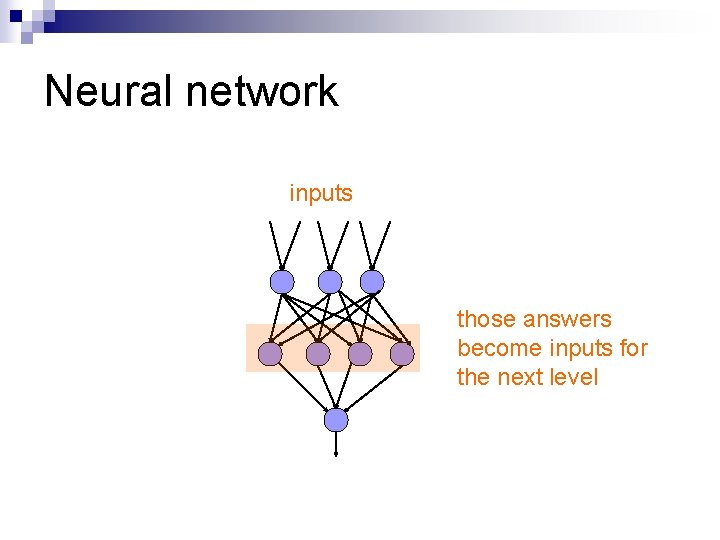
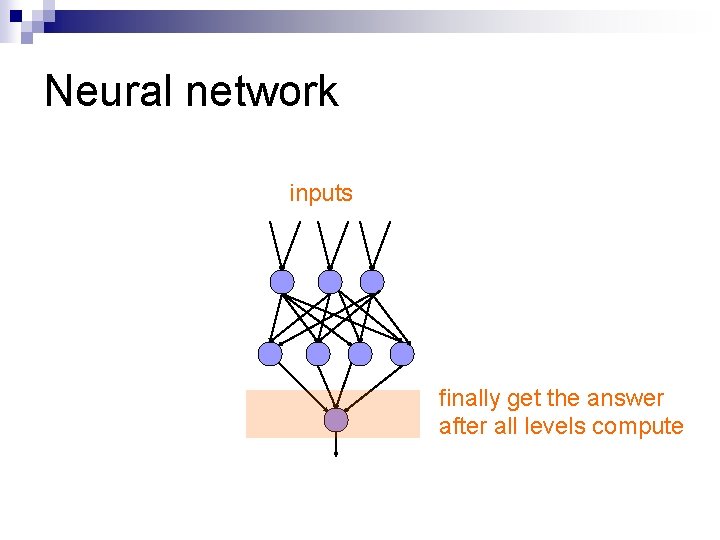
Neural network inputs Individual perceptrons/ neurons
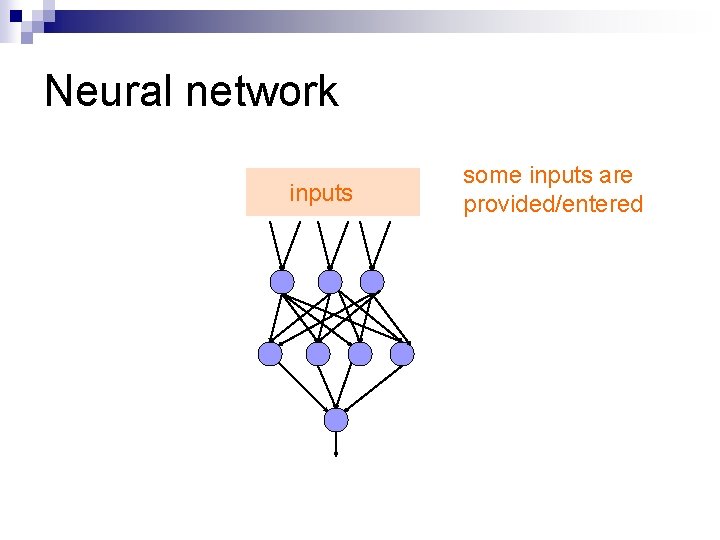
Neural network inputs some inputs are provided/entered
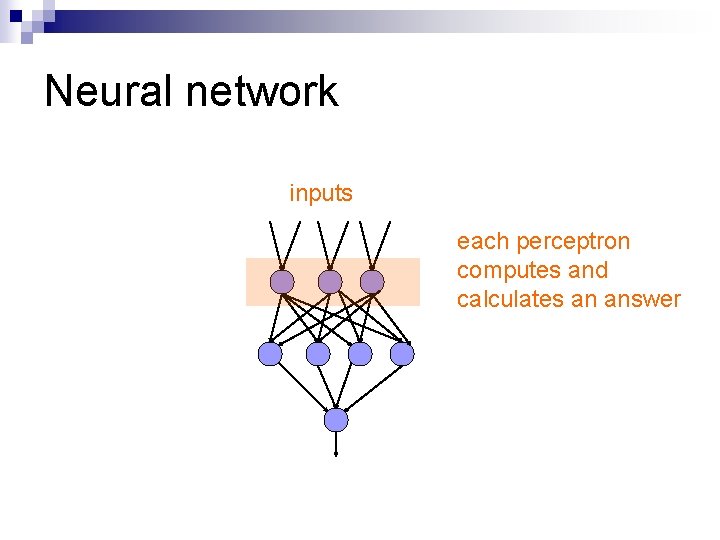
Neural network inputs each perceptron computes and calculates an answer
Neural network inputs those answers become inputs for the next level
Neural network inputs finally get the answer after all levels compute
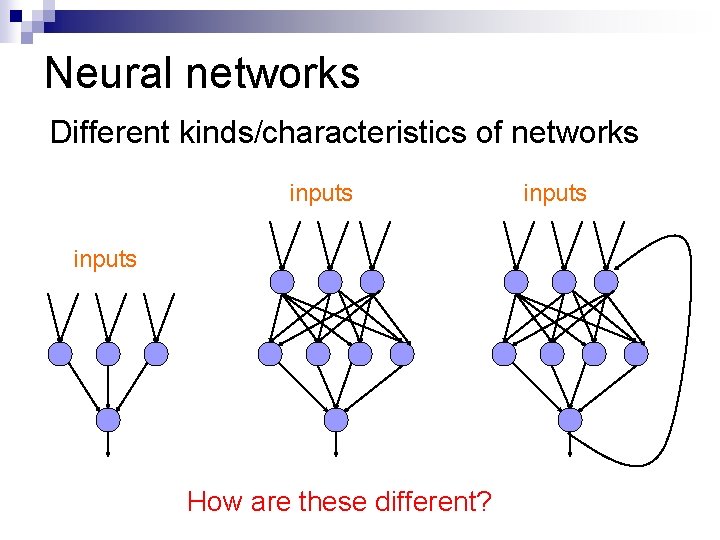
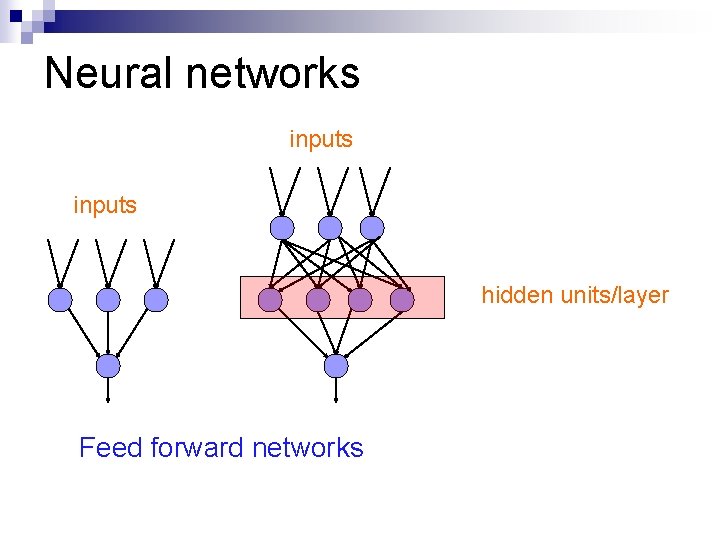
Neural networks Different kinds/characteristics of networks inputs How are these different? inputs
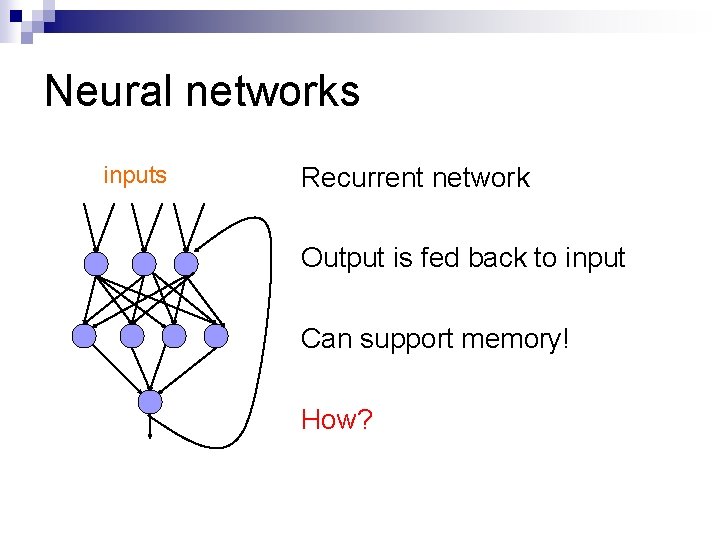
Neural networks inputs hidden units/layer Feed forward networks
Neural networks inputs Recurrent network Output is fed back to input Can support memory! How?
History of Neural Networks Mc. Culloch and Pitts (1943) – introduced model of artificial neurons and suggested they could learn Hebb (1949) – Simple updating rule for learning Rosenblatt (1962) - the perceptron model Minsky and Papert (1969) – wrote Perceptrons Bryson and Ho (1969, but largely ignored until 1980 s--Rosenblatt) – invented back-propagation learning for multilayer networks
Training the perceptron First wave in neural networks in the 1960’s Single neuron Trainable: its threshold and input weights can be modified If the neuron doesn’t give the desired output, then it has made a mistake Input weights and threshold can be changed according to a learning algorithm
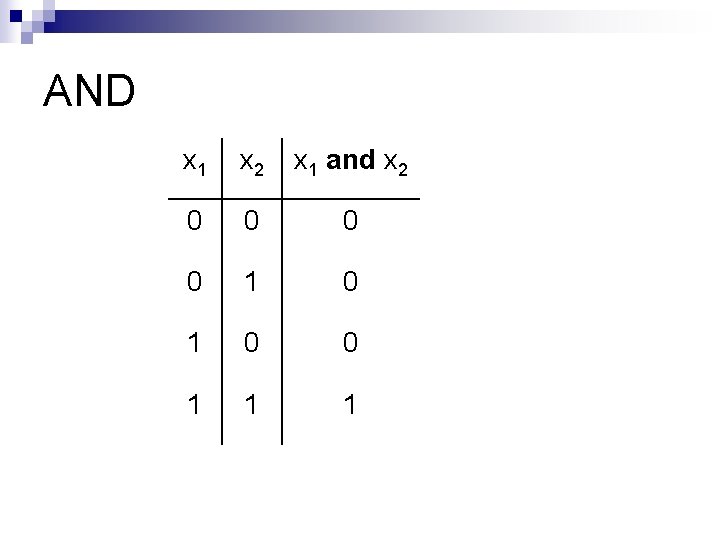
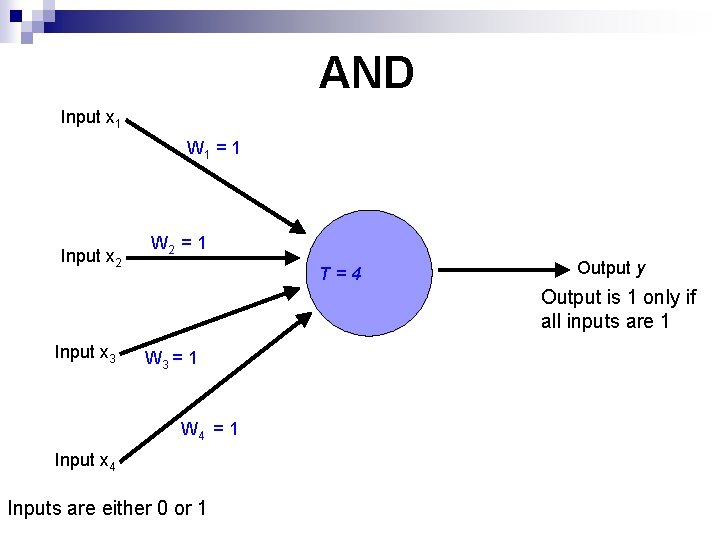
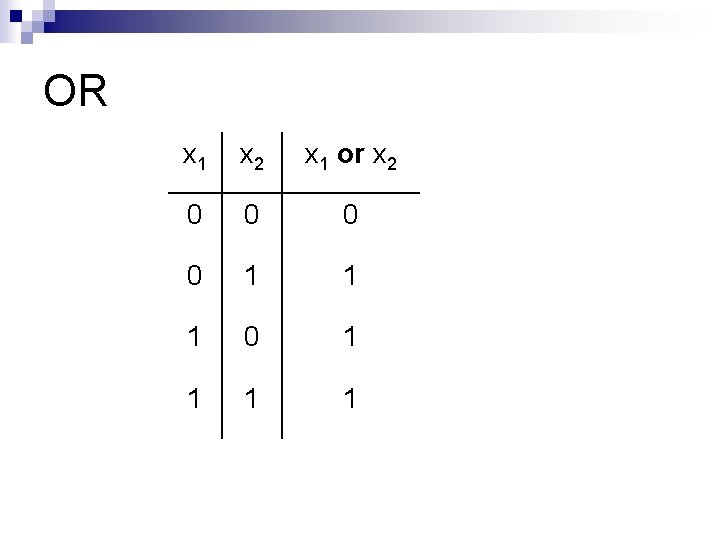
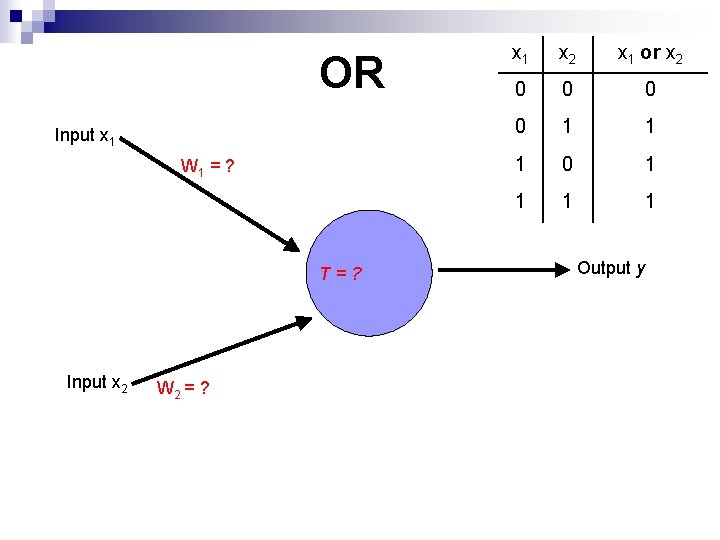
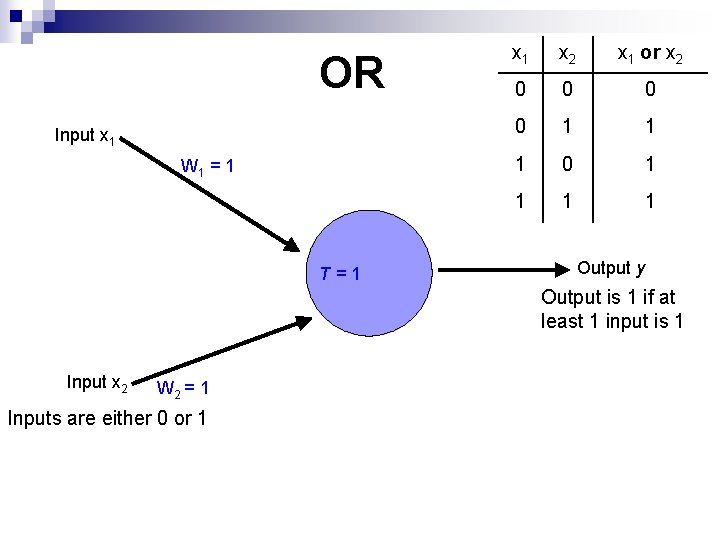
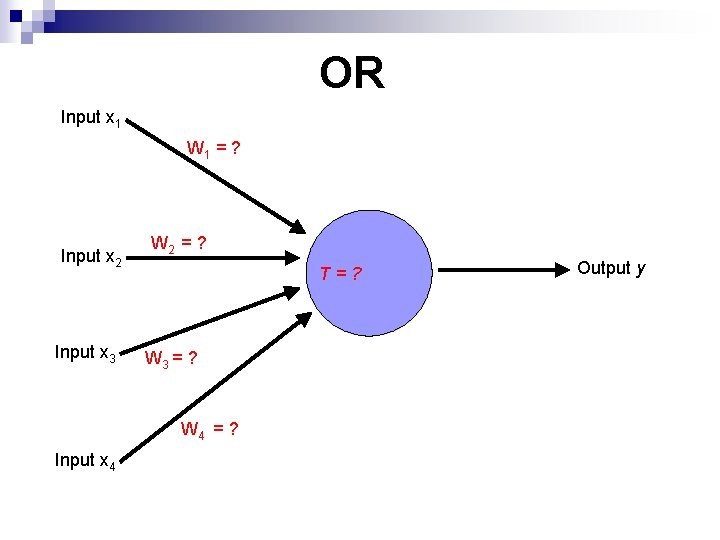
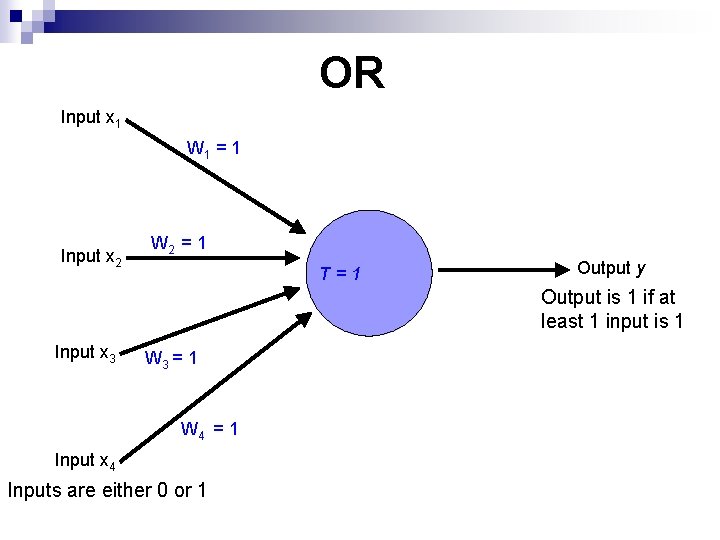
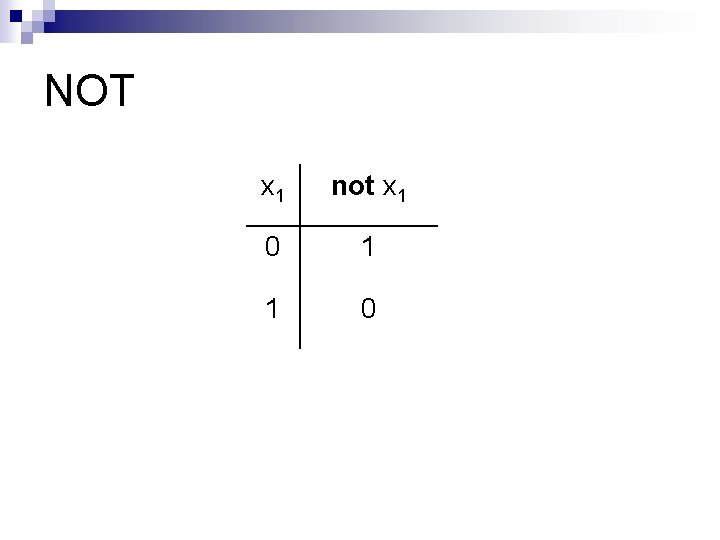
Examples - Logical operators AND – if all inputs are 1, return 1, otherwise return 0 OR – if at least one input is 1, return 1, otherwise return 0 NOT – return the opposite of the input XOR – if exactly one input is 1, then return 1, otherwise return 0
AND x 1 x 2 x 1 and x 2 0 0 1 1 1
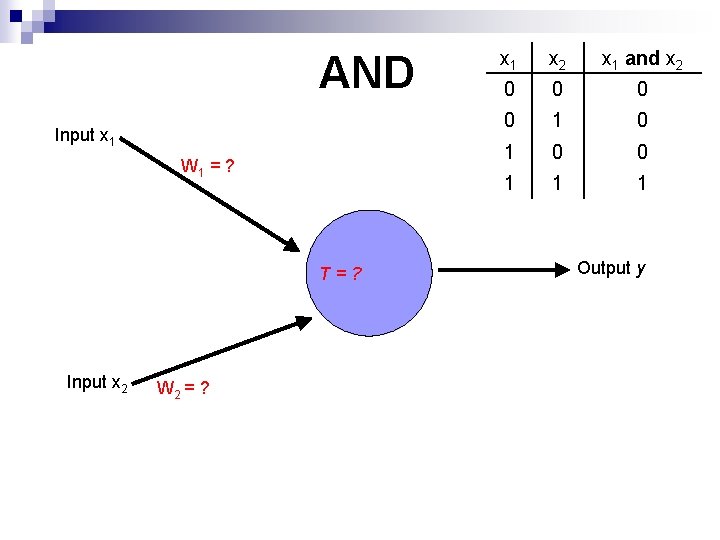
AND Input x 1 W 1 = ? T=? Input x 2 W 2 = ? x 1 x 2 x 1 and x 2 0 0 1 1 1 Output y
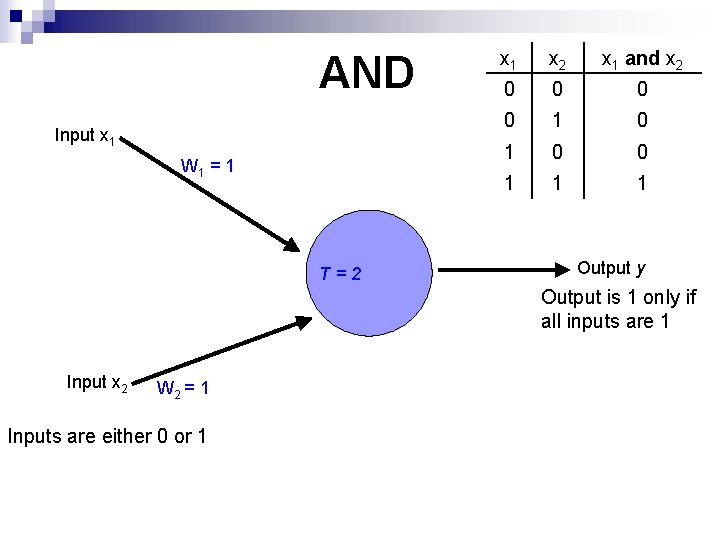
AND Input x 1 W 1 = 1 T=2 x 1 x 2 x 1 and x 2 0 0 1 1 1 Output y Output is 1 only if all inputs are 1 Input x 2 W 2 = 1 Inputs are either 0 or 1
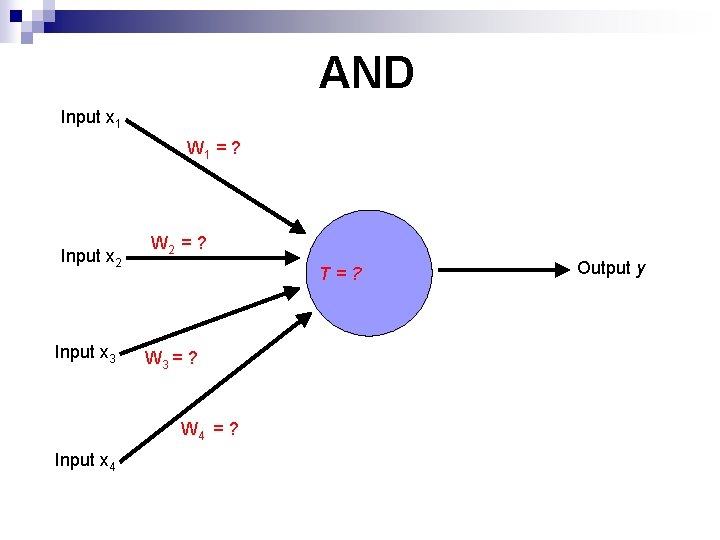
AND Input x 1 W 1 = ? Input x 2 Input x 3 W 2 = ? T=? W 3 = ? W 4 = ? Input x 4 Output y
AND Input x 1 W 1 = 1 Input x 2 W 2 = 1 T=4 Output y Output is 1 only if all inputs are 1 Input x 3 W 3 = 1 W 4 = 1 Input x 4 Inputs are either 0 or 1
OR x 1 x 2 x 1 or x 2 0 0 1 1 1 0 1 1
OR Input x 1 W 1 = ? T=? Input x 2 W 2 = ? x 1 x 2 x 1 or x 2 0 0 1 1 1 0 1 1 Output y
OR Input x 1 W 1 = 1 T=1 x 2 x 1 or x 2 0 0 1 1 1 0 1 1 Output y Output is 1 if at least 1 input is 1 Input x 2 W 2 = 1 Inputs are either 0 or 1
OR Input x 1 W 1 = ? Input x 2 Input x 3 W 2 = ? T=? W 3 = ? W 4 = ? Input x 4 Output y
OR Input x 1 W 1 = 1 Input x 2 W 2 = 1 T=1 Output y Output is 1 if at least 1 input is 1 Input x 3 W 3 = 1 W 4 = 1 Input x 4 Inputs are either 0 or 1
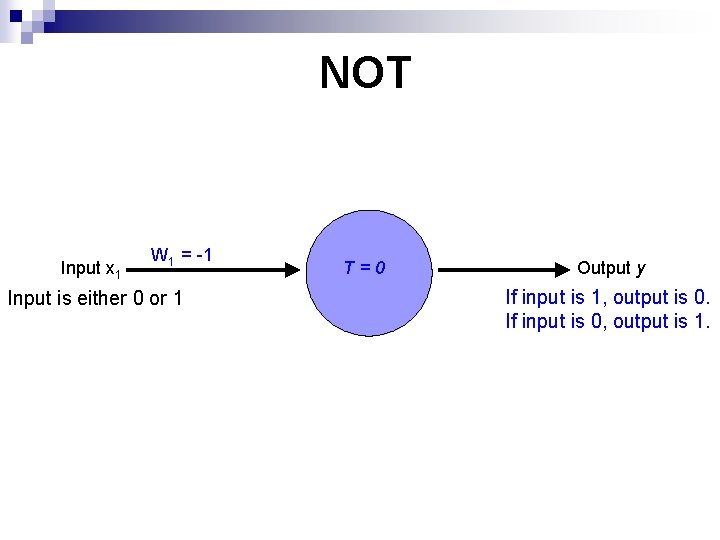
NOT x 1 not x 1 0 1 1 0
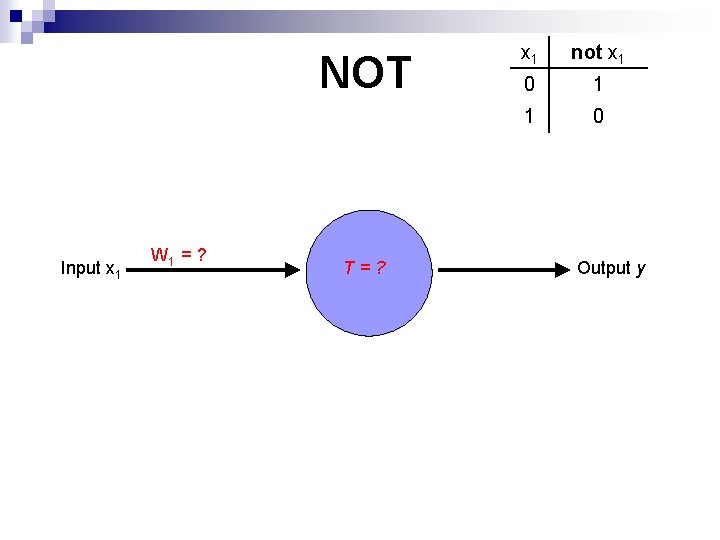
NOT Input x 1 W 1 = ? T=? x 1 not x 1 0 1 1 0 Output y
NOT Input x 1 W 1 = -1 Input is either 0 or 1 T=0 Output y If input is 1, output is 0. If input is 0, output is 1.
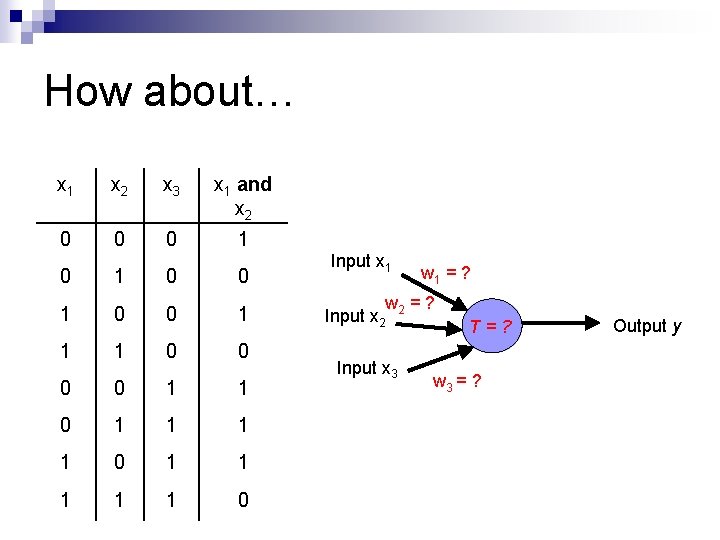
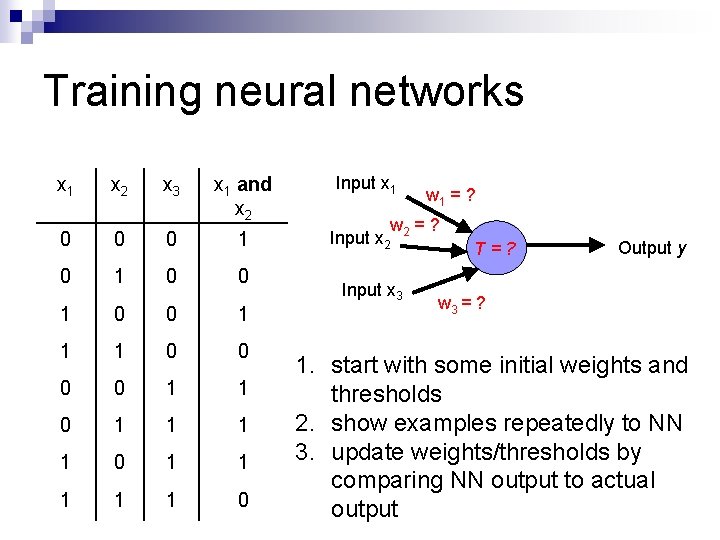
How about… x 1 x 2 x 3 x 1 and x 2 0 0 0 1 1 1 0 0 1 1 1 1 1 0 Input x 1 w 1 = ? w =? Input x 2 2 Input x 3 T=? w 3 = ? Output y
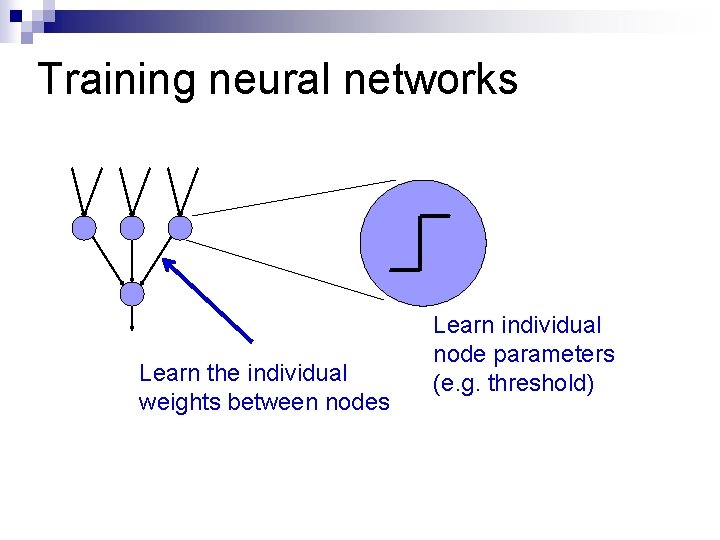
Training neural networks Learn the individual weights between nodes Learn individual node parameters (e. g. threshold)
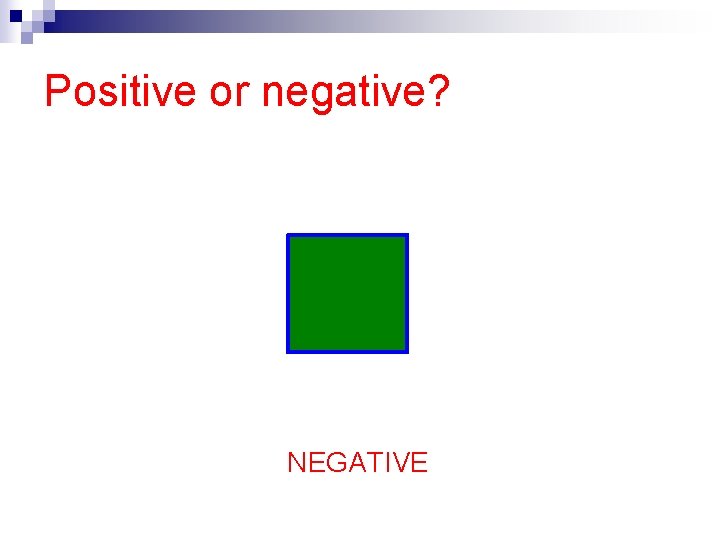
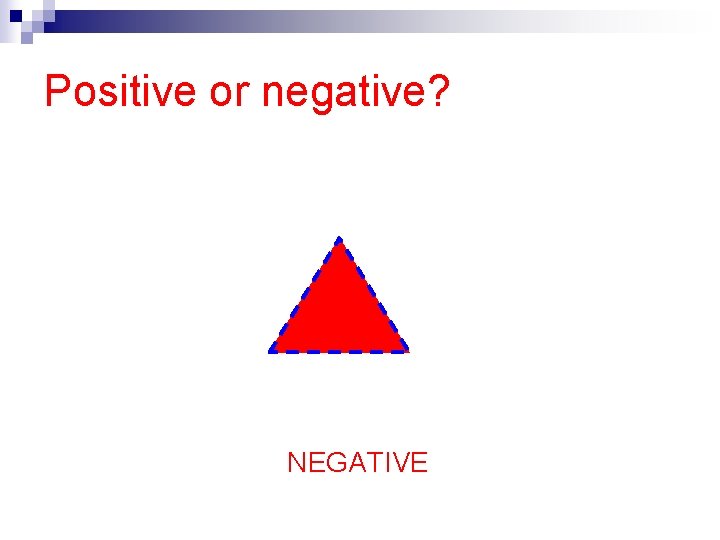
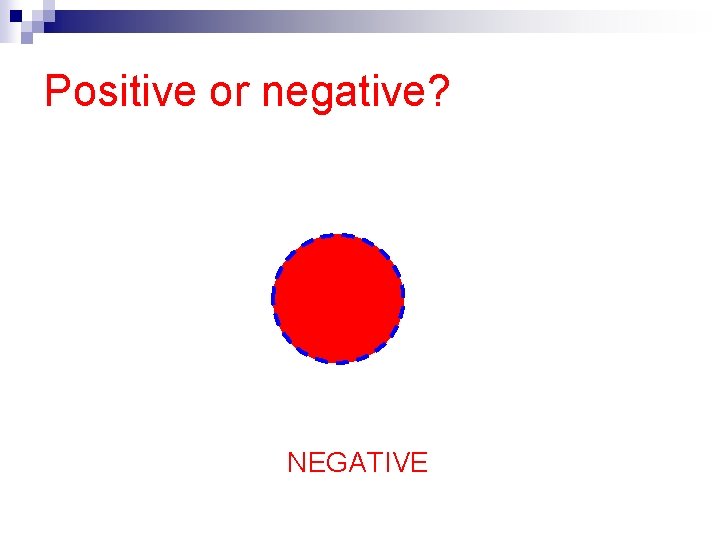
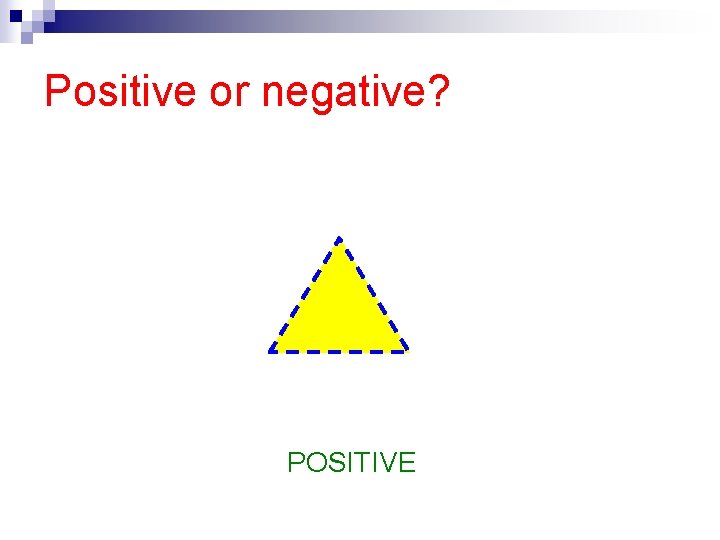
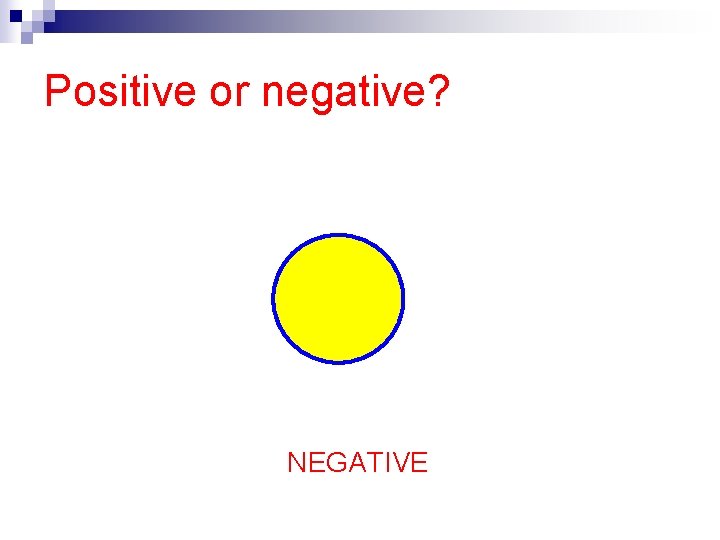
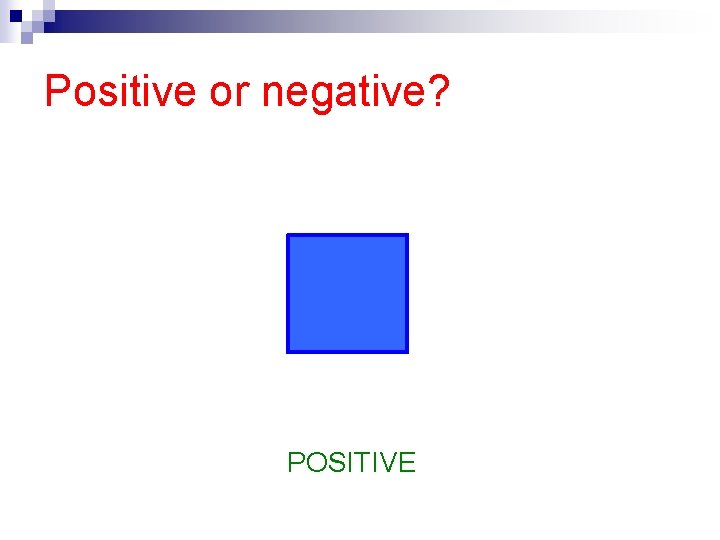
Positive or negative? NEGATIVE
Positive or negative? NEGATIVE
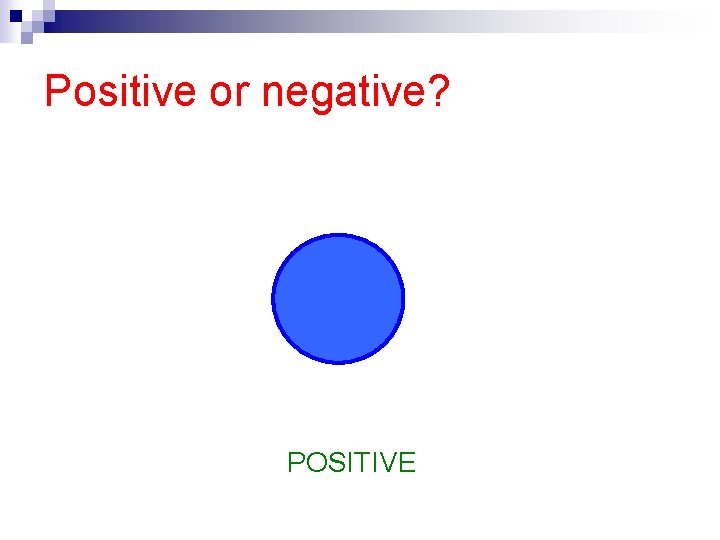
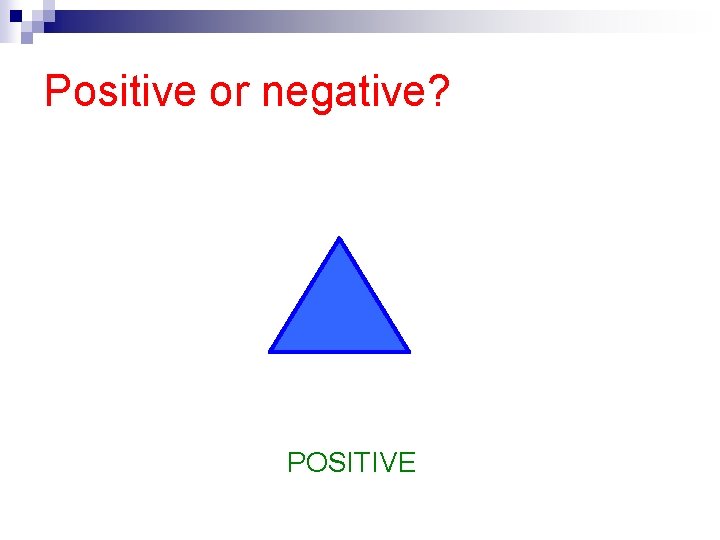
Positive or negative? POSITIVE
Positive or negative? NEGATIVE
Positive or negative? POSITIVE
Positive or negative? POSITIVE
Positive or negative? NEGATIVE
Positive or negative? POSITIVE
A method to the madness blue = positive yellow triangles = positive all others negative How did you figure this out (or some of it)?
Training neural networks x 1 x 2 x 3 x 1 and x 2 0 0 0 1 1 1 0 0 1 1 1 1 1 0 Input x 1 w 1 = ? w 2 = ? Input x 2 Input x 3 T=? Output y w 3 = ? 1. start with some initial weights and thresholds 2. show examples repeatedly to NN 3. update weights/thresholds by comparing NN output to actual output