
http www fao orgaims Semantic Technologies at FAO
- Slides: 69
http: //www. fao. org/aims/ Semantic Technologies at FAO International Society for Knowledge Organization (ISKO) 3 Aprile 2009, Torino Margherita Sini FAO 1/70
http: //www. fao. org/aims/ Few words about myself FAO 2/70
http: //www. fao. org/aims/ Just a very rapid introduction • What? – semantic, semantic web, semantic technologies – ontologies, Knowledge Organization Systems, – metadata • Why? – interoperability, exchange, share – user orientation, precision and recall – multilinguality, cultural views, context • Who? – everybody, all domains, all countries, all. org • Which instruments? FAO – experts, NLP, methodologies and techniques 3/70
http: //www. fao. org/aims/ Outline • Semantic projects involving FAO – AOS – IPFSAPH, FNA, CWR, Fisheries, Food & nutrition, Geopolitical ontology, AGROVOC Concept Server – Thai Rice Onto, Agropedia Indica • Conclusions – ontology-based applications – Collaborations – Take home messages FAO 4/70
http: //www. fao. org/aims/ Semantic projects involving FAO 5/70
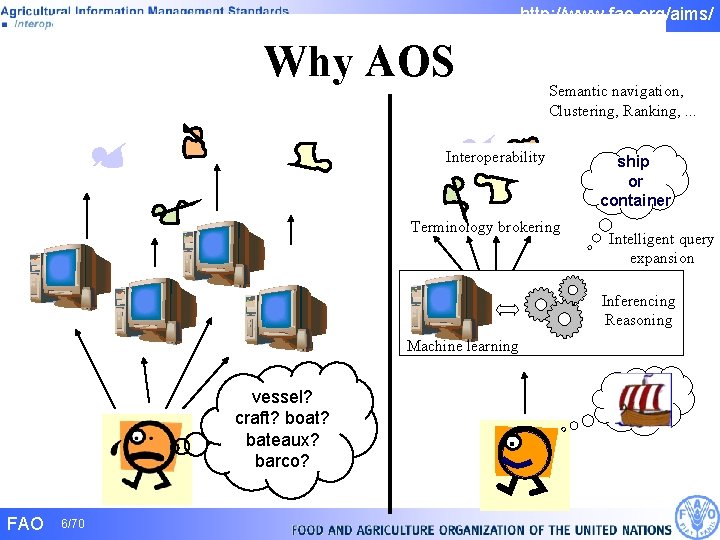
http: //www. fao. org/aims/ Why AOS Semantic navigation, Clustering, Ranking, . . . Interoperability Terminology brokering ship or container Intelligent query expansion Inferencing Reasoning Machine learning vessel? craft? boat? bateaux? barco? FAO 6/70
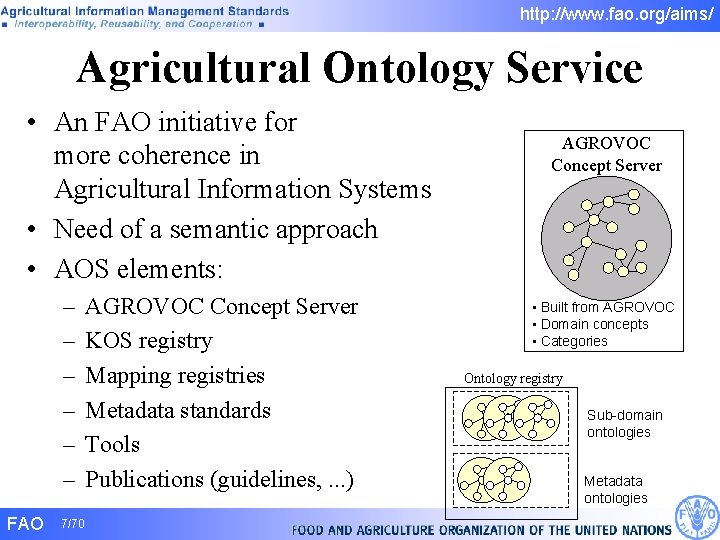
http: //www. fao. org/aims/ Agricultural Ontology Service • An FAO initiative for more coherence in Agricultural Information Systems • Need of a semantic approach • AOS elements: – – – FAO 7/70 AGROVOC Concept Server KOS registry Mapping registries Metadata standards Tools Publications (guidelines, . . . ) AGROVOC Concept Server • Built from AGROVOC • Domain concepts • Categories Ontology registry Sub-domain ontologies Metadata ontologies
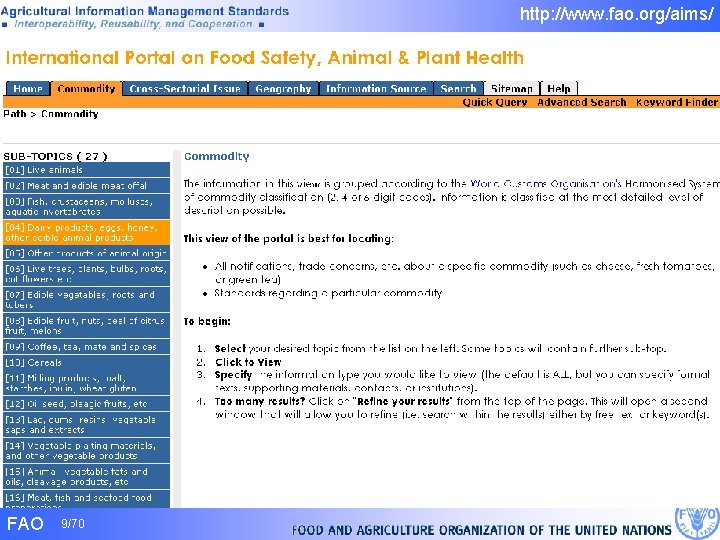
http: //www. fao. org/aims/ IPFSAPH FAO 8/70
http: //www. fao. org/aims/ IPFSAPH FAO 9/70
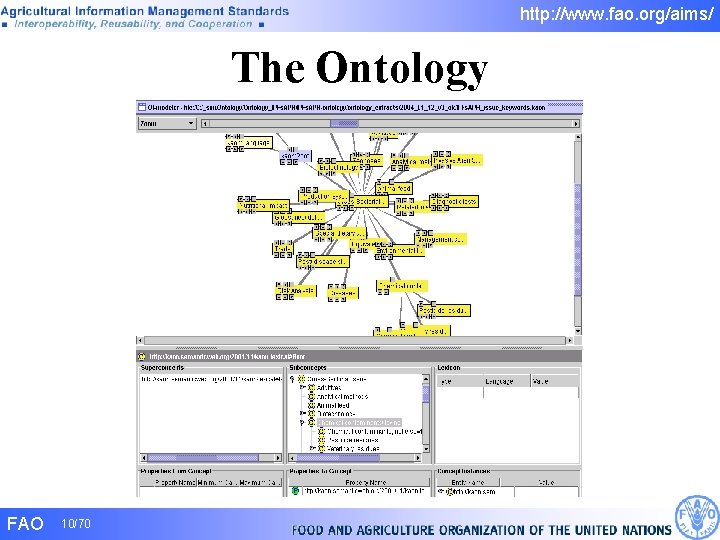
http: //www. fao. org/aims/ The Ontology FAO 10/70
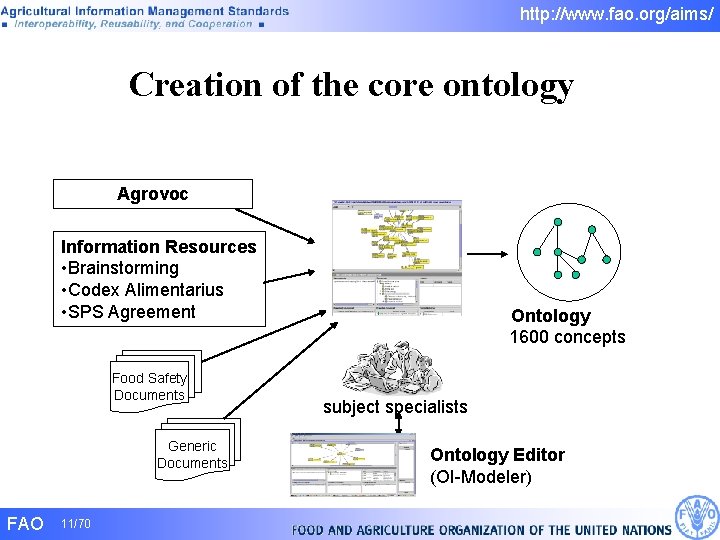
http: //www. fao. org/aims/ Creation of the core ontology Agrovoc Information Resources • Brainstorming • Codex Alimentarius • SPS Agreement Food Safety Documents Generic Documents FAO 11/70 Ontology 1600 concepts subject specialists Ontology Editor (OI-Modeler)
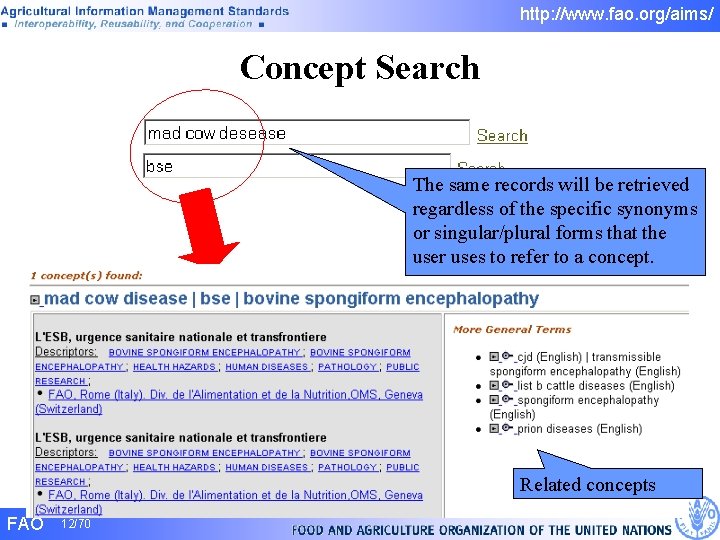
http: //www. fao. org/aims/ Concept Search The same records will be retrieved regardless of the specific synonyms or singular/plural forms that the user uses to refer to a concept. Related concepts FAO 12/70
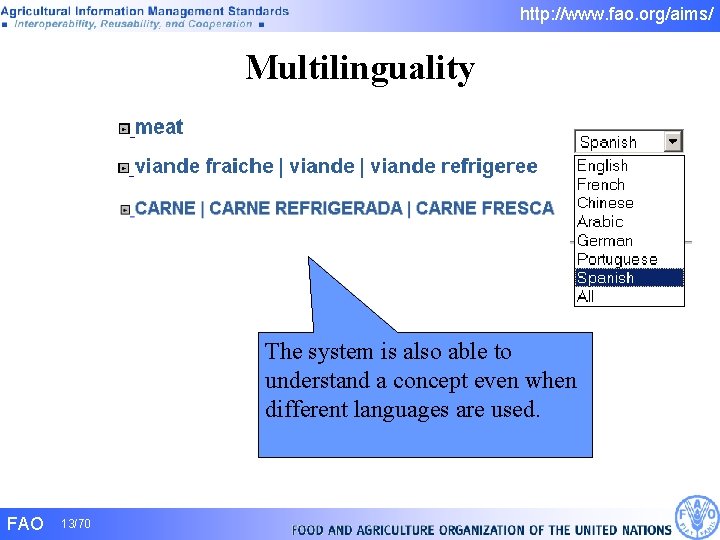
http: //www. fao. org/aims/ Multilinguality The system is also able to understand a concept even when different languages are used. FAO 13/70
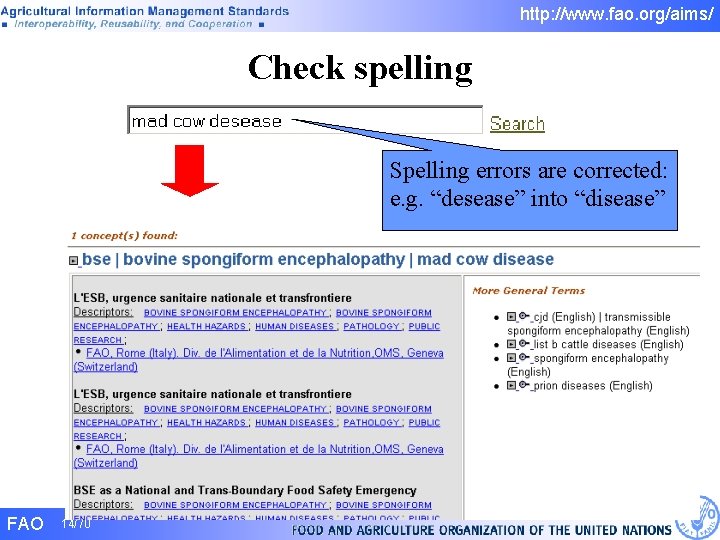
http: //www. fao. org/aims/ Check spelling Spelling errors are corrected: e. g. “desease” into “disease” FAO 14/70
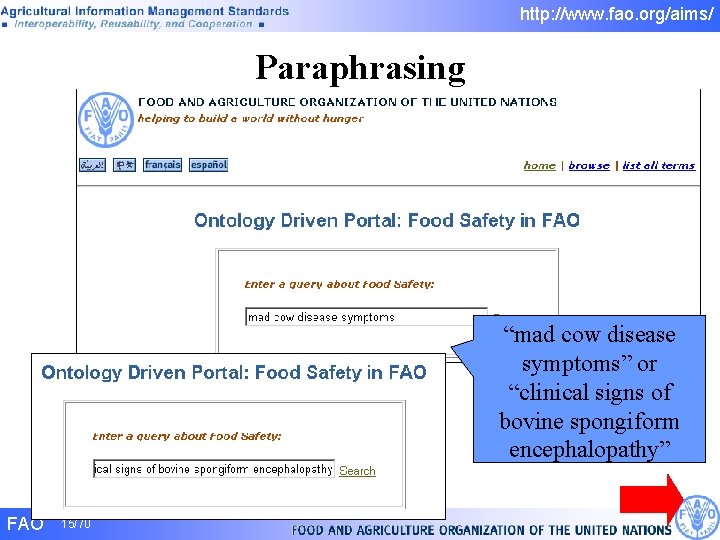
http: //www. fao. org/aims/ Paraphrasing “mad cow disease symptoms” or “clinical signs of bovine spongiform encephalopathy” FAO 15/70
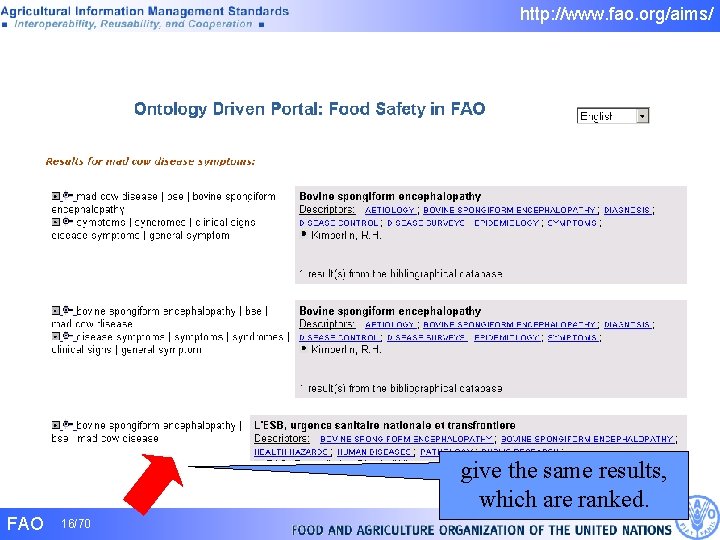
http: //www. fao. org/aims/ give the same results, which are ranked. FAO 16/70
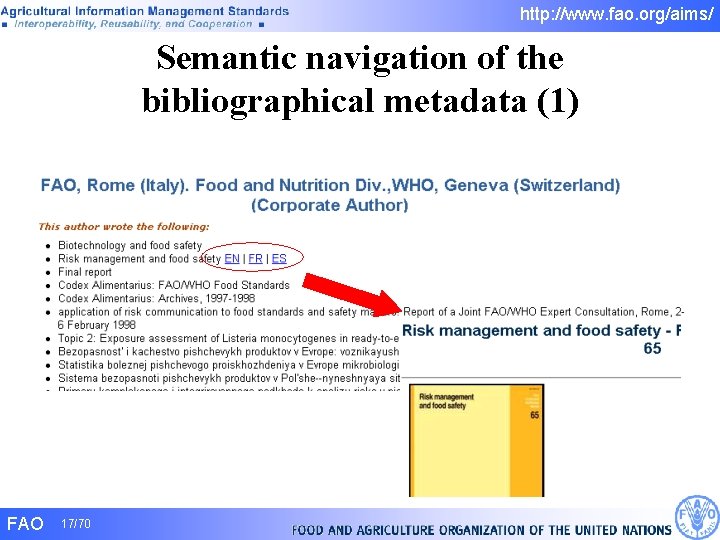
http: //www. fao. org/aims/ Semantic navigation of the bibliographical metadata (1) FAO 17/70
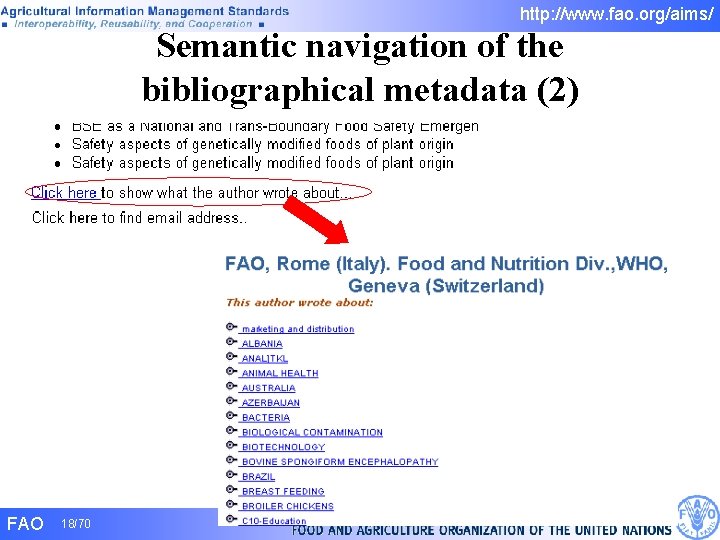
http: //www. fao. org/aims/ Semantic navigation of the bibliographical metadata (2) FAO 18/70
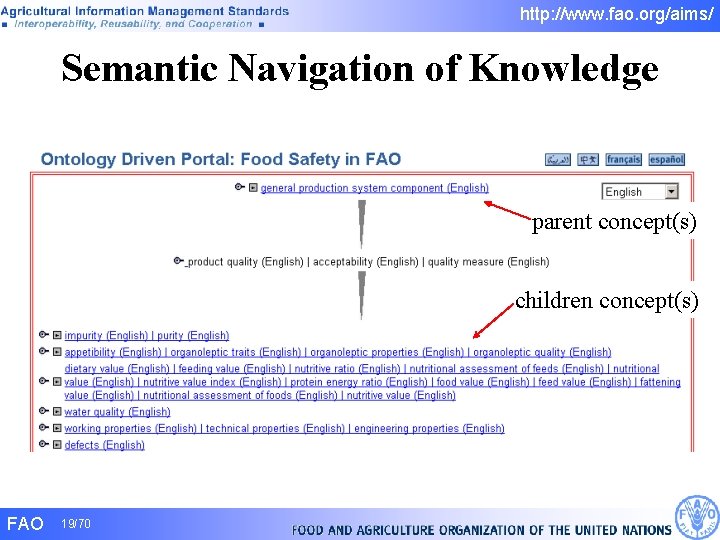
http: //www. fao. org/aims/ Semantic Navigation of Knowledge parent concept(s) children concept(s) FAO 19/70
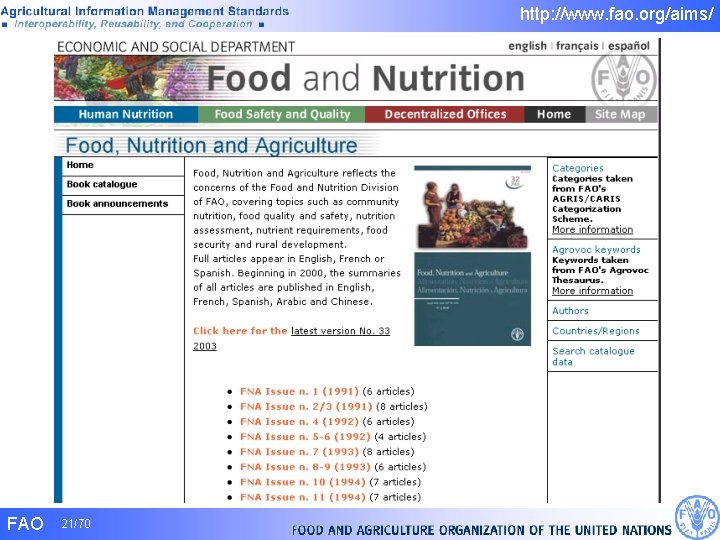
http: //www. fao. org/aims/ FNA FAO 20/70
http: //www. fao. org/aims/ FAO 21/70
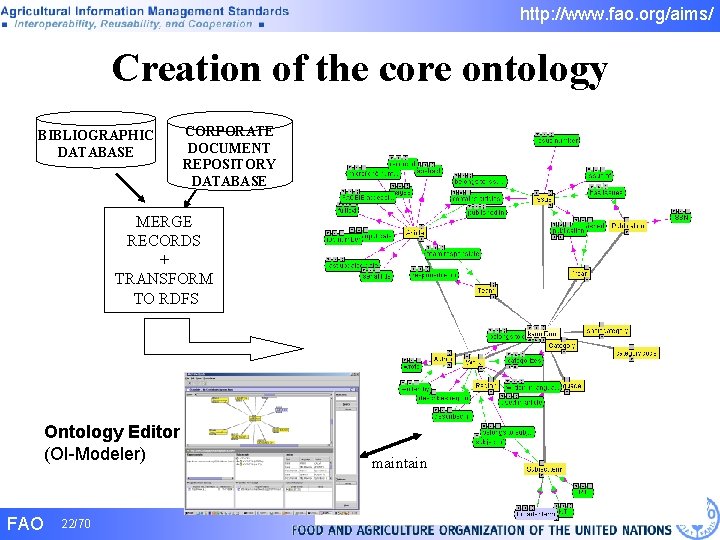
http: //www. fao. org/aims/ Creation of the core ontology BIBLIOGRAPHIC DATABASE CORPORATE DOCUMENT REPOSITORY DATABASE MERGE RECORDS + TRANSFORM TO RDFS Ontology Editor (OI-Modeler) FAO 22/70 maintain
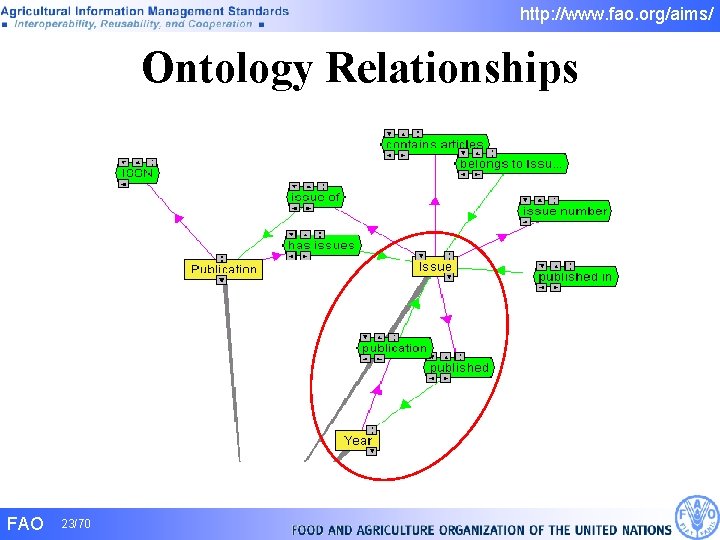
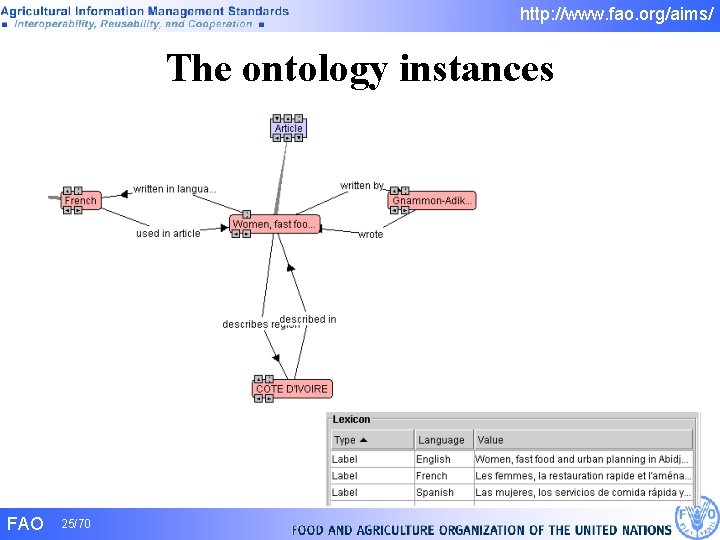
http: //www. fao. org/aims/ Ontology Relationships FAO 23/70
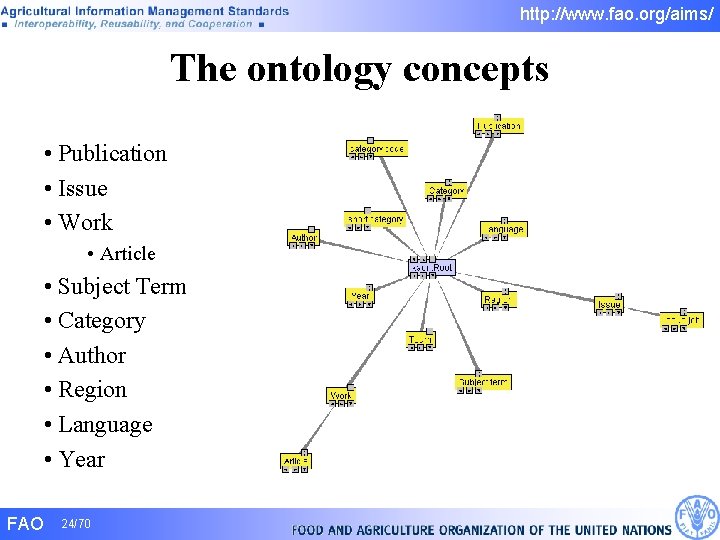
http: //www. fao. org/aims/ The ontology concepts • Publication • Issue • Work • Article • Subject Term • Category • Author • Region • Language • Year FAO 24/70
http: //www. fao. org/aims/ The ontology instances FAO 25/70
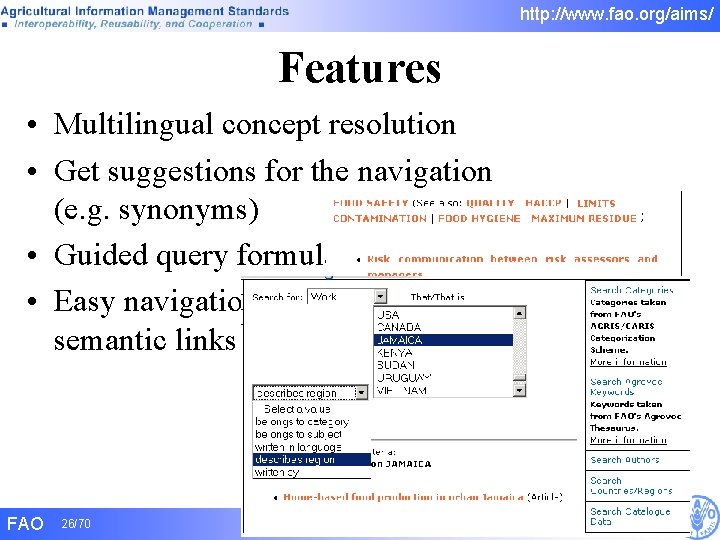
http: //www. fao. org/aims/ Features • Multilingual concept resolution • Get suggestions for the navigation (e. g. synonyms) • Guided query formulation • Easy navigation of the objects by following the semantic links FAO 26/70
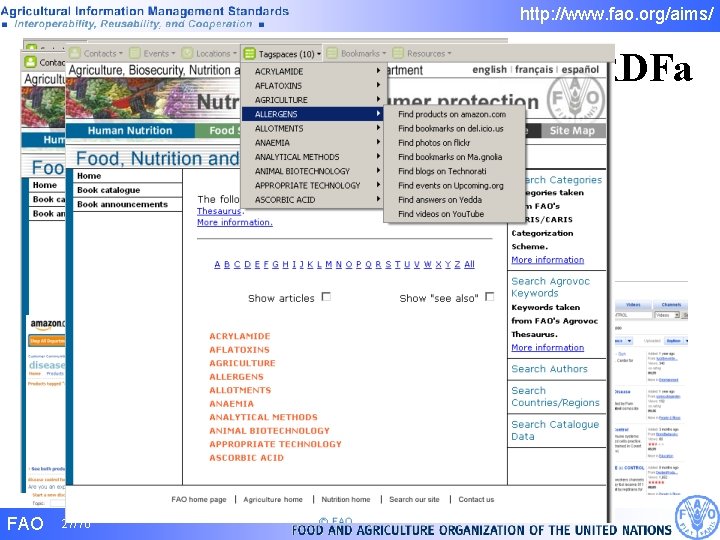
http: //www. fao. org/aims/ RDFa FAO 27/70
http: //www. fao. org/aims/ CWR FAO 28/70
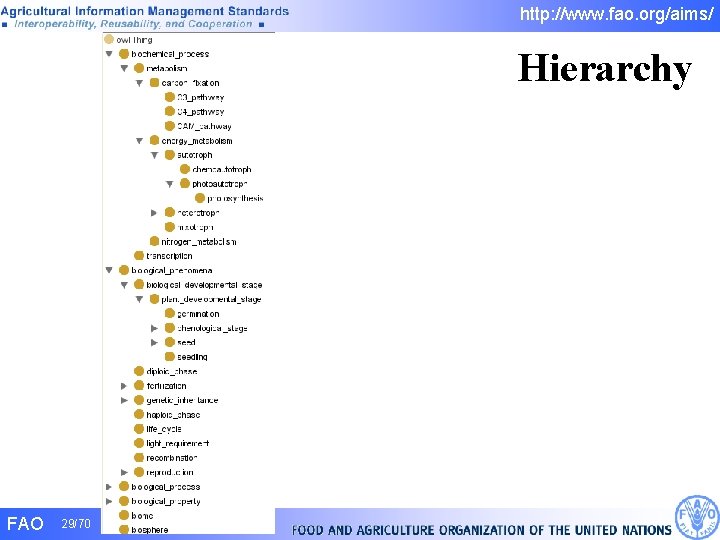
http: //www. fao. org/aims/ Hierarchy FAO 29/70
http: //www. fao. org/aims/ The project • Undertaken by FAO with partners • Developed in harmony with CWR descriptor list • First version (English only) available by December 2006 • About 800 core terms + acronyms + spelling variants; • Clearly definition of concepts (AGROVOC + other sources); and • Relationships: hierarchical + causative FAO 30/70
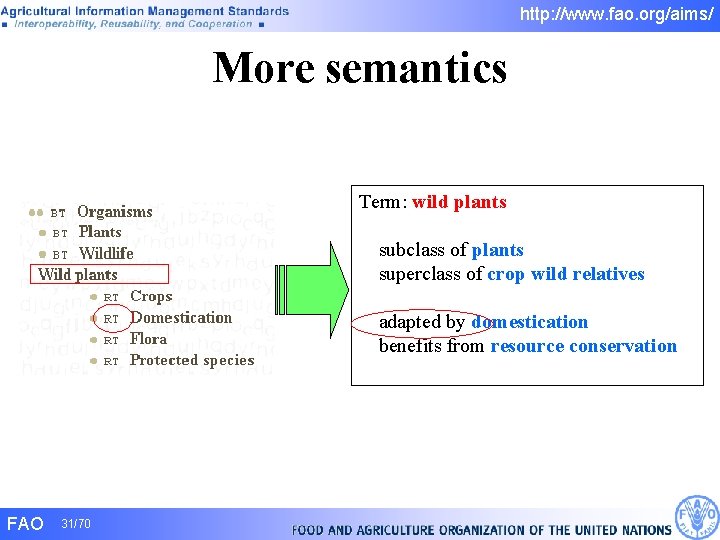
http: //www. fao. org/aims/ More semantics Term: wild plants subclass of plants superclass of crop wild relatives adapted by domestication benefits from resource conservation FAO 31/70
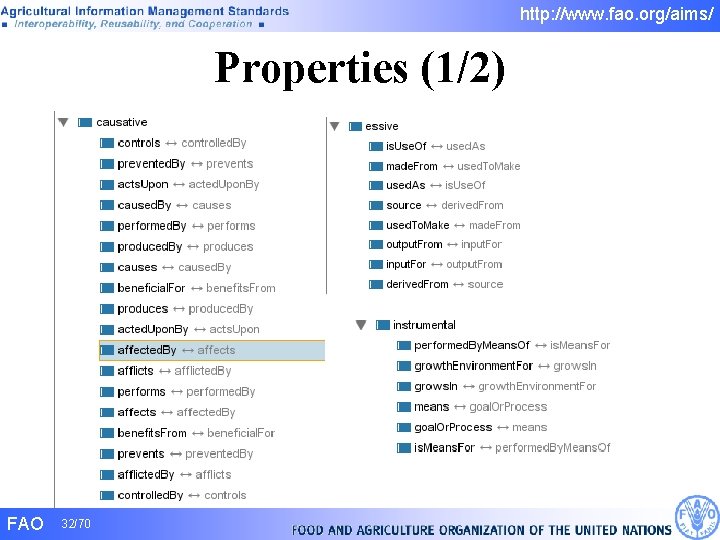
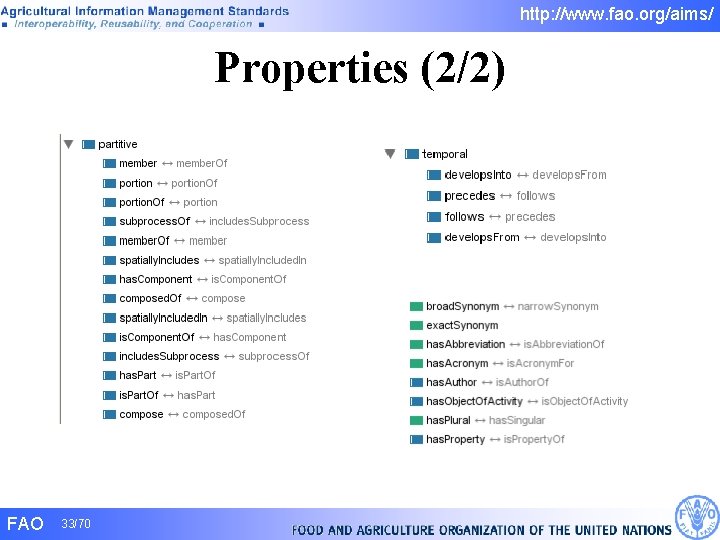
http: //www. fao. org/aims/ Properties (1/2) FAO 32/70
http: //www. fao. org/aims/ Properties (2/2) FAO 33/70
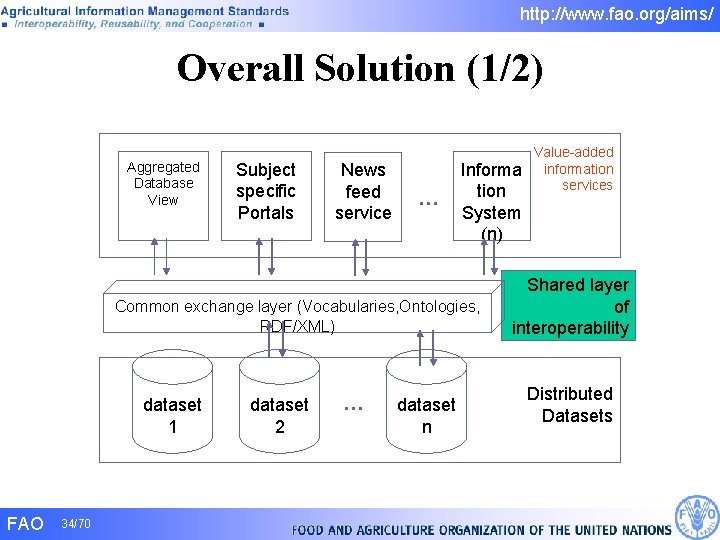
http: //www. fao. org/aims/ Overall Solution (1/2) Aggregated Database View Subject specific Portals News feed service … Informa tion System (n) Common exchange layer (Vocabularies, Ontologies, RDF/XML) dataset 1 FAO 34/70 dataset 2 … dataset n Value-added information services Shared layer of interoperability Distributed Datasets
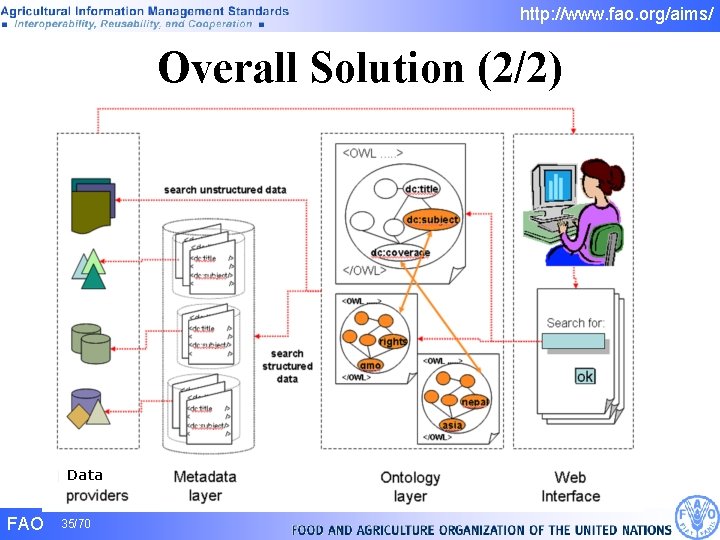
http: //www. fao. org/aims/ Overall Solution (2/2) Data FAO 35/70
http: //www. fao. org/aims/ Fisheries FAO 36/70
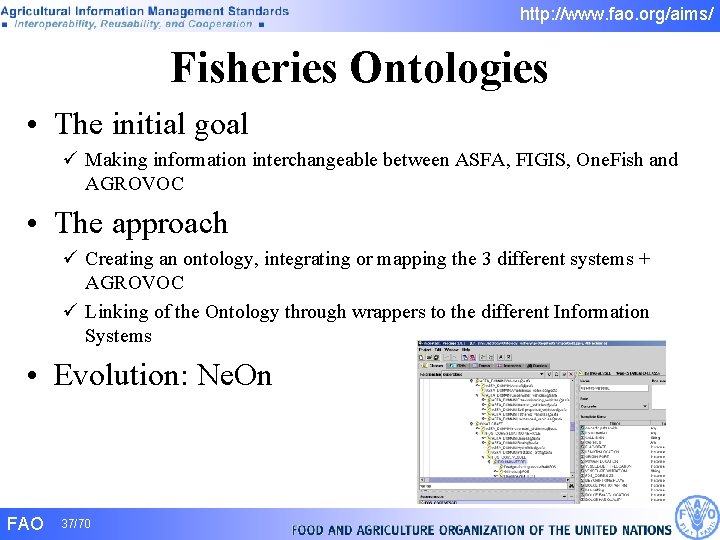
http: //www. fao. org/aims/ Fisheries Ontologies • The initial goal ü Making information interchangeable between ASFA, FIGIS, One. Fish and AGROVOC • The approach ü Creating an ontology, integrating or mapping the 3 different systems + AGROVOC ü Linking of the Ontology through wrappers to the different Information Systems • Evolution: Ne. On FAO 37/70
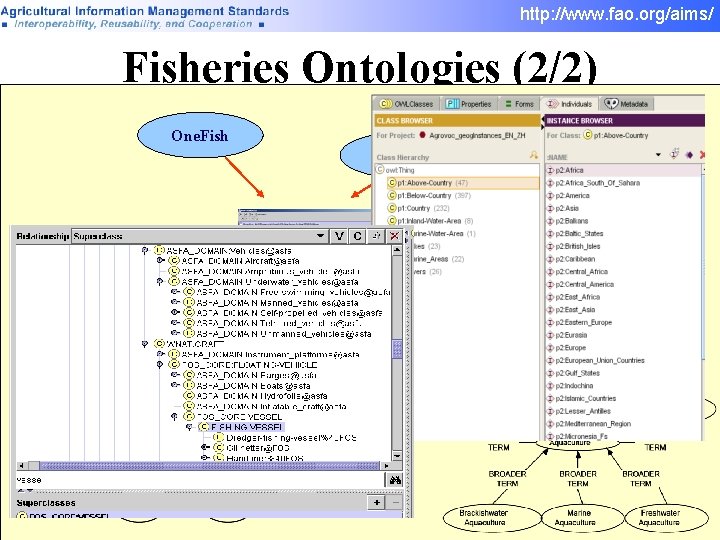
http: //www. fao. org/aims/ Fisheries Ontologies (2/2) diseases One. Fish FIGIS strains Species life cycle Hatchery technique Spawning Farmin technique g techniq Ex Health monitoring Breeding pl. ue for technique m Aquaculture Resource Environment Production center Water Regulation suppliers land management system Institution Area AGROVOC ASFA FAO 39/70 Farming system
http: //www. fao. org/aims/ Features 1. Form versus meaning: a) Traditional Search b) Concept Search 2. Implemented functionalities: a) synonym search b) multilingual capability c) terminology brokering d) disambiguation e) related concepts f) query expansion FAO 40/70 3. Basic natural language queries 4. Semantic navigation of bibliographical metadata 5. Semantic Navigation of Knowledge a) Alphabetic list. . . b) Core Fishery Concepts. . .
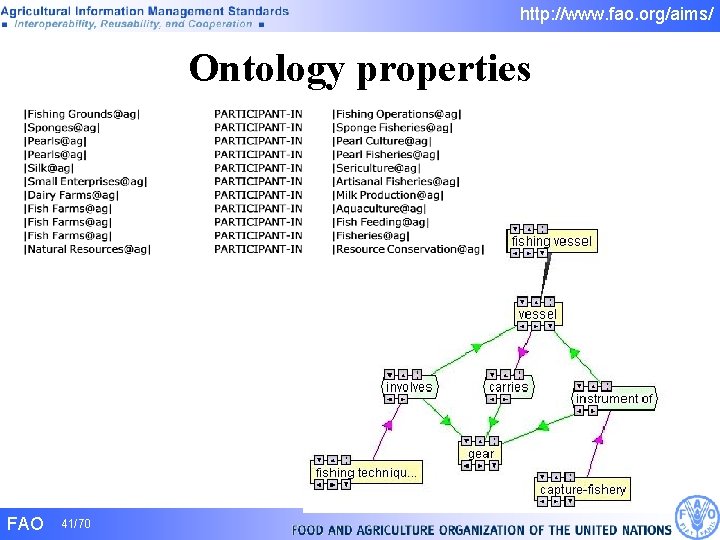
http: //www. fao. org/aims/ Ontology properties FAO 41/70
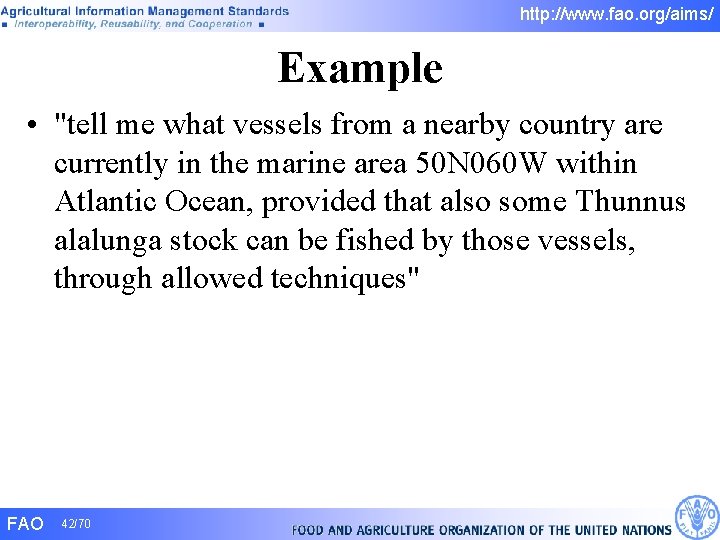
http: //www. fao. org/aims/ Example • "tell me what vessels from a nearby country are currently in the marine area 50 N 060 W within Atlantic Ocean, provided that also some Thunnus alalunga stock can be fished by those vessels, through allowed techniques" FAO 42/70
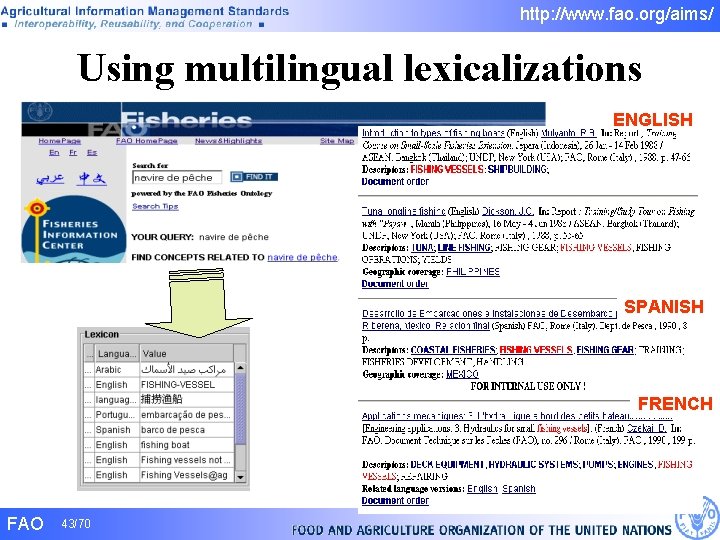
http: //www. fao. org/aims/ Using multilingual lexicalizations ENGLISH SPANISH FRENCH FAO 43/70
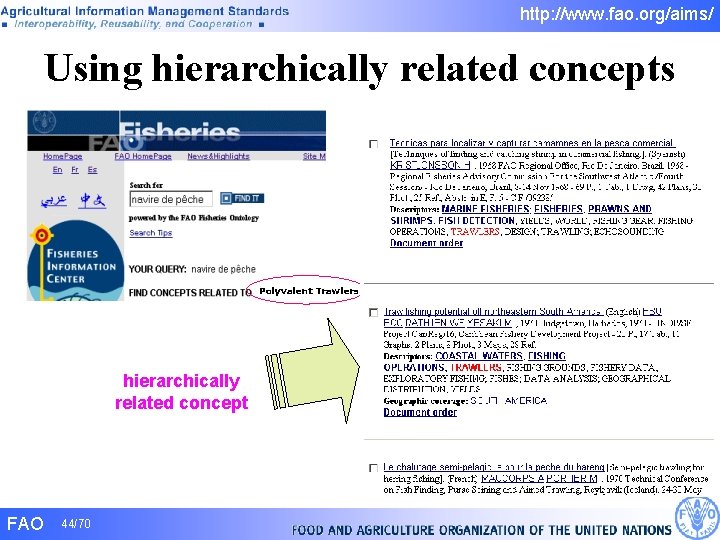
http: //www. fao. org/aims/ Using hierarchically related concepts Polyvalent Trawlers hierarchically related concept FAO 44/70
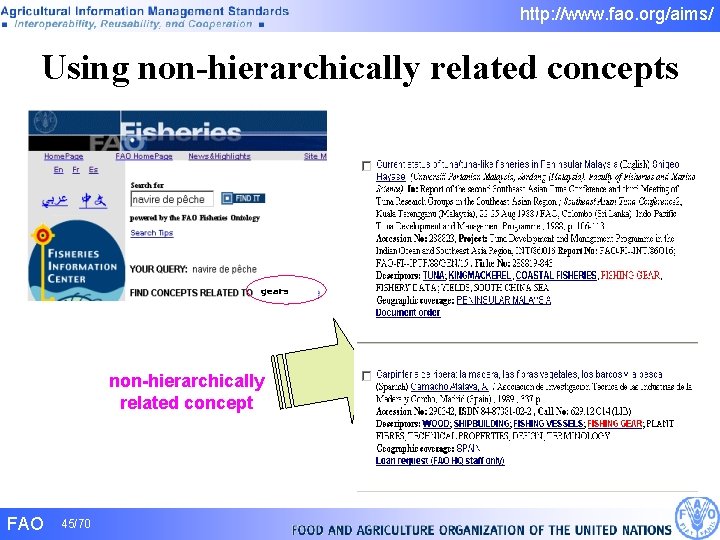
http: //www. fao. org/aims/ Using non-hierarchically related concepts gears non-hierarchically related concept FAO 45/70
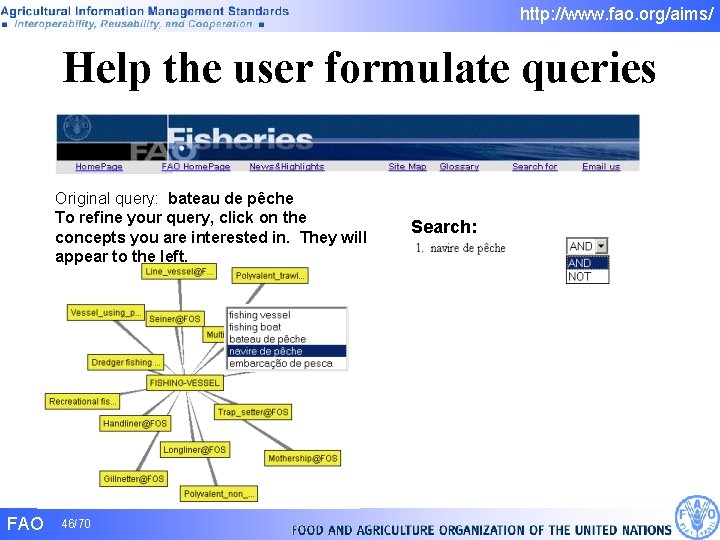
http: //www. fao. org/aims/ Help the user formulate queries Original query: bateau de pêche To refine your query, click on the concepts you are interested in. They will appear to the left. FAO 46/70 Search:
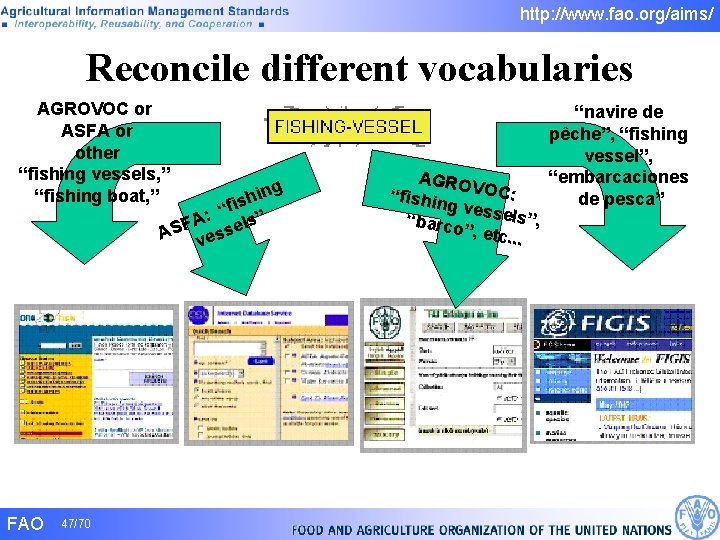
http: //www. fao. org/aims/ Reconcile different vocabularies AGROVOC or ASFA or other “fishing vessels, ” “fishing boat, ” ing fish “ FA: sels” S A ves FAO 47/70 AGRO “fishin VOC: g vess els”, “barco ”, etc. . . “navire de pêche”, “fishing vessel”, “embarcaciones de pesca”
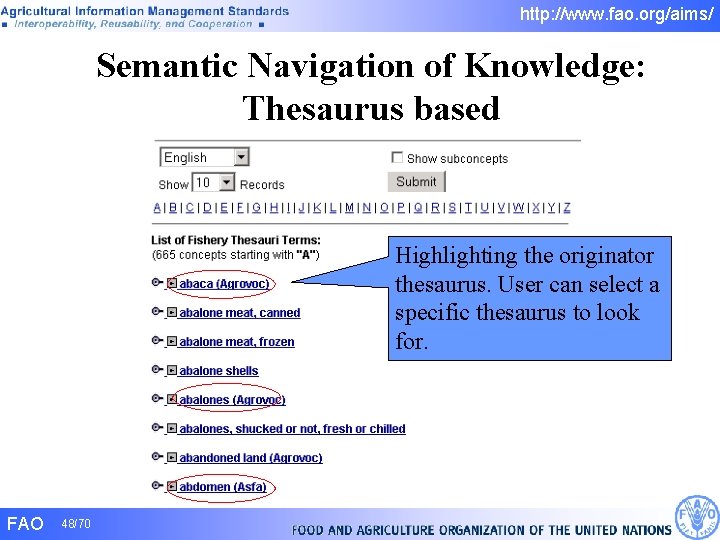
http: //www. fao. org/aims/ Semantic Navigation of Knowledge: Thesaurus based Highlighting the originator thesaurus. User can select a specific thesaurus to look for. FAO 48/70
http: //www. fao. org/aims/ Geopolitical ontology FAO 49/70
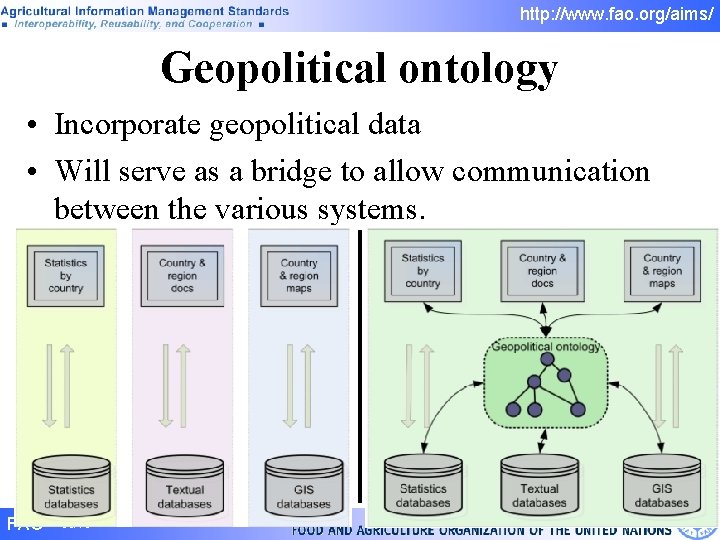
http: //www. fao. org/aims/ Geopolitical ontology • Incorporate geopolitical data • Will serve as a bridge to allow communication between the various systems. FAO 50/70
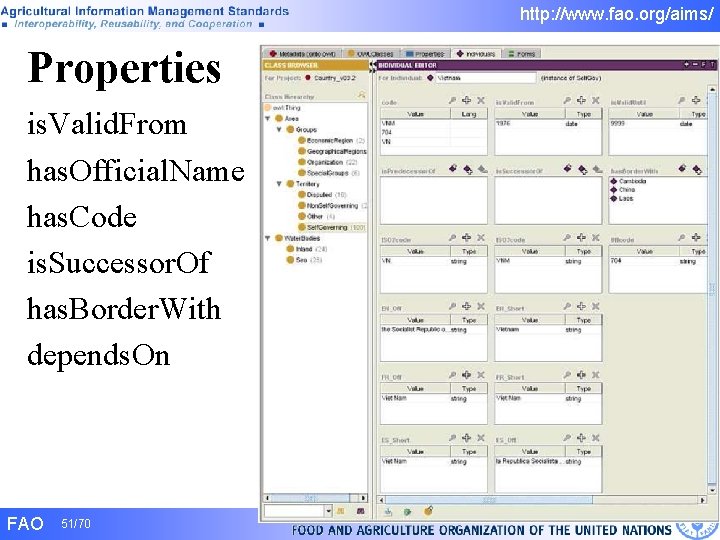
http: //www. fao. org/aims/ Properties is. Valid. From has. Official. Name has. Code is. Successor. Of has. Border. With depends. On FAO 51/70
http: //www. fao. org/aims/ Nutrition Ontology FAO 52/70
http: //www. fao. org/aims/ FAO 53/70
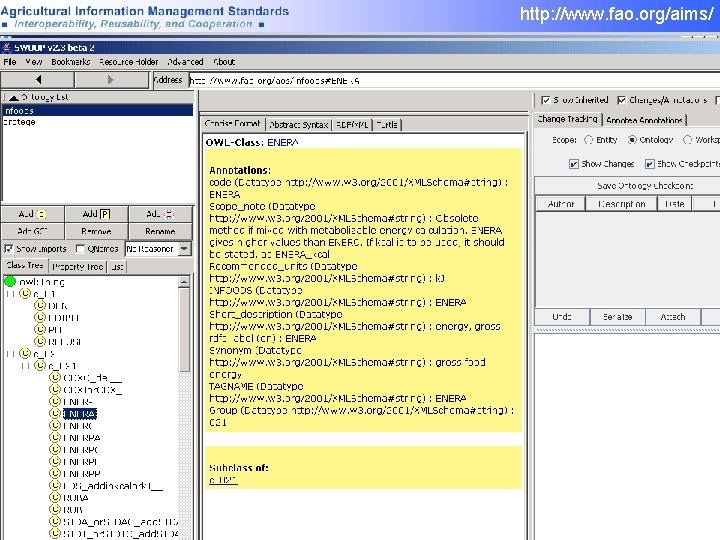
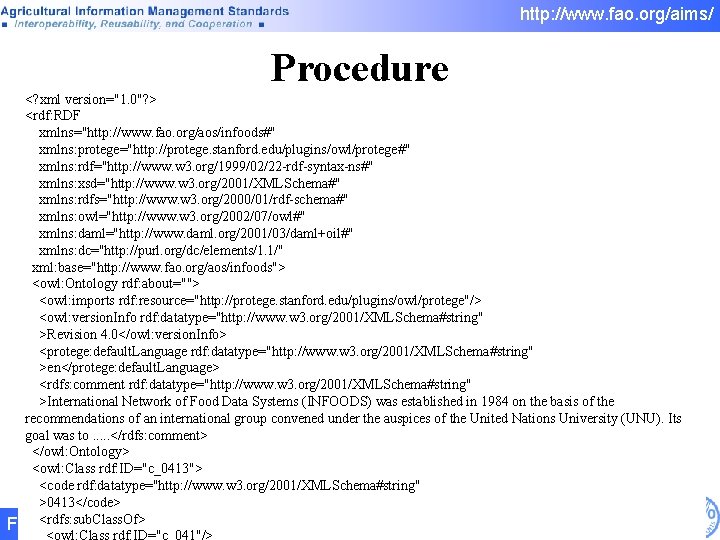
http: //www. fao. org/aims/ Procedure <? xml version="1. 0"? > <rdf: RDF xmlns="http: //www. fao. org/aos/infoods#" xmlns: protege="http: //protege. stanford. edu/plugins/owl/protege#" xmlns: rdf="http: //www. w 3. org/1999/02/22 -rdf-syntax-ns#" xmlns: xsd="http: //www. w 3. org/2001/XMLSchema#" xmlns: rdfs="http: //www. w 3. org/2000/01/rdf-schema#" xmlns: owl="http: //www. w 3. org/2002/07/owl#" xmlns: daml="http: //www. daml. org/2001/03/daml+oil#" xmlns: dc="http: //purl. org/dc/elements/1. 1/" xml: base="http: //www. fao. org/aos/infoods"> <owl: Ontology rdf: about=""> <owl: imports rdf: resource="http: //protege. stanford. edu/plugins/owl/protege"/> <owl: version. Info rdf: datatype="http: //www. w 3. org/2001/XMLSchema#string" >Revision 4. 0</owl: version. Info> <protege: default. Language rdf: datatype="http: //www. w 3. org/2001/XMLSchema#string" >en</protege: default. Language> <rdfs: comment rdf: datatype="http: //www. w 3. org/2001/XMLSchema#string" >International Network of Food Data Systems (INFOODS) was established in 1984 on the basis of the recommendations of an international group convened under the auspices of the United Nations University (UNU). Its goal was to. . . </rdfs: comment> =CONCATENATE("<owl: Class rdf: ID=""", J 2, """><rdfs: sub. Class. Of><owl: Class </owl: Ontology> rdf: ID=""c_", B 2, """/></rdfs: sub. Class. Of><rdfs: label <owl: Class rdf: ID="c_0413"> xml: lang=""en""><![CDATA[", D 2, "]]></rdfs: label><code><![CDATA[", J 2, "]]></code><T <code rdf: datatype="http: //www. w 3. org/2001/XMLSchema#string" AGNAME><![CDATA[", J 2, "]]></TAGNAME>", S 2, T 2, "</owl: Class>") >0413</code> 54/70 FAO<rdfs: sub. Class. Of>
http: //www. fao. org/aims/ AGROVOC FAO 55/70
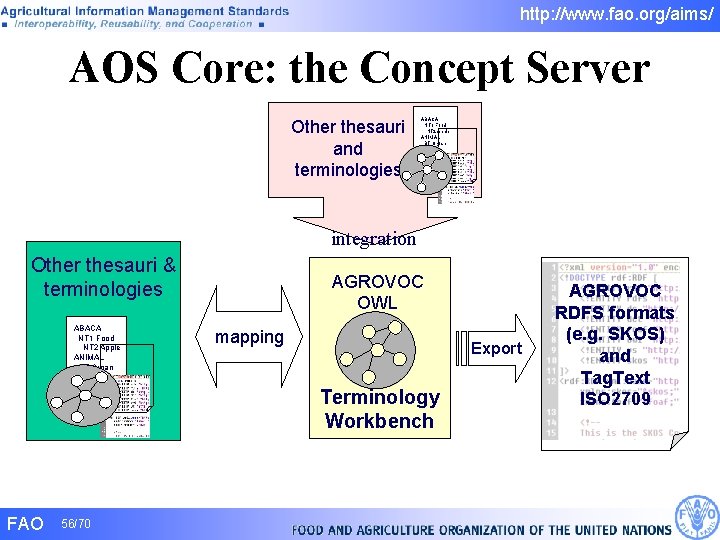
http: //www. fao. org/aims/ AOS Core: the Concept Server Other thesauri and terminologies ABACA NT 1 Food NT 2 Apple ANIMAL BT Organ NT. . integration Other thesauri & terminologies ABACA NT 1 Food NT 2 Apple ANIMAL BT Organ NT. . AGROVOC OWL mapping Export Terminology Workbench FAO 56/70 AGROVOC RDFS formats (e. g. SKOS) and Tag. Text ISO 2709
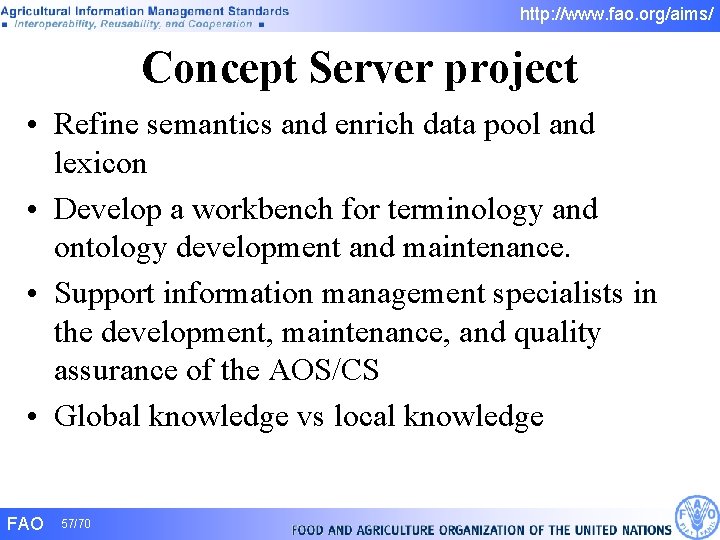
http: //www. fao. org/aims/ Concept Server project • Refine semantics and enrich data pool and lexicon • Develop a workbench for terminology and ontology development and maintenance. • Support information management specialists in the development, maintenance, and quality assurance of the AOS/CS • Global knowledge vs local knowledge FAO 57/70
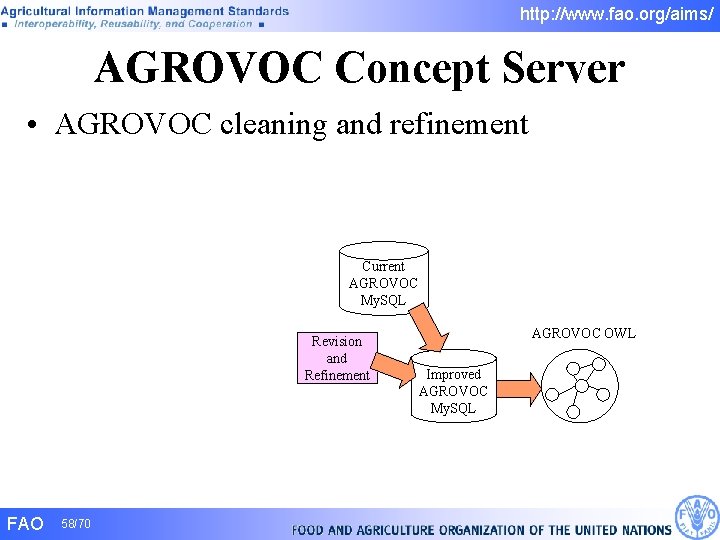
http: //www. fao. org/aims/ AGROVOC Concept Server • AGROVOC cleaning and refinement Current AGROVOC My. SQL Revision and Refinement FAO 58/70 AGROVOC OWL Improved AGROVOC My. SQL
http: //www. fao. org/aims/ Modelling FAO – Conversion to UTF-8 – Migration to My. SQL (from SQL server) – Migration to Postgre. SQL (from My. SQL) – Incorporated AGRIS/CARIS classification scheme (multilingual) and the mapping with AGROVOC keywords – Modified structure to store multiple classification schemes – Revised RDBMS scheme for ontology representation – Designed OWL models – Export to OWL format (v 0. 8 a) – Export to SKOS format (v 0. 8 a) 59/70
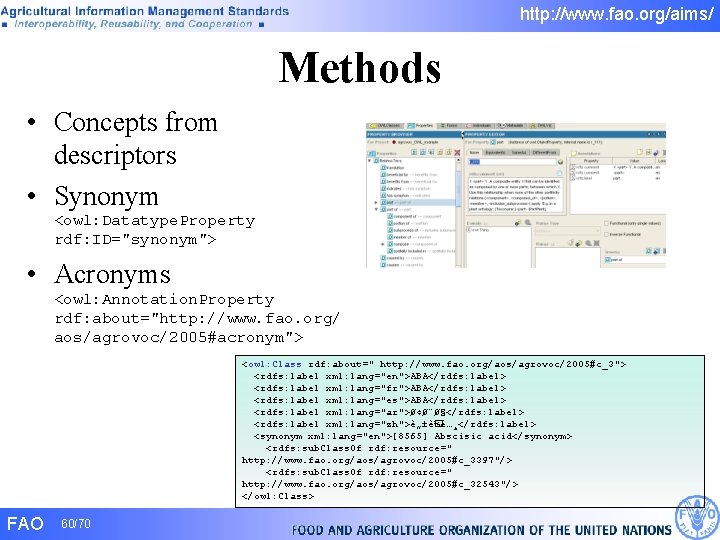
http: //www. fao. org/aims/ Methods • Concepts from descriptors • Synonym <owl: Datatype. Property rdf: ID="synonym"> • Acronyms <owl: Annotation. Property rdf: about="http: //www. fao. org/ aos/agrovoc/2005#acronym"> <owl: Class rdf: about=" http: //www. fao. org/aos/agrovoc/2005#c_3"> <rdfs: label xml: lang="en">ABA</rdfs: label> <rdfs: label xml: lang="fr">ABA</rdfs: label> <rdfs: label xml: lang="es">ABA</rdfs: label> <rdfs: label xml: lang="ar">آبا</rdfs: label> <rdfs: label xml: lang="zh">脱è� ½é…¸</rdfs: label> <synonym xml: lang="en">[8565] Abscisic acid</synonym> <rdfs: sub. Class. Of rdf: resource=" http: //www. fao. org/aos/agrovoc/2005#c_3397"/> <rdfs: sub. Class. Of rdf: resource=" http: //www. fao. org/aos/agrovoc/2005#c_32543"/> </owl: Class> FAO 60/70
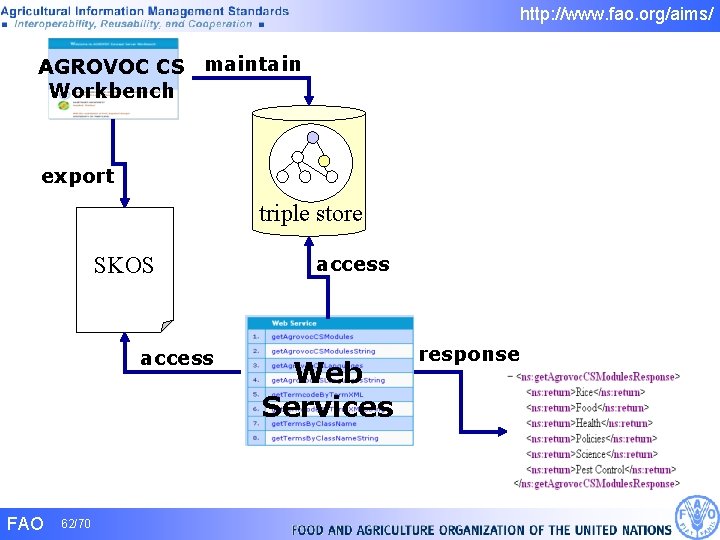
http: //www. fao. org/aims/ SKOS • SKOS export from AGROVOC Concept Server Workbench (WB) • SKOS web services – SKOS-services for DSpace plug-in • SKOS for mapping projects FAO 61/70
http: //www. fao. org/aims/ AGROVOC CS maintain Workbench export triple store SKOS access FAO 62/70 access Web Services response
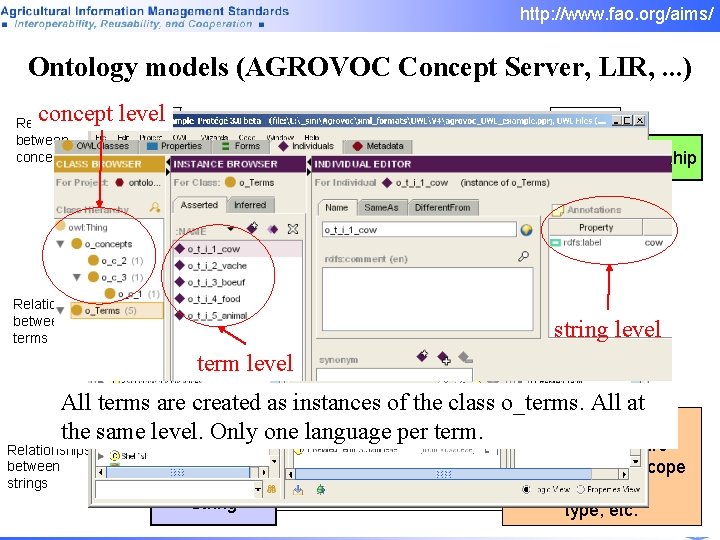
http: //www. fao. org/aims/ Ontology models (AGROVOC Concept Server, LIR, . . . ) concept level Relationships between concepts Relationships between Relationships Concept designated by Relationships between terms Lexicalization/ term level Term Relationship annotation relationship string level All terms are created as instances of the class o_terms. All at Other information: Note the same level. Only oneaslanguage per term. manifested Relationships between strings String FAO 63/70 language/culture subvocabulary/scope audience type, etc.
http: //www. fao. org/aims/ Agropedia Indica FAO 64/70
http: //www. fao. org/aims/ References • http: //www. slideshare. net/marghe_rita/1 pantnagar • http: //www. slideshare. net/marghe_rita/2 pantnagar-w-guidelines • http: //www. slideshare. net/marghe_rita/3 pantnagar-w-exercices • http: //agropedia. iitk. ac. in/ FAO 65/70
http: //www. fao. org/aims/ Conclusions FAO 66/70
http: //www. fao. org/aims/ Ontology-based applications • Better exploitation of the potentiality at the application level: powerful IR • No more words but URIs in IS • Networked Ontologies • Ontology Web services (OWS) FAO 67/70
http: //www. fao. org/aims/ Collaborations • With AOS partners • Within EU Projects – Ne. On – SEMIC. EU • With other initiatives – GFIS – Ecoterm • Mapping projects • GBIF Global Biodiversity Information Facility secretariat • JRC + BGS + Biblioteca Nazionale di Firenze FAO 68/70
http: //www. fao. org/aims/ Take-home message • There are many uses for terminology & ontology systems in food and agriculture, both for information access and information processing • FAO has several projects using such systems • FAO is deploying the Agricultural Ontology Server (AOS) as a global resource • SKOS and other knowledge representation standards play a key role FAO 69/70
http: //www. fao. org/aims/ Questions? Thanks Margherita Sini: margherita. Sini@fao. org Johannes Keizer: Johannes. Keizer@fao. org Dagobert Soergel: dsoergel@umd. edu Asanee Kawtrakul: asanee_naist@yahoo. com But Also: Gudrun Johannsen, Boris Lauser, Claudio Baldassarre, Gauri Salokhe, Marta Iglesias, Caterina Caracciolo, Sachit Rajbhandari, Jeetendra Singh, Mary Redahan, Shrestha, Prashanta, Ton, Imm, Thanapth, Trakul, and many others. . . FAO 70/70