
http www cic gc caenglishresourcespublicationsdiscoversection06 asp Chapter 2
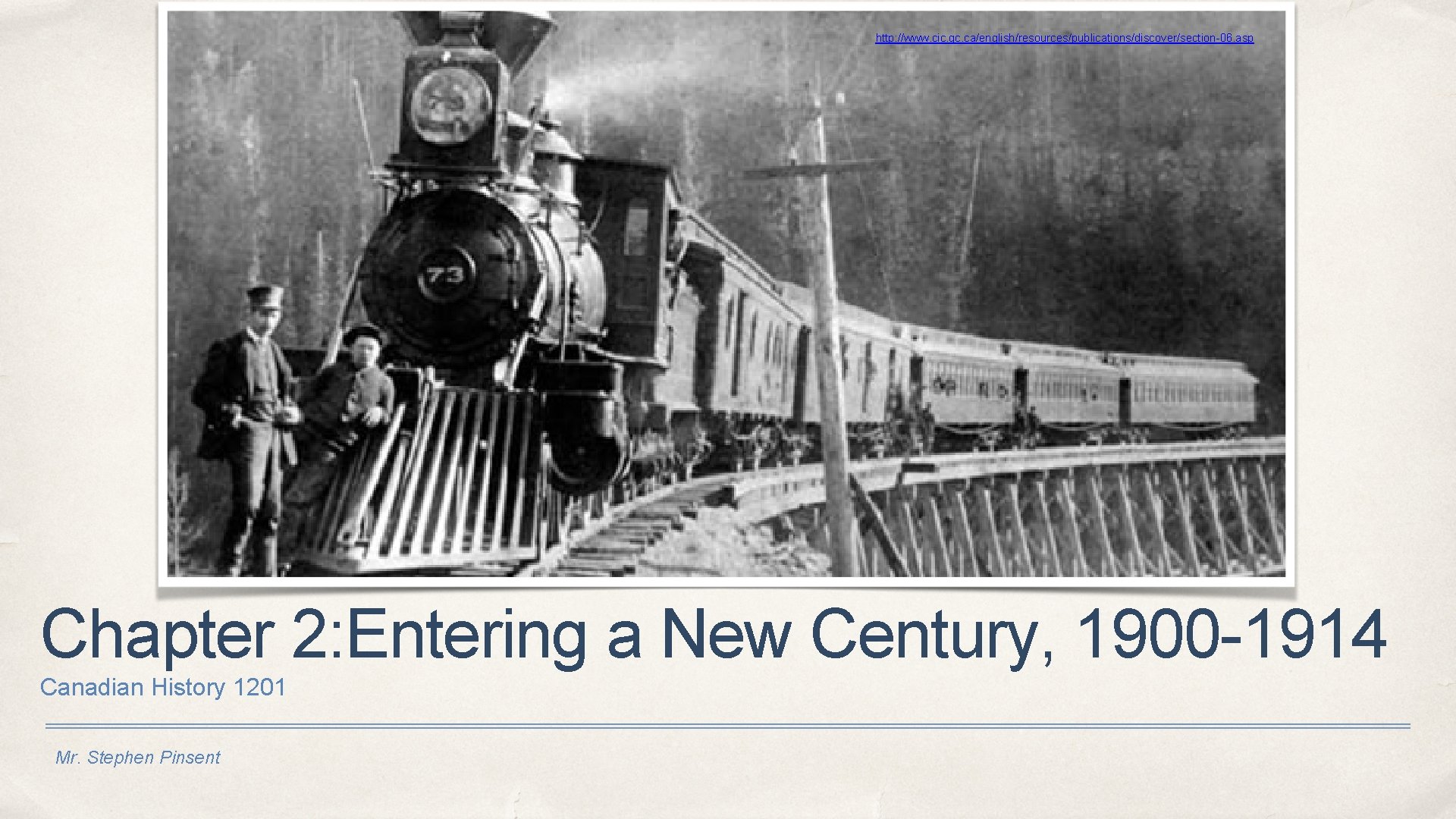
http: //www. cic. gc. ca/english/resources/publications/discover/section-06. asp Chapter 2: Entering a New Century, 1900 -1914 Canadian History 1201 Mr. Stephen Pinsent
2. 1 Canada: Land of Opportunity ✤ Immigration ✤ Between 1901 -1914 Canada’s populations jumped from 5. 3 million to 8 million people ✤ Most of this was through immigration (coming into a country to live) ✤ Up until this point most immigrants (persons who came into the country or region to live) had come from Great Britain and the United States. ✤ This was no longer the case. Nearly 3 million of these immigrants were from other areas and this radically changed Canada’s ethnic composition (the make-up of a country basis if different ethnic groups.
✤ The federal government in determining our immigration policy adopted an “open door” policy. ✤ The government was trying to attract farmers form the U. S. , Great Britain and from northern, central and eastern Europe to settle in Canada’s west. ✤ All other immigrant during this time were actively discouraged from applying.
✤ “Desirable” countries were flooded with pamphlets, posters and advertisements promising free land in the “last, best, west, ” with families being offered 160 acres of free land. ✤ Nearly 1 million immigrant families settled in the West between 1896 and 1914. ✤ The Immigrant Experience ✤ Many came to Canada to practise their religion free from persecution. Russians, German-speaking Mennonites, Anglican English settlers, Ukrainian, and Poles all came during this time. ✤ Many Americans came for the free land which was not available in the U. S. ✤ As well immigrants from China, Japan and India came to work in fisheries, mines, and lumber industries. Soon the government pass laws that made it difficult for Asians and other minorities to enter Canada.

Immigration: Push and Pull Factors “Old Country” Reasons to Leave Peace Jobs Available Land Freedom Opportunities Good Housing Religious Freedom Violence/War Fewer Jobs Little Available Land Limited Freedom Crowded Cities Poor Housing Religious Persecution “New Country” Reasons to Settle
2. 2 Railways and the Expansion of Canada ✤ Immigration in Western Canada made possible the development of the railway. ✤ The Canadian Pacific Railway (CPR) was an important link between Western and Eastern Canada. ✤ It carried settlers, workers, products west, and it transported grain to the East. ✤ The CPR had a difficult time meeting demand for all the immigrants as well grain terminals were backed up every year. 6
✤ Railway demands led Prime Minister Wilfrid Laurier to subsidize the construction of additional rail lines in 1903. ✤ In 1867 Canada had 3666 km of line, by 1914 there was 49, 588 km of track. ✤ By 1917 overbuilding along with the First World War put tremendous financial pressure on railway companies. ✤ Between 1917 and 1923 the Canadian Government took over many railway companies and it became the government run Canadian National Railways.
Patterns of Settlement and Development ✤ Railways played a major role in the settlement patterns in the early twentieth century. ✤ Factories and factory towns, industrial districts, Prairie towns and grain elevators all developed around rail lines. ✤ Settlement around market hubs for Canadian goods, as well as shipping ports also developed. ✤ As well many Canadians settled in close proximity to the Canadian/U. S. border.
2. 3 The Changing Face of Canada ✤ The Roots of Multiculturalism ✤ In the West and in Eastern Canada, new immigrants brought great changes. ✤ A new cultural mix was evident throughout Canada, and ethnic diversity was emerging in many Canadian towns and cities, marked by the appearance of new neighbourhoods that are were largely based on ethnic origins. ✤ Many of these neighbourhoods still exist today. 9
✤ Growth of Cities ✤ In 1900 the majority of Canadians lived on farms, and the countries population was predominately a rural one. ✤ During this time Canada’s urban population increased dramatically. ✤ Cities grew by leaps and bounds as large numbers of immigrants arrived and moved to cities looking for jobs in the new factories. ✤ New inventions such as electric lights brightened city nights, and electric streetcars carried people to and from city centres.
✤ New Provinces & Expanding Borders ✤ In 1905 both Alberta and Saskatchewan became provinces having previously been part fo the Northwest Territories (see maps pg. 30) ✤ In 1912 Manitoba, a small province at the time expanded its borders to its present boundries. ✤ As well during this time there was renewed tensions between French and English in Canada, many French and other minority groups felt that secular English-speaking schools were “Canadianizing” new settlers. ✤ Eventually school districts established public English-speaking schools, and minorities were free to establish a separate school if they wished.
2. 4 A Changing Economy ✤ The early 1900’s saw enormous changes in Canada’s economy. ✤ A capitalist system was developing and a new economic pattern was emerging. ✤ Fewer people were self sufficient (Grade 8 Social Studies). People now purchased manufactured clothes, tools, and food instead of making their own. ✤ Mass produced factory products were eagerly purchased by consumers. ✤ Manufacturing went from a handful of workers to huge factories employing hundreds of workers. 12
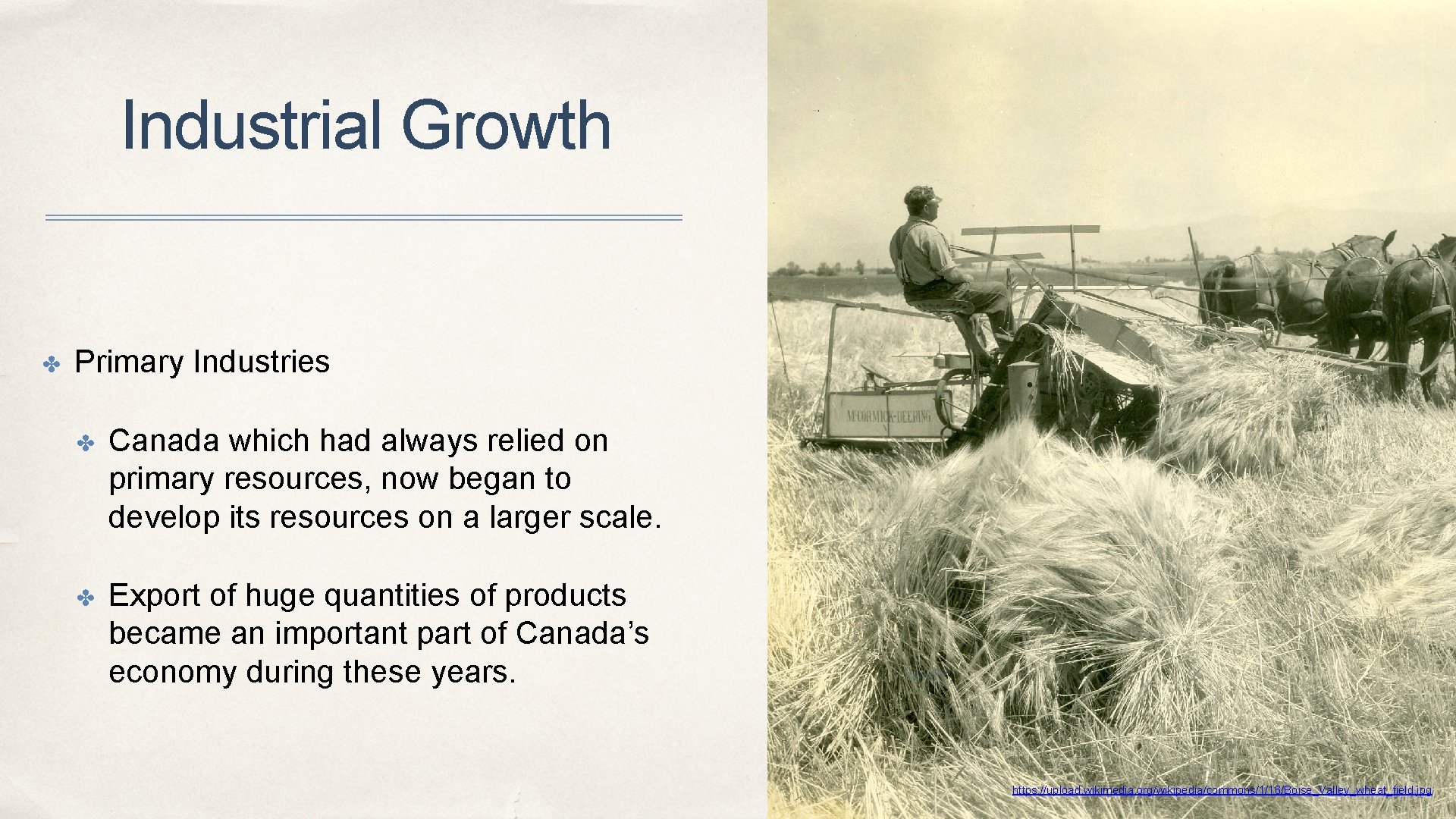
Industrial Growth ✤ Primary Industries ✤ Canada which had always relied on primary resources, now began to develop its resources on a larger scale. ✤ Export of huge quantities of products became an important part of Canada’s economy during these years. https: //upload. wikimedia. org/wikipedia/commons/1/16/Boise_Valley_wheat_field. jpg
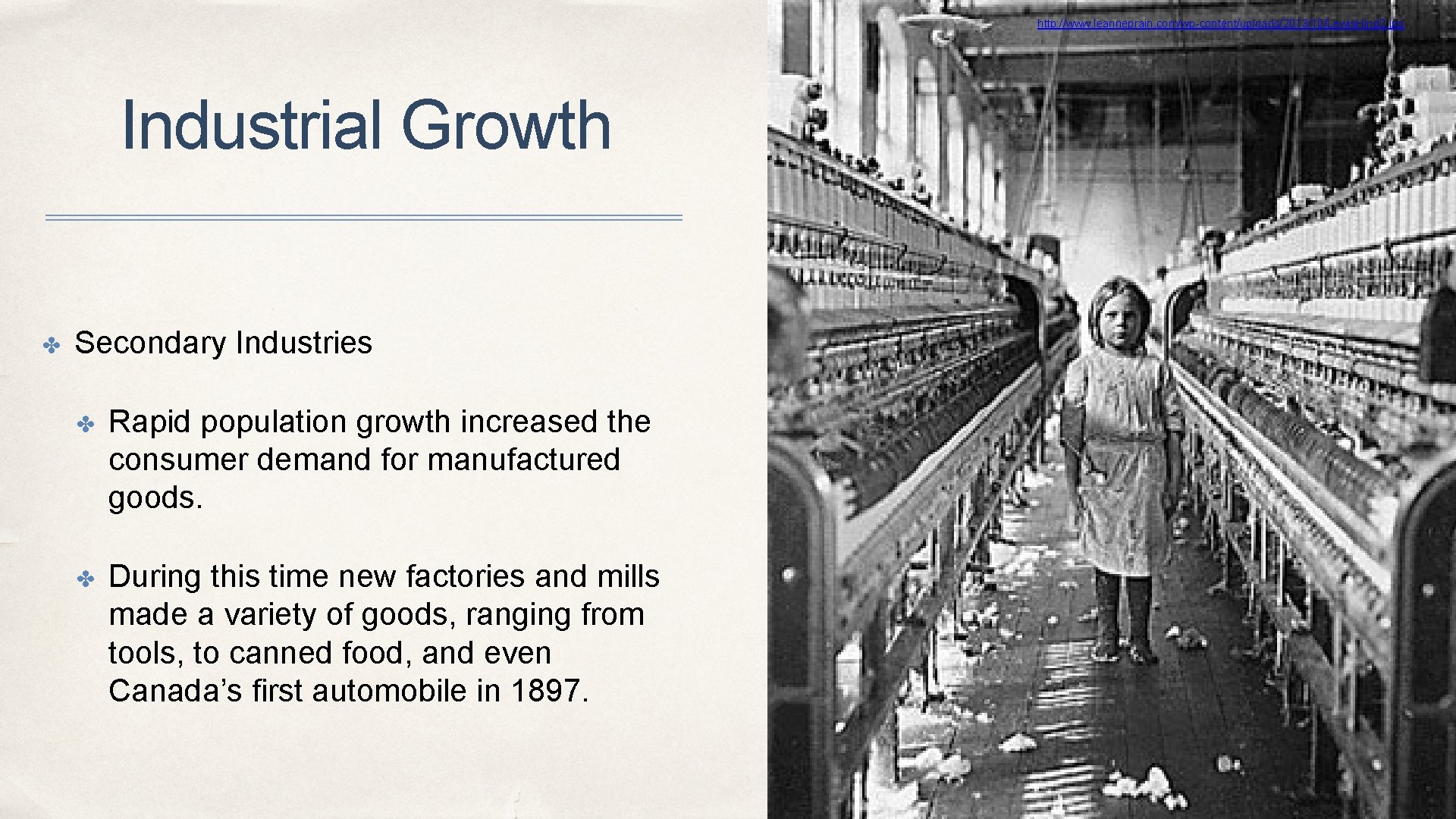
http: //www. leanneprain. com/wp-content/uploads/2013/10/Lewis. Hind 2. jpg Industrial Growth ✤ Secondary Industries ✤ Rapid population growth increased the consumer demand for manufactured goods. ✤ During this time new factories and mills made a variety of goods, ranging from tools, to canned food, and even Canada’s first automobile in 1897.
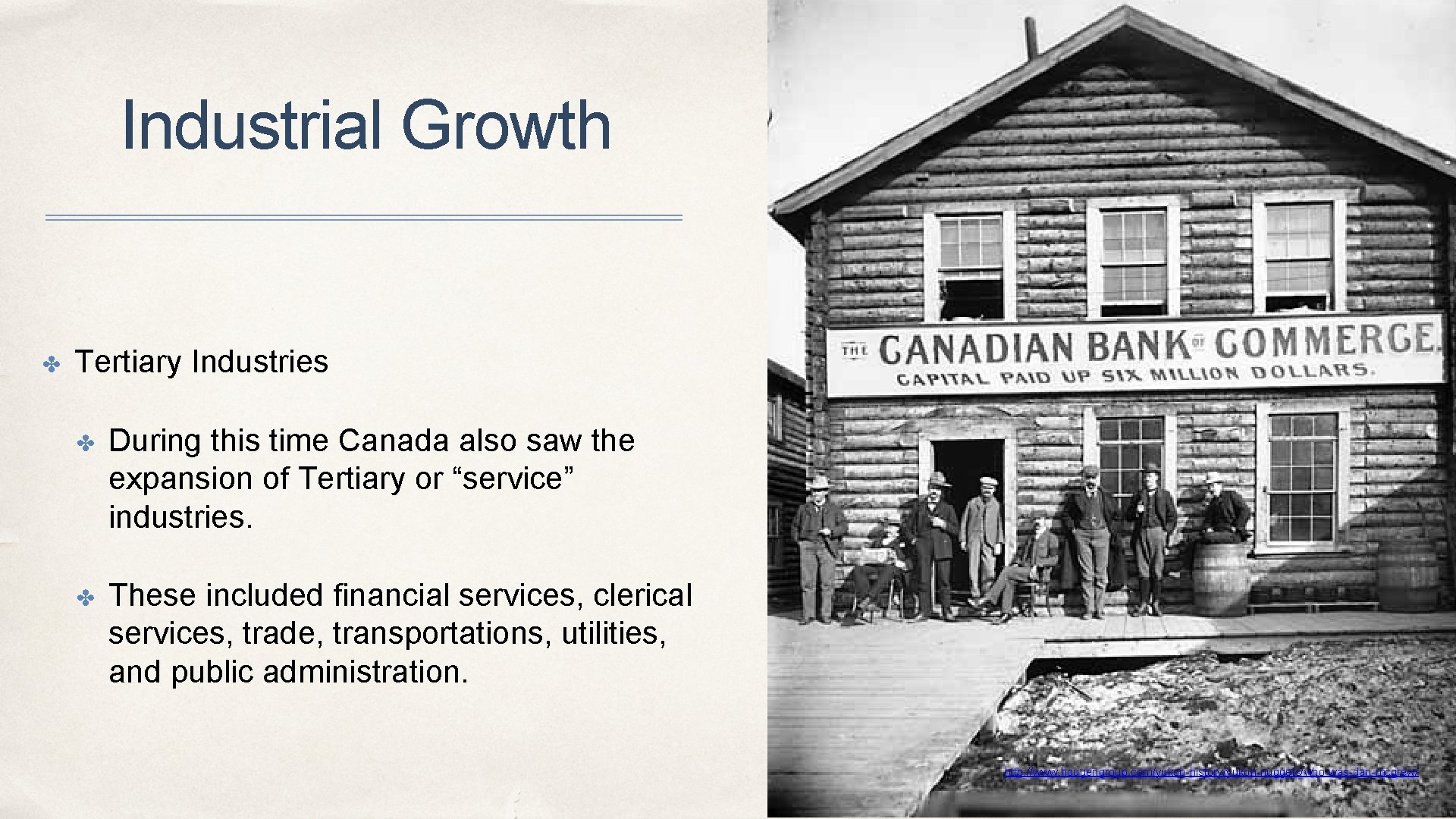
Industrial Growth ✤ Tertiary Industries ✤ During this time Canada also saw the expansion of Tertiary or “service” industries. ✤ These included financial services, clerical services, trade, transportations, utilities, and public administration. http: //www. hougengroup. com/yukon-history/yukon-nuggets/who-was-dan-mcgrew/
✤ Foreign Trade ✤ Canada had traditionally relied on the export of it’s primary goods, and the import of manufactured goods. ✤ The government adopted a policy of high tariffs on imported, manufactured goods. This was to keep the cost of imported good higher than good made in Canada. ✤ There began to be a shift in exports as Canada found new opportunities in the export of newsprint and industrial metals to markets in Great Britain and to the United States.
✤ Technology and the Industrial Boom ✤ New technology played an important role in the development of industries in the early 20 th century. ✤ Electricity, refrigeration, steam power, all fuelled the technological boom. ✤ Labour-saving machines made work faster, easier, and required fewer workers. ✤ Industrial developments such as the assembly line and specialized machinery led to the mass production of goods. ✤ As well the large scale mechanization of the printing industry lead to the beginnings of mass media - newspapers, magazines, and books were now being printed in large numbers. ✤ The silent motion picture was also developed during this time.
Answer the Following: 1. In your own words define the meaning of the term “multiculturalism. ” 2. Referring to the maps on page 30. There was a boundary dispute between Quebec and Newfoundland over Labrador. Speculate as to the reasons for the dispute. 3. Knowing the definitions of Primary, Secondary and Tertiary industries, give examples of each from the early 1900’s in Canada. What are some current examples of these industries? Which in your opinion have changed the most? 4. When we refer to “Mass” in mass media and mass production, what do we mean? 5. In the early 20 th century, which primary, secondary, and tertiary industries were growing rapidly? 6. Answer: a. In what ways did technological developments help change the work world? b. What were some positive effects of these developments? c. What were some negative effects?
2. 5 The Growth of Big Business, Foreign Investment, and Unions ✤ Big Business ✤ as industry and manufacturing grew, many owners found that bigger factories could mass-produce good more efficiently and inexpensively than small factories could. ✤ bankers and investors formed large corporations during this time - in many cases they did not live or work in the towns or cities where there factories were located. ✤ as well department stores were also growing during this time; such as the T. Eaton Company ad the Robert Simpson Company. 19
✤ Foreign Investment ✤ Canada’s economic expansion had largely been financed by foreign investors, particularly from Britain. ✤ In the early 1900’s foreign investments from the U. S. made possible the development of the new industrial technologies and many of the new products powering Canada’s economic boom. ✤ American companies established “Branch Plants” throughout Canada; in 1904 Henry Ford opened the first Canadian car plant in Ontario. ✤ This boom in business greatly increased Canada’s wealth, however some were concerned as to how this progress affected Canadian life.
✤ The Growth of Unions ✤ The world of work changed drastically for Canadians in the first two decades of the 20 th century. ✤ Employees rarely kew the owners of the corporations and factories that they worked for, and employers rarely knew their employees. ✤ Urban workers were the most seriously affected by industry and big business. Work places were dark, uncomfortable, and poorly ventilated. ✤ Machinery was designed for efficiency, not worker safety, and workers began to believe that owners and bosses were more interested in profit than the welfare of their workers.
✤ Many workers began to join unions and through them, workers began to bargain with owners. If negotiations failed unions would sometimes strike. ✤ In 1901 there were only 1078 local unions in Canada, within ten years the unions had doubled with more than 130, 000 workers that had joined unions ✤ Later, farmers concerned with high transportation costs resulted in the formation of the Ontario Famers’ Association, the Territorial Grain Owners’ Association was established and in Newfoundland fisherman established the Fisherman’s Protective Union (FPU) was formed to help fisherman to move away from the “truck system” (a merchant run trade/credit system).
✤ Child Labour ✤ During this time employers could pay children far less than adults to do the same job. ✤ Unions fought hard for laws prohibiting children from working - they did not want children to take jobs away from adults. (In these years unions also discriminated against minorities, immigrants, and women) ✤ Even though the first child labour laws were passed in 1908, the number of children 10 -14 working in factories remained on the rise.
2. 6 Inequality, Intolerance, and Racism ✤ The New Urban Poor ✤ Immigrants and farmers were flocking to the factories in Canadian cities - soon these areas became overcrowded and the need for housing was high. ✤ Factory workers often earned very low income and could not afford good housing even when available. ✤ Several families would often occupy single family dwellings, landlords often did not maintain houses, and city slums were growing. ✤ Dirty air and water, contaminated milk, and outdoor toilets led to sickness and death. During this time, 1 in 4 babies born to poor parents died before their first birthday. 24
✤ ✤ The government did very little during this time as they felt that the problems of the poor were not the governments responsibility. ✤ The fight to improve the lives of the poor were left to private charities and individuals. Changing Lives for Native peoples ✤ While Canada was “booming” the native people who could move freely across Canada a generation before were being limited in the early 20 th century. ✤ As more land was being surveyed, settled by immigrants, and claimed by mining and government officials, many natives found themselves being moved onto land being “reserved” for them.
✤ As well as being pushed onto reservations, the Indian Acts of 1876 & 1895 were designed to force Native peoples to give up their own culture and traditions and assimilate into mainstream Christian English & French speaking culture. ✤ During this time Natives could not earn university degrees, become lawyers, doctors, or ministers as they were considered “Status Indians”. ✤ Native children were often sent to residential schools, often far from their homes and families. ✤ These schools were run by Christian organizations who believed that they were “saving” Native children by making them Christians. Children were not allowed to use their own language, or to practice any of their beliefs, as well they were sometimes abused.
✤ Intolerance and Racism ✤ during this time American and British settlers were generally accepted, non-English speaking settlers often had a difficult time being accepted. ✤ in some cases settlers form minority cultures banned together and settled in the same neighbourhoods. This caused some Canadians to regard such groups with suspicion and intolerance. ✤ As numbers of non-caucasian settlers increased, many Canadians demanded the government to take action to “keep Canada White. ” ✤ Western Canada had policies to exclude Black Americans to receive free land. Canada began to actively discourage Black Americans from settling in Canada.
✤ As Chinese and Japanese immigrants increased dramatically in B. C. and Western Canada, some spoke out against Asian immigration. ✤ The Asian Exclusion League was formed as a result - and poor economic times were brining out the worst in people. ✤ In 1907, an anti-Asian riot broke out in Vancouver and many Asian-owned businesses were damaged. ✤ Canada then underlined its closed door policy by raising the head tax charging $500 to Chinese immigrants entering Canada - a staggering amount at that time.
2. 7 Women in the Early Twentieth Century ✤ At the beginning of the 20 th century it was socially acceptable for women to work outside of the home, generally when unmarried, between the time in leaving school and being married and starting a family. ✤ Often women in poorer families had to work to supplement income; these jobs were seen as temporary, thus women offend filled jobs that had low income, and required lower-level skills. ✤ In 1901, 13% of workers outside the home were women; many were domestic servants, or worked in factories, mills, and sweatshops of the clothing industry. ✤ Businesses such as banks were reluctant to hire women, and professions such as law, medicine, and engineering generally excluded women. 29
✤ By 1914 over 21% of the Canadian work force was women, and more were finishing high school and attending university. ✤ More jobs were becoming available such as teaching, sales and clerical positions, and telephone operator jobs. These jobs however, paid less to women their male counterparts. ✤ And while women were now becoming doctors, lawyers , these carriers continued to be difficult for women to enter. ✤ See Canada “Historica Video” Jennie Trout 1871
✤ Women Organize ✤ in the late 1800’s/early 1900; s many women created or joined a number of organizations such as the Women’s Christian Temperance Union; ✤ they worked to better the lives of women, children, workers and the poor. ✤ In 1893 the National Council of the Women of Canada was formed to bring together representatives of different women’s groups across Canada - providing a network for women to communicate their concerns and ideas.
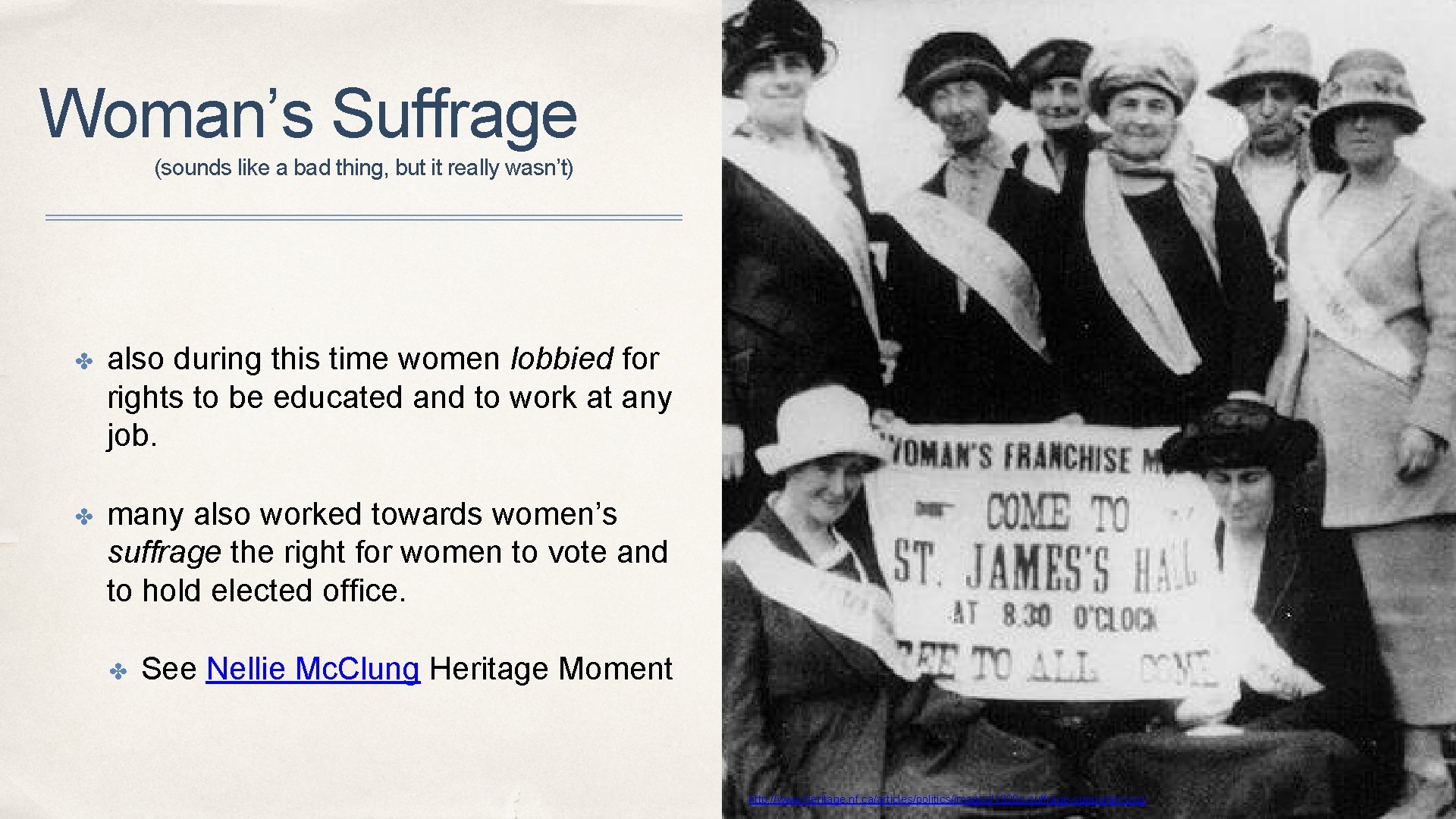
Woman’s Suffrage (sounds like a bad thing, but it really wasn’t) ✤ also during this time women lobbied for rights to be educated and to work at any job. ✤ many also worked towards women’s suffrage the right for women to vote and to hold elected office. ✤ See Nellie Mc. Clung Heritage Moment http: //www. heritage. nf. ca/articles/politics/images/1920 s-suffrage-supporters. jpg
2. 8 Canada, Britain, and the Empire ✤ At the beginning of the 20 th century, Canada was still part of the British Empire. Canada controlled most of its internal affairs, but defence and external affairs were still largely governed by Britain. ✤ The majority of English-speaking Canadians were proud of their imperial connection to the “mother country”. ✤ Some Canadians even volunteered and served with the British Army, serving the Empire in far-off campaigns. ✤ The attachment to Britain caused tentions between French-speaking and Englishspeaking Canadians. 33
✤ The South African War, 1899 -1902 ✤ In the 1880’s the South African republics of Transvaal and the Orange Free State were controlled by Afrikaners (descendants of Dutch settlers - commonly called “Boers”) ✤ The discovery of gold in 1885 -6 led to an inrush of British settlers. The South African War broke out after Britain tried to bring the republics under its control. ✤ Britain initially suffering huge defeats asked Canada and other countries in the Empire for help.
✤ Prime Minister Laurier was concerned that if he agreed with Britain's request, he would loos support among French Canadians. ✤ Officially Laurier refused to order the Canadian Army to South Africa, instead he allowed troops to volunteer to serve in Britain, Canada would equip and transport soldiers, however the British would assume the expenses. ✤ Over the course of the war Canadians played an important role in several major battles, with 4 Canadians being awarded the Victoria Cross. ✤ In all 7000 Canadians went to South Africa, with approximately 270 having died. ✤ Canada also served in non-combatant roles during the war. Nurses in field hospitals, volunteer teachers taught children and women detained in camps, and former police officers helped create the South African
✤ French-English Relations and the South African War ✤ Amongst English-speaking Canadians, the war was accompanied by a wave of patriotism. ✤ They wanted a vigorous response by the government, and were disappointed with Laurier’s lukewarm reaction. ✤ In contrast, French Canadians had little enthusiasm for the war, and wanted Canada to work together to build Canada’s independence from the British Empire.
✤ The Naval Issue ✤ Laurier while maintaining ties to Britain feared a unified foreign policy under British rule - he lead the opposition against an imperial union. ✤ Britain now involved in a naval race with Germany wanted financial help from Canada and other British dominion nations. ✤ As with the South African War, Canada refused direct help, however the Naval Service bill in 1910 resulted in the creation of its own navy. ✤ Canada would then be able to protect its own coasts, while easing the burden of the British navy. ✤ Opponents to Laurier, feared that any support of Britain would increase the likelihood of Canada being dragged into British wars around the world.
2. 9 Canada and the United States ✤ Canadian-American Relations in the Early Twentieth Century ✤ in the early 20 th century, relations between Canada and the United States were tense. ✤ Disputes of over fishing and seal-hunting during the 1880’s the threat and spread of American imperialism, lead many Canadians to fear that the U. S. may see Canada as a target for imperialism. 38
✤ The Alaska Boundary Dispute ✤ When the U. S. bought Alaska from the Russians in 1867 the boundary between Alaska and Canada was unclear. ✤ This became a critical issue during the Yukon Gold Rush of 1898. ✤ In 1903 the U. S. , British, and Canadians agreed to settle the matter by arbitration through a tribunal. ✤ Britain wanting the U. S. was an ally, supported an agreement favouring the Americans ✤ This outraged many Canadians and many began to doubt Britain’s commitment to the members of its Empire.
✤ Signs of Improved Relations ✤ Despite suspicion of U. S. intentions relations began to improve. In 1909 the International Joint Commission (IJC) was established between Canada and the U. S. to resolve disputes between the two countries involving the shared waters along the border.
✤ Reciprocity and the 1911 Election ✤ The election of John A. Mac. Donald and the conservative in 1878 saw an end to free trade or reciprocity that had existed between British North America and the U. S. Goods coming into Canada would now be taxed in an effort to protect Canadian industries. ✤ In 1910, Laurier found renewed interesting reciprocity, in particular amongst Ontario and Western farmers. ✤ It became a major issues in the election of 1911. Fearing reciprocity, voters thrashed Laurier’s Liberals, and the Conservatives’ Robert Borden became Canada’s 8 th Prime Minister. ✤ The Laurier era was over and Borden now faced the challenges of the difficult times that lay ahead…
Questions 1. What is a corporation? How is a corporation different than a company? 2. Why did unions and associations grow so much during these times? 3. Describe the living conditions in the industrial slums? 4. Read People in History fig 2. 7 b on page 46. What is meant by “Educate a boy and you educate a man; educate a women and you educate a family, ”? 5. What are some important changes that took place Canada that can be traced to the South African War? (hint: look to Canada’s relationship to Britain) 6. What is Imperialism - what were some signs of American Imperialism in the early 20 th century. ?
- Slides: 42