
http www ajaonline orgsubmissions4 Guidelines 2 3 6

http: //www. ajaonline. org/submissions#4
Guidelines 2. 3. 6 Acknowledgments should be placed immediately before the first note and referenced by an asterisk at the end of the abstract.
2. 3. 7 – Submission Guidelines for Tables should replace text, not duplicate it, and should be numbered consecutively with Arabic numerals. All sections of tables should be double spaced. A short caption should be placed above each table. Tables must be submitted in Microsoft Word and should be included as separate files. Complex tables are best submitted as figures. Long tables are best presented on a maximum of one published page, which equates to 35– 40 one line rows in Microsoft Word (fewer if there are several table footnotes). AJA tables do not contain internal rule lines, and a dash is used in cells to indicate no data or information is available. Authors should refer to past issues of the journal for examples of table format.
2. 3. 8 List of figures. References to figures in the text must appear in consecutive order (e. g. , fig. 1 is called out before fig. 2, etc. ; fig. 2 a is called out before fig. 2 b etc. ). Captions should be set as suggested below, with credits placed in parentheses and ending with a period (see also § 8. 2. 3): Fig. 1. Detail of the northwest corner of the Sanctuary of Apollo with an earlier street superimposed on it. Fig. 2. Trench 1, section a, northern elevation with strata indicated, from the south. The foundation trench is represented by deposits 4– 8 and 17 (drawing by S. Schmidt). Fig. 3. Corridor Z, layout of the decoration, assembled by the author (Paley and Sobolewski 1987, pl. 4; courtesy R. Sobolewski).
General Matters of Style
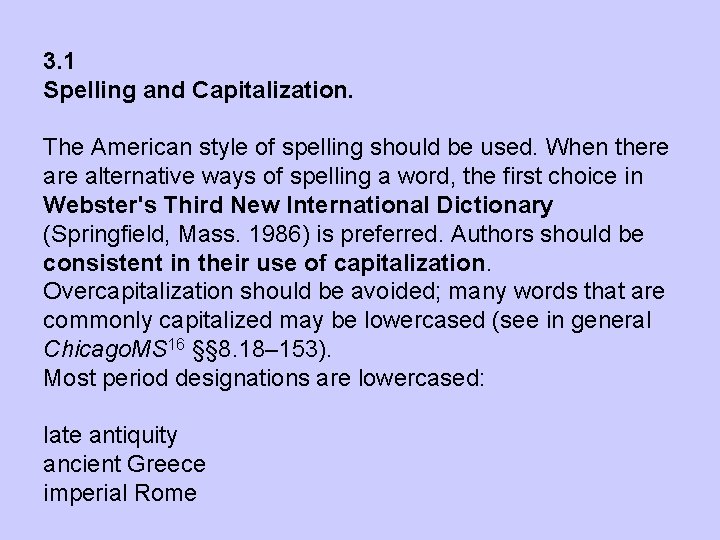
3. 1 Spelling and Capitalization. The American style of spelling should be used. When there alternative ways of spelling a word, the first choice in Webster's Third New International Dictionary (Springfield, Mass. 1986) is preferred. Authors should be consistent in their use of capitalization. Overcapitalization should be avoided; many words that are commonly capitalized may be lowercased (see in general Chicago. MS 16 §§ 8. 18– 153). Most period designations are lowercased: late antiquity ancient Greece imperial Rome
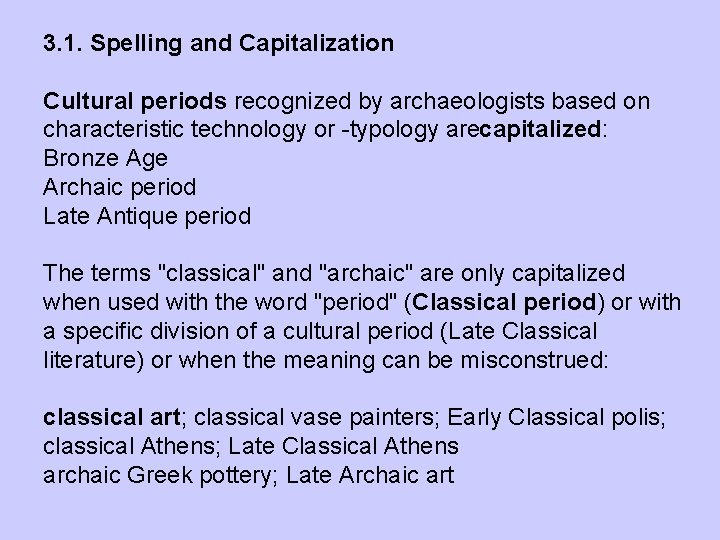
3. 1. Spelling and Capitalization Cultural periods recognized by archaeologists based on characteristic technology or typology arecapitalized: Bronze Age Archaic period Late Antique period The terms "classical" and "archaic" are only capitalized when used with the word "period" (Classical period) or with a specific division of a cultural period (Late Classical literature) or when the meaning can be misconstrued: classical art; classical vase painters; Early Classical polis; classical Athens; Late Classical Athens archaic Greek pottery; Late Archaic art
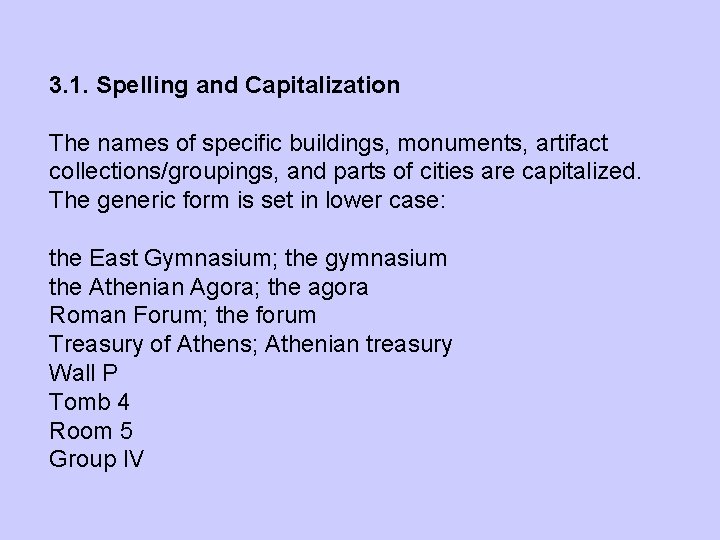
3. 1. Spelling and Capitalization The names of specific buildings, monuments, artifact collections/groupings, and parts of cities are capitalized. The generic form is set in lower case: the East Gymnasium; the gymnasium the Athenian Agora; the agora Roman Forum; the forum Treasury of Athens; Athenian treasury Wall P Tomb 4 Room 5 Group IV
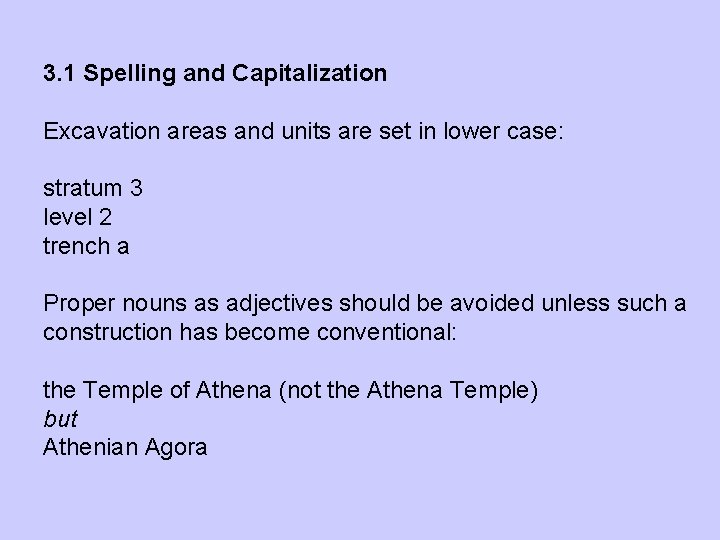
3. 1 Spelling and Capitalization Excavation areas and units are set in lower case: stratum 3 level 2 trench a Proper nouns as adjectives should be avoided unless such a construction has become conventional: the Temple of Athena (not the Athena Temple) but Athenian Agora
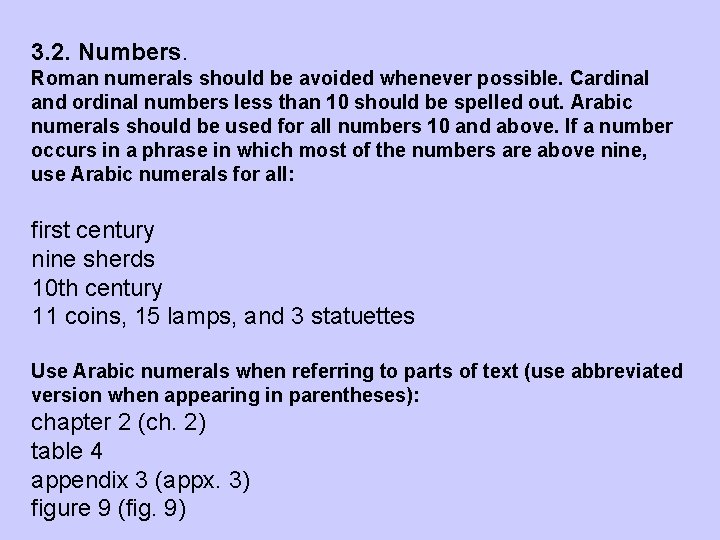
3. 2. Numbers. Roman numerals should be avoided whenever possible. Cardinal and ordinal numbers less than 10 should be spelled out. Arabic numerals should be used for all numbers 10 and above. If a number occurs in a phrase in which most of the numbers are above nine, use Arabic numerals for all: first century nine sherds 10 th century 11 coins, 15 lamps, and 3 statuettes Use Arabic numerals when referring to parts of text (use abbreviated version when appearing in parentheses): chapter 2 (ch. 2) table 4 appendix 3 (appx. 3) figure 9 (fig. 9)
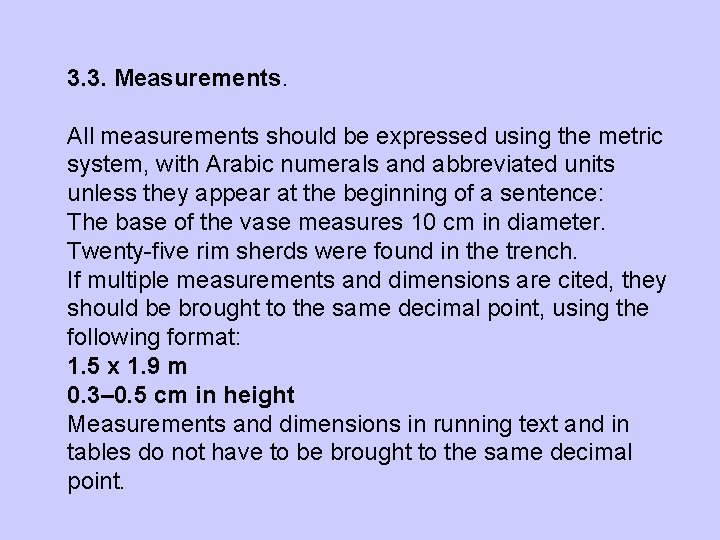
3. 3. Measurements. All measurements should be expressed using the metric system, with Arabic numerals and abbreviated units unless they appear at the beginning of a sentence: The base of the vase measures 10 cm in diameter. Twenty five rim sherds were found in the trench. If multiple measurements and dimensions are cited, they should be brought to the same decimal point, using the following format: 1. 5 x 1. 9 m 0. 3– 0. 5 cm in height Measurements and dimensions in running text and in tables do not have to be brought to the same decimal point.
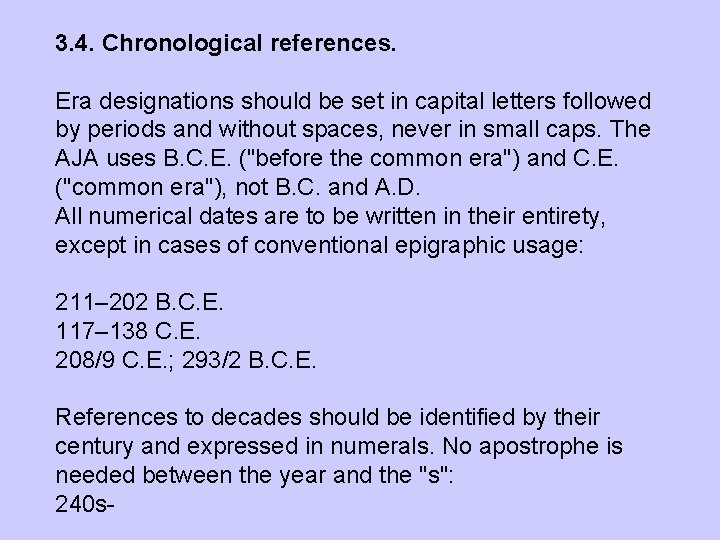
3. 4. Chronological references. Era designations should be set in capital letters followed by periods and without spaces, never in small caps. The AJA uses B. C. E. ("before the common era") and C. E. ("common era"), not B. C. and A. D. All numerical dates are to be written in their entirety, except in cases of conventional epigraphic usage: 211– 202 B. C. E. 117– 138 C. E. 208/9 C. E. ; 293/2 B. C. E. References to decades should be identified by their century and expressed in numerals. No apostrophe is needed between the year and the "s": 240 s
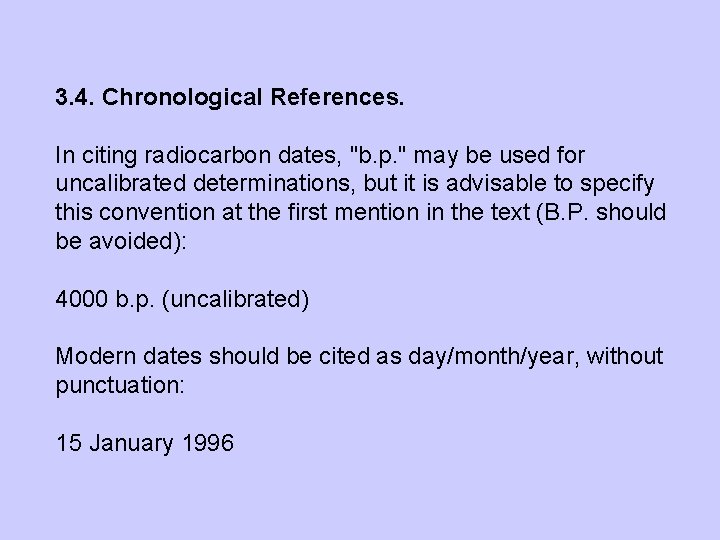
3. 4. Chronological References. In citing radiocarbon dates, "b. p. " may be used for uncalibrated determinations, but it is advisable to specify this convention at the first mention in the text (B. P. should be avoided): 4000 b. p. (uncalibrated) Modern dates should be cited as day/month/year, without punctuation: 15 January 1996
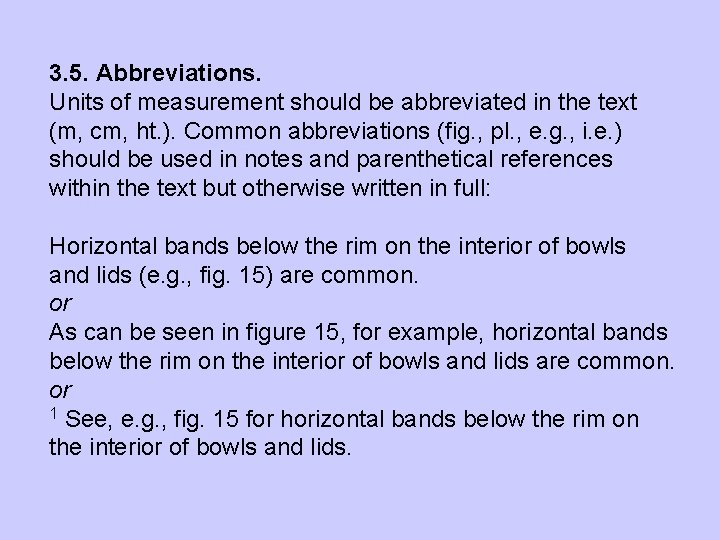
3. 5. Abbreviations. Units of measurement should be abbreviated in the text (m, cm, ht. ). Common abbreviations (fig. , pl. , e. g. , i. e. ) should be used in notes and parenthetical references within the text but otherwise written in full: Horizontal bands below the rim on the interior of bowls and lids (e. g. , fig. 15) are common. or As can be seen in figure 15, for example, horizontal bands below the rim on the interior of bowls and lids are common. or 1 See, e. g. , fig. 15 for horizontal bands below the rim on the interior of bowls and lids.
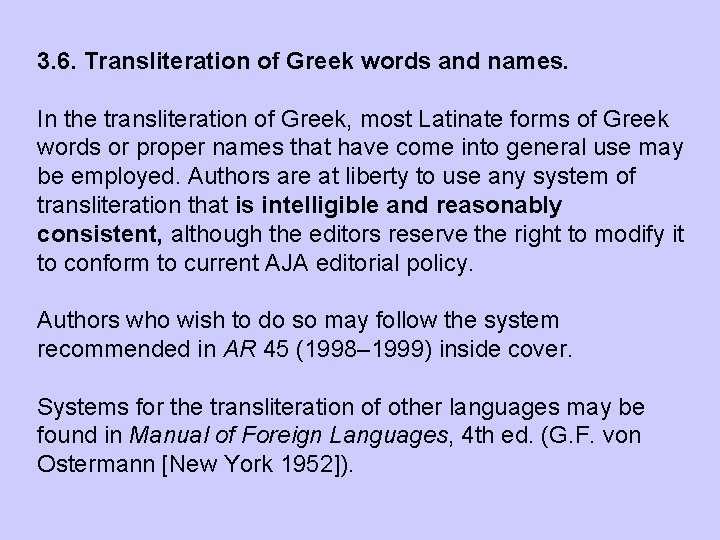
3. 6. Transliteration of Greek words and names. In the transliteration of Greek, most Latinate forms of Greek words or proper names that have come into general use may be employed. Authors are at liberty to use any system of transliteration that is intelligible and reasonably consistent, although the editors reserve the right to modify it to conform to current AJA editorial policy. Authors who wish to do so may follow the system recommended in AR 45 (1998– 1999) inside cover. Systems for the transliteration of other languages may be found in Manual of Foreign Languages, 4 th ed. (G. F. von Ostermann [New York 1952]).
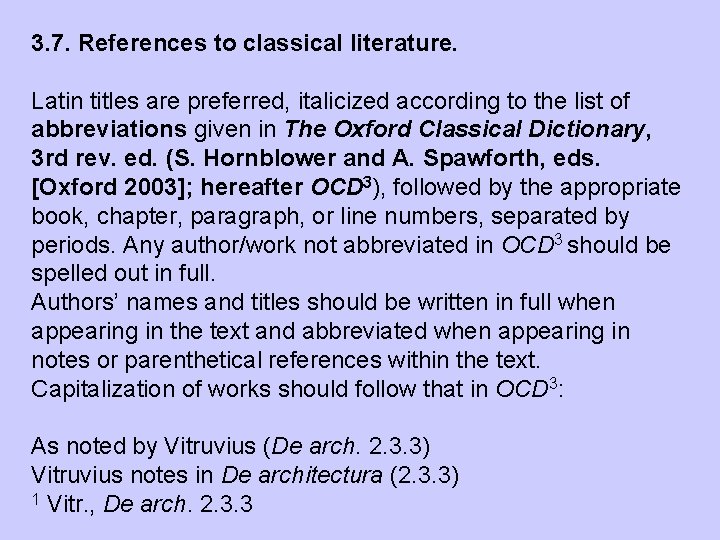
3. 7. References to classical literature. Latin titles are preferred, italicized according to the list of abbreviations given in The Oxford Classical Dictionary, 3 rd rev. ed. (S. Hornblower and A. Spawforth, eds. [Oxford 2003]; hereafter OCD 3), followed by the appropriate book, chapter, paragraph, or line numbers, separated by periods. Any author/work not abbreviated in OCD 3 should be spelled out in full. Authors’ names and titles should be written in full when appearing in the text and abbreviated when appearing in notes or parenthetical references within the text. Capitalization of works should follow that in OCD 3: As noted by Vitruvius (De arch. 2. 3. 3) Vitruvius notes in De architectura (2. 3. 3) 1 Vitr. , De arch. 2. 3. 3
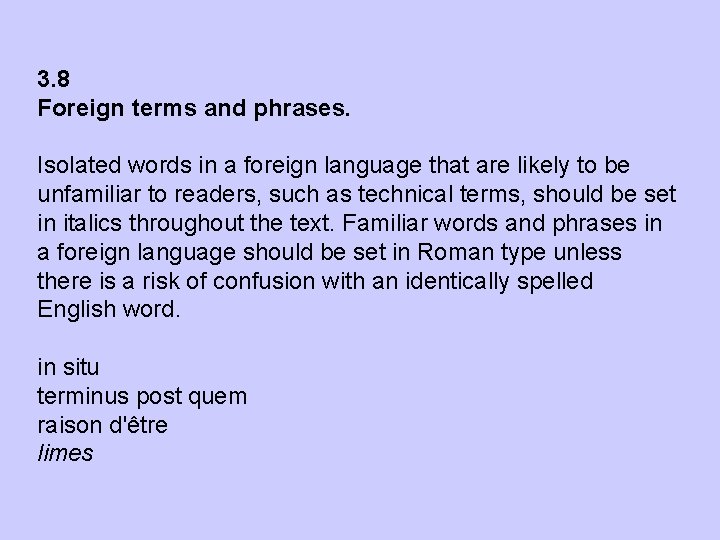
3. 8 Foreign terms and phrases. Isolated words in a foreign language that are likely to be unfamiliar to readers, such as technical terms, should be set in italics throughout the text. Familiar words and phrases in a foreign language should be set in Roman type unless there is a risk of confusion with an identically spelled English word. in situ terminus post quem raison d'être limes
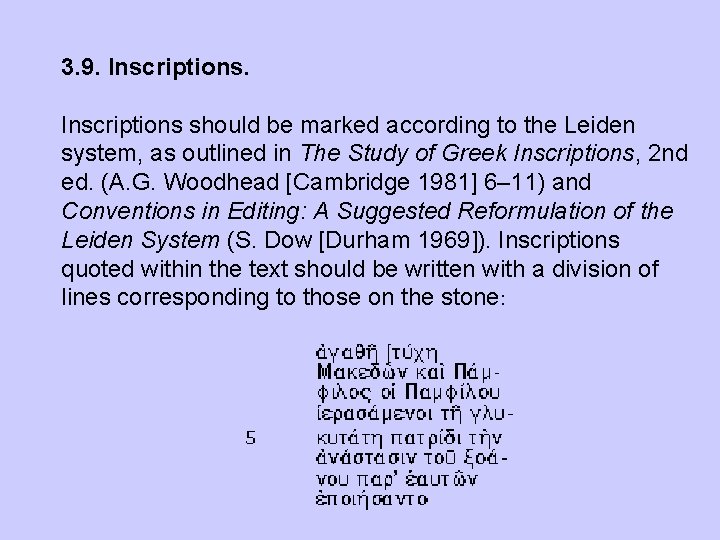
3. 9. Inscriptions should be marked according to the Leiden system, as outlined in The Study of Greek Inscriptions, 2 nd ed. (A. G. Woodhead [Cambridge 1981] 6– 11) and Conventions in Editing: A Suggested Reformulation of the Leiden System (S. Dow [Durham 1969]). Inscriptions quoted within the text should be written with a division of lines corresponding to those on the stone:
3. 9. Inscriptions of 50 words or fewer and inscriptions appearing in notes may be written continuously, with a single upright line ( | ) used to mark the beginning of each line and a double upright line ( || ) used to indicate the beginning of every fifth line: Inscriptions in corpora are cited using Arabic numerals only by inscription number, without page references, the abbreviation "no. , " or intervening periods/commas: IG 22 65 line 23 CIL 1(2) 327

Bibliographical References and Footnotes
Bibliographical References and Footnotes General Policy 4. 1 Notes may contain explanation, amplification, or commentary in addition to short bibliographical citations whose full form is given in a list of all cited works published at the end of the manuscript. No in text citations should be used, except for references to primary ancient sources.
Bibliographical References and Footnotes 4. 3 Notes may consist of discussion only, discussion and bibliographical citation, or bibliographical citation only. Bibliographical citations in notes should appear in chronological order and be drawn from the list of cited works. These citations should consist of the author’s last name, the year of publication, and relevant inclusive pages, sections, figures, plates, etc. Each note should not exceed 200 words.
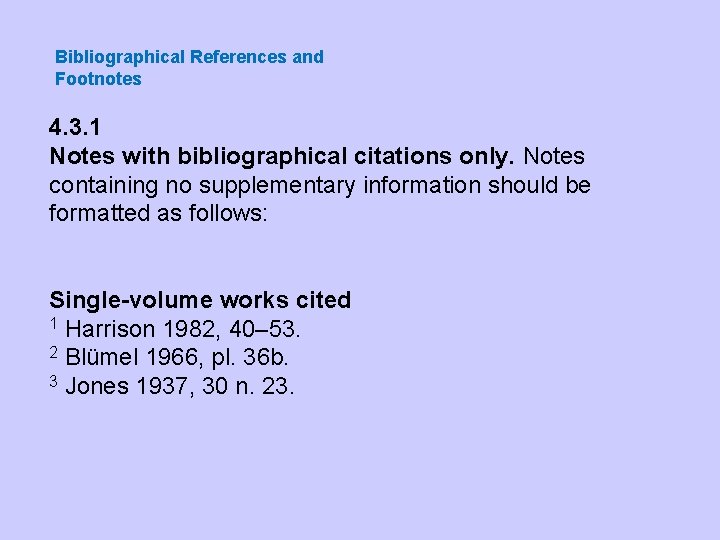
Bibliographical References and Footnotes 4. 3. 1 Notes with bibliographical citations only. Notes containing no supplementary information should be formatted as follows: Single-volume works cited 1 Harrison 1982, 40– 53. 2 Blümel 1966, pl. 36 b. 3 Jones 1937, 30 n. 23.
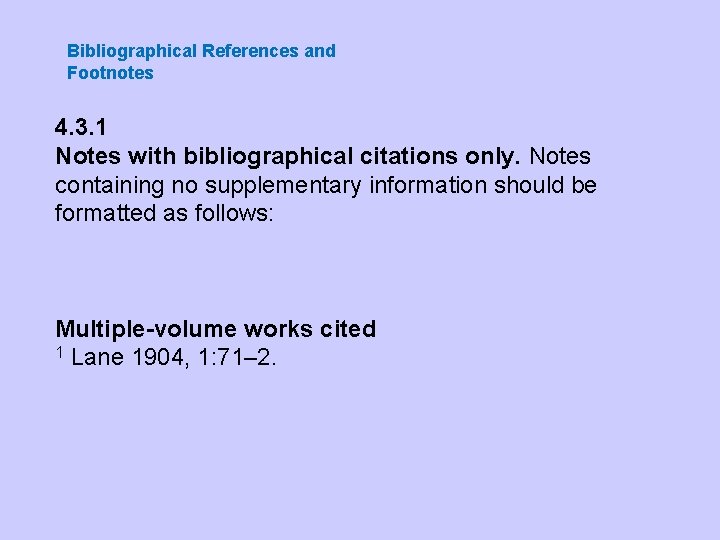
Bibliographical References and Footnotes 4. 3. 1 Notes with bibliographical citations only. Notes containing no supplementary information should be formatted as follows: Multiple-volume works cited 1 Lane 1904, 1: 71– 2.
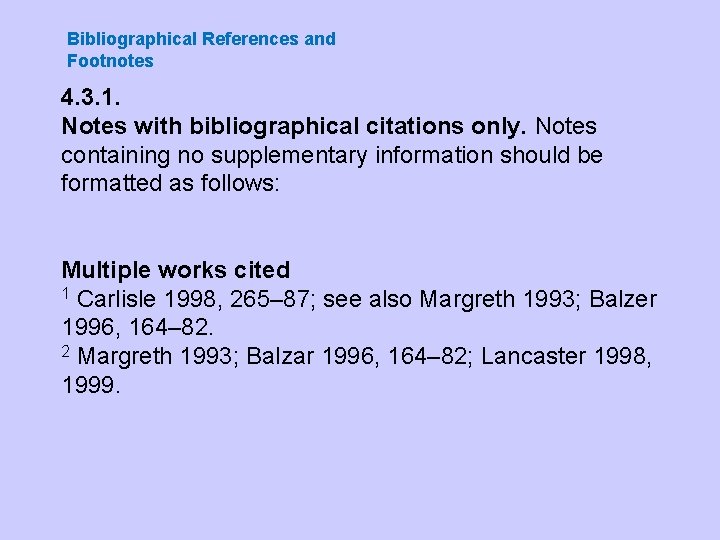
Bibliographical References and Footnotes 4. 3. 1. Notes with bibliographical citations only. Notes containing no supplementary information should be formatted as follows: Multiple works cited 1 Carlisle 1998, 265– 87; see also Margreth 1993; Balzer 1996, 164– 82. 2 Margreth 1993; Balzar 1996, 164– 82; Lancaster 1998, 1999.
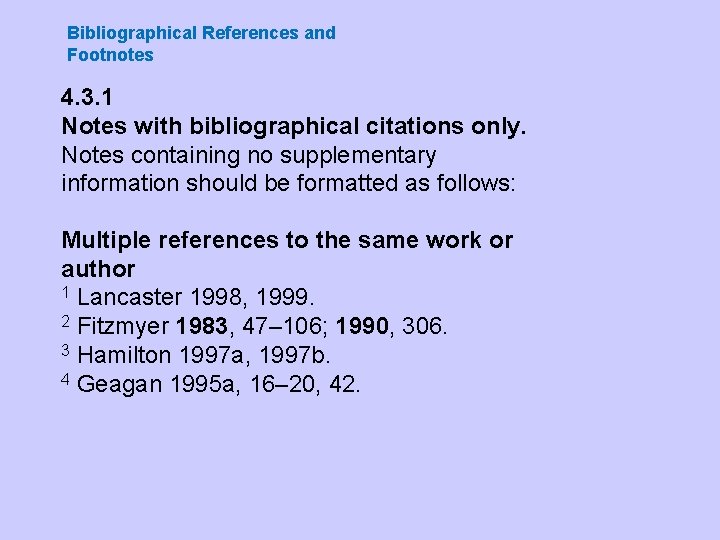
Bibliographical References and Footnotes 4. 3. 1 Notes with bibliographical citations only. Notes containing no supplementary information should be formatted as follows: Multiple references to the same work or author 1 Lancaster 1998, 1999. 2 Fitzmyer 1983, 47– 106; 1990, 306. 3 Hamilton 1997 a, 1997 b. 4 Geagan 1995 a, 16– 20, 42.
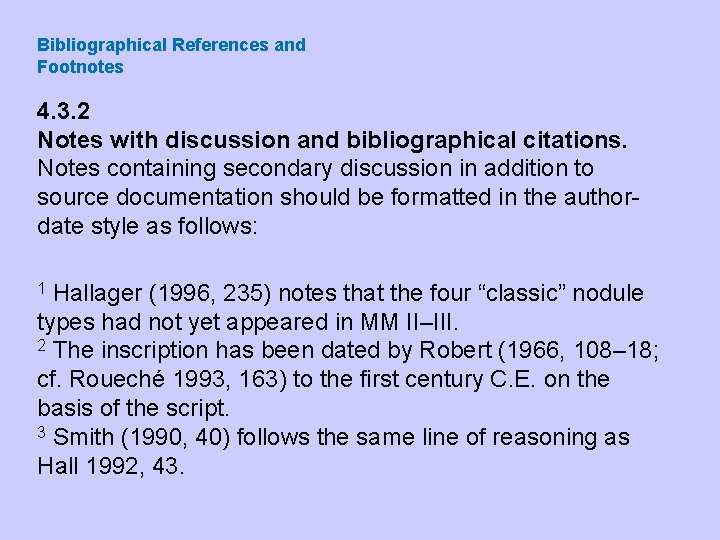
Bibliographical References and Footnotes 4. 3. 2 Notes with discussion and bibliographical citations. Notes containing secondary discussion in addition to source documentation should be formatted in the author date style as follows: Hallager (1996, 235) notes that the four “classic” nodule types had not yet appeared in MM II–III. 2 The inscription has been dated by Robert (1966, 108– 18; cf. Roueché 1993, 163) to the first century C. E. on the basis of the script. 3 Smith (1990, 40) follows the same line of reasoning as Hall 1992, 43. 1
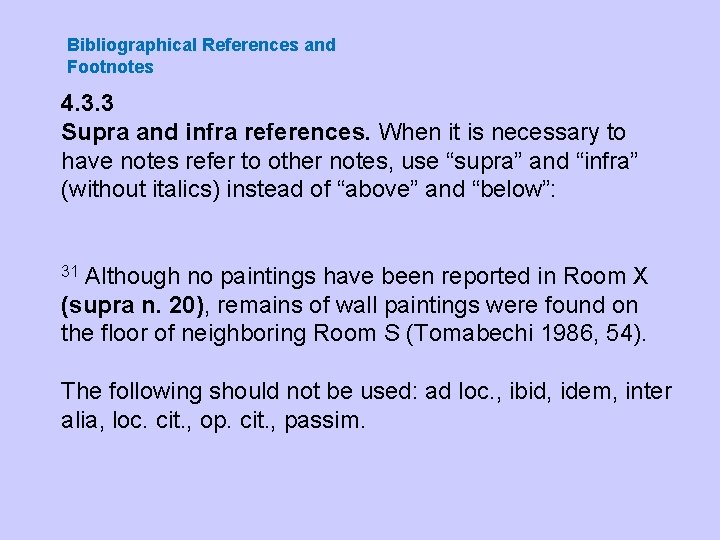
Bibliographical References and Footnotes 4. 3. 3 Supra and infra references. When it is necessary to have notes refer to other notes, use “supra” and “infra” (without italics) instead of “above” and “below”: Although no paintings have been reported in Room X (supra n. 20), remains of wall paintings were found on the floor of neighboring Room S (Tomabechi 1986, 54). 31 The following should not be used: ad loc. , ibid, idem, inter alia, loc. cit. , op. cit. , passim.
4. 4 Abbreviations of titles of periodicals and standard reference works are given in § 9. 1. Works not listed there should be written in full. Abbreviations of ancient authors and works should be those listed in OCD 3 xxix–liv.
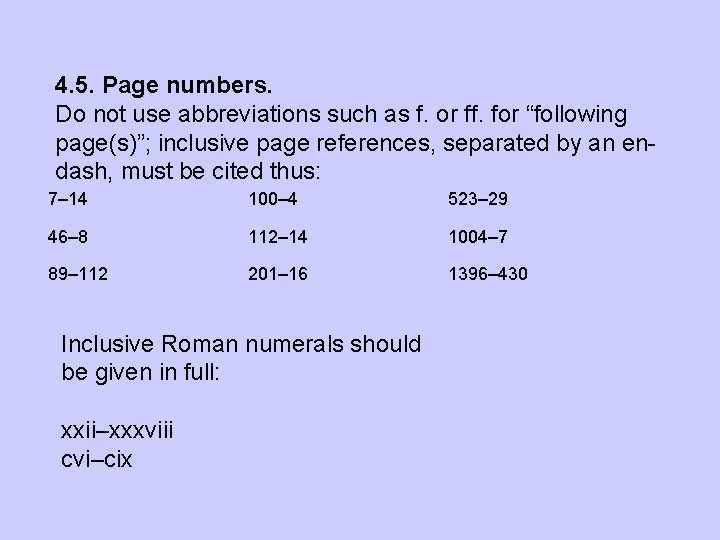
4. 5. Page numbers. Do not use abbreviations such as f. or ff. for “following page(s)”; inclusive page references, separated by an en dash, must be cited thus: 7– 14 100– 4 523– 29 46– 8 112– 14 1004– 7 89– 112 201– 16 1396– 430 Inclusive Roman numerals should be given in full: xxii–xxxviii cvi–cix
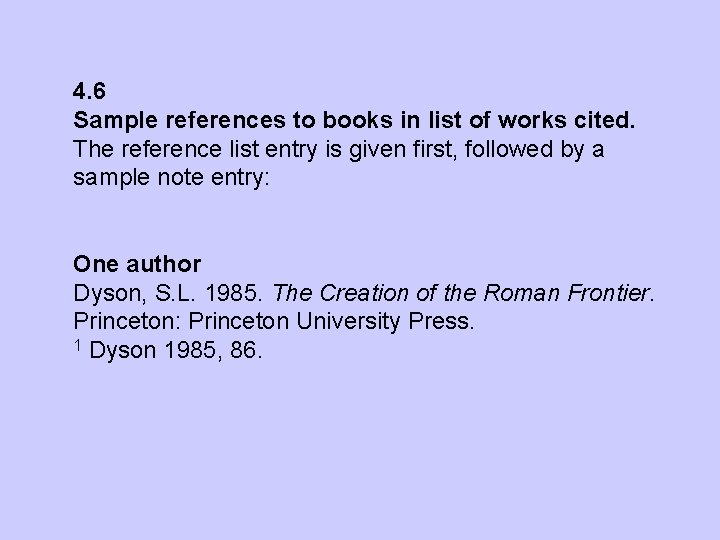
4. 6 Sample references to books in list of works cited. The reference list entry is given first, followed by a sample note entry: One author Dyson, S. L. 1985. The Creation of the Roman Frontier. Princeton: Princeton University Press. 1 Dyson 1985, 86.
4. 6 Sample references to books in list of works cited. The reference list entry is given first, followed by a sample note entry: One author Dyson, S. L. 1985. The Creation of the Roman Frontier. Princeton: Princeton University Press. 1 Dyson 1985, 86.
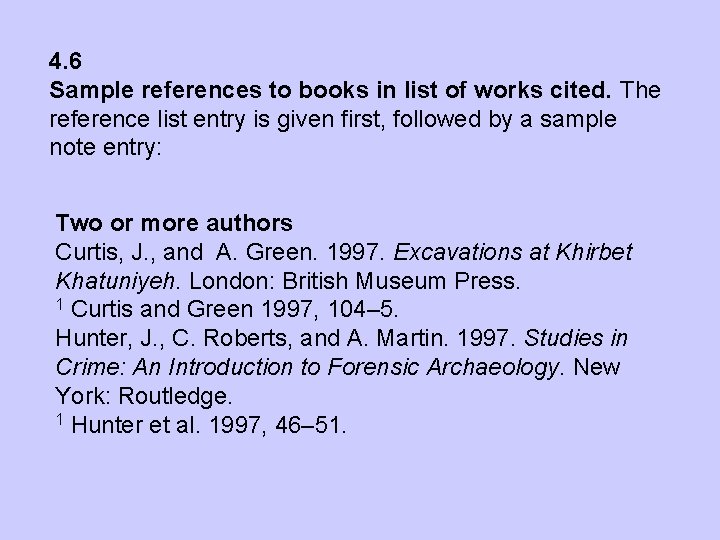
4. 6 Sample references to books in list of works cited. The reference list entry is given first, followed by a sample note entry: Two or more authors Curtis, J. , and A. Green. 1997. Excavations at Khirbet Khatuniyeh. London: British Museum Press. 1 Curtis and Green 1997, 104– 5. Hunter, J. , C. Roberts, and A. Martin. 1997. Studies in Crime: An Introduction to Forensic Archaeology. New York: Routledge. 1 Hunter et al. 1997, 46– 51.
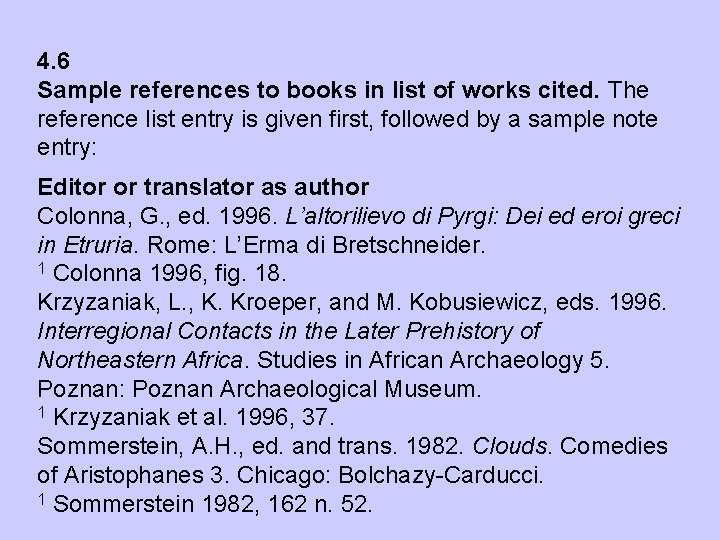
4. 6 Sample references to books in list of works cited. The reference list entry is given first, followed by a sample note entry: Editor or translator as author Colonna, G. , ed. 1996. L’altorilievo di Pyrgi: Dei ed eroi greci in Etruria. Rome: L’Erma di Bretschneider. 1 Colonna 1996, fig. 18. Krzyzaniak, L. , K. Kroeper, and M. Kobusiewicz, eds. 1996. Interregional Contacts in the Later Prehistory of Northeastern Africa. Studies in African Archaeology 5. Poznan: Poznan Archaeological Museum. 1 Krzyzaniak et al. 1996, 37. Sommerstein, A. H. , ed. and trans. 1982. Clouds. Comedies of Aristophanes 3. Chicago: Bolchazy Carducci. 1 Sommerstein 1982, 162 n. 52.
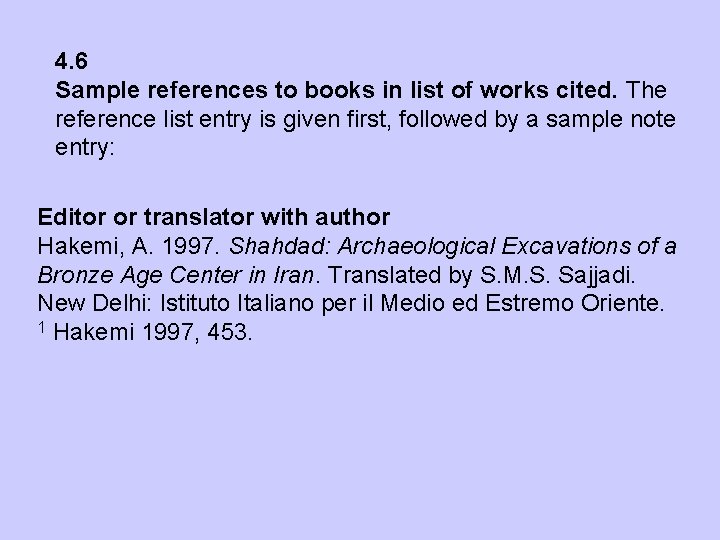
4. 6 Sample references to books in list of works cited. The reference list entry is given first, followed by a sample note entry: Editor or translator with author Hakemi, A. 1997. Shahdad: Archaeological Excavations of a Bronze Age Center in Iran. Translated by S. M. S. Sajjadi. New Delhi: Istituto Italiano per il Medio ed Estremo Oriente. 1 Hakemi 1997, 453.
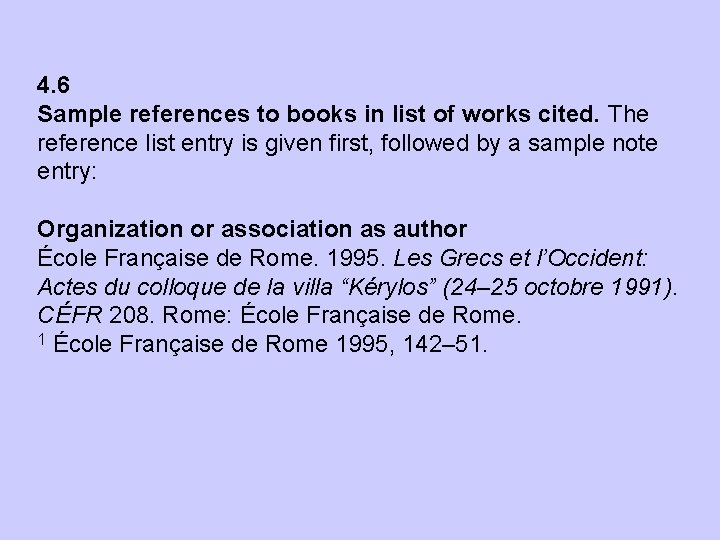
4. 6 Sample references to books in list of works cited. The reference list entry is given first, followed by a sample note entry: Organization or association as author École Française de Rome. 1995. Les Grecs et l’Occident: Actes du colloque de la villa “Kérylos” (24– 25 octobre 1991). CÉFR 208. Rome: École Française de Rome. 1 École Française de Rome 1995, 142– 51.
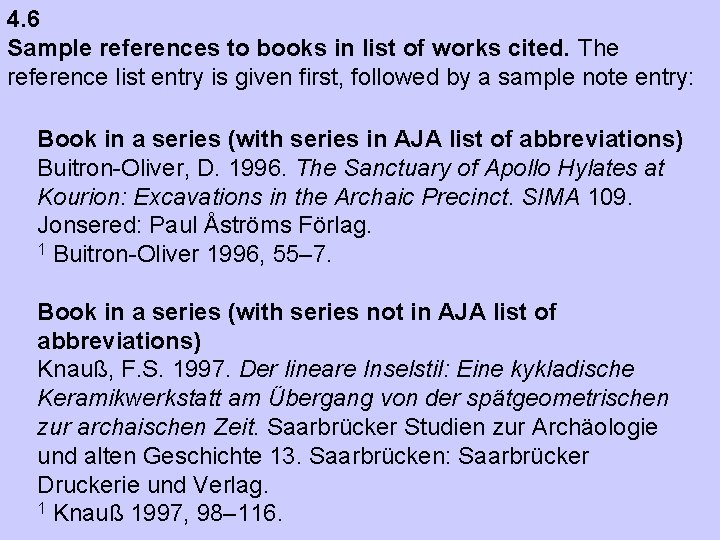
4. 6 Sample references to books in list of works cited. The reference list entry is given first, followed by a sample note entry: Book in a series (with series in AJA list of abbreviations) Buitron Oliver, D. 1996. The Sanctuary of Apollo Hylates at Kourion: Excavations in the Archaic Precinct. SIMA 109. Jonsered: Paul Åströms Förlag. 1 Buitron Oliver 1996, 55– 7. Book in a series (with series not in AJA list of abbreviations) Knauß, F. S. 1997. Der lineare Inselstil: Eine kykladische Keramikwerkstatt am Übergang von der spätgeometrischen zur archaischen Zeit. Saarbrücker Studien zur Archäologie und alten Geschichte 13. Saarbrücken: Saarbrücker Druckerie und Verlag. 1 Knauß 1997, 98– 116.
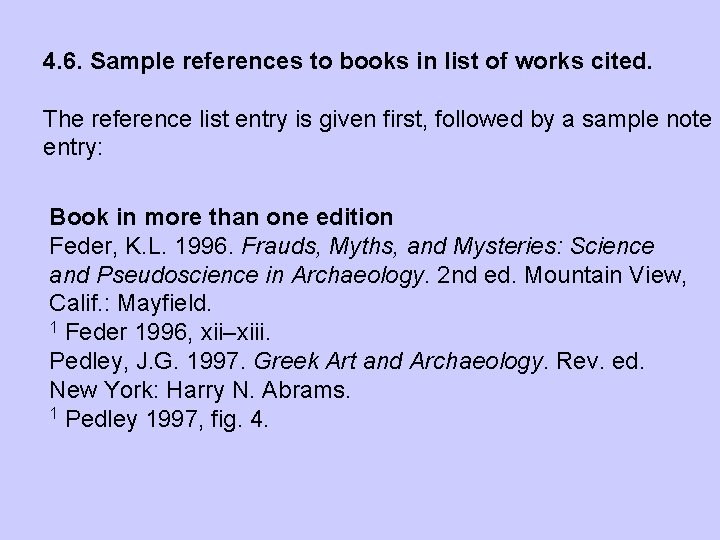
4. 6. Sample references to books in list of works cited. The reference list entry is given first, followed by a sample note entry: Book in more than one edition Feder, K. L. 1996. Frauds, Myths, and Mysteries: Science and Pseudoscience in Archaeology. 2 nd ed. Mountain View, Calif. : Mayfield. 1 Feder 1996, xii–xiii. Pedley, J. G. 1997. Greek Art and Archaeology. Rev. ed. New York: Harry N. Abrams. 1 Pedley 1997, fig. 4.
4. 6 Sample references to books in list of works cited. The reference list entry is given first, followed by a sample note entry: Book in more than one volume (citing the work as a whole) Kiderlen, M. 1995. Megale Oikia: Untersuchungen zur Entwicklung aufwendiger griechischer Stadthausarchitektur: Von der Früharchaik bis ins 3. Jhr. v. Chr. 2 vols. Hürth: Martin Lange. 1 Kiderlen 1995, 1: 247. Book in more than one volume (citing a particular volume) Caminos, R. A. 1998. Semna-Kumma. Vol. 2, The Temple of Kumma. London: Egypt Exploration Society. 1 Caminos 1998, 100– 17.
4. 6 Sample references to books in list of works cited. The reference list entry is given first, followed by a sample note entry: One volume in two or more books Evans, A. J. 1928. The Palace of Minos at Knossos. Vol. 2, pt. 2. London: Macmillan. 1 Evans 1928, 131– 35.
4. 6 Sample references to books in list of works cited. The reference list entry is given first, followed by a sample note entry: Preface, foreword, introduction, and similar parts of a book de Montebello, P. 1988. Foreword to Bronze and Iron: Ancient Near Eastern Artifacts in the Metropolitan Museum of Art, by O. W. Muscarella, 7. New York: The Metropolitan Museum of Art. 1 de Montebello 1988. Vermeule, E. 1972. Introduction to The Mycenaean Origin of Greek Mythology, by M. P. Nilsson, vii–xiii. Sather Classical Lectures 8. Berkeley: University of California Press. 1 Vermeule 1972.
4. 7 Sample references to parts of books in works cited list. Chapters or other titled parts of a book Snodgrass, A. 1990. "Survey Archaeology and the Rural Landscape of the Greek City. " In The Greek City from Homer to Alexander, edited by O. Murray and S. Price, 113– 36. Oxford: Oxford University Press and Clarendon Press. 1 Snodgrass 1990, 113– 19. Hägg, R. 1998. "Osteology and Greek Sacrificial Practice. " In Ancient Greek Cult Practice from the Archaeological Evidence, edited by R. Hägg, 49– 56. Skr. Ath 8º, 15. Stockholm: Paul Åströms Förlag. 1 Hägg 1998, fig. 1.
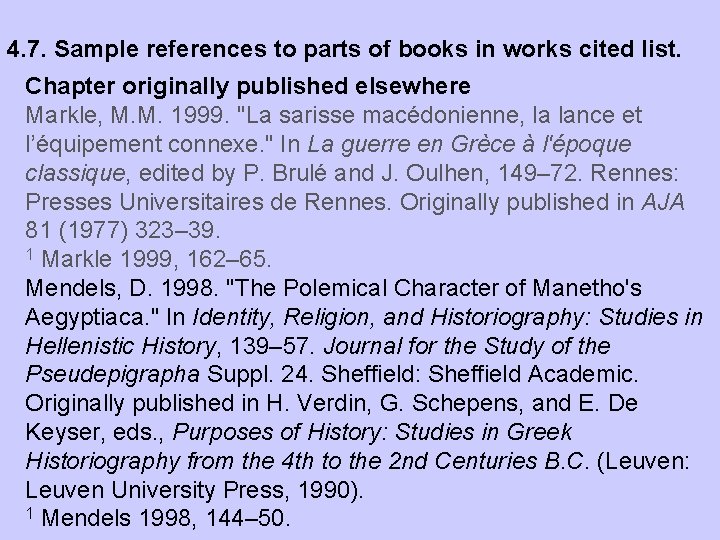
4. 7. Sample references to parts of books in works cited list. Chapter originally published elsewhere Markle, M. M. 1999. "La sarisse macédonienne, la lance et l’équipement connexe. " In La guerre en Grèce à l'époque classique, edited by P. Brulé and J. Oulhen, 149– 72. Rennes: Presses Universitaires de Rennes. Originally published in AJA 81 (1977) 323– 39. 1 Markle 1999, 162– 65. Mendels, D. 1998. "The Polemical Character of Manetho's Aegyptiaca. " In Identity, Religion, and Historiography: Studies in Hellenistic History, 139– 57. Journal for the Study of the Pseudepigrapha Suppl. 24. Sheffield: Sheffield Academic. Originally published in H. Verdin, G. Schepens, and E. De Keyser, eds. , Purposes of History: Studies in Greek Historiography from the 4 th to the 2 nd Centuries B. C. (Leuven: Leuven University Press, 1990). 1 Mendels 1998, 144– 50.
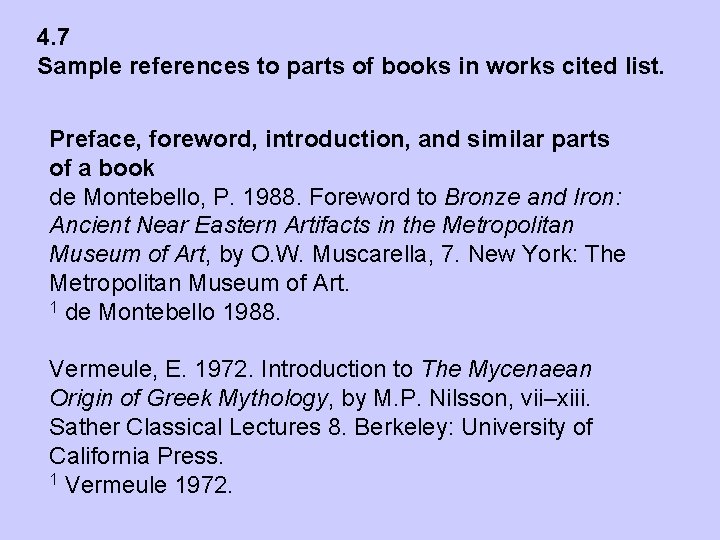
4. 7 Sample references to parts of books in works cited list. Preface, foreword, introduction, and similar parts of a book de Montebello, P. 1988. Foreword to Bronze and Iron: Ancient Near Eastern Artifacts in the Metropolitan Museum of Art, by O. W. Muscarella, 7. New York: The Metropolitan Museum of Art. 1 de Montebello 1988. Vermeule, E. 1972. Introduction to The Mycenaean Origin of Greek Mythology, by M. P. Nilsson, vii–xiii. Sather Classical Lectures 8. Berkeley: University of California Press. 1 Vermeule 1972.
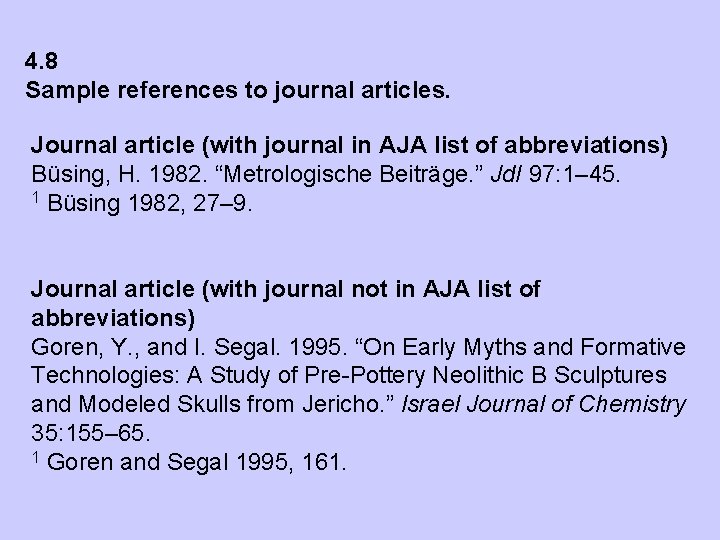
4. 8 Sample references to journal articles. Journal article (with journal in AJA list of abbreviations) Büsing, H. 1982. “Metrologische Beiträge. ” Jd. I 97: 1– 45. 1 Büsing 1982, 27– 9. Journal article (with journal not in AJA list of abbreviations) Goren, Y. , and I. Segal. 1995. “On Early Myths and Formative Technologies: A Study of Pre Pottery Neolithic B Sculptures and Modeled Skulls from Jericho. ” Israel Journal of Chemistry 35: 155– 65. 1 Goren and Segal 1995, 161.
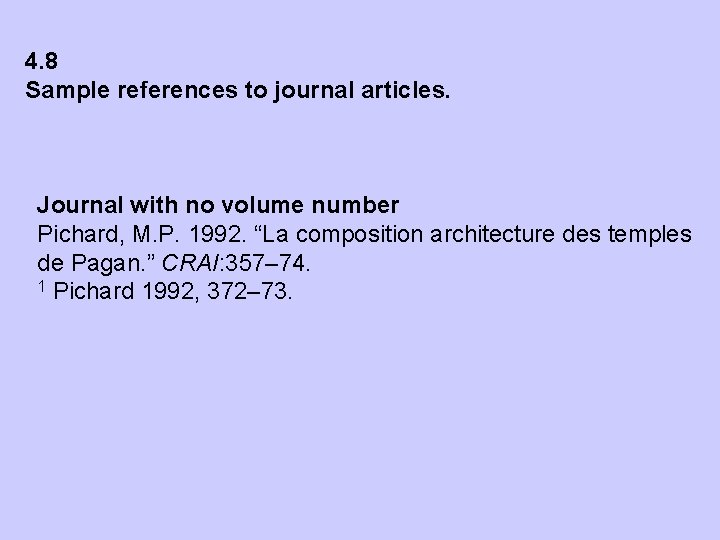
4. 8 Sample references to journal articles. Journal with no volume number Pichard, M. P. 1992. “La composition architecture des temples de Pagan. ” CRAI: 357– 74. 1 Pichard 1992, 372– 73.
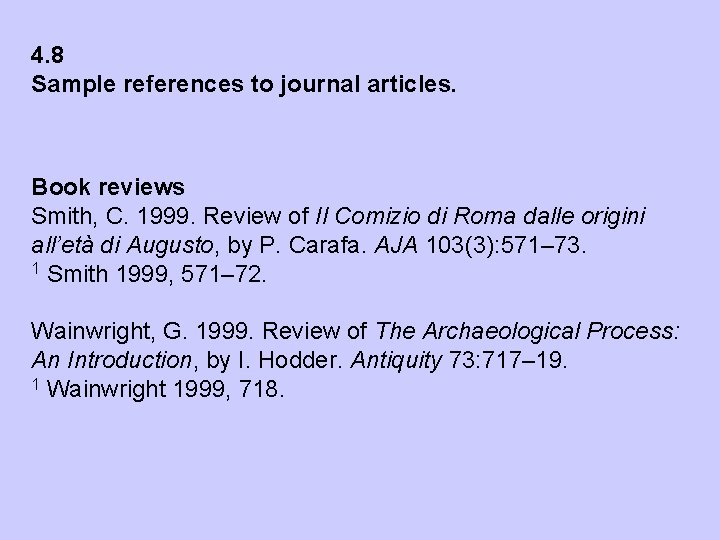
4. 8 Sample references to journal articles. Book reviews Smith, C. 1999. Review of Il Comizio di Roma dalle origini all’età di Augusto, by P. Carafa. AJA 103(3): 571– 73. 1 Smith 1999, 571– 72. Wainwright, G. 1999. Review of The Archaeological Process: An Introduction, by I. Hodder. Antiquity 73: 717– 19. 1 Wainwright 1999, 718.
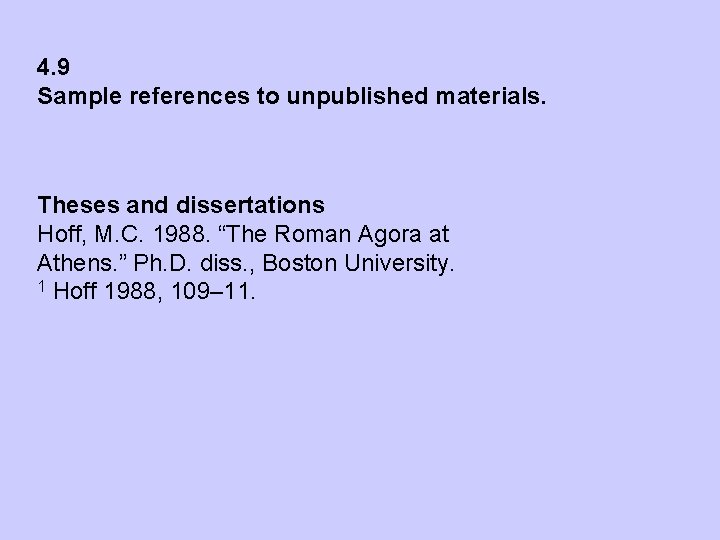
4. 9 Sample references to unpublished materials. Theses and dissertations Hoff, M. C. 1988. “The Roman Agora at Athens. ” Ph. D. diss. , Boston University. 1 Hoff 1988, 109– 11.
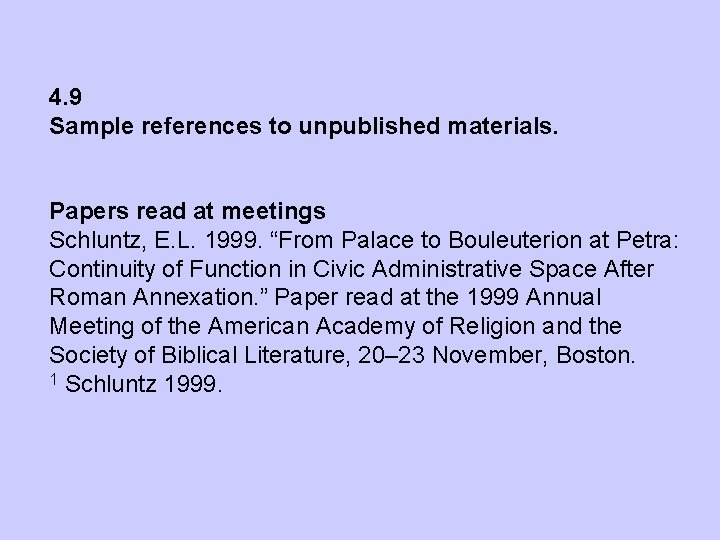
4. 9 Sample references to unpublished materials. Papers read at meetings Schluntz, E. L. 1999. “From Palace to Bouleuterion at Petra: Continuity of Function in Civic Administrative Space After Roman Annexation. ” Paper read at the 1999 Annual Meeting of the American Academy of Religion and the Society of Biblical Literature, 20– 23 November, Boston. 1 Schluntz 1999.
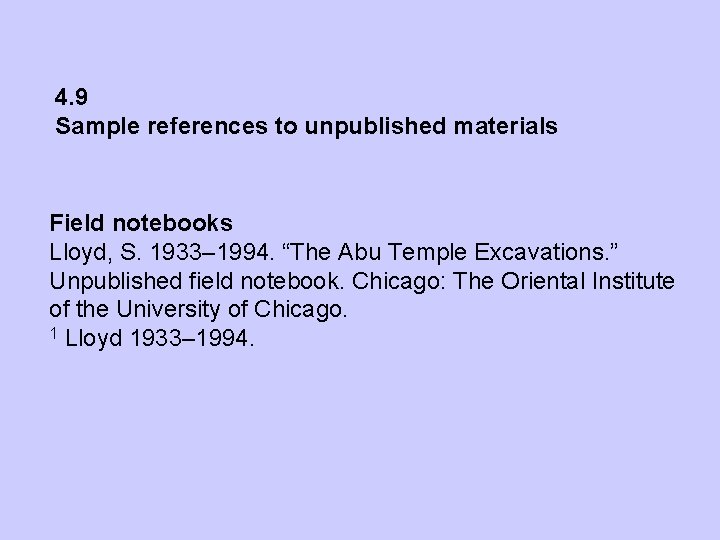
4. 9 Sample references to unpublished materials Field notebooks Lloyd, S. 1933– 1994. “The Abu Temple Excavations. ” Unpublished field notebook. Chicago: The Oriental Institute of the University of Chicago. 1 Lloyd 1933– 1994.

4. 10 Sample references to privately printed materials. Mommsen, T. 1883. Res gestae divi Augusti ex monumentis Ancyrano et Apolloniensi. Berlin: Privately printed. 1 Mommsen 1883, 25
4. 11 Sample references to auction catalogues. Christie’s. 2007. Antiquities. Auction catalogue 1846. 8 June 2007, New York. 1 Christie’s 2007, cat. no. 25. Hôtel Drouot. 1921. Collection Hirsch (première vente): Orfèvrerie, bronzes, pierres, marbres, céramique et verrerie; trouvaille de Sala Consilina; ivories, enluminures, terres cuites. Auction catalogue. 30 June– 2 July 1921, Paris. 1 Hôtel Drouot 1921. Werke ägyptischer Kunst von der Frühzeit bis zur Spätantike. 1974. Auction catalogue 49. Basel: Münzen und Medaillen A. G. 1 Werke ägyptischer Kunst 1974.
Citing Electronic Sources General Policy 5. 1 The citing of electronic sources should be treated, as much as possible, as bibliographic references to printed sources, with sufficient information provided to allow readers to locate original documents or sources of information. If printed versions of electronic sources exist, references should be made to the most recent and complete version. The most common sources of electronic information are files on the Internet and electronic publications, such as CD ROMs. Both are considered below.
Citing Electronic Sources Format and Style 5. 2 References to files on websites. The list of works cited should contain full citations to the home page of a website and may include other pages, files, links, paragraphs, or graphics. The basic format for citing electronic sources in the reference list is as follows: Author’s Last Name, Initial(s) or Maintainer or Sponsoring Institution. Year, date of publication or last update. “Title of Document. ” Title of Site or Journal Name, volume number (year) [if applicable]. URL.
Citing Electronic Sources Format and Style 5. 3 References to CD-ROMs and similar electronic publications. The basic format for citing electronic publications in the reference list is as follows: Author’s Last Name, Initial(s). Date of publication. “Title of Article. ” Title of Publication (Version or file number). Series name [if applicable]. City: Publisher or Distributor.
5. 4. Citing electronic sources – Format and style Sample references to electronic media in list of works cited. The reference list entry is given first, followed by a sample note entry: Home page of a website Lavan, L. , and A. Gering. 2009. Kent-Berling Ostia Excavations. http: //lateantiqueostia. wordpress. com. 1 Lavan and Gering (2009) have recently designed a project to explore this topic. Secondary page of a website Lavan, L. , and A. Gering. 2010, 26 November. “Bones Bring a New Story. ” Kent-Berling Ostia Excavations. http: //lateantiqueostia. wordpress. com. 1 Lavan and Gering 2010.
5. 4. Citing electronic sources – format and style Article in an online journal Iverson, P. 2008, 3 September. “Virtual Seminar on Some Unpublished Inscriptions from Corinth IX. ” Current Epigraphy. www. currentepigraphy. org/2008/09/03/virtual seminar on some unpublished inscriptions fromcorinth ix/. 1 They still remain unpublished, although Iverson (2008) offered a virtual seminar on the inscriptions. Online PDF Yeganehshakib, R. , and K. Rezakhani. 2009. “Sasanian Chemical Warfare? A Scientific Re Assessment. ” Sasanika. www. humanities. uci. edu/sasanika/pdf/Sasanian%20 Chemi cal%20 Warfare. pdf. 1 Yeganehshakib and Rezakhani 2009.
Citing electronic sources – Format and style 5. 4. CD-ROM Duchêne, H. , and S. Girerd. 1998. Delos: A Database of Archaeological Images (U. S. version). Translated by N. K. Rauh, R. F. Townsend, and J. C. Bednar. New York: Educagri Éditions. 1 Duchêne and Girerd (1998, fig. 4278) illustrate a Hellenistic bronze plaque from the Fountain of Minoe depicting Hekate at an altar.
- Slides: 58