
http vilenski orgsciencesafaricellstructurechloroplasts html REACTIONS of PHOTOSYNTHESIS 8



- Slides: 37
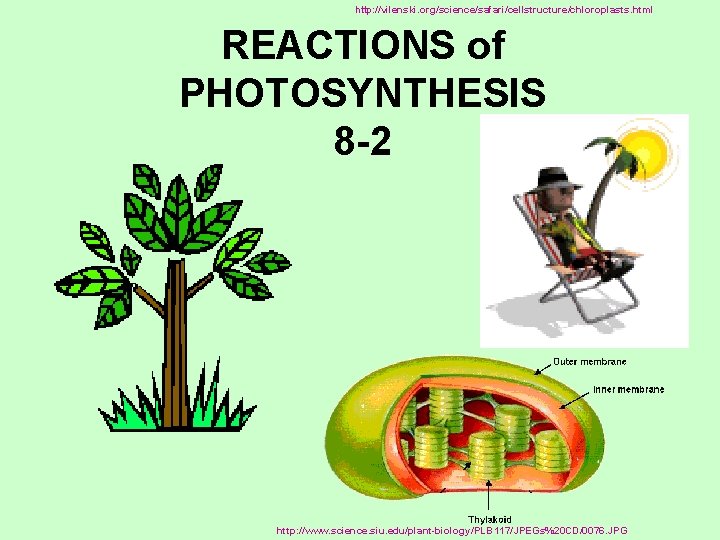
http: //vilenski. org/science/safari/cellstructure/chloroplasts. html REACTIONS of PHOTOSYNTHESIS 8 -2 http: //www. science. siu. edu/plant-biology/PLB 117/JPEGs%20 CD/0076. JPG
Research into PHOTOSYNTHESIS began centuries ago with this simple question: When a tiny seed grows into a huge plant, where does all the “new plant” come from? http: //ninenet. pbslearningmedia. org/resource/tdc 02. sci. life. stru. photosynth/photosynthesis/ http: //www. nofretete-page. de/gemischt. Neu/TN_plant_grow_w. JPG
Discussion Questions • Do you think that the factory is a good analogy for the process of photosynthesis in plants? • Why did von Helmont think that plants got their nourishment from soil? • Why did he eliminate soil as a source of nourishment and focus on water? • What did he measure to find out if the willow plant got its nourishment from soil? • What do you think von Helmont concluded when he measured the change in weight of the plant and the soil?
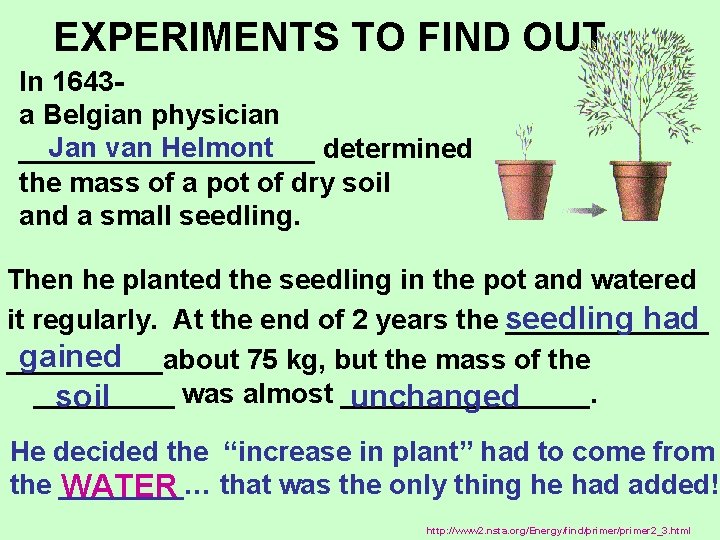
EXPERIMENTS TO FIND OUT In 1643 a Belgian physician Jan van Helmont __________ determined the mass of a pot of dry soil and a small seedling. Then he planted the seedling in the pot and watered had it regularly. At the end of 2 years the seedling _______ gained _____about 75 kg, but the mass of the _____ was almost ________. soil unchanged He decided the “increase in plant” had to come from the ____… WATER that was the only thing he had added! http: //www 2. nsta. org/Energy/find/primer 2_3. html
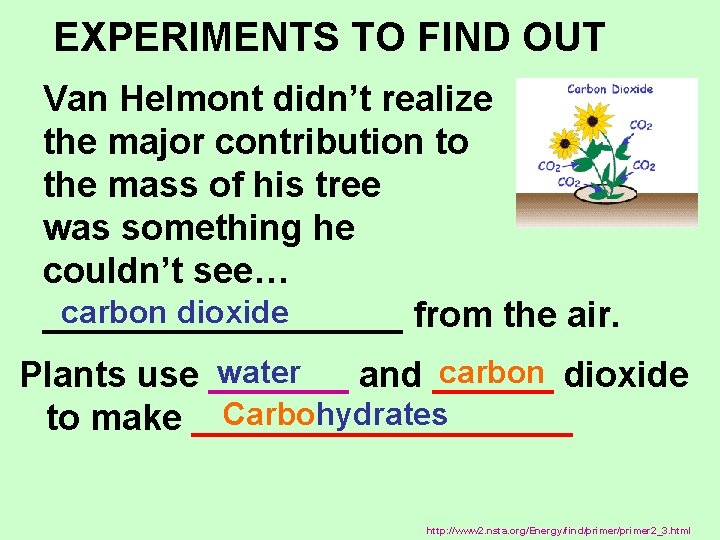
EXPERIMENTS TO FIND OUT Van Helmont didn’t realize the major contribution to the mass of his tree was something he couldn’t see… carbon dioxide _________ from the air. water carbon dioxide Plants use _______ and ______ Carbohydrates to make __________ http: //www 2. nsta. org/Energy/find/primer 2_3. html
EXPERIMENTS TO FIND OUT 1771 - An English minister, Joseph Priestley _____________, discovered that a flame burning in a closed jar would die out. http: //www 2. nsta. org/Energy/find/primer 2_7. html http: //www 2. nsta. org/Energy/find/primer 2_8. html live plant in the If he placed a _____ jar and allowed a few days to pass, the candle could be lit again. The plant produced something “required for burning” that the candle used up OXYGEN We now know it was …______
EXPERIMENTS TO FIND OUT 1779 Jan Ingenhousz Dutch scientist ____________ showed Priestley’s plant experiment only worked if the plant was exposed to light _________ ! http: //www. rgg. og. schule-bw. de/Dokus/d-faech/Biologie/Klasse%208/Bilder/Fotosynthese/Ingenhousz-Netz. JPG
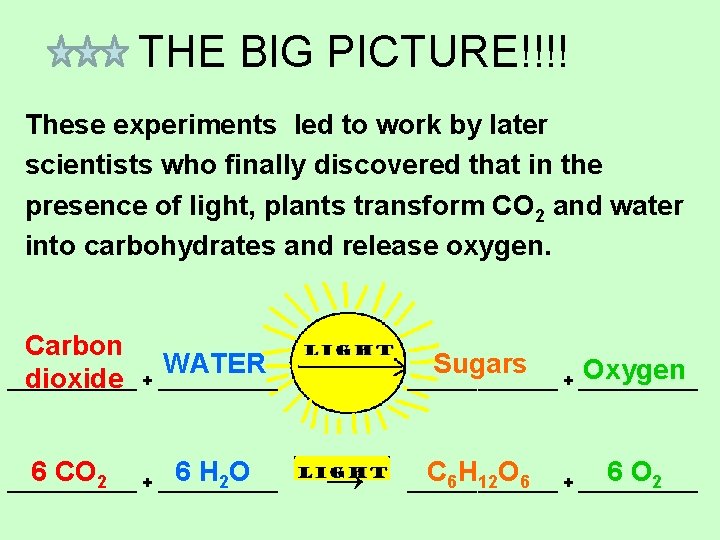
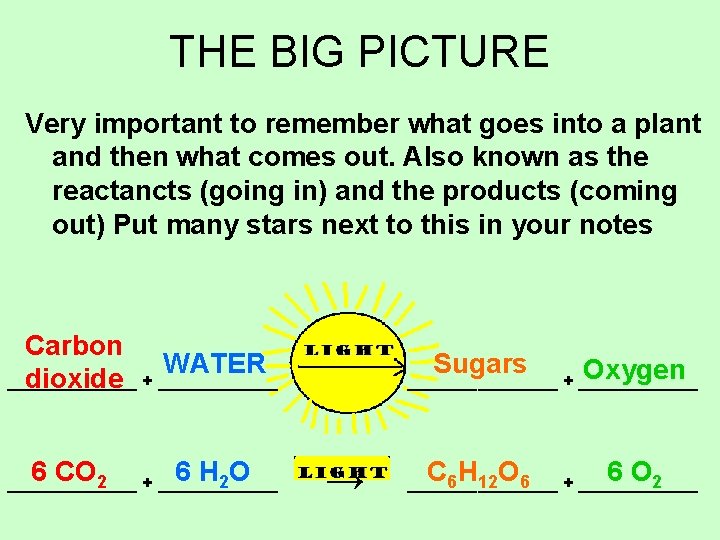
THE BIG PICTURE!!!! These experiments led to work by later scientists who finally discovered that in the presence of light, plants transform CO 2 and water into carbohydrates and release oxygen. Carbon WATER _______ + ______ dioxide 6 CO 2 + ______ 6 H 2 O _______ Sugars Oxygen ________ + ______ → C 6 H 12 O 6 + ______ 6 O 2 ________
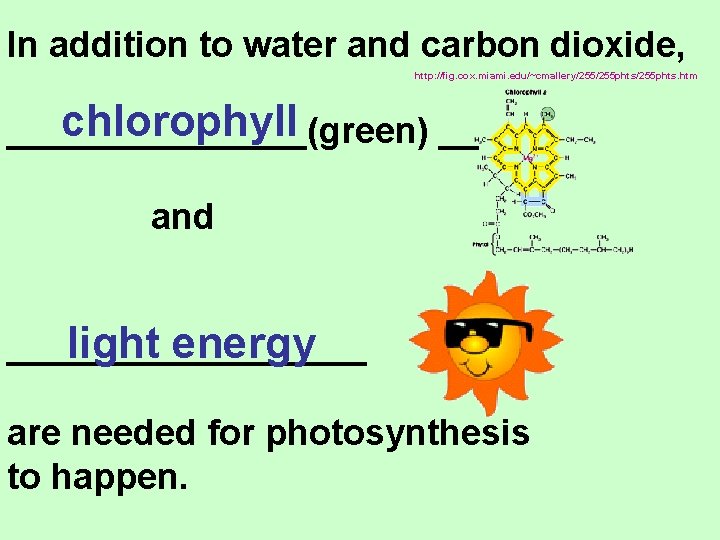
In addition to water and carbon dioxide, http: //fig. cox. miami. edu/~cmallery/255 phts/255 phts. htm chlorophyll ________(green) __ and light energy _________ are needed for photosynthesis to happen.
See a video about PHOTOSYNTHESIS 8 B
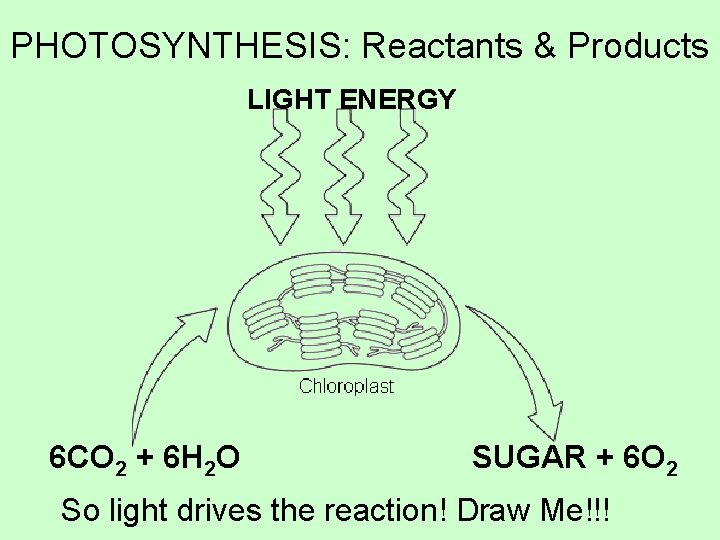
PHOTOSYNTHESIS: Reactants & Products LIGHT ENERGY 6 CO 2 + 6 H 2 O SUGAR + 6 O 2 So light drives the reaction! Draw Me!!!
Pearson Education Inc, Pusblishing as Pearson Prentice Hall Because light is a form of ______, ENERGY any molecule that absorbs light also ABSORBS ______the energy from the light.
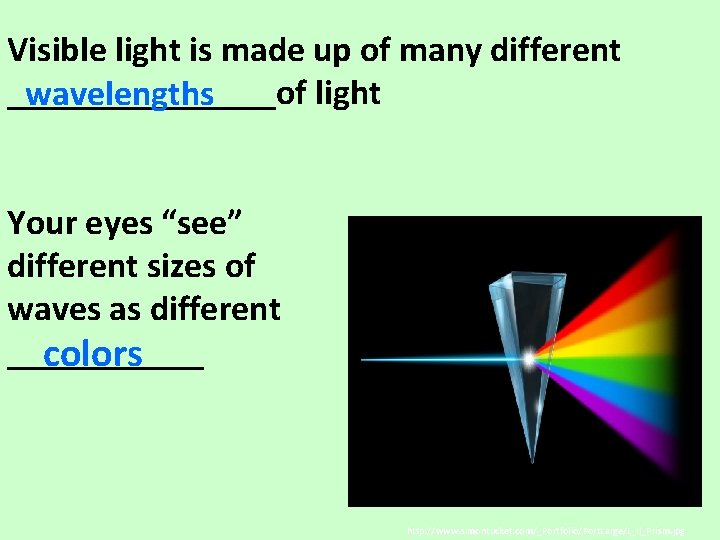
Visible light is made up of many different ________of light wavelengths Your eyes “see” different sizes of waves as different ______ colors http: //www. simontucket. com/_Portfolio/Port. Large/L_Il_Prism. jpg
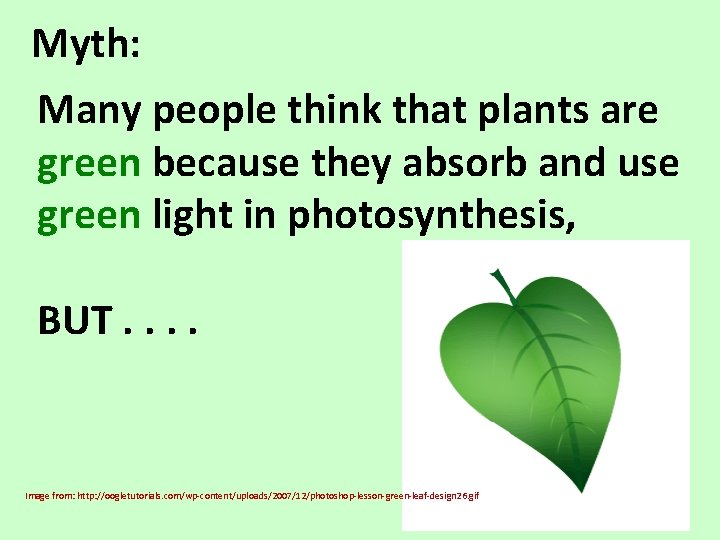
Myth: Many people think that plants are green because they absorb and use green light in photosynthesis, BUT. . Image from: http: //oogletutorials. com/wp-content/uploads/2007/12/photoshop-lesson-green-leaf-design 26. gif
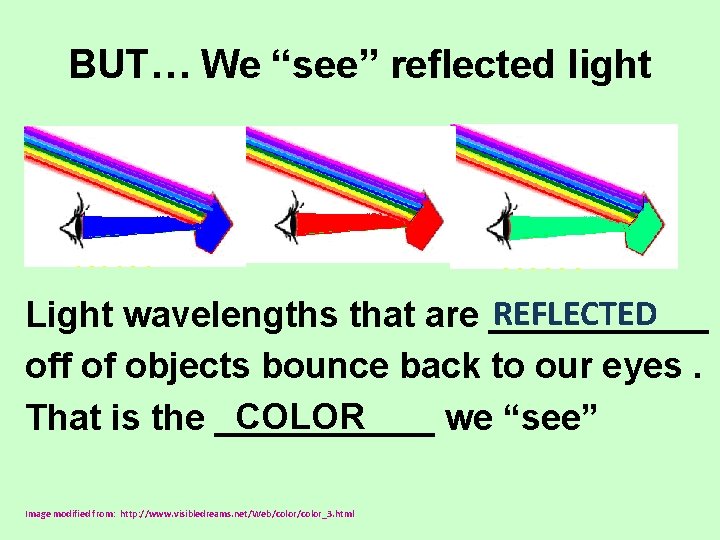
BUT… We “see” reflected light REFLECTED Light wavelengths that are ______ off of objects bounce back to our eyes. COLOR That is the ______ we “see” Image modified from: http: //www. visibledreams. net/Web/color_3. html
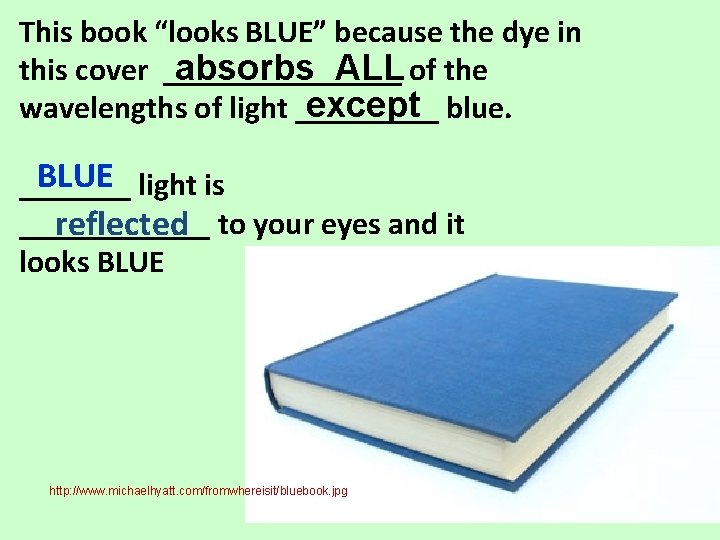
This book “looks BLUE” because the dye in this cover ________ absorbs ALL of the except blue. wavelengths of light _____ BLUE light is ____________ reflected to your eyes and it looks BLUE http: //www. michaelhyatt. com/fromwhereisit/bluebook. jpg
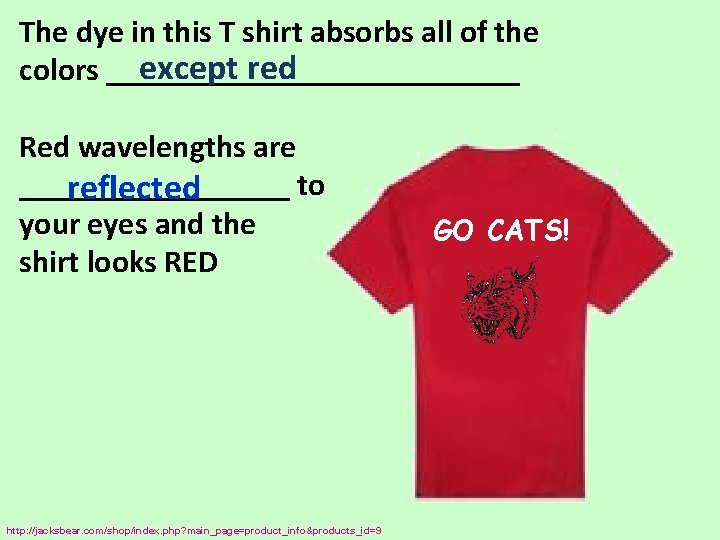
The dye in this T shirt absorbs all of the except red colors _____________ Red wavelengths are _________ to reflected your eyes and the shirt looks RED http: //jacksbear. com/shop/index. php? main_page=product_info&products_id=9 GO CATS!
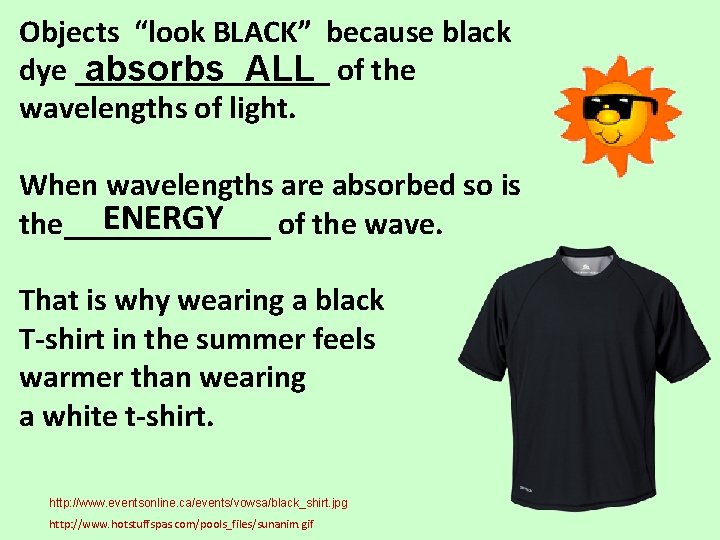
Objects “look BLACK” because black dye ________ absorbs ALL of the wavelengths of light. When wavelengths are absorbed so is ENERGY the_______ of the wave. That is why wearing a black T-shirt in the summer feels warmer than wearing a white t-shirt. http: //www. eventsonline. ca/events/vowsa/black_shirt. jpg http: //www. hotstuffspas. com/pools_files/sunanim. gif
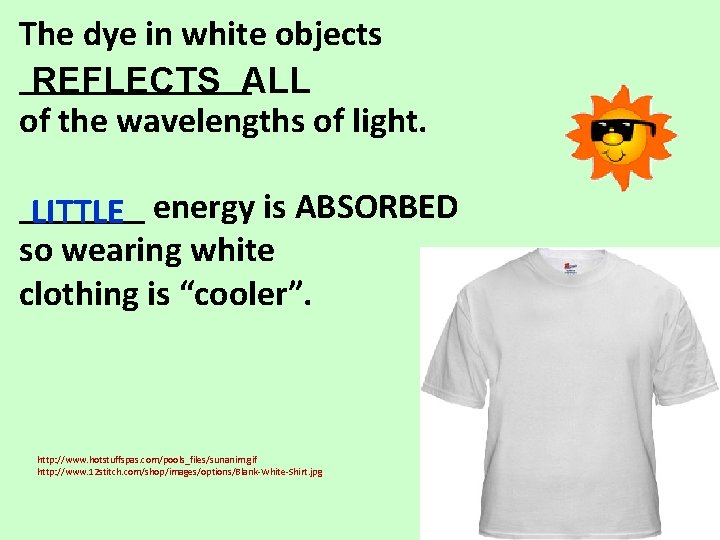
The dye in white objects _______ REFLECTS ALL of the wavelengths of light. _______ LITTLE energy is ABSORBED so wearing white clothing is “cooler”. http: //www. hotstuffspas. com/pools_files/sunanim. gif http: //www. 12 stitch. com/shop/images/options/Blank-White-Shirt. jpg
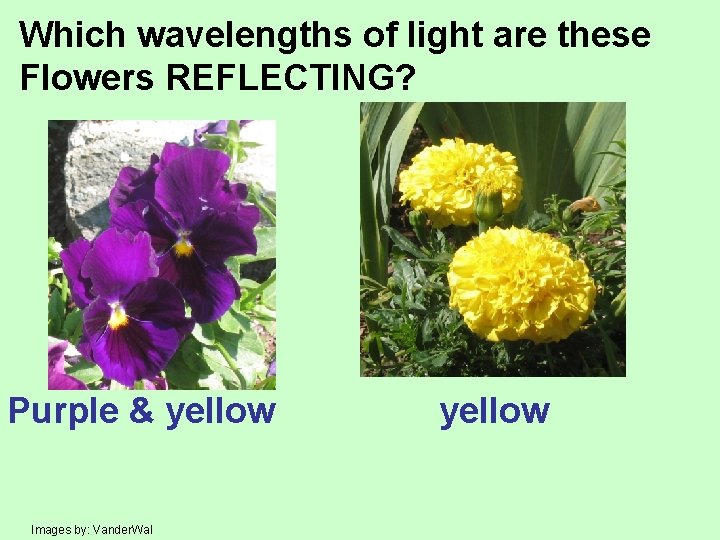
Which wavelengths of light are these Flowers REFLECTING? Purple & yellow Images by: Vander. Wal yellow
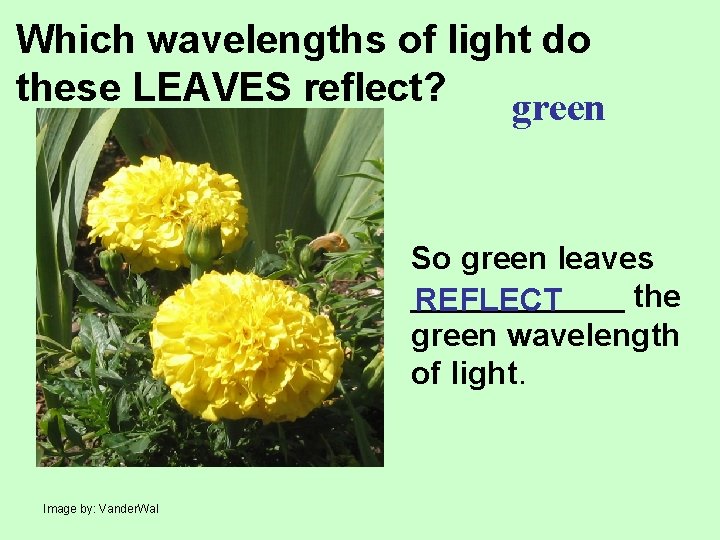
Which wavelengths of light do these LEAVES reflect? green So green leaves ______ the REFLECT green wavelength of light. Image by: Vander. Wal
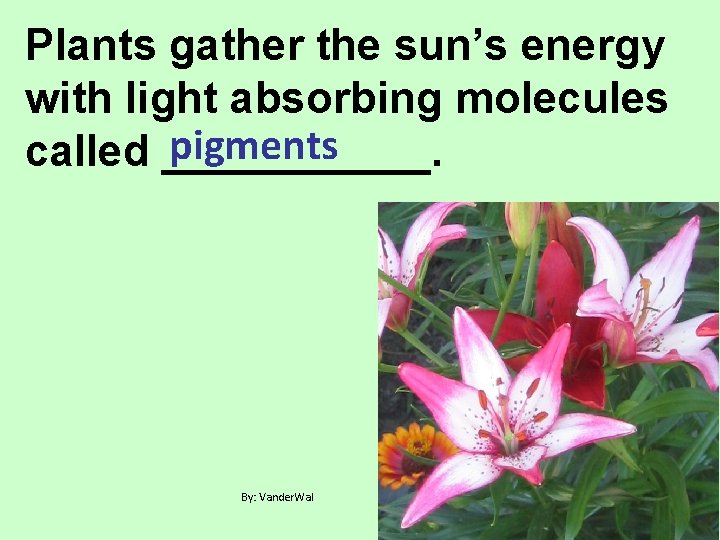
Plants gather the sun’s energy with light absorbing molecules pigments called ______. By: Vander. Wal
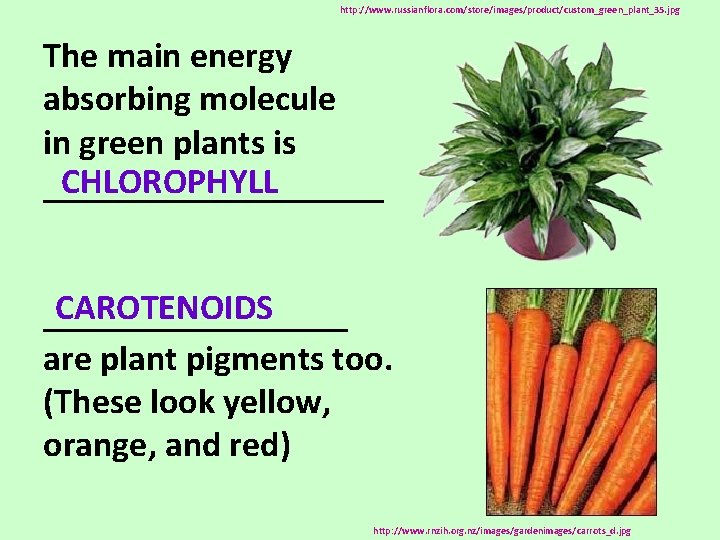
http: //www. russianflora. com/store/images/product/custom_green_plant_35. jpg The main energy absorbing molecule in green plants is CHLOROPHYLL __________ CAROTENOIDS _________ are plant pigments too. (These look yellow, orange, and red) http: //www. rnzih. org. nz/images/gardenimages/carrots_d. jpg
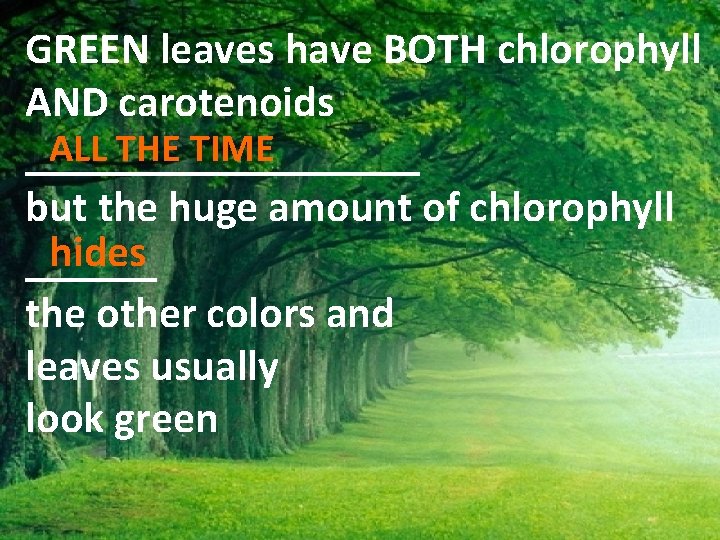
GREEN leaves have BOTH chlorophyll AND carotenoids ALL THE TIME _________ but the huge amount of chlorophyll hides ______ the other colors and leaves usually look green
FALL chlorophyll production In ______, slows as the trees shut down and photosynthesis stops for winter. http: //sps. k 12. ar. us/massengale/ecology_notes_bi. htm
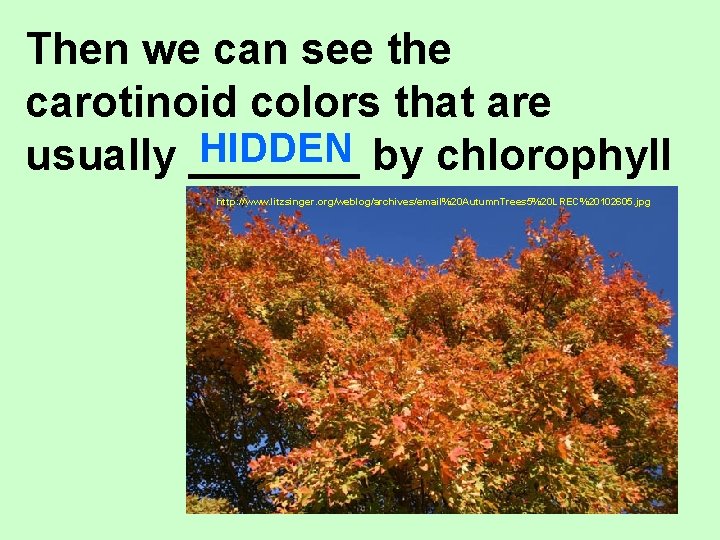
Then we can see the carotinoid colors that are HIDDEN by chlorophyll usually _______ http: //www. litzsinger. org/weblog/archives/email%20 Autumn. Trees 5%20 LREC%20102605. jpg
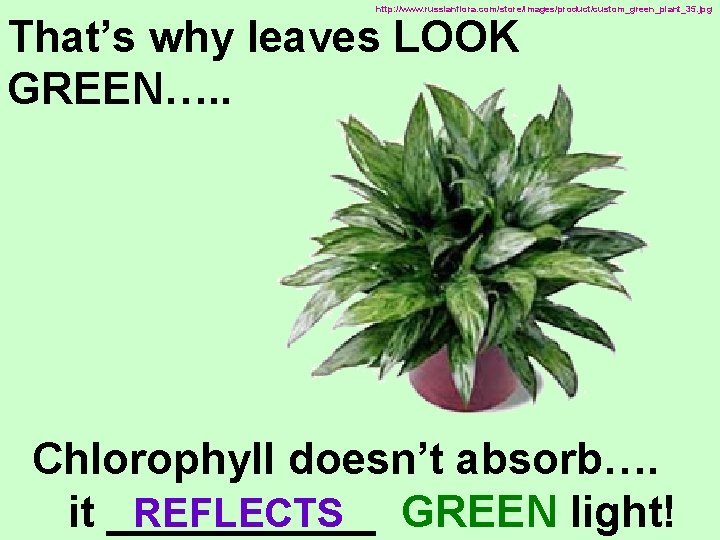
http: //www. russianflora. com/store/images/product/custom_green_plant_35. jpg That’s why leaves LOOK GREEN…. . Chlorophyll doesn’t absorb…. it ______ REFLECTS GREEN light!
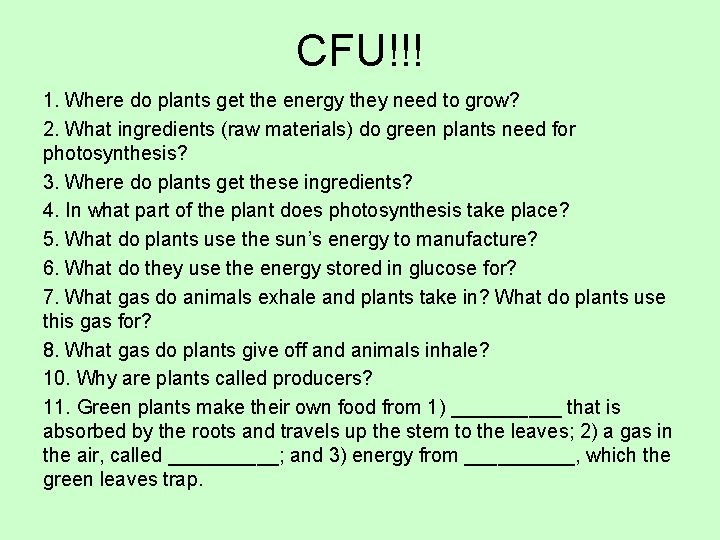
CFU!!! 1. Where do plants get the energy they need to grow? 2. What ingredients (raw materials) do green plants need for photosynthesis? 3. Where do plants get these ingredients? 4. In what part of the plant does photosynthesis take place? 5. What do plants use the sun’s energy to manufacture? 6. What do they use the energy stored in glucose for? 7. What gas do animals exhale and plants take in? What do plants use this gas for? 8. What gas do plants give off and animals inhale? 10. Why are plants called producers? 11. Green plants make their own food from 1) _____ that is absorbed by the roots and travels up the stem to the leaves; 2) a gas in the air, called _____; and 3) energy from _____, which the green leaves trap.
THE BIG PICTURE Very important to remember what goes into a plant and then what comes out. Also known as the reactancts (going in) and the products (coming out) Put many stars next to this in your notes Carbon WATER _______ + ______ dioxide 6 CO 2 + ______ 6 H 2 O _______ Sugars Oxygen ________ + ______ → C 6 H 12 O 6 + ______ 6 O 2 ________
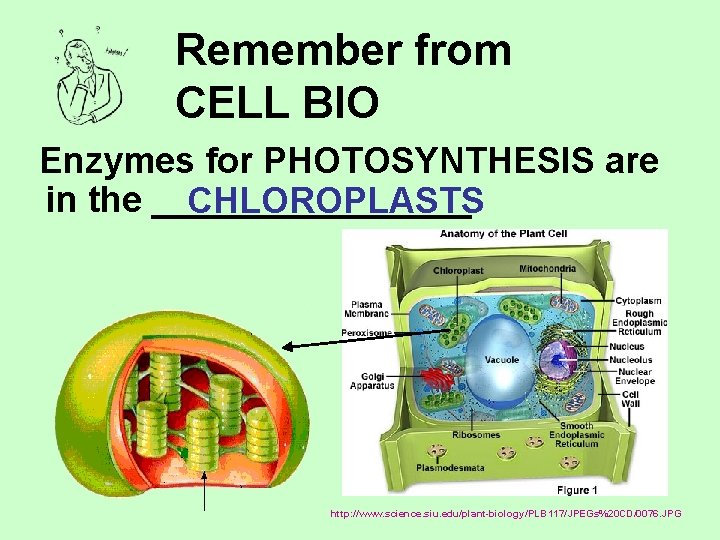
Remember from CELL BIO Enzymes for PHOTOSYNTHESIS are in the ________ CHLOROPLASTS http: //www. science. siu. edu/plant-biology/PLB 117/JPEGs%20 CD/0076. JPG
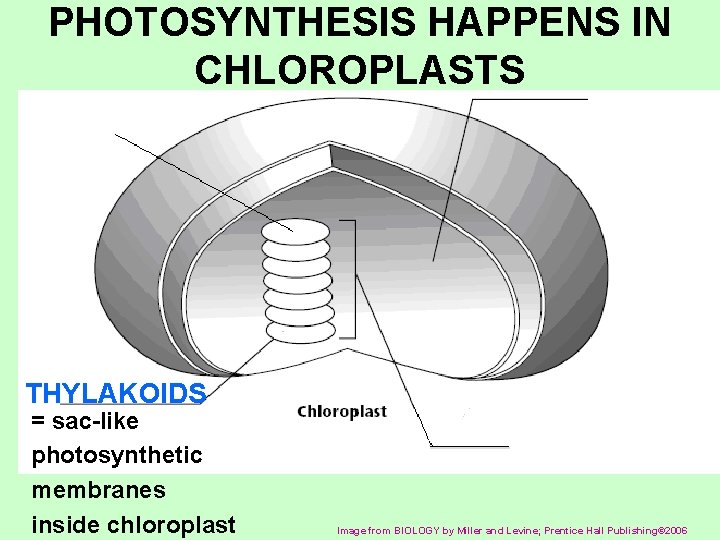
PHOTOSYNTHESIS HAPPENS IN CHLOROPLASTS THYLAKOIDS = sac-like photosynthetic membranes inside chloroplast Image from BIOLOGY by Miller and Levine; Prentice Hall Publishing© 2006
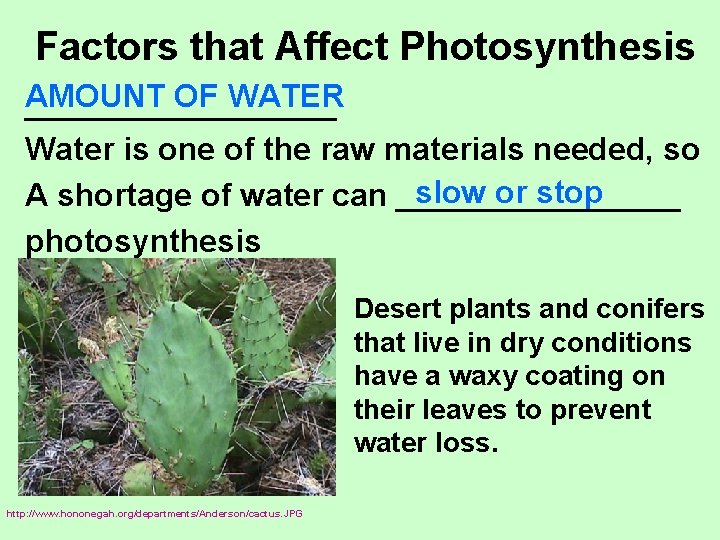
Factors that Affect Photosynthesis AMOUNT OF WATER __________ Water is one of the raw materials needed, so slow or stop A shortage of water can ________ photosynthesis Desert plants and conifers that live in dry conditions have a waxy coating on their leaves to prevent water loss. http: //www. hononegah. org/departments/Anderson/cactus. JPG
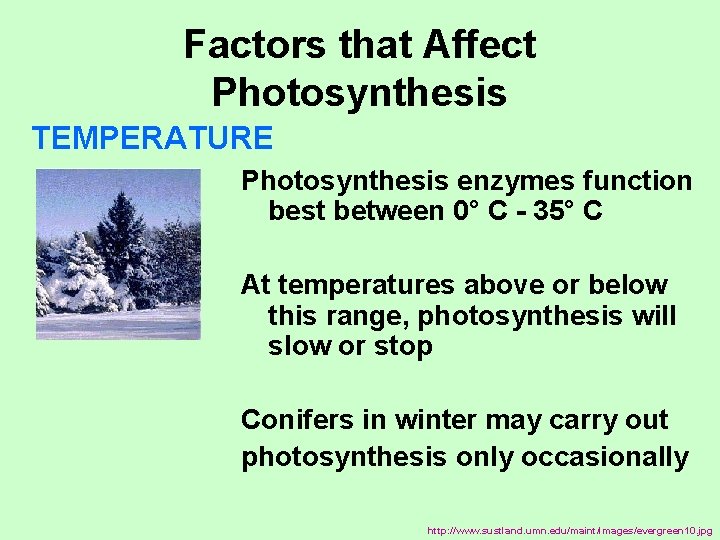
Factors that Affect Photosynthesis TEMPERATURE Photosynthesis enzymes function best between 0° C - 35° C At temperatures above or below this range, photosynthesis will slow or stop Conifers in winter may carry out photosynthesis only occasionally http: //www. sustland. umn. edu/maint/images/evergreen 10. jpg
Factors that Affect Photosynthesis LIGHT INTENSITY __________ More light increases rate of photosynthesis up to a certain level until plant reaches its maximum rate of photosynthesis http: //206. 173. 89. 42/REALTYWITHALOHA_COM/piphoto/funny%20 sun%20 with%20 sunglasses. gif
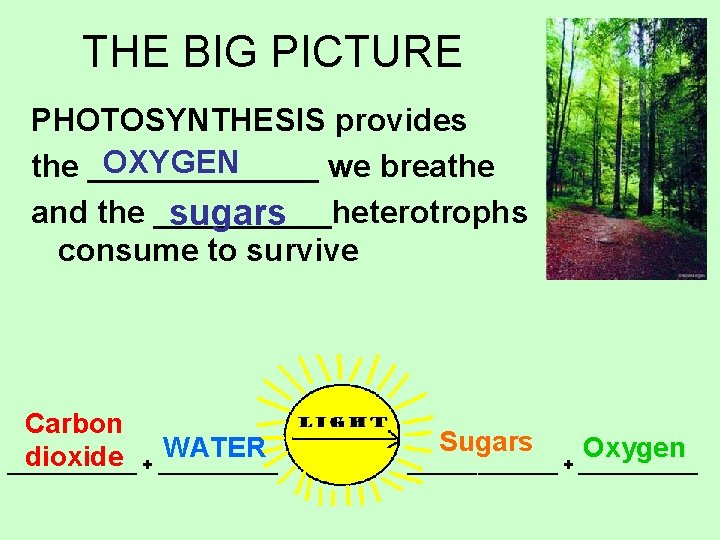
THE BIG PICTURE PHOTOSYNTHESIS provides OXYGEN the _______ we breathe and the _____heterotrophs sugars consume to survive Carbon WATER dioxide + _____________ Sugars Oxygen ________ + ______
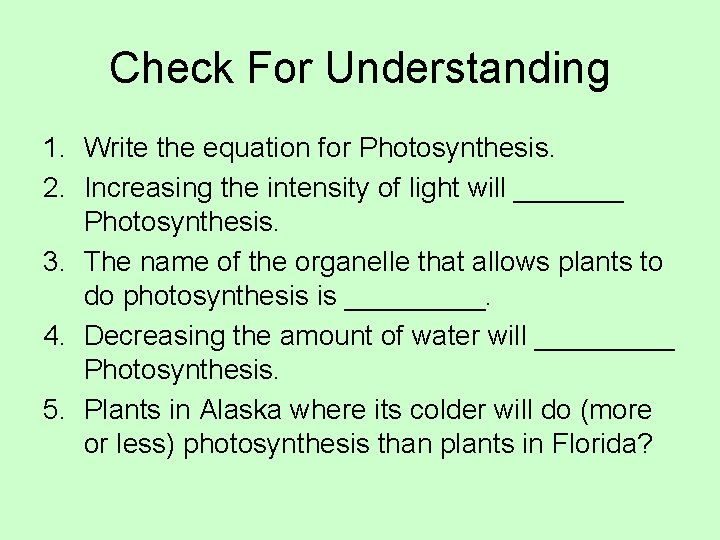
Check For Understanding 1. Write the equation for Photosynthesis. 2. Increasing the intensity of light will _______ Photosynthesis. 3. The name of the organelle that allows plants to do photosynthesis is _____. 4. Decreasing the amount of water will _____ Photosynthesis. 5. Plants in Alaska where its colder will do (more or less) photosynthesis than plants in Florida?
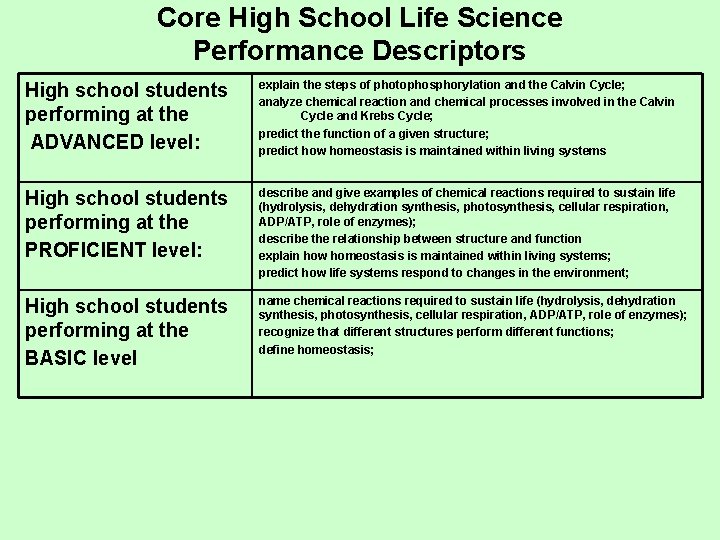
Core High School Life Science Performance Descriptors High school students performing at the ADVANCED level: explain the steps of photophosphorylation and the Calvin Cycle; analyze chemical reaction and chemical processes involved in the Calvin Cycle and Krebs Cycle; predict the function of a given structure; predict how homeostasis is maintained within living systems High school students performing at the PROFICIENT level: describe and give examples of chemical reactions required to sustain life (hydrolysis, dehydration synthesis, photosynthesis, cellular respiration, ADP/ATP, role of enzymes); describe the relationship between structure and function explain how homeostasis is maintained within living systems; predict how life systems respond to changes in the environment; High school students performing at the BASIC level name chemical reactions required to sustain life (hydrolysis, dehydration synthesis, photosynthesis, cellular respiration, ADP/ATP, role of enzymes); recognize that different structures perform different functions; define homeostasis;