
http cpi asm md ERA Instruments implementation in
- Slides: 20
http: //cpi. asm. md ERA Instruments implementation in Moldova Dr. Lidia ROMANCIUC Director, Center of International Projects Academy of Sciences of Moldova Nov, 2017 Center of International Projects 1
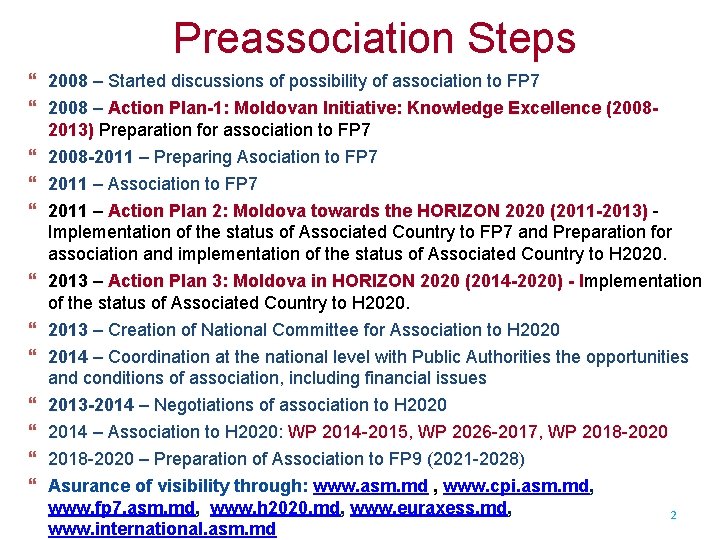
Preassociation Steps 2008 – Started discussions of possibility of association to FP 7 2008 – Action Plan-1: Moldovan Initiative: Knowledge Excellence (20082013) Preparation for association to FP 7 2008 -2011 – Preparing Asociation to FP 7 2011 – Association to FP 7 2011 – Action Plan 2: Moldova towards the HORIZON 2020 (2011 -2013) Implementation of the status of Associated Country to FP 7 and Preparation for association and implementation of the status of Associated Country to H 2020. 2013 – Action Plan 3: Moldova in HORIZON 2020 (2014 -2020) - Implementation of the status of Associated Country to H 2020. 2013 – Creation of National Committee for Association to H 2020 2014 – Coordination at the national level with Public Authorities the opportunities and conditions of association, including financial issues 2013 -2014 – Negotiations of association to H 2020 2014 – Association to H 2020: WP 2014 -2015, WP 2026 -2017, WP 2018 -2020 – Preparation of Association to FP 9 (2021 -2028) Asurance of visibility through: www. asm. md , www. cpi. asm. md, www. fp 7. asm. md, www. h 2020. md, www. euraxess. md, 2 www. international. asm. md
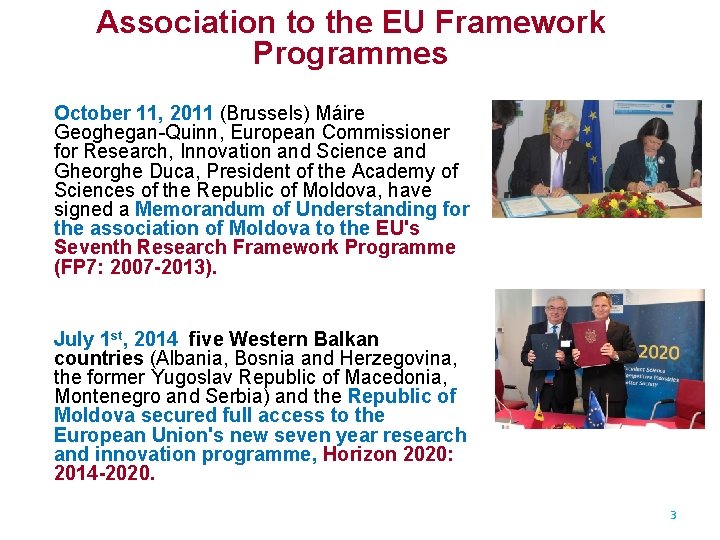
Association to the EU Framework Programmes October 11, 2011 (Brussels) Máire Geoghegan-Quinn, European Commissioner for Research, Innovation and Science and Gheorghe Duca, President of the Academy of Sciences of the Republic of Moldova, have signed a Memorandum of Understanding for the association of Moldova to the EU's Seventh Research Framework Programme (FP 7: 2007 -2013). July 1 st, 2014 five Western Balkan countries (Albania, Bosnia and Herzegovina, the former Yugoslav Republic of Macedonia, Montenegro and Serbia) and the Republic of Moldova secured full access to the European Union's new seven year research and innovation programme, Horizon 2020: 2014 -2020. 3
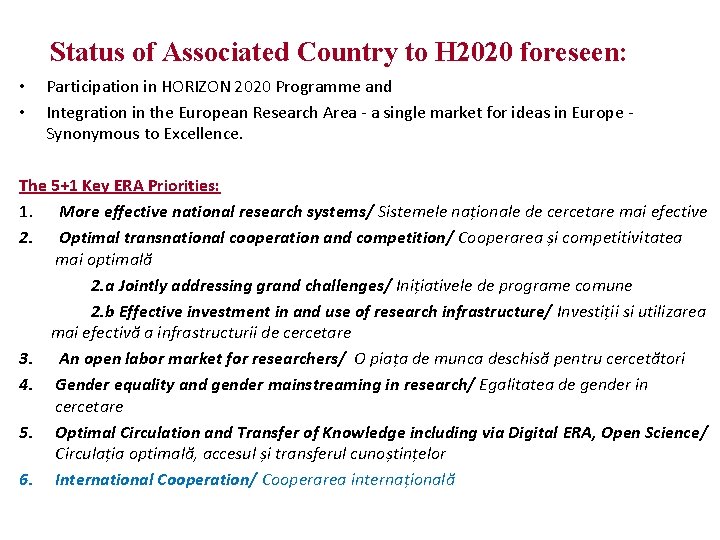
Status of Associated Country to H 2020 foreseen: • • Participation in HORIZON 2020 Programme and Integration in the European Research Area - a single market for ideas in Europe Synonymous to Excellence. The 5+1 Key ERA Priorities: 1. More effective national research systems/ Sistemele naționale de cercetare mai efective 2. Optimal transnational cooperation and competition/ Cooperarea și competitivitatea mai optimală 2. a Jointly addressing grand challenges/ Inițiativele de programe comune 2. b Effective investment in and use of research infrastructure/ Investiții si utilizarea mai efectivă a infrastructurii de cercetare 3. An open labor market for researchers/ O piața de munca deschisă pentru cercetători 4. Gender equality and gender mainstreaming in research/ Egalitatea de gender in cercetare 5. Optimal Circulation and Transfer of Knowledge including via Digital ERA, Open Science/ Circulația optimală, accesul și transferul cunoștințelor 6. International Cooperation/ Cooperarea internațională
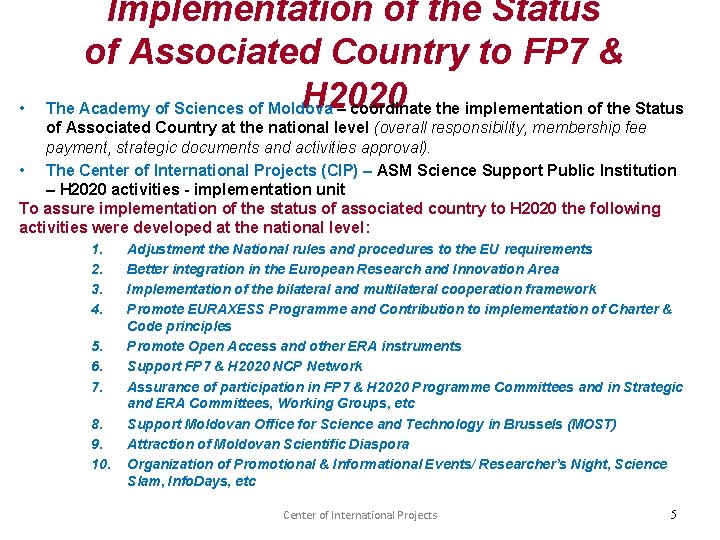
• Implementation of the Status of Associated Country to FP 7 & H 2020 The Academy of Sciences of Moldova – coordinate the implementation of the Status of Associated Country at the national level (overall responsibility, membership fee payment, strategic documents and activities approval). • The Center of International Projects (CIP) – ASM Science Support Public Institution – H 2020 activities - implementation unit To assure implementation of the status of associated country to H 2020 the following activities were developed at the national level: 1. 2. 3. 4. 5. 6. 7. 8. 9. 10. Adjustment the National rules and procedures to the EU requirements Better integration in the European Research and Innovation Area Implementation of the bilateral and multilateral cooperation framework Promote EURAXESS Programme and Contribution to implementation of Charter & Code principles Promote Open Access and other ERA instruments Support FP 7 & H 2020 NCP Network Assurance of participation in FP 7 & H 2020 Programme Committees and in Strategic and ERA Committees, Working Groups, etc Support Moldovan Office for Science and Technology in Brussels (MOST) Attraction of Moldovan Scientific Diaspora Organization of Promotional & Informational Events/ Researcher’s Night, Science Slam, Info. Days, etc Center of International Projects 5
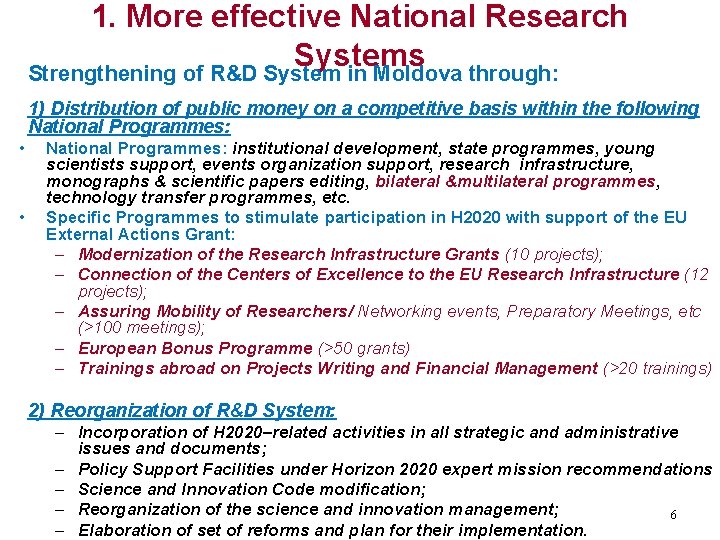
1. More effective National Research Systems Strengthening of R&D System in Moldova through: 1) Distribution of public money on a competitive basis within the following National Programmes: • • National Programmes: institutional development, state programmes, young scientists support, events organization support, research infrastructure, monographs & scientific papers editing, bilateral &multilateral programmes, technology transfer programmes, etc. Specific Programmes to stimulate participation in H 2020 with support of the EU External Actions Grant: – Modernization of the Research Infrastructure Grants (10 projects); – Connection of the Centers of Excellence to the EU Research Infrastructure (12 projects); – Assuring Mobility of Researchers/ Networking events, Preparatory Meetings, etc (>100 meetings); – European Bonus Programme (>50 grants) – Trainings abroad on Projects Writing and Financial Management (>20 trainings) 2) Reorganization of R&D System: – Incorporation of H 2020–related activities in all strategic and administrative issues and documents; – Policy Support Facilities under Horizon 2020 expert mission recommendations – Science and Innovation Code modification; – Reorganization of the science and innovation management; 6 – Elaboration of set of reforms and plan for their implementation.
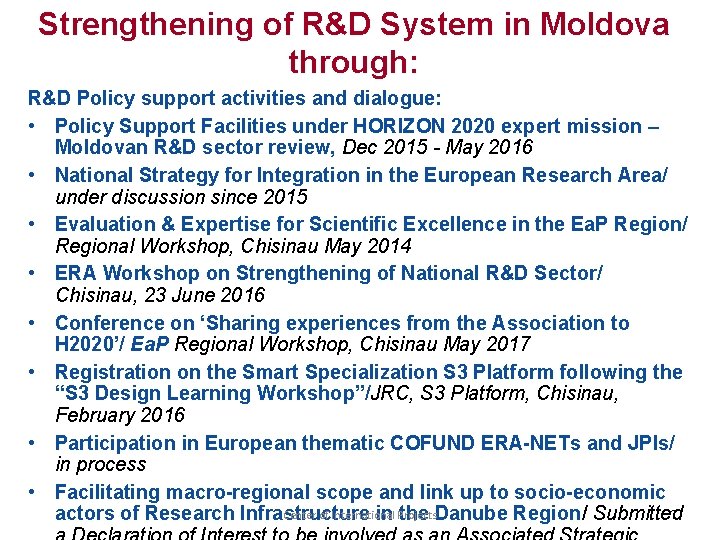
Strengthening of R&D System in Moldova through: R&D Policy support activities and dialogue: • Policy Support Facilities under HORIZON 2020 expert mission – Moldovan R&D sector review, Dec 2015 - May 2016 • National Strategy for Integration in the European Research Area/ under discussion since 2015 • Evaluation & Expertise for Scientific Excellence in the Ea. P Region/ Regional Workshop, Chisinau May 2014 • ERA Workshop on Strengthening of National R&D Sector/ Chisinau, 23 June 2016 • Conference on ‘Sharing experiences from the Association to H 2020’/ Ea. P Regional Workshop, Chisinau May 2017 • Registration on the Smart Specialization S 3 Platform following the “S 3 Design Learning Workshop”/JRC, S 3 Platform, Chisinau, February 2016 • Participation in European thematic COFUND ERA-NETs and JPIs/ in process • Facilitating macro-regional scope and link up to socio-economic Center of International 7 actors of Research Infrastructure in Projects the Danube Region/ Submitted
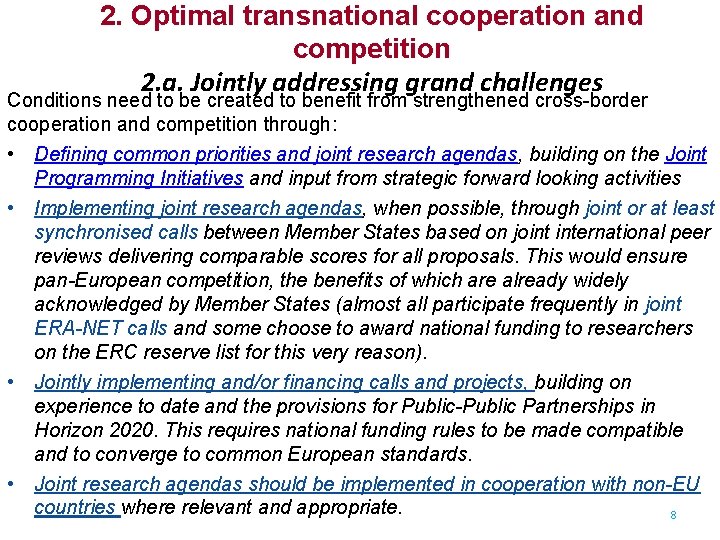
2. Optimal transnational cooperation and competition 2. a. Jointly addressing grand challenges Conditions need to be created to benefit from strengthened cross-border cooperation and competition through: • Defining common priorities and joint research agendas, building on the Joint Programming Initiatives and input from strategic forward looking activities • Implementing joint research agendas, when possible, through joint or at least synchronised calls between Member States based on joint international peer reviews delivering comparable scores for all proposals. This would ensure pan-European competition, the benefits of which are already widely acknowledged by Member States (almost all participate frequently in joint ERA-NET calls and some choose to award national funding to researchers on the ERC reserve list for this very reason). • Jointly implementing and/or financing calls and projects, building on experience to date and the provisions for Public-Public Partnerships in Horizon 2020. This requires national funding rules to be made compatible and to converge to common European standards. • Joint research agendas should be implemented in cooperation with non-EU countries where relevant and appropriate. 8
• 2. Optimal transnational cooperation and competition Bilateral & Multilateral Cooperation: More then 40 bilateral scientific cooperation agreements signed by ASM with the R&D Funding Partners from Europe, NIS and other countries; • Since 2009 were supported more than 300 bilateral projects under cooperation agreements with the National R&D Funding Authorities from Belarus, Germany, France, Italy, Romania, Russia, Ukraine and STCU; • Since 2012 were introduced the overarch priorities in all National Programmes: ◦ Demonstrate the experience of participation in the FP 7 &H 2020 Programme; ◦ Consolidation of efforts for elaboration and submission the new projects to FP 7 & H 2020 programmes during the implementation of projects. Participation within ERANET and other Joint Calls is very important to lay the ground for further participation in the EU FP: FP 7 Black-Sea-ERA. Net – Pilot Joint Call FP 7 SEERA-EI – Pilot Joint Call FP 7 ERA. Net-RUS-PLUS - Single Joint Call, 2014 and 2017 H 2020 Water Works ERA. Net 2014 -2019 in Support of the Water JPI–Announced 2014, 2015, 2017 BMBF Danube Regional Call – 2 ongoing projects H 2020 Black Sea HORIZON – Joint Call - Announced in 2017 H 2020 IC 4 Water ERA. Net– ERA. Net Joint Call - Announced in 2017 9 H 2020 AXIC ERA. Net – Joint Call – To be Announced in 2018
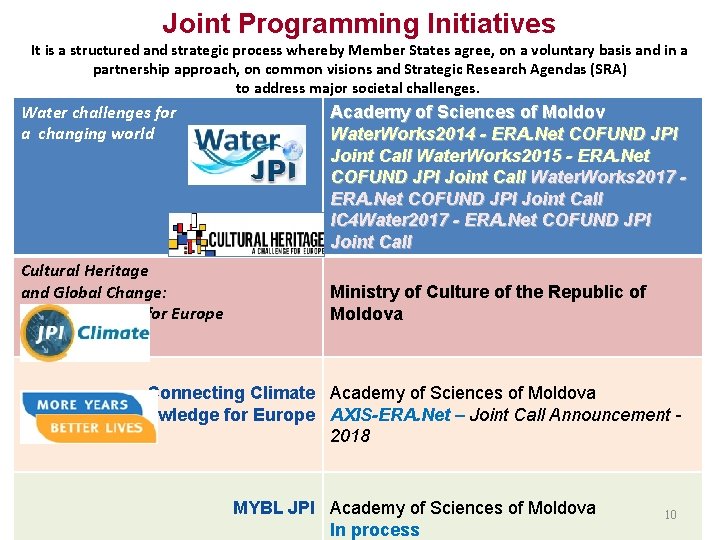
Joint Programming Initiatives It is a structured and strategic process whereby Member States agree, on a voluntary basis and in a partnership approach, on common visions and Strategic Research Agendas (SRA) to address major societal challenges. Water challenges for a changing world Cultural Heritage and Global Change: a new challenge for Europe Academy of Sciences of Moldov Water. Works 2014 - ERA. Net COFUND JPI Joint Call Water. Works 2015 - ERA. Net COFUND JPI Joint Call Water. Works 2017 ERA. Net COFUND JPI Joint Call IC 4 Water 2017 - ERA. Net COFUND JPI Joint Call Ministry of Culture of the Republic of Moldova Connecting Climate Academy of Sciences of Moldova Knowledge for Europe AXIS-ERA. Net – Joint Call Announcement 2018 MYBL JPI Academy of Sciences of Moldova In process 10
2. b. Effective investment in and use of research infrastructure Excellent research depends upon world-class facilities and research infrastructures (RIs), including ICT-based e-infrastructures (e. RIs). Such RIs attract talent and stimulate innovation and business opportunities. e. RIs in particular enable increasingly prevalent data-intensive collaborative research by geographically dispersed teams - e. Science. European Commission will: • Support through Horizon 2020 access to RIs as well as the on-going overall integration of EU RIs particularly those awarded ERIC status. • Encourage Member States to link RI roadmaps to the ESFRI roadmap and Smart Specialization Strategies in Structural Funds co-financed research and innovation programmes. • Support training programmes for the management of such Ris. • Develop in cooperation with ESFRI, and other stakeholders a Charter of Access setting out common standards and harmonized access rules and conditions for the use of Ris. • Work with ESFRI to set priorities for implementing the Roadmap and to provide advice and guidance to Member States on overcoming legal, financial or technical obstacles to implementation. • Define with ESFRI and other stakeholders common evaluation principles, impact-assessment criteria and monitoring tools which can be applied in regional, national and European programmes to help combine funds from different sources At the National level: first steps and measures to improve research infrastructure: – National & International Programmes for Equipment Purchase 11 – Connection of the Centers of Excellence to the EU Research Infrastructure-2015 -
3. An open labor market for researchers EURAXESS Facilitating mobility, supporting training and ensuring attractive careers • • • While researcher mobility contributes to excellence, several obstacles stand in the way of a genuine European research labour market. One of the most important is the lack of transparent, open and merit-based recruitment, which makes research careers less attractive and hampers mobility, Gender equality and research performance. Giving non-nationals/ non-residents access to national grants and making them portable across borders would make mobility easier. In some cases, legal and administrative barriers prevent this. Initiatives such as 'Money Follows Researcher' show those barriers can be removed and how Member States and research organisations can organise access to and portability of national grants, while upholding the interests of all parties. Other obstacles include human resources policies which result in poor career prospects for young researchers, inadequate Gender equality practices, social security obstacles and, insufficient academia-business mobility with only one in six Centre of International Projects 12 researchers in academia having experience in the private sector. Obstacles to the
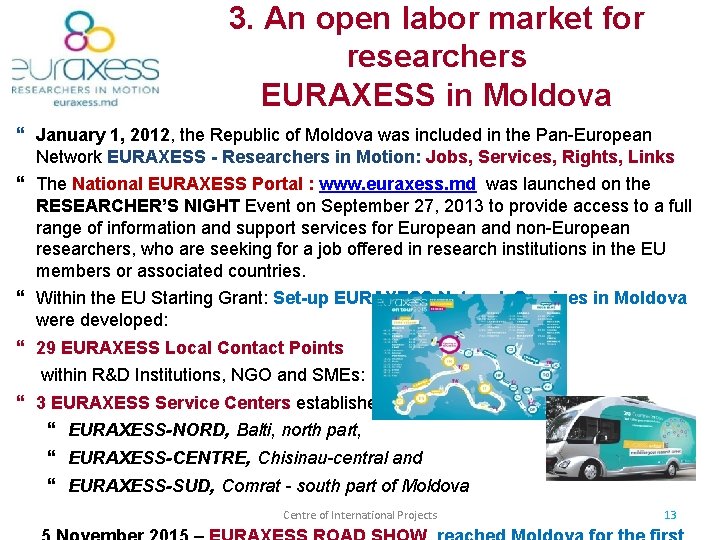
3. An open labor market for researchers EURAXESS in Moldova January 1, 2012, the Republic of Moldova was included in the Pan-European Network EURAXESS - Researchers in Motion: Jobs, Services, Rights, Links The National EURAXESS Portal : www. euraxess. md was launched on the RESEARCHER’S NIGHT Event on September 27, 2013 to provide access to a full range of information and support services for European and non-European researchers, who are seeking for a job offered in research institutions in the EU members or associated countries. Within the EU Starting Grant: Set-up EURAXESS Network Services in Moldova were developed: 29 EURAXESS Local Contact Points within R&D Institutions, NGO and SMEs: 3 EURAXESS Service Centers established: EURAXESS-NORD, Balti, north part, EURAXESS-CENTRE, Chisinau-central and EURAXESS-SUD, Comrat - south part of Moldova Centre of International Projects 13
3. An open labor market for researchers EURAXESS Rights: Charter and Code • • • December 12, 2011, the scientific community of the Republic of Moldova joined the European Charter for Researchers and the Code of Conduct for the Recruitment of Researchers, providing a set of principles and conditions which specify the responsibilities and rights of both researchers and employers. Since 2012 Moldova is involved in the working sessions of 4 th cohort of the Human Resources Strategy for Researchers. Since 2013 CIP started to work with several selected R&D Institution in order to implement the Charter & Code principles. Six LOGOs “Excellence in Research” was offered by the European Commission to the: University of the Academy of Sciences of Moldova, 2014; State University of Moldova, 2015; National Institute for Economic Research, 2015; State University of Medicine and Pharmaceutics ”N. Testemitanu”, 2016 Institute for Development of Informational Society, 2016 Academy of Economic Studies of Moldova, 2017 Main expectation – to obtain and maintain more Logos: “HR Excellence in Research”. Center of International Projects 14
4. Gender equality and gender mainstreaming in research In spite of national and EU-level strategies on Gender equality, European research still suffers from a considerable loss and inefficient use of highly skilled women. The annual increase in female researchers is less than half the annual number of female Ph. D graduates and too few women are in leadership positions or involved in decision-making. The integration of a gender dimension into the design, evaluation and implementation of research is also still too limited. The challenge is to improve on all these points to increase the quality and relevance of research. The Commission is already committed to ensure 40% of the under-represented sex in all its expert groups, panels and committees and will apply this particularly under Horizon 2020. The countries are invited to: • Create a legal and policy environment and provide incentives to remove legal and other barriers to the recruitment, retention and career progression of female researchers while fully complying with EU law on Gender equality; address gender imbalances in decision making processes and strengthen the gender dimension in research programmes. • Engage in partnerships with funding agencies, research organisations and universities to foster cultural and institutional change on gender - charters, performance agreements, awards. • Ensure that at least 40% of the under-represented sex participate in committees involved in recruitment/career progression and in establishing and evaluating research programme. The Research Stakeholders Organizations are invited to: Implement institutional change relating to HR management, funding, decision-making and research programmes through Gender Equality Plans which aim to conduct impact assessment / 15 audits of procedures and practices to identify gender bias, implement innovative strategies to
5. Optimal circulation, access to and transfer of scientific knowledge To guarantee access to and uptake of knowledge by all. Research and innovation benefit from scientists, research institutions, businesses and citizens accessing, sharing and using existing scientific knowledge and the possibility to express timely expectations or concerns on such activities. A major challenge is to broadly implement Open Access - i. e. free internet access to and use of publicly-funded scientific publications and data. To increase the economic impact of research, we need to foster Open Innovation, links between research, business and education (the knowledge triangle) as via EIT and in particular knowledge transfer between public research institutions and the private sector while respecting intellectual property rights. As most knowledge creation and transfer uses digital means, all barriers preventing seamless online access to digital research services for collaboration, computing and accessing scientific information (e-Science) and to einfrastructures must also be removed by promoting a digital ERA. The different types of knowledge transfer, circulation and access should also be judiciously factored into research cooperation with non-EU countries. Member States are invited to: • Define and coordinate their policies on access to and preservation of scientific information • Ensure that public research contributes to Open Innovation and foster knowledge transfer between public and private sectors through national knowledge transfer strategies • Harmonise access and usage policies for research and education-related public einfrastructures and for associated digital research services enabling consortia of different types of public and private partners 16 • Adopt and implement national strategies for electronic identity for researchers giving them
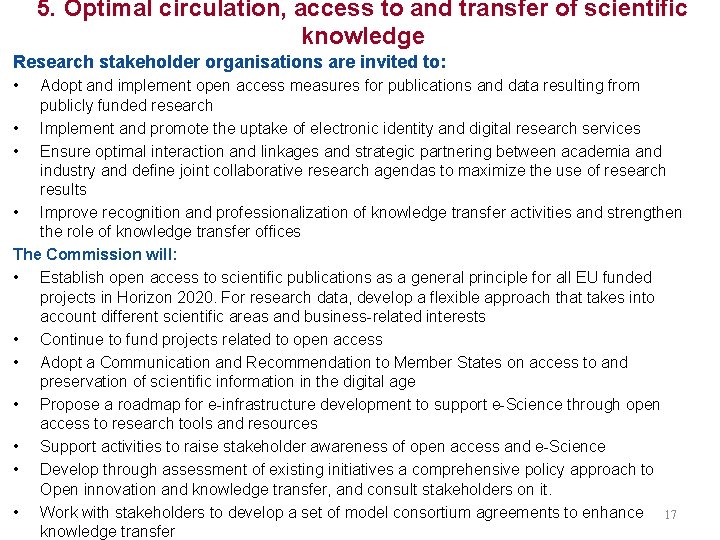
5. Optimal circulation, access to and transfer of scientific knowledge Research stakeholder organisations are invited to: • Adopt and implement open access measures for publications and data resulting from publicly funded research • Implement and promote the uptake of electronic identity and digital research services • Ensure optimal interaction and linkages and strategic partnering between academia and industry and define joint collaborative research agendas to maximize the use of research results • Improve recognition and professionalization of knowledge transfer activities and strengthen the role of knowledge transfer offices The Commission will: • Establish open access to scientific publications as a general principle for all EU funded projects in Horizon 2020. For research data, develop a flexible approach that takes into account different scientific areas and business-related interests • Continue to fund projects related to open access • Adopt a Communication and Recommendation to Member States on access to and preservation of scientific information in the digital age • Propose a roadmap for e-infrastructure development to support e-Science through open access to research tools and resources • Support activities to raise stakeholder awareness of open access and e-Science • Develop through assessment of existing initiatives a comprehensive policy approach to Open innovation and knowledge transfer, and consult stakeholders on it. • Work with stakeholders to develop a set of model consortium agreements to enhance 17 knowledge transfer
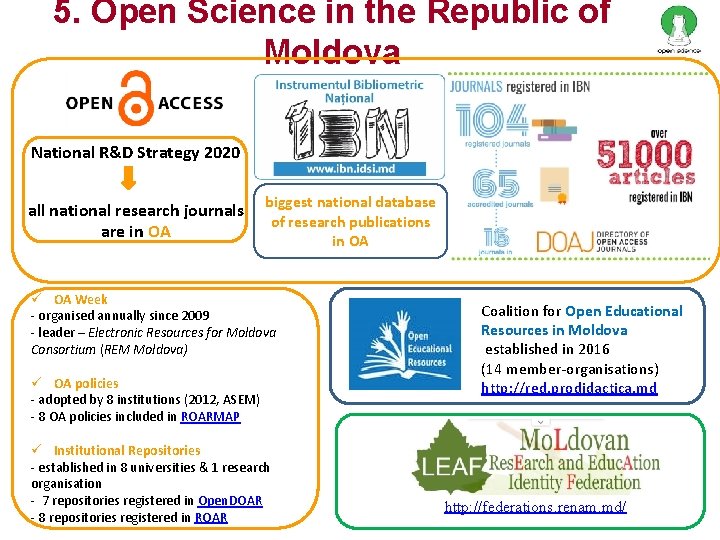
5. Open Science in the Republic of Moldova National R&D Strategy 2020 all national research journals are in OA biggest national database of research publications in OA ü OA Week - organised annually since 2009 - leader – Electronic Resources for Moldova Consortium (REM Moldova) ü OA policies - adopted by 8 institutions (2012, ASEM) - 8 OA policies included in ROARMAP ü Institutional Repositories - established in 8 universities & 1 research organisation - 7 repositories registered in Open. DOAR - 8 repositories registered in ROAR Coalition for Open Educational Resources in Moldova established in 2016 (14 member-organisations) http: //red. prodidactica. md http: //federations. renam. md/
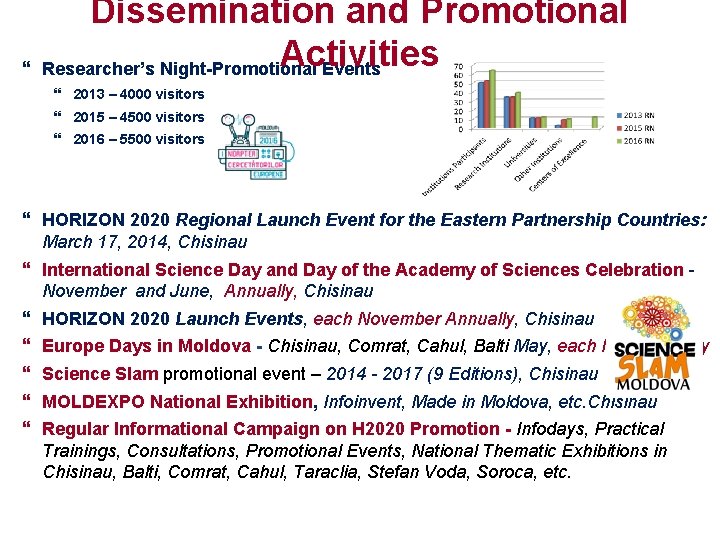
Dissemination and Promotional Activities Researcher’s Night-Promotional Events 2013 – 4000 visitors 2015 – 4500 visitors 2016 – 5500 visitors HORIZON 2020 Regional Launch Event for the Eastern Partnership Countries: March 17, 2014, Chisinau International Science Day and Day of the Academy of Sciences Celebration November and June, Annually, Chisinau HORIZON 2020 Launch Events, each November Annually, Chisinau Europe Days in Moldova - Chisinau, Comrat, Cahul, Balti May, each May Annually Science Slam promotional event – 2014 - 2017 (9 Editions), Chisinau MOLDEXPO National Exhibition, Infoinvent, Made in Moldova, etc. Chisinau Regular Informational Campaign on H 2020 Promotion - Infodays, Practical Trainings, Consultations, Promotional Events, National Thematic Exhibitions in Chisinau, Balti, Comrat, Cahul, Taraclia, Stefan Voda, Soroca, etc.
Thank you! http: //asm. md/ - ASM http: //cpi. asm. md/ - CIP http: //h 2020. md/ - H 2020 National Portal http: //euraxess. md/ - EURAXESS National Portal Center of International Projects 20