
http blog lib umn edutorre 107sipicssuperficialintelligence 2 jpg
http: //blog. lib. umn. edu/torre 107/si/pics/superficialintelligence 2. jpg
Uninformed Search CS 311 David Kauchak Spring 2013 Adapted from notes from: Sara Owsley Sood, Eric Eaton

Administrative � Send me videos! � Written problems will be posted today � Programming assignment 1 due before class on Tue. � Anyone � My started? office hours posted: � Mon/Wed 1 -2: 30 pm � Fri 11 am-12 � and by appointment
Python � Whether importing or running, python executes code from the top down � Be careful about calling functions before they’re defined � Comments � Don’t and docstrings mix tabs and spaces! (setup your text editor to only use spaces)
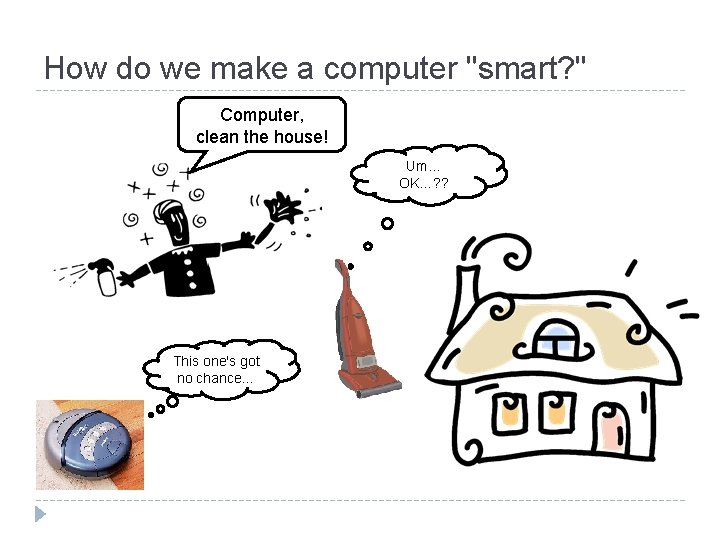
How do we make a computer "smart? " Computer, clean the house! Um… OK…? ? This one's got no chance…
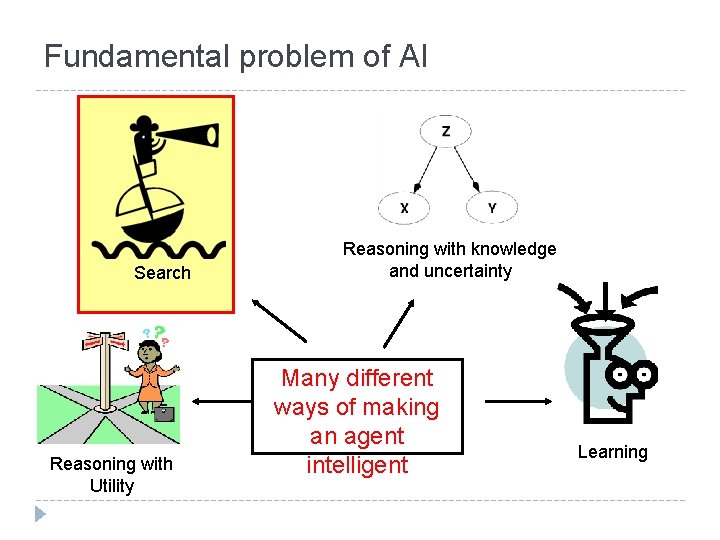
Fundamental problem of AI Search Reasoning with Utility Reasoning with knowledge and uncertainty Many different ways of making an agent intelligent Learning
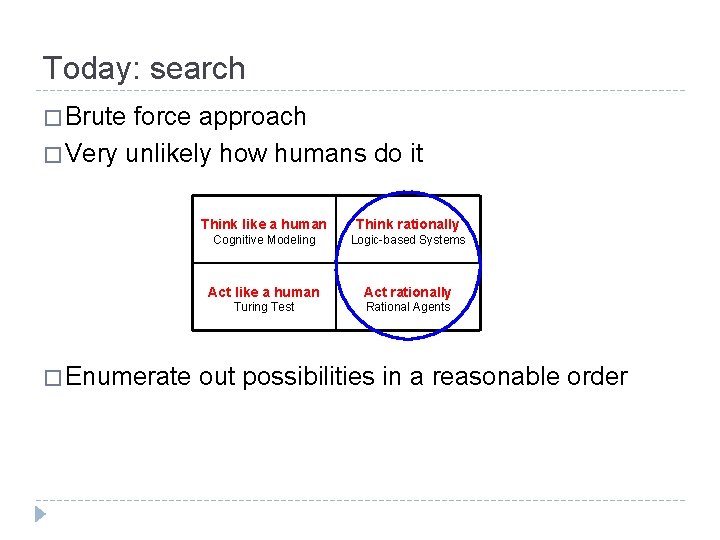
Today: search � Brute force approach � Very unlikely how humans do it � Enumerate Think like a human Think rationally Cognitive Modeling Logic-based Systems Act like a human Act rationally Turing Test Rational Agents out possibilities in a reasonable order
What is an “agent”? “anything that can be viewed as perceiving its environment through sensors and acting upon that environment through actuators” � Human agent � sensors = eyes, ears, etc � actuators = hands, legs, mouth, etc � Software � sensors agent = any input devices - keyboard gives it keystrokes, commands over the network, files give it text or data � actuators = any output devices - using the screen to display things, pass things over the network, write things to files, etc
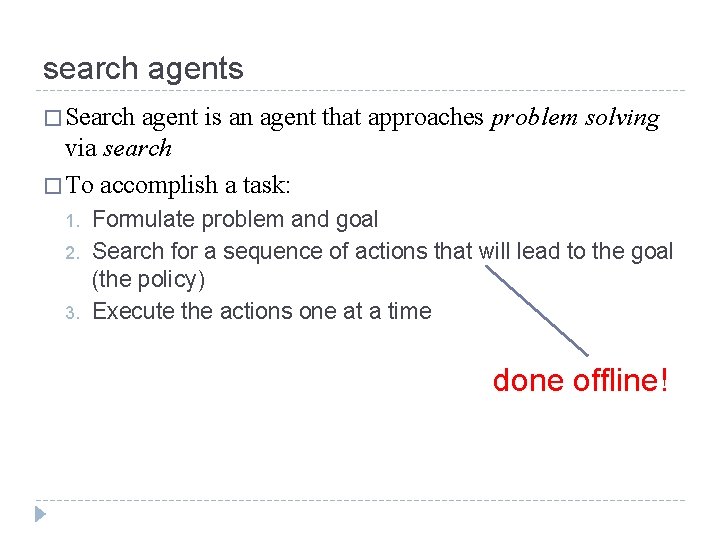
search agents � Search agent is an agent that approaches problem solving via search � To accomplish a task: 1. 2. 3. Formulate problem and goal Search for a sequence of actions that will lead to the goal (the policy) Execute the actions one at a time done offline!
Formulating the problem: What information does a search agent need to know to plan out a solution?
Formulating the problem: Initial state: where are we starting from � what are the states? Actions: what are the possible actions Transition model: aka state-space, mapping from action x state to state Goal/goal test: what is the end result we’re trying to achieve? Cost: what are the costs of the different actions
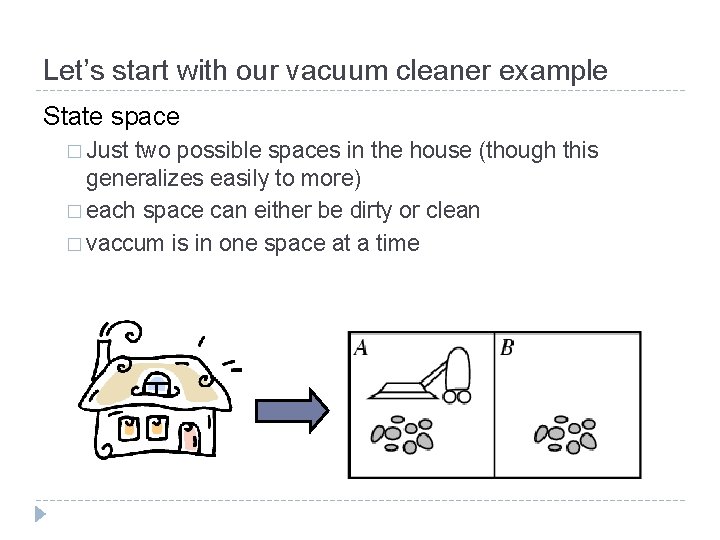
Let’s start with our vacuum cleaner example State space � Just two possible spaces in the house (though this generalizes easily to more) � each space can either be dirty or clean � vaccum is in one space at a time
Let’s start with our vacuum cleaner example State space � Just two possible spaces in the house (though this generalizes easily to more) � each space can either be dirty or clean � vaccum is in one space at a time How many states?
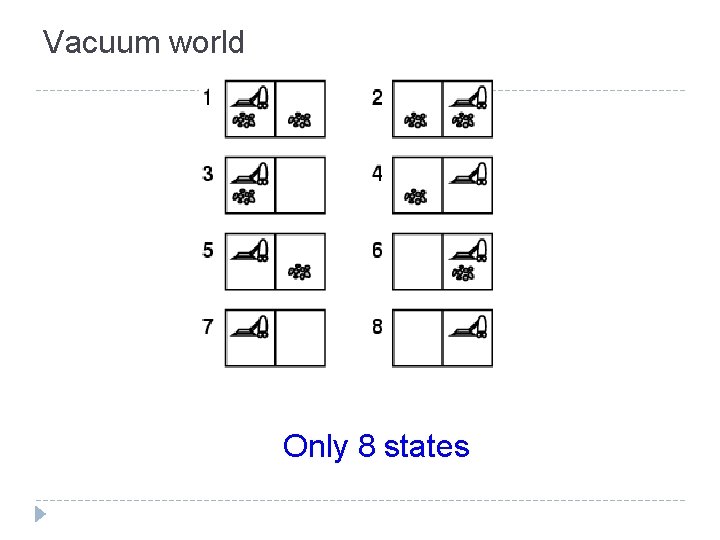
Vacuum world Only 8 states
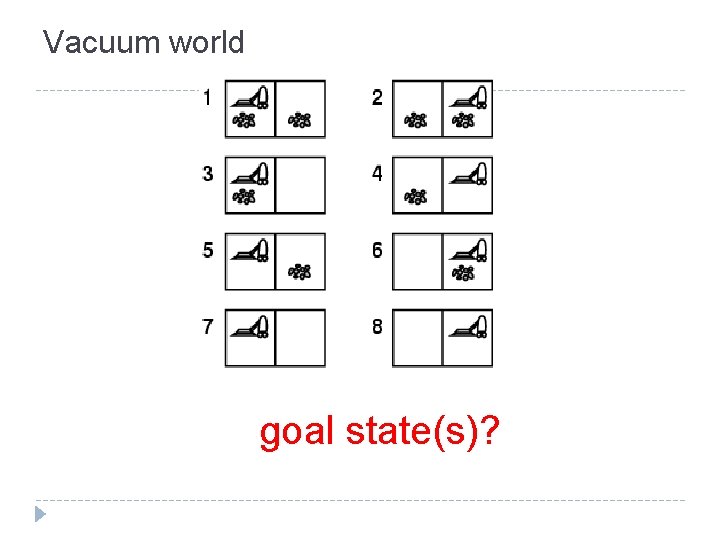
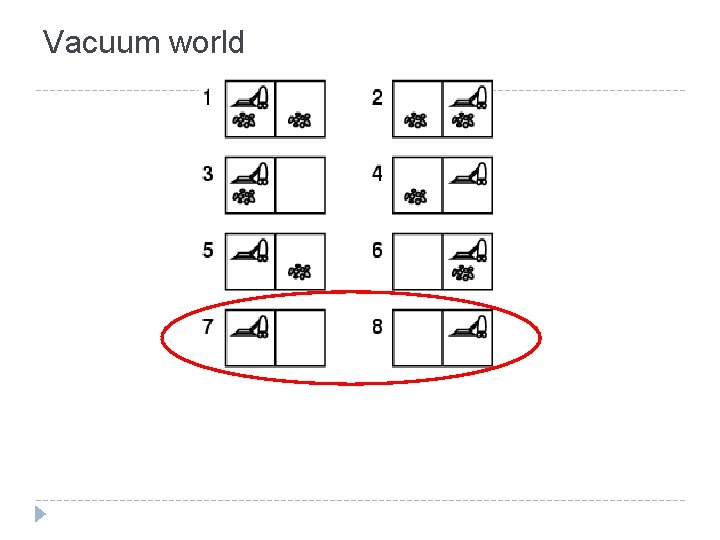
Vacuum world goal state(s)?
Vacuum world
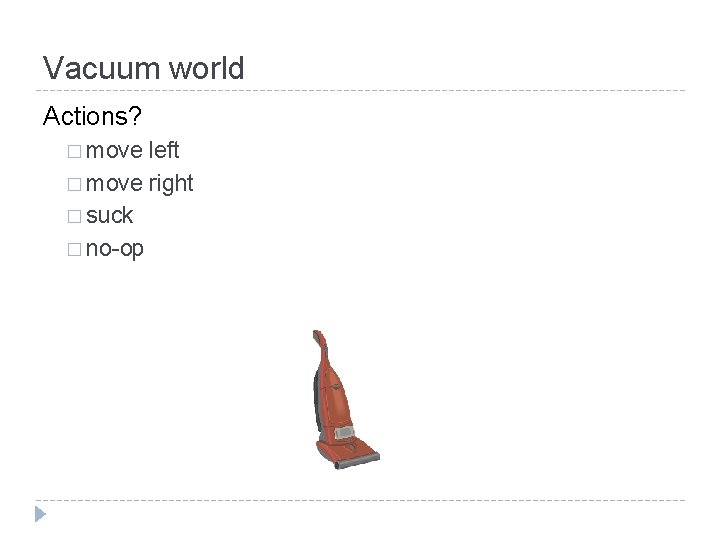
Vacuum world Actions? � move left � move right � suck � no-op
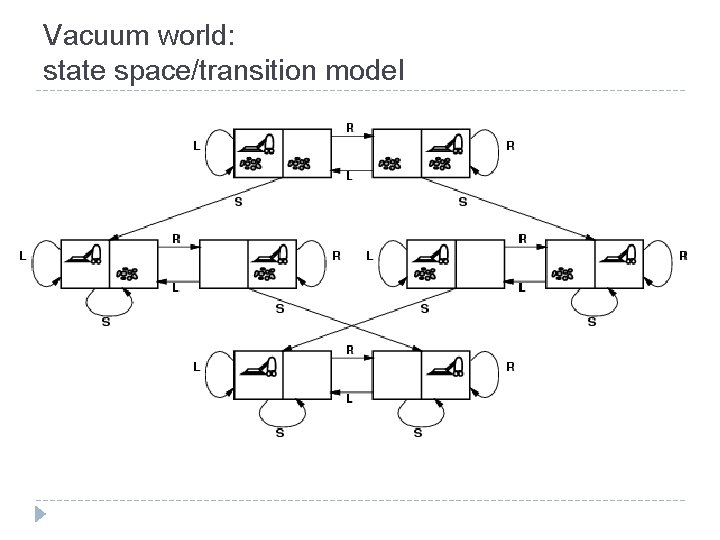
Vacuum world: state space/transition model
Problem characteristics Fully observable vs. partially observable � do we have access to all of the relevant information � noisy information, inaccurate sensors, missing information Deterministic vs. non-deterministic (stochastic) � outcome of an action are not always certain � probabilistic sometimes Known/unknown environment � Do we know a priori what the problem space is like (e. g. do we have a map)
Search problem types Deterministic, fully observable Agent knows exactly which state it will be in � solution is a sequence of actions � Non-observable sensorless problem Agent may have no idea where it is � solution is still a sequence � Non-deterministic and/or partially observable contingency problem percepts provide new information about current state � often interleave search, execution � Unknown state space exploration problem � this is how roomba works
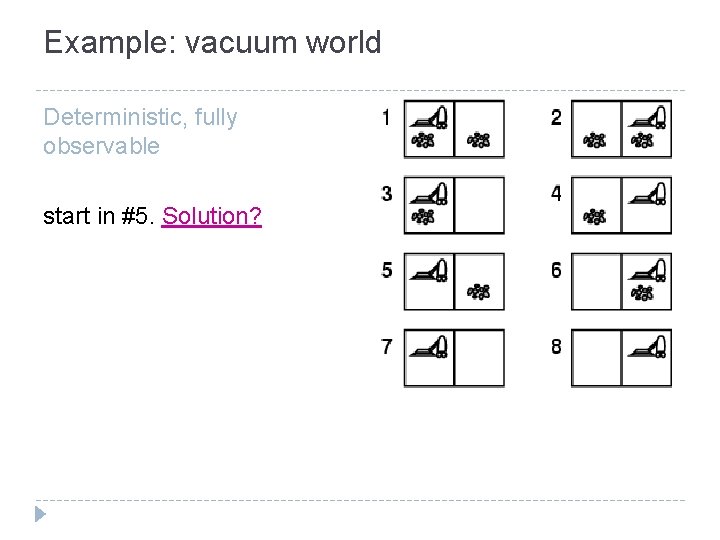
Example: vacuum world Deterministic, fully observable start in #5. Solution?
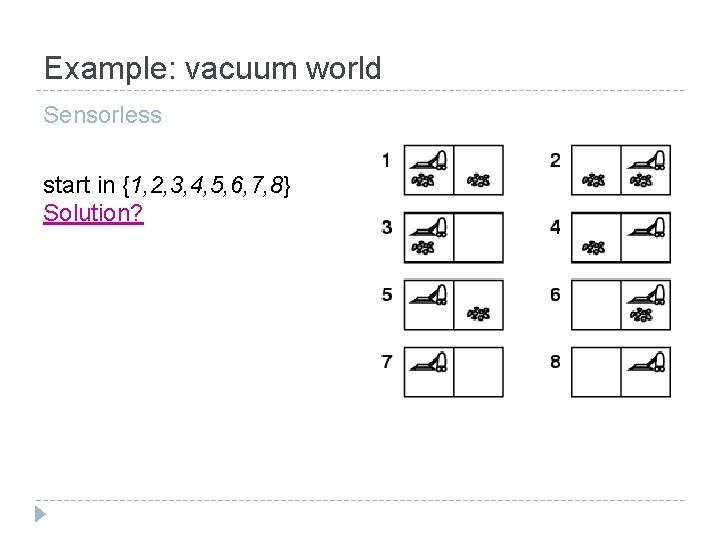
Example: vacuum world Sensorless start in {1, 2, 3, 4, 5, 6, 7, 8} Solution?
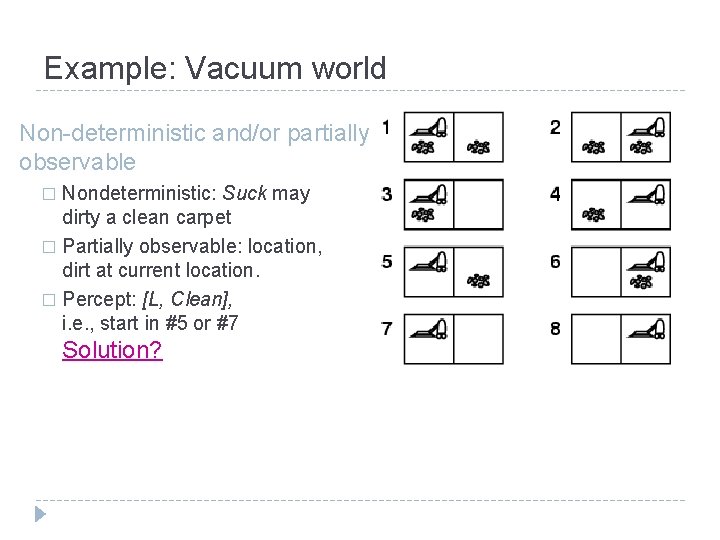
Example: Vacuum world Non-deterministic and/or partially observable Nondeterministic: Suck may dirty a clean carpet � Partially observable: location, dirt at current location. � Percept: [L, Clean], i. e. , start in #5 or #7 � Solution?
Vacuum world Cost ?
Some example problems Toy problems and micro-worlds � 8 -Puzzle �Missionaries and Cannibals �Cryptarithmetic �Remove 5 Sticks �Water Jug Problem Real-world problems
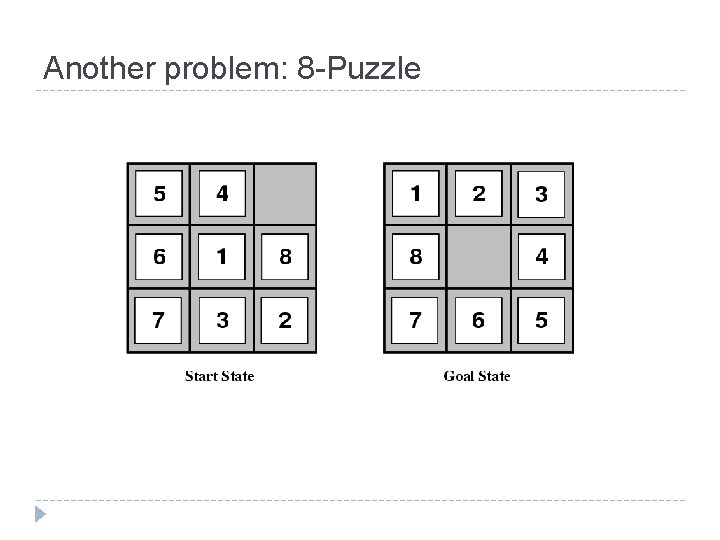
Another problem: 8 -Puzzle
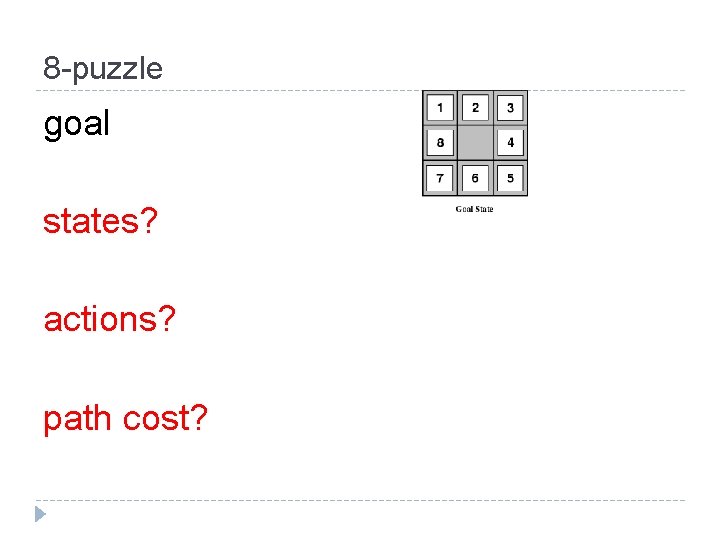
8 -puzzle goal states? actions? path cost?
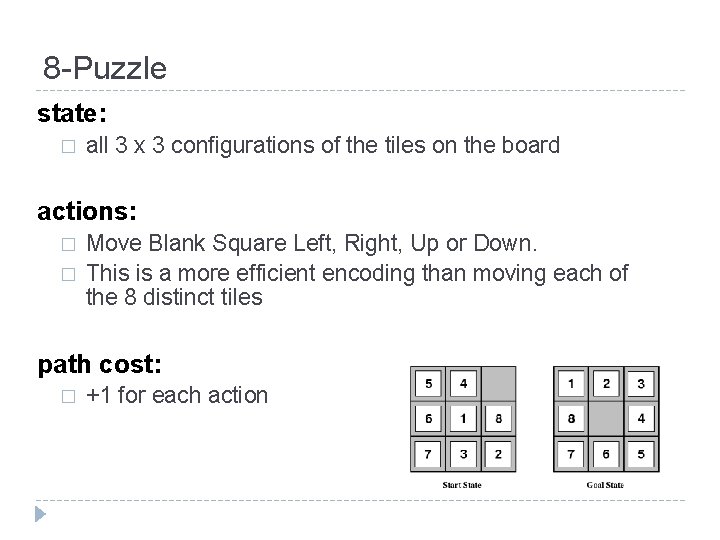
8 -Puzzle state: � all 3 x 3 configurations of the tiles on the board actions: � � Move Blank Square Left, Right, Up or Down. This is a more efficient encoding than moving each of the 8 distinct tiles path cost: � +1 for each action
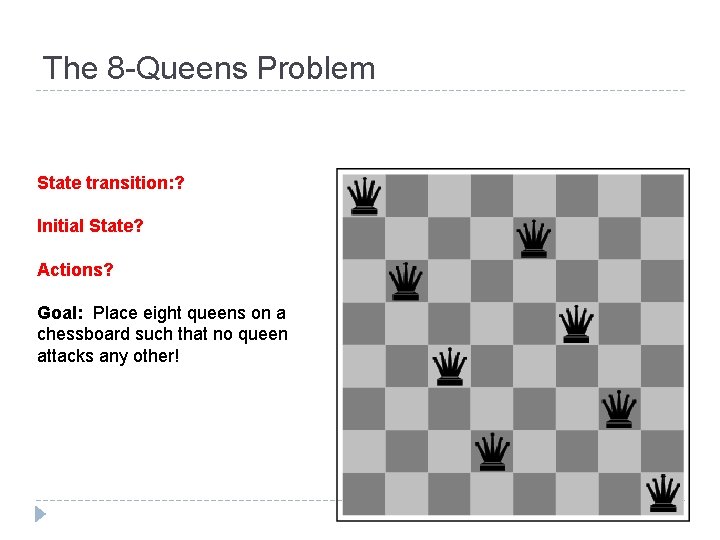
The 8 -Queens Problem State transition: ? Initial State? Actions? Goal: Place eight queens on a chessboard such that no queen attacks any other!
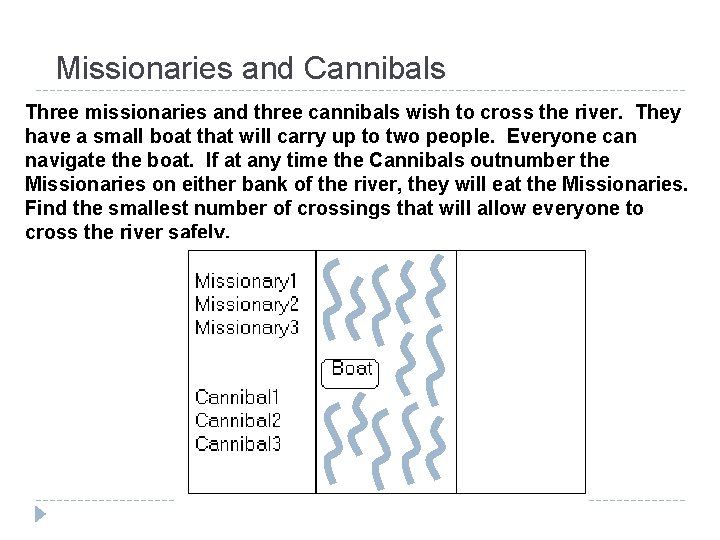
Missionaries and Cannibals Three missionaries and three cannibals wish to cross the river. They have a small boat that will carry up to two people. Everyone can navigate the boat. If at any time the Cannibals outnumber the Missionaries on either bank of the river, they will eat the Missionaries. Find the smallest number of crossings that will allow everyone to cross the river safely.
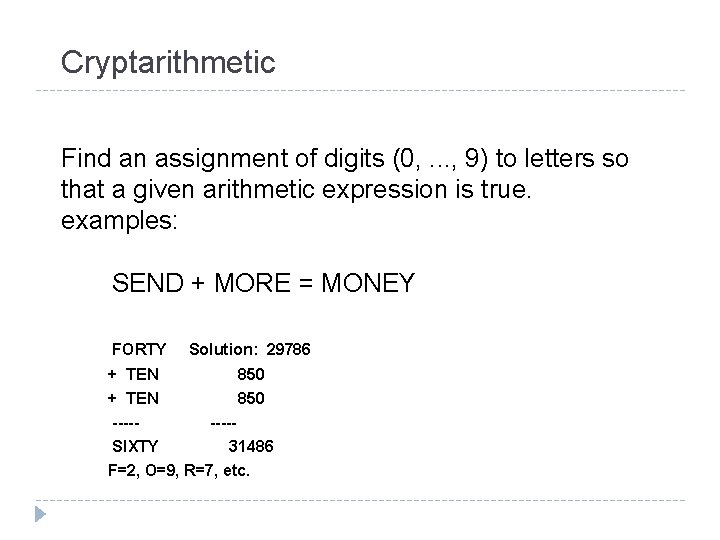
Cryptarithmetic Find an assignment of digits (0, . . . , 9) to letters so that a given arithmetic expression is true. examples: SEND + MORE = MONEY FORTY Solution: 29786 + TEN 850 ----SIXTY ----31486 F=2, O=9, R=7, etc.
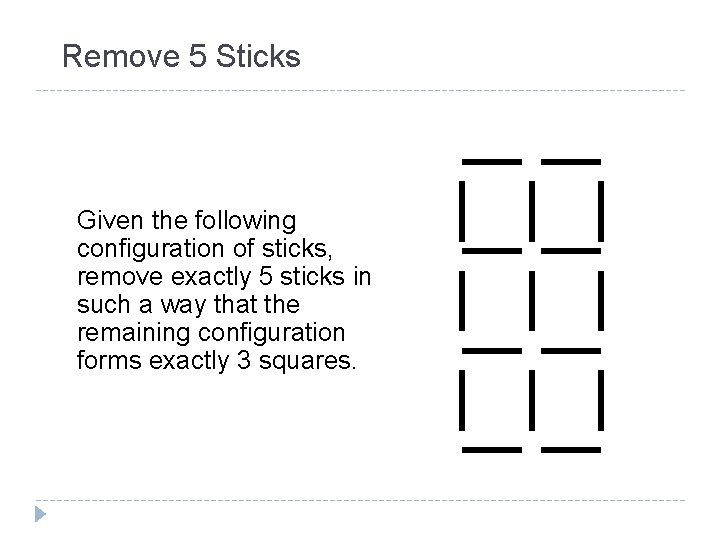
Remove 5 Sticks Given the following configuration of sticks, remove exactly 5 sticks in such a way that the remaining configuration forms exactly 3 squares.
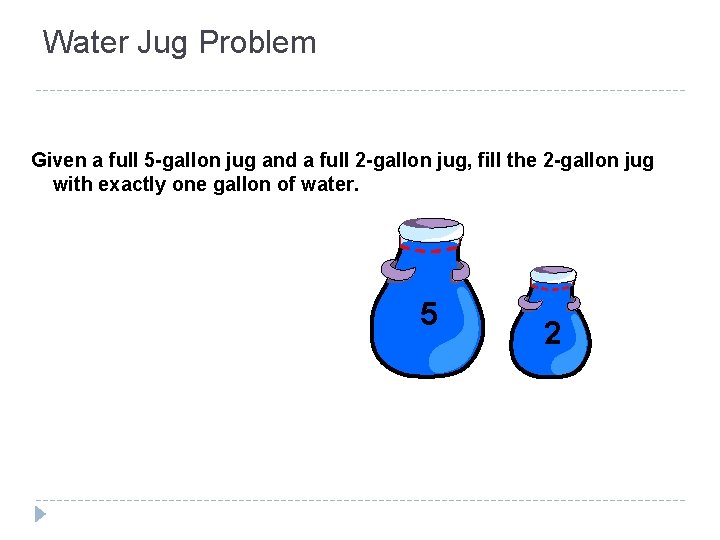
Water Jug Problem Given a full 5 -gallon jug and a full 2 -gallon jug, fill the 2 -gallon jug with exactly one gallon of water. 5 2
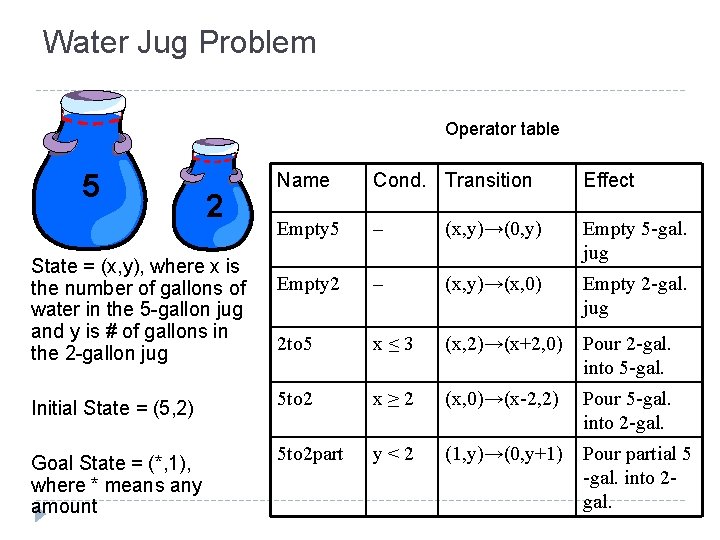
Water Jug Problem Operator table 5 Name Cond. Transition Effect Empty 5 – (x, y)→(0, y) Empty 5 -gal. jug Empty 2 – (x, y)→(x, 0) Empty 2 -gal. jug 2 to 5 x≤ 3 (x, 2)→(x+2, 0) Pour 2 -gal. into 5 -gal. Initial State = (5, 2) 5 to 2 x≥ 2 (x, 0)→(x-2, 2) Pour 5 -gal. into 2 -gal. Goal State = (*, 1), where * means any amount 5 to 2 part y<2 (1, y)→(0, y+1) Pour partial 5 -gal. into 2 gal. 2 State = (x, y), where x is the number of gallons of water in the 5 -gallon jug and y is # of gallons in the 2 -gallon jug
Some real-world problems Route finding � directions, maps � computer networks � airline travel VLSI layout Touring (traveling salesman) Agent planning
Search algorithms We’ve defined the problem Now we want to find the solution! Use search techniques offline, simulated exploration of state space by generating successors of already-explored states (a. k. a. expanding states) � Start at the initial state and search for a goal state � What are candidate search techniques? BFS � DFS � Uniform-cost search � Depth limited DFS � Depth-first iterative deepening �
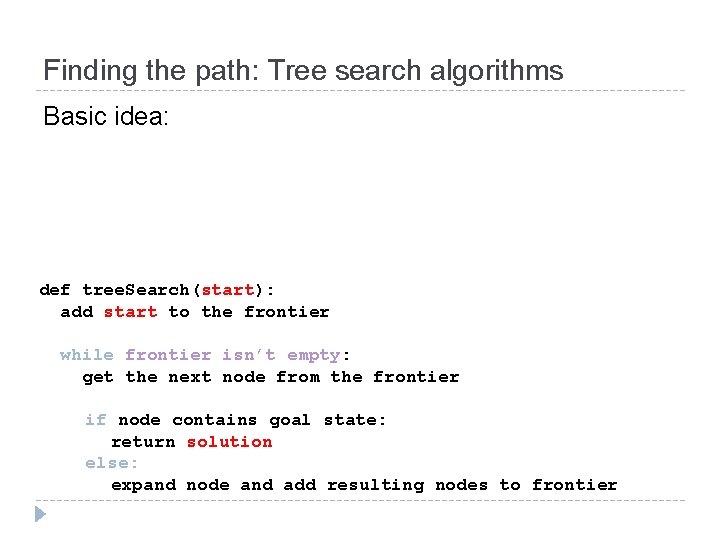
Finding the path: Tree search algorithms Basic idea: def tree. Search(start): add start to the frontier while frontier isn’t empty: get the next node from the frontier if node contains goal state: return solution else: expand node and add resulting nodes to frontier
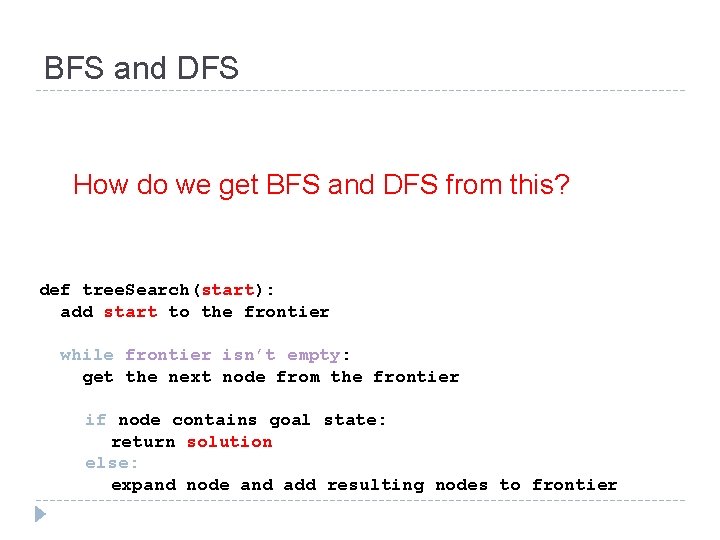
BFS and DFS How do we get BFS and DFS from this? def tree. Search(start): add start to the frontier while frontier isn’t empty: get the next node from the frontier if node contains goal state: return solution else: expand node and add resulting nodes to frontier
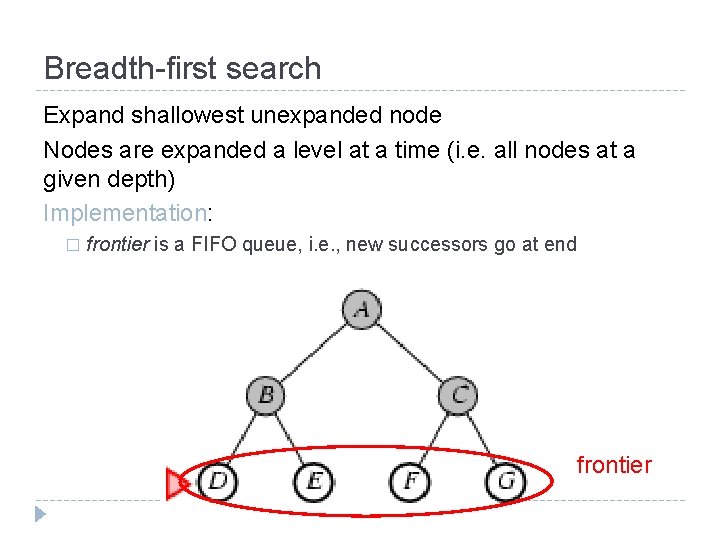
Breadth-first search Expand shallowest unexpanded node Nodes are expanded a level at a time (i. e. all nodes at a given depth) Implementation: � frontier is a FIFO queue, i. e. , new successors go at end frontier
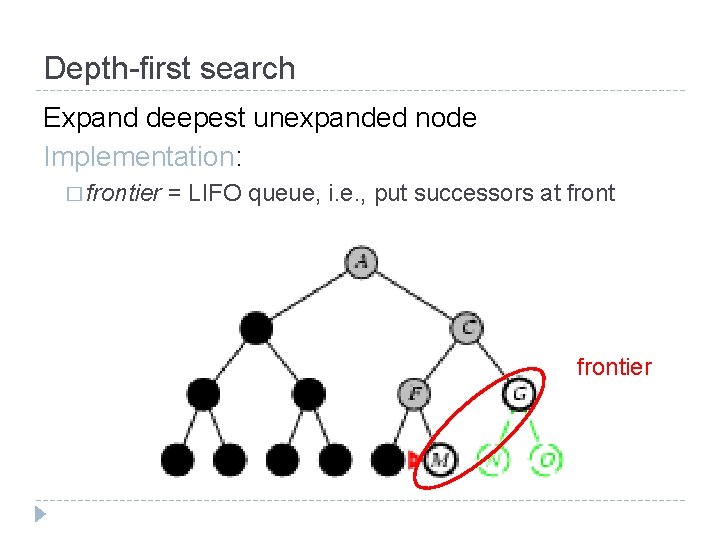
Depth-first search Expand deepest unexpanded node Implementation: � frontier = LIFO queue, i. e. , put successors at frontier
Search algorithm properties Time (using Big-O) Space (using Big-O) Complete � If a solution exists, will we find it? Optimal � If we return a solution, will it be the best/optimal solution A divergence from algorithms/data structures � we generally won’t use V and E to define time and space. Why? Often V and E are infinite! � Instead, we often use the branching factor (b) and depth (d) �
Activity Analyze DFS and BFS according to the criteria time, space, completeness and optimality (for time and space, analyze in terms of b, d, and m (max depth); for complete and optimal - simply YES or NO) � Which strategy would you use and why? Brainstorm improvements to DFS and BFS
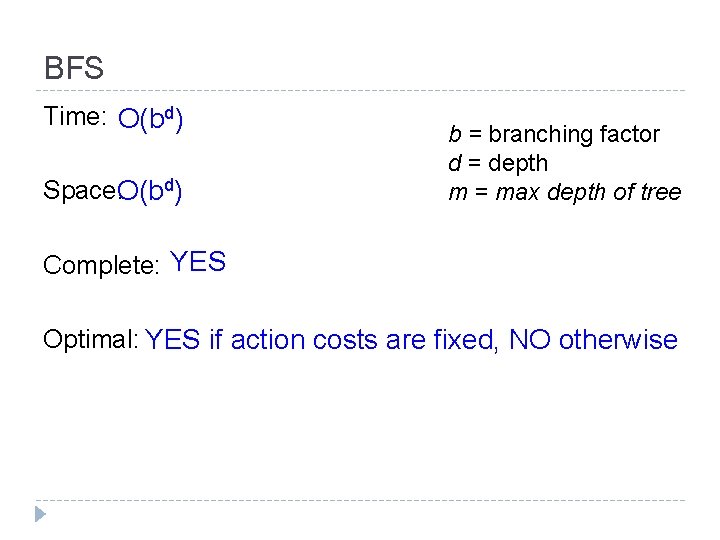
BFS Time: O(bd) Space: O(bd) b = branching factor d = depth m = max depth of tree Complete: YES Optimal: YES if action costs are fixed, NO otherwise
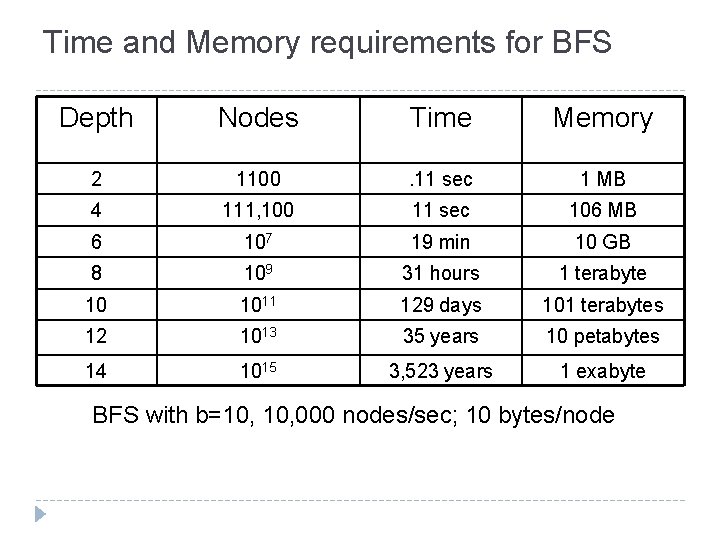
Time and Memory requirements for BFS Depth Nodes Time Memory 2 1100 . 11 sec 1 MB 4 111, 100 11 sec 106 MB 6 107 19 min 10 GB 8 109 31 hours 1 terabyte 10 1011 129 days 101 terabytes 12 1013 35 years 10 petabytes 14 1015 3, 523 years 1 exabyte BFS with b=10, 000 nodes/sec; 10 bytes/node
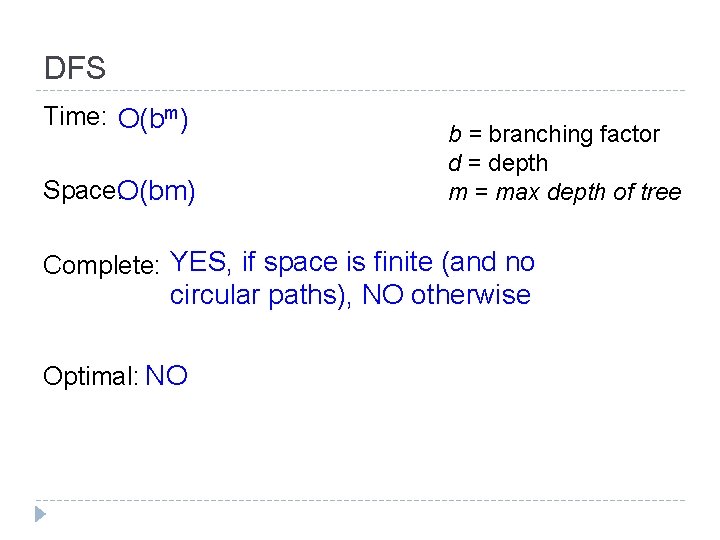
DFS Time: O(bm) Space: O(bm) b = branching factor d = depth m = max depth of tree Complete: YES, if space is finite (and no circular paths), NO otherwise Optimal: NO
Problems with BFS and DFS BFS � doesn’t take into account costs � memory! DFS � doesn’t take into account costs � not optimal � can’t handle infinite spaces � loops
Uniform-cost search Expand unexpanded node with the smallest path cost, g(x) Implementation?
Uniform-cost search Expand unexpanded node with the smallest path cost, g(x) Implementation: � frontier = priority queue ordered by path cost � similar to Dijkstra’s algorithm How does it relate to bfs? equivalent if costs are fixed
Uniform-cost search Time? and Space? � dependent on the costs and optimal path cost, so cannot be represented in terms of b and d � Space will still be expensive (e. g. take uniform costs) Complete? � YES, assuming costs > 0 Optimal? � Yes, assuming costs > 0 This helped us tackle the issue of costs, but still going to be expensive from a memory standpoint!
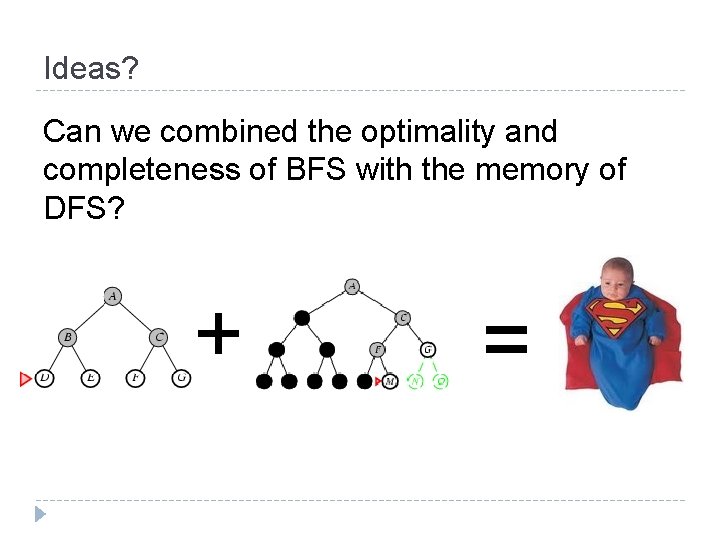
Ideas? Can we combined the optimality and completeness of BFS with the memory of DFS? + =
Depth limited DFS, but with a depth limit L specified � nodes at depth L are treated as if they have no successors � we only search down to depth L Time? � O(b. L) Space? � O(b. L) Complete? � NO, if solution is longer than L Optimal � NO, for same reasons DFS isn’t
Ideas?
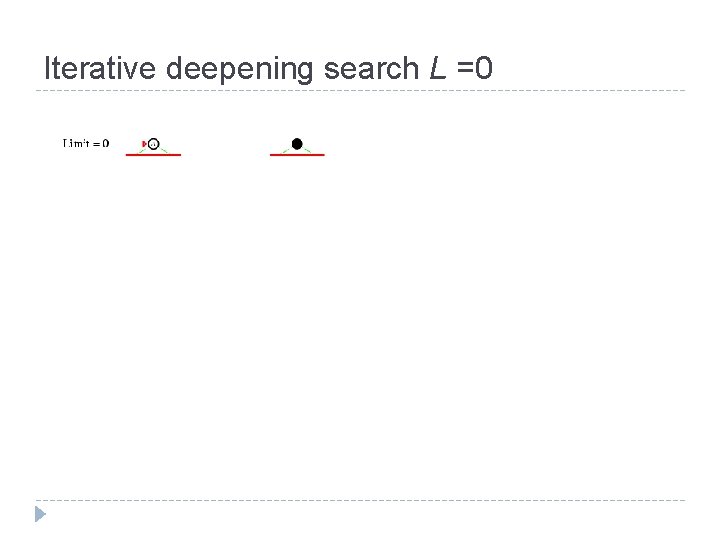
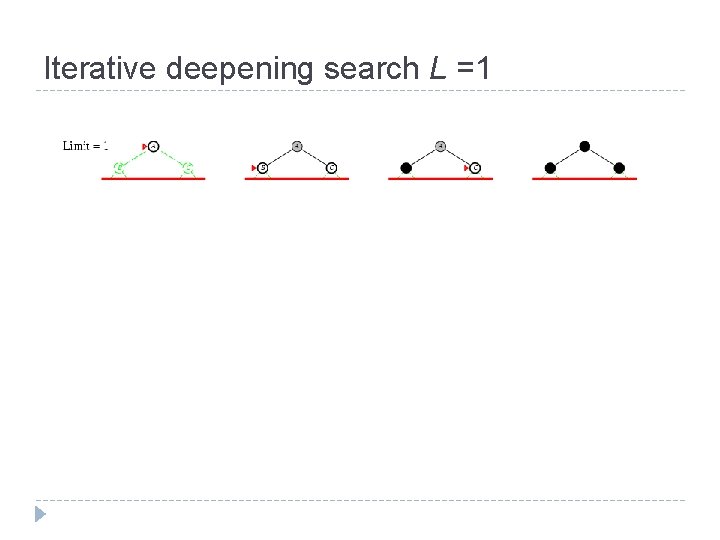
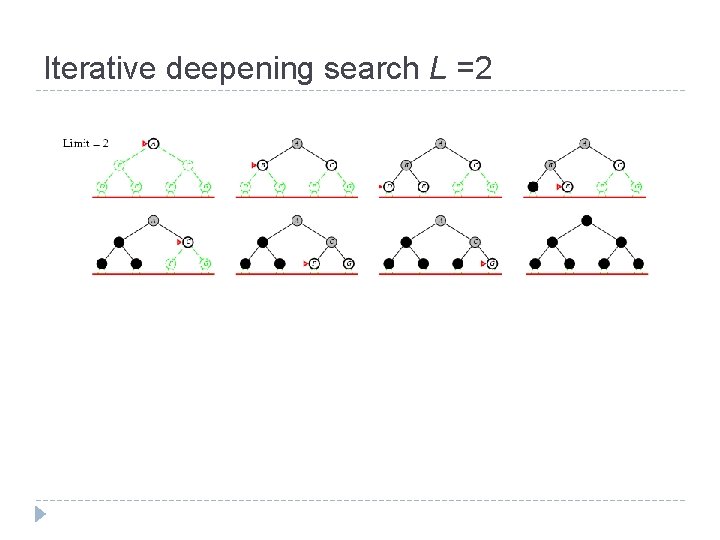
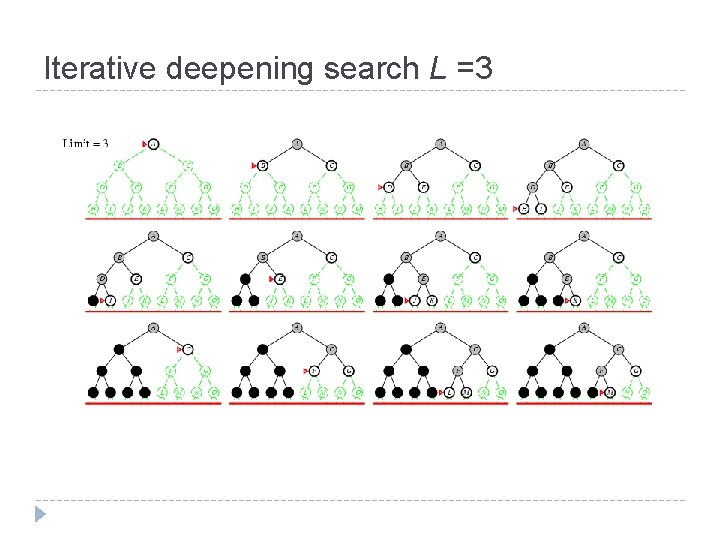
Iterative deepening search For depth 0, 1, …. , ∞ run depth limited DFS if solution found, return result Blends the benefits of BFS and DFS � searches in a similar order to BFS � but has the memory requirements of DFS Will find the solution when L is the depth of the shallowest goal
Iterative deepening search L =0
Iterative deepening search L =1
Iterative deepening search L =2
Iterative deepening search L =3
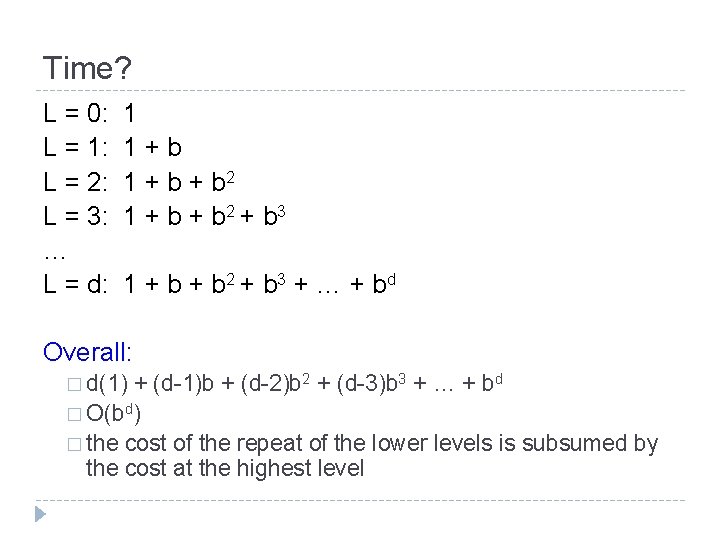
Time? L = 0: L = 1: L = 2: L = 3: … L = d: 1 1+b 1 + b + b 2 + b 3 1 + b 2 + b 3 + … + b d Overall: � d(1) + (d-1)b + (d-2)b 2 + (d-3)b 3 + … + bd � O(bd) � the cost of the repeat of the lower levels is subsumed by the cost at the highest level
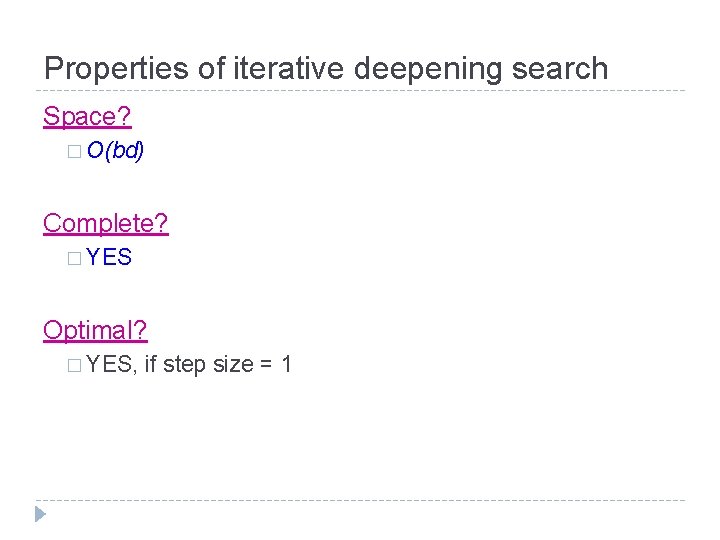
Properties of iterative deepening search Space? � O(bd) Complete? � YES Optimal? � YES, if step size = 1
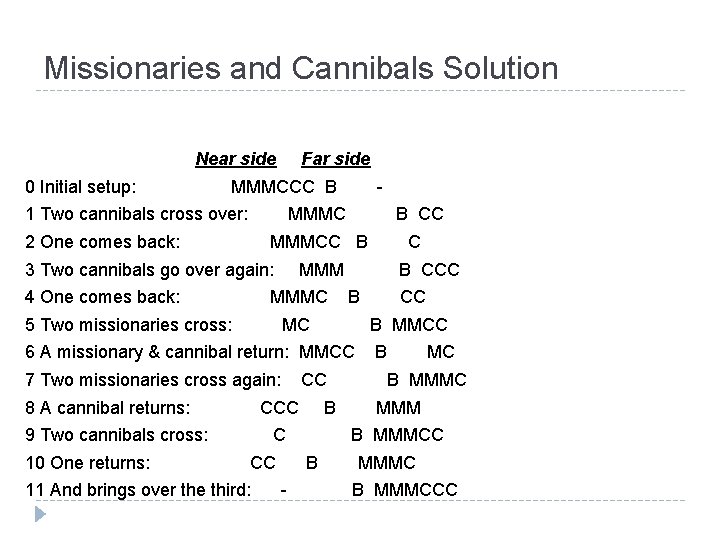
Missionaries and Cannibals Solution Near side 0 Initial setup: Far side MMMCCC B 1 Two cannibals cross over: - MMMC 2 One comes back: B CC MMMCC B 3 Two cannibals go over again: 4 One comes back: MMMC 5 Two missionaries cross: B CCC B MC 7 Two missionaries cross again: 9 Two cannibals cross: 10 One returns: CC CCC B C CC 11 And brings over the third: B MC B MMMC MMM B MMMCC B - CC B MMCC 6 A missionary & cannibal return: MMCC 8 A cannibal returns: C MMMC B MMMCCC
- Slides: 60