
http bit lySCDNPF Paper Folding The NYS Next
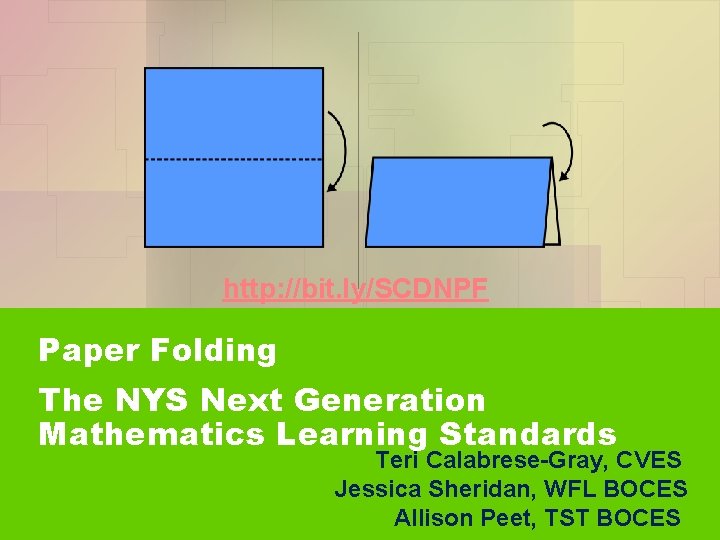
http: //bit. ly/SCDNPF Paper Folding The NYS Next Generation Mathematics Learning Standards Teri Calabrese-Gray, CVES Jessica Sheridan, WFL BOCES Allison Peet, TST BOCES
Objectives • Investigate the area of various polygons by folding paper • Identify the Standards for Mathematical Practice and explain how the task aligns to each one • Determine the NYS Next Generation Mathematics Learning Standards in the Folding Paper task and justify your reasoning
Paper Folding Jo Boaler http: //www. youcubed. org "A special thank you to Mark Driscoll for an engaging task that blends Number Sense and Geometry through paper folding. Great activity to kick off the school year with this task in order to build classroom collaboration. "
Jo Boaler Video Doing Math: It's about Thinking Deeply and Slowly - It's not about Speed! .

Paper Folding • • Math Topics: Area, Fractions, Geometry Concepts: Number Sense, Shape & Space Mathematical Practices: MP 1, MP 2, MP 3, MP 4, MP 5, MP 6, MP 7, MP 8 Grades: Low Floor High Ceiling, 4, 5, 6, 7, 8, 9, 10
Materials • Square pieces of paper for each student • Markers (optional)
Task Instructions For each part of the task, start with a square sheet of paper and make folds to construct a new shape. Then, explain how you know the shape you constructed has the specified area.
Convincing Mathematical Explanations
Convincing Mathematical Explanations Convincing mathematical explanations stand up to any challenge and can convince others of a mathematical result. Two conditions must be satisfied: – Convincing explanations use facts, not opinions, to support claims. – Convincing explanations are complete and don’t leave any gaps or holes.
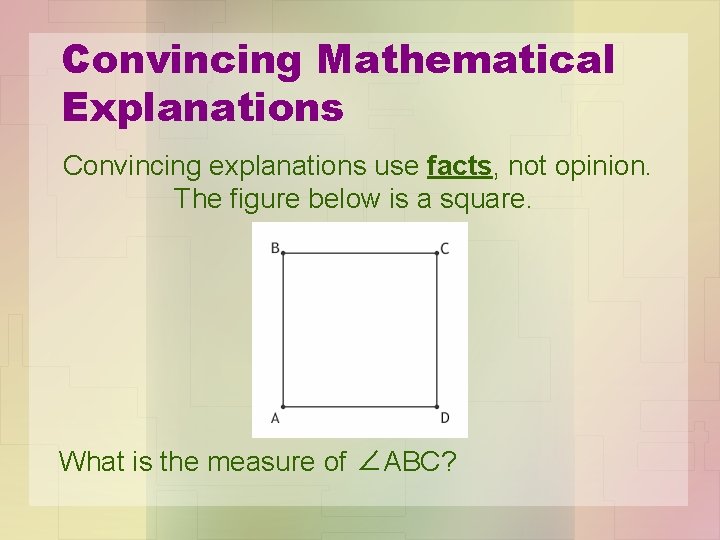
Convincing Mathematical Explanations Convincing explanations use facts, not opinion. The figure below is a square. What is the measure of ∠ABC?
Turn and talk to an elbow partner at your table to provide a convincing mathematical explanation.
Convincing Mathematical Explanations • Opinion: ∠ABC is 90 degrees because it looks like an L. • Fact: ∠ABC is 90 degrees because it is one of the 4 angles in a square and all 4 angles of a square 90 degrees.
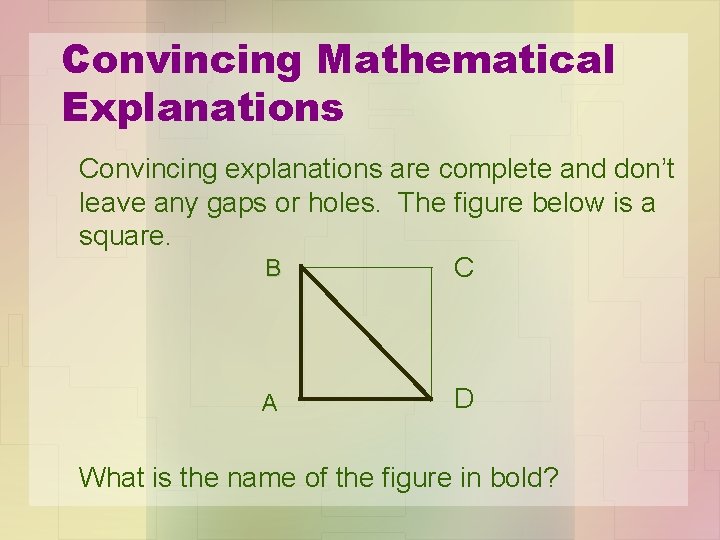
Convincing Mathematical Explanations Convincing explanations are complete and don’t leave any gaps or holes. The figure below is a square. B C A D What is the name of the figure in bold?
Turn and talk to your other elbow partner at your table to provide a convincing mathematical explanation.
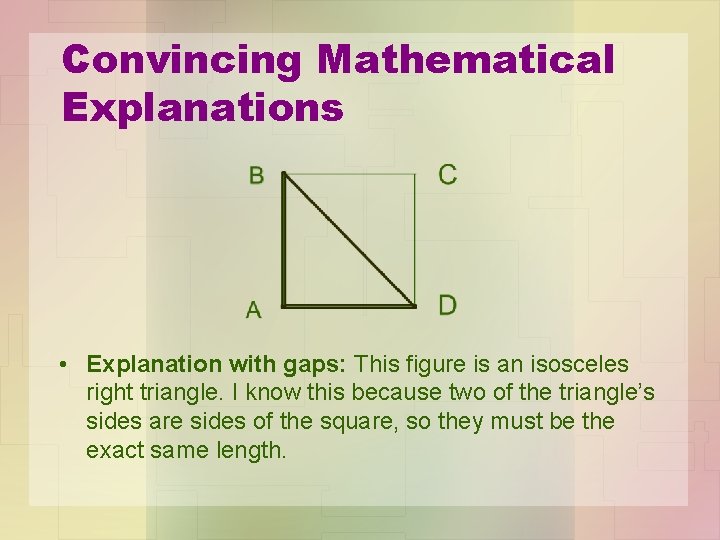
Convincing Mathematical Explanations • Explanation with gaps: This figure is an isosceles right triangle. I know this because two of the triangle’s sides are sides of the square, so they must be the exact same length.
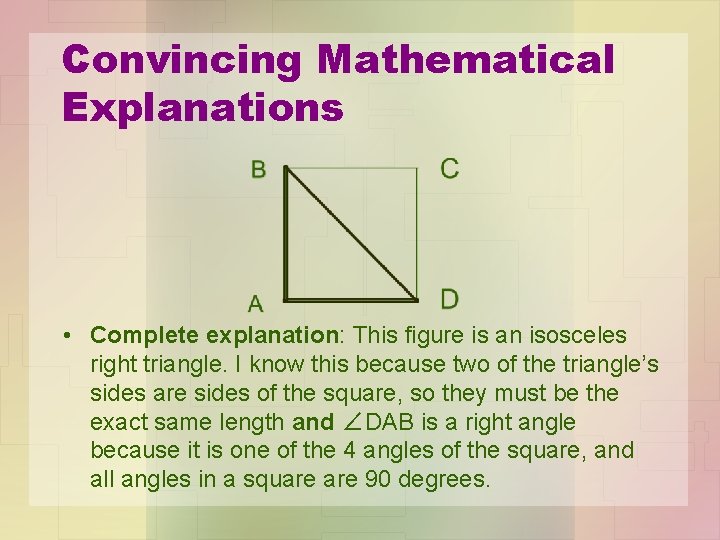
Convincing Mathematical Explanations • Complete explanation: This figure is an isosceles right triangle. I know this because two of the triangle’s sides are sides of the square, so they must be the exact same length and ∠DAB is a right angle because it is one of the 4 angles of the square, and all angles in a square 90 degrees.
Warm-Up Investigating Area by Folding Paper
Warm-Up for Investigating Area by Folding Paper 1. If you fold a square piece of paper along one of its diagonals: a) What do you get?
Warm-Up for Investigating Area by Folding Paper 1. If you fold a square piece of paper along one of its diagonals: a) What do you get? b) What kind of triangle is this?
Warm-Up for Investigating Area by Folding Paper 1. If you fold a square piece of paper along one of its diagonals: a) What do you get? b) What kind of triangle is this? c) What is the relationship between the area of this triangle and the area of the original square?
Warm-Up for Investigating Area by Folding Paper 1. If you fold a square piece of paper along one of its diagonals: a) What do you get? b) What kind of triangle is this? c) What is the relationship between the area of this triangle and the area of the original square? d) Explain how you decided on the relationship.
Numbered Heads Together 1. Number off at your table. 2. Stand up and "put your heads together" showing answers, discussing and teaching each other. 3. Once your group comes to consensus, please sit down. 4. We will call a number and that person will report for your group.
Warm-Up for Investigating Area by Folding Paper 2. Where can you fold a square in order to construct a rectangle with exactly ½ the area of the square? How do you know your rectangle has exactly ½ the area of the square?
Task Instructions Throughout the Paper Folding task, keep a running list of academic vocabulary used at your table.
Task Instructions 1. Construct a square with exactly ¼ the area of the original square. Convince yourself that it is a square and has ¼ of the area.
How do you know? Explain how you know it has ¼ the area.
How do you know? Sentence Starter: To create a square with ¼ the area of the original square piece of paper, I folded: _________________________________
How do you know? Frame: To create a _______with______ the area of the original square piece of paper, I folded: __________________________
Task Instructions 2. Construct a triangle with exactly ¼ the area of the original square. Convince a friend that it has ¼ of the area.
How do you know? Explain how you know it has ¼ the area.
How do you know? Sentence Starter: To create a triangle with ¼ the area of the original square piece of paper, I folded: _________________________________
How do you know? Frame: The way I folded the paper to create a _______ with ¼ the area and a triangle with ¼ the area of the original piece of paper was different because: _________________________________
Comparing Task 1 to Task 2 - How do you know? Explain the difference between folding a square to make a square ¼ the area of the original square (Task 1) compared to folding a square to make a triangle ¼ the area of the original square (Task 2).
How do you know? Sentence Starter: The way I folded the paper to create a square with ¼ the area and a triangle with ¼ the area of the original square piece of paper was different because: _________________
Task Instructions 3. Construct another triangle, also with ¼ the area, that is not congruent to the first one you constructed. Convince a skeptic that it has ¼ of the area.
How do you know? Explain how you know it has ¼ the area.
How do you know? Sentence Starter: To create a triangle with ¼ the area of the original square piece of paper, I folded: _________________________________
Comparing Task 2 to Task 3 Explain the difference between the triangle you folded in Task 2 with the triangle you folded in Task 3. How do you know the triangles are not congruent?
Comparing Task 2 to Task 3 - How do you know Sentence Starter: I know that the two triangles I have created in Task 2 and Task 3 are not congruent because: _________________________________
Comparing Task 2 to Task 3 - How do you know? Frame: I know that the two triangles I have created in Task 2 and Task 3 are not __________because they cannot be transformed or manipulated in a way that allows me to place one exactly over the other.
Task Instructions 4. Construct a square with exactly ½ the area of the original square. Convince yourself that it is a square and has ½ of the area.
How do you know? Explain how you know it has ½ the area.
Task Instructions 5. Construct another square, also with ½ the area, that is oriented differently from the one you constructed in 4. Convince someone not at your table that it has ½ of the area.
How do you know? Explain how you know it has ½ the area.
Academic Language Learners should have opportunities to see, hear, and write key mathematical ideas during this activity. There are some specific terms that learners need to understand in order to engage in this task, and there are some additional terms and phrases that may surface as the learners engage with the task.
Academic Language As the task is introduced, solved by the learners, and discussed, ensure that learners have opportunities to experience (i. e. , through discussion, pictures, and the use of gestures) and to build understanding for key words and phrases.
Word Chart for Investigating Area by Folding Paper http: //bit. ly/mathwordchart (Click on the link above or copy and paste the link to access the collaborative word chart. )
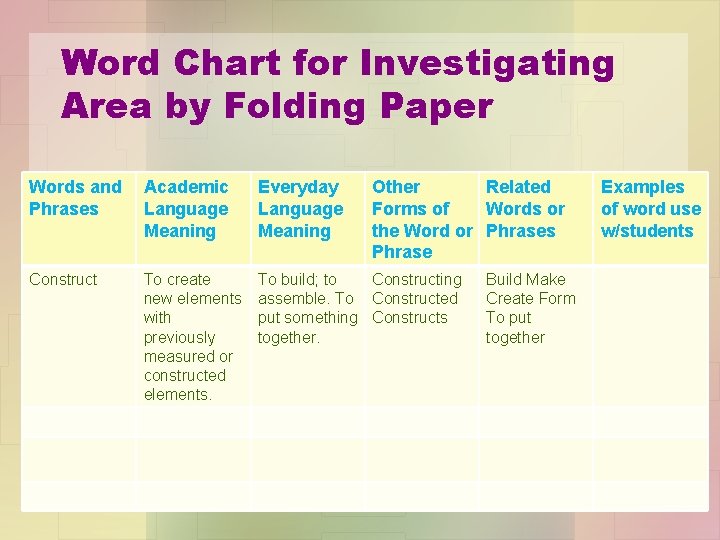
Word Chart for Investigating Area by Folding Paper Words and Academic Phrases Language Meaning Everyday Language Meaning Construct To build; to Constructing assemble. To Constructed put something Constructs together. To create new elements with previously measured or constructed elements. Other Related Forms of Words or the Word or Phrases Phrase Build Make Create Form To put together Examples of word use w/students
Debriefing the Task
Standards for Mathematical Practice 1. Make sense of problems and persevere in solving them 2. Reason abstractly and quantitatively 3. Construct viable arguments and critique the reasoning of others 4. Model with mathematics 5. Use appropriate tools strategically 6. Attend to precision 7. Look for and make use of structure 8. Look for and express regularity in repeated reasoning
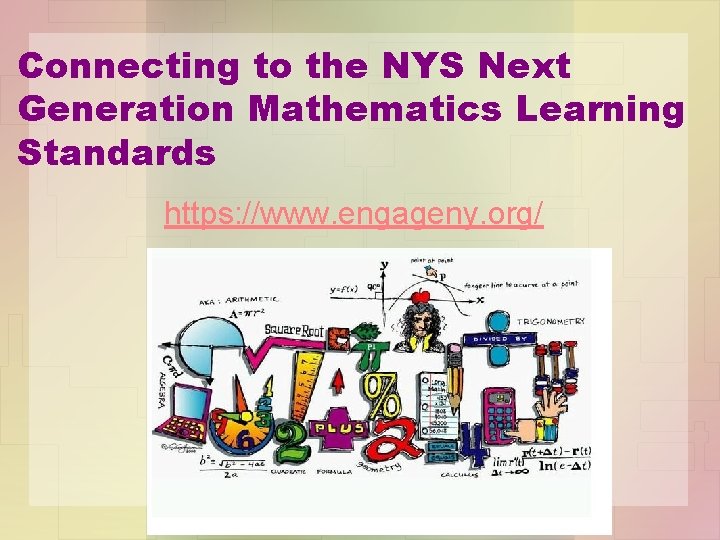
Connecting to the NYS Next Generation Mathematics Learning Standards https: //www. engageny. org/
Idea. Boardz What Next Generation Mathematics Learning Standards were addressed in the Paper Folding Activity? Record your thoughts online at http: //bit. ly/nysmathstandards
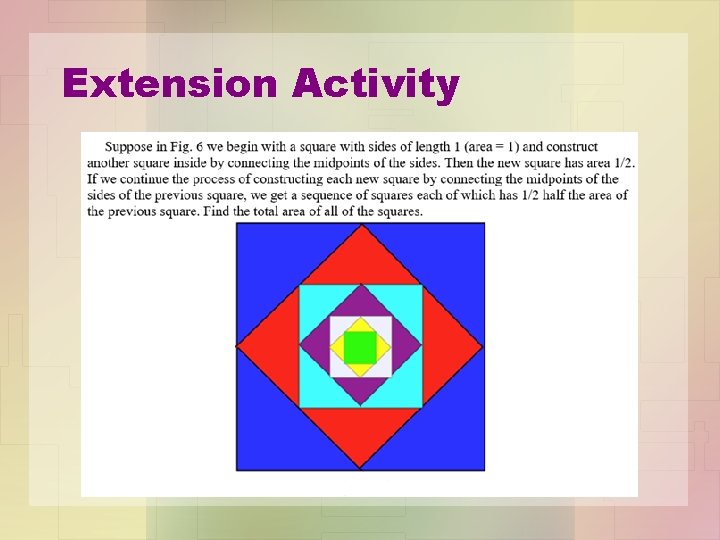
Extension Activity
What would be the total area if you constructed an: • 8 th square? • 9 th square? • Nth square? Think
Notice Think Wonder 1. What do you notice? 2. What do you think? 3. What do you wonder? http: //bit. ly/noticethinkwonder
3 -2 -1 Reflection http: //bit. ly/321 sheet
"Mathematics is not about numbers, equations, computations, or algorithms: it is about UNDERSTANDING!" William Paul Thurston THE END!
- Slides: 57