
HTS Roebel cables for the Eu CARD 2
HTS Roebel cables for the Eu. CARD 2 “Future Magnets” A. Kario, S. Otten, A. Kling, W. Goldacker (KIT) C. Senatore, C. Barth, M. Bonura (UG) L. Bottura, G. Kirby, J. van Nugteren (CERN) Y. Yang (US) M. Dhallé, B. van Nugteren (UT) A. Rutt, A. Usoskin (Bruker) C. Lorin, M. Durante (CEA Saclay)
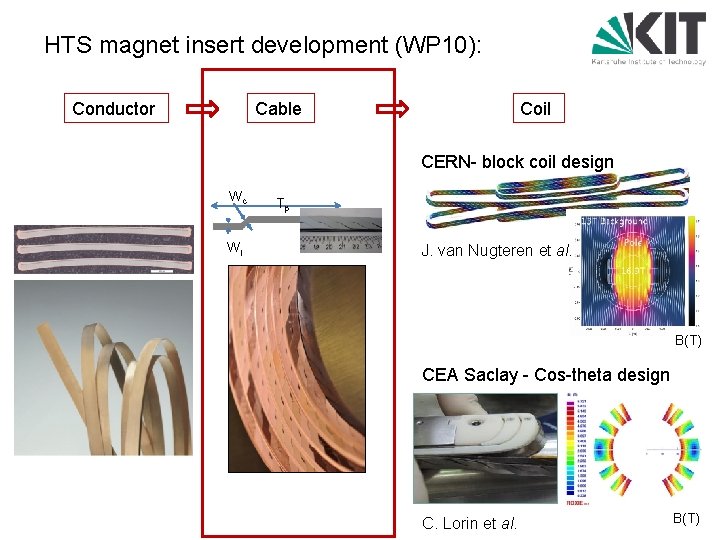
HTS magnet insert development (WP 10): Conductor Cable Coil CERN- block coil design Wc Wl Tp J. van Nugteren et al. B(T) CEA Saclay - Cos-theta design C. Lorin et al. B(T)
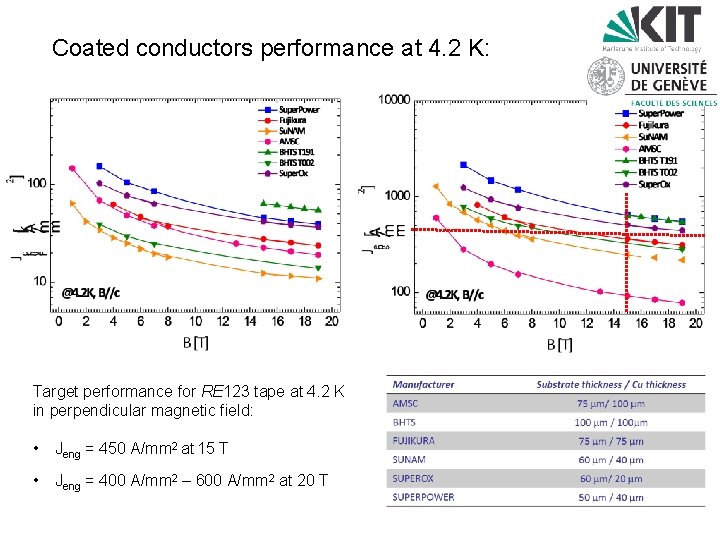
Coated conductors performance at 4. 2 K: Target performance for RE 123 tape at 4. 2 K in perpendicular magnetic field: • Jeng = 450 A/mm 2 at 15 T • Jeng = 400 A/mm 2 – 600 A/mm 2 at 20 T
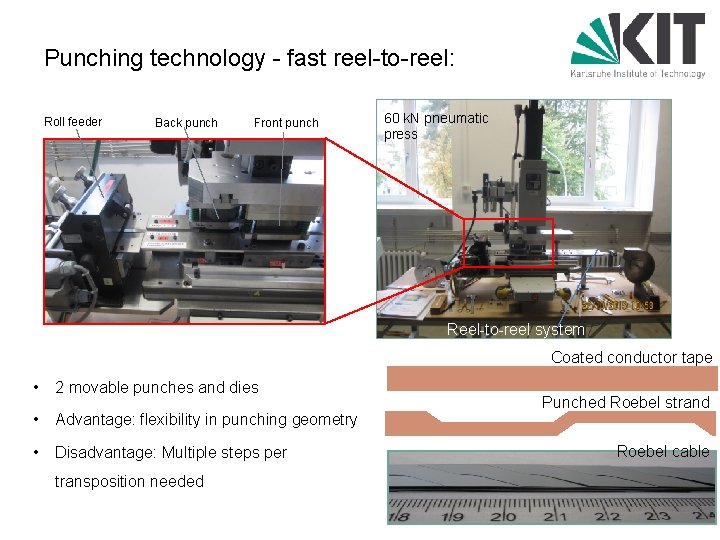
Punching technology - fast reel-to-reel: Roll feeder Back punch Front punch 60 k. N pneumatic press Reel-to-reel system Coated conductor tape • 2 movable punches and dies • Advantage: flexibility in punching geometry • Disadvantage: Multiple steps per transposition needed Punched Roebel strand Roebel cable
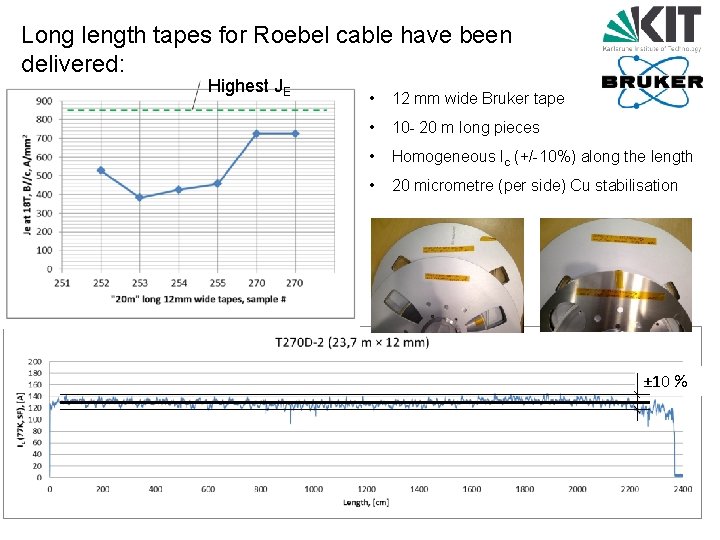
Long length tapes for Roebel cable have been delivered: Highest JE • 12 mm wide Bruker tape • 10 - 20 m long pieces • Homogeneous Ic (+/-10%) along the length • 20 micrometre (per side) Cu stabilisation ± 10 %
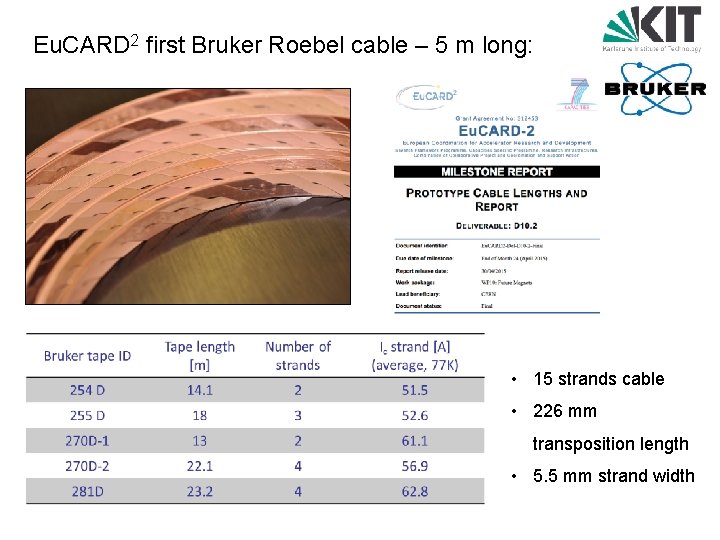
Eu. CARD 2 first Bruker Roebel cable – 5 m long: • 15 strands cable • 226 mm transposition length • 5. 5 mm strand width
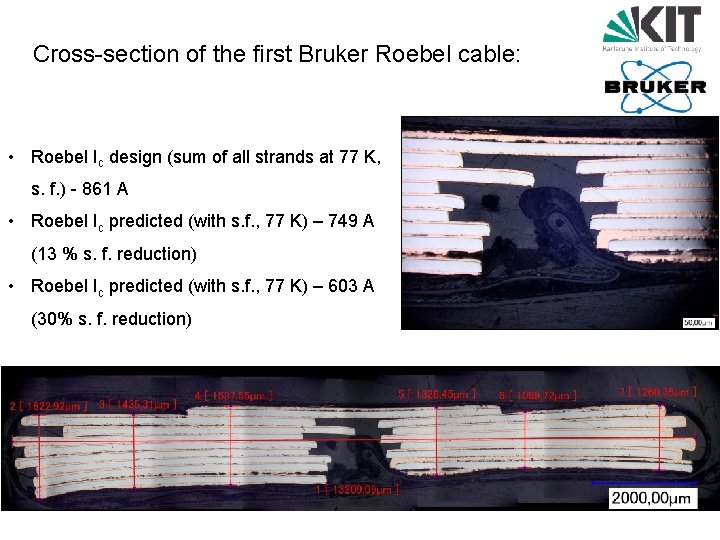
Cross-section of the first Bruker Roebel cable: • Roebel Ic design (sum of all strands at 77 K, s. f. ) - 861 A • Roebel Ic predicted (with s. f. , 77 K) – 749 A (13 % s. f. reduction) • Roebel Ic predicted (with s. f. , 77 K) – 603 A (30% s. f. reduction)
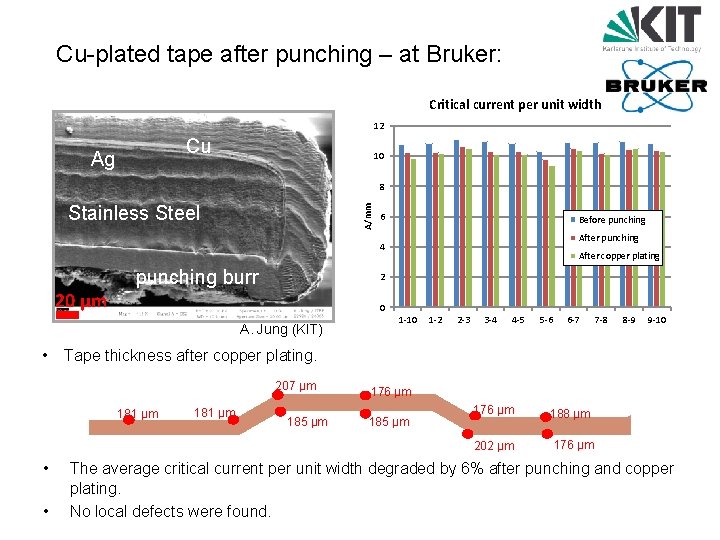
Cu-plated tape after punching – at Bruker: Critical current per unit width 12 Cu Ag 10 8 A/mm Stainless Steel 6 Before punching After punching 4 punching burr 2 20 µm 0 A. Jung (KIT) • 181 µm • 1 -10 1 -2 2 -3 3 -4 4 -5 5 -6 6 -7 7 -8 8 -9 9 -10 Tape thickness after copper plating. 207 µm • After copper plating 181 µm 185 µm 176 µm 188 µm 202 µm 176 µm The average critical current per unit width degraded by 6% after punching and copper plating. No local defects were found.
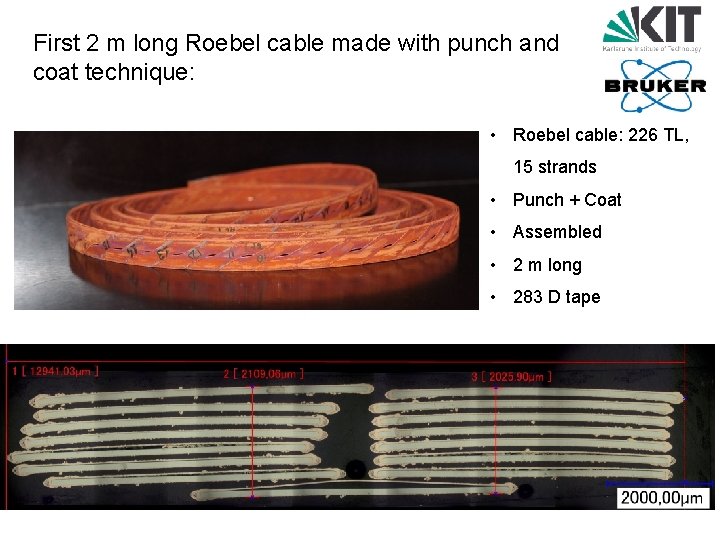
First 2 m long Roebel cable made with punch and coat technique: • Roebel cable: 226 TL, 15 strands • Punch + Coat • Assembled • 2 m long • 283 D tape
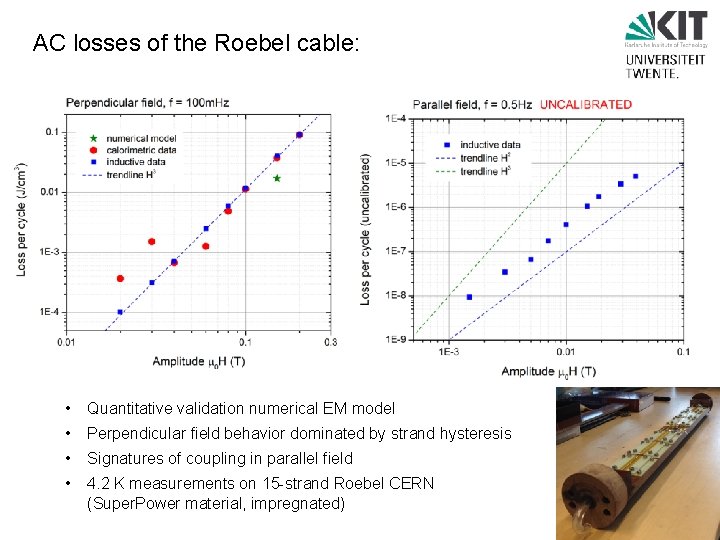
AC losses of the Roebel cable: • Quantitative validation numerical EM model • Perpendicular field behavior dominated by strand hysteresis • Signatures of coupling in parallel field • 4. 2 K measurements on 15 -strand Roebel CERN (Super. Power material, impregnated)
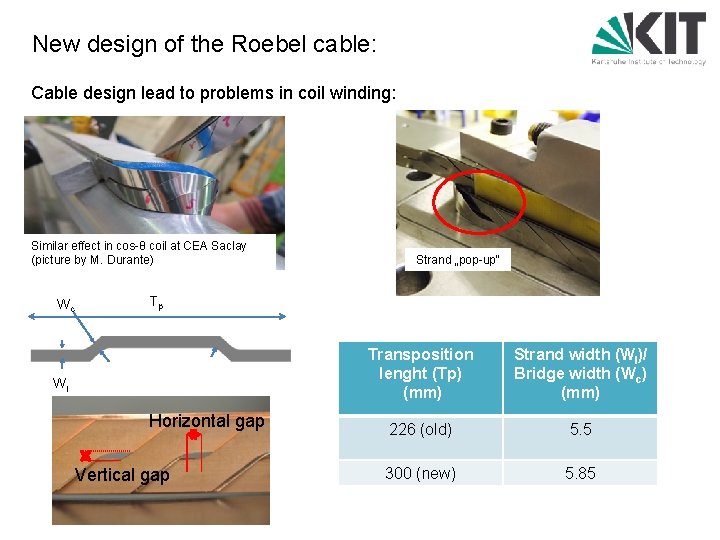
New design of the Roebel cable: Cable design lead to problems in coil winding: Similar effect in cos-θ coil at CEA Saclay (picture by M. Durante) Wc Strand „pop-up“ Tp Wl Horizontal gap Vertical gap Transposition lenght (Tp) (mm) Strand width (Wl)/ Bridge width (Wc) (mm) 226 (old) 5. 5 300 (new) 5. 85
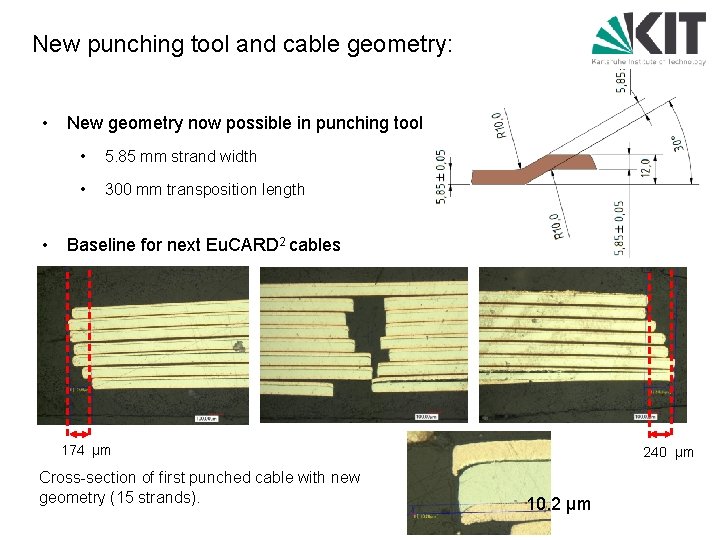
New punching tool and cable geometry: • New geometry now possible in punching tool • 5. 85 mm strand width • 300 mm transposition length • Baseline for next Eu. CARD 2 cables 174 µm Cross-section of first punched cable with new geometry (15 strands). 240 µm 10. 2 µm
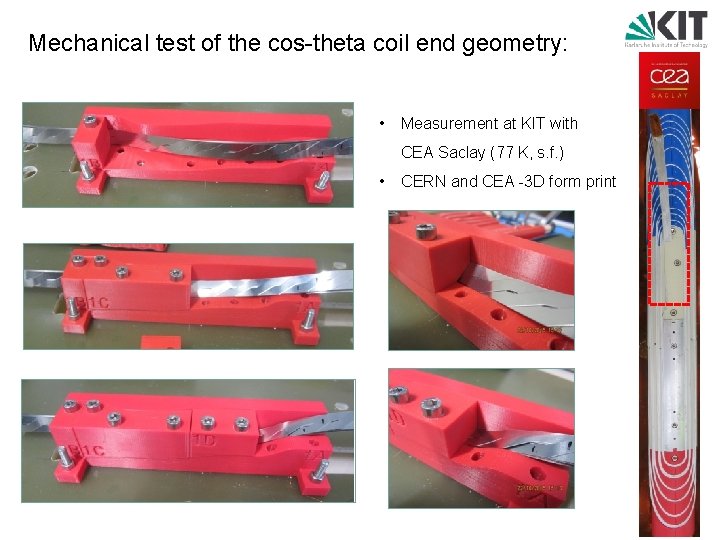
Mechanical test of the cos-theta coil end geometry: • Measurement at KIT with CEA Saclay (77 K, s. f. ) • CERN and CEA -3 D form print
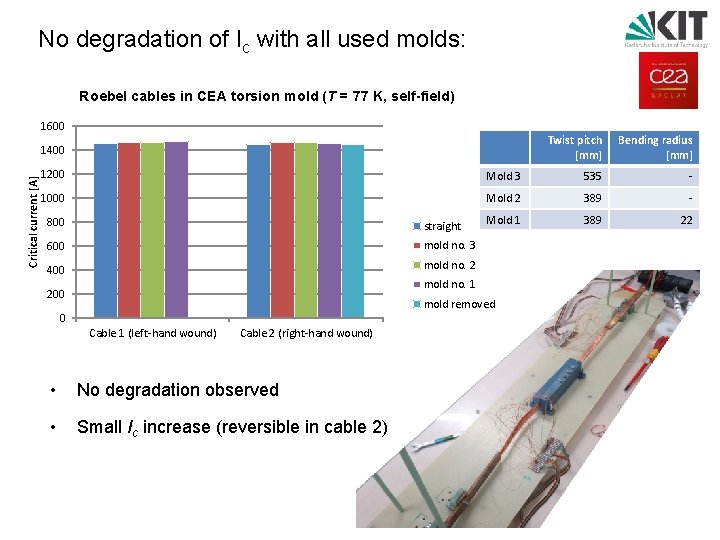
No degradation of Ic with all used molds: Roebel cables in CEA torsion mold (T = 77 K, self-field) 1600 Critical current [A] 1400 Twist pitch [mm] Bending radius [mm] 1200 Mold 3 535 - 1000 Mold 2 389 - Mold 1 389 22 800 straight 600 mold no. 3 400 mold no. 2 mold no. 1 200 mold removed 0 Cable 1 (left-hand wound) Cable 2 (right-hand wound) • No degradation observed • Small Ic increase (reversible in cable 2)
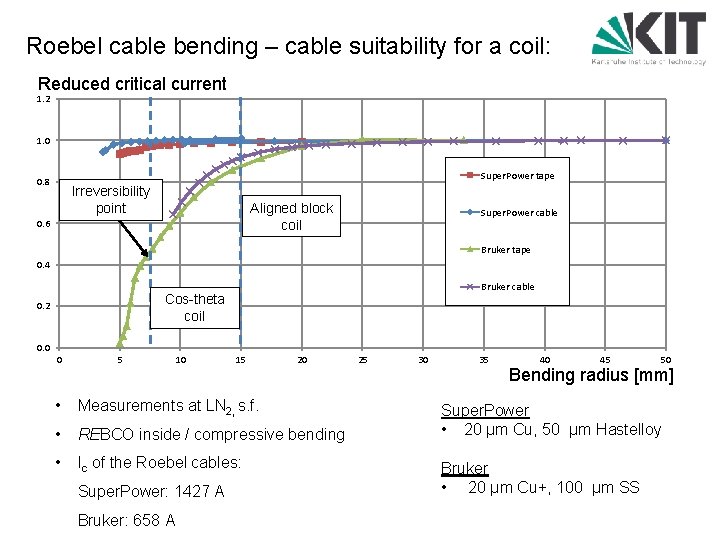
Roebel cable bending – cable suitability for a coil: • Measurements at LN 2, s. f. • REBCO inside / compressive bending • Ic of the Roebel cables: Super. Power: 1427 A Bruker: 658 A Super. Power • 20 µm Cu, 50 µm Hastelloy Bruker • 20 µm Cu+, 100 µm SS

HTS Roebel cables for the Eu. CARD 2 “Future Magnets” Coated Conductor: • Tapes for different supplies being tested (tape Je, punching). • Successful Bruker technology - punch and coat approach. Roebel coated conductor cable: • First 5 m long cables were made and delivered for coil winding. • Punch and coat technology used for first 2 m long cable. • Cable design change towards magnet design. Roebel cable for the coil winding: • First results on AC losses of impregnated cable. • It is possible to wind the cables into small radius coils without Ic degradation and test those at 77 K. • Cos-theta end design tested-no Ic cable degradation. Conductor Cable Coil
- Slides: 16