
HTPB Fuel Grain Flow Rate Sizing and Thrust
HTPB Fuel Grain Flow Rate, Sizing, and Thrust
Regression Rate Governs Size • • The faster the solid propellant is burned, the “fatter” the rocket must be to accommodate such a burn. Several parameters must be known to size a rocket – – • Fuel Mass Regression Rate Once regression rate and fuel mass have been determined, mass flow rate and thrust can be found.
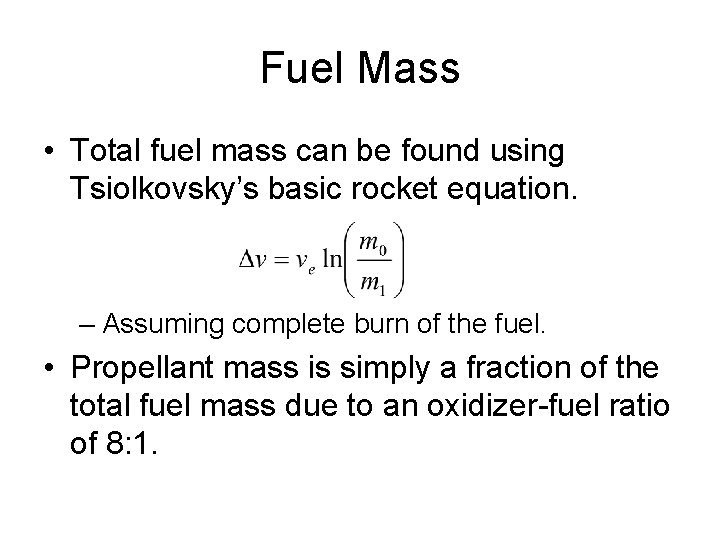
Fuel Mass • Total fuel mass can be found using Tsiolkovsky’s basic rocket equation. – Assuming complete burn of the fuel. • Propellant mass is simply a fraction of the total fuel mass due to an oxidizer-fuel ratio of 8: 1.
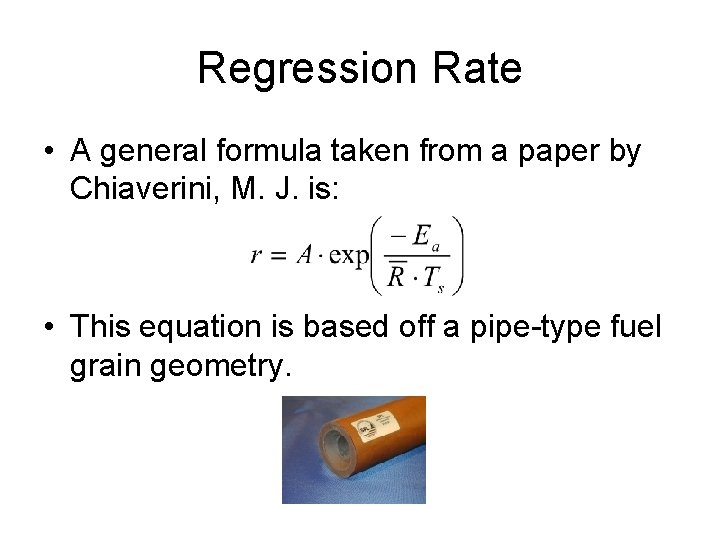
Regression Rate • A general formula taken from a paper by Chiaverini, M. J. is: • This equation is based off a pipe-type fuel grain geometry.
Fuel Grain Sizing • The amount of solid propellant burned in one second was estimated using the regression rate, which then leads to an approximate mass flow rate for HTPB. • Using this, total time for the fuel to burn up can be estimated an outside diameter for the fuel grain calculated. L = 0. 3 m di = 0. 03 m do = 0. 0588 m
Fuel Grain Sizing cont’d • The outside diameter of the fuel grain, however, was increased to 0. 0635 m. – Allow extra fuel to insulate combustion chamber walls – Utilize standard pipe sizes during ground testing
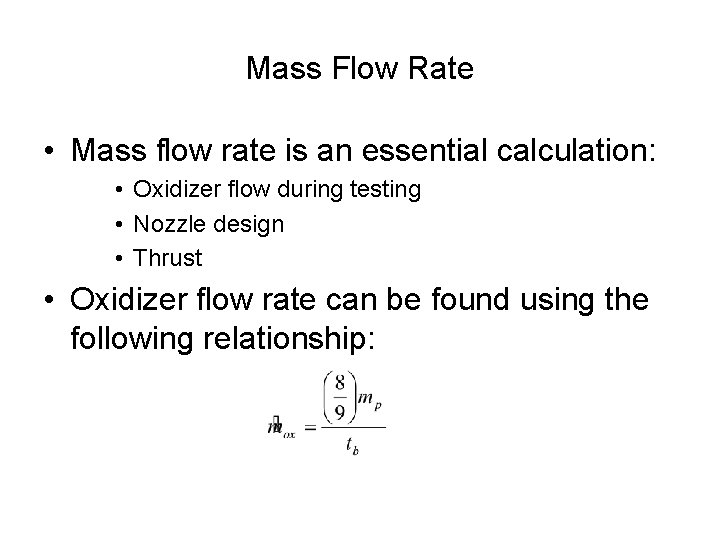
Mass Flow Rate • Mass flow rate is an essential calculation: • Oxidizer flow during testing • Nozzle design • Thrust • Oxidizer flow rate can be found using the following relationship:

Thrust • The calculation of thrust is very basic. • During ground testing, we can assume atmospheric pressure to be equivalent to exit pressure (pe = pa). – The new equation is as follows: • This results in a thrust of approximately 550 N.

Thrust cont’d • In a vacuum, we can assume pa << pe. – The new thrust equation is as follows: • The pressure differential in a vacuum generates an even greater thrust. • How much extra thrust is generated will depend on the design of the nozzle.
Final Notes • Regression rate is an inexact science which relies on multiple parameters. • It is based off experimental data, theoretical predictions, and correlation of parameters. • The sizing calculations performed will give our team the ability to conduct our first test. • Testing of the engine and measurements of actual regression rate will determine the true size of the final rocket design.
- Slides: 10