
Hsia Most historians believed the Hsia to be

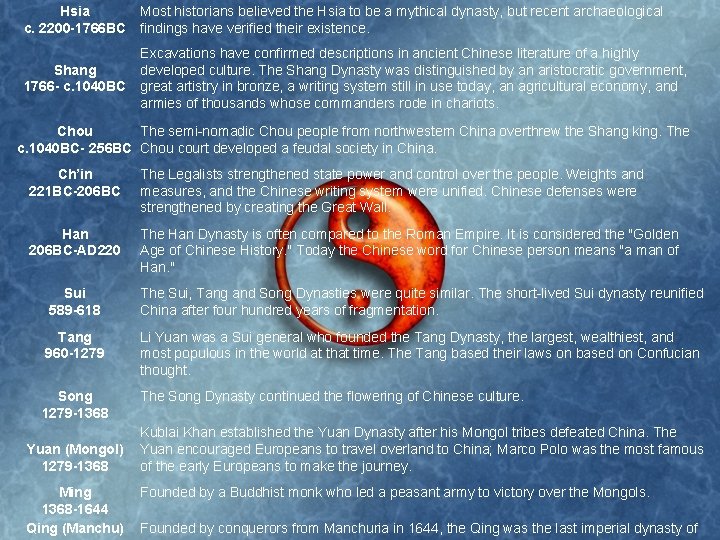
Hsia Most historians believed the Hsia to be a mythical dynasty, but recent archaeological c. 2200 -1766 BC findings have verified their existence. Excavations have confirmed descriptions in ancient Chinese literature of a highly Shang developed culture. The Shang Dynasty was distinguished by an aristocratic government, 1766 - c. 1040 BC great artistry in bronze, a writing system still in use today, an agricultural economy, and armies of thousands whose commanders rode in chariots. Chou The semi-nomadic Chou people from northwestern China overthrew the Shang king. The c. 1040 BC- 256 BC Chou court developed a feudal society in China. Ch’in 221 BC-206 BC The Legalists strengthened state power and control over the people. Weights and measures, and the Chinese writing system were unified. Chinese defenses were strengthened by creating the Great Wall. Han 206 BC-AD 220 The Han Dynasty is often compared to the Roman Empire. It is considered the "Golden Age of Chinese History. " Today the Chinese word for Chinese person means "a man of Han. " Sui 589 -618 The Sui, Tang and Song Dynasties were quite similar. The short-lived Sui dynasty reunified China after four hundred years of fragmentation. Tang 960 -1279 Li Yuan was a Sui general who founded the Tang Dynasty, the largest, wealthiest, and most populous in the world at that time. The Tang based their laws on based on Confucian thought. Song 1279 -1368 The Song Dynasty continued the flowering of Chinese culture. Yuan (Mongol) 1279 -1368 Ming 1368 -1644 Qing (Manchu) Kublai Khan established the Yuan Dynasty after his Mongol tribes defeated China. The Yuan encouraged Europeans to travel overland to China; Marco Polo was the most famous of the early Europeans to make the journey. Founded by a Buddhist monk who led a peasant army to victory over the Mongols. Founded by conquerors from Manchuria in 1644, the Qing was the last imperial dynasty of
The Civilization of Ancient China (Mythical and Historical Dynasties)
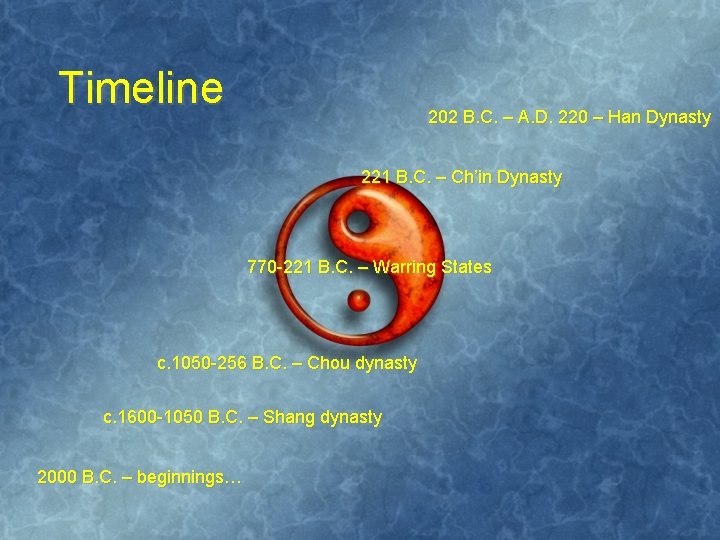
Timeline 202 B. C. – A. D. 220 – Han Dynasty 221 B. C. – Ch’in Dynasty 770 -221 B. C. – Warring States c. 1050 -256 B. C. – Chou dynasty c. 1600 -1050 B. C. – Shang dynasty 2000 B. C. – beginnings…

Sinic Culture Latin word for China Chinese civilization spread later to Korea, Vietnam and Japan Refers to East Asia as a whole Arose largely independent of contact with or influences from other areas (later) Because of isolation, Chinese civilized tradition was more continuous, coherent, and slow to change over a longer period than any other in history.
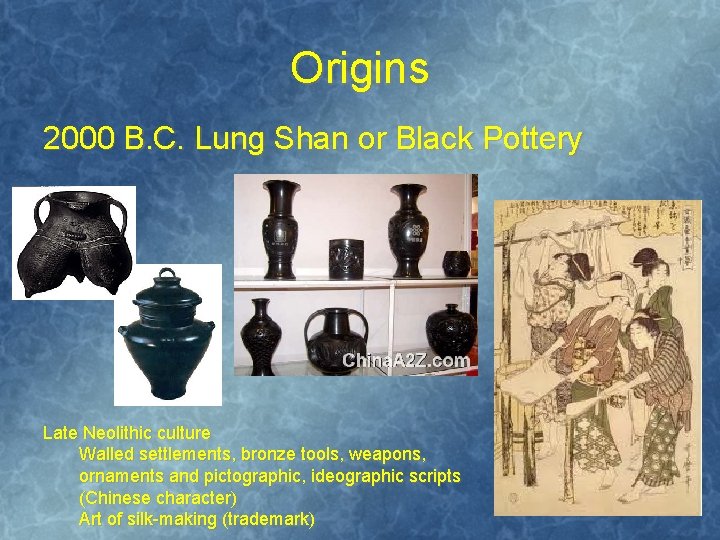
Origins 2000 B. C. Lung Shan or Black Pottery Late Neolithic culture Walled settlements, bronze tools, weapons, ornaments and pictographic, ideographic scripts (Chinese character) Art of silk-making (trademark)
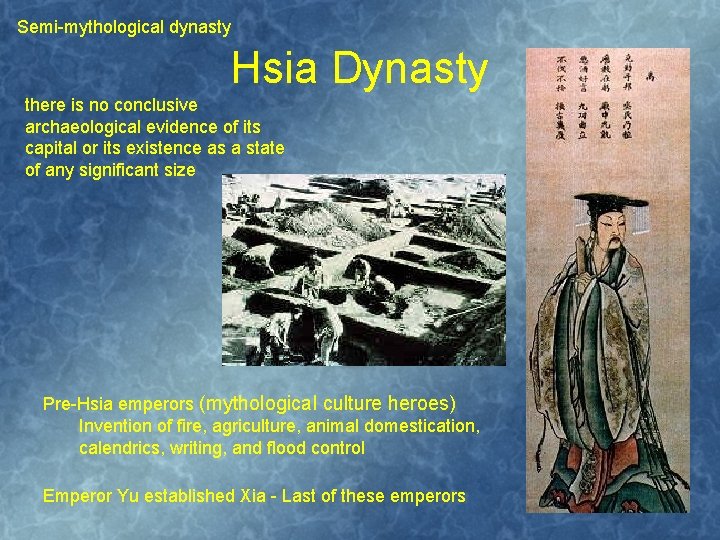
Semi-mythological dynasty Hsia Dynasty there is no conclusive archaeological evidence of its capital or its existence as a state of any significant size Pre-Hsia emperors (mythological culture heroes) Invention of fire, agriculture, animal domestication, calendrics, writing, and flood control Emperor Yu established Xia - Last of these emperors
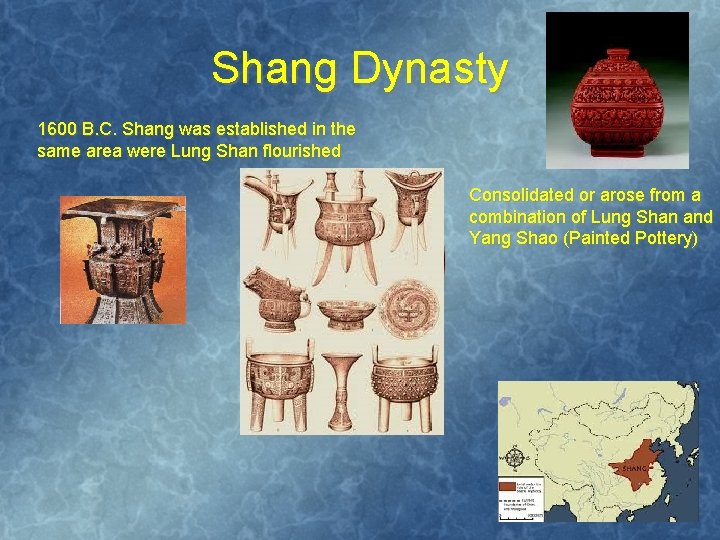
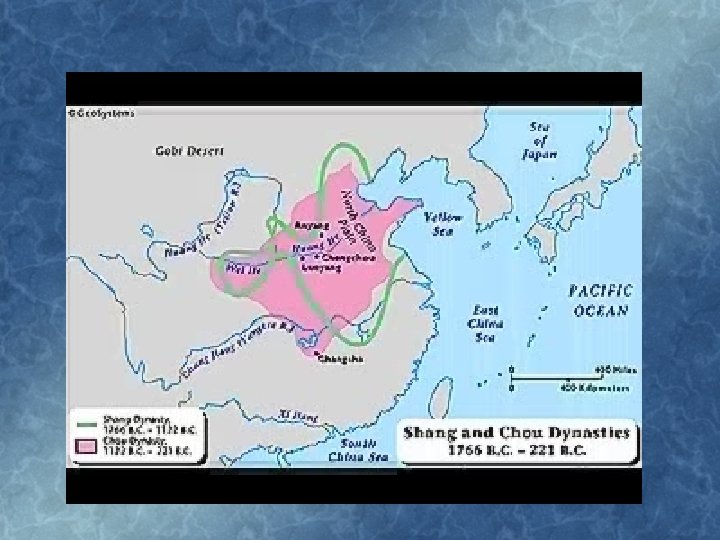
Shang Dynasty 1600 B. C. Shang was established in the same area were Lung Shan flourished Consolidated or arose from a combination of Lung Shan and Yang Shao (Painted Pottery)
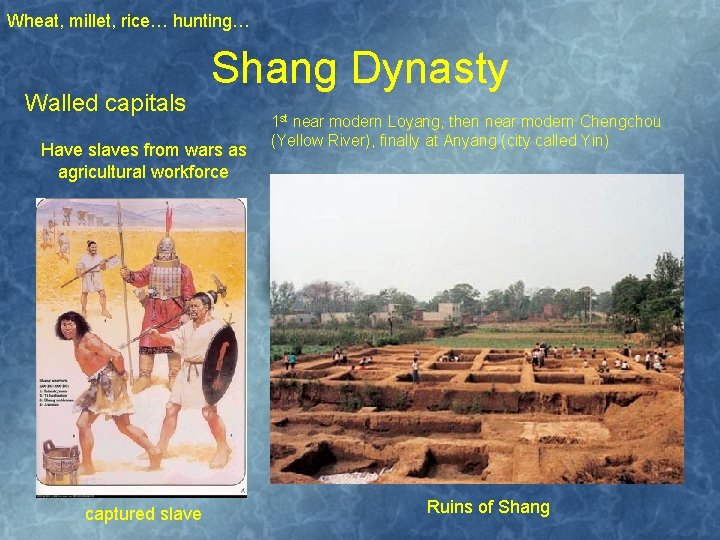
Wheat, millet, rice… hunting… Walled capitals Shang Dynasty Have slaves from wars as agricultural workforce captured slave 1 st near modern Loyang, then near modern Chengchou (Yellow River), finally at Anyang (city called Yin) Ruins of Shang
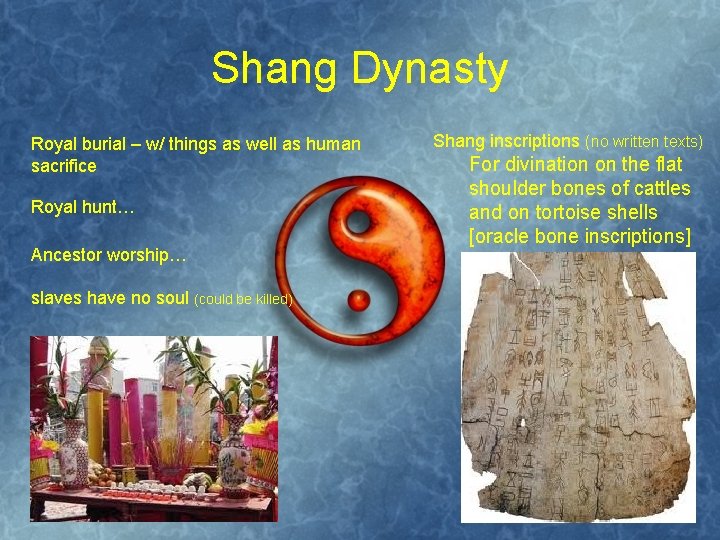
Shang Dynasty Royal burial – w/ things as well as human sacrifice Royal hunt… Ancestor worship… slaves have no soul (could be killed) Shang inscriptions (no written texts) For divination on the flat shoulder bones of cattles and on tortoise shells [oracle bone inscriptions]
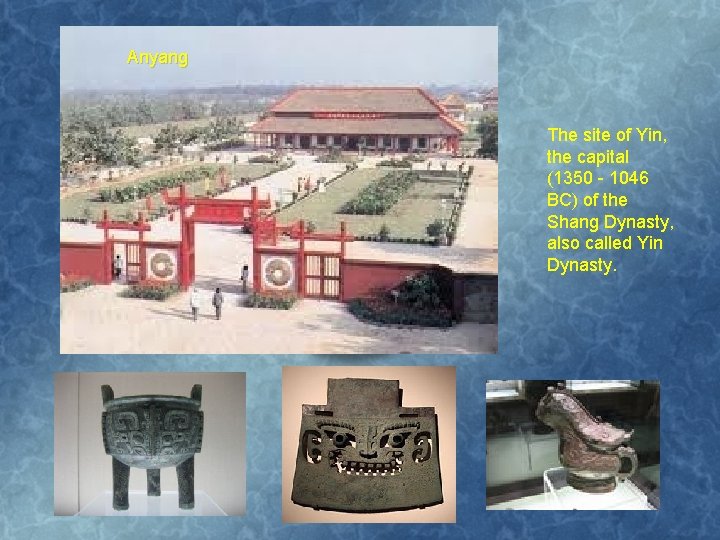
Anyang The site of Yin, the capital (1350 - 1046 BC) of the Shang Dynasty, also called Yin Dynasty.
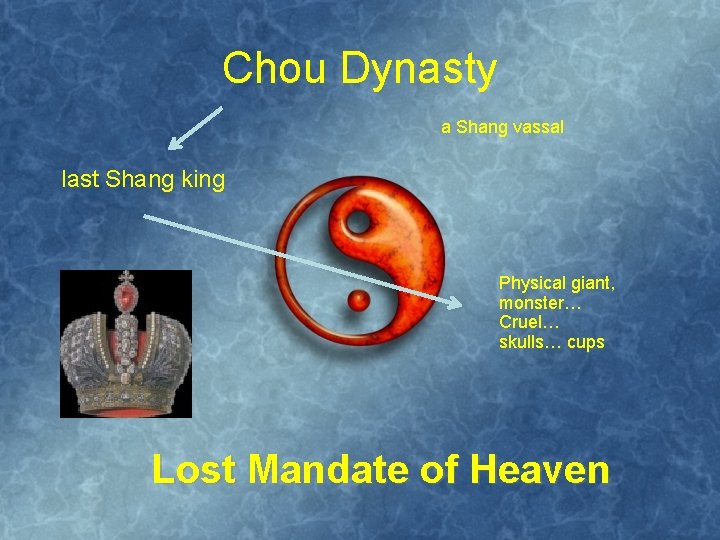
Chou Dynasty a Shang vassal last Shang king Physical giant, monster… Cruel… skulls… cups Lost Mandate of Heaven
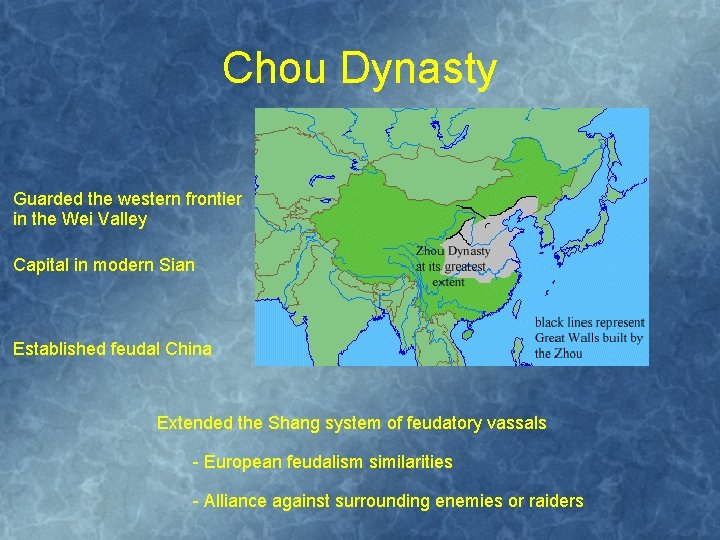
Chou Dynasty Guarded the western frontier in the Wei Valley Capital in modern Sian Established feudal China Extended the Shang system of feudatory vassals - European feudalism similarities - Alliance against surrounding enemies or raiders
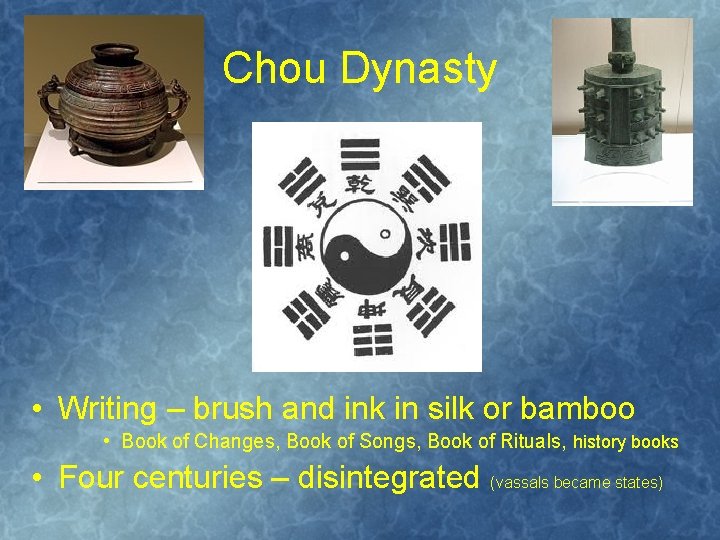
Chou Dynasty • Writing – brush and ink in silk or bamboo • Book of Changes, Book of Songs, Book of Rituals, history books • Four centuries – disintegrated (vassals became states)
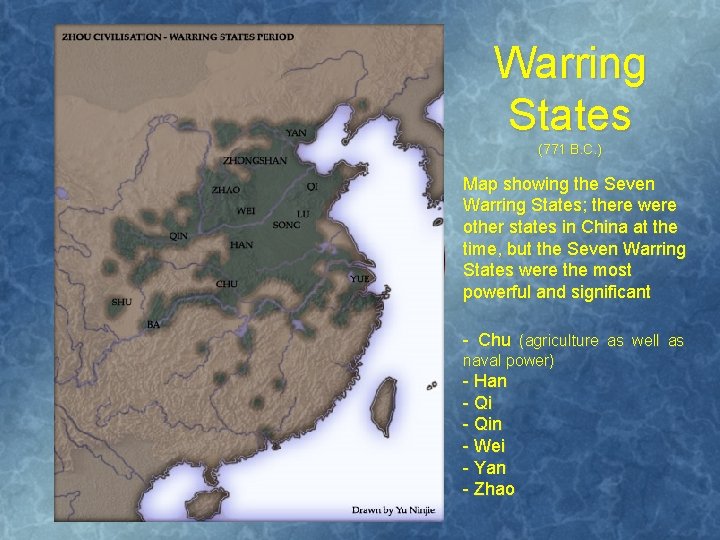
Warring States (771 B. C. ) Map showing the Seven Warring States; there were other states in China at the time, but the Seven Warring States were the most powerful and significant - Chu (agriculture as well as naval power) - Han - Qin - Wei - Yan - Zhao
Ch’in Dynasty • As Military Power – Formerly one of the poorest, smallest and remote • Importance of hard work, frugality, discipline and emphasized agriculture, and peasant soldiers instead of trade, merchants or intellectuals • Succession of able rulers • Masters of strategy and tactics – Diplomacy, propaganda, treacherous espionage, and various forms of psychological warfare • Ch’in Shih Huang Ti • First empire… – Capital called Hsian Yang near modern Sian
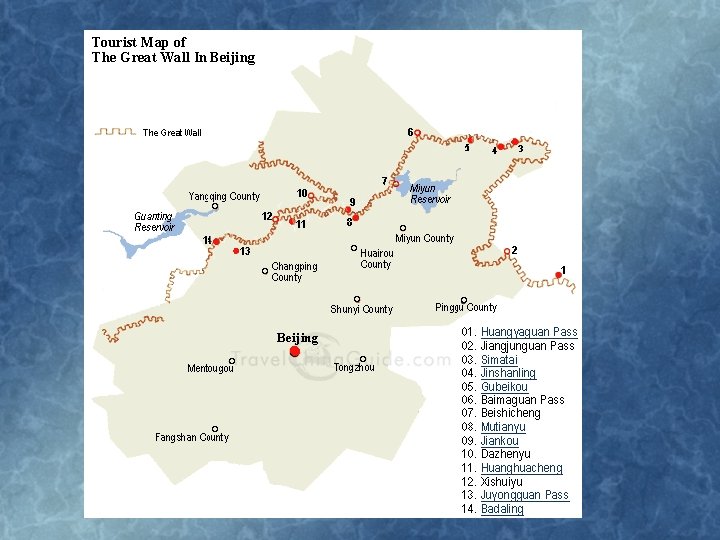
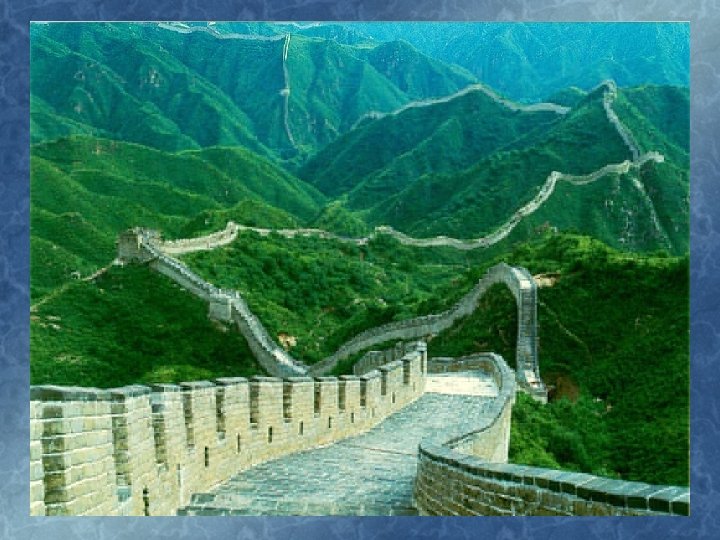
• Significant changes… • Primogeniture was abolished • Slavery was also abolished, except for minor servants • Former feudal and land-tenure arrangements were abolished. • Land became freely bought and sold. • The Great Wall was made through corvée labor, wherein 1 million people died. • Intellectuals were persecuted (trouble-makers). • No admiration of the past, no criticism of the present and no recommendations of the future
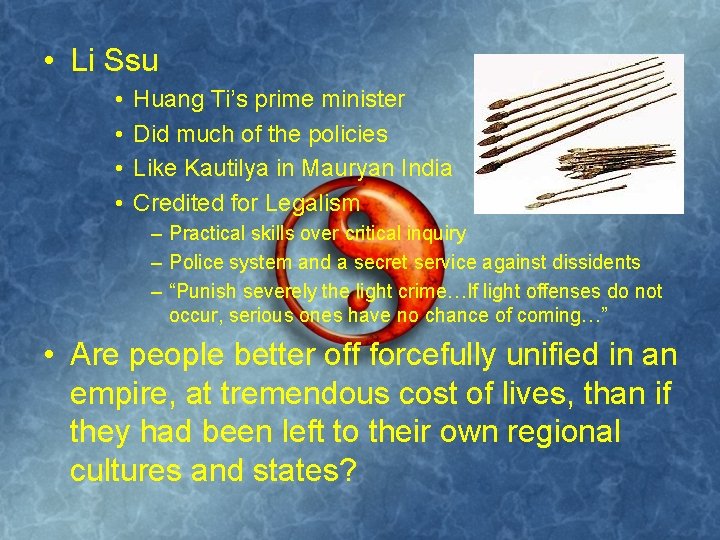
• Li Ssu • • Huang Ti’s prime minister Did much of the policies Like Kautilya in Mauryan India Credited for Legalism – Practical skills over critical inquiry – Police system and a secret service against dissidents – “Punish severely the light crime…If light offenses do not occur, serious ones have no chance of coming…” • Are people better off forcefully unified in an empire, at tremendous cost of lives, than if they had been left to their own regional cultures and states?
• People were ready to break from their feudal past • To a system based on achievement rather than based on birth. • Li Ping • • Hydraulic engineer Credited for many ambitious projects “Dig the bed deep, and keep the banks low. ” Famous irrigation works at Kuan Hsien in western Szechuan • Now his irrigation works are visited by tourists…
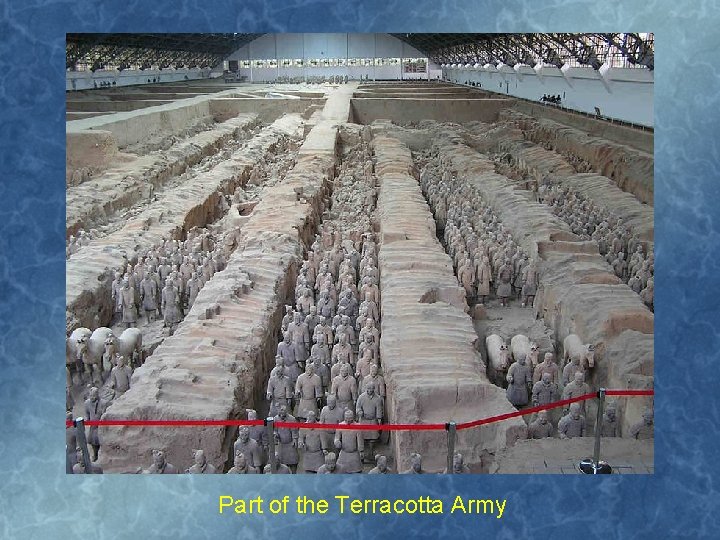
Part of the Terracotta Army
Han Dynasty • Ch’in Shih Huang Ti – Died in 210 – Country in turmoil, exhausted the people, drained the treasury, alienated the educated upper classes. » Started by Liu Pang (Liu Bang) in 202 B. C. E. when his troop was turned out to be the over-all winner of the rebellion against the Qi’n Dynasty » Established separately in Chang ‘An and Luoyang • Liu Pang – – Han Kao-tsu (High Progenitor) Emphasized Confucian precepts Pool of educated men (Confucian) serve the state Divided the empire into hsien (counties) under a magistrate
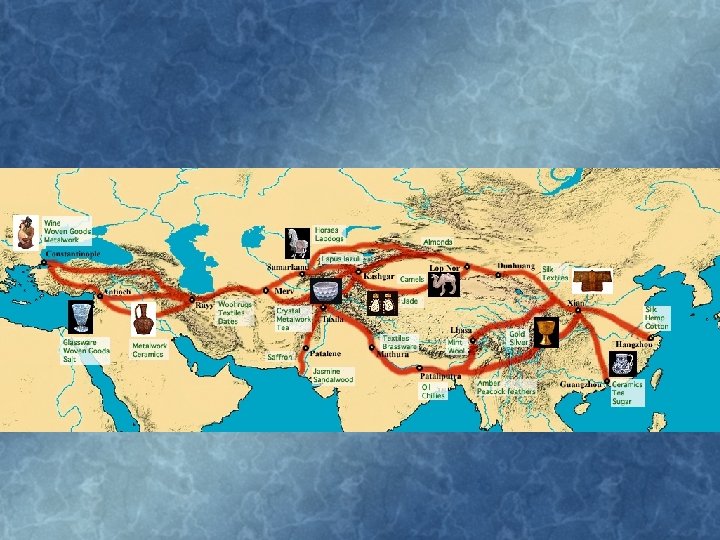
• Emperor Wu Ti (141 -87 B. C. ) • Removed the remaining powers of the lords created by Liu Pang • Ambitious programs of new conquests – Yueh kingdom (northern Vietnam) – Southern Manchuria and northern Koreasi – Silk Road » International trade » Goods—silk—reach as far as Rome with Asiatic tribes as in-between » Exhausted Rome’s fund? – China-Rome relationship – Chang Ch’ien, a courtier who try to make alliance with Hsiung-nu but was captured. » Was able to escape to Han capital at Ch’ang An in Wei Valley
• Rome, Mauryan India and Han China • Han culture – Confucianism – Civil Service system • Ability and education rather than inherited status • Wang Mang (A. D. 9 -23) – Abolition of private estates – Nationalization of lands • Was murdered by Red Eyebrows • AD. 25 Eastern or Later Han • Capital at Loyang • AD. 89 defeated the Hsiung-nu---westward-Huns
- Fall of the Han Rule Caused by corruption and political conflict among three powerful groups: • • • Eunuchs; Empress’ Clans; and Confucian scholar- officials – – Dark age Buddhism spread…
dynasties and territories
- Slides: 29