
HSE Requirements for Loading and Unloading Road and

- Slides: 16
HSE Requirements for Loading and Unloading Road and Rail Vehicles GROUP HSE RULE (CR-GR-HSE-431) SUMMARY This rule defines the minimum HSE requirements to manage the risks during operations involving the loading and unloading of dangerous or non-dangerous goods, into or out of road and rail vehicles, at dedicated loading / unloading areas and bays.
CR-GR-HSE-431 q Context: ü ü 4, 3 Millions loadings/year; 12 Millions unloadings/year. variety of goods or objects loaded. q 13 requierements, grouped in 4 themes: ü ü risk analysis & procedure; information & training; implementation; audits. q Remplace documents: ü ü ü DIR-SEC-14 - Road/Rail Loading and Unloading operations; REG-GR-SEC-031 - Control procedure before loading tank trucks with liquid hydrocarbons and LPG ‟Safe to Load”; No rule defined into the MS referential. q Date of publication in REFLEX : 02/10/2020 q Date of application : 02/04/2021
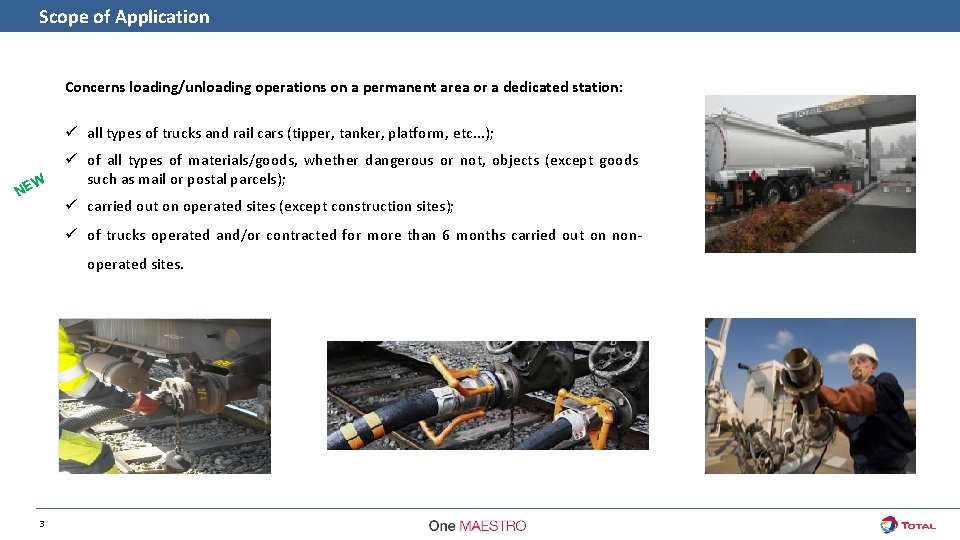
Scope of Application Concerns loading/unloading operations on a permanent area or a dedicated station: ü all types of trucks and rail cars (tipper, tanker, platform, etc. . . ); W NE ü of all types of materials/goods, whether dangerous or not, objects (except goods such as mail or postal parcels); ü carried out on operated sites (except construction sites); ü of trucks operated and/or contracted for more than 6 months carried out on nonoperated sites. 3
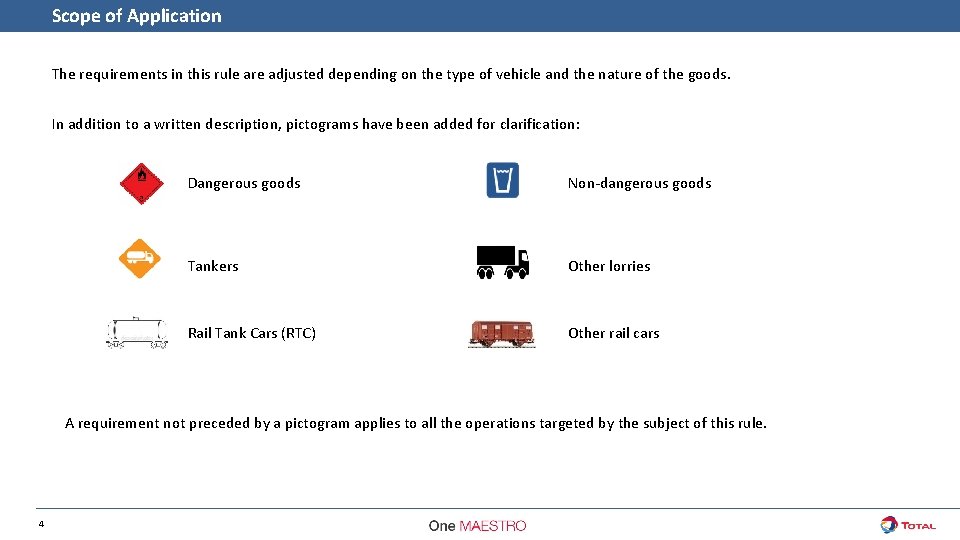
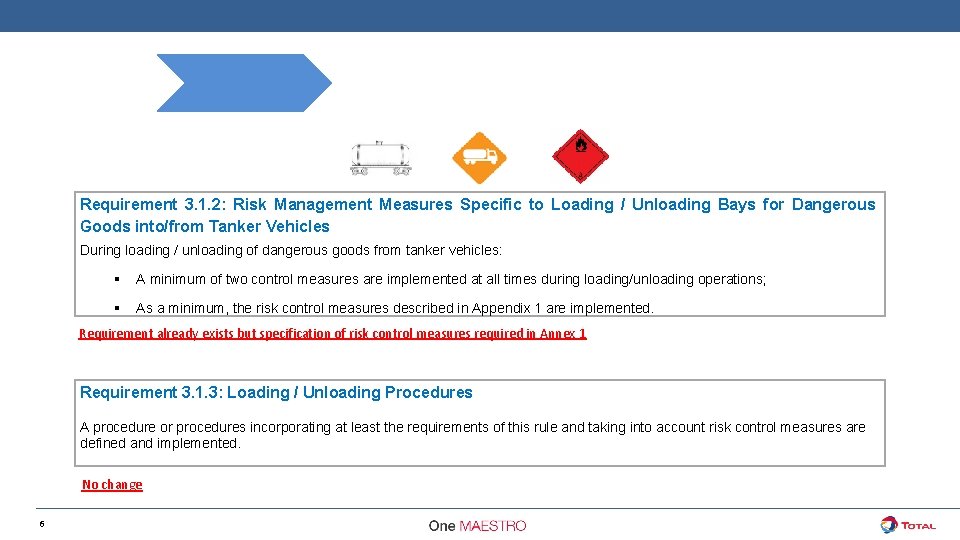
Scope of Application The requirements in this rule are adjusted depending on the type of vehicle and the nature of the goods. In addition to a written description, pictograms have been added for clarification: Dangerous goods Non-dangerous goods Tankers Other lorries Rail Tank Cars (RTC) Other rail cars A requirement not preceded by a pictogram applies to all the operations targeted by the subject of this rule. 4
REQUIEREMENTS Requirement 3. 1. 1: Risk Analysis Any kind of loading / unloading operations are to undergo a risk analysis. The risk analysis is formalised and revised in the event of significant changes to the loading or unloading areas and bays, or to the operating instruction. No change 5
Requirement 3. 1. 2: Risk Management Measures Specific to Loading / Unloading Bays for Dangerous Goods into/from Tanker Vehicles During loading / unloading of dangerous goods from tanker vehicles: § A minimum of two control measures are implemented at all times during loading/unloading operations; § As a minimum, the risk control measures described in Appendix 1 are implemented. Requirement already exists but specification of risk control measures required in Annex 1 Requirement 3. 1. 3: Loading / Unloading Procedures A procedure or procedures incorporating at least the requirements of this rule and taking into account risk control measures are defined and implemented. No change 6
Requirement 3. 2. 1: Informing Crew Members NE W Crew members are informed of the safety instructions specific to the loading / unloading area or bay (including instructions for positioning the vehicle) before they are authorised to enter the site. New requirement for MS (formalisation of information on safety instructions to crew members) 7
Requirement 3. 2. 2: Training and Authorisation The persons involved (including the road driver) in the supervision, control or execution of loading / unloading operations of dangerous goods are trained as a minimum: In applicable procedures, in order to know the risks related to the operations and products handled, and the corresponding risk control measures; § Action required in the event of an accident or emergency situation; § A refresher course is completed every 5 years at maximum. NEW In addition, on an industrial site and for personnel performing self-service loading / unloading operations: § the courses include a practical part specific to the loading / unloading bay(s) and product types; § a refresher is carried out after a significant change in the loading / unloading bay / station or operating instructions. NEW § For drivers operating self-service loading / unloading bays on an industrial site, training is validated by an authorisation. Training, refresher courses and authorisations are recorded. Already existing requirement with a new precision on the periodicity of the training courses of 5 years 8
REQUIEREMENTS Requirement 3. 3. 1: Control of Vehicles (Road and Rail) and Road Drivers A control system, of which the frequency and check points are defined based on the risk analysis, return of experience (REX) and applicable local regulations is implemented. Particular attention is paid to ensure that no overloaded, over-pressurised or over-filled vehicles leave the site. The results of these checks are recorded any corrective measures are implemented. No change 9
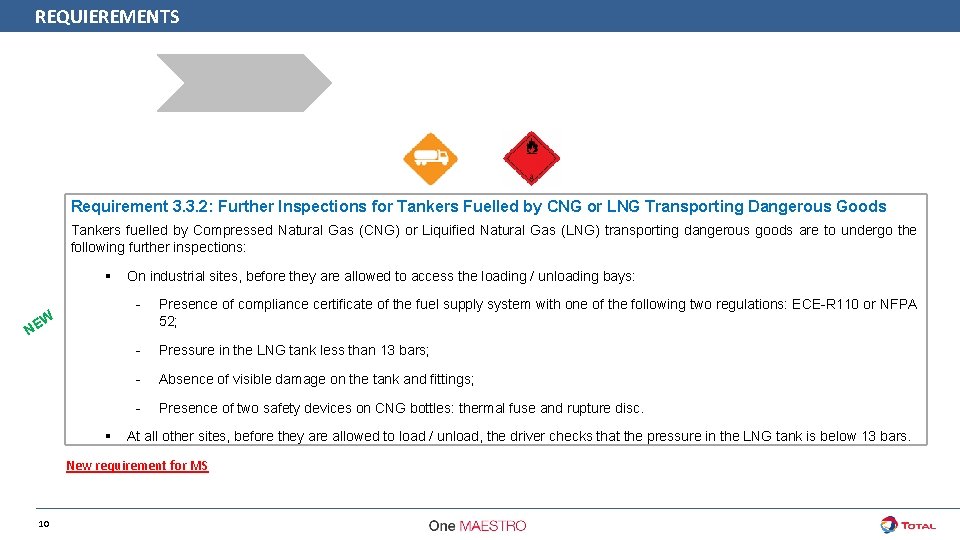
REQUIEREMENTS Requirement 3. 3. 2: Further Inspections for Tankers Fuelled by CNG or LNG Transporting Dangerous Goods Tankers fuelled by Compressed Natural Gas (CNG) or Liquified Natural Gas (LNG) transporting dangerous goods are to undergo the following further inspections: § NE W § On industrial sites, before they are allowed to access the loading / unloading bays: - Presence of compliance certificate of the fuel supply system with one of the following two regulations: ECE-R 110 or NFPA 52; - Pressure in the LNG tank less than 13 bars; - Absence of visible damage on the tank and fittings; - Presence of two safety devices on CNG bottles: thermal fuse and rupture disc. At all other sites, before they are allowed to load / unload, the driver checks that the pressure in the LNG tank is below 13 bars. New requirement for MS 10
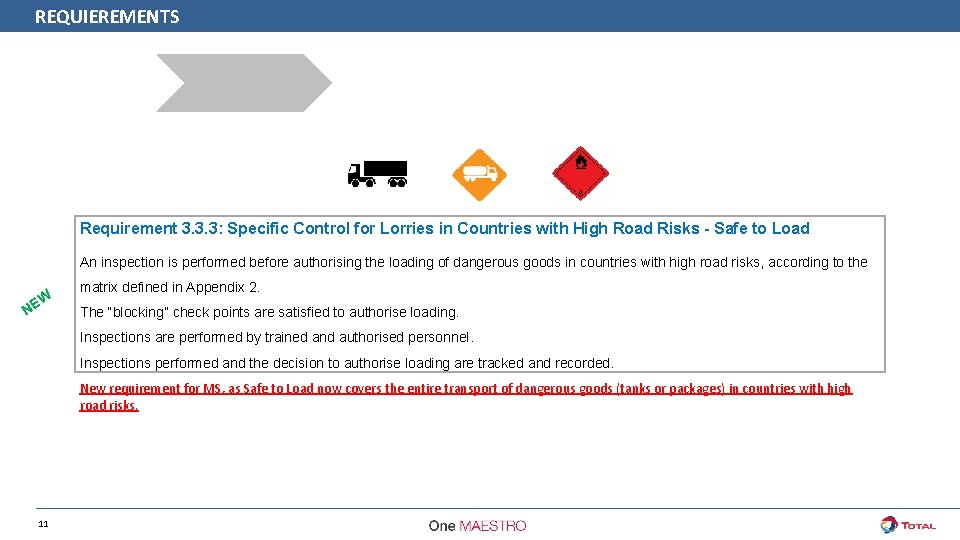
REQUIEREMENTS Requirement 3. 3. 3: Specific Control for Lorries in Countries with High Road Risks - Safe to Load An inspection is performed before authorising the loading of dangerous goods in countries with high road risks, according to the EW N matrix defined in Appendix 2. The “blocking” check points are satisfied to authorise loading. Inspections are performed by trained and authorised personnel. Inspections performed and the decision to authorise loading are tracked and recorded. New requirement for MS, as Safe to Load now covers the entire transport of dangerous goods (tanks or packages) in countries with high road risks. 11
REQUIEREMENTS Requirement 3. 3. 4: Vehicle Immobilisation at the Loading / Unloading Bay One or more systems are installed to make sure that the road or rail vehicle is immobilised during the loading / unloading operation. In particular, chocks are used when discharging flammable liquids at service stations. During the loading / unloading of a rail car, measures are taken to prevent another rail car accessing the same bay. No change 12
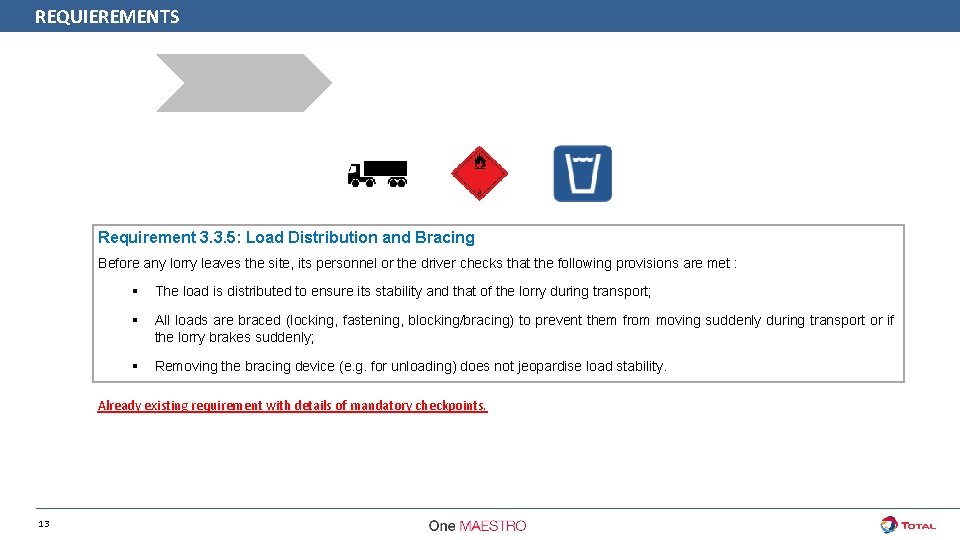
REQUIEREMENTS Requirement 3. 3. 5: Load Distribution and Bracing Before any lorry leaves the site, its personnel or the driver checks that the following provisions are met : § The load is distributed to ensure its stability and that of the lorry during transport; § All loads are braced (locking, fastening, blocking/bracing) to prevent them from moving suddenly during transport or if the lorry brakes suddenly; § Removing the bracing device (e. g. for unloading) does not jeopardise load stability. Already existing requirement with details of mandatory checkpoints. 13
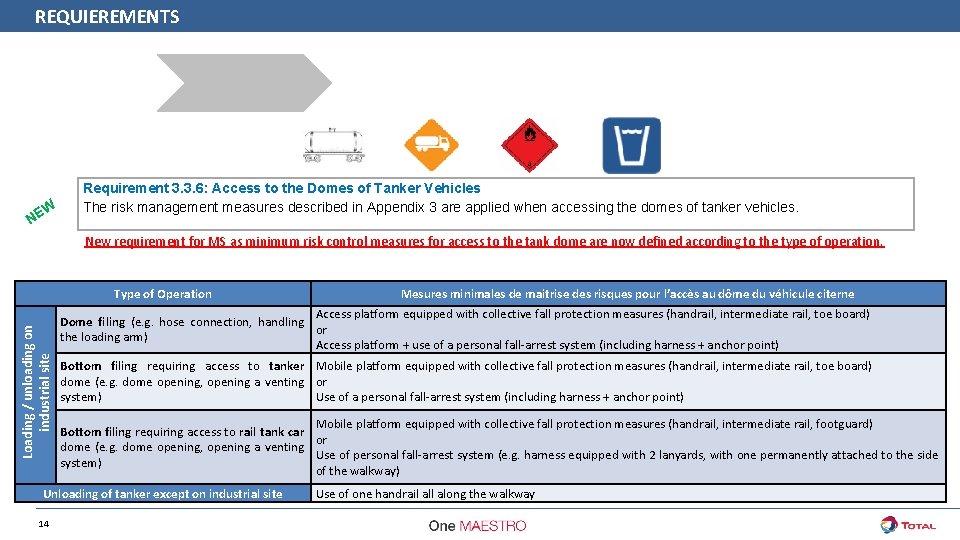
REQUIEREMENTS NE W Requirement 3. 3. 6: Access to the Domes of Tanker Vehicles The risk management measures described in Appendix 3 are applied when accessing the domes of tanker vehicles. New requirement for MS as minimum risk control measures for access to the tank dome are now defined according to the type of operation. Loading / unloading on industrial site Type of Operation Access platform equipped with collective fall protection measures (handrail, intermediate rail, toe board) Dome filing (e. g. hose connection, handling or the loading arm) Access platform + use of a personal fall-arrest system (including harness + anchor point) Bottom filing requiring access to tanker Mobile platform equipped with collective fall protection measures (handrail, intermediate rail, toe board) dome (e. g. dome opening, opening a venting or system) Use of a personal fall-arrest system (including harness + anchor point) Mobile platform equipped with collective fall protection measures (handrail, intermediate rail, footguard) Bottom filing requiring access to rail tank car or dome (e. g. dome opening, opening a venting Use of personal fall-arrest system (e. g. harness equipped with 2 lanyards, with one permanently attached to the side system) of the walkway) Unloading of tanker except on industrial site 14 Mesures minimales de maitrise des risques pour l’accès au dôme du véhicule citerne Use of one handrail along the walkway
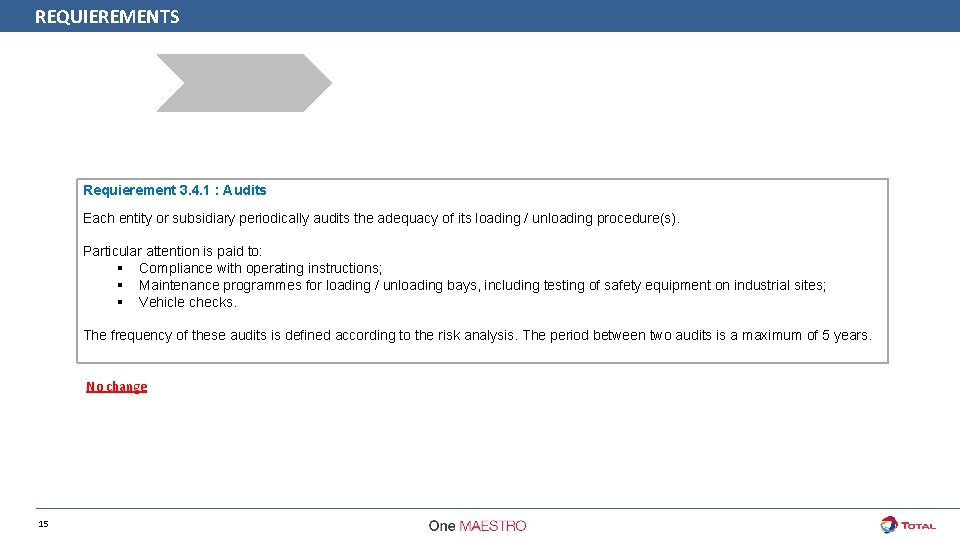
REQUIEREMENTS Requierement 3. 4. 1 : Audits Each entity or subsidiary periodically audits the adequacy of its loading / unloading procedure(s). Particular attention is paid to: § Compliance with operating instructions; § Maintenance programmes for loading / unloading bays, including testing of safety equipment on industrial sites; § Vehicle checks. The frequency of these audits is defined according to the risk analysis. The period between two audits is a maximum of 5 years. No change 15
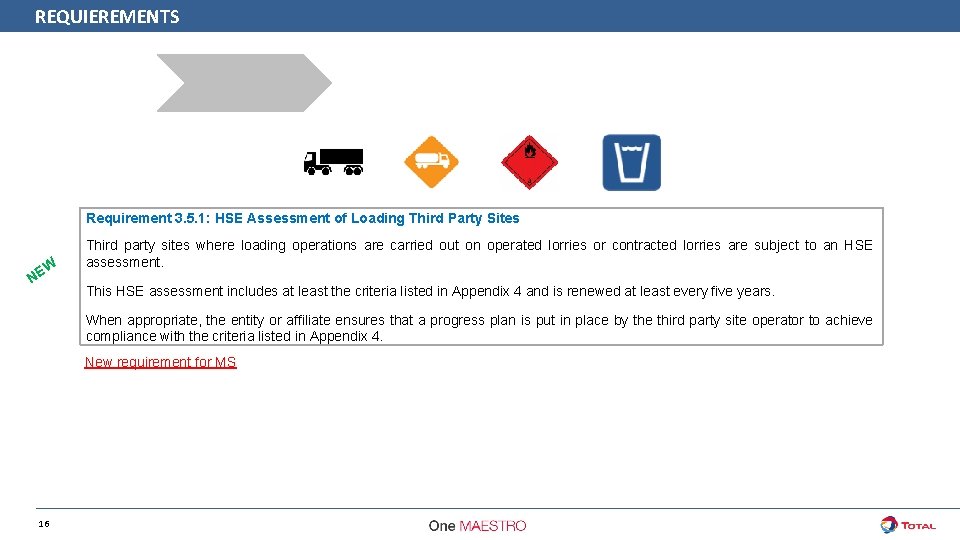
REQUIEREMENTS Requirement 3. 5. 1: HSE Assessment of Loading Third Party Sites NE W Third party sites where loading operations are carried out on operated lorries or contracted lorries are subject to an HSE assessment. This HSE assessment includes at least the criteria listed in Appendix 4 and is renewed at least every five years. When appropriate, the entity or affiliate ensures that a progress plan is put in place by the third party site operator to achieve compliance with the criteria listed in Appendix 4. New requirement for MS 16