
HSC 4572 DIABETES VALERIE SCHULZ MMSC RD LDN
HSC 4572 - DIABETES VALERIE SCHULZ, MMSC, RD, LD/N, CDE
WHAT IS DIABETES? Etymology: Gk, diabainein, to pass or flow through • a clinical condition characterized by the excessive excretion of urine. • The excess may be caused by a deficiency of antidiuretic hormone(ADH), as in diabetes insipidus • insipidus n 1. a metabolic disturbance characterized by marked urinary excretion and great thirst but no elevation of sugar in the blood or urine. n 2. a pituitary dysfunction characterized by an insufficient output of antidiuretic hormone, leading to polyuria and polydipsia. • For comparison only, NOT the type of diabetes we will be studying…
WHAT IS DIABETES MELLITUS (DM) AND HISTORY • This is the type of diabetes we will be studying • Diabetes mellitus: “honey-sweet” – ancient times physicians tasted the urine from a person with diabetes mellitus • polyuria results from the hyperglycemia (high blood glucose) • DM: We now know insulin is needed to usher the blood sugar into the cells. • Before the discovery of insulin, diabetes was a feared disease that most certainly led to death. • Therapy prior to the invention of insulin was to restrict all sugars and encourage the person to exercise almost continuously. • Before 1922, in some cases, the harsh diets even caused patients to die of starvation. • Pancreatic extract (insulin) created in 1922. • http: //www. nobelprize. org/educational/medicine/insulin/discoveryinsulin. html
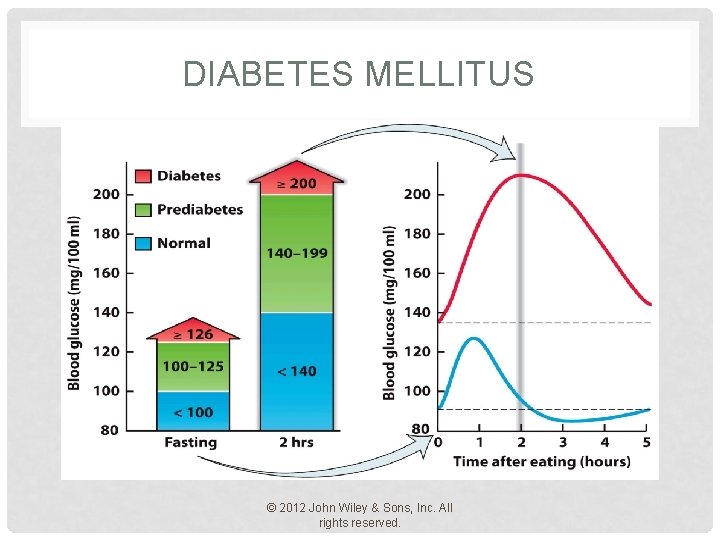
INTERPRETATION OF BLOOD SUGARS • The following slide has two arrows showing blood sugars for people • Without diabetes (otherwise known as ‘normal’) • With pre-diabetes • With diabetes • These are diagnostic values, meaning this is where the health professional would diagnose the disease • The left arrow is for fasting (before meal) sugars and the right arrow shows 2 -hour after meal (known as “postprandial”, or pp). The 2 hr pp sugars are routinely used to assess how the person tolerated the meal. • The chart shows the same data, just in chart form (prediabetes is not shown in the chart)
DIABETES MELLITUS © 2012 John Wiley & Sons, Inc. All rights reserved.
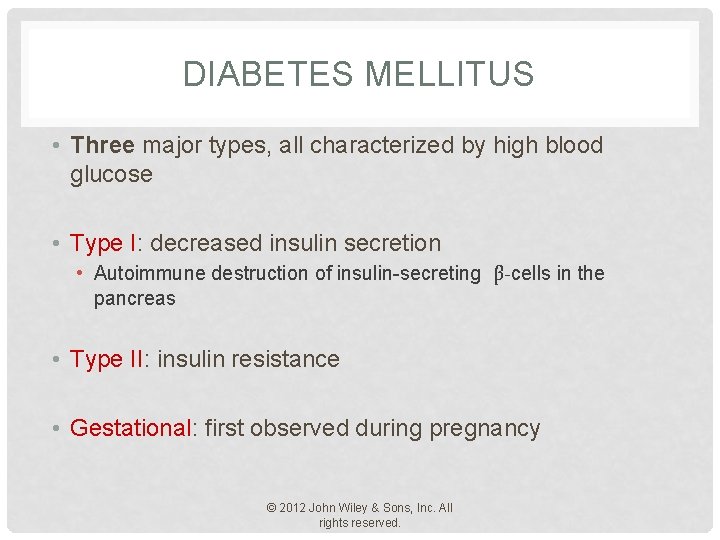
DIABETES MELLITUS • Three major types, all characterized by high blood glucose • Type I: decreased insulin secretion • Autoimmune destruction of insulin-secreting β-cells in the pancreas • Type II: insulin resistance • Gestational: first observed during pregnancy © 2012 John Wiley & Sons, Inc. All rights reserved.
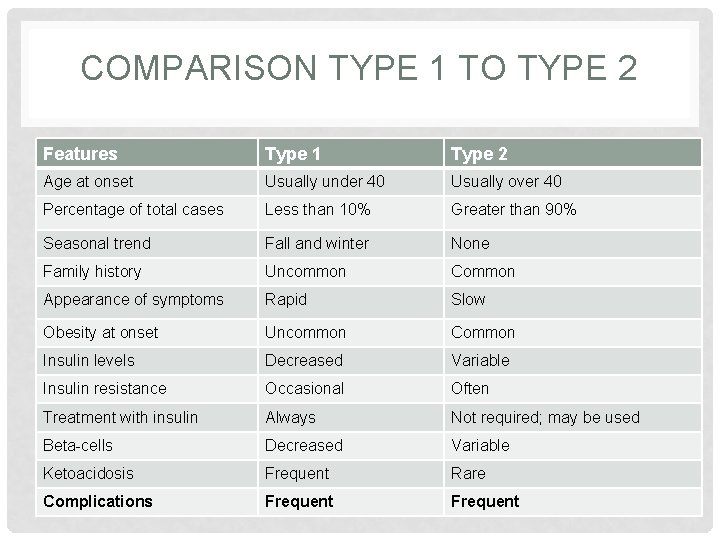
COMPARISON TYPE 1 TO TYPE 2 Features Type 1 Type 2 Age at onset Usually under 40 Usually over 40 Percentage of total cases Less than 10% Greater than 90% Seasonal trend Fall and winter None Family history Uncommon Common Appearance of symptoms Rapid Slow Obesity at onset Uncommon Common Insulin levels Decreased Variable Insulin resistance Occasional Often Treatment with insulin Always Not required; may be used Beta-cells Decreased Variable Ketoacidosis Frequent Rare Complications Frequent
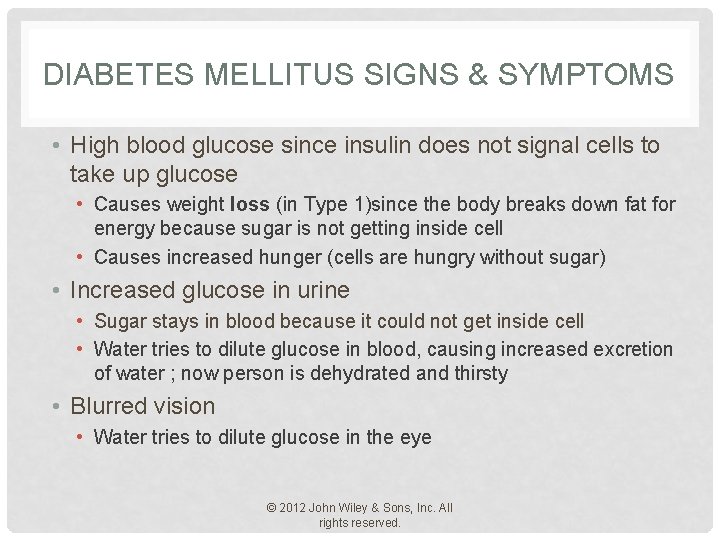
DIABETES MELLITUS SIGNS & SYMPTOMS • High blood glucose since insulin does not signal cells to take up glucose • Causes weight loss (in Type 1)since the body breaks down fat for energy because sugar is not getting inside cell • Causes increased hunger (cells are hungry without sugar) • Increased glucose in urine • Sugar stays in blood because it could not get inside cell • Water tries to dilute glucose in blood, causing increased excretion of water ; now person is dehydrated and thirsty • Blurred vision • Water tries to dilute glucose in the eye © 2012 John Wiley & Sons, Inc. All rights reserved.
TREATMENT OF TYPE 1 • Insulin (multiple speeds and mixtures for insulin coverage – we will not learn these, beyond scope of course) • Carbohydrate counting/ diet education • Carbohydrate intake may be matched to rapid acting insulin • Control of amounts/types of fats (to reduce cardiovascular complications) • Overriding goal: control blood sugars. Assessed by hemoglobin A 1 c
TYPE 2 (T 2) – INSULIN RESISTANCE • Major problem in T 2 is insulin resistance • Etiology is still not completely understood; related to obesity, especially visceral fat around organs • “Silent” build-up • At cell membrane level • As blood sugar rises after meals, usual amount of insulin secreted is not enough to move sugar from blood into cells • To compensate, the pancreas secretes insulin in ever-increasing amounts to maintain fairly adequate blood-sugar movement into cells and a normal blood-sugar level. • Eventually, pancreas wears down, can’t secrete enough, blood sugars rise, person begins to have symptoms, and Type 2 is diagnosed • http: //www. drweil. com/drw/u/ART 03085/Insulin-Resistance. html • (focus on ‘causes’ and ‘therapies Dr. Weil recommends’)
ACANTHOSIS NIGRICANS • Usually no outward visible signs of insulin resistance • In some instances, dark ring of skin called acanthosis nigricans can develop on the back or front of the neck. • These dark patches can also occur on the elbows, knees, knuckles and armpits. • A person with this visible sign should be watchful of blood sugars, and should have A 1 c checked • Can have pre-diabetes and NOT have acanthosis; I have pre-diabetes that is currently well managed (meaning my sugars are [almost] always in the normal range) and I do not have acanthosis
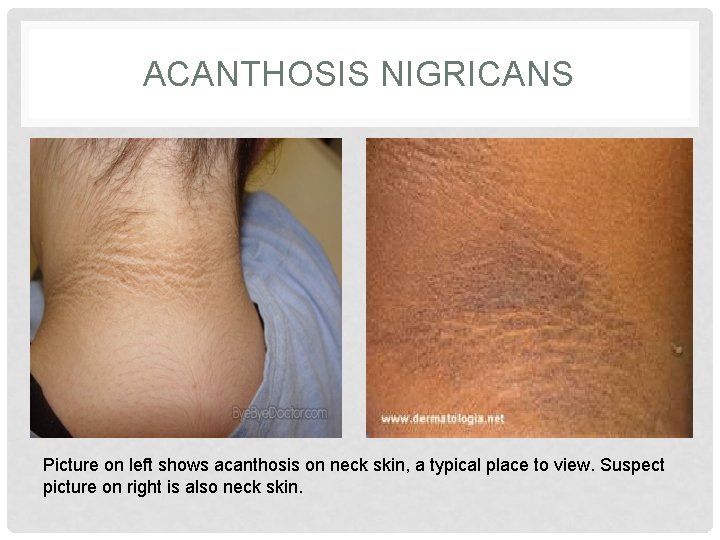
ACANTHOSIS NIGRICANS Picture on left shows acanthosis on neck skin, a typical place to view. Suspect picture on right is also neck skin.
BASIC TREATMENT OF TYPE 2 • Increased exercise • Weight loss • Even 7 -10% of body weight loss can be very helpful • Carbohydrate counting/ diet education • Carbs usually spread fairly evenly over day • Control of amounts/types of fats (to reduce cardiovascular complications) • Overriding goal: control blood sugars. Assessed by hemoglobin A 1 c (see next slide)
WHAT IS HEMOGLOBIN A 1 C? • Hemoglobin A 1 is one of the four chains of the hemoglobin molecule • When sugar elevates in the blood, some of the sugar attaches irreversibly to the hemoglobin protein • This process is dose related: the higher the blood sugar, the higher the A 1 c
HEMOGLOBIN A 1 C LEVELS • Person without diabetes: 5% or less • People with pre-diabetes will have a reading between 5. 7 and 6. 4 percent (my last test was 5. 9%) • Person with a reading of 6. 5 percent or higher will be diagnosed as having diabetes. • Measured no more often than every 3 months (why? What is the life span of the red blood cells that carry the hemoglobin? ) • A 1 c is an easily obtained SAMPLE of the glycation (sugar attachment to proteins) occurring all over the body
GESTATIONAL DIABETES (US) • Reported rates of gestational diabetes range from 2 to 10 percent of pregnancies. • Immediately after pregnancy, 5 to 10 percent of women with gestational diabetes are found to have diabetes, usually type 2. • Women who have had gestational diabetes have a 35 to 60 percent chance of developing diabetes in the next 10 – 20 years. • Using new diagnostic criteria, an international, multicenter study of gestational diabetes found that 18 percent of pregnancies were affected by gestational diabetes.
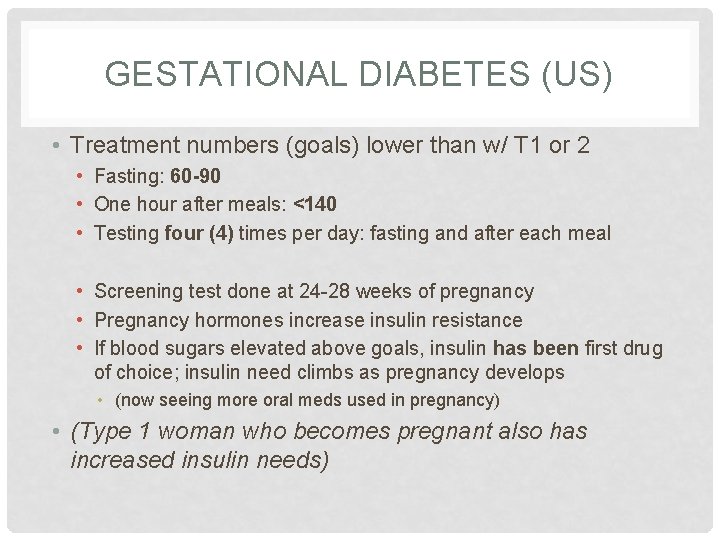
GESTATIONAL DIABETES (US) • Treatment numbers (goals) lower than w/ T 1 or 2 • Fasting: 60 -90 • One hour after meals: <140 • Testing four (4) times per day: fasting and after each meal • Screening test done at 24 -28 weeks of pregnancy • Pregnancy hormones increase insulin resistance • If blood sugars elevated above goals, insulin has been first drug of choice; insulin need climbs as pregnancy develops • (now seeing more oral meds used in pregnancy) • (Type 1 woman who becomes pregnant also has increased insulin needs)
GESTATIONAL DIABETES (US) • Nutritional treatment • Total carbohydrate percentage is lower (40 -45%) than for nongestational • Breakfast is restricted the most: 2 carb choices and a protein because …. • …Insulin resistance is greatest in the morning • Multiple smaller feedings are recommended: 3 meals and at least 2 snacks
HOW MANY IN US HAVE DM? • http: //www. cdc. gov/diabetes/pubs/estimates 11. htm • • _____% of people in US have diabetes (all ages) ____ million people are undiagnosed (all ages) (scroll down a bit) _____ % of people in US 65 years old or older have DM
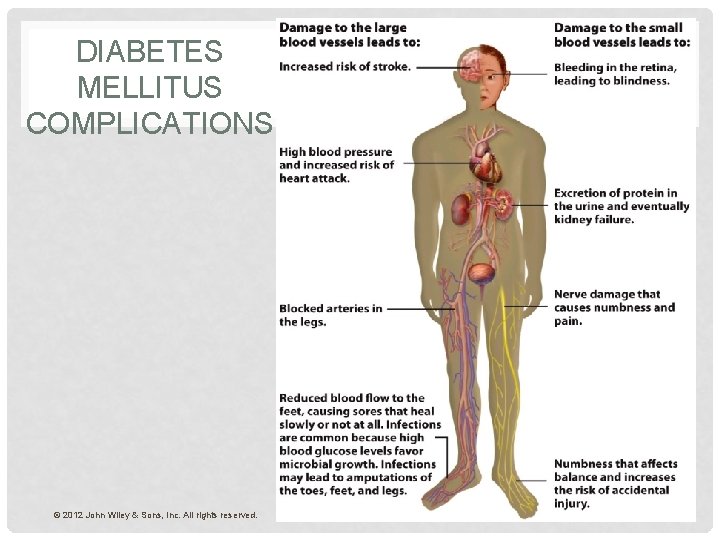
DIABETES MELLITUS COMPLICATIONS © 2012 John Wiley & Sons, Inc. All rights reserved.
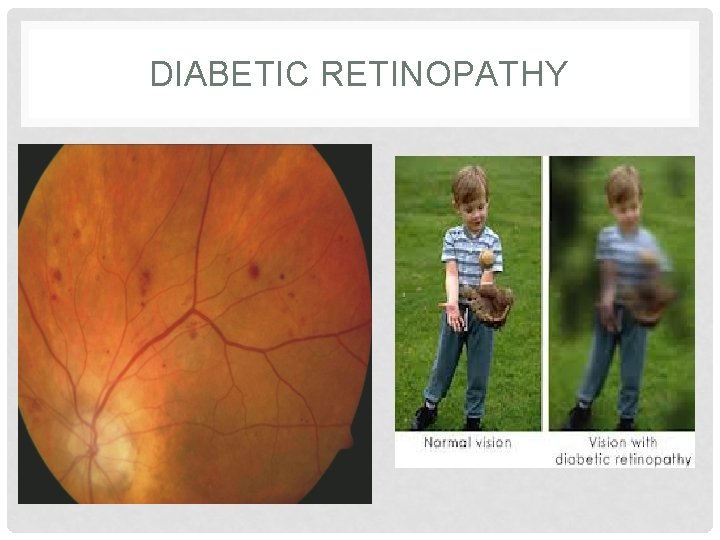
DIABETIC RETINOPATHY • How does DM cause retinopathy? • High blood sugars cause elevated A 1 c, “sticky” red blood cells (rbc) • Sticky rbc tend to stick together, causing clumps or clots • Vasculature in the eye is mostly very tiny and thin • Clump of cells gets stuck, pressure builds up behind clump, vessel blows out. • Cells downstream from blowout don’t get oxygenated blood and die • Dead cells don’t see, causing blank areas seen as black areas by patient
DIABETIC RETINOPATHY
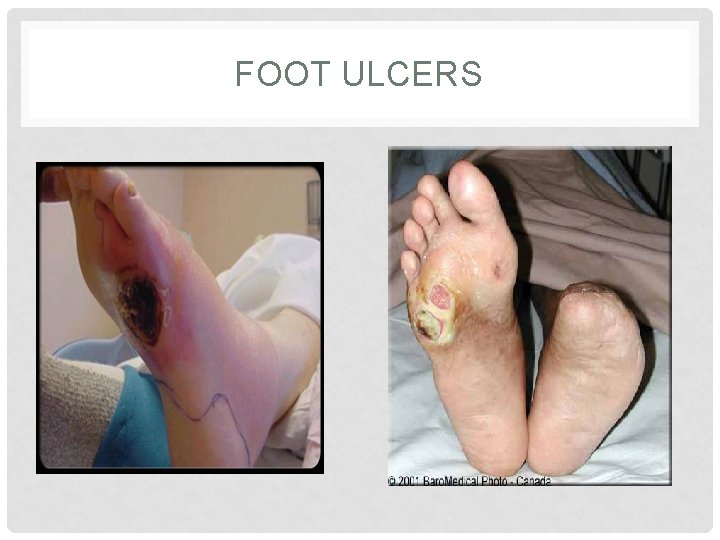
FOOT ULCERS • How does DM cause foot ulcers and amputations? • Elevated blood sugars encourage “sticky” rbc, AND the extra sugar in the blood (which should have gone into the cell but didn’t due to insulin resistance) is used to create more blood fats • The combination of the sticky rbc and higher blood fat levels encourages blockages in blood vessels feeding the feet • If a cut allows bacteria in, there is not enough blood flow to bring white blood cells to fight the infection, which gets worse • What started as a small cut becomes a large wound, sometimes treatable only by amputation
FOOT ULCERS
STATISTICS • Almost 26 million Americans have been diagnosed with diabetes • 57 million have pre-diabetes • 6 million are unaware and go untreated • Ranks 7 th on the leading causes of (premature) deaths in the US • For people with diabetes, the risk of heart disease and stroke is doubled • Leading cause of blindness (in US) • Leading cause of fatal kidney failure • Cost $132 billion/year for health care services
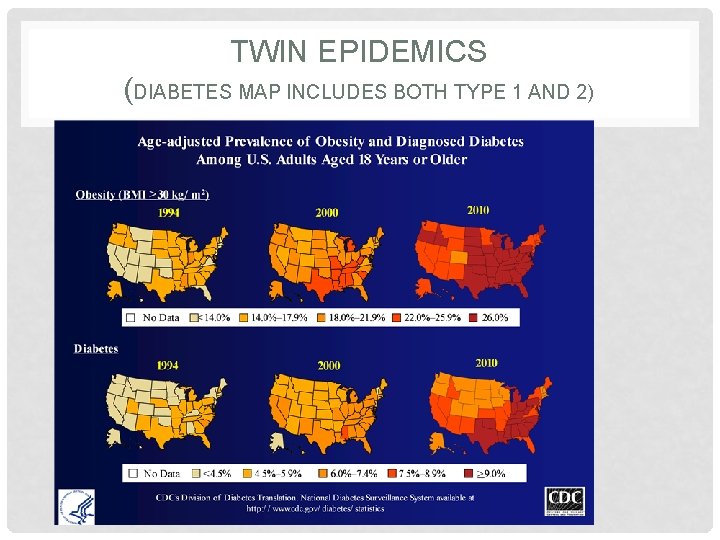
TWIN EPIDEMICS (DIABETES MAP INCLUDES BOTH TYPE 1 AND 2)
UPDATES OF ESTIMATES • In contrast to the 2007 National Diabetes Fact Sheet, which used fasting glucose data to estimate undiagnosed diabetes and pre-diabetes, the 2011 National Diabetes Fact Sheet uses both fasting glucose and hemoglobin A 1 c (A 1 c) levels to derive estimates for undiagnosed diabetes and prediabetes. These tests were chosen because they are most frequently used in clinical practice.
CONCEPT CHECK Which hormone is secreted when blood glucose is low? a) Insulin b) Glycogen c) Ketones d) Glucagon © 2012 John Wiley & Sons, Inc. All rights reserved.
DIABETES MELLITUS MANAGEMENT • Control blood sugar levels • • Limit carbohydrate intake Increase whole grains, decrease refined sugars Type I & some Type II patients need insulin injections Type II patients often take oral drugs • Exercise and weight loss in Type II helps prevent, reverse, and manage the disease • Low saturated fat, low trans fat, low cholesterol © 2012 John Wiley & Sons, Inc. All rights reserved.
WHAT ARE SIMILARITIES AND DIFFERENCES BETWEEN: • Insulin and glucagon? • Type I and Type II diabetes? © 2012 John Wiley & Sons, Inc. All rights reserved.
HYPOGLYCEMIA • Low blood sugar levels • Caused by: • Overmedication with insulin • Abnormal insulin or other hormone secretion or response • Fasting hypoglycemia: when a person has not eaten and blood sugar is <70 (or <60 if pregnant) • Reactive hypoglycemia: too much insulin response after a high-carbohydrate meal © 2012 John Wiley & Sons, Inc. All rights reserved.
VITAMIN D • Type 1 diabetes develops more often in winter than summer and is more common in places with cold climates. • Possible connection: There have been several studies linking low levels of vitamin D with higher risk for type 1 and 2 diabetes, but results are conflicting. • People with diabetes tend to have low levels of vitamin D circulating in their blood. • Current status: all those at risk of diabetes or with prediabetes should have serum D checked, and treated if too low (<30 ng/ml) • Example: (My last Vit D test was 38 ng/ml; not quite as high as desired, so I take supplemental D to support appropriate blood sugar functions)
EATING HEALTHIER WITH DIABETES • Very similar to eating healthy for anyone • Biggest difference is being knowledgeable about and controlling carbohydrates • Women: 3 -4 choices per meal • Men: 4 -5 choices pr meal • http: //www. diabetes. org/food-and-fitness/food/what-can-ieat/making-healthy-food-choices. html
- Slides: 33