
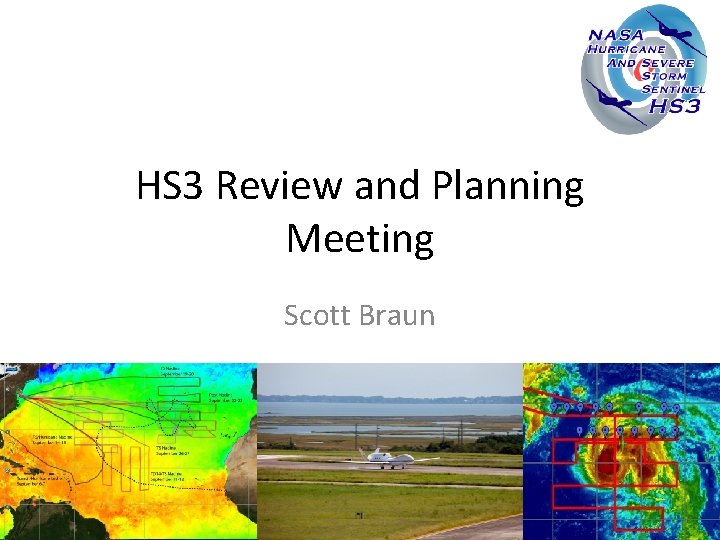
HS 3 Review and Planning Meeting Scott Braun
HS 3 Review and Planning Meeting Scott Braun
Goals of Meeting • Review 2012 campaign – Initial science results – Lessons learned • Prepare for 2013 campaign – Status of all instruments – Changes to aircraft operations for 2013 – Revised strategies based upon lessons learned and changes from 2012 operations – Changes to MTS – Deployment details
GH Status and Changes • Status (progress with pods, new instruments) • 2013 and 2014 schedule • Operational constraints (flight duration issues, turn-around time, hazard avoidance, other issues) • Fatigue management • Changes to the COA (if any)

Discussion on Wednesday • • Forecasting procedures Flight modules & planning Mission scientist’s roles and responsibilities Pay. MOF operations
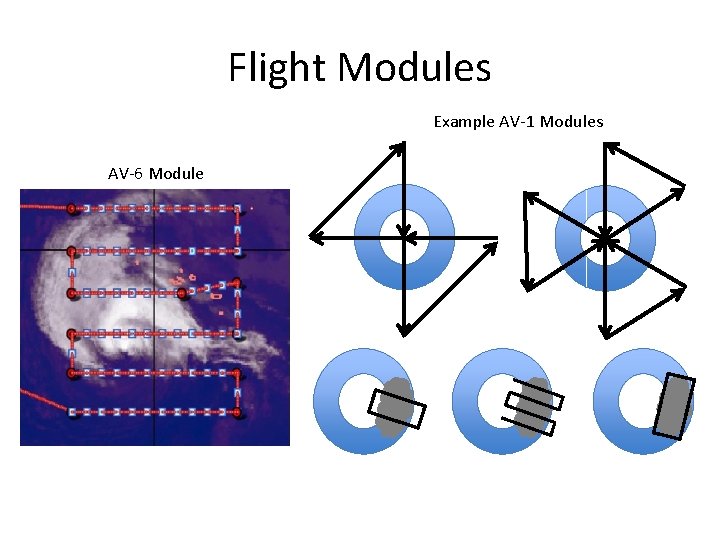
Flight Modules Example AV-1 Modules AV-6 Module
Review of Science Goals Environment: • What impact does the Saharan Air Layer (SAL) have on intensity change? • How do storms interact with shear produced by large-scale wind systems? In particular, how do horizontal and vertical variations in shear impact intensity change? • How does the outflow layer interact with the environment? Inner-core: • What is the role of deep convective towers (bursts) in intensity change? – Are they critical to intensification? – How does the low-level wind field respond to convective bursts? – How does the upper-level warm core depend on convective bursts? • How do intrusions of dry air impact intensity change? • What changes in storm structure occur prior to and during genesis and rapid intensification?
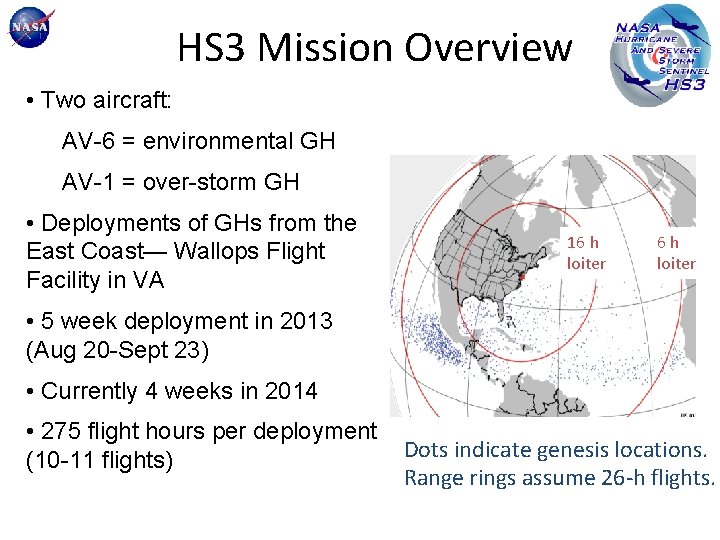
HS 3 Mission Overview • Two aircraft: AV-6 = environmental GH AV-1 = over-storm GH • Deployments of GHs from the East Coast— Wallops Flight Facility in VA 16 h loiter 6 h loiter • 5 week deployment in 2013 (Aug 20 -Sept 23) • Currently 4 weeks in 2014 • 275 flight hours per deployment (10 -11 flights) Dots indicate genesis locations. Range rings assume 26 -h flights.
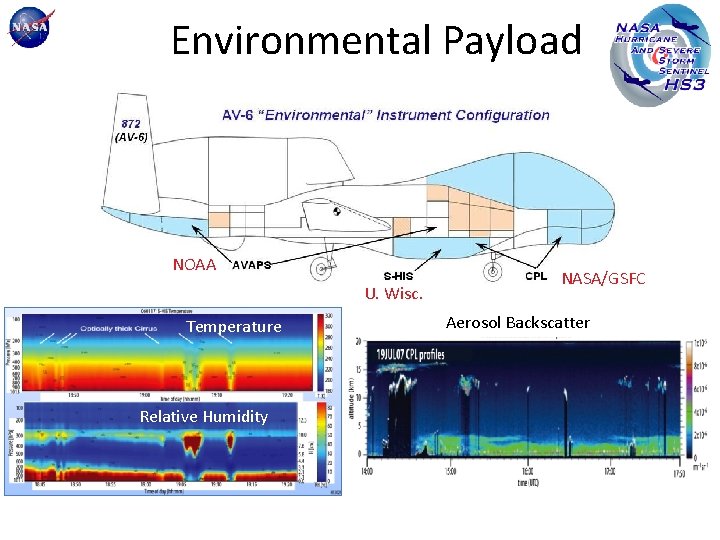
Environmental Payload NOAA U. Wisc. Temperature Relative Humidity NASA/GSFC Aerosol Backscatter
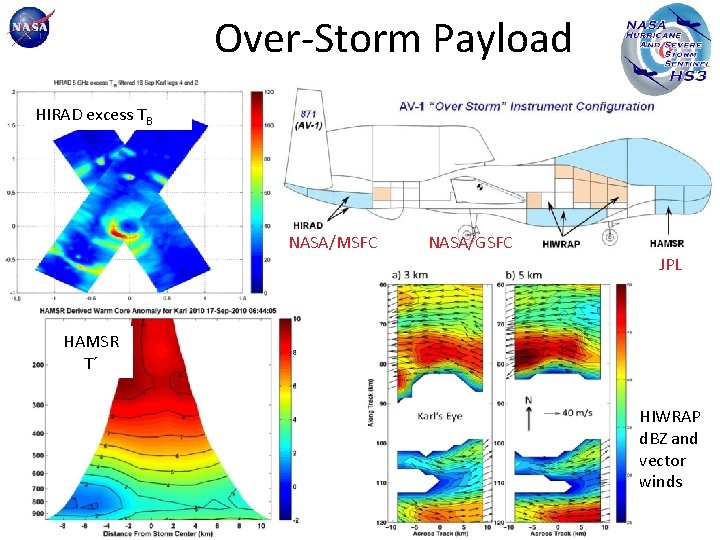
Over-Storm Payload HIRAD excess TB NASA/MSFC NASA/GSFC JPL HAMSR T´ HIWRAP d. BZ and vector winds
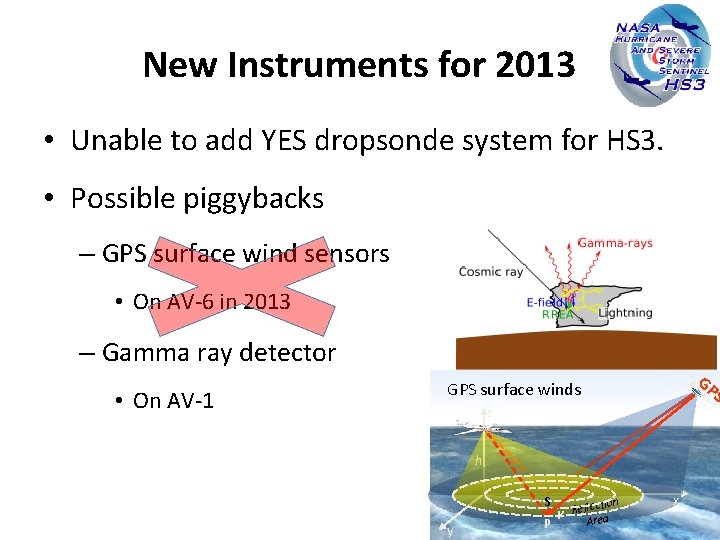
New Instruments for 2013 • Unable to add YES dropsonde system for HS 3. • Possible piggybacks – GPS surface wind sensors • On AV-6 in 2013 – Gamma ray detector • On AV-1 GP S GPS surface winds z h S y lection γ Ref a Are P x
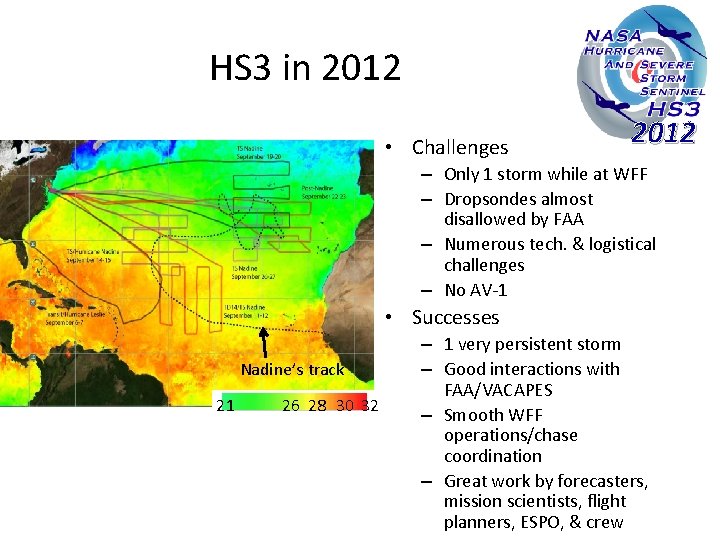
HS 3 in 2012 • Challenges 2012 – Only 1 storm while at WFF – Dropsondes almost disallowed by FAA – Numerous tech. & logistical challenges – No AV-1 • Successes Nadine’s track 21 26 28 30 32 – 1 very persistent storm – Good interactions with FAA/VACAPES – Smooth WFF operations/chase coordination – Great work by forecasters, mission scientists, flight planners, ESPO, & crew

AV-1 Prep for 2013 -2014 • AV-1 did not make the 2012 deployment due to aircraft issues • Test flight in Pacific on Nov. 5 -6 • In addition to HAMSR and HIWRAP, flying HIRAD for the first time OSCAT image from 00 UTC 6 November
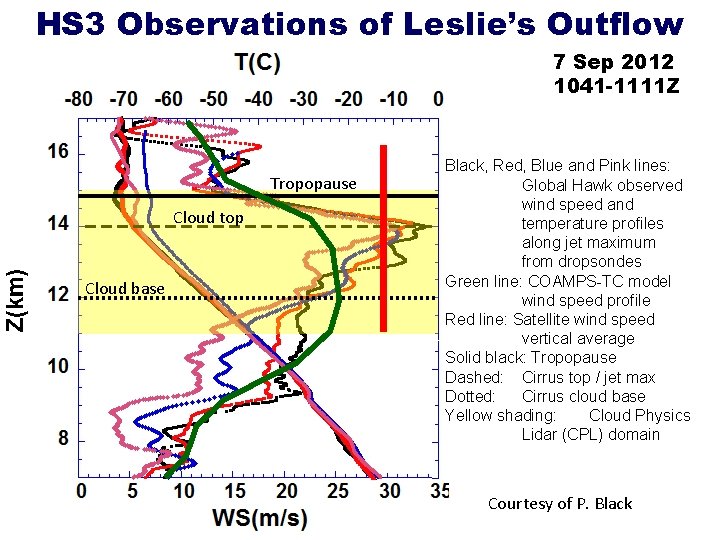
HS 3 Observations of Leslie’s Outflow 7 Sep 2012 1041 -1111 Z Tropopause Cloud top Cloud base Black, Red, Blue and Pink lines: Global Hawk observed wind speed and temperature profiles along jet maximum from dropsondes Green line: COAMPS-TC model wind speed profile Red line: Satellite wind speed vertical average Solid black: Tropopause Dashed: Cirrus top / jet max Dotted: Cirrus cloud base Yellow shading: Cloud Physics Lidar (CPL) domain Courtesy of P. Black
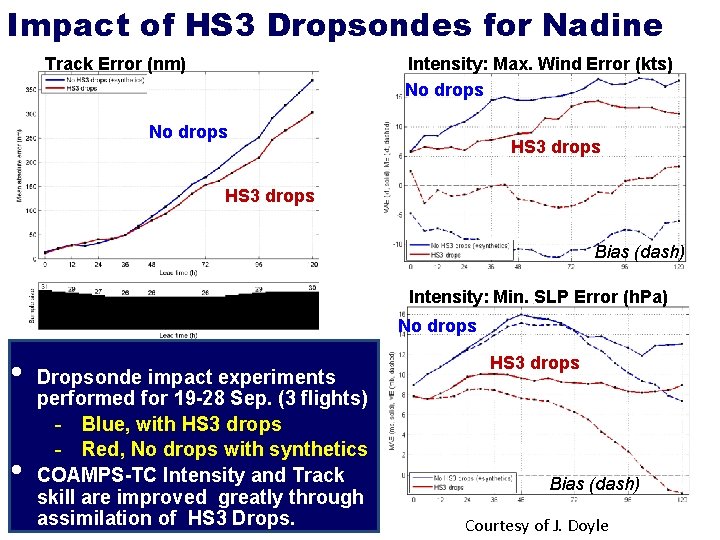
Impact of HS 3 Dropsondes for Nadine Track Error (nm) Intensity: Max. Wind Error (kts) No drops HS 3 drops Bias (dash) Intensity: Min. SLP Error (h. Pa) No drops • • Dropsonde impact experiments performed for 19 -28 Sep. (3 flights) - Blue, with HS 3 drops - Red, No drops with synthetics COAMPS-TC Intensity and Track skill are improved greatly through assimilation of HS 3 Drops. HS 3 drops Bias (dash) Courtesy of J. Doyle
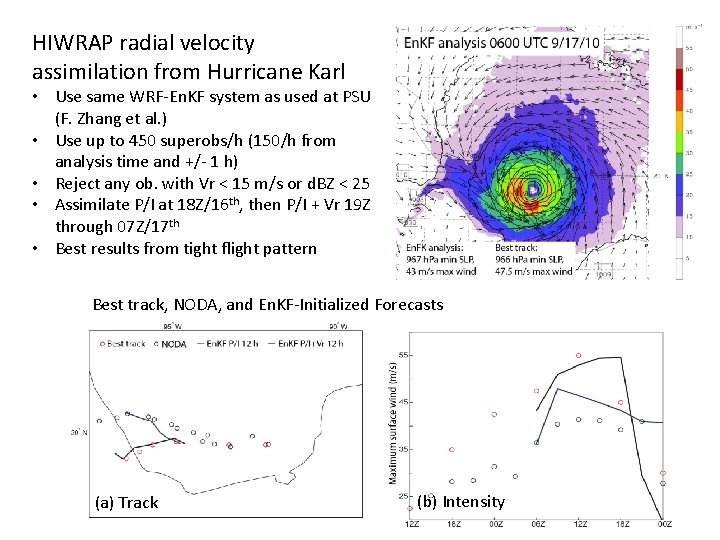
HIWRAP radial velocity assimilation from Hurricane Karl • Use same WRF-En. KF system as used at PSU (F. Zhang et al. ) • Use up to 450 superobs/h (150/h from analysis time and +/- 1 h) • Reject any ob. with Vr < 15 m/s or d. BZ < 25 • Assimilate P/I at 18 Z/16 th, then P/I + Vr 19 Z through 07 Z/17 th • Best results from tight flight pattern Best track, NODA, and En. KF-Initialized Forecasts (a) Track (b) Intensity
- Slides: 15