
HRM Practices in Nepal Chhabindra Parajuli Joint Secretary
HRM Practices in Nepal Chhabindra Parajuli Joint Secretary Government of Nepal 1 prepared by chhabindra parajuli
Coverage of this class � Introduction � Concept � Evolution of HRM � Characteristics � Objectives of HRM � HRM System 2 prepared by chhabindra parajuli
Contd. . . �Scope of HRM �Why HRM is different than PA? �Outcomes of HRM System �Challenges of HRM �HRM Practices in Nepal 3 prepared by chhabindra parajuli
What is HRM? �Management of only living resources in an organization, �HR matters for the efficient management of other resources like Organizational platform and process, financial and physical property Informational Network and Organizational Image, �HR is independent variable and others are entirely dependent to HR, �HR can appreciate the ‘‘Organizational Code of 4 Ethics’’, prepared by chhabindra parajuli
Conceptual Definitions � HRM is only concerned with the R to R activities – Traditional Approach; � HRM is emphasised now Pre R to Post R entire activities – Recent Approach; � Karmachari Prasason (Ka. Pra. ) – Traditional Approach still practices in Nepalese Government administration system; � Some P. Es. practices HRM Sections; � The concept of Ka. Pra. Is very arrow approach; 5 prepared by chhabindra parajuli
Contd. . . �HRM is a process consisting of the acquisition, development, motivation and maintenance of human resources. � Robbins 6 prepared by chhabindra parajuli Decenzo and
Evolution of HRM �First Stage- Welfare Management(WM)- in between 1900 onwards to before 1940; �Second Stage- Personnel Management (Ka. Pra. ) - in between 1940 s to before 1980 s; �Third Stage- Human Resource Management(HRM)-in 1980 s; �Fourth Stage- Strategic HRM(SHRM)- 1980 s onwards till date; 7 prepared by chhabindra parajuli
Characteristics of HRM � Employees around and centred; �Managing people concept; �Employees development concerned; �Exist in all organizations; �Changing concept; �Dynamic process; �Social and Cultural influenced; �Emotional aspect; �Strategically focused; 8 prepared by chhabindra parajuli
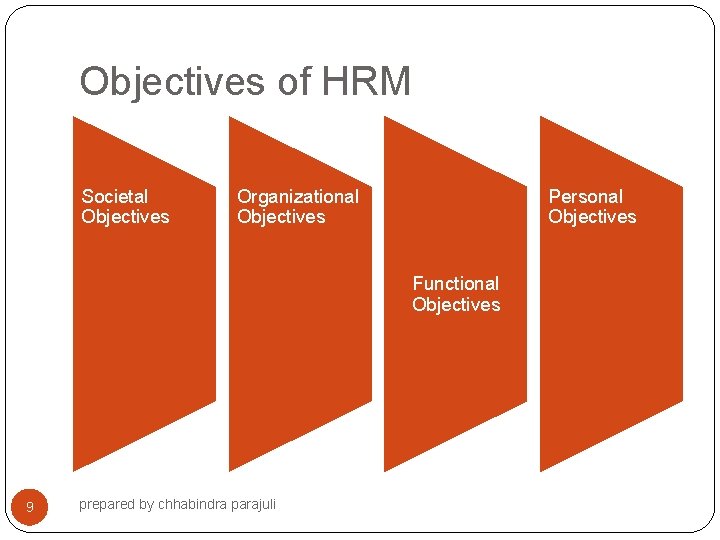
Objectives of HRM Societal Objectives Organizational Objectives Personal Objectives Functional Objectives 9 prepared by chhabindra parajuli
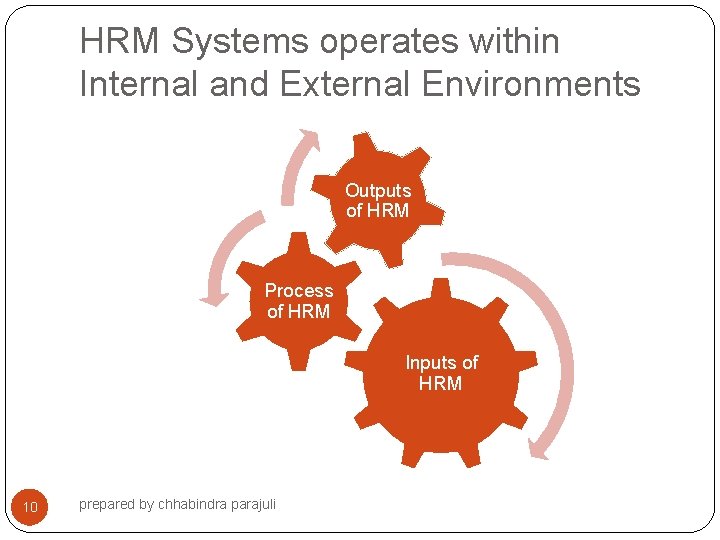
HRM Systems operates within Internal and External Environments Outputs of HRM Process of HRM Inputs of HRM 10 prepared by chhabindra parajuli
Scope of HRM �Training and Development; �Organizational Development; �Organization design and redesign; �HR Planning; �Selection and staffing; �Personnel development and motivation; �Compensation management; �Employees welfare and support; �Trade Union relation maximization; 11 prepared by chhabindra parajuli
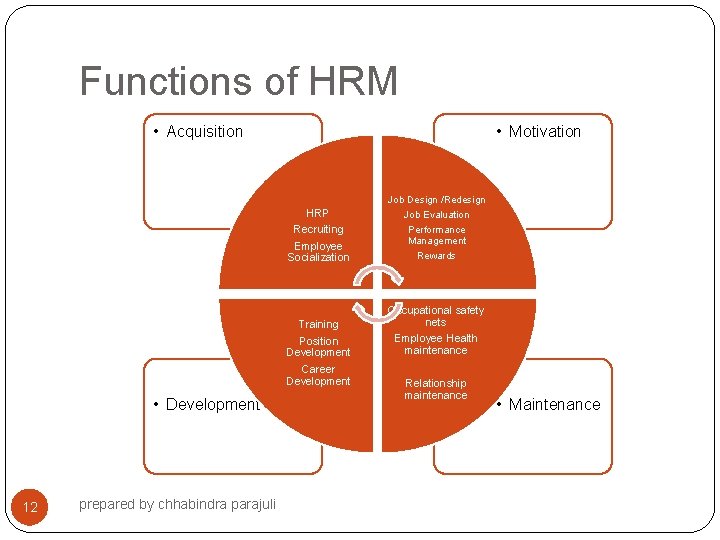
Functions of HRM • Acquisition • Motivation HRP Recruiting Employee Socialization Training Position Development Career Development • Development 12 prepared by chhabindra parajuli Job Design /Redesign Job Evaluation Performance Management Rewards Occupational safety nets Employee Health maintenance Relationship maintenance • Maintenance
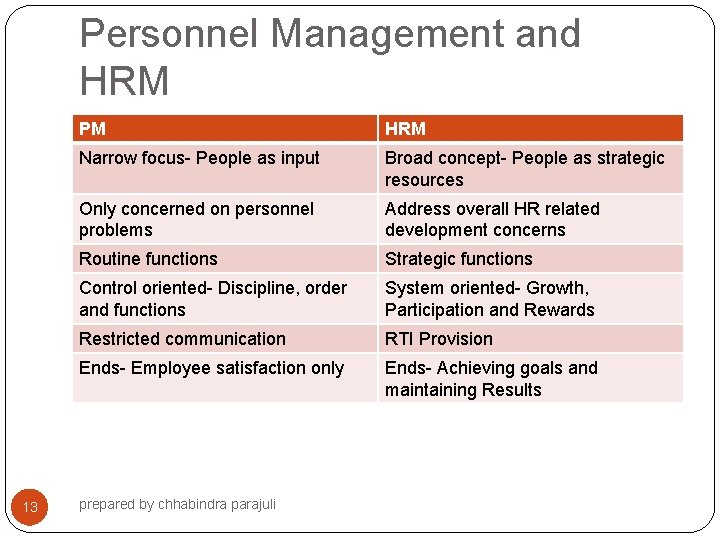
Personnel Management and HRM 13 PM HRM Narrow focus- People as input Broad concept- People as strategic resources Only concerned on personnel problems Address overall HR related development concerns Routine functions Strategic functions Control oriented- Discipline, order and functions System oriented- Growth, Participation and Rewards Restricted communication RTI Provision Ends- Employee satisfaction only Ends- Achieving goals and maintaining Results prepared by chhabindra parajuli
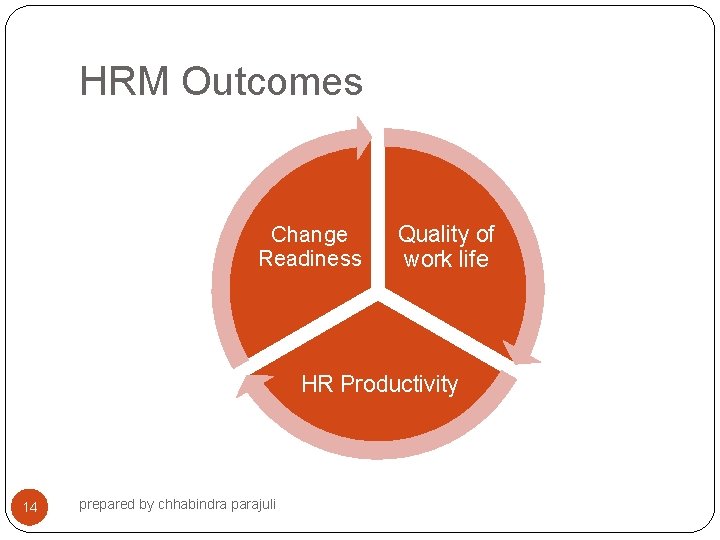
HRM Outcomes Change Readiness Quality of work life HR Productivity 14 prepared by chhabindra parajuli
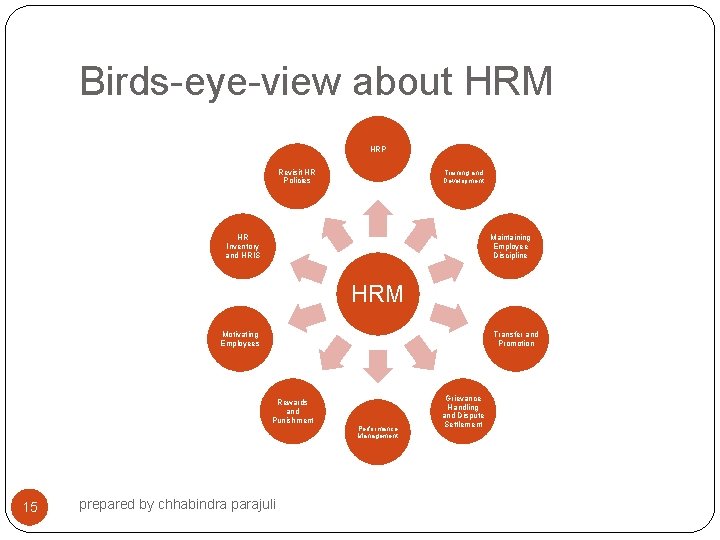
Birds-eye-view about HRM HRP Revisit HR Policies Training and Development Maintaining Employee Discipline HR Inventory and HRIS HRM Motivating Employees Transfer and Promotion Rewards and Punishment Performance Management 15 prepared by chhabindra parajuli Grievance Handling and Dispute Settlement
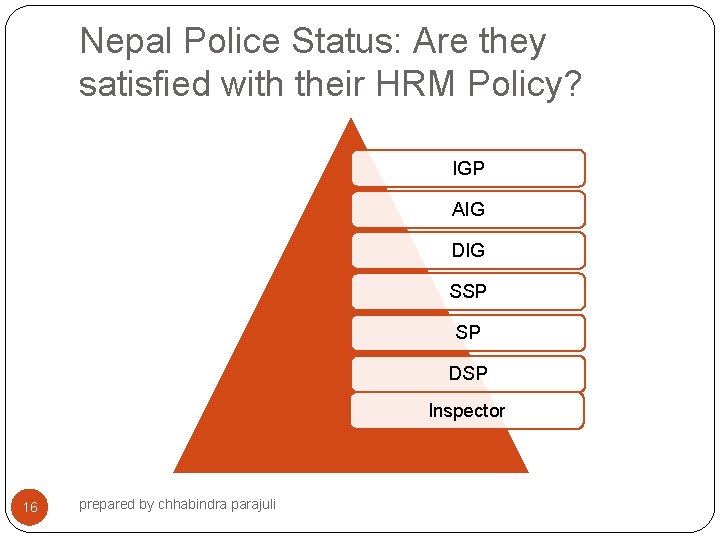
Nepal Police Status: Are they satisfied with their HRM Policy? IGP AIG DIG SSP SP DSP Inspector 16 prepared by chhabindra parajuli
HRM Policy – Nepal Organizations �Retirement policy at Nepal Police- Service period 30 years / Age / Post based fixed tenure. Result. Overall unsatisfied ; �Case of Promotion-( Unsatisfied) DIG Ramesh Kharel and Late DIG Nawaraj Silwal; �Nepal Rastra Bank Case- Service period 30 years and age bar( 58 years)- Still Debated; �Civil Service case- Retirement age 58 or 60? 17 prepared by chhabindra parajuli
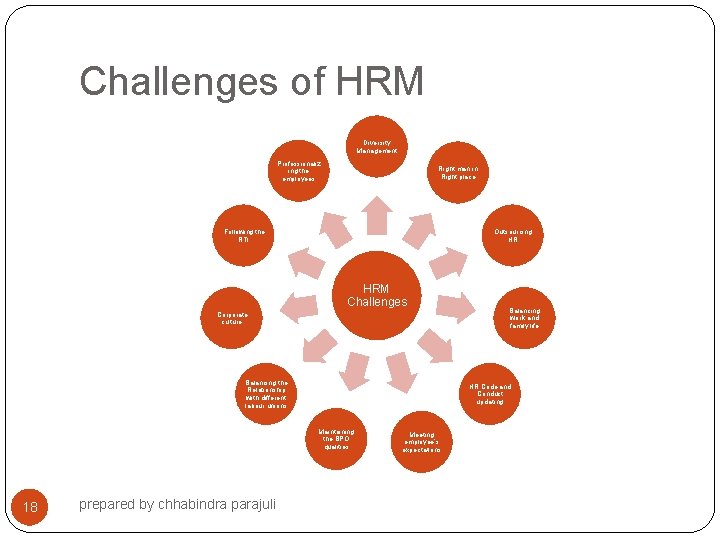
Challenges of HRM Diversity Management Professionaliz ing the employees Right man in Right place Following the RTI Outsourcing HR HRM Challenges Corporate culture Balancing the Relationship with different labour unions HR Code and Conduct updating Maintaining the BPO qualities 18 prepared by chhabindra parajuli Balancing work and family life Meeting employee’s expectations
HRM Practices in Nepal �HRM Practices in Nepal Go. N: Single Civil Service Act and Regulation; �HRM in Nepalese P Es : Separate HRM policies for different P Es; �HRM in Private sectors: Pre- R to Post R Policies; e. g Khetan Group, Private commercial Bank and other corporate houses; 19 prepared by chhabindra parajuli
Conclusion �Retired should be replaced by Re-change tyre ; �HR should be utilized as human capital interest by the organizations as interest earning of the fixed capital by the customer; �Organization specific HR Policy is essential; �Dynamic HRM is the need of today; 20 prepared by chhabindra parajuli
Group work Exercise �Suppose you are recently appointed as the 21 Under secretary position of the Government of Nepal and your posting is fixed at the Ministry of Federal affairs and General Administration and you started your duties at the HRM Section chief. If the secretary of this ministry asked you to prepare a model draft of HRM Policy in order to address the current challenges of the Nepalese Public sector organizations, what are the major issues to be included in your draft? Prepare individual draft first and discuss this draft within the group members and produce one draft for the prepared by chhabindra parajuli group.
�Thank you for your kind attention. 22 prepared by chhabindra parajuli
- Slides: 22