
HR Metrics Speaking the Language of Your CFO

- Slides: 32
HR Metrics: Speaking the Language of Your CFO HR. com Presentation December 12, 2011 Presented by: Robert J. Buckley, MBA RO Buckley Consulting
Agenda l l Why Are We Here? Characteristics of High Credibility HR Metrics Generic Examples Case Studies l l Recruiting Metrics Benefits Metrics The Future of HR Metrics Q&A Compensation Tie-In
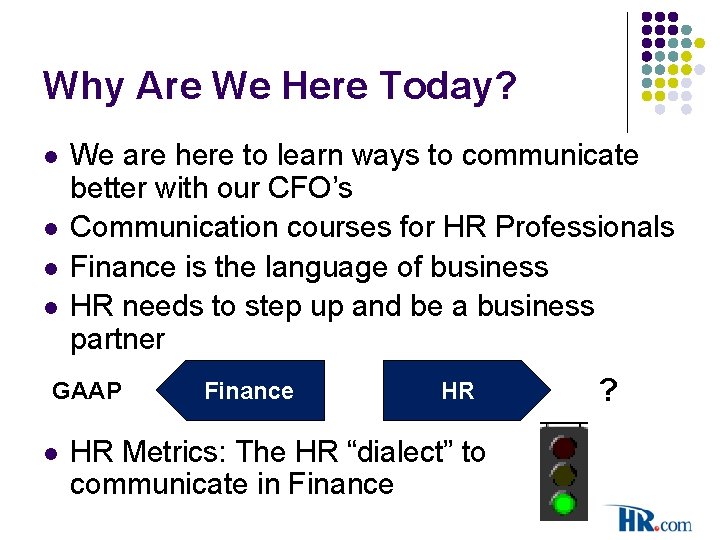
Why Are We Here Today? l l We are here to learn ways to communicate better with our CFO’s Communication courses for HR Professionals Finance is the language of business HR needs to step up and be a business partner GAAP l Finance HR HR Metrics: The HR “dialect” to communicate in Finance ?
Characteristics of Quality HR Metrics l l Accurate Consistently engineered l l l There are no GAAP or FASB Rules for HR Metrics Fully integrated into the business Driven by business strategy Impact measured in $dollars (Finance) Enabled by technology The level of HR metric used is driven by the needs of both client and provider
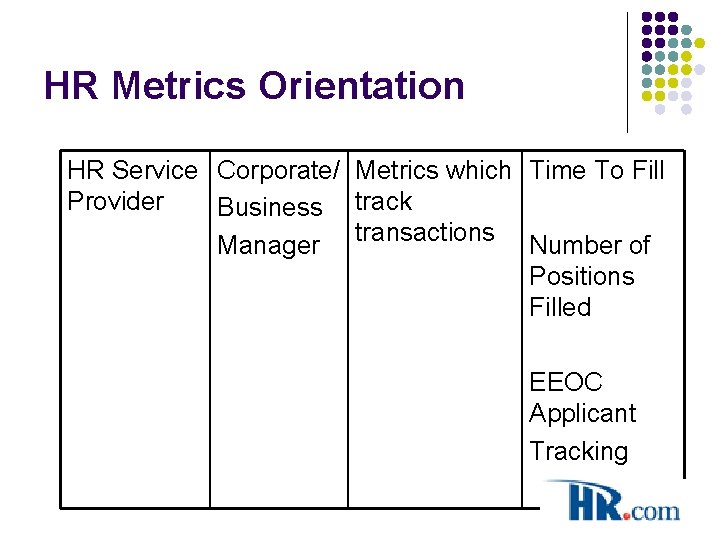
HR Metrics Orientation HR Service Corporate/ Metrics which Time To Fill Provider Business track Manager transactions Number of Positions Filled EEOC Applicant Tracking
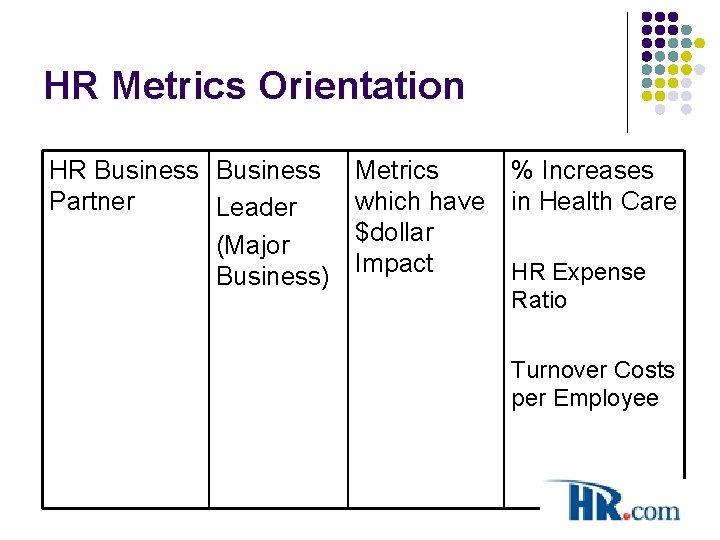
HR Metrics Orientation HR Business Partner Leader (Major Business) Metrics % Increases which have in Health Care $dollar Impact HR Expense Ratio Turnover Costs per Employee
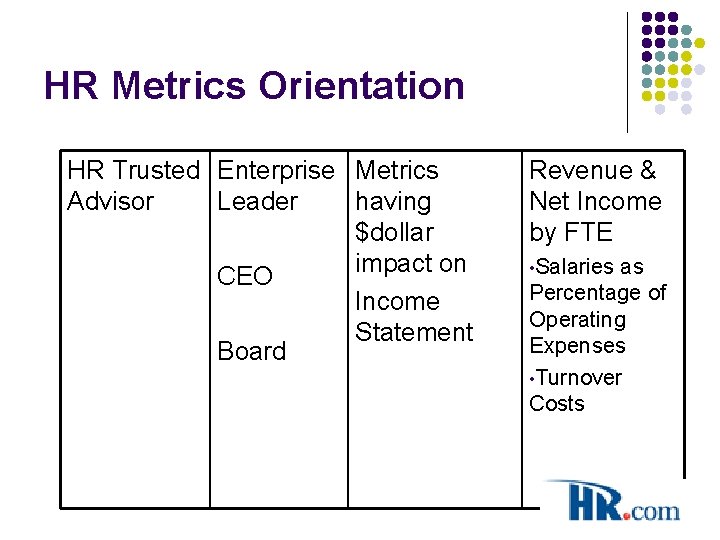
HR Metrics Orientation HR Trusted Enterprise Metrics Advisor Leader having $dollar impact on CEO Income Statement Board Revenue & Net Income by FTE • Salaries as Percentage of Operating Expenses • Turnover Costs
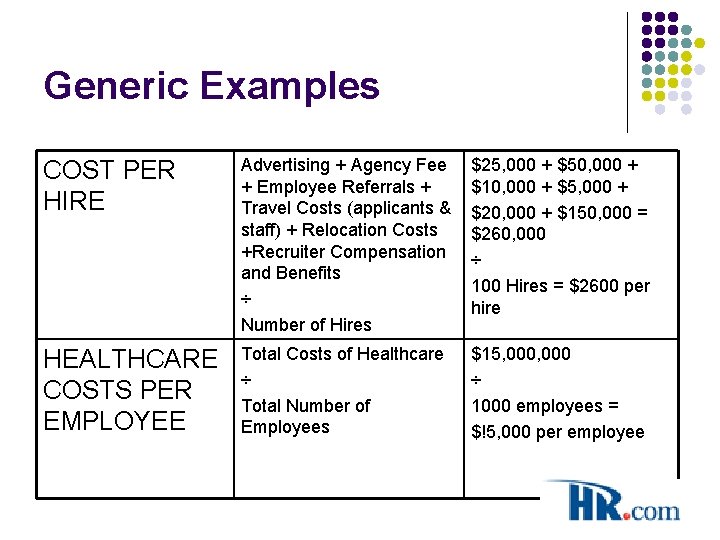
Generic Examples COST PER HIRE Advertising + Agency Fee + Employee Referrals + Travel Costs (applicants & staff) + Relocation Costs +Recruiter Compensation and Benefits ÷ Number of Hires $25, 000 + $50, 000 + $10, 000 + $5, 000 + $20, 000 + $150, 000 = $260, 000 ÷ 100 Hires = $2600 per hire HEALTHCARE COSTS PER EMPLOYEE Total Costs of Healthcare ÷ Total Number of Employees $15, 000 ÷ 1000 employees = $!5, 000 per employee
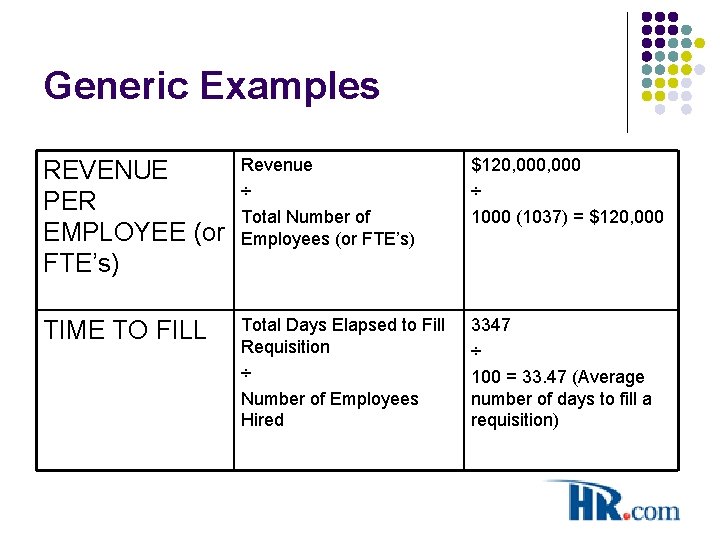
Generic Examples REVENUE PER EMPLOYEE (or FTE’s) Revenue ÷ Total Number of Employees (or FTE’s) $120, 000 ÷ 1000 (1037) = $120, 000 TIME TO FILL Total Days Elapsed to Fill Requisition ÷ Number of Employees Hired 3347 ÷ 100 = 33. 47 (Average number of days to fill a requisition)
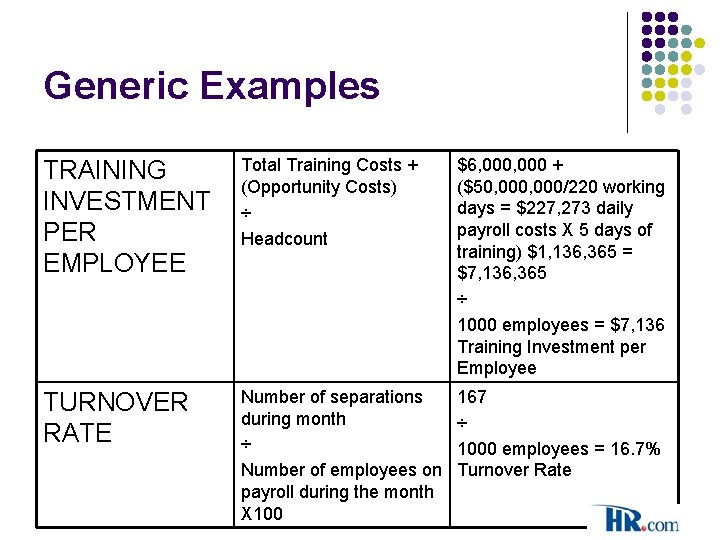
Generic Examples TRAINING INVESTMENT PER EMPLOYEE Total Training Costs + (Opportunity Costs) ÷ Headcount $6, 000 + ($50, 000/220 working days = $227, 273 daily payroll costs X 5 days of training) $1, 136, 365 = $7, 136, 365 ÷ 1000 employees = $7, 136 Training Investment per Employee TURNOVER RATE Number of separations during month ÷ Number of employees on payroll during the month X 100 167 ÷ 1000 employees = 16. 7% Turnover Rate
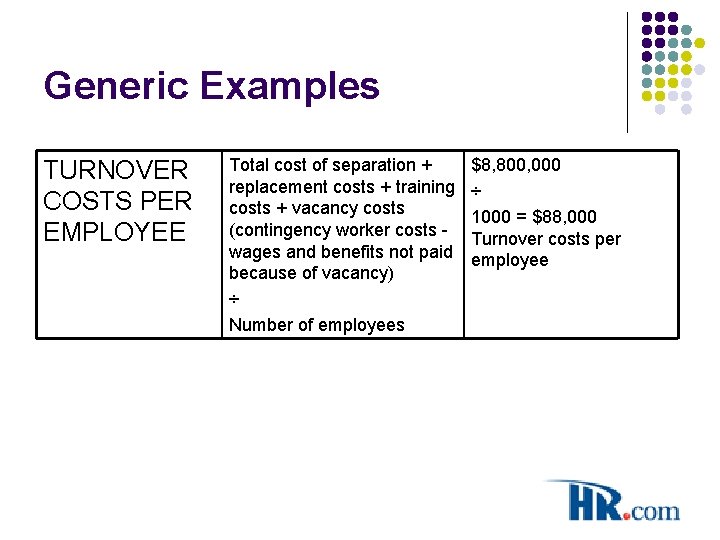
Generic Examples TURNOVER COSTS PER EMPLOYEE Total cost of separation + replacement costs + training costs + vacancy costs (contingency worker costs wages and benefits not paid because of vacancy) ÷ Number of employees $8, 800, 000 ÷ 1000 = $88, 000 Turnover costs per employee
Recruiting Metrics Case Study
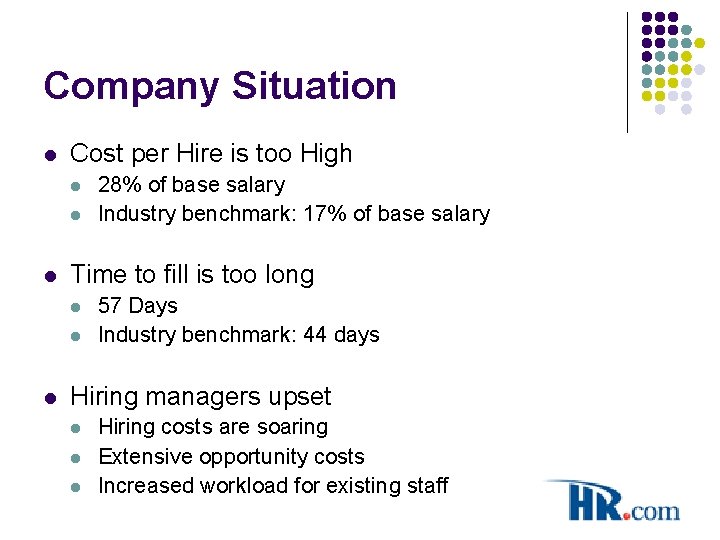
Company Situation l Cost per Hire is too High l l l Time to fill is too long l l l 28% of base salary Industry benchmark: 17% of base salary 57 Days Industry benchmark: 44 days Hiring managers upset l l l Hiring costs are soaring Extensive opportunity costs Increased workload for existing staff
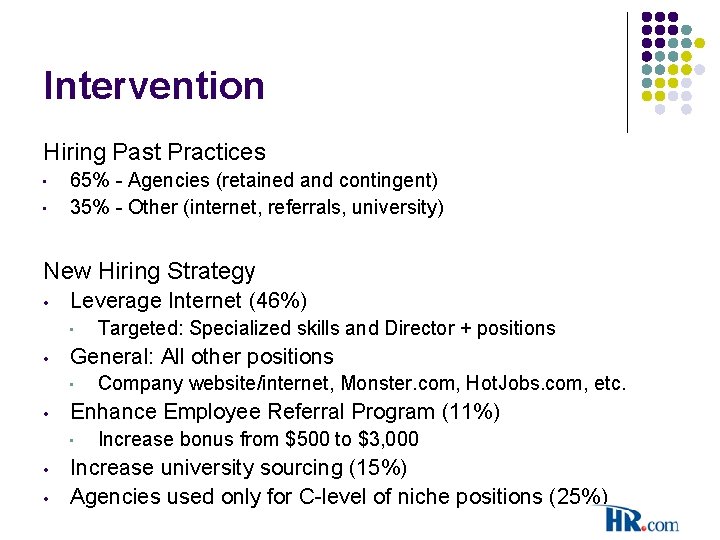
Intervention Hiring Past Practices • • 65% - Agencies (retained and contingent) 35% - Other (internet, referrals, university) New Hiring Strategy • Leverage Internet (46%) • • General: All other positions • • • Company website/internet, Monster. com, Hot. Jobs. com, etc. Enhance Employee Referral Program (11%) • • Targeted: Specialized skills and Director + positions Increase bonus from $500 to $3, 000 Increase university sourcing (15%) Agencies used only for C-level of niche positions (25%)
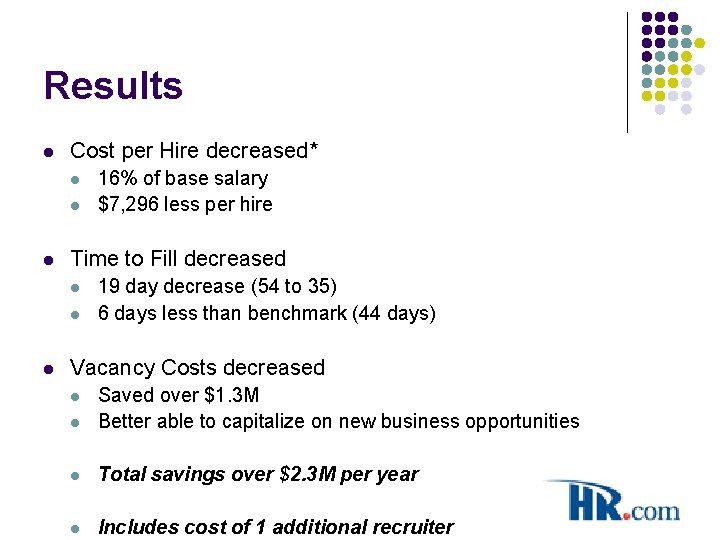
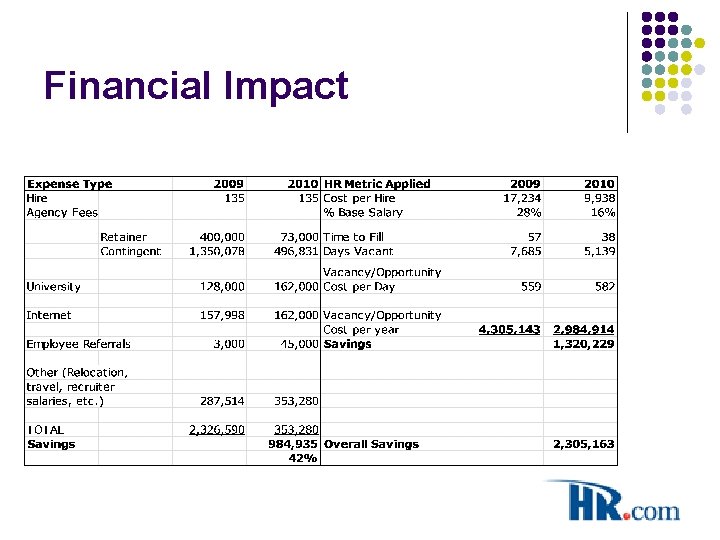
Results l Cost per Hire decreased* l l l Time to Fill decreased l l l 16% of base salary $7, 296 less per hire 19 day decrease (54 to 35) 6 days less than benchmark (44 days) Vacancy Costs decreased l Saved over $1. 3 M Better able to capitalize on new business opportunities l Total savings over $2. 3 M per year l Includes cost of 1 additional recruiter l
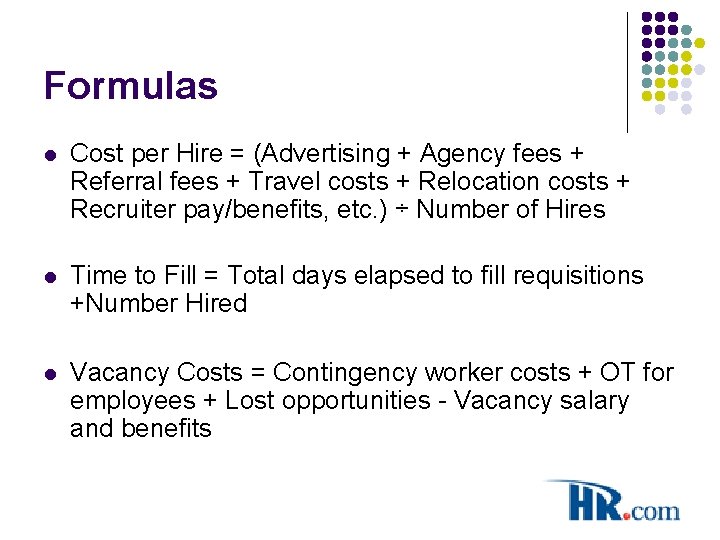
Formulas l Cost per Hire = (Advertising + Agency fees + Referral fees + Travel costs + Relocation costs + Recruiter pay/benefits, etc. ) ÷ Number of Hires l Time to Fill = Total days elapsed to fill requisitions +Number Hired l Vacancy Costs = Contingency worker costs + OT for employees + Lost opportunities - Vacancy salary and benefits
Financial Impact
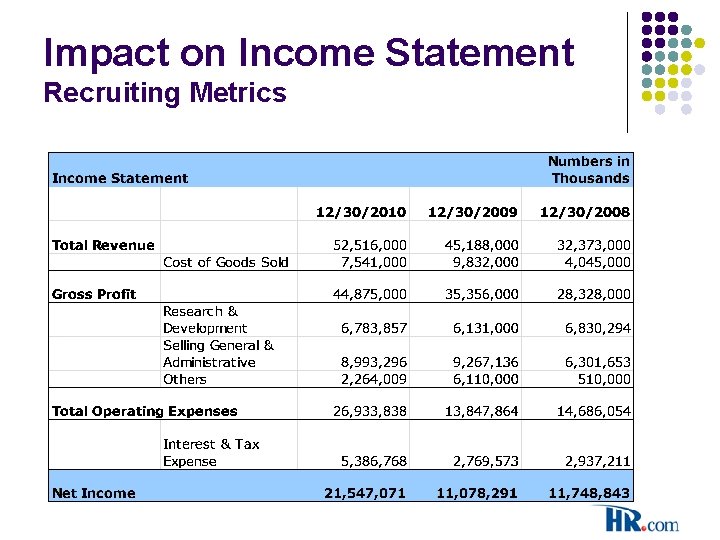
Impact on Income Statement Recruiting Metrics
Benefits Metrics Case Study
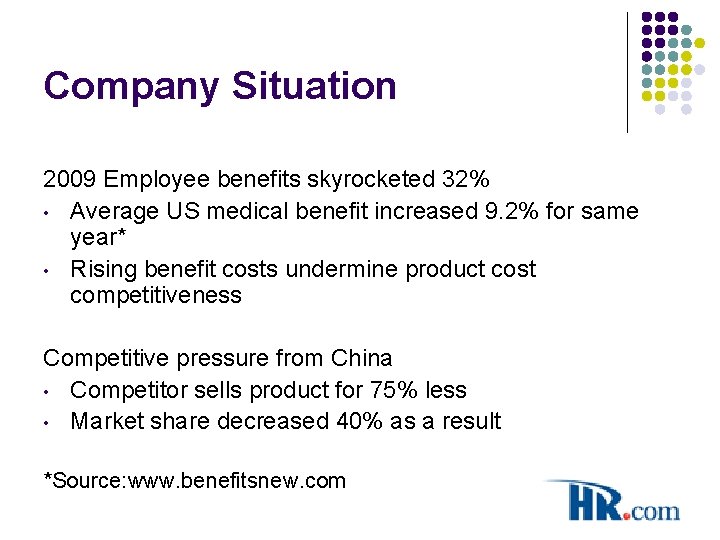
Company Situation 2009 Employee benefits skyrocketed 32% • Average US medical benefit increased 9. 2% for same year* • Rising benefit costs undermine product cost competitiveness Competitive pressure from China • Competitor sells product for 75% less • Market share decreased 40% as a result *Source: www. benefitsnew. com
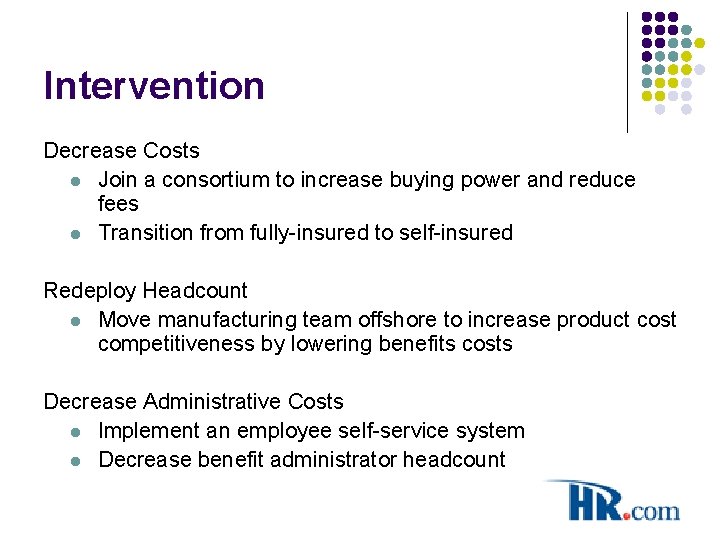
Intervention Decrease Costs l Join a consortium to increase buying power and reduce fees l Transition from fully-insured to self-insured Redeploy Headcount l Move manufacturing team offshore to increase product cost competitiveness by lowering benefits costs Decrease Administrative Costs l Implement an employee self-service system l Decrease benefit administrator headcount
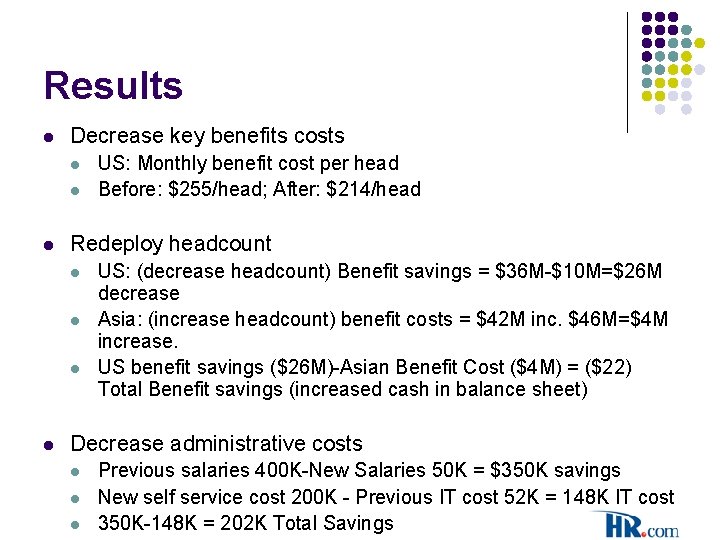
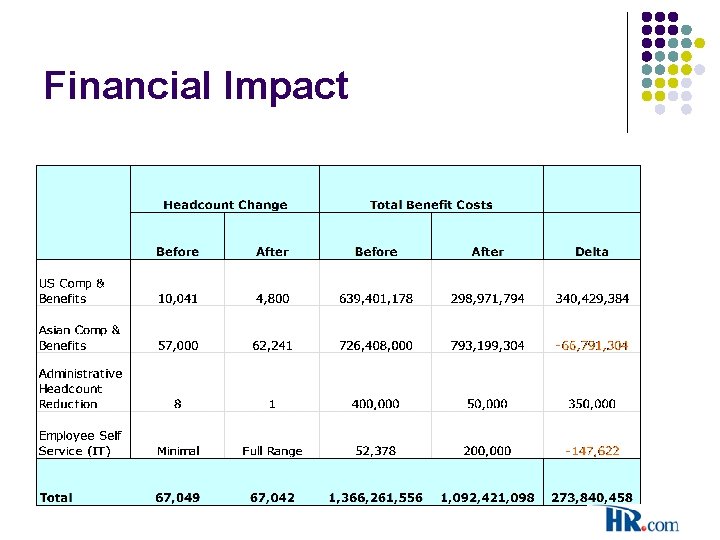
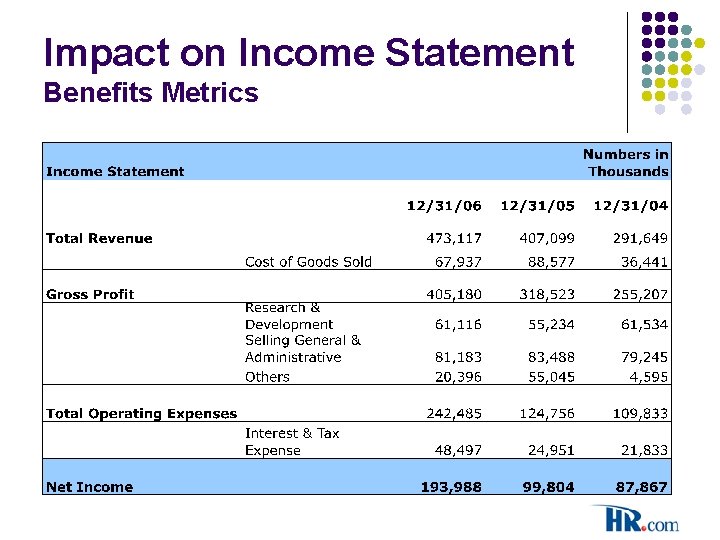
Results l Decrease key benefits costs l l l Redeploy headcount l l US: Monthly benefit cost per head Before: $255/head; After: $214/head US: (decrease headcount) Benefit savings = $36 M-$10 M=$26 M decrease Asia: (increase headcount) benefit costs = $42 M inc. $46 M=$4 M increase. US benefit savings ($26 M)-Asian Benefit Cost ($4 M) = ($22) Total Benefit savings (increased cash in balance sheet) Decrease administrative costs l l l Previous salaries 400 K-New Salaries 50 K = $350 K savings New self service cost 200 K - Previous IT cost 52 K = 148 K IT cost 350 K-148 K = 202 K Total Savings
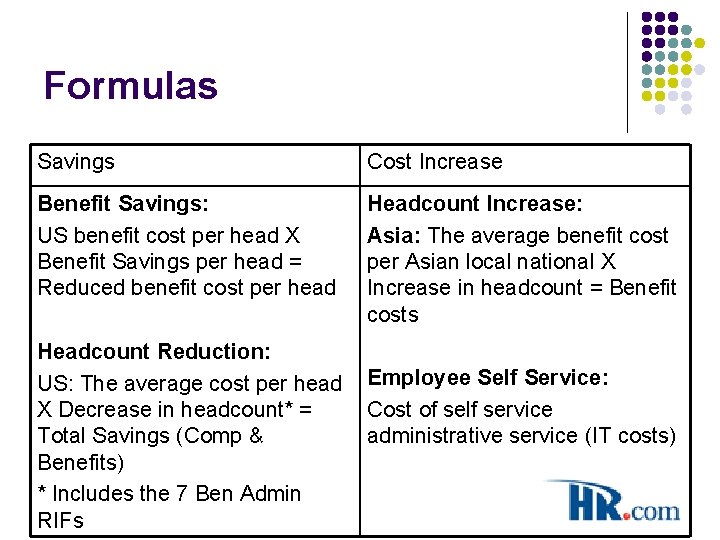
Formulas Savings Cost Increase Benefit Savings: US benefit cost per head X Benefit Savings per head = Reduced benefit cost per head Headcount Increase: Asia: The average benefit cost per Asian local national X Increase in headcount = Benefit costs Headcount Reduction: US: The average cost per head X Decrease in headcount* = Total Savings (Comp & Benefits) * Includes the 7 Ben Admin RIFs Employee Self Service: Cost of self service administrative service (IT costs)
Financial Impact
Impact on Income Statement Benefits Metrics
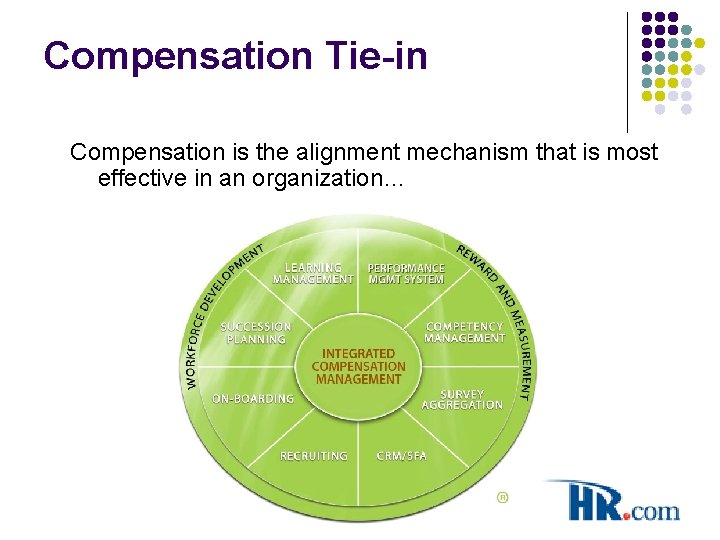
Compensation Tie-in Compensation is the alignment mechanism that is most effective in an organization…
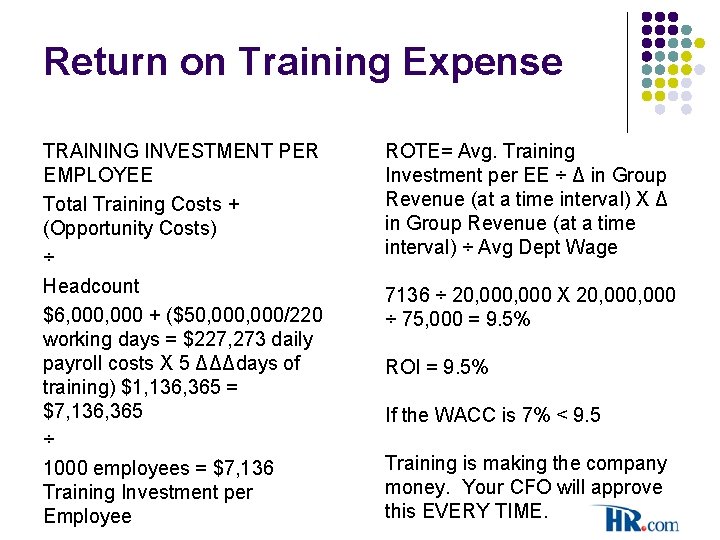
Return on Training Expense TRAINING INVESTMENT PER EMPLOYEE Total Training Costs + (Opportunity Costs) ÷ Headcount $6, 000 + ($50, 000/220 working days = $227, 273 daily payroll costs X 5 ΔΔΔdays of training) $1, 136, 365 = $7, 136, 365 ÷ 1000 employees = $7, 136 Training Investment per Employee ROTE= Avg. Training Investment per EE ÷ Δ in Group Revenue (at a time interval) X Δ in Group Revenue (at a time interval) ÷ Avg Dept Wage 7136 ÷ 20, 000 X 20, 000 ÷ 75, 000 = 9. 5% ROI = 9. 5% If the WACC is 7% < 9. 5 Training is making the company money. Your CFO will approve this EVERY TIME.
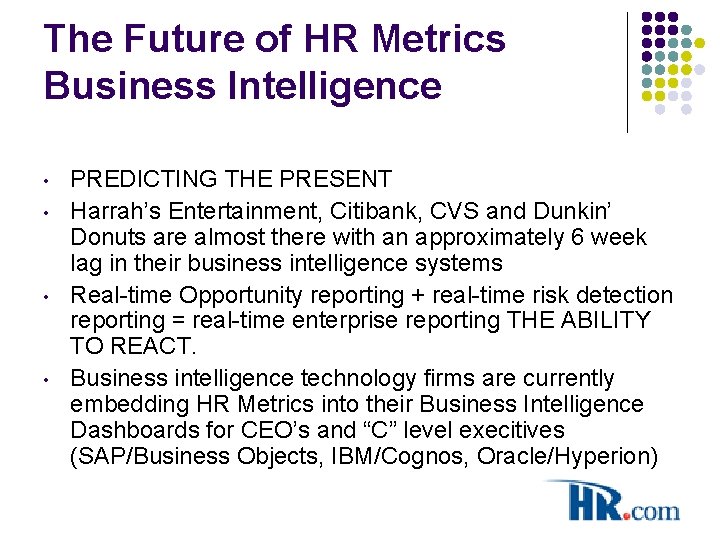
The Future of HR Metrics Business Intelligence • • PREDICTING THE PRESENT Harrah’s Entertainment, Citibank, CVS and Dunkin’ Donuts are almost there with an approximately 6 week lag in their business intelligence systems Real-time Opportunity reporting + real-time risk detection reporting = real-time enterprise reporting THE ABILITY TO REACT. Business intelligence technology firms are currently embedding HR Metrics into their Business Intelligence Dashboards for CEO’s and “C” level execitives (SAP/Business Objects, IBM/Cognos, Oracle/Hyperion)
The Future of HR Metrics Business Intelligence • Do you really want to have technology and finance experts construct the metrics that HR will be judged by? The time to become involved in HR Metrics is NOW! • Success stories for HR Metrics • William Clay Ford (Ford) includes the success rate of HR in recruiting and retaining high performing salespeople as an HR metric in his BI Dashboard • Jeff Immelt (GE) includes the ratings of the developmental experiences of his high potentials as an HR metric in his BI Dashboard
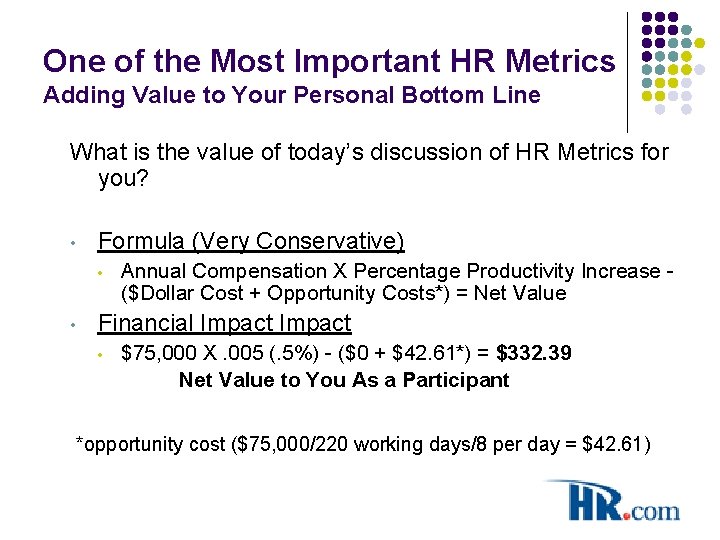
One of the Most Important HR Metrics Adding Value to Your Personal Bottom Line What is the value of today’s discussion of HR Metrics for you? • Formula (Very Conservative) • • Annual Compensation X Percentage Productivity Increase ($Dollar Cost + Opportunity Costs*) = Net Value Financial Impact • $75, 000 X. 005 (. 5%) - ($0 + $42. 61*) = $332. 39 Net Value to You As a Participant *opportunity cost ($75, 000/220 working days/8 per day = $42. 61)
Summary • Some Final Thoughts • HR Metrics are formula-driven and easy to use • HR Metrics and BI are fast becoming “the way we do things around here” - so catch the wave now! Early adoption is over… • If you become an HR Metrics user-both you and your HR organization will gain increased respect from CEOs, CFOs and senior managers • If you don’t use HR Metrics someone who isn’t HR (Finance or IT) will use them and may even imbed them in a BI Dashboard for the CEO or Board - “and the fault will lie not in our stars but in ourselves” (Shakespeare)
Contact Information Robert J. Buckley President RO Buckley Consulting Phone: 908. 502. 5251 Mobile: 646. 595. 6128 Email: robert@robuckley. com