
HR LEADERSHIP Sofia Evangelidou President of GPMA Branch

HR LEADERSHIP Sofia Evangelidou President of GPMA – Branch of Northern Greece Director of HR & Quality Management Dept. MISSIRIAN S. A.
TABLE OF CONTENTS 1. DEFINITION OF LEADERSHIP 2. LEADERSHIP VS MANAGEMENT 3. THE 5 LEVELS OF LEADERSHIP 4. FUTURE TRENDS IN LEADERSHIP 5. CEO PERSPECTIVES: HOW HR CAN TAKE A BIGGER ROLE IN DRIVING GROWTH? 6. BUILDING BETTER LEADERS 7. MANAGING NEW LEADERS 8. DEVELOPING NEW LEADERS 9. APPENDIX HR LEADERSHIP Slide 2
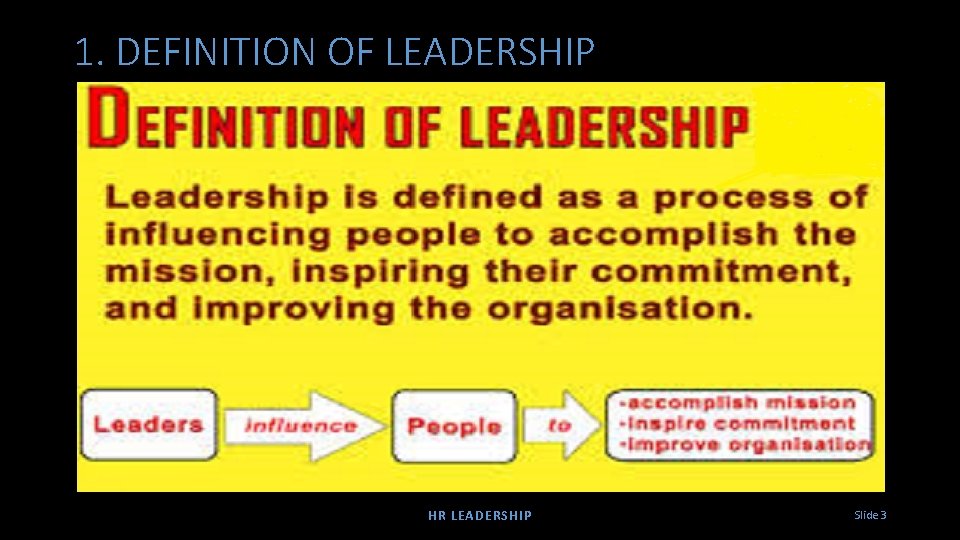
1. DEFINITION OF LEADERSHIP HR LEADERSHIP Slide 3
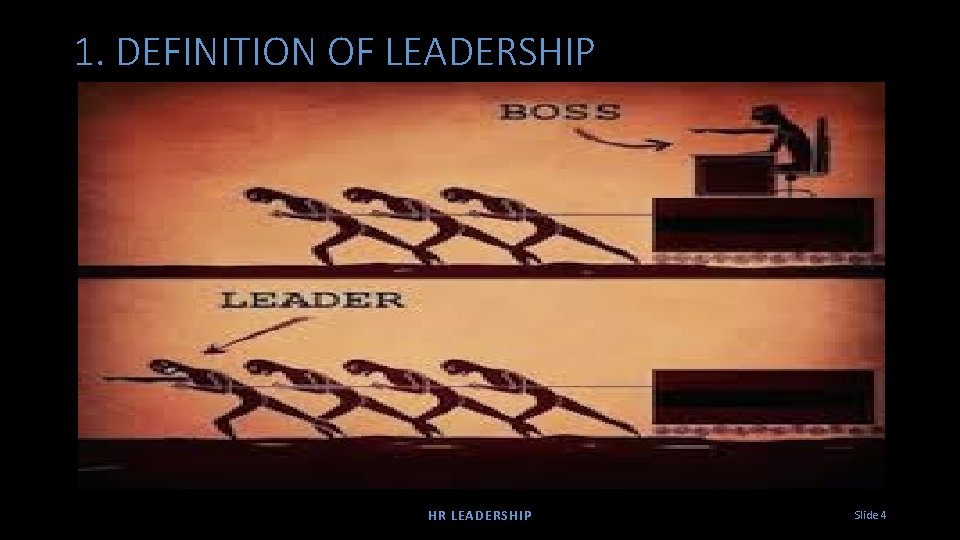
1. DEFINITION OF LEADERSHIP HR LEADERSHIP Slide 4
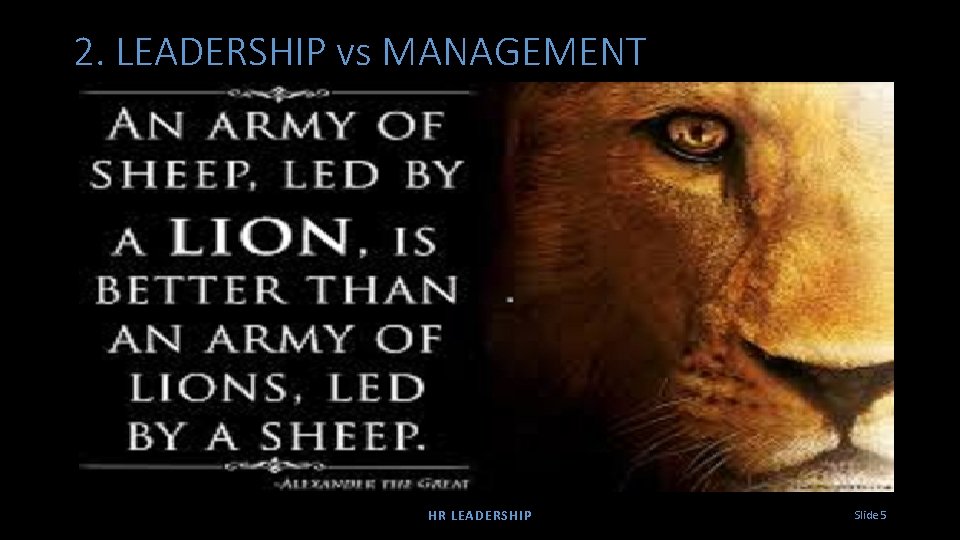
2. LEADERSHIP vs MANAGEMENT HR LEADERSHIP Slide 5
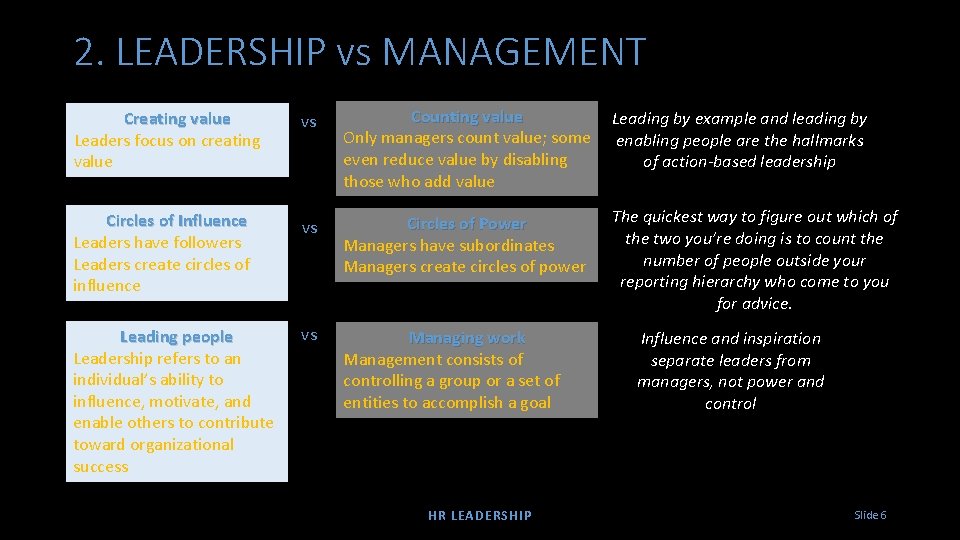
2. LEADERSHIP vs MANAGEMENT Creating value Leaders focus on creating value vs Counting value Only managers count value; some even reduce value by disabling those who add value Leading by example and leading by enabling people are the hallmarks of action-based leadership Circles of Influence Leaders have followers Leaders create circles of influence vs Circles of Power Managers have subordinates Managers create circles of power The quickest way to figure out which of the two you’re doing is to count the number of people outside your reporting hierarchy who come to you for advice. Leading people Leadership refers to an individual’s ability to influence, motivate, and enable others to contribute toward organizational success vs Managing work Management consists of controlling a group or a set of entities to accomplish a goal HR LEADERSHIP Influence and inspiration separate leaders from managers, not power and control Slide 6
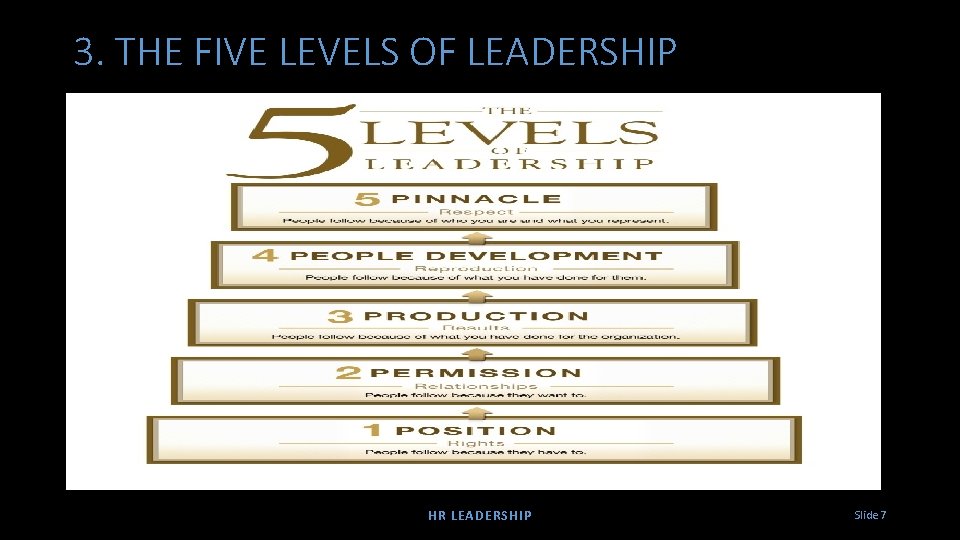
3. THE FIVE LEVELS OF LEADERSHIP HR LEADERSHIP Slide 7
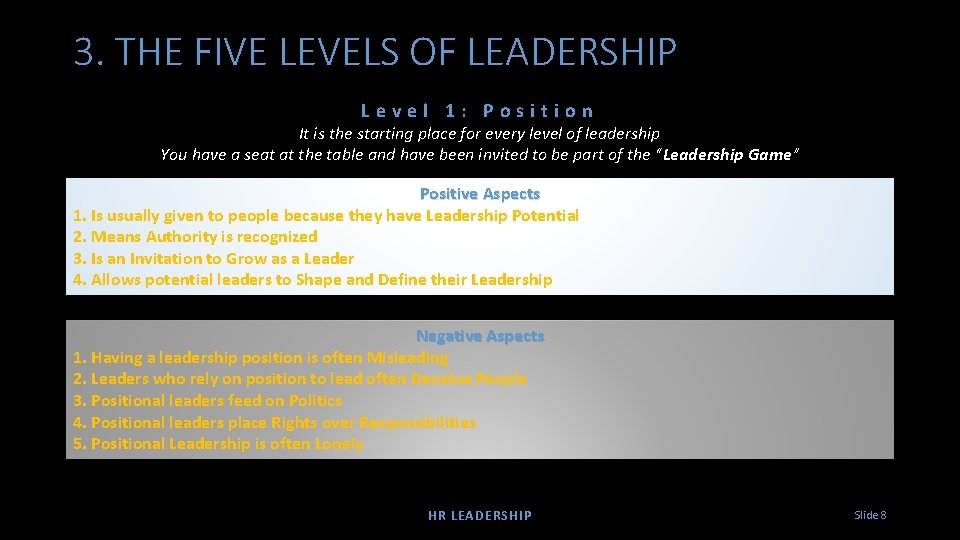
3. THE FIVE LEVELS OF LEADERSHIP Level 1: Position It is the starting place for every level of leadership You have a seat at the table and have been invited to be part of the “Leadership Game” Positive Aspects 1. Is usually given to people because they have Leadership Potential 2. Means Authority is recognized 3. Is an Invitation to Grow as a Leader 4. Allows potential leaders to Shape and Define their Leadership Negative Aspects 1. Having a leadership position is often Misleading 2. Leaders who rely on position to lead often Devalue People 3. Positional leaders feed on Politics 4. Positional leaders place Rights over Responsibilities 5. Positional Leadership is often Lonely HR LEADERSHIP Slide 8
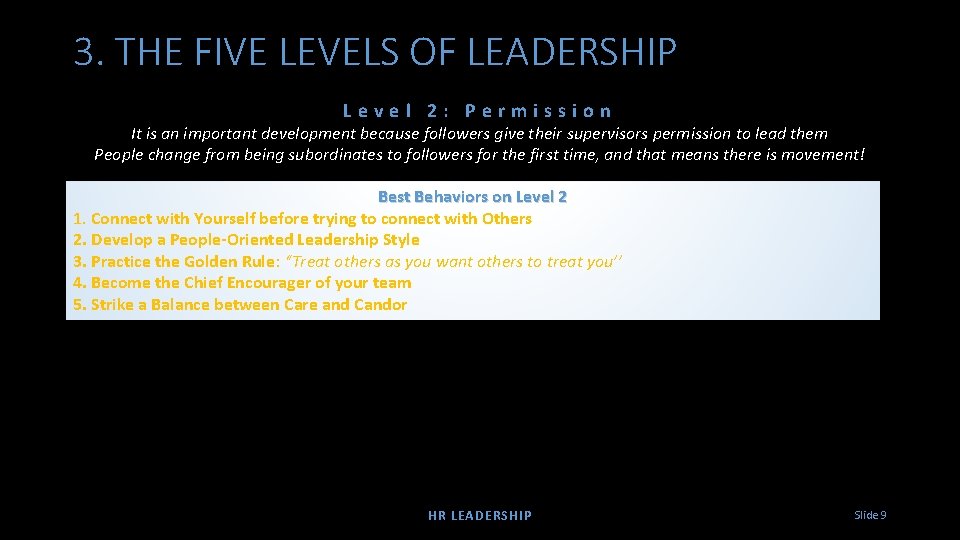
3. THE FIVE LEVELS OF LEADERSHIP Level 2: Permission It is an important development because followers give their supervisors permission to lead them People change from being subordinates to followers for the first time, and that means there is movement! Best Behaviors on Level 2 1. Connect with Yourself before trying to connect with Others 2. Develop a People-Oriented Leadership Style 3. Practice the Golden Rule: “Treat others as you want others to treat you’’ 4. Become the Chief Encourager of your team 5. Strike a Balance between Care and Candor HR LEADERSHIP Slide 9
3. THE FIVE LEVELS OF LEADERSHIP Level 3: Production It is where leadership really takes off and shifts into another Gear Production qualifies and separates true leaders from people who merely occupy leadership positions Thomas Watson, the founder of IBM, noted, “The outstanding leaders of every age are those who set up their own quotas and constantly exceed them. ” The Laws of Leadership at the Production Level 1. The Law of Respect: People naturally Follow leaders Stronger than Themselves 2. The Law of Magnetism: Who You Are is Who You Attract 3. The Law of the Picture: People Do What People See 4. The Law of Victory: Leaders Find a Way for the Team to Win 5. The Law of the Big Mo: Momentum is a Leader’s Best Friend 6. The Law of Priorities: Leaders understand that Activity is not necessarily Accomplishment. Level 3 leaders do the right things the right way at the right time for the right reasons 7. The Law of Sacrifice: A Leader Must Give Up to Go Up 8. The Law of Buy-In: People Buy into the Leader, then the Vision HR LEADERSHIP Slide 10
3. THE FIVE LEVELS OF LEADERSHIP Level 4: People Development Creates elite organizations and leaders must transition from Producers to Developers Leaders who have managed to move up to Level 4, they are leading higher than 90 % of all other leaders Ken Blanchard said, “I think the most important and difficult thing is to create a culture in the organization where leadership is really important’’ Bringing out the Best in the Team They put only 20% of their focus on their personal productivity while putting 80% of it on developing and leading others Beliefs That Help a Leader Move Up to Level 5 1. The highest goal of Leadership is to Develop Leaders, not gain followers or do work 2. To develop leaders, you must create a Leadership Culture 3. Developing leaders is a Life Commitment, not a job commitment HR LEADERSHIP Slide 11
3. THE FIVE LEVELS OF LEADERSHIP Level 5: The Pinnacle Fewer than 1% of all leaders achieve it Guide to Being Your Best at Level 5 1. Remain Humble and Teachable 2. Maintain your Core Focus - Identify the core strength and write out a plan for making the most of it in the coming years 3. Create the right Inner Circle to keep you grounded 4. Do What Only you Can Do 5. Create a Supercharged Leadership Development Environment 6. Create Room at the Top 7. Develop your Top Leaders. One-on-one mentoring 8. Plan your Succession 9. Plan your Legacy 10. Use your Leadership Success as a Platform for Something Greater HR LEADERSHIP Slide 12
4. FUTURE TRENDS IN LEADERSHIP HR LEADERSHIP Slide 13
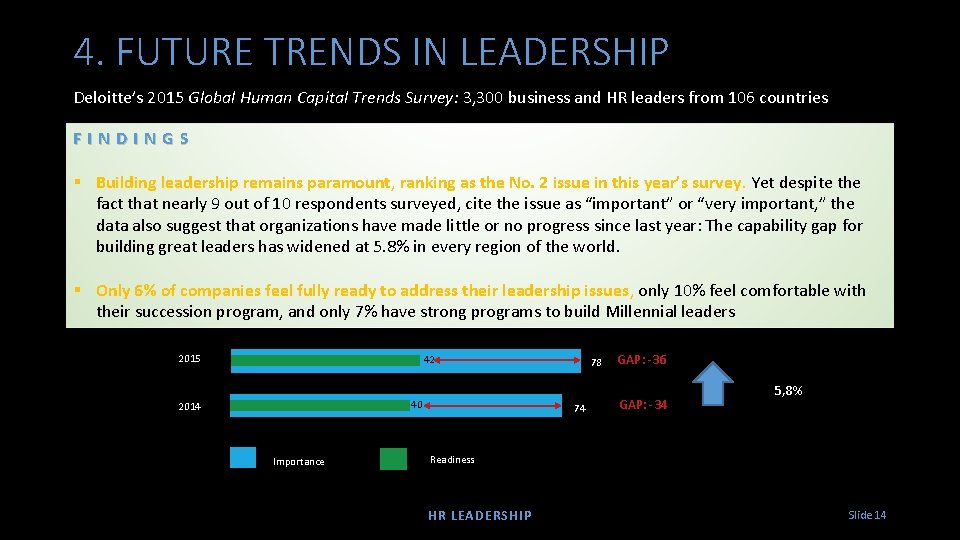
4. FUTURE TRENDS IN LEADERSHIP Deloitte’s 2015 Global Human Capital Trends Survey: 3, 300 business and HR leaders from 106 countries FINDINGS § Building leadership remains paramount, ranking as the No. 2 issue in this year’s survey. Yet despite the fact that nearly 9 out of 10 respondents surveyed, cite the issue as “important” or “very important, ” the data also suggest that organizations have made little or no progress since last year: The capability gap for building great leaders has widened at 5. 8% in every region of the world. § Only 6% of companies feel fully ready to address their leadership issues, only 10% feel comfortable with their succession program, and only 7% have strong programs to build Millennial leaders 2015 42 40 2014 Importance 78 74 GAP: -36 GAP: -34 5, 8% Readiness HR LEADERSHIP Slide 14
4. FUTURE TRENDS IN LEADERSHIP REASONS § Leadership for the few, not the many: At the top of the corporate pyramid, fewer than 50% of C-suite executives feel they are receiving any development at all. Meanwhile, lower down in the organization, just 6% of survey respondents report they have “excellent” programs in place to develop Millennials. This is despite the fact that 53% of Millennials aspire to become the leader or senior executive of their own organization. § Lack of consistent investment: Many organizations view leadership as a short term training program or series of episodic events that are funded one year but not the next. Companies that “get it” invest in developing leaders during good times and spend 1. 5 to 2 times more on leadership than other companies, and reap results that are triple or quadruple the levels of their competitors. § A weak leadership pipeline: Unless developing leadership is treated as an ongoing, strategic initiative by HR and the business, leadership pipelines will be weak and potentially impact the ability of the business to deliver on its strategy. HR LEADERSHIP Slide 15
4. FUTURE TRENDS IN LEADERSHIP SOLUTIONS ü Start with commitment to leadership development from the top: Without CEO ownership, leadership development will likely never be a long-term commitment. ü Answer the question: Leadership for what? Begin a conversation about your top business priorities. ü Develop inclusive leaders at all levels: While many executives worry about top leadership, mid-level and first-level leaders actually operate the company and are the future strategic leaders of the organization. This requires focusing on growing segments of leaders such as Millennials, global leaders, and women—and tailoring development to their unique needs and preferences. ü Make talent development and succession a priority: Reward leaders for developing successors and sharing talent. ü Develop or leverage a capability model: Build a framework for selection, assessment, development, and succession that defines the leadership you need for today and tomorrow. Keep the model simple—it should be your “language for leadership” across the enterprise. ü Extend boundaries to create new leadership development opportunities: Work with business partners, universities, non governmental organizations, and other third-party organizations to create a range of new leadership experiences, including pro bono and community service projects HR LEADERSHIP Slide 16
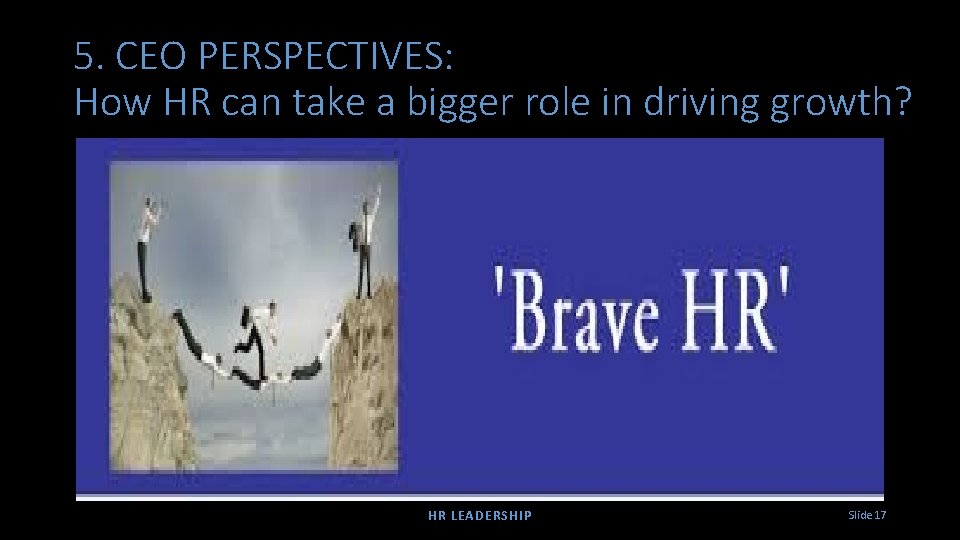
5. CEO PERSPECTIVES: How HR can take a bigger role in driving growth? HR LEADERSHIP Slide 17
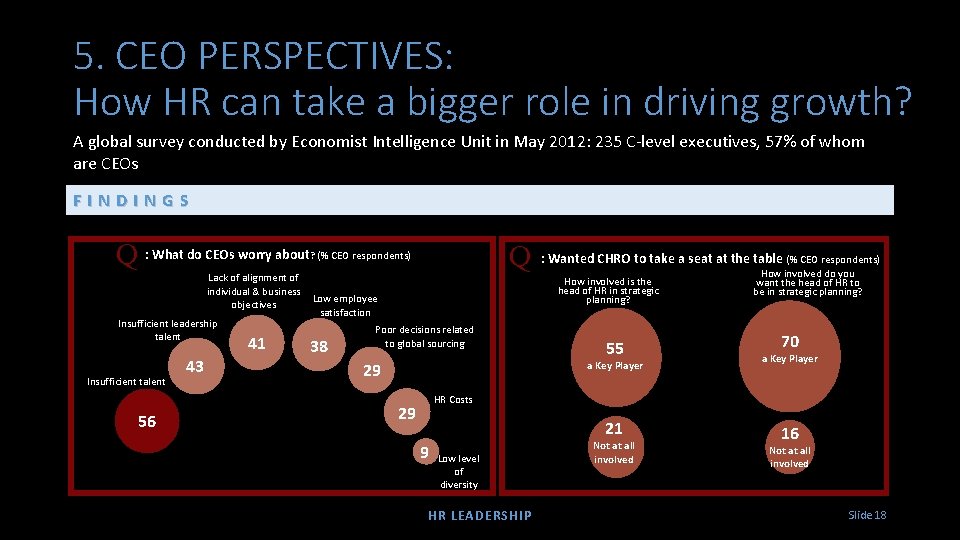
5. CEO PERSPECTIVES: How HR can take a bigger role in driving growth? A global survey conducted by Economist Intelligence Unit in May 2012: 235 C-level executives, 57% of whom are CEOs FINDINGS Q : What do CEOs worry about Lack of alignment of individual & business objectives Insufficient leadership talent Insufficient talent 56 43 41 Q ? (% CEO respondents) How involved is the head of HR in strategic planning? Low employee satisfaction 38 : Wanted CHRO to take a seat at the table (% CEO respondents) Poor decisions related to global sourcing 29 55 a Key Player How involved do you want the head of HR to be in strategic planning? 70 a Key Player HR Costs 29 21 9 Low level of diversity HR LEADERSHIP Not at all involved 16 Not at all involved Slide 18
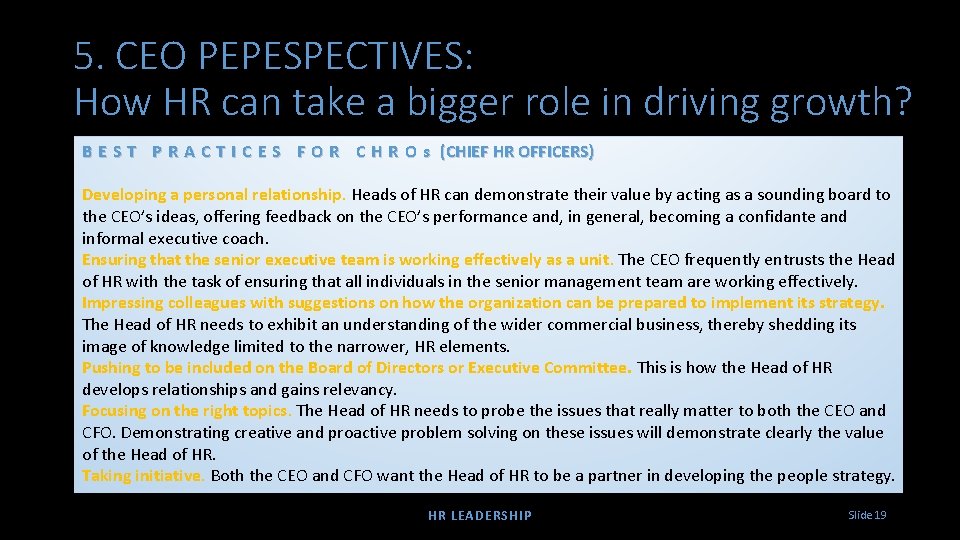
5. CEO PEPESPECTIVES: How HR can take a bigger role in driving growth? B E S T P R A C T I C E S F O R C H R O s (CHIEF HR OFFICERS) Developing a personal relationship. Heads of HR can demonstrate their value by acting as a sounding board to the CEO’s ideas, offering feedback on the CEO’s performance and, in general, becoming a confidante and informal executive coach. Ensuring that the senior executive team is working effectively as a unit. The CEO frequently entrusts the Head of HR with the task of ensuring that all individuals in the senior management team are working effectively. Impressing colleagues with suggestions on how the organization can be prepared to implement its strategy. The Head of HR needs to exhibit an understanding of the wider commercial business, thereby shedding its image of knowledge limited to the narrower, HR elements. Pushing to be included on the Board of Directors or Executive Committee. This is how the Head of HR develops relationships and gains relevancy. Focusing on the right topics. The Head of HR needs to probe the issues that really matter to both the CEO and CFO. Demonstrating creative and proactive problem solving on these issues will demonstrate clearly the value of the Head of HR. Taking initiative. Both the CEO and CFO want the Head of HR to be a partner in developing the people strategy. HR LEADERSHIP Slide 19
6. BUILDING BETTER LEADERS HR LEADERSHIP Slide 20
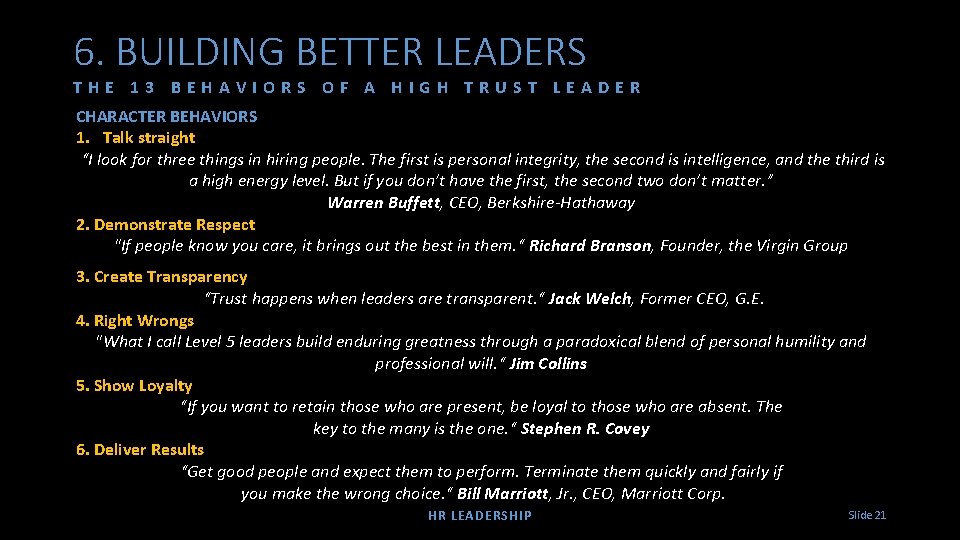
6. BUILDING BETTER LEADERS THE 13 BEHAVIORS OF A HIGH TRUST LEADER CHARACTER BEHAVIORS 1. Talk straight “I look for three things in hiring people. The first is personal integrity, the second is intelligence, and the third is a high energy level. But if you don’t have the first, the second two don’t matter. ” Warren Buffett, CEO, Berkshire-Hathaway 2. Demonstrate Respect "If people know you care, it brings out the best in them. “ Richard Branson, Founder, the Virgin Group 3. Create Transparency “Trust happens when leaders are transparent. “ Jack Welch, Former CEO, G. E. 4. Right Wrongs "What I call Level 5 leaders build enduring greatness through a paradoxical blend of personal humility and professional will. “ Jim Collins 5. Show Loyalty “If you want to retain those who are present, be loyal to those who are absent. The key to the many is the one. “ Stephen R. Covey 6. Deliver Results “Get good people and expect them to perform. Terminate them quickly and fairly if you make the wrong choice. “ Bill Marriott, Jr. , CEO, Marriott Corp. HR LEADERSHIP Slide 21
6. BUILDING BETTER LEADERS THE 13 BEHAVIORS OF A HIGH TRUST LEADER COMPETENCE BEHAVIORS 7. Get Better “The illiterate of the 21 st century will not be those who cannot read and write but those who cannot learn, unlearn, and relearn. “ Alvin Toffler 8. Confront Reality “Leaders need to be more candid with those they purport to lead. Sharing good news is easy. When it comes to the more troublesome negative news, be candid and take responsibility. Don’t withhold unpleasant possibilities and don’t pass off bad news to subordinates to deliver. Level with employees about problems in a timely fashion. “ Jon Huntsman, Chairman, Huntsman Corp. 9. Clarify Expectations “Almost all conflict is a result of violated expectations. “ Blaine Lee 10. Practice Accountability "Remember, when you were made a leader, you weren't given a crown, you were given a responsibility to bring out the best in others. For that, your people need to trust you. “ Jack Welch, former CEO, General Electric HR LEADERSHIP Slide 22
6. BUILDING BETTER LEADERS THE 13 BEHAVIORS OF A HIGH TRUST LEADER CHARACTER & COMPETENCE BEHAVIORS 11. Listen First "Nothing beats personal, two-way communication for fostering cooperation and teamwork and for building an attitude of trust and understanding among employees. “ Bill Packard, Co-Founder, Hewlett Packard 12. Keep Commitments “Trust doesn’t mean they tell you everything. It doesn’t mean they don’t posture. But it means if they say, ‘We will do this, ’ they will do it. It is credibility. It is integrity. " Scott Smith, Publisher, Chicago Tribune 13. Extend Trust "I have found that by trusting people until they prove themselves unworthy of that trust, a lot more happens. “ Jim Burke, former CEO, Johnson & Johnson HR LEADERSHIP Slide 23
7. MANAGING NEW LEADERS HR LEADERSHIP Slide 24
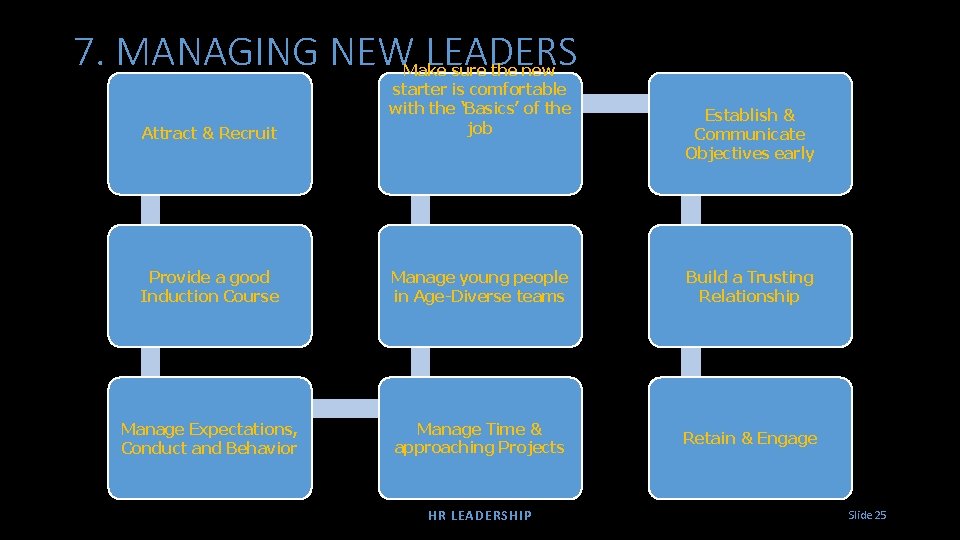
7. MANAGING NEW LEADERS Attract & Recruit Make sure the new starter is comfortable with the ‘Basics’ of the job Provide a good Induction Course Manage young people in Age-Diverse teams Build a Trusting Relationship Manage Expectations, Conduct and Behavior Manage Time & approaching Projects Retain & Engage HR LEADERSHIP Establish & Communicate Objectives early Slide 25
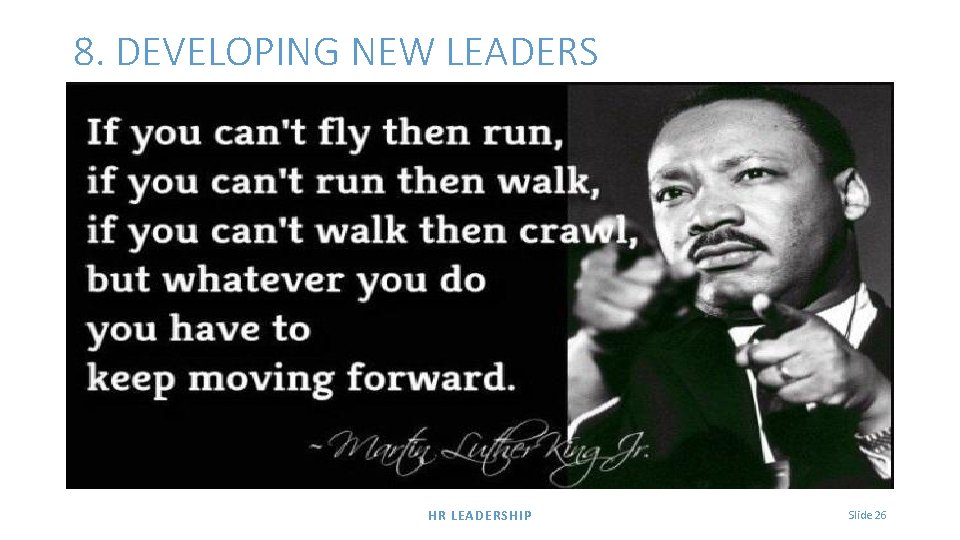
8. DEVELOPING NEW LEADERS HR LEADERSHIP Slide 26
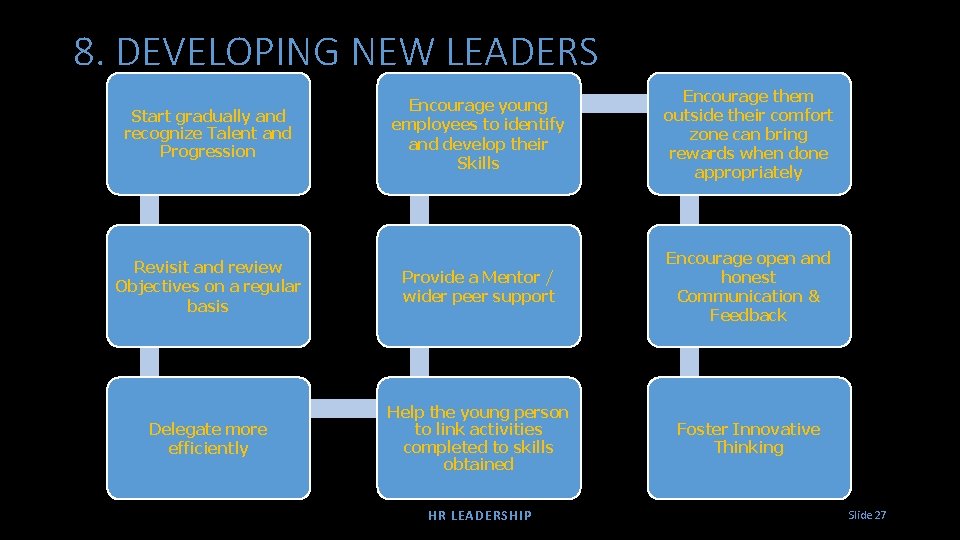
8. DEVELOPING NEW LEADERS Encourage young employees to identify and develop their Skills Encourage them outside their comfort zone can bring rewards when done appropriately Revisit and review Objectives on a regular basis Provide a Mentor / wider peer support Encourage open and honest Communication & Feedback Delegate more efficiently Help the young person to link activities completed to skills obtained Foster Innovative Thinking Start gradually and recognize Talent and Progression HR LEADERSHIP Slide 27
9. APPENDIX 1. Three differences between Managers and Leaders, Vineet Nayar, Harvard Business Review, August 2 2013 2. The 5 levels of Leadership, John C. Maxwell, Soundview Executive Book Summaries, Vol. 34, No. 4 (3 parts), Part 2, April 2012 3. Global Human Capital Trends 2015, Deloitte University Press 4. White Paper – CEO Perspectives: How HR Can Take a Bigger Role in Driving Growth, Economist Intelligence Unit, May 2012 5. The 13 behaviors of a High Trust Leader, Stephen M. R. Covey 6. Developing Leaders, IEDP, 2012 7. The Will to Lead, Marvin Bower, Mc. Kinsey, 1997 HR LEADERSHIP Slide 28
Thank you for your attention HR LEADERSHIP Slide 29
- Slides: 29