
HPT Stage Efficiency Improvements of High Pressure Turbine
HPT Stage Efficiency Improvements of High Pressure Turbine Stages Ranjan Saha (KTH) Hina Noor (KTH) RS, HN 20100414 Turbo. Power – HPT Stage efficiency 1
Outline of Presentation • Background • Turbo. Aero project • Work packages (WP 1 and WP 2) • WP 1 : Leading Edge Contouring • WP 2 : Reaction Degree • Time Schedule RS, HN 20100414 Turbo. Power – HPT Stage efficiency 2
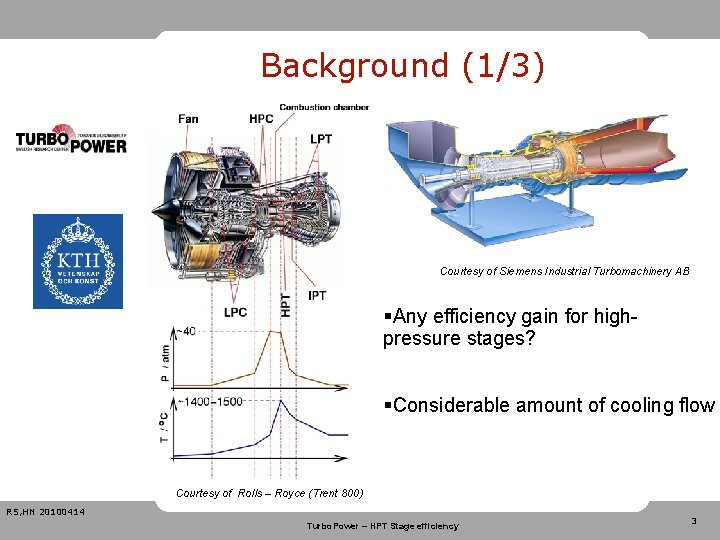
Background (1/3) Courtesy of Siemens Industrial Turbomachinery AB §Any efficiency gain for highpressure stages? §Considerable amount of cooling flow Courtesy of Rolls – Royce (Trent 800) RS, HN 20100414 Turbo. Power – HPT Stage efficiency 3
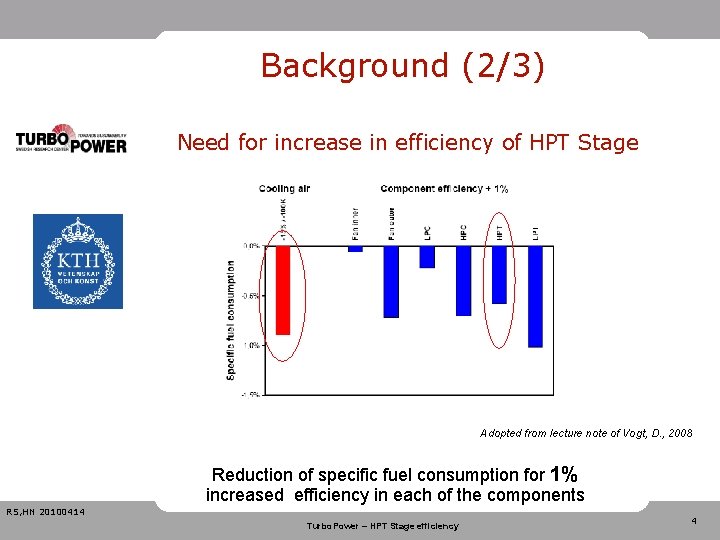
Background (2/3) Need for increase in efficiency of HPT Stage Adopted from lecture note of Vogt, D. , 2008 Reduction of specific fuel consumption for 1% increased efficiency in each of the components RS, HN 20100414 Turbo. Power – HPT Stage efficiency 4
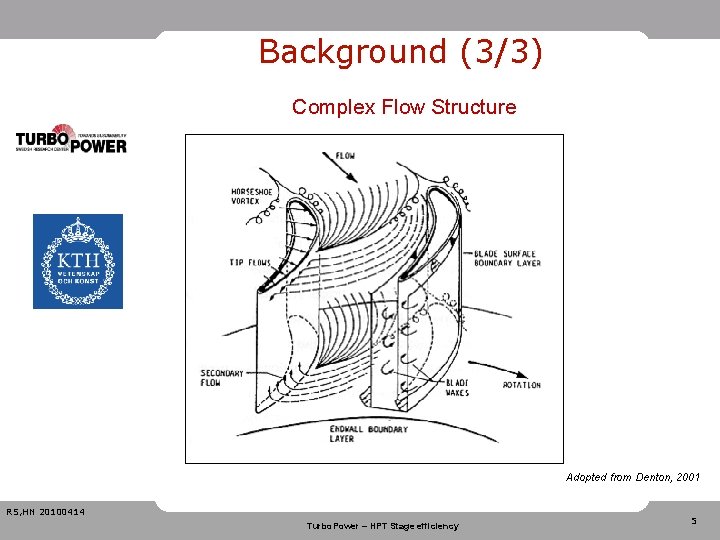
Background (3/3) Complex Flow Structure Adopted from Denton, 2001 RS, HN 20100414 Turbo. Power – HPT Stage efficiency 5
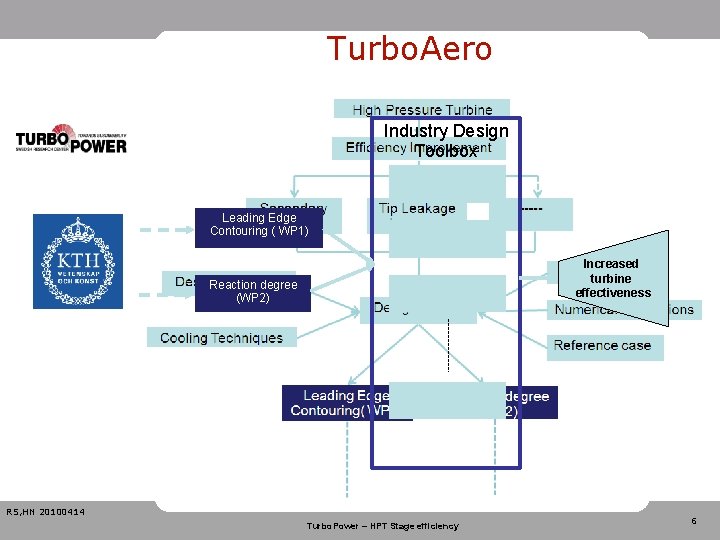
Turbo. Aero Industry Design Toolbox Leading Edge Contouring ( WP 1) Increased turbine effectiveness Reaction degree (WP 2) RS, HN 20100414 Turbo. Power – HPT Stage efficiency 6
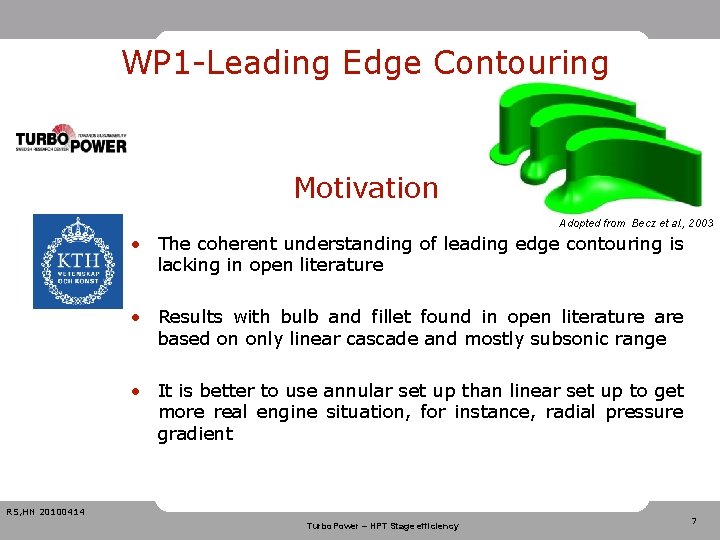
WP 1 -Leading Edge Contouring Motivation Adopted from Becz et al. , 2003 • The coherent understanding of leading edge contouring is lacking in open literature • Results with bulb and fillet found in open literature are based on only linear cascade and mostly subsonic range • It is better to use annular set up than linear set up to get more real engine situation, for instance, radial pressure gradient RS, HN 20100414 Turbo. Power – HPT Stage efficiency 7
Objectives WP 1: Leading Edge Contouring • Establish physical interpretations of leading edge contouring effect onto the endwall flow (horseshoe vortex and passage vortex) • Develop design criteria of leading edge contouring for high pressure turbine vane/blade to decrease secondary flow RS, HN 20100414 Turbo. Power – HPT Stage efficiency 8
Overview of Investigations WP 1: Leading Edge Contouring • Detailed literature study on Leading edge contouring and determine design criteria based on findings in open literature • Design optimization study by CFD computations • Experimental campaigns of 2 -3 different designs with pneumatic probe measurement and oil visualization RS, HN 20100414 Turbo. Power – HPT Stage efficiency 9
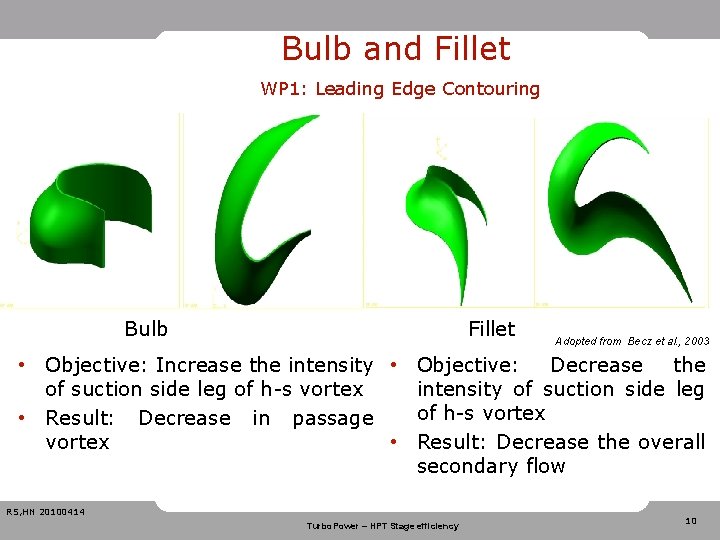
Bulb and Fillet WP 1: Leading Edge Contouring Bulb Fillet Adopted from Becz et al. , 2003 • Objective: Increase the intensity • Objective: Decrease the of suction side leg of h-s vortex intensity of suction side leg of h-s vortex • Result: Decrease in passage vortex • Result: Decrease the overall secondary flow RS, HN 20100414 Turbo. Power – HPT Stage efficiency 10
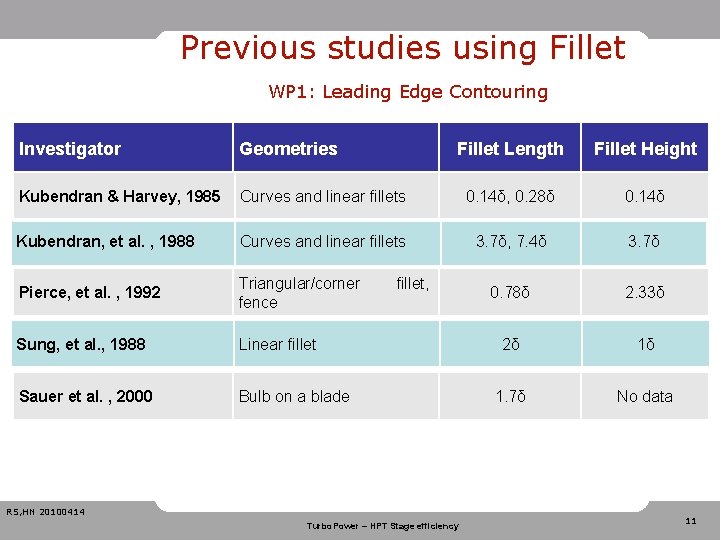
Previous studies using Fillet WP 1: Leading Edge Contouring Investigator Geometries Fillet Length Fillet Height Kubendran & Harvey, 1985 Curves and linear fillets 0. 14δ, 0. 28δ 0. 14δ Kubendran, et al. , 1988 Curves and linear fillets 3. 7δ, 7. 4δ 3. 7δ Pierce, et al. , 1992 Triangular/corner fence 0. 78δ 2. 33δ Sung, et al. , 1988 Linear fillet 2δ 1δ Sauer et al. , 2000 Bulb on a blade 1. 7δ No data fillet, RS, HN 20100414 Turbo. Power – HPT Stage efficiency 11
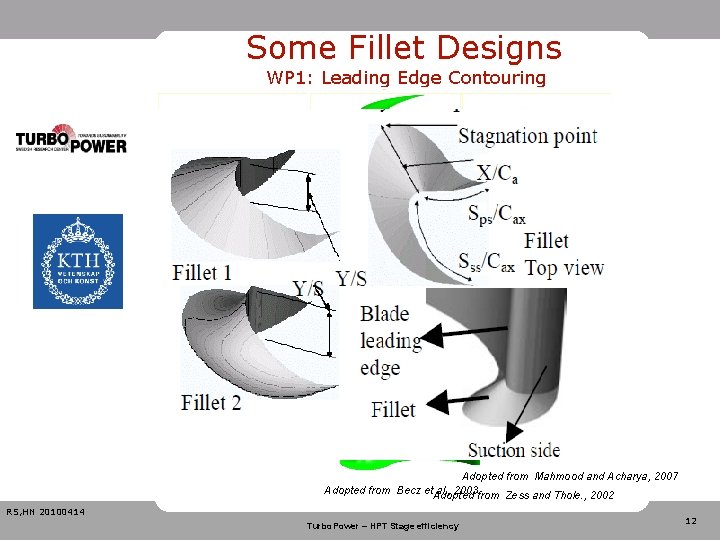
Some Fillet Designs WP 1: Leading Edge Contouring Adopted from Sauer et al. , 2000 Adopted from Mahmood and Acharya, 2007 Adopted from Becz et. Adopted al. , 2003 from Zess and Thole. , 2002 RS, HN 20100414 Turbo. Power – HPT Stage efficiency 12
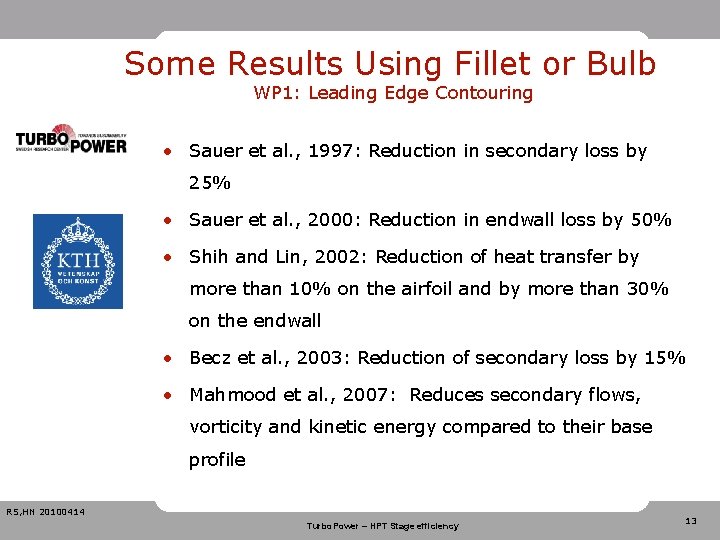
Some Results Using Fillet or Bulb WP 1: Leading Edge Contouring • Sauer et al. , 1997: Reduction in secondary loss by 25% • Sauer et al. , 2000: Reduction in endwall loss by 50% • Shih and Lin, 2002: Reduction of heat transfer by more than 10% on the airfoil and by more than 30% on the endwall • Becz et al. , 2003: Reduction of secondary loss by 15% • Mahmood et al. , 2007: Reduces secondary flows, vorticity and kinetic energy compared to their base profile RS, HN 20100414 Turbo. Power – HPT Stage efficiency 13
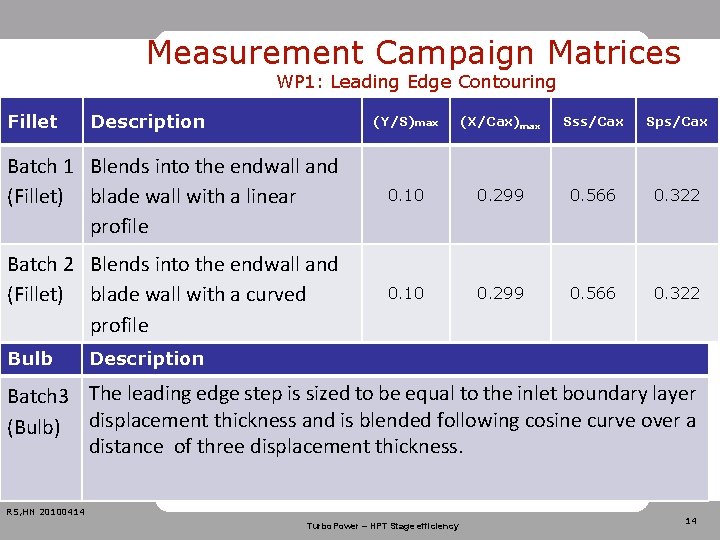
Measurement Campaign Matrices WP 1: Leading Edge Contouring Fillet Description (Y/S)max (X/Cax)max Sss/Cax Sps/Cax Batch 1 Blends into the endwall and (Fillet) blade wall with a linear profile 0. 10 0. 299 0. 566 0. 322 Batch 2 Blends into the endwall and (Fillet) blade wall with a curved profile 0. 10 0. 299 0. 566 0. 322 Bulb Description Batch 3 The leading edge step is sized to be equal to the inlet boundary layer (Bulb) displacement thickness and is blended following cosine curve over a distance of three displacement thickness. RS, HN 20100414 Turbo. Power – HPT Stage efficiency 14
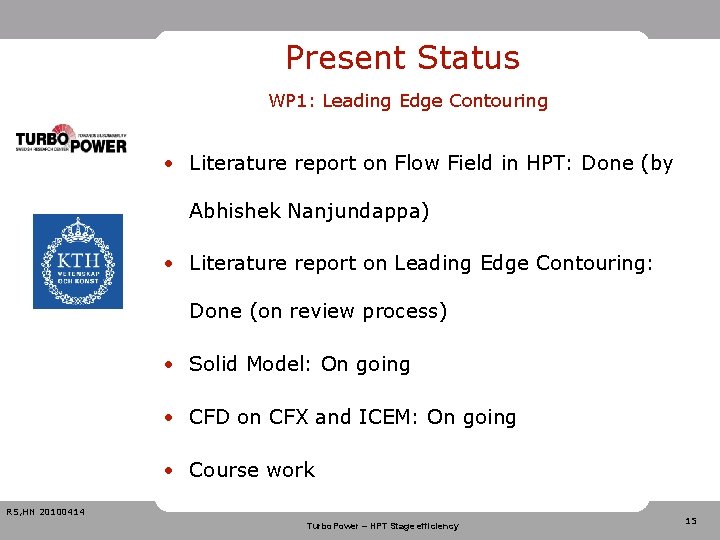
Present Status WP 1: Leading Edge Contouring • Literature report on Flow Field in HPT: Done (by Abhishek Nanjundappa) • Literature report on Leading Edge Contouring: Done (on review process) • Solid Model: On going • CFD on CFX and ICEM: On going • Course work RS, HN 20100414 Turbo. Power – HPT Stage efficiency 15
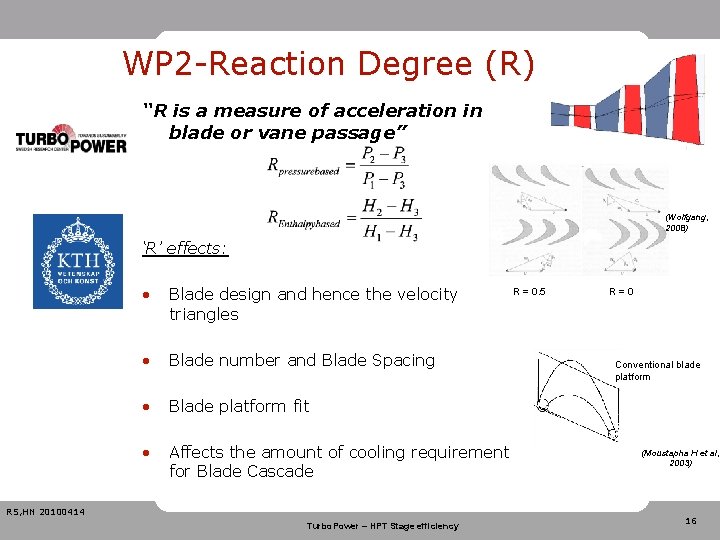
WP 2 -Reaction Degree (R) “R is a measure of acceleration in blade or vane passage” (Wolfgang, 2008) ‘R’ effects: • Blade design and hence the velocity triangles • Blade number and Blade Spacing • Blade platform fit • Affects the amount of cooling requirement for Blade Cascade RS, HN 20100414 Turbo. Power – HPT Stage efficiency R = 0. 5 R=0 Conventional blade platform (Moustapha H et al, 2003) 16
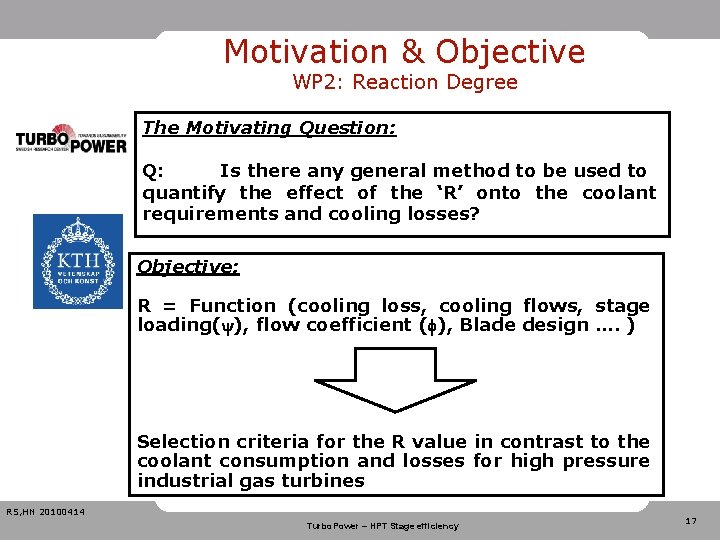
Motivation & Objective WP 2: Reaction Degree The Motivating Question: Q: Is there any general method to be used to quantify the effect of the ‘R’ onto the coolant requirements and cooling losses? Objective: R = Function (cooling loss, cooling flows, stage loading( ), flow coefficient ( ), Blade design …. ) Selection criteria for the R value in contrast to the coolant consumption and losses for high pressure industrial gas turbines RS, HN 20100414 Turbo. Power – HPT Stage efficiency 17
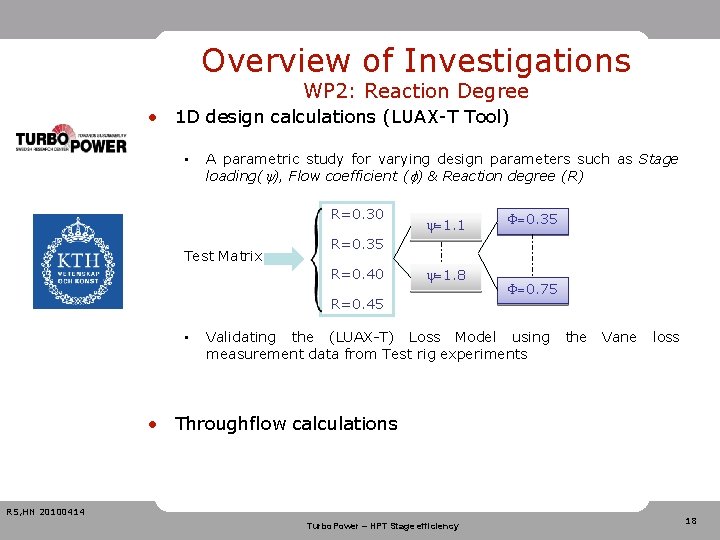
Overview of Investigations WP 2: Reaction Degree • 1 D design calculations (LUAX-T Tool) • A parametric study for varying design parameters such as Stage loading( ), Flow coefficient ( ) & Reaction degree (R) R=0. 30 Test Matrix y=1. 1 R=0. 35 R=0. 40 y=1. 8 R=0. 45 • F=0. 35 F=0. 75 Validating the (LUAX-T) Loss Model using measurement data from Test rig experiments the Vane loss • Throughflow calculations RS, HN 20100414 Turbo. Power – HPT Stage efficiency 18
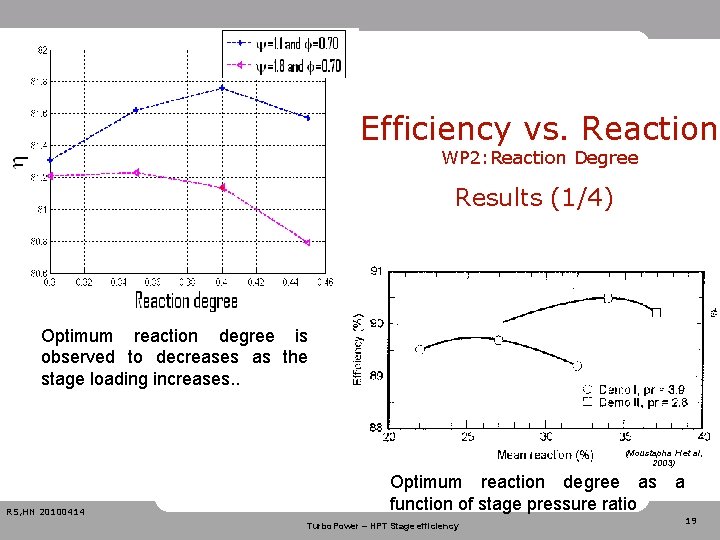
Efficiency vs. Reaction WP 2: Reaction Degree Results (1/4) Optimum reaction degree is observed to decreases as the stage loading increases. . (Moustapha H et al, 2003) RS, HN 20100414 Optimum reaction degree as function of stage pressure ratio Turbo. Power – HPT Stage efficiency a 19
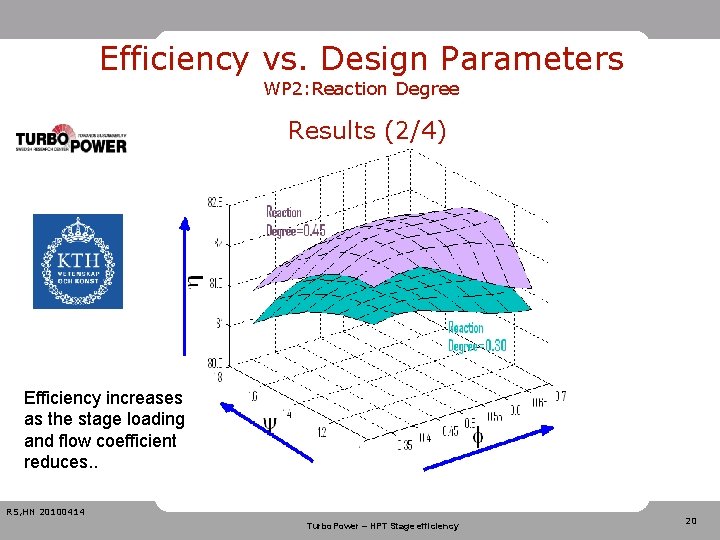
Efficiency vs. Design Parameters WP 2: Reaction Degree Results (2/4) Efficiency increases as the stage loading and flow coefficient reduces. . RS, HN 20100414 Turbo. Power – HPT Stage efficiency 20
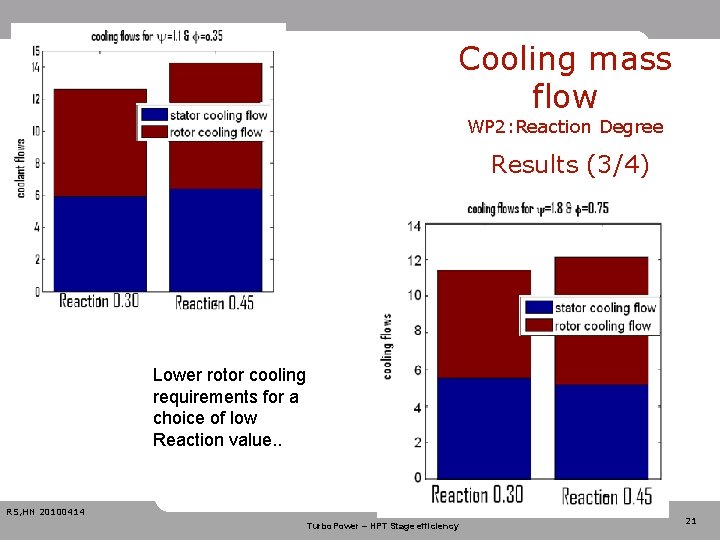
Cooling mass flow WP 2: Reaction Degree Results (3/4) Lower rotor cooling requirements for a choice of low Reaction value. . RS, HN 20100414 Turbo. Power – HPT Stage efficiency 21
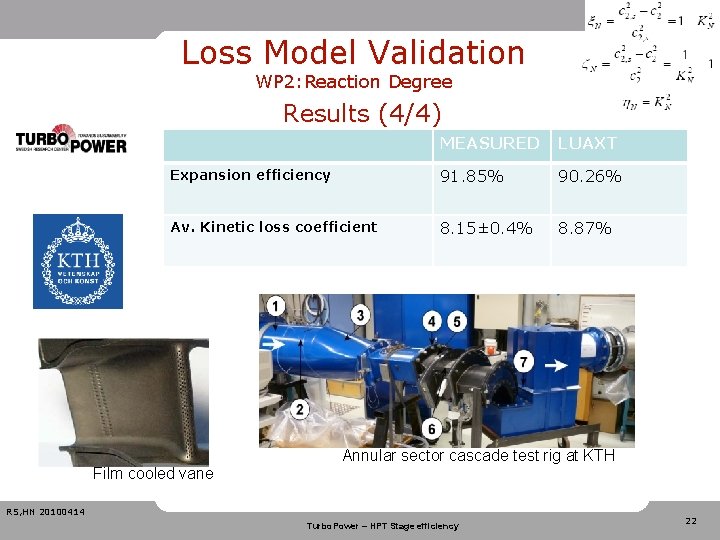
Loss Model Validation WP 2: Reaction Degree Results (4/4) MEASURED LUAXT Expansion efficiency 91. 85% 90. 26% Av. Kinetic loss coefficient 8. 15± 0. 4% 8. 87% Annular sector cascade test rig at KTH Film cooled vane RS, HN 20100414 Turbo. Power – HPT Stage efficiency 22
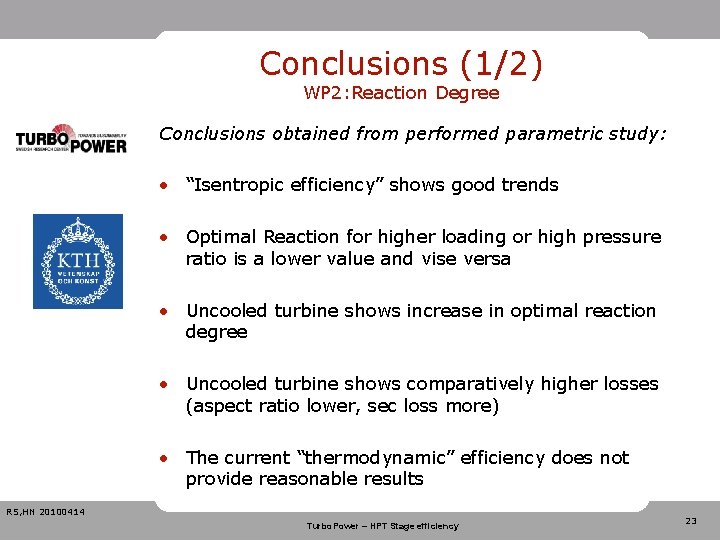
Conclusions (1/2) WP 2: Reaction Degree Conclusions obtained from performed parametric study: • “Isentropic efficiency” shows good trends • Optimal Reaction for higher loading or high pressure ratio is a lower value and vise versa • Uncooled turbine shows increase in optimal reaction degree • Uncooled turbine shows comparatively higher losses (aspect ratio lower, sec loss more) • The current “thermodynamic” efficiency does not provide reasonable results RS, HN 20100414 Turbo. Power – HPT Stage efficiency 23
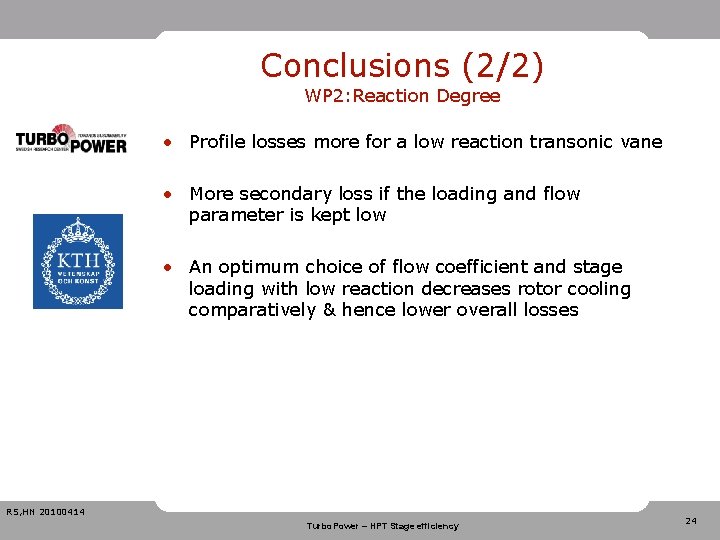
Conclusions (2/2) WP 2: Reaction Degree • Profile losses more for a low reaction transonic vane • More secondary loss if the loading and flow parameter is kept low • An optimum choice of flow coefficient and stage loading with low reaction decreases rotor cooling comparatively & hence lower overall losses RS, HN 20100414 Turbo. Power – HPT Stage efficiency 24
Present Status & Next Step WP 2: Reaction Degree • 1 D Results interpretation • Course work • The loss Model validation using the measured data from test rig • Abstract submitted to 9 th European Turbomachinery Conference • Comparing results to SIT in-house loss models • Through-flow calculations RS, HN 20100414 Turbo. Power – HPT Stage efficiency 25
Time Schedule (1/2) WP 1(Leading Edge contouring) & WP 2(Reaction degree) Work Package No WP 1. 1 & WP 2. 1 Description Literature Study, cycle & flow path calculations WP 1. 2 Detailed literature study on Leading edge contouring WP 2. 2 1 D Design calculations & Loss Model Validation WP 1. 3 Design study (of leading edge contouring) & steady CFD computation of final designs WP 2. 3 Throughflow calculations WP 1. 4 Experimental campaigns of 2 -3 different designs Deliverable No Description D 1. 1 D 2. 1 Literature report and 1 D Calculations report D 1. 2 D 2. 2 Leading edge contouring (lit. report) (31 -01 -2010) Results from 1 D turbine design Calculations (publication+report) D 1. 3 D 2. 3 Synthesis of design and numerical calculations (report) Results for throughflow calculations and vane inclination technique (31. 12. 2010) D 1. 4 Synthesis of experimental results with numerical comparisons (30 -06 -2011). ASME Turbo IGTI 2011 (Submitted before 15 -11 -2010), ASME Turbo IGTI 2012 (Submitted before 30 -06 -2011) RS, HN 20100414 Turbo. Power – HPT Stage efficiency 26
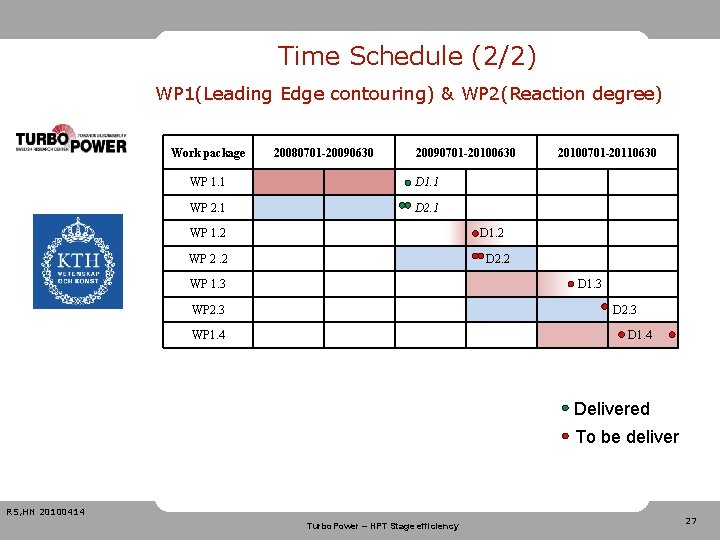
Time Schedule (2/2) WP 1(Leading Edge contouring) & WP 2(Reaction degree) Work package 20080701 -20090630 20090701 -20100630 WP 1. 1 D 1. 1 WP 2. 1 D 2. 1 WP 1. 2 20100701 -20110630 D 1. 2 WP 2. 2 D 2. 2 WP 1. 3 D 1. 3 WP 2. 3 D 2. 3 WP 1. 4 Delivered To be deliver RS, HN 20100414 Turbo. Power – HPT Stage efficiency 27
THANK YOU RS, HN 20100414 Turbo. Power – HPT Stage efficiency 28
- Slides: 28