
HPC Cloud and Big Data Testbed Geoffrey Fox
HPC Cloud and Big Data Testbed Geoffrey Fox, November 21, 2017 Department of Intelligent Systems Engineering gcf@indiana. edu, http: //www. dsc. soic. indiana. edu/, http: //spidal. org/ ` Work with Judy Qiu, Peng Bo, Supun Kamburugamuve, Kannan Govindarajan, Pulasthi Wickramasinghe 3/4/2021 1
Big Data Processing Systems • Application Requirements: The structure of application clearly impacts needed hardware and software • Pleasingly parallel • Workflow • Global Machine Learning • Analytics • Data management • Streaming or Repository access or both • Data model: SQL, No. SQL; File Systems, Object store; Lustre, HDFS • Distributed data from distributed sensors and instruments (Internet of Things) requires Edge computing model • Device – Fog – Cloud model and streaming data software and algorithms • Hardware: node (accelerators such as GPU or KNL for deep learning) and multinode architecture configured as HPC Cloud; • Disks speed and location • This implies software requirements 3/4/2021 2
Motivating Remarks • Use of public clouds increasing rapidly • Clouds becoming diverse with subsystems containing GPU’s, FPGA’s, high performance networks, storage, memory … • Rich software stacks: • HPC (High Performance Computing) for Parallel Computing less used than • Apache for Big Data Software Stack ABDS including some edge computing (streaming data) • Messaging is used pervasively for parallel and distributed computing with • Service-oriented Systems, Internet of Things and Edge Computing growing in importance using messages differently from each other and parallel computing. • Serverless (server hidden) computing attractive to user: “No server is easier to manage than no server” • A lot of confusion coming from different communities (database, distributed, parallel computing, machine learning, computational/data science) investigating similar ideas with little knowledge exchange and mixed up (unclear) requirements 3/4/2021 3
Requirements • On general principles parallel and distributed computing have different requirements even if sometimes similar functionalities • Apache stack ABDS typically uses distributed computing concepts • For example, Reduce operation is different in MPI (Harp) and Spark • Large scale simulation requirements are well understood • Big Data requirements are not clear but there a few key use types 1) Pleasingly parallel processing (including local machine learning LML) as of different tweets from different users with perhaps Map. Reduce style of statistics and visualizations; possibly Streaming 2) Database model with queries again supported by Map. Reduce for horizontal scaling 3) Global Machine Learning GML with single job using multiple nodes as classic parallel computing 4) Deep Learning certainly needs HPC – possibly only multiple small systems • Current workloads stress 1) and 2) and are suited to current clouds and to ABDS (with no HPC) • This explains why Spark with poor GML performance is so successful and why it can ignore MPI even though MPI best technology for parallel computing 3/4/2021 4
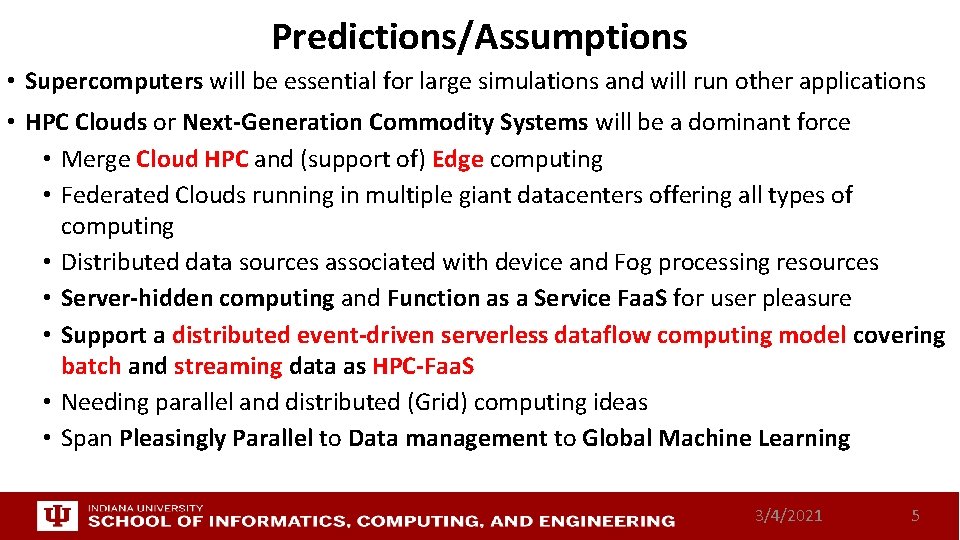
Predictions/Assumptions • Supercomputers will be essential for large simulations and will run other applications • HPC Clouds or Next-Generation Commodity Systems will be a dominant force • Merge Cloud HPC and (support of) Edge computing • Federated Clouds running in multiple giant datacenters offering all types of computing • Distributed data sources associated with device and Fog processing resources • Server-hidden computing and Function as a Service Faa. S for user pleasure • Support a distributed event-driven serverless dataflow computing model covering batch and streaming data as HPC-Faa. S • Needing parallel and distributed (Grid) computing ideas • Span Pleasingly Parallel to Data management to Global Machine Learning 3/4/2021 5
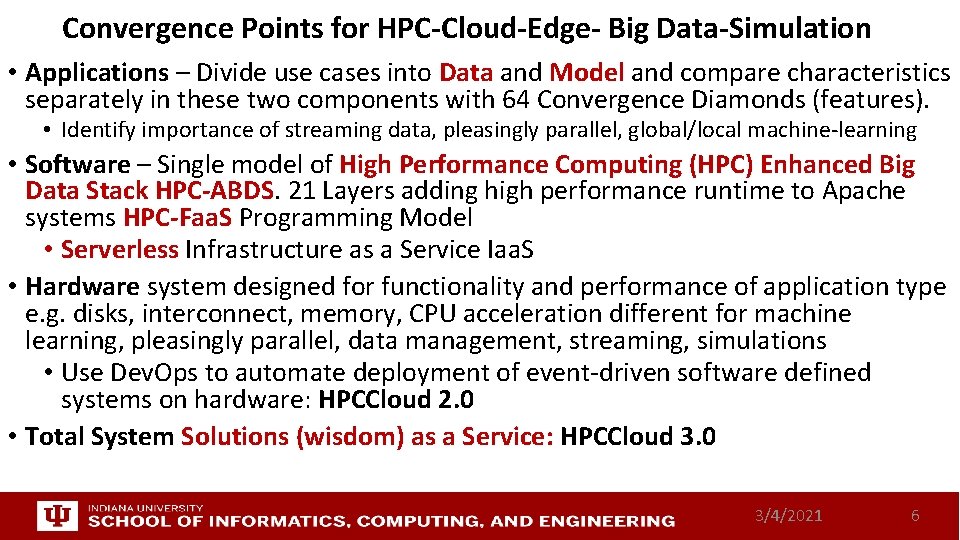
Convergence Points for HPC-Cloud-Edge- Big Data-Simulation • Applications – Divide use cases into Data and Model and compare characteristics separately in these two components with 64 Convergence Diamonds (features). • Identify importance of streaming data, pleasingly parallel, global/local machine-learning • Software – Single model of High Performance Computing (HPC) Enhanced Big Data Stack HPC-ABDS. 21 Layers adding high performance runtime to Apache systems HPC-Faa. S Programming Model • Serverless Infrastructure as a Service Iaa. S • Hardware system designed for functionality and performance of application type e. g. disks, interconnect, memory, CPU acceleration different for machine learning, pleasingly parallel, data management, streaming, simulations • Use Dev. Ops to automate deployment of event-driven software defined systems on hardware: HPCCloud 2. 0 • Total System Solutions (wisdom) as a Service: HPCCloud 3. 0 3/4/2021 6
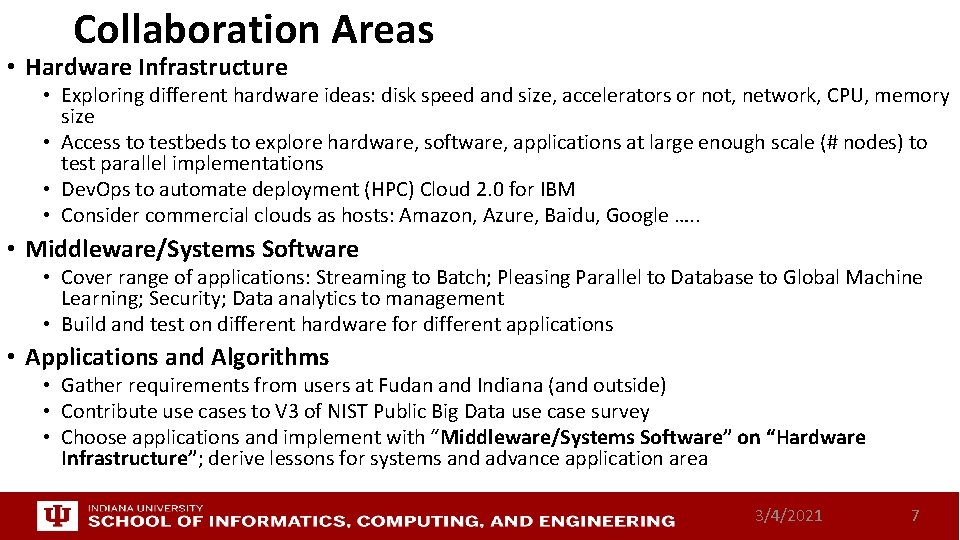
Collaboration Areas • Hardware Infrastructure • Exploring different hardware ideas: disk speed and size, accelerators or not, network, CPU, memory size • Access to testbeds to explore hardware, software, applications at large enough scale (# nodes) to test parallel implementations • Dev. Ops to automate deployment (HPC) Cloud 2. 0 for IBM • Consider commercial clouds as hosts: Amazon, Azure, Baidu, Google …. . • Middleware/Systems Software • Cover range of applications: Streaming to Batch; Pleasing Parallel to Database to Global Machine Learning; Security; Data analytics to management • Build and test on different hardware for different applications • Applications and Algorithms • Gather requirements from users at Fudan and Indiana (and outside) • Contribute use cases to V 3 of NIST Public Big Data use case survey • Choose applications and implement with “Middleware/Systems Software” on “Hardware Infrastructure”; derive lessons for systems and advance application area 3/4/2021 7
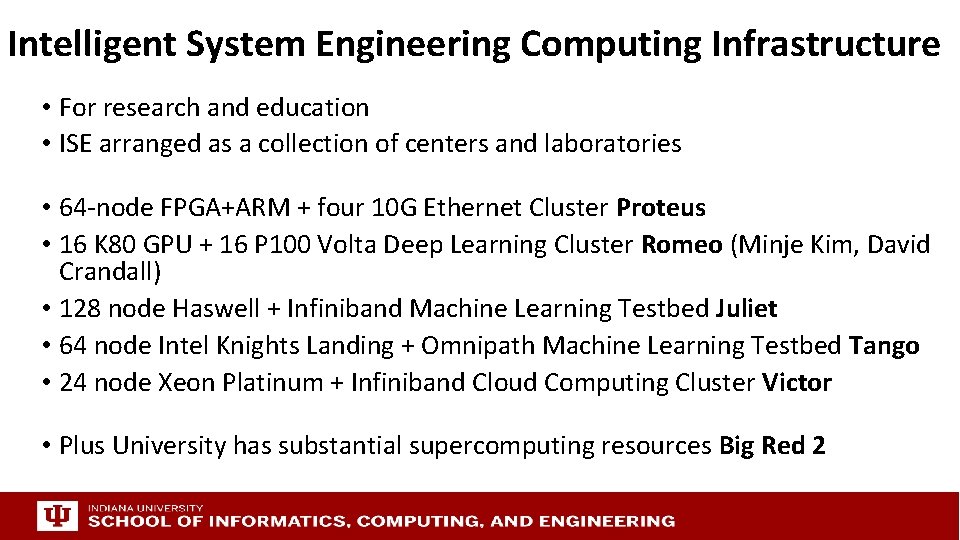
Intelligent System Engineering Computing Infrastructure • For research and education • ISE arranged as a collection of centers and laboratories • 64 -node FPGA+ARM + four 10 G Ethernet Cluster Proteus • 16 K 80 GPU + 16 P 100 Volta Deep Learning Cluster Romeo (Minje Kim, David Crandall) • 128 node Haswell + Infiniband Machine Learning Testbed Juliet • 64 node Intel Knights Landing + Omnipath Machine Learning Testbed Tango • 24 node Xeon Platinum + Infiniband Cloud Computing Cluster Victor • Plus University has substantial supercomputing resources Big Red 2
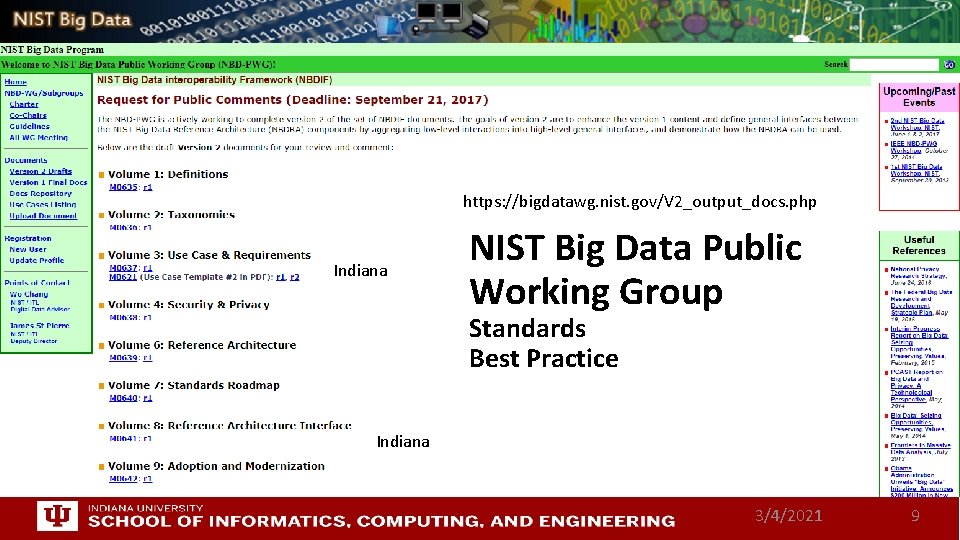
https: //bigdatawg. nist. gov/V 2_output_docs. php Indiana NIST Big Data Public Working Group Standards Best Practice Indiana 3/4/2021 9
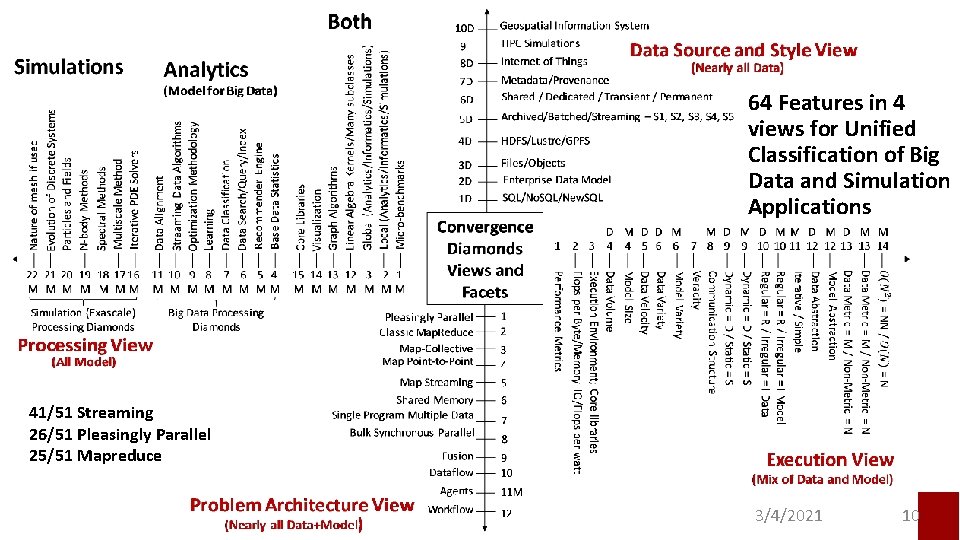
64 Features in 4 views for Unified Classification of Big Data and Simulation Applications 41/51 Streaming 26/51 Pleasingly Parallel 25/51 Mapreduce 3/4/2021 10
Software HPC-ABDS HPC-Faa. S 3/4/2021 11
HPC-ABDS Integrated wide range of HPC and Big Data technologies. I gave up updating list in January 2016! 3/4/2021 12
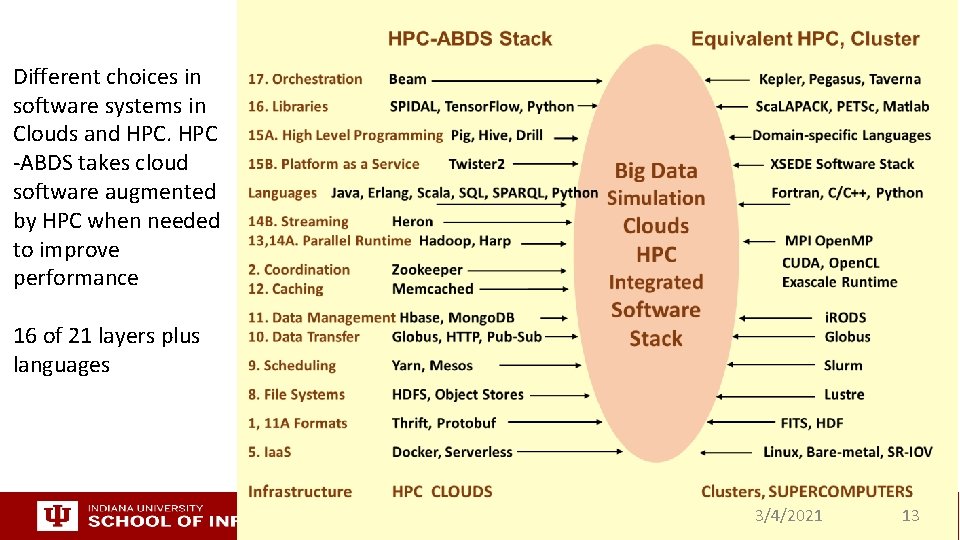
Different choices in software systems in Clouds and HPC -ABDS takes cloud software augmented by HPC when needed to improve performance 16 of 21 layers plus languages 3/4/2021 13
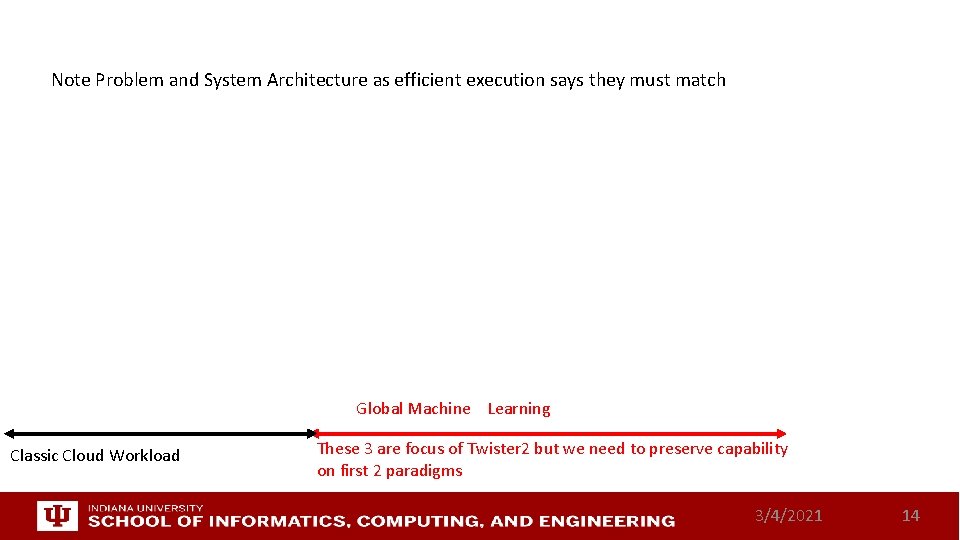
Note Problem and System Architecture as efficient execution says they must match Global Machine Learning Classic Cloud Workload These 3 are focus of Twister 2 but we need to preserve capability on first 2 paradigms 3/4/2021 14
Machine Learning Library 3/4/2021 15
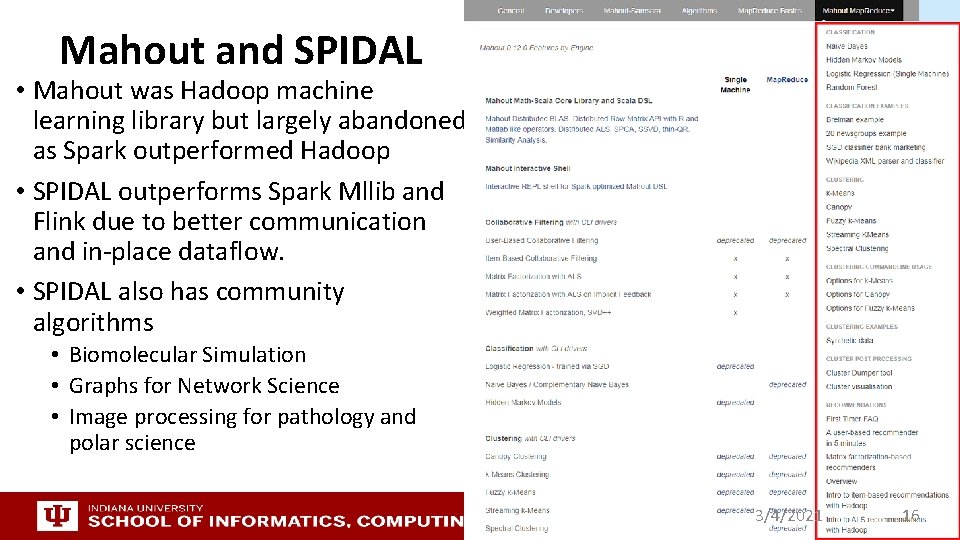
Mahout and SPIDAL • Mahout was Hadoop machine learning library but largely abandoned as Spark outperformed Hadoop • SPIDAL outperforms Spark Mllib and Flink due to better communication and in-place dataflow. • SPIDAL also has community algorithms • Biomolecular Simulation • Graphs for Network Science • Image processing for pathology and polar science 3/4/2021 16
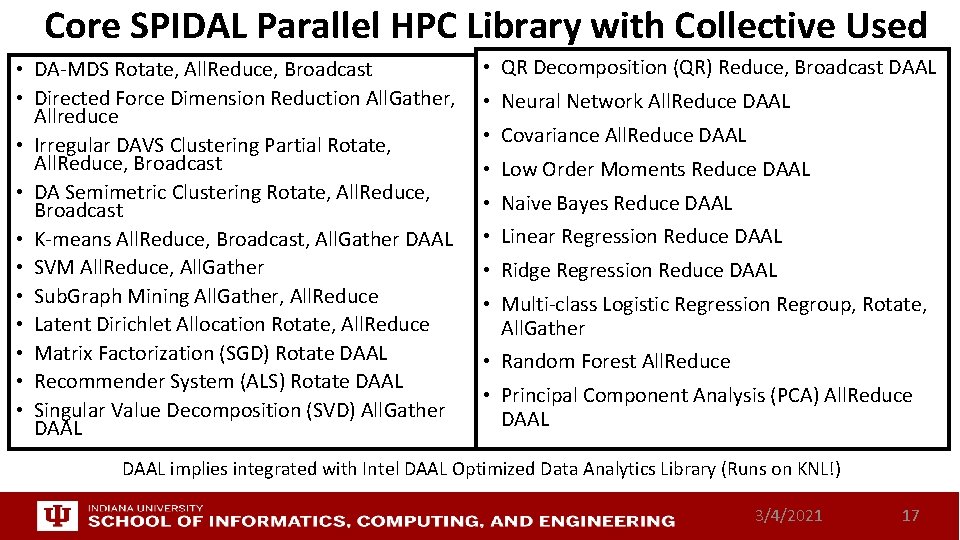
Core SPIDAL Parallel HPC Library with Collective Used • DA-MDS Rotate, All. Reduce, Broadcast • Directed Force Dimension Reduction All. Gather, Allreduce • Irregular DAVS Clustering Partial Rotate, All. Reduce, Broadcast • DA Semimetric Clustering Rotate, All. Reduce, Broadcast • K-means All. Reduce, Broadcast, All. Gather DAAL • SVM All. Reduce, All. Gather • Sub. Graph Mining All. Gather, All. Reduce • Latent Dirichlet Allocation Rotate, All. Reduce • Matrix Factorization (SGD) Rotate DAAL • Recommender System (ALS) Rotate DAAL • Singular Value Decomposition (SVD) All. Gather DAAL • QR Decomposition (QR) Reduce, Broadcast DAAL • Neural Network All. Reduce DAAL • Covariance All. Reduce DAAL • Low Order Moments Reduce DAAL • Naive Bayes Reduce DAAL • Linear Regression Reduce DAAL • Ridge Regression Reduce DAAL • Multi-class Logistic Regression Regroup, Rotate, All. Gather • Random Forest All. Reduce • Principal Component Analysis (PCA) All. Reduce DAAL implies integrated with Intel DAAL Optimized Data Analytics Library (Runs on KNL!) 3/4/2021 17
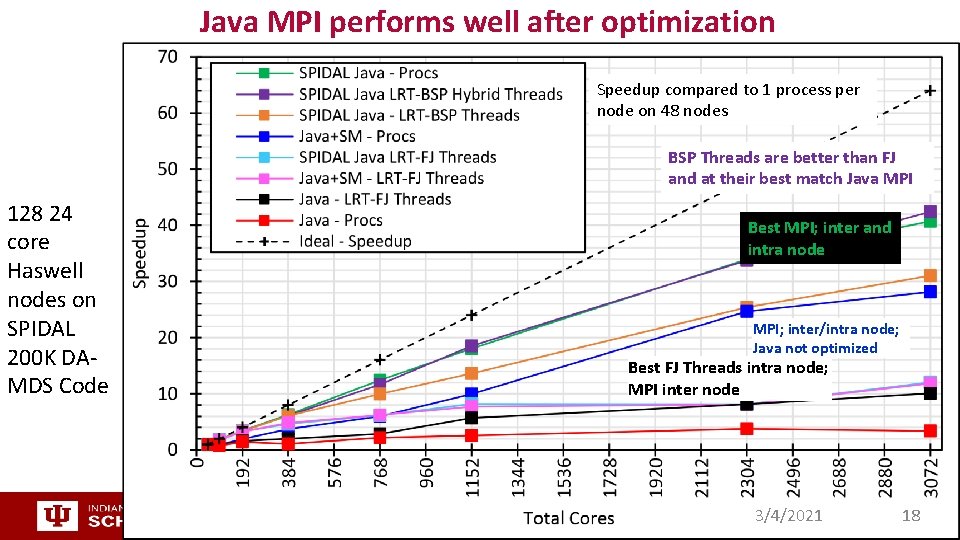
Java MPI performs well after optimization Speedup compared to 1 process per node on 48 nodes BSP Threads are better than FJ and at their best match Java MPI 128 24 core Haswell nodes on SPIDAL 200 K DAMDS Code Best MPI; inter and intra node MPI; inter/intra node; Java not optimized Best FJ Threads intra node; MPI inter node 3/4/2021 18
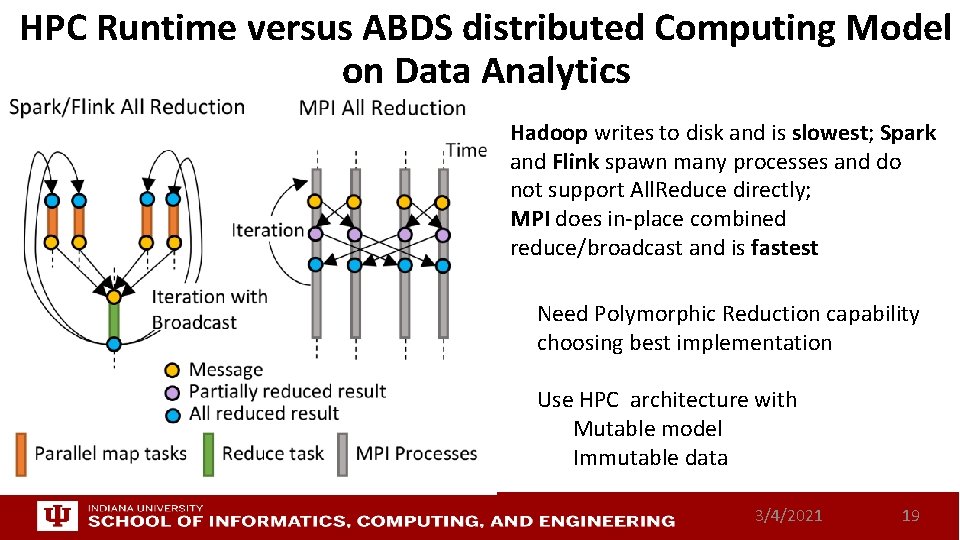
HPC Runtime versus ABDS distributed Computing Model on Data Analytics Hadoop writes to disk and is slowest; Spark and Flink spawn many processes and do not support All. Reduce directly; MPI does in-place combined reduce/broadcast and is fastest Need Polymorphic Reduction capability choosing best implementation Use HPC architecture with Mutable model Immutable data 3/4/2021 19
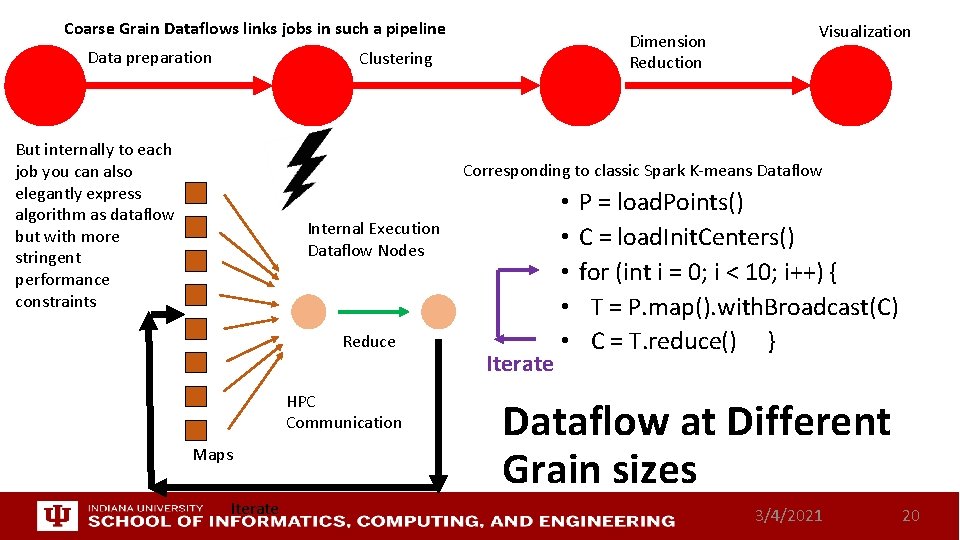
Coarse Grain Dataflows links jobs in such a pipeline Data preparation Dimension Reduction Clustering But internally to each job you can also elegantly express algorithm as dataflow but with more stringent performance constraints Visualization Corresponding to classic Spark K-means Dataflow Internal Execution Dataflow Nodes Reduce HPC Communication Maps Iterate • • • P = load. Points() C = load. Init. Centers() for (int i = 0; i < 10; i++) { T = P. map(). with. Broadcast(C) C = T. reduce() } Dataflow at Different Grain sizes 3/4/2021 20
Summary of Big Data HPC Convergence I • Applications, Benchmarks and Libraries • 51 NIST Big Data Use Cases, 7 Computational Giants of the NRC report, 13 Berkeley dwarfs, 7 NAS parallel benchmarks • Unified discussion by separately discussing data & model for each application; • 64 facets– Convergence Diamonds -- characterize applications • Characterization identifies hardware and software features for each application across big data, simulation; “complete” set of benchmarks (NIST) • Exemplar Ogre and Convergence Diamond Features • Overall application structure e. g. pleasingly parallel • Data Features e. g. from Io. T, stored in HDFS …. • Processing Features e. g. uses neural nets or conjugate gradient • Execution Structure e. g. data or model volume • Need to distinguish data management from data analytics • Management and Search I/O intensive and suitable for classic clouds • Science data has fewer users than commercial but requirements poorly understood • Analytics has many features in common with large scale simulations • Data analytics often SPMD, BSP and benefits from high performance networking and communication libraries. • Decompose Model (as in simulation) and Data (bit different and confusing) across nodes of cluster 3/4/2021 21
Summary of Big Data HPC Convergence II • Software Architecture and its implementation • HPC-ABDS: Cloud-HPC interoperable software: performance of HPC (High Performance Computing) and the rich functionality of the Apache Big Data Stack. • Added HPC to Hadoop, Storm, Heron, Spark; • Twister 2 will add to Beam and Flink as a HPC-Faa. S programming model • Could work in Apache model contributing code in different ways • One approach is an HPC project in Apache Foundation • HPCCloud runs same HPC-ABDS software across all platforms but “data management” nodes have different balance in I/O, Network and Compute from “model” nodes • Optimize to data and model functions as specified by convergence diamonds rather than optimizing for simulation and big data • Convergence Language: Make C++, Java, Scala, Python (R) … perform well • Training: Students prefer to learn machine learning and clouds and need to be taught importance of HPC to Big Data • Sustainability: research/HPC communities cannot afford to develop everything (hardware and software) from scratch • HPCCloud 2. 0 uses Dev. Ops to deploy HPC-ABDS on clouds or HPC • HPCCloud 3. 0 delivers Solutions as a Service with an HPC-Faa. S programming model 3/4/2021 22
Bringing it together Twister 2 3/4/2021 23
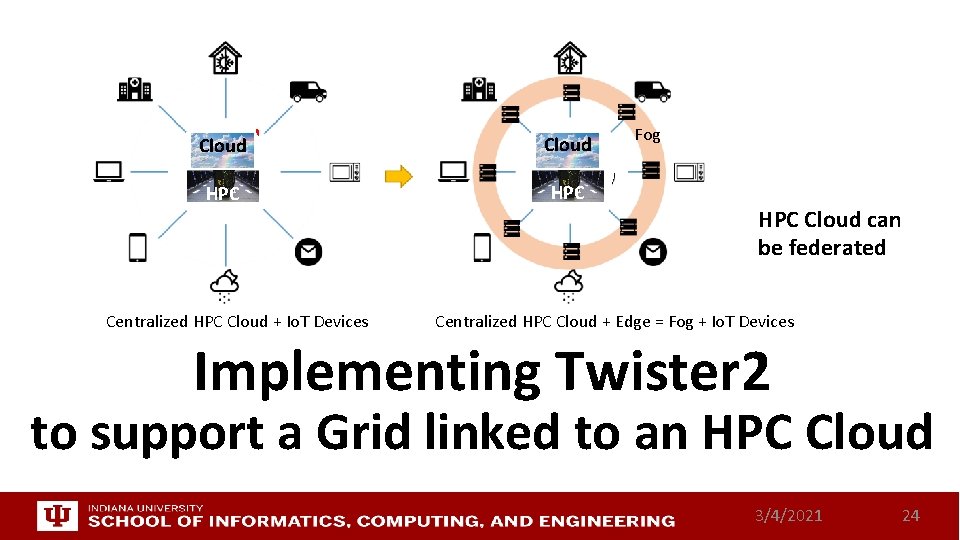
Cloud HPC Centralized HPC Cloud + Io. T Devices Cloud Fog HPC Cloud can be federated Centralized HPC Cloud + Edge = Fog + Io. T Devices Implementing Twister 2 to support a Grid linked to an HPC Cloud 3/4/2021 24
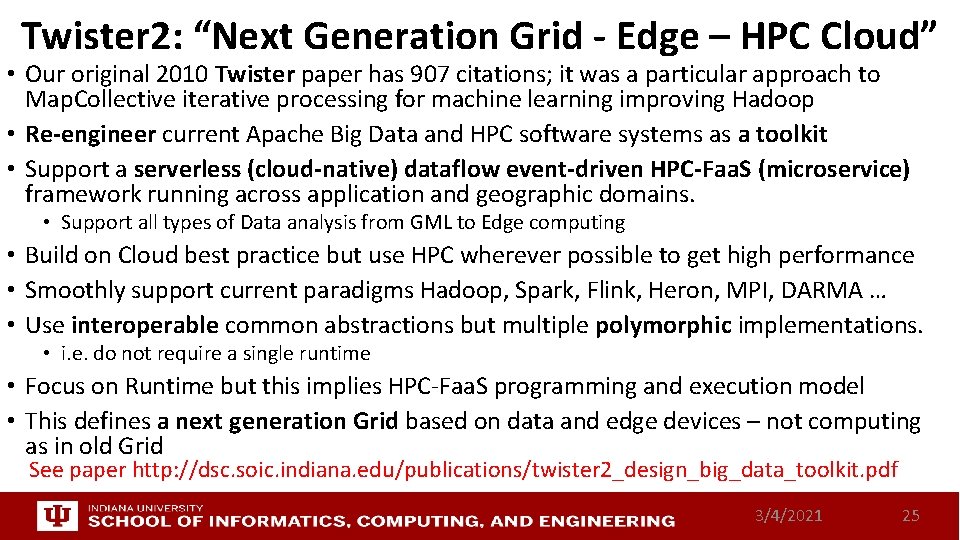
Twister 2: “Next Generation Grid - Edge – HPC Cloud” • Our original 2010 Twister paper has 907 citations; it was a particular approach to Map. Collective iterative processing for machine learning improving Hadoop • Re-engineer current Apache Big Data and HPC software systems as a toolkit • Support a serverless (cloud-native) dataflow event-driven HPC-Faa. S (microservice) framework running across application and geographic domains. • Support all types of Data analysis from GML to Edge computing • Build on Cloud best practice but use HPC wherever possible to get high performance • Smoothly support current paradigms Hadoop, Spark, Flink, Heron, MPI, DARMA … • Use interoperable common abstractions but multiple polymorphic implementations. • i. e. do not require a single runtime • Focus on Runtime but this implies HPC-Faa. S programming and execution model • This defines a next generation Grid based on data and edge devices – not computing as in old Grid See paper http: //dsc. soic. indiana. edu/publications/twister 2_design_big_data_toolkit. pdf 3/4/2021 25
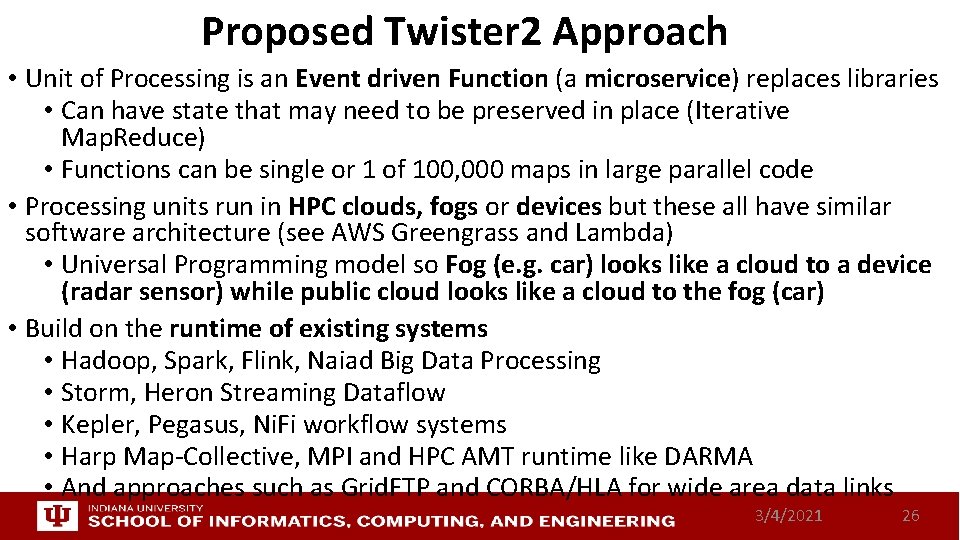
Proposed Twister 2 Approach • Unit of Processing is an Event driven Function (a microservice) replaces libraries • Can have state that may need to be preserved in place (Iterative Map. Reduce) • Functions can be single or 1 of 100, 000 maps in large parallel code • Processing units run in HPC clouds, fogs or devices but these all have similar software architecture (see AWS Greengrass and Lambda) • Universal Programming model so Fog (e. g. car) looks like a cloud to a device (radar sensor) while public cloud looks like a cloud to the fog (car) • Build on the runtime of existing systems • Hadoop, Spark, Flink, Naiad Big Data Processing • Storm, Heron Streaming Dataflow • Kepler, Pegasus, Ni. Fi workflow systems • Harp Map-Collective, MPI and HPC AMT runtime like DARMA • And approaches such as Grid. FTP and CORBA/HLA for wide area data links 3/4/2021 26
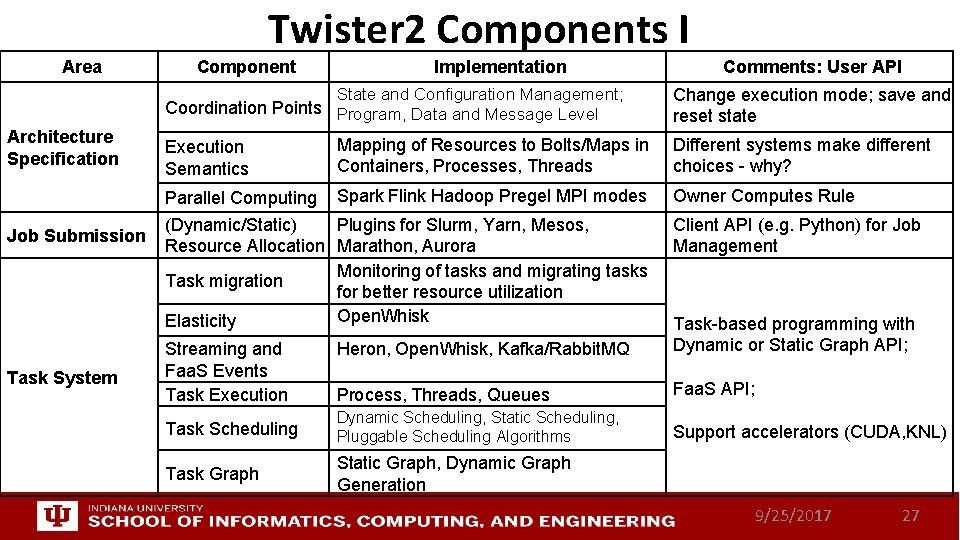
Twister 2 Components I Area Component Implementation State and Configuration Management; Coordination Points Program, Data and Message Level Architecture Specification Job Submission Task System Execution Semantics Mapping of Resources to Bolts/Maps in Containers, Processes, Threads Parallel Computing Spark Flink Hadoop Pregel MPI modes (Dynamic/Static) Plugins for Slurm, Yarn, Mesos, Resource Allocation Marathon, Aurora Monitoring of tasks and migrating tasks Task migration for better resource utilization Open. Whisk Elasticity Comments: User API Change execution mode; save and reset state Different systems make different choices - why? Owner Computes Rule Client API (e. g. Python) for Job Management Heron, Open. Whisk, Kafka/Rabbit. MQ Task-based programming with Dynamic or Static Graph API; Process, Threads, Queues Faa. S API; Task Scheduling Dynamic Scheduling, Static Scheduling, Pluggable Scheduling Algorithms Support accelerators (CUDA, KNL) Task Graph Static Graph, Dynamic Graph Generation Streaming and Faa. S Events Task Execution 9/25/2017 27
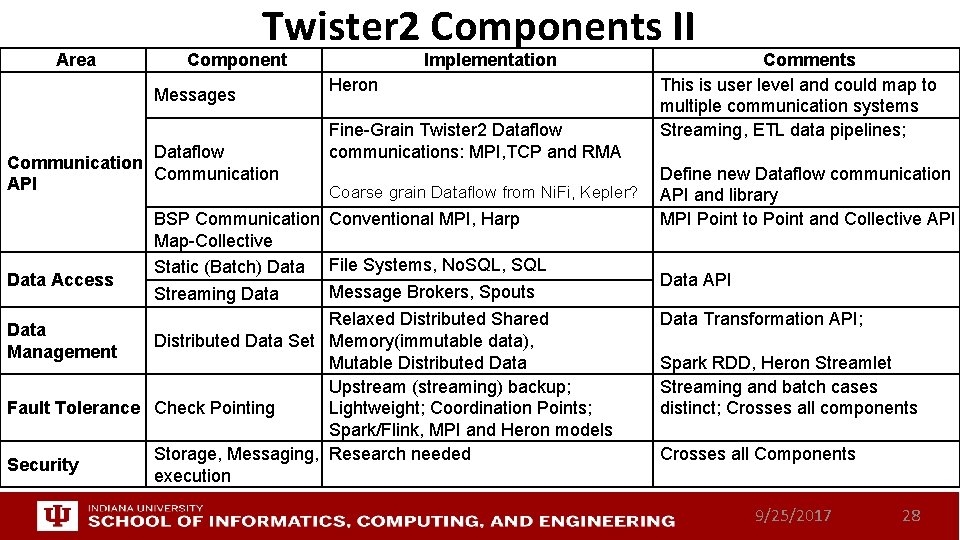
Area Twister 2 Components II Component Messages Dataflow Communication API Data Access Implementation Heron Fine-Grain Twister 2 Dataflow communications: MPI, TCP and RMA Coarse grain Dataflow from Ni. Fi, Kepler? BSP Communication Conventional MPI, Harp Map-Collective Static (Batch) Data File Systems, No. SQL, SQL Message Brokers, Spouts Streaming Data Relaxed Distributed Shared Distributed Data Set Memory(immutable data), Mutable Distributed Data Upstream (streaming) backup; Fault Tolerance Check Pointing Lightweight; Coordination Points; Spark/Flink, MPI and Heron models Storage, Messaging, Research needed Security execution Data Management Comments This is user level and could map to multiple communication systems Streaming, ETL data pipelines; Define new Dataflow communication API and library MPI Point to Point and Collective API Data Transformation API; Spark RDD, Heron Streamlet Streaming and batch cases distinct; Crosses all components Crosses all Components 9/25/2017 28
Summary of Twister 2: Next Generation HPC Cloud + Edge + Grid • We have built a high performance data analysis library SPIDAL supporting Global and Local Machine Learning • We have integrated HPC into many Apache systems with HPC-ABDS • SPIDAL ML library currently implemented as Harp on Hadoop but PHI needs richer Spark (and Heron for Streaming? ) • Twister 2 will offer Hadoop, Spark (batch big data), Heron (Streaming) and MPI(parallel computing) • Event driven computing model built around Cloud and HPC and spanning batch, streaming, and edge applications • Highly parallel on cloud; possibly sequential at the edge • Integrate current technology of Faa. S (Function as a Service) and server-hidden (serverless) computing (Open. Whisk) with HPC and Apache batch/streaming systems • Apache systems use dataflow communication which is natural for distributed systems but inevitably slow for classic parallel computing • Twister 2 has dataflow and parallel communication models 3/4/2021 29
- Slides: 29