
HP Assessment Note Writing Outpatient Visits NEW PATIENTS

- Slides: 15
H&P, Assessment, & Note Writing
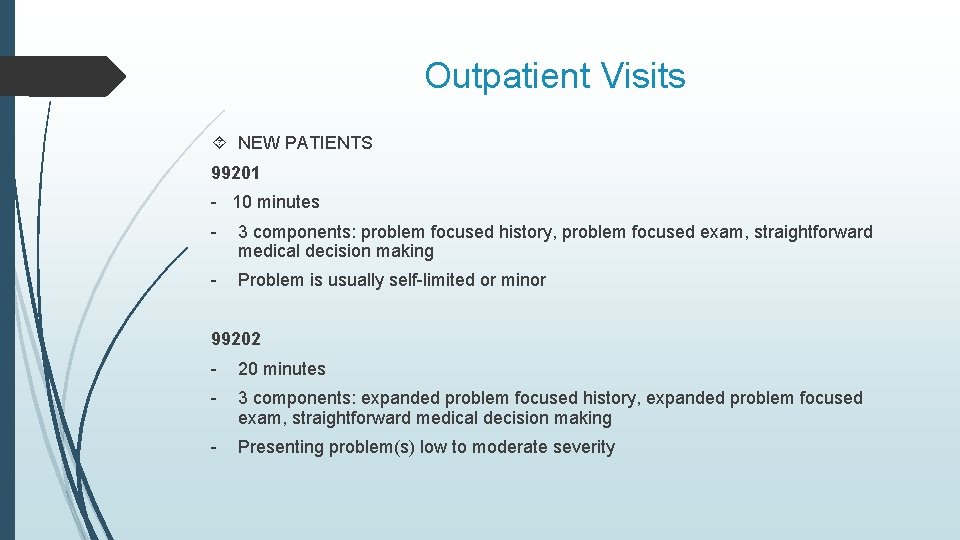
Outpatient Visits NEW PATIENTS 99201 - 10 minutes - 3 components: problem focused history, problem focused exam, straightforward medical decision making - Problem is usually self-limited or minor 99202 - 20 minutes - 3 components: expanded problem focused history, expanded problem focused exam, straightforward medical decision making - Presenting problem(s) low to moderate severity
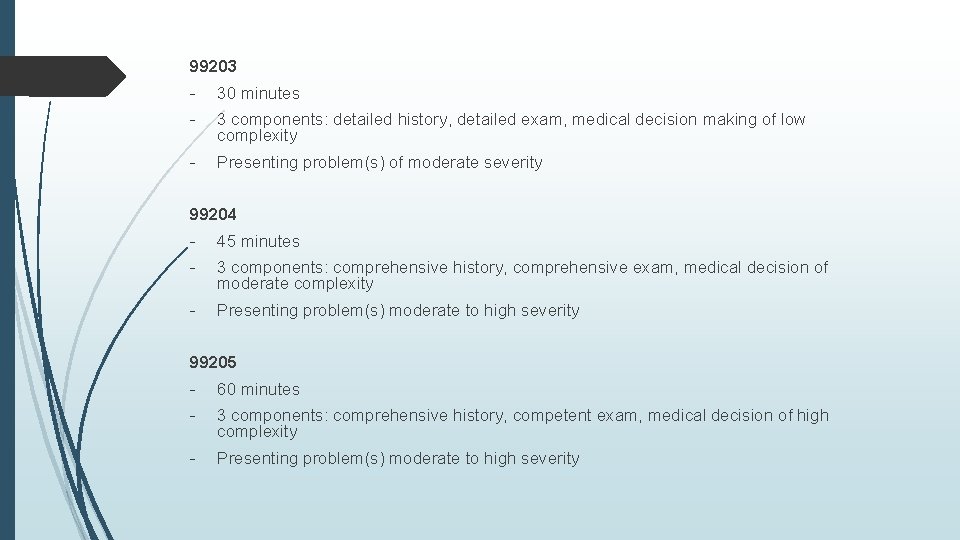
99203 - 30 minutes - 3 components: detailed history, detailed exam, medical decision making of low complexity - Presenting problem(s) of moderate severity 99204 - 45 minutes - 3 components: comprehensive history, comprehensive exam, medical decision of moderate complexity - Presenting problem(s) moderate to high severity 99205 - 60 minutes - 3 components: comprehensive history, competent exam, medical decision of high complexity - Presenting problem(s) moderate to high severity
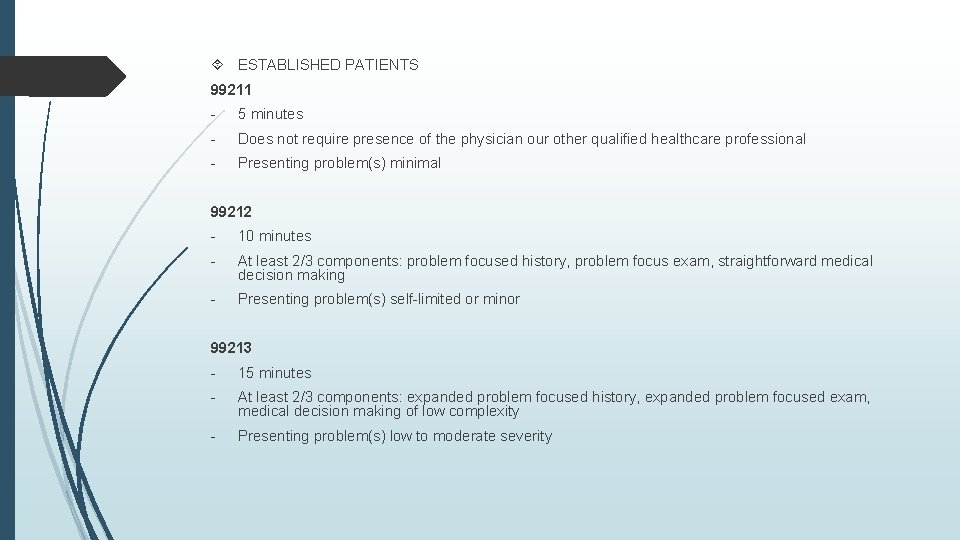
ESTABLISHED PATIENTS 99211 - 5 minutes - Does not require presence of the physician our other qualified healthcare professional - Presenting problem(s) minimal 99212 - 10 minutes - At least 2/3 components: problem focused history, problem focus exam, straightforward medical decision making - Presenting problem(s) self-limited or minor 99213 - 15 minutes - At least 2/3 components: expanded problem focused history, expanded problem focused exam, medical decision making of low complexity - Presenting problem(s) low to moderate severity
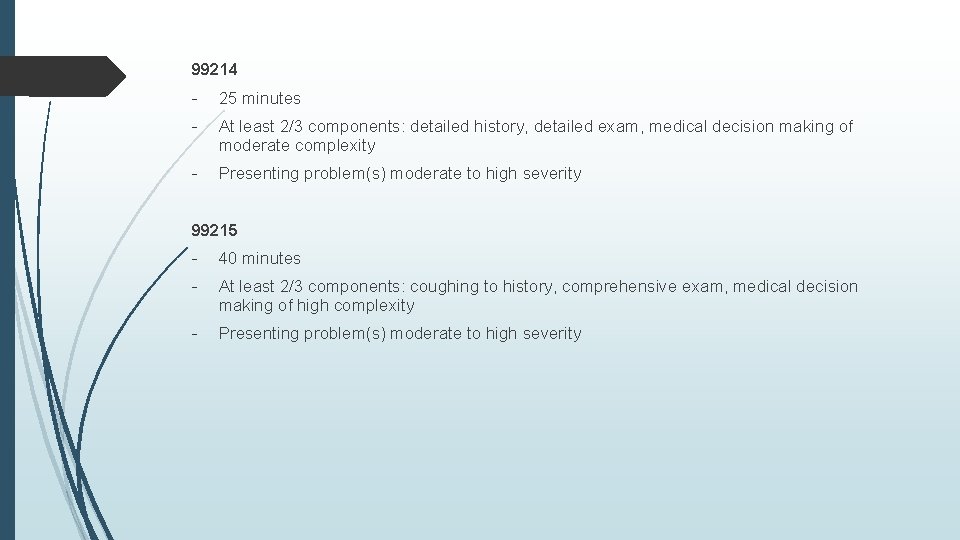
99214 - 25 minutes - At least 2/3 components: detailed history, detailed exam, medical decision making of moderate complexity - Presenting problem(s) moderate to high severity 99215 - 40 minutes - At least 2/3 components: coughing to history, comprehensive exam, medical decision making of high complexity - Presenting problem(s) moderate to high severity
Office: History of Physical Chief Complaint – completed by medical assistant when rooming the patient (ie. Left thigh soft tissue mass or Right humerus bone lesion) History of present illness – age/gender followed by reason for visit and history about mass/lesion, include history of any personal cancers and their oncologists and treatments done (XRT/chemo/Sx), if in remission for how long Patients with no history of cancer include pain, fevers, chills, numbness/tingling to affected extremity, sudden weight loss/gain, injury/trauma to site, night sweats, does pain keep patient up at night, what pain medications they are currently taking or have tried Soft tissue mass – note any increase/decrease in size
Review of Systems See HPI above – is NOT acceptable answer!! Need to summarize patient’s complaints such as swelling, LROM, pain
Physical Examination General: AAO X 3, well nourished/well developed; no apparent distress Add something personal here: husband/dtr/son present HEENT: NCAT. Head/neck FROM Lungs: Breathing comfortably; equal symmetric chest expansion Cardiac: we don’t need to address because we don’t assess this Abdomen: we don’t need to address, however this tumor is in this area – soft, nontender, nondistended, morbidly obese Mass/Tumor: left/right, site, palpable/nonpalpable, mobile/immobile, firm/soft, erythematous/non-erythematous, tender/nontender, describes size in fruits
Extremities Range of motion of the joints: full range of motion of all extremities except. . . Also include degrees of flexion to effected extremity for baseline Motor strength: WNL to all extremities. B/L UE grips strong/moderate/weak. B/L LE dorsi/pedal flexion strong/moderate/weak. Note comparison of strength by resistance Sensation: grossly intact to all extremities/brisk. Numbness/tingling… Lymph nodes: unremarkable/palpable enlarged site Pulses: B/L +2 radial/pedal pulses Skin: warm/dry, no lesions/rashes/petechiae/purpura, no clubbing/cyanosis/edema, no other palpable lumps/masses; note any pinning/non-pitting edema here Gait: normal/antalgic/limping/ambulating with walker/ambulating with cane Surgical site: well-healing surgical incision
Imaging results XR/CT scan/MRI/WBBS Because Dr. Wittig reviews the actual images, interpretations written in this section must be in accordance with Dr. Wittig’s opinion If the radiologist report states it is a cyst and Dr. Wittig states it is a lipoma, we document that Dr. Wittig disagrees with radiologist interpretation and finds that the mass is a lipoma based on the findings at the radiologist reports, such as T 1/T 2 or hypointense/hyperintense Please include date of when imaging was done as well as site (right thigh). This is an important habit for consistency Please include measurements of mass/lesion
Pathology This portion is usually used when the patient comes for their first postoperative visit and pathology is finalized Please specify the site, date it was done, and final diagnosis – left posterolateral low-grade liposarcoma If staging is provided please include This portion should also be used for new patients when they have had previous biopsies done Please specify the type of biopsy such as core needle biopsy, punch biopsy, aspiration cytology (include date when it was done)
Cultures New patients – if they had previous cultures of aspirations or wound cultures; if from other facilities please be sure these reports are obtained and scanned into the system for records Postop patients – if cultures were done intraoperatively please follow-up with updated status Gram stain culture, anaerobic culture, fungal culture (may take a few weeks for final result), AFB culture, urine culture
Labs If concern for any kind of infection: CBC with differential, ESR, CRP, UA If new patient with concern for multiple myeloma in new patient with new lesion and no history of cancer and based on clinical findings: SPEP (serum protein electrophoresis)
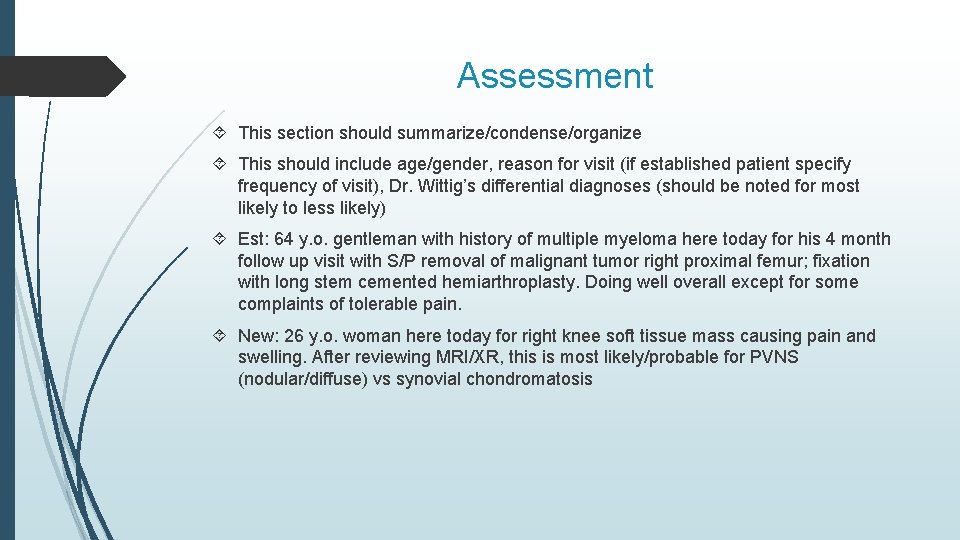
Assessment This section should summarize/condense/organize This should include age/gender, reason for visit (if established patient specify frequency of visit), Dr. Wittig’s differential diagnoses (should be noted for most likely to less likely) Est: 64 y. o. gentleman with history of multiple myeloma here today for his 4 month follow up visit with S/P removal of malignant tumor right proximal femur; fixation with long stem cemented hemiarthroplasty. Doing well overall except for some complaints of tolerable pain. New: 26 y. o. woman here today for right knee soft tissue mass causing pain and swelling. After reviewing MRI/XR, this is most likely/probable for PVNS (nodular/diffuse) vs synovial chondromatosis
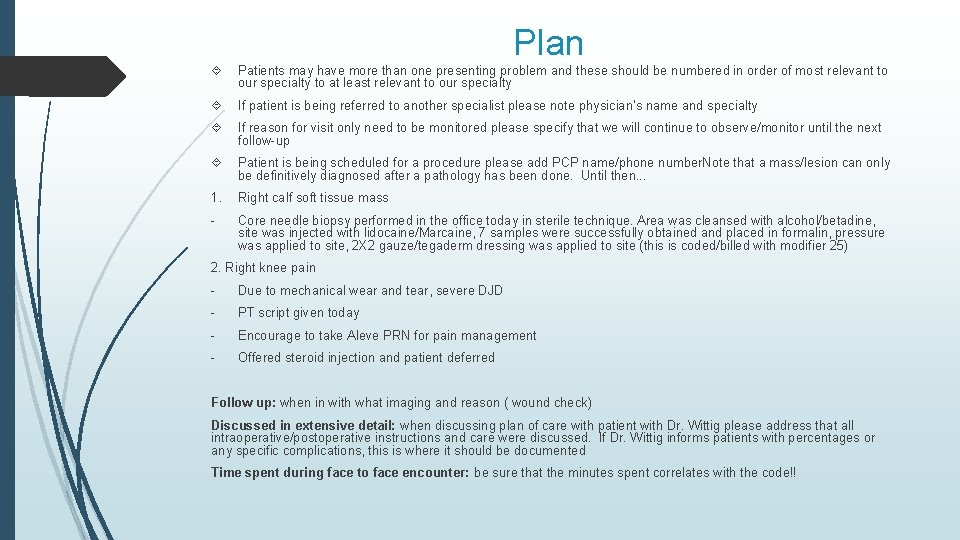
Plan Patients may have more than one presenting problem and these should be numbered in order of most relevant to our specialty to at least relevant to our specialty If patient is being referred to another specialist please note physician’s name and specialty If reason for visit only need to be monitored please specify that we will continue to observe/monitor until the next follow-up Patient is being scheduled for a procedure please add PCP name/phone number. Note that a mass/lesion can only be definitively diagnosed after a pathology has been done. Until then. . . 1. Right calf soft tissue mass - Core needle biopsy performed in the office today in sterile technique. Area was cleansed with alcohol/betadine, site was injected with lidocaine/Marcaine, 7 samples were successfully obtained and placed in formalin, pressure was applied to site, 2 X 2 gauze/tegaderm dressing was applied to site (this is coded/billed with modifier 25) 2. Right knee pain - Due to mechanical wear and tear, severe DJD - PT script given today - Encourage to take Aleve PRN for pain management - Offered steroid injection and patient deferred Follow up: when in with what imaging and reason ( wound check) Discussed in extensive detail: when discussing plan of care with patient with Dr. Wittig please address that all intraoperative/postoperative instructions and care were discussed. If Dr. Wittig informs patients with percentages or any specific complications, this is where it should be documented Time spent during face to face encounter: be sure that the minutes spent correlates with the code!!