
HP 10 HEAT PROCESSES Combustion and burners pulverized
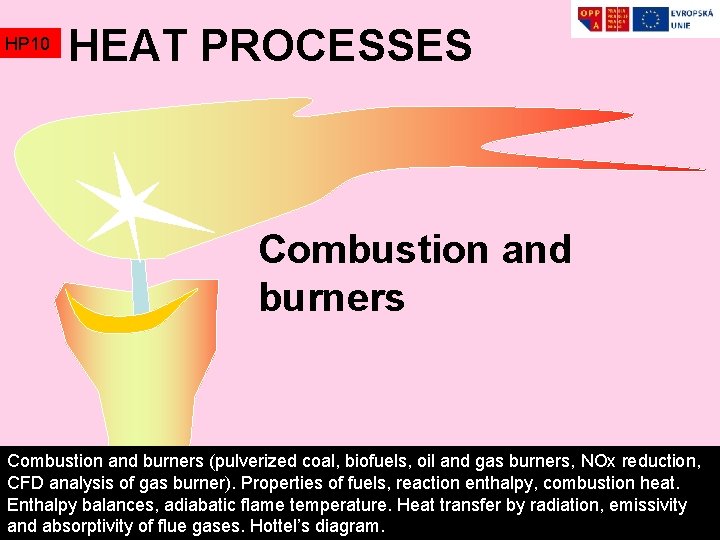
HP 10 HEAT PROCESSES Combustion and burners (pulverized coal, biofuels, oil and gas burners, NOx reduction, CFD analysis of gas burner). Properties of fuels, reaction enthalpy, combustion heat. Enthalpy balances, adiabatic flame temperature. Heat transfer by radiation, emissivity Rudolf Žitný, Ústav procesní a and absorptivity of. FSflue zpracovatelské techniky ČVUT 2010 gases. Hottel’s diagram.
HP 10 Combustion and burners Combustors, burners, boilers, can be classified according to size of fuel particles ØLarge lumps (Stoker fired furnaces, bio-fuels, wastes) ØMedium particles (fluidised beds) ØFine particles (conveying burners) ØLiquid fuels (atomizers) ØGas burners Tomasso
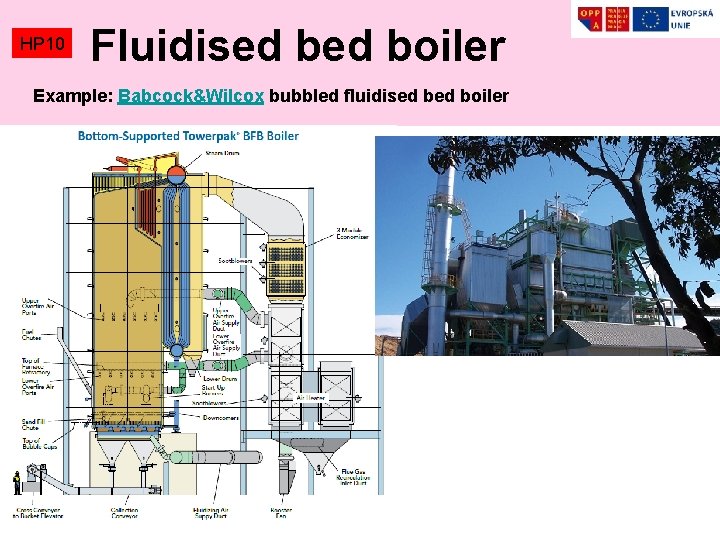
HP 10 Fluidised boiler Example: Babcock&Wilcox bubbled fluidised boiler
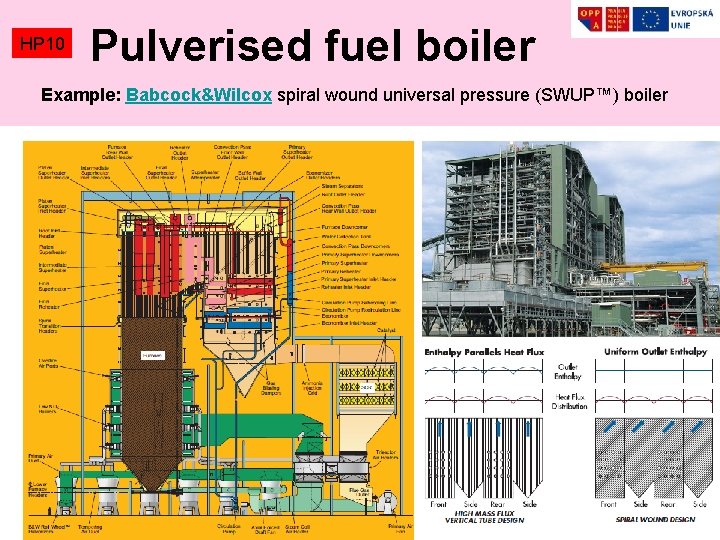
HP 10 Pulverised fuel boiler Example: Babcock&Wilcox spiral wound universal pressure (SWUP™) boiler
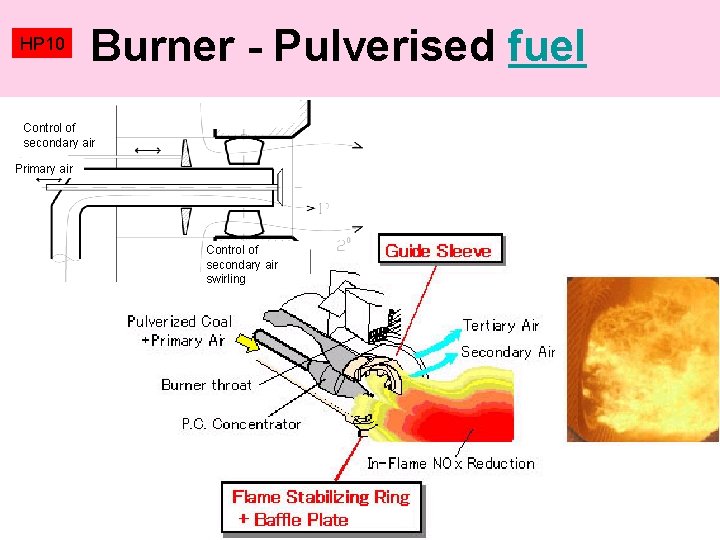
HP 10 Burner - Pulverised fuel Control of secondary air Primary air Control of secondary air swirling
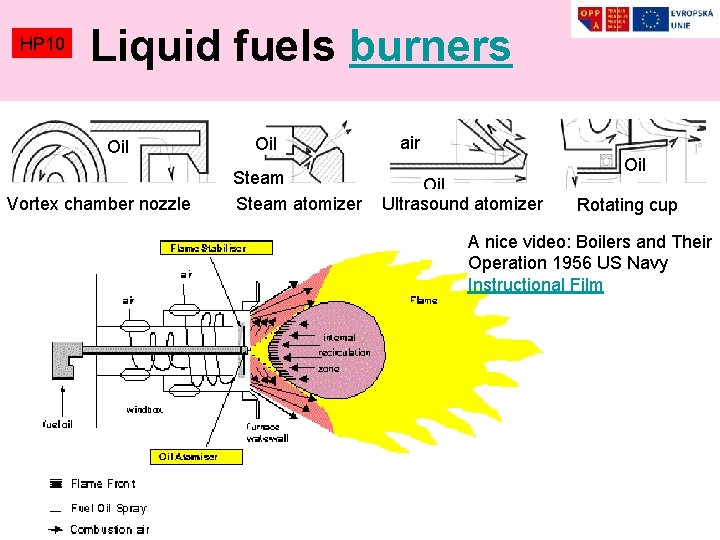
HP 10 Liquid fuels burners Oil Vortex chamber nozzle Oil Steam atomizer air Oil Ultrasound atomizer Rotating cup A nice video: Boilers and Their Operation 1956 US Navy Instructional Film
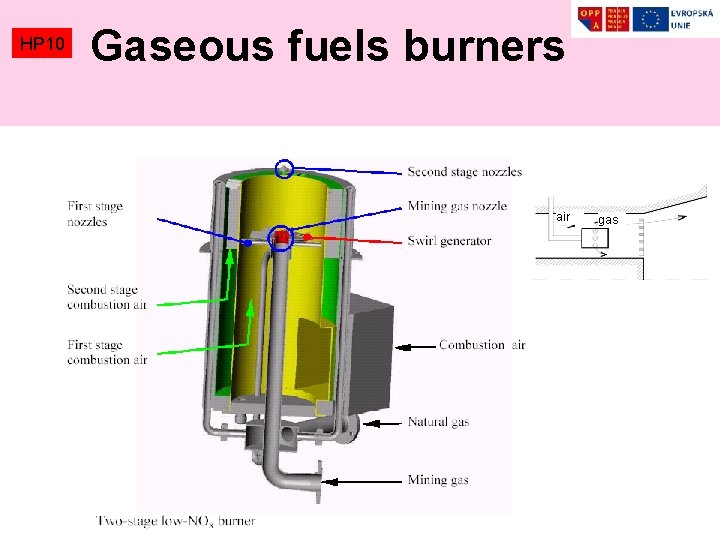
HP 10 Gaseous fuels burners air gas
COMBUSTION - fundamentals HP 10 • • Fuel composition and Heating value Statics of combustion Mass and enthalpy balancing Heat transfer - radiation Benson
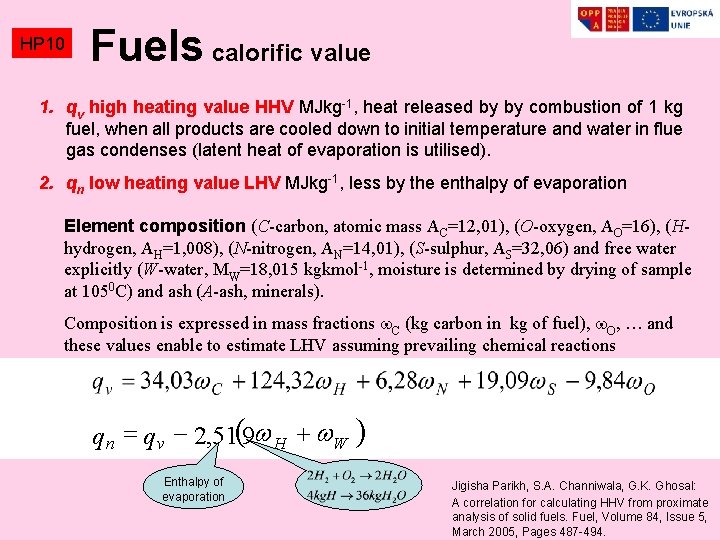
HP 10 Fuels calorific value 1. qv high heating value HHV MJkg-1, heat released by by combustion of 1 kg fuel, when all products are cooled down to initial temperature and water in flue gas condenses (latent heat of evaporation is utilised). 2. qn low heating value LHV MJkg-1, less by the enthalpy of evaporation Element composition (C-carbon, atomic mass AC=12, 01), (O-oxygen, AO=16), (Hhydrogen, AH=1, 008), (N-nitrogen, AN=14, 01), (S-sulphur, AS=32, 06) and free water explicitly (W-water, MW=18, 015 kgkmol-1, moisture is determined by drying of sample at 1050 C) and ash (A-ash, minerals). Composition is expressed in mass fractions C (kg carbon in kg of fuel), O, … and these values enable to estimate LHV assuming prevailing chemical reactions q n = qv - 2, 51(9 w H + w. W ) Enthalpy of evaporation Jigisha Parikh, S. A. Channiwala, G. K. Ghosal: A correlation for calculating HHV from proximate analysis of solid fuels. Fuel, Volume 84, Issue 5, March 2005, Pages 487 -494.
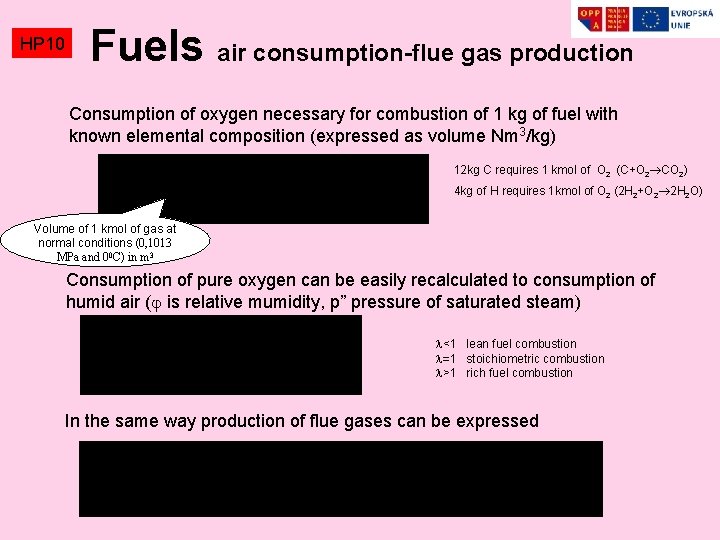
HP 10 Fuels air consumption-flue gas production Consumption of oxygen necessary for combustion of 1 kg of fuel with known elemental composition (expressed as volume Nm 3/kg) 12 kg C requires 1 kmol of O 2 (C+O 2 CO 2) 4 kg of H requires 1 kmol of O 2 (2 H 2+O 2 2 H 2 O) Volume of 1 kmol of gas at normal conditions (0, 1013 MPa and 00 C) in m 3 Consumption of pure oxygen can be easily recalculated to consumption of humid air ( is relative mumidity, p” pressure of saturated steam) <1 lean fuel combustion =1 stoichiometric combustion >1 rich fuel combustion In the same way production of flue gases can be expressed
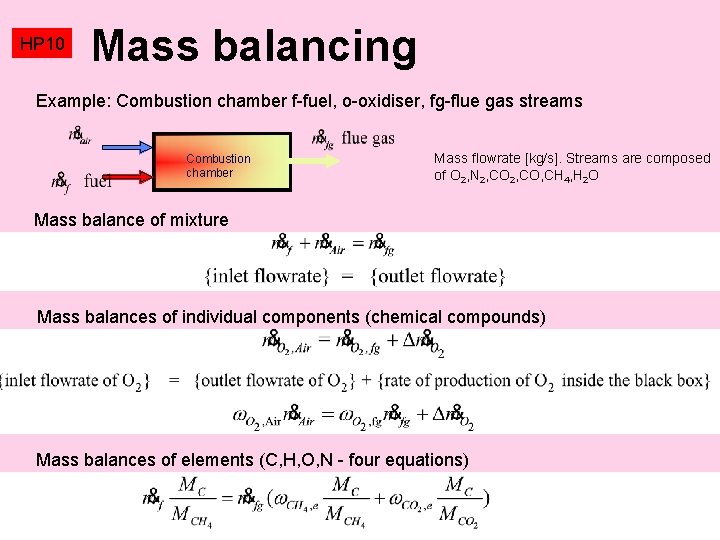
HP 10 Mass balancing Example: Combustion chamber f-fuel, o-oxidiser, fg-flue gas streams Combustion chamber Mass flowrate [kg/s]. Streams are composed of O 2, N 2, CO, CH 4, H 2 O Mass balance of mixture Mass balances of individual components (chemical compounds) Mass balances of elements (C, H, O, N - four equations)
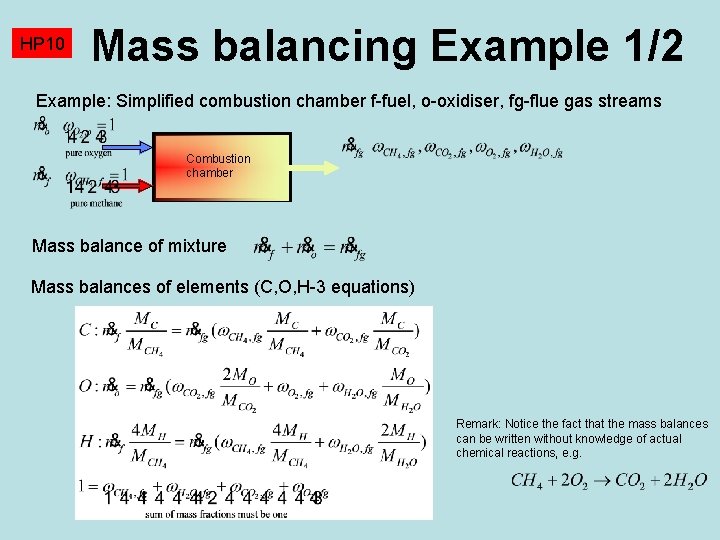
HP 10 Mass balancing Example 1/2 Example: Simplified combustion chamber f-fuel, o-oxidiser, fg-flue gas streams Combustion chamber Mass balance of mixture Mass balances of elements (C, O, H-3 equations) Remark: Notice the fact that the mass balances can be written without knowledge of actual chemical reactions, e. g.
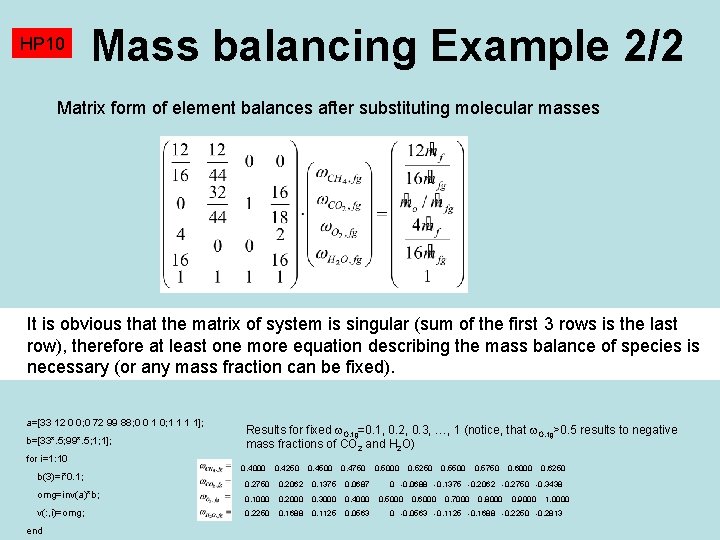
HP 10 Mass balancing Example 2/2 Matrix form of element balances after substituting molecular masses It is obvious that the matrix of system is singular (sum of the first 3 rows is the last row), therefore at least one more equation describing the mass balance of species is necessary (or any mass fraction can be fixed). a=[33 12 0 0; 0 72 99 88; 0 0 1 0; 1 1]; b=[33*. 5; 99*. 5; 1; 1]; for i=1: 10 b(3)=i*0. 1; Results for fixed O, fg=0. 1, 0. 2, 0. 3, …, 1 (notice, that O, fg>0. 5 results to negative mass fractions of CO 2 and H 2 O) 0. 4000 0. 4250 0. 4500 0. 4750 0. 2062 0. 1375 0. 0687 omg=inv(a)*b; 0. 1000 0. 2000 0. 3000 0. 4000 v(: , i)=omg; 0. 2250 0. 1688 0. 1125 0. 0563 end 0. 5000 0. 5250 0. 5500 0. 5750 0. 6000 0. 6250 0 -0. 0688 -0. 1375 -0. 2062 -0. 2750 -0. 3438 0. 5000 0. 6000 0. 7000 0. 8000 0. 9000 1. 0000 0 -0. 0563 -0. 1125 -0. 1688 -0. 2250 -0. 2813
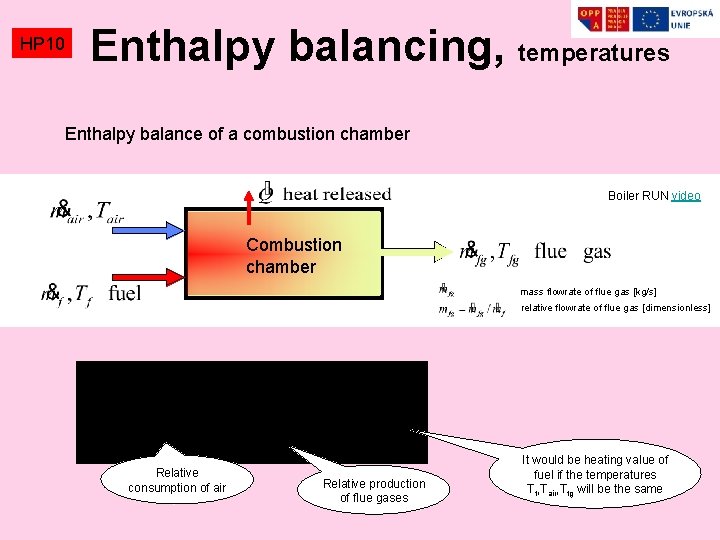
HP 10 Enthalpy balancing, temperatures Enthalpy balance of a combustion chamber Boiler RUN video Combustion chamber mass flowrate of flue gas [kg/s] relative flowrate of flue gas [dimensionless] Relative consumption of air Relative production of flue gases It would be heating value of fuel if the temperatures Tf, Tair, Tfg will be the same
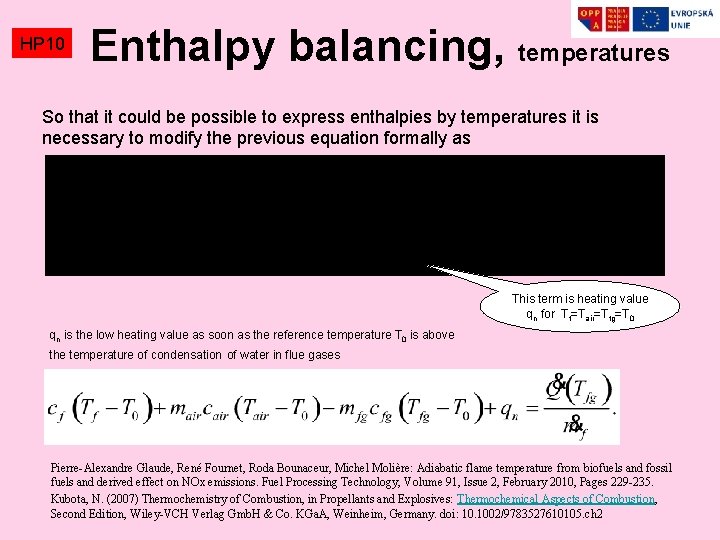
HP 10 Enthalpy balancing, temperatures So that it could be possible to express enthalpies by temperatures it is necessary to modify the previous equation formally as This term is heating value qn for Tf=Tair=Tfg=T 0 qn is the low heating value as soon as the reference temperature T 0 is above the temperature of condensation of water in flue gases Pierre-Alexandre Glaude, René Fournet, Roda Bounaceur, Michel Molière: Adiabatic flame temperature from biofuels and fossil fuels and derived effect on NOx emissions. Fuel Processing Technology, Volume 91, Issue 2, February 2010, Pages 229 -235. Kubota, N. (2007) Thermochemistry of Combustion, in Propellants and Explosives: Thermochemical Aspects of Combustion, Second Edition, Wiley-VCH Verlag Gmb. H & Co. KGa. A, Weinheim, Germany. doi: 10. 1002/9783527610105. ch 2
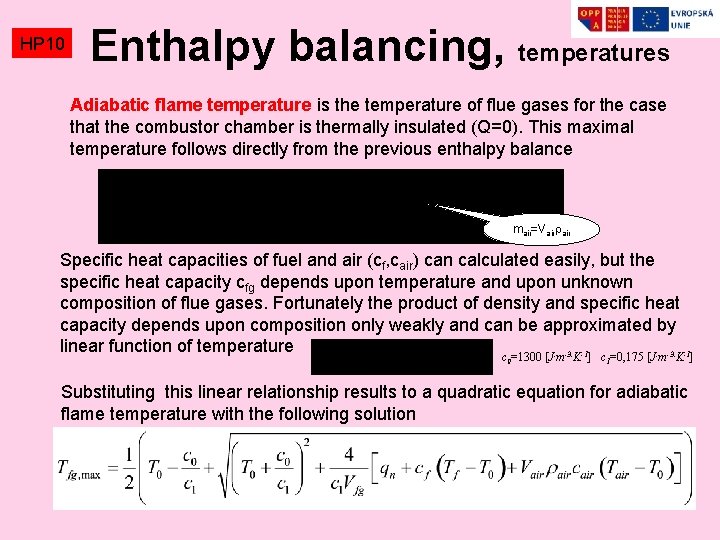
HP 10 Enthalpy balancing, temperatures Adiabatic flame temperature is the temperature of flue gases for the case that the combustor chamber is thermally insulated (Q=0). This maximal temperature follows directly from the previous enthalpy balance mair=Vair Specific heat capacities of fuel and air (cf, cair) can calculated easily, but the specific heat capacity cfg depends upon temperature and upon unknown composition of flue gases. Fortunately the product of density and specific heat capacity depends upon composition only weakly and can be approximated by linear function of temperature c =1300 [J. m-3. K-1] c =0, 175 [J. m-3. K-1] 0 1 Substituting this linear relationship results to a quadratic equation for adiabatic flame temperature with the following solution
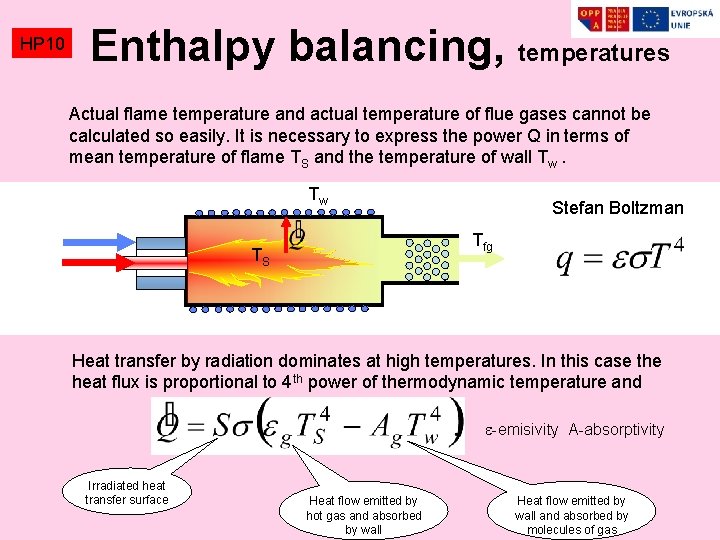
HP 10 Enthalpy balancing, temperatures Actual flame temperature and actual temperature of flue gases cannot be calculated so easily. It is necessary to express the power Q in terms of mean temperature of flame TS and the temperature of wall Tw. Tw Stefan Boltzman Tfg TS Heat transfer by radiation dominates at high temperatures. In this case the heat flux is proportional to 4 th power of thermodynamic temperature and -emisivity A-absorptivity Irradiated heat transfer surface Heat flow emitted by hot gas and absorbed by wall Heat flow emitted by wall and absorbed by molecules of gas
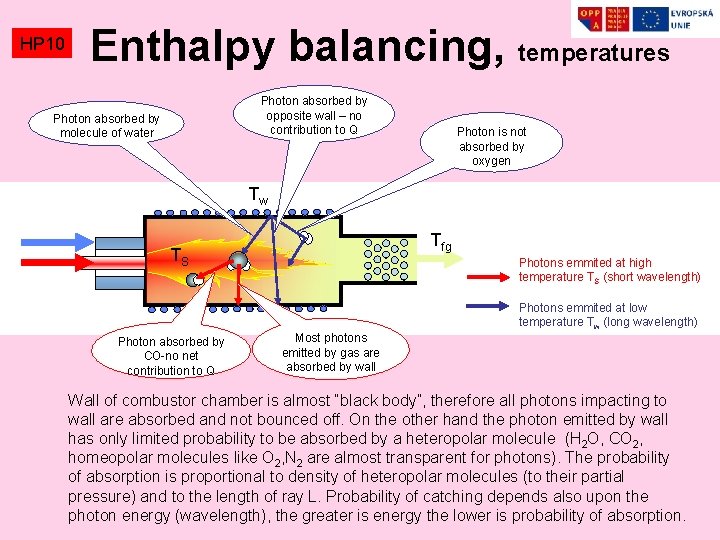
HP 10 Enthalpy balancing, temperatures Photon absorbed by opposite wall – no contribution to Q Photon absorbed by molecule of water Photon is not absorbed by oxygen Tw Tfg TS Photons emmited at high temperature TS (short wavelength) Photons emmited at low temperature Tw (long wavelength) Photon absorbed by CO-no net contribution to Q Most photons emitted by gas are absorbed by wall Wall of combustor chamber is almost “black body”, therefore all photons impacting to wall are absorbed and not bounced off. On the other hand the photon emitted by wall has only limited probability to be absorbed by a heteropolar molecule (H 2 O, CO 2, homeopolar molecules like O 2, N 2 are almost transparent for photons). The probability of absorption is proportional to density of heteropolar molecules (to their partial pressure) and to the length of ray L. Probability of catching depends also upon the photon energy (wavelength), the greater is energy the lower is probability of absorption.
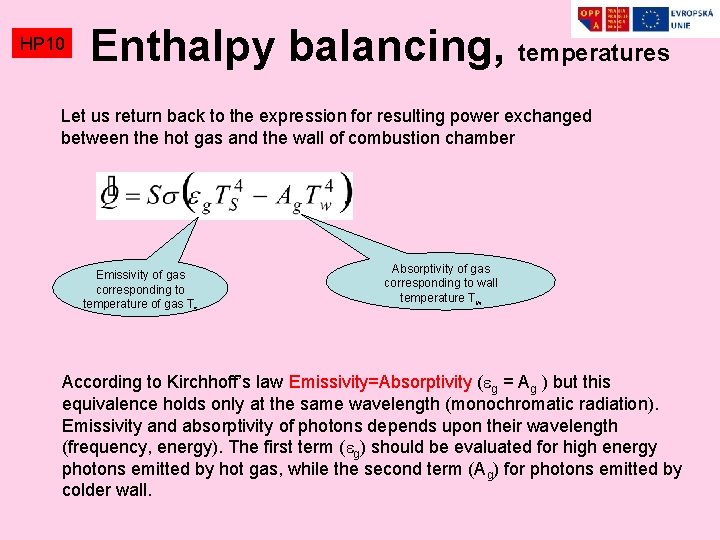
HP 10 Enthalpy balancing, temperatures Let us return back to the expression for resulting power exchanged between the hot gas and the wall of combustion chamber Emissivity of gas corresponding to temperature of gas Ts Absorptivity of gas corresponding to wall temperature Tw According to Kirchhoff’s law Emissivity=Absorptivity ( g = Ag ) but this equivalence holds only at the same wavelength (monochromatic radiation). Emissivity and absorptivity of photons depends upon their wavelength (frequency, energy). The first term ( g) should be evaluated for high energy photons emitted by hot gas, while the second term (Ag) for photons emitted by colder wall.
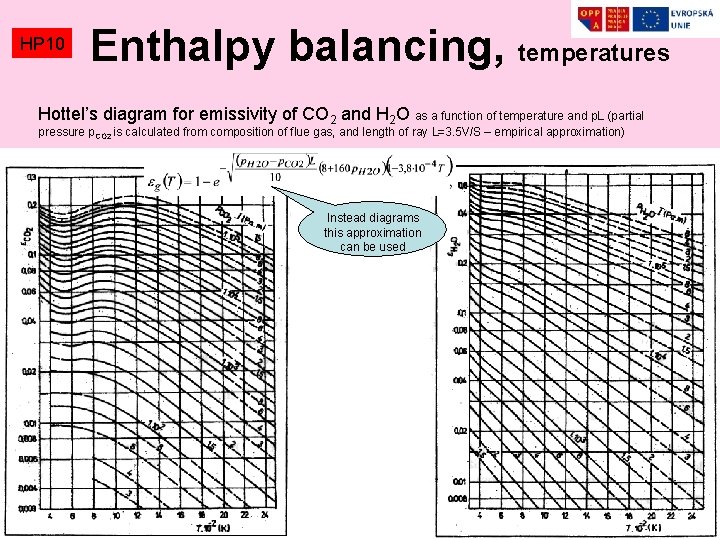
HP 10 Enthalpy balancing, temperatures Hottel’s diagram for emissivity of CO 2 and H 2 O as a function of temperature and p. L (partial pressure p. CO 2 is calculated from composition of flue gas, and length of ray L=3. 5 V/S – empirical approximation) Instead diagrams this approximation can be used
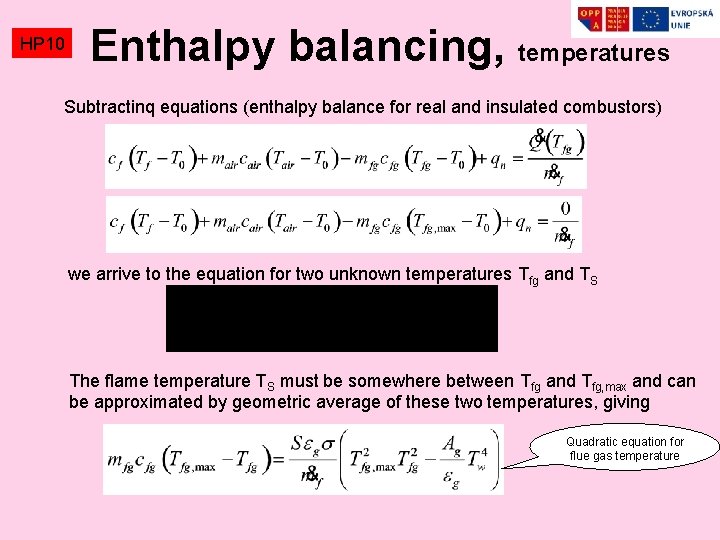
HP 10 Enthalpy balancing, temperatures Subtractinq equations (enthalpy balance for real and insulated combustors) we arrive to the equation for two unknown temperatures Tfg and TS The flame temperature TS must be somewhere between Tfg and Tfg, max and can be approximated by geometric average of these two temperatures, giving Quadratic equation for flue gas temperature
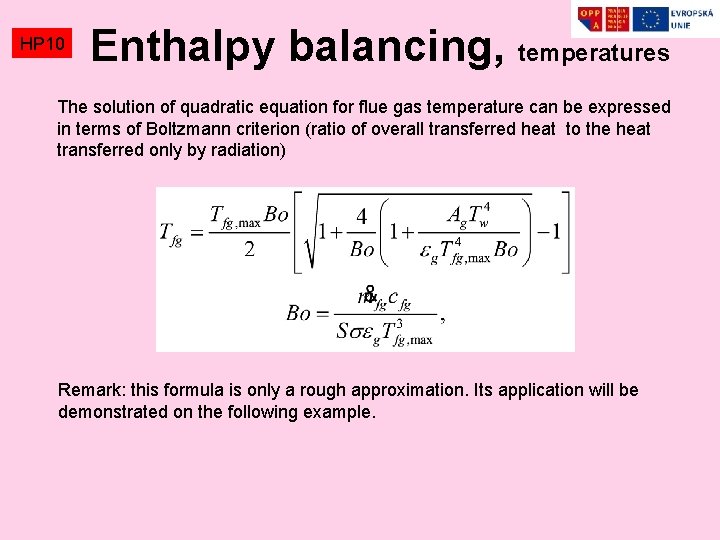
HP 10 Enthalpy balancing, temperatures The solution of quadratic equation for flue gas temperature can be expressed in terms of Boltzmann criterion (ratio of overall transferred heat to the heat transferred only by radiation) Remark: this formula is only a rough approximation. Its application will be demonstrated on the following example.
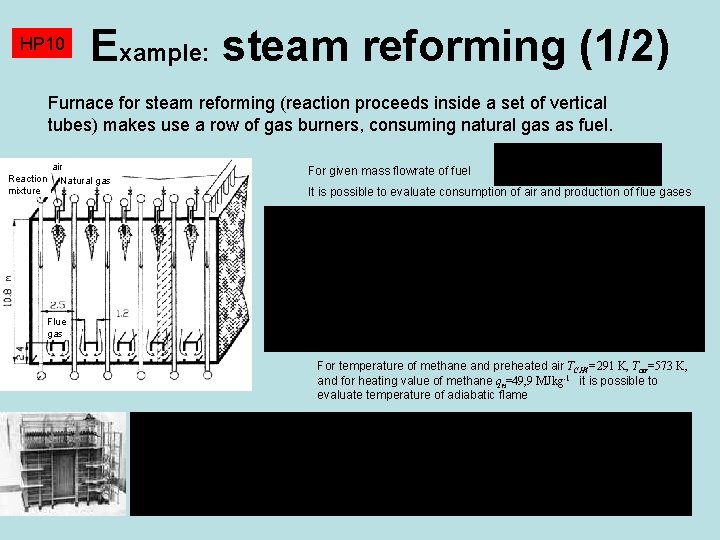
HP 10 Example: steam reforming (1/2) Furnace for steam reforming (reaction proceeds inside a set of vertical tubes) makes use a row of gas burners, consuming natural gas as fuel. Reaction mixture air Natural gas For given mass flowrate of fuel It is possible to evaluate consumption of air and production of flue gases Flue gas For temperature of methane and preheated air TCH 4=291 K, Tair=573 K, and for heating value of methane qn=49, 9 MJkg-1 it is possible to evaluate temperature of adiabatic flame
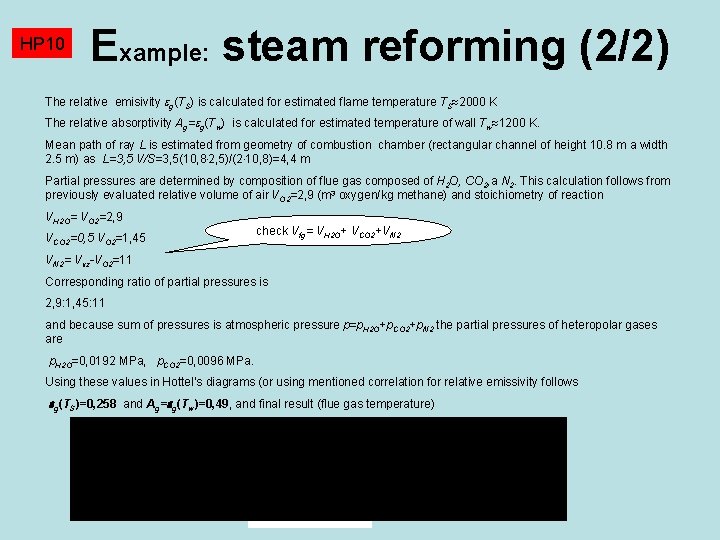
HP 10 Example: steam reforming (2/2) The relative emisivity g(TS) is calculated for estimated flame temperature TS 2000 K The relative absorptivity Ag= g(Tw) is calculated for estimated temperature of wall Tw 1200 K. Mean path of ray L is estimated from geometry of combustion chamber (rectangular channel of height 10. 8 m a width 2. 5 m) as L=3, 5 V/S=3, 5(10, 8. 2, 5)/(2. 10, 8)=4, 4 m Partial pressures are determined by composition of flue gas composed of H 2 O, CO 2, a N 2. This calculation follows from previously evaluated relative volume of air VO 2=2, 9 (m 3 oxygen/kg methane) and stoichiometry of reaction VH 2 O= VO 2=2, 9 VCO 2=0, 5 VO 2=1, 45 check Vfg= VH 2 O+ VCO 2+VN 2= Vvz-VO 2=11 Corresponding ratio of partial pressures is 2, 9: 1, 45: 11 and because sum of pressures is atmospheric pressure p=p. H 2 O+p. CO 2+p. N 2 the partial pressures of heteropolar gases are p. H 2 O=0, 0192 MPa, p. CO 2=0, 0096 MPa. Using these values in Hottel’s diagrams (or using mentioned correlation for relative emissivity follows g(TS)=0, 258 and Ag= g(Tw)=0, 49, and final result (flue gas temperature)

HP 10
HP 10 EXAM Combustion Equations describing static of combustion follow from the assumed chemical reactions C+O 2 CO 2 2 H 2+O 2 2 H 2 O S+O 2 SO 2 … You also need to know atomic masses of participating elements MC=12 g/mol, MO=16, MS=32, MH=1, MN=14, …
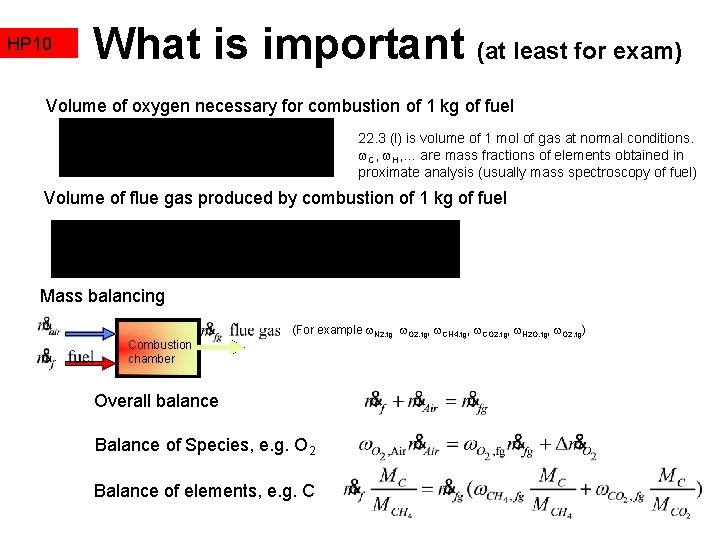
HP 10 What is important (at least for exam) Volume of oxygen necessary for combustion of 1 kg of fuel 22. 3 (l) is volume of 1 mol of gas at normal conditions. C, H, … are mass fractions of elements obtained in proximate analysis (usually mass spectroscopy of fuel) Volume of flue gas produced by combustion of 1 kg of fuel Mass balancing Combustion chamber (For example N 2, fg O 2, fg, CH 4, fg, CO 2, fg, H 2 O, fg, O 2, fg) Overall balance Balance of Species, e. g. O 2 Balance of elements, e. g. C
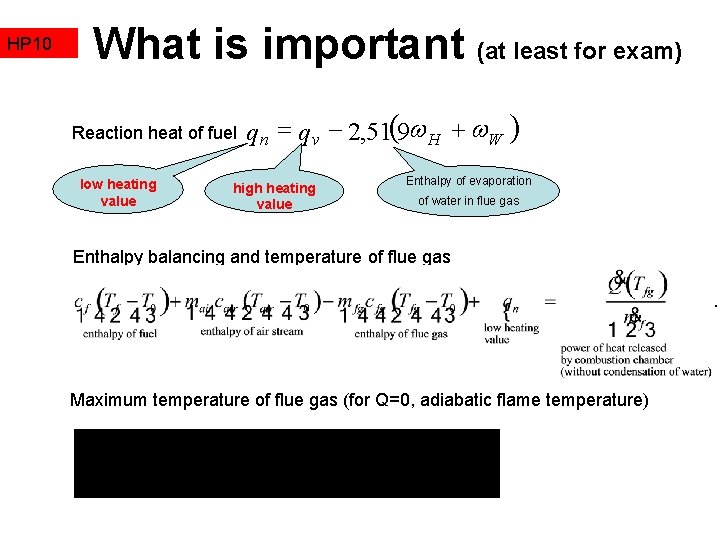
HP 10 What is important (at least for exam) Reaction heat of fuel low heating value q n = qv - 2, 51(9 w H + w. W ) high heating value Enthalpy of evaporation of water in flue gas Enthalpy balancing and temperature of flue gas Maximum temperature of flue gas (for Q=0, adiabatic flame temperature)
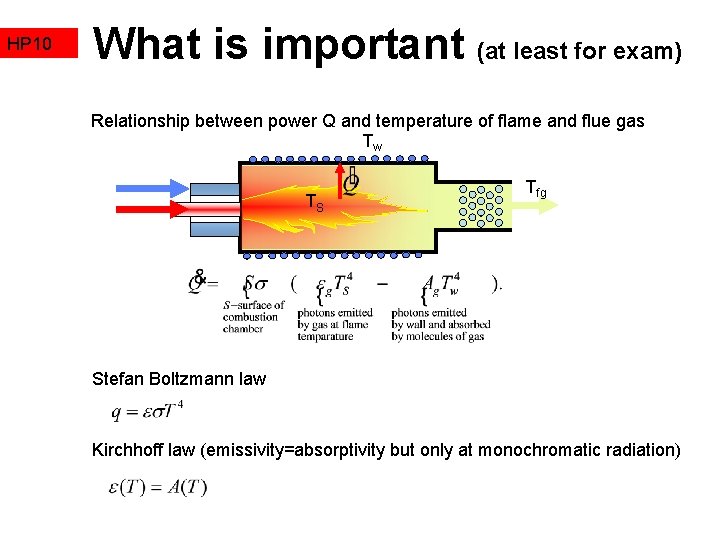
HP 10 What is important (at least for exam) Relationship between power Q and temperature of flame and flue gas Tw TS Tfg Stefan Boltzmann law Kirchhoff law (emissivity=absorptivity but only at monochromatic radiation)
- Slides: 29