
How wireless networks scale the illusion of spectrum


- Slides: 28
How wireless networks scale: the illusion of spectrum scarcity David P. Reed [http: //www. reed. com/dpr. html] Presented at FCC Technological Advisory Council Washington, D. C. April 26, 2002 4/26/2002 Copyright © 2002 David P. Reed
Agenda • Scalability matters • Does spectrum have a capacity? – “Spectrum, a non-depleting but limited resource” • • Interference and information Capacity, architecture, and scaling laws How do networks create value? Property vs. physics and architecture 4/26/2002 Copyright © 2002 David P. Reed 2
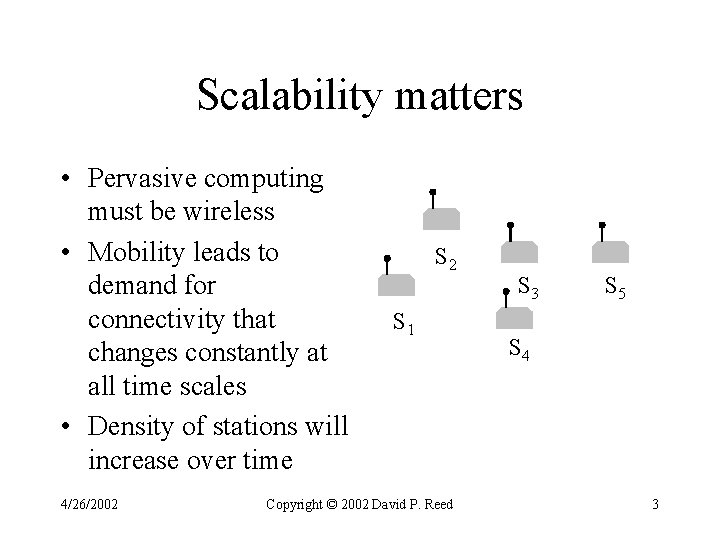
Scalability matters • Pervasive computing must be wireless • Mobility leads to demand for connectivity that changes constantly at all time scales • Density of stations will increase over time 4/26/2002 S 1 Copyright © 2002 David P. Reed S 3 S 5 S 4 3
70 years of FCC and regulation MV Mesaba to Titanic: “Ice report…much heavy pack ice and great number of large icebergs also field ice. ” Titanic: "Keep out, I'm working Cape Race ! " FCC created when tank circuits were hard to build 20 years before Shannon created Information Theory, before RADAR, digital electronics, and distributed computing We have had 50 years to begin applying these to radio networking But radio policy based in 1932 technology, practice 4/26/2002 Copyright © 2002 David P. Reed 4
Metaphor, reality, technology change • Legal evolution based on metaphor (abstract model) • Precedent = fitting the new into an existing metaphor • Economics, Law, Technology connect via metaphor (e. g. property) • Property laws and Newton’s laws 4/26/2002 Copyright © 2002 David P. Reed 5
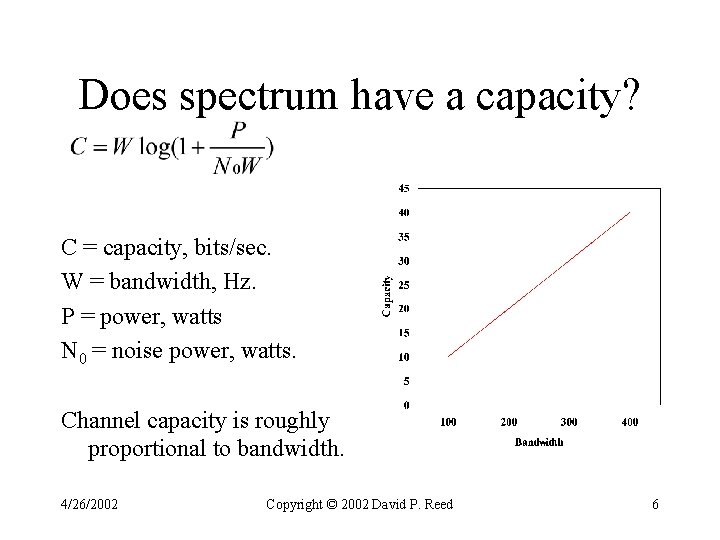
Does spectrum have a capacity? C = capacity, bits/sec. W = bandwidth, Hz. P = power, watts N 0 = noise power, watts. Channel capacity is roughly proportional to bandwidth. 4/26/2002 Copyright © 2002 David P. Reed 6
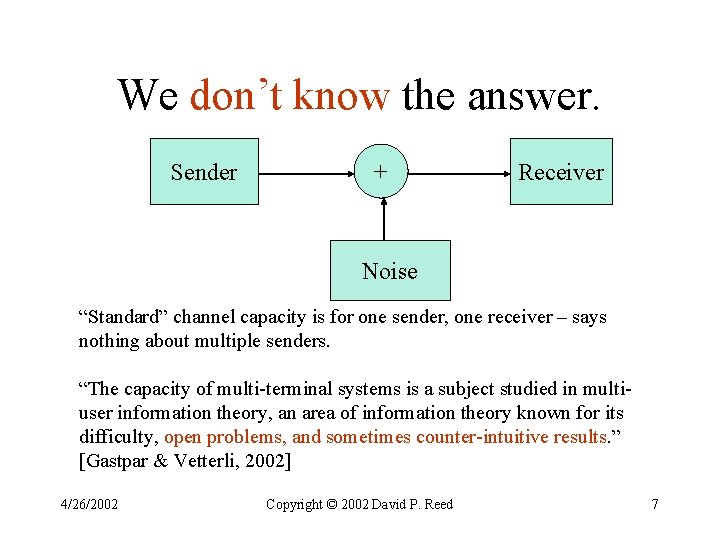
We don’t know the answer. Sender + Receiver Noise “Standard” channel capacity is for one sender, one receiver – says nothing about multiple senders. “The capacity of multi-terminal systems is a subject studied in multiuser information theory, an area of information theory known for its difficulty, open problems, and sometimes counter-intuitive results. ” [Gastpar & Vetterli, 2002] 4/26/2002 Copyright © 2002 David P. Reed 7
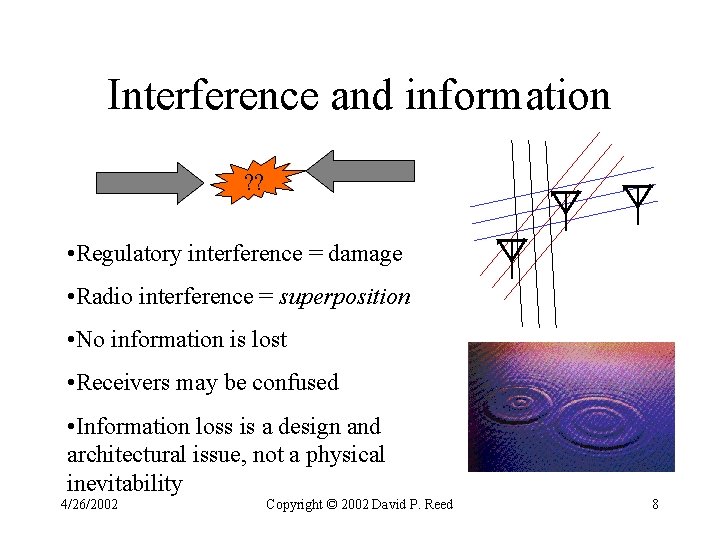
Interference and information ? ? • Regulatory interference = damage • Radio interference = superposition • No information is lost • Receivers may be confused • Information loss is a design and architectural issue, not a physical inevitability 4/26/2002 Copyright © 2002 David P. Reed 8
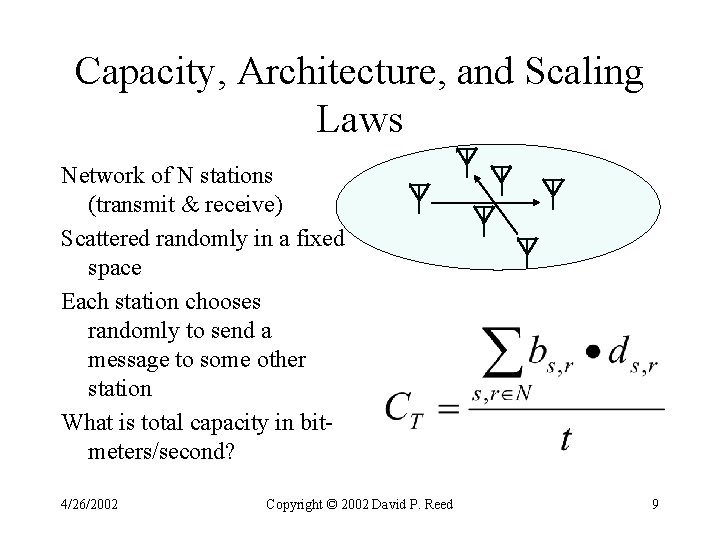
Capacity, Architecture, and Scaling Laws Network of N stations (transmit & receive) Scattered randomly in a fixed space Each station chooses randomly to send a message to some other station What is total capacity in bitmeters/second? 4/26/2002 Copyright © 2002 David P. Reed 9
Capacity of a radio network architecture N – number of stations B – bandwidth CT(N, B) increases linearly in B but what function of N? 4/26/2002 Copyright © 2002 David P. Reed 10
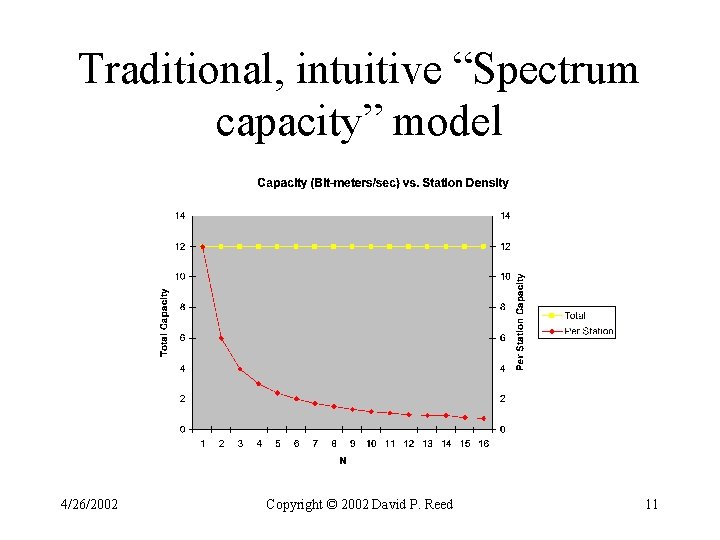
Traditional, intuitive “Spectrum capacity” model 4/26/2002 Copyright © 2002 David P. Reed 11
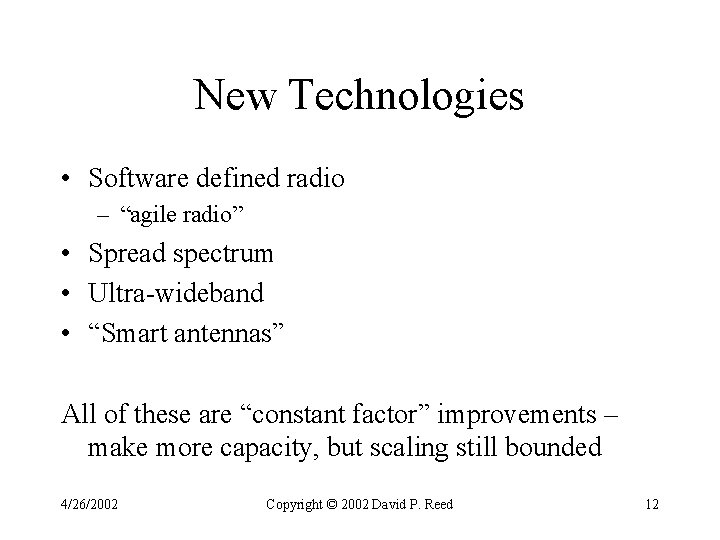
New Technologies • Software defined radio – “agile radio” • Spread spectrum • Ultra-wideband • “Smart antennas” All of these are “constant factor” improvements – make more capacity, but scaling still bounded 4/26/2002 Copyright © 2002 David P. Reed 12
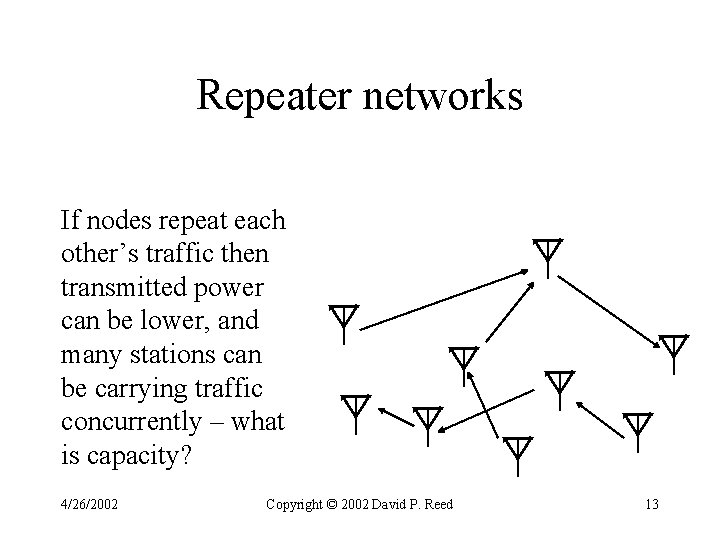
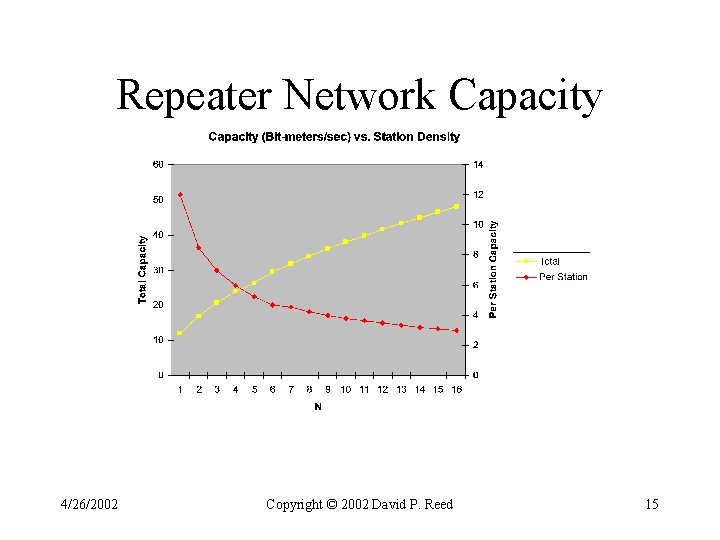
Repeater networks If nodes repeat each other’s traffic then transmitted power can be lower, and many stations can be carrying traffic concurrently – what is capacity? 4/26/2002 Copyright © 2002 David P. Reed 13
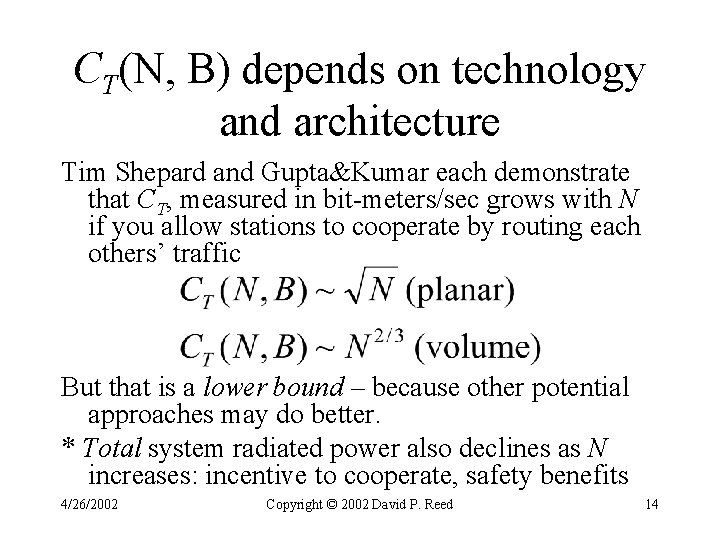
CT(N, B) depends on technology and architecture Tim Shepard and Gupta&Kumar each demonstrate that CT, measured in bit-meters/sec grows with N if you allow stations to cooperate by routing each others’ traffic But that is a lower bound – because other potential approaches may do better. * Total system radiated power also declines as N increases: incentive to cooperate, safety benefits 4/26/2002 Copyright © 2002 David P. Reed 14
Repeater Network Capacity 4/26/2002 Copyright © 2002 David P. Reed 15
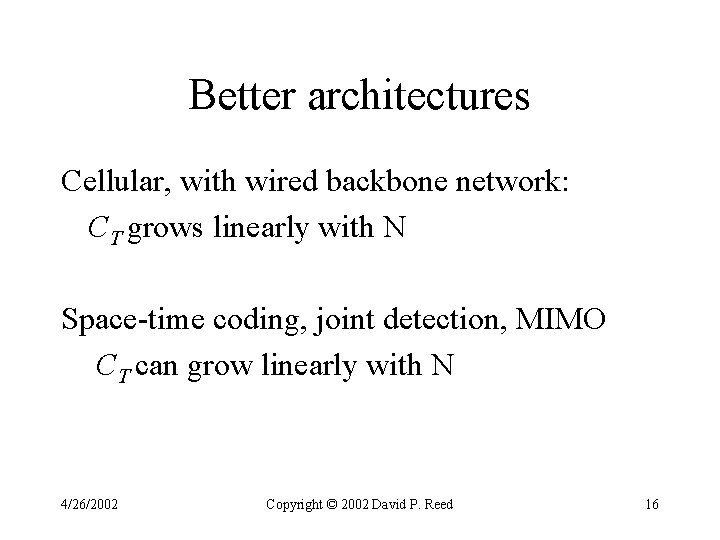
Better architectures Cellular, with wired backbone network: CT grows linearly with N Space-time coding, joint detection, MIMO CT can grow linearly with N 4/26/2002 Copyright © 2002 David P. Reed 16
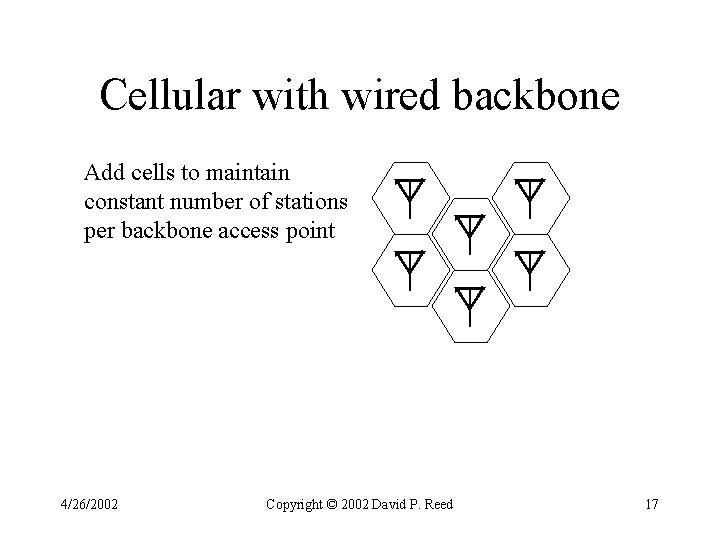
Cellular with wired backbone Add cells to maintain constant number of stations per backbone access point 4/26/2002 Copyright © 2002 David P. Reed 17
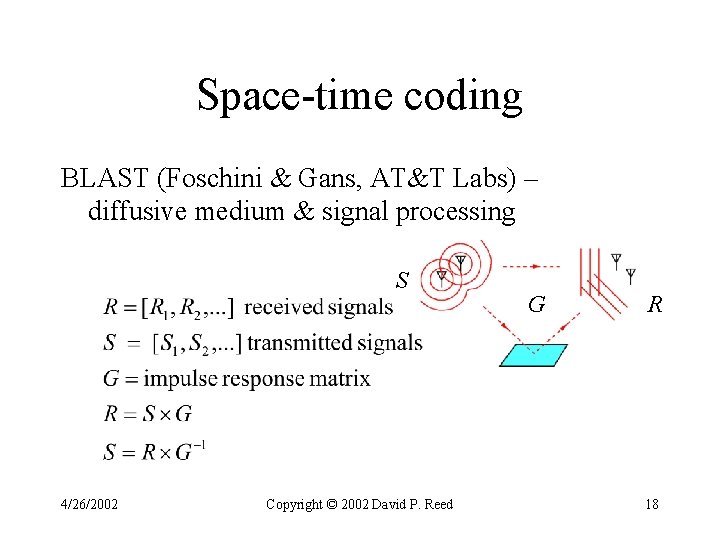
Space-time coding BLAST (Foschini & Gans, AT&T Labs) – diffusive medium & signal processing S 4/26/2002 Copyright © 2002 David P. Reed G R 18
Counterintuitive results from multiuser information theory, network architectures, and physics • • • Multipath increases capacity Repeating increases capacity Motion increases capacity Repeating reduces energy (safety) Distributed computation increases battery life • Channel sharing decreases latency and jitter 4/26/2002 Copyright © 2002 David P. Reed 19
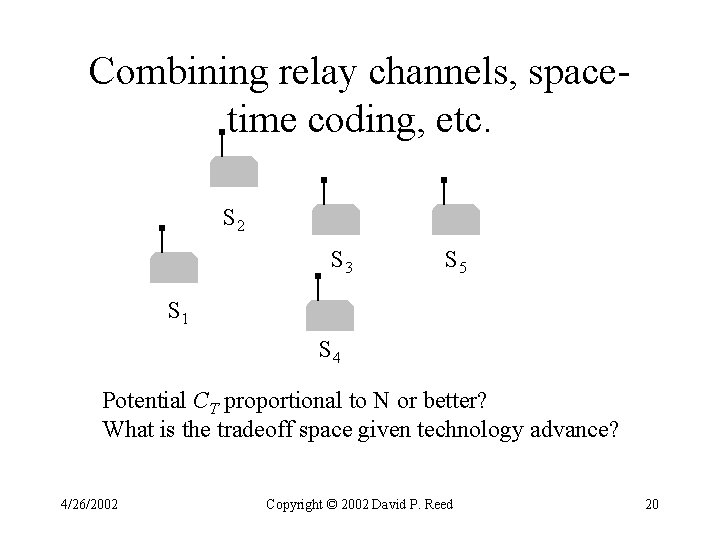
Combining relay channels, spacetime coding, etc. S 2 S 3 S 5 S 1 S 4 Potential CT proportional to N or better? What is the tradeoff space given technology advance? 4/26/2002 Copyright © 2002 David P. Reed 20
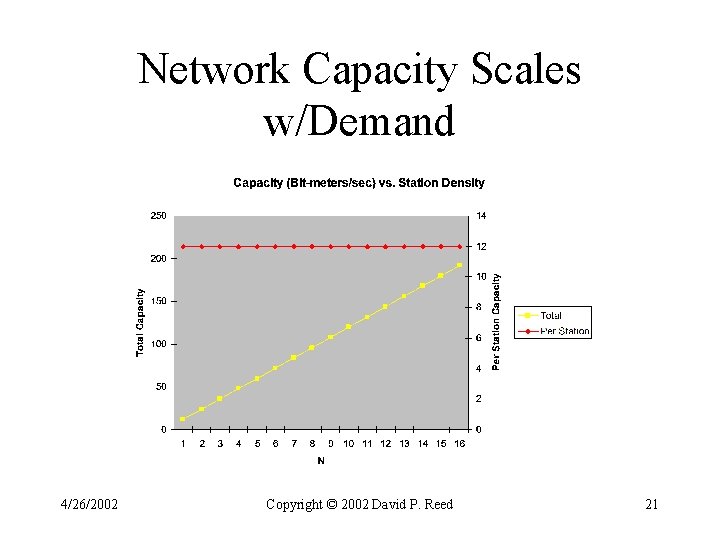
Network Capacity Scales w/Demand 4/26/2002 Copyright © 2002 David P. Reed 21
How do networks create value? • Value depends on capacity • But also on “optionality”: – Flexibility in allocating capacity to demand (dynamic allocation) – Flexibility in “random addressability” (e. g. Metcalfe’s Law) – Flexibility in group forming (e. g. Reed’s Law) • And security, robustness, etc. 4/26/2002 Copyright © 2002 David P. Reed 22
Economics and “spectrum property” Property rights are a solution to the “tragedy of the commons” by allocating property to its most valuable uses But property rights assume property is conserved Yet spectrum capacity increases with the number of users, and if proportional to N, each new user is self supporting! 4/26/2002 Copyright © 2002 David P. Reed 23
Partitioning problems – Coase and Transaction cost economics – Burst allocation capped – Random addressability & group -forming value severely harmed • Robustness reduced, security reduced. 4/26/2002 Frequency • “Guard bands” – each time a band partitioned in space or time, capacity wasted • Partitioning impacts flexibility value: Copyright © 2002 David P. Reed Guard band 24
Increasing returns • Increasing returns + spectrum ownership lead to “winner takes all” where scale trumps efficiency • Having “taken all” winner has reduced incentive to innovate rather than just raise prices. 4/26/2002 Copyright © 2002 David P. Reed 25
Calls to action • Research needed to create efficient wireless architectures that are based on networks that cooperate dynamically in spectrum use • New incentive structures (regulatory or economic) need to be in place to encourage use of efficient architectures. Property models (e. g. , auctions, band management) likely incompatible with dynamic cooperation needed for dense scalability • Architectures for cooperation -- “hourglass”-like Internet -enabling variety of underlying technologies and variety of services/apps to be under constant innovation and evolution 4/26/2002 Copyright © 2002 David P. Reed 26
Summary Spectrum regulation should recognize physics Spectrum regulation should recognize rapid change and learning, especially technical innovation Commons is one simple idea to allow for free innovation. 4/26/2002 Copyright © 2002 David P. Reed 27
4/26/2002 Copyright © 2002 David P. Reed 28