
How why do Koreans and Japanese shift styles


- Slides: 25
How & why do Koreans and Japanese shift styles to plain forms? : In a spoken discourse genre of TV cooking programs Heeyeong JUNG The University of Hawaii at Manoa
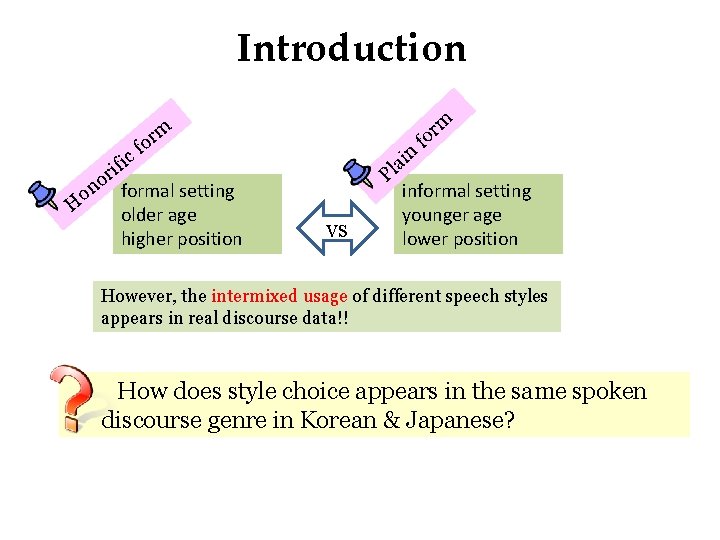
Introduction m or f n i a f if c ri o on formal setting H older age higher position m r o Pl vs informal setting younger age lower position However, the intermixed usage of different speech styles appears in real discourse data!! How does style choice appears in the same spoken discourse genre in Korean & Japanese?
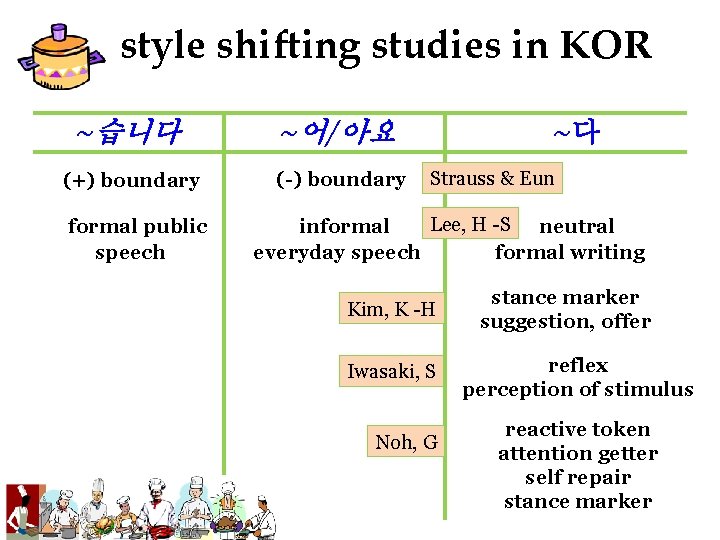
style shifting studies in KOR ~습니다 ~어/아요 (+) boundary (-) boundary formal public speech ~다 Strauss & Eun Lee, H -S neutral informal everyday speech formal writing Kim, K -H Iwasaki, S Noh, G stance marker suggestion, offer reflex perception of stimulus reactive token attention getter self repair stance marker
style shifting studies in JPN masu form plain form polite/formal speech level marker (+) distance (empathy) non-polite/informal speech level marker Ikuta high conscious of ‘thou’ Maynard self-presentation cook (-) distance (empathy) low conscious of ‘thou’ lack of self-presentation
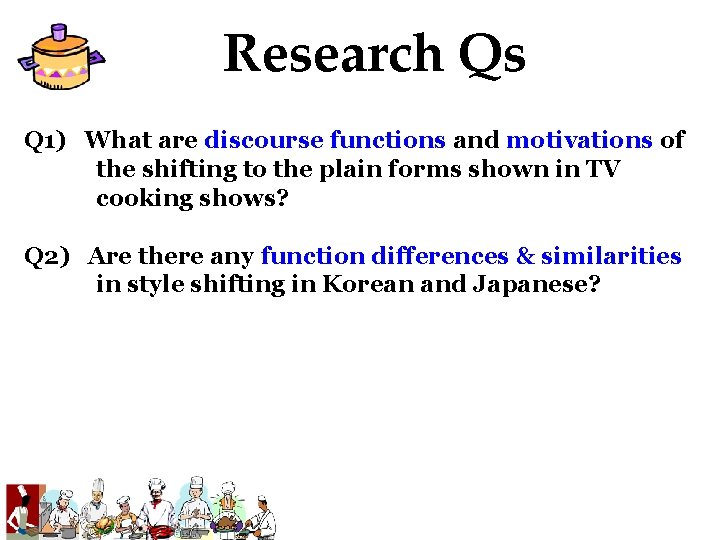
Research Qs Q 1) What are discourse functions and motivations of the shifting to the plain forms shown in TV cooking shows? Q 2) Are there any function differences & similarities in style shifting in Korean and Japanese?
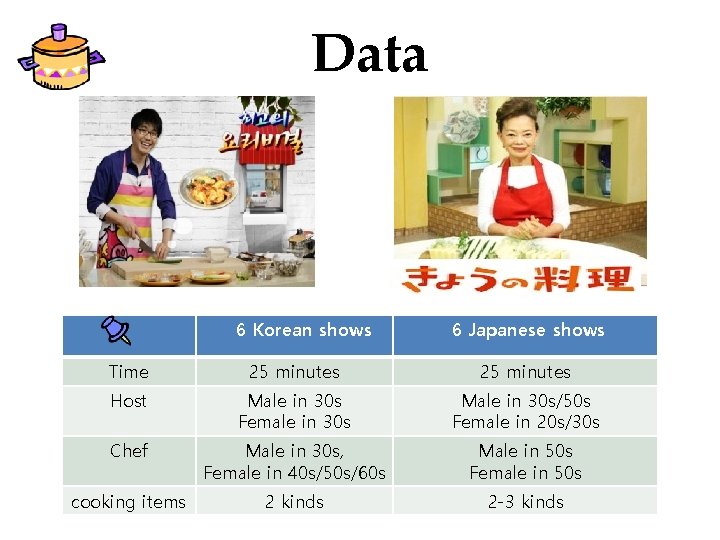
Data 6 Korean shows 6 Japanese shows Time 25 minutes Host Male in 30 s Female in 30 s Male in 30 s/50 s Female in 20 s/30 s Chef Male in 30 s, Female in 40 s/50 s/60 s Male in 50 s Female in 50 s cooking items 2 kinds 2 -3 kinds
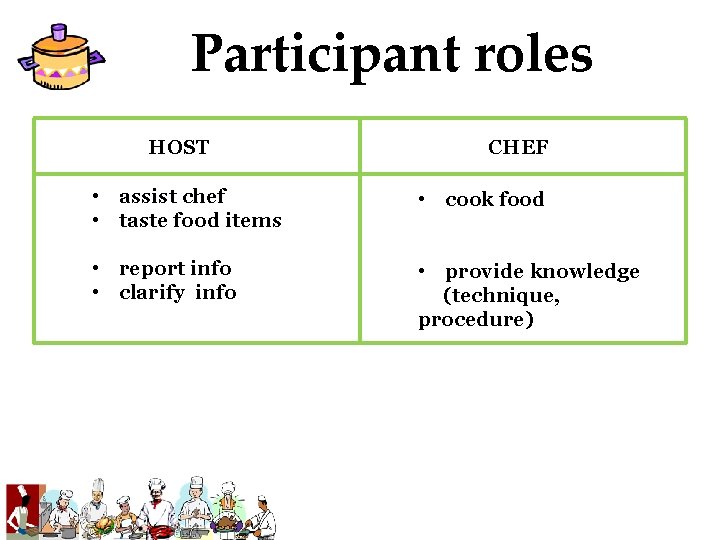
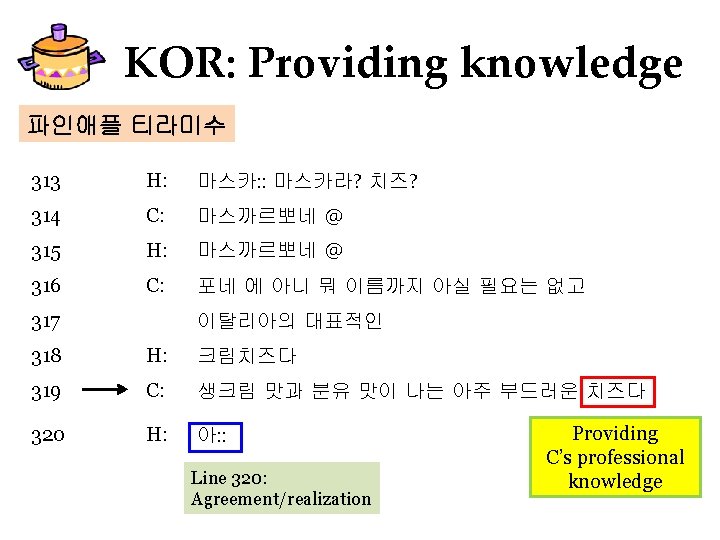
Participant roles HOST CHEF • assist chef • taste food items • cook food • report info • clarify info • provide knowledge (technique, procedure)
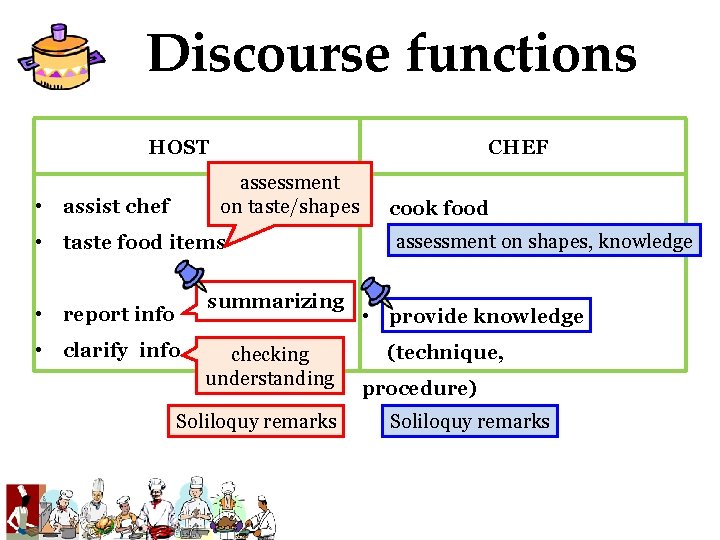
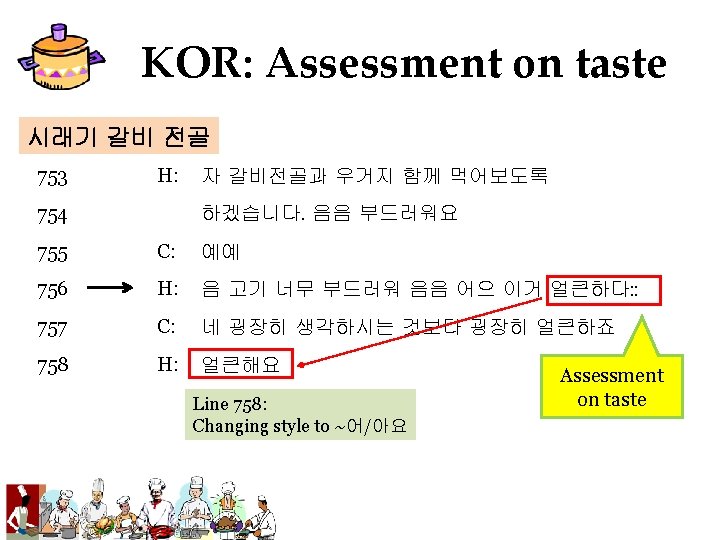
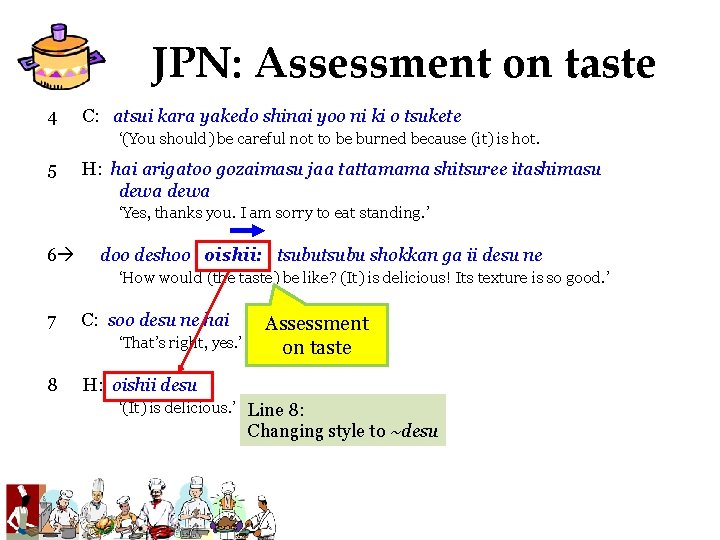
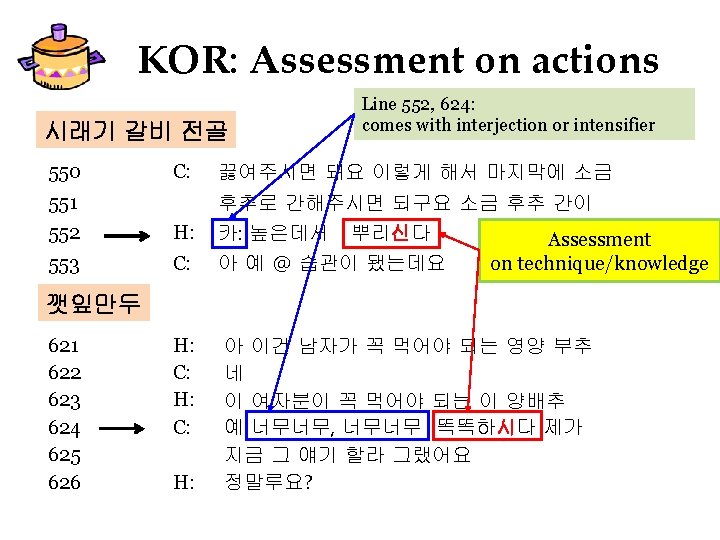
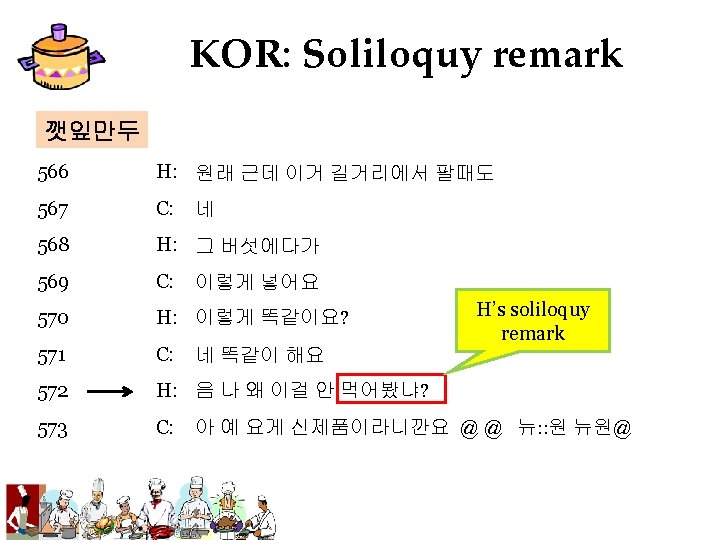
Discourse functions HOST CHEF assessment on taste/shapes • • assist chef • taste food items summarizing • report info • clarify info checking understanding Soliloquy remarks cook food assessment on shapes, knowledge • provide knowledge (technique, procedure) Soliloquy remarks
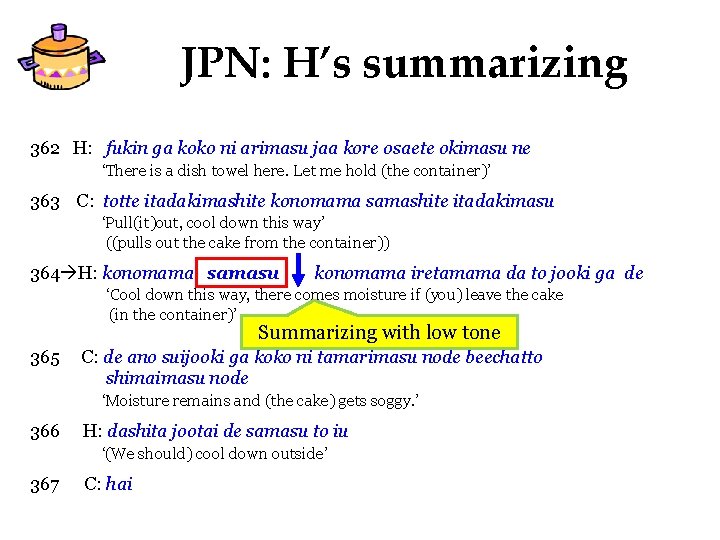
JPN: H’s summarizing 362 H: fukin ga koko ni arimasu jaa kore osaete okimasu ne ‘There is a dish towel here. Let me hold (the container)’ 363 C: totte itadakimashite konomama samashite itadakimasu ‘Pull(it)out, cool down this way’ ((pulls out the cake from the container)) 364 H: konomama samasu konomama iretamama da to jooki ga de ‘Cool down this way, there comes moisture if (you) leave the cake (in the container)’ Summarizing with low tone 365 C: de ano suijooki ga koko ni tamarimasu node beechatto shimaimasu node ‘Moisture remains and (the cake) gets soggy. ’ 366 H: dashita jootai de samasu to iu ‘(We should) cool down outside’ 367 C: hai
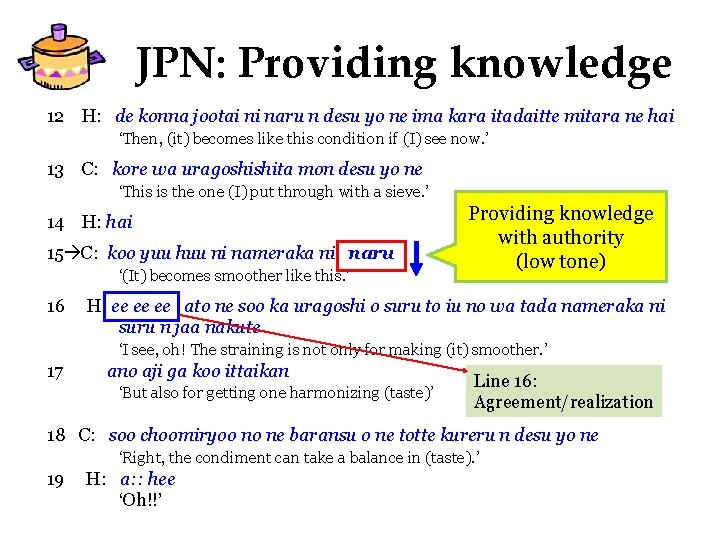
JPN: Providing knowledge 12 H: de konna jootai ni naru n desu yo ne ima kara itadaitte mitara ne hai ‘Then, (it) becomes like this condition if (I) see now. ’ 13 C: kore wa uragoshishita mon desu yo ne ‘This is the one (I) put through with a sieve. ’ 14 H: hai 15 C: koo yuu huu ni nameraka ni naru ‘(It) becomes smoother like this. ’ Providing knowledge with authority (low tone) 16 H: ee ee ee ato ne soo ka uragoshi o suru to iu no wa tada nameraka ni suru n jaa nakute ‘I see, oh! The straining is not only for making (it) smoother. ’ 17 ano aji ga koo ittaikan Line 16: ‘But also for getting one harmonizing (taste)’ Agreement/realization 18 C: soo choomiryoo no ne baransu o ne totte kureru n desu yo ne ‘Right, the condiment can take a balance in (taste). ’ 19 H: a: : hee ‘Oh!!’
JPN: Assessment on taste 4 C: atsui kara yakedo shinai yoo ni ki o tsukete ‘(You should) be careful not to be burned because (it) is hot. 5 H: hai arigatoo gozaimasu jaa tattamama shitsuree itashimasu dewa ‘Yes, thanks you. I am sorry to eat standing. ’ 6 doo deshoo oishii: tsubu shokkan ga ii desu ne ‘How would (the taste) be like? (It) is delicious! Its texture is so good. ’ 7 C: soo desu ne hai ‘That’s right, yes. ’ Assessment on taste 8 H: oishii desu ‘(It) is delicious. ’ Line 8: Changing style to ~desu
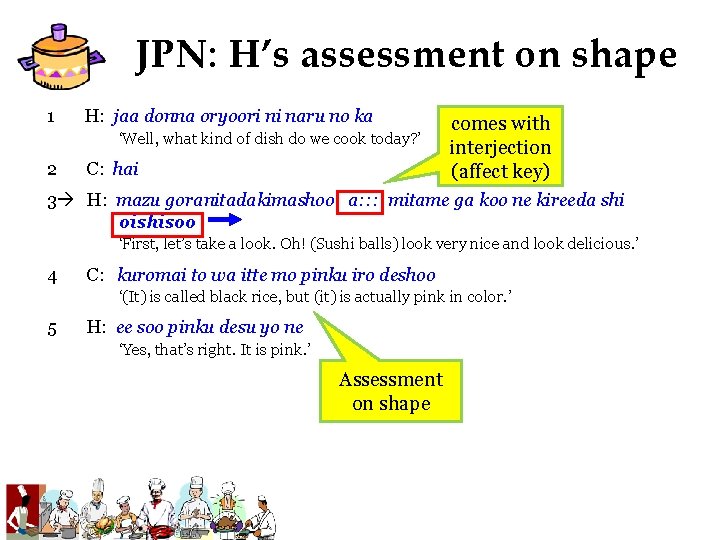
JPN: H’s assessment on shape 1 H: jaa donna oryoori ni naru no ka ‘Well, what kind of dish do we cook today? ’ 2 C: hai comes with interjection (affect key) 3 H: mazu goranitadakimashoo a: : : mitame ga koo ne kireeda shi oishisoo ‘First, let’s take a look. Oh! (Sushi balls) look very nice and look delicious. ’ 4 C: kuromai to wa itte mo pinku iro deshoo ‘(It) is called black rice, but (it) is actually pink in color. ’ 5 H: ee soo pinku desu yo ne ‘Yes, that’s right. It is pink. ’ Assessment on shape
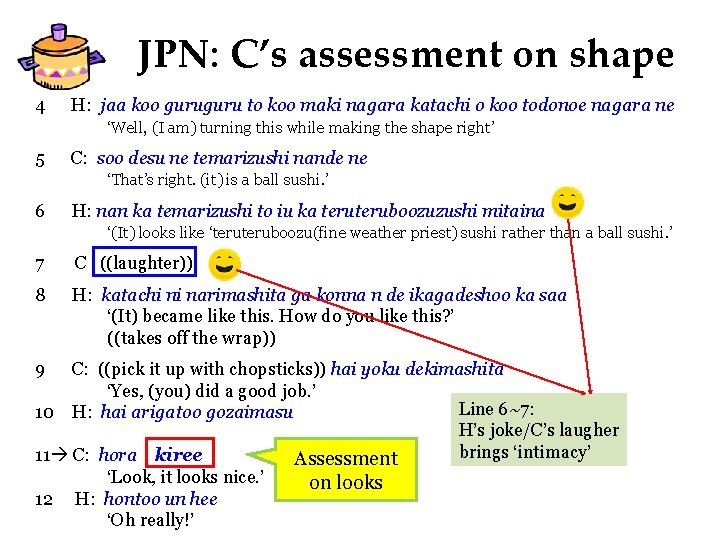
JPN: C’s assessment on shape 4 H: jaa koo guru to koo maki nagara katachi o koo todonoe nagara ne ‘Well, (I am) turning this while making the shape right’ 5 C: soo desu ne temarizushi nande ne ‘That’s right. (it) is a ball sushi. ’ 6 H: nan ka temarizushi to iu ka teruboozuzushi mitaina ‘(It) looks like ‘teruboozu(fine weather priest) sushi rather than a ball sushi. ’ 7 C ((laughter)) 8 H: katachi ni narimashita ga konna n de ikagadeshoo ka saa ‘(It) became like this. How do you like this? ’ ((takes off the wrap)) 9 C: ((pick it up with chopsticks)) hai yoku dekimashita ‘Yes, (you) did a good job. ’ Line 6~7: 10 H: hai arigatoo gozaimasu H’s joke/C’s laugher brings ‘intimacy’ 11 C: hora kiree Assessment ‘Look, it looks nice. ’ on looks 12 H: hontoo un hee ‘Oh really!’
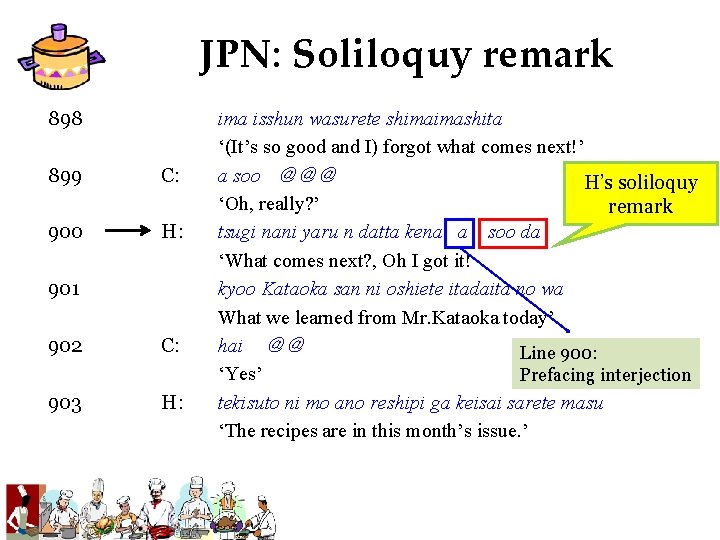
JPN: Soliloquy remark 898 899 C: 900 H: 901 902 C: 903 H: ima isshun wasurete shimaimashita ‘(It’s so good and I) forgot what comes next!’ a soo @@@ H’s soliloquy ‘Oh, really? ’ remark tsugi nani yaru n datta kena a soo da ‘What comes next? , Oh I got it! kyoo Kataoka san ni oshiete itadaita no wa What we learned from Mr. Kataoka today’ hai @@ Line 900: ‘Yes’ Prefacing interjection tekisuto ni mo ano reshipi ga keisai sarete masu ‘The recipes are in this month’s issue. ’
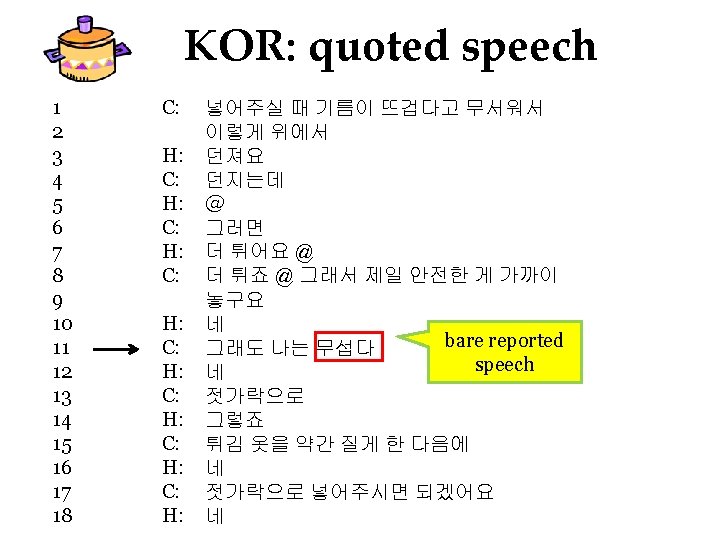
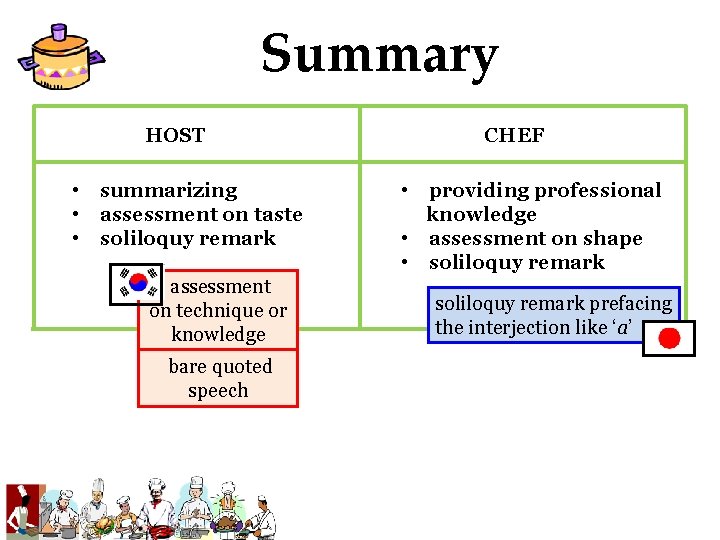
Summary HOST • summarizing • assessment on taste • soliloquy remark assessment on technique or knowledge bare quoted speech CHEF • providing professional knowledge • assessment on shape • soliloquy remark prefacing the interjection like ‘a’
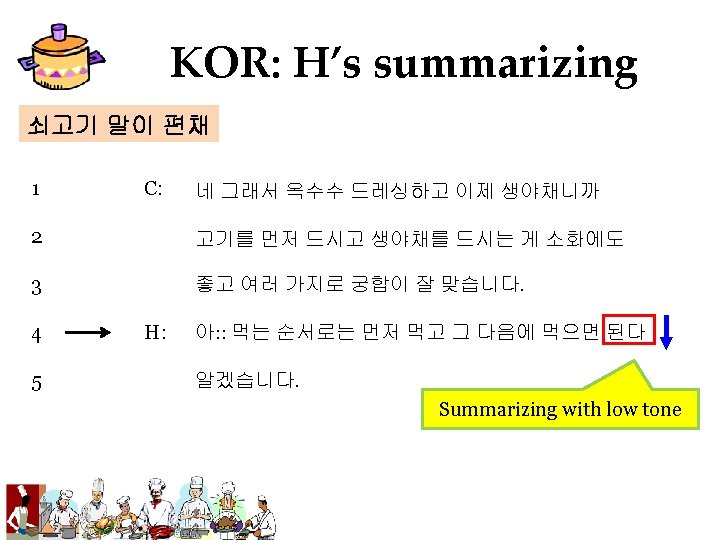
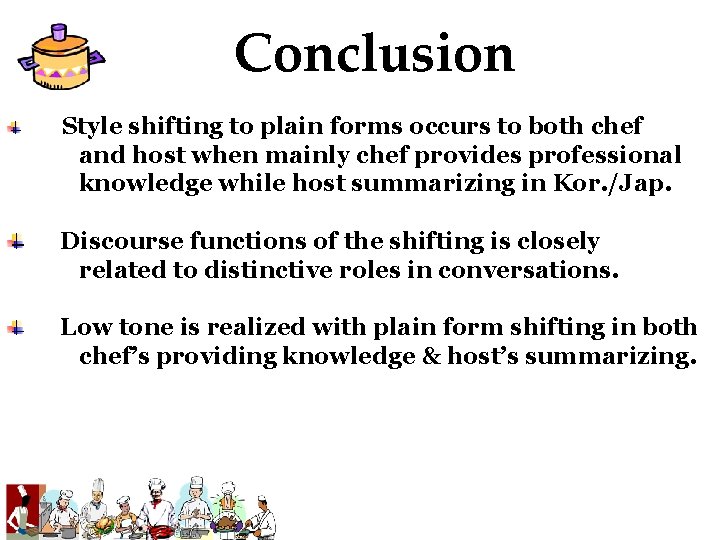
Conclusion Style shifting to plain forms occurs to both chef and host when mainly chef provides professional knowledge while host summarizing in Kor. /Jap. Discourse functions of the shifting is closely related to distinctive roles in conversations. Low tone is realized with plain form shifting in both chef’s providing knowledge & host’s summarizing.
Further studies Looking at more episodes in consideration of gender, age differences
Selected references • Cook, H. M. (1998). Situational Meanings of Japanese Social Deixis: The Mixed Use of the Masu and Plain Forms, Journal of Linguistic Anthropology 8(l), 87 -110. • Cook, H. M. (2008). Style shifts in Japanese academic consultations. In K. Jones and T. Ono (eds), Style shifting in Japanese. Amsterdam: John Benjamins, 9 -38. • Ikuta, S. (1983). Speech level shift and conversational strategy in Japanese discourse. Language Sciences, 5, 37 -53 • Ikuta, S. (2008). Speech style shift as an interactional discourse strategy: The use and non-use of desu/-masu in Japanese conversational interview. In K. Jones and T. Ono (eds. ), Style shifting in Japanese. Amsterdam: John Benjamins, 71 -90. • Iwasaki, S. (2006). The structure of internal state expressions in Japanese and Korean. Japanese/Korean Linguistics, 14, 331 -342. • Kim, K. -H. (2004). A conversation analysis of Korean sentence-ending modal suffixes –ney, -kwun(a), and – ta: Noticing as a social action. Sociolinguistic Journal of Korea, 12(1), 1 -35. • Lee, H. S. (1991). Tense, aspect, and modality: A discourse-progmatic analysis of verbal affixes in Korean from a typological perspective. Ph. D. dissertation, University of California. • Maynard, S. (1991). Pragmatics of discourse modality: a case of da and desu/masu forms in Japanese. Journal of Pragmatics, 15, 551 -582. • Maynard, S. (2008). Playing with multiple voices: Emotivity and creativity in Japanese style mixture. In K. Jones and T. Ono (eds. ), Style shifting in Japanese. Amsterdam: John Benjamins, 91 -130. • Noh, J. (2008). A usage-based account on the Korean suffix –ta in spoken discourse. Korean Linguistics, 14, 203 -222. • Strauss, S. , Eun, J. O. (2005). Indexicality and honorific speech level choice in Korean. Linguistics, 43(3), 611651.
Mahalo!!