
How when and why do Teachers use ICT
- Slides: 12
How, when and why do Teachers use ICT within their Mathematics Lessons Upgrade presentation November 2011 by Alison Parish Supervised by Alan Pritchard, Peter Johnston-Wilder, Michael Hammond
Rationale l “Despite significant improvement in the provision of hardware resources, access to ICT facilities for mathematics departments in some schools and colleges remains inadequate. ‘Mobile technology, including graphing calculators and wireless laptops, is not used sufficiently to address such problems” (Ofsted, 2004, p. 27)
Rationale 2 l l l Is there a universally accepted definition of ICT as it applies to use in school classrooms? What response would teacher’s make to the Ofsted quote? Are there reasons that some teachers are using little ICT in classrooms? My research proposal arose out of work I did for the Teaching Advanced Mathematics (TAM) course at Warwick University and personal experiences.
Background l l My own experience of working in schools as both an ICT co-ordinator and Head of Mathematics made me aware that there is a great variation in teacher’s attitude towards and use of ICT. Experience from international conferences concerning ICT and Mathematics led to realisation that this is an international issue.
Research Questions l l l The key research question is how, when and why some mathematics teachers use ICT in their lessons. Why are there difference in the amount and type of ICT used? Firstly: How is ICT defined? Is the term definitive, or subject to different interpretations? Where are the technical boundaries being placed?
Methodology l l l Using mainly qualitative methods Pilot questionnaire Suite of questionnaires and interviews for students, teachers, advisors, teacher trainers. Review of mathematics software, and links with secondary curriculum. Literature reviews, including the historical perspective of ICT in schools, pedagogy Look at the results of my data collection and how they fit into the findings of other research.
Pilot study l l To test questions and revise as necessary. To ascertain whether initial questionnaire allows me to gain the information I am seeking. To look at the data to determine whethere might be influential factors that I need to include. To enable me to practice data analysis on a small scale using SPSS.
Questionnaires and Interviews l l Set of questionnaires to form a trail from mathematics undergraduates and trainee teachers to experienced teachers and advisors about use of ICT in mathematics lessons. Interviews with people involved in ICT and mathematics education to include teachers who regularly use ICT, advisors and teacher trainers.
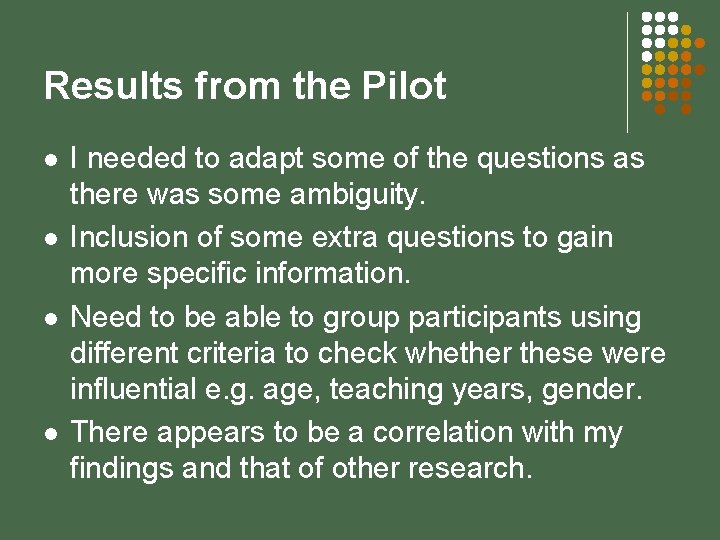
Results from the Pilot l l I needed to adapt some of the questions as there was some ambiguity. Inclusion of some extra questions to gain more specific information. Need to be able to group participants using different criteria to check whether these were influential e. g. age, teaching years, gender. There appears to be a correlation with my findings and that of other research.
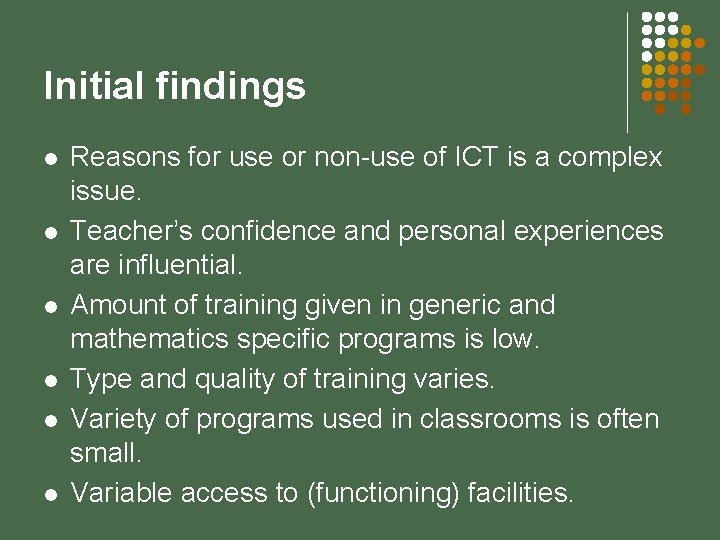
Initial findings l l l Reasons for use or non-use of ICT is a complex issue. Teacher’s confidence and personal experiences are influential. Amount of training given in generic and mathematics specific programs is low. Type and quality of training varies. Variety of programs used in classrooms is often small. Variable access to (functioning) facilities.
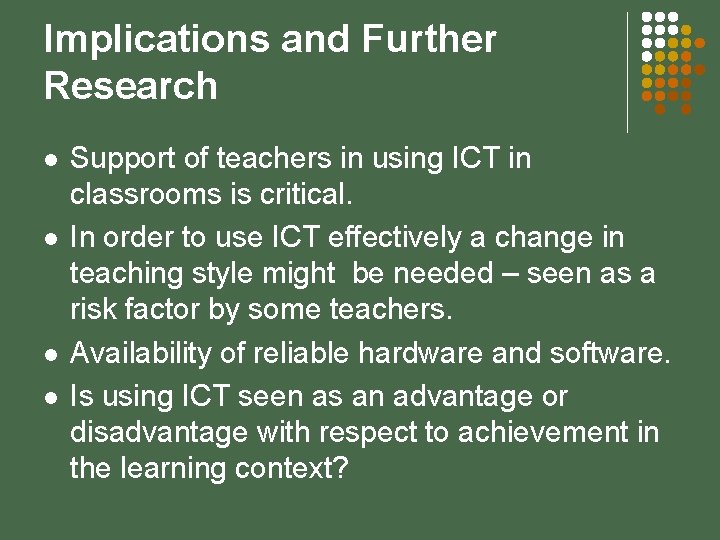
Implications and Further Research l l Support of teachers in using ICT in classrooms is critical. In order to use ICT effectively a change in teaching style might be needed – seen as a risk factor by some teachers. Availability of reliable hardware and software. Is using ICT seen as an advantage or disadvantage with respect to achievement in the learning context?
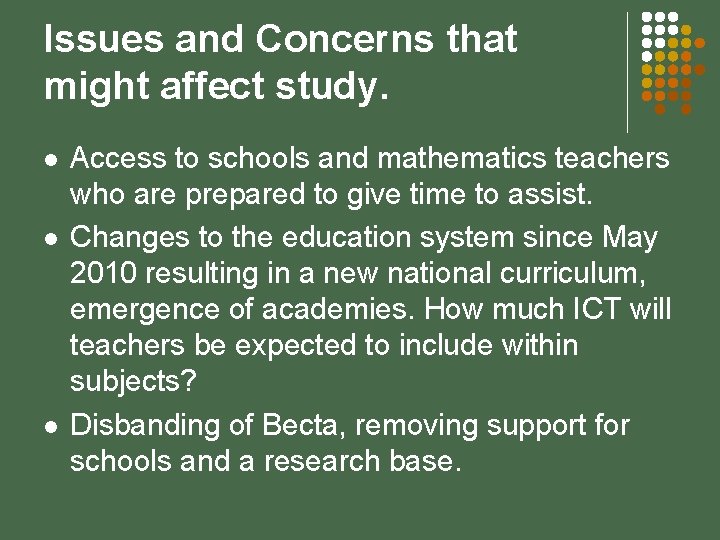
Issues and Concerns that might affect study. l l l Access to schools and mathematics teachers who are prepared to give time to assist. Changes to the education system since May 2010 resulting in a new national curriculum, emergence of academies. How much ICT will teachers be expected to include within subjects? Disbanding of Becta, removing support for schools and a research base.