
How well does Visual Literacy support childrens learning
![DEPARTMENT FOR EDUCATION, 2012. What is the Research Evidence of Writing? [online]. Available from:](https://slidetodoc.com/presentation_image_h2/83c89e835a66e311b5cbe62aa28aa7ad/image-12.jpg "DEPARTMENT FOR EDUCATION, 2012. What is the Research Evidence of Writing? [online]. Available from:")
- Slides: 12
How well does Visual Literacy support children’s learning in writing and performing a play script? The National Curriculum states that we need to teach children to write play scripts in order to: ‘read aloud and to perform, showing understanding through intonation, tone, volume and action. ’ (NC: English Programs of Study, 2014: 26)
Why did I focus on writing a play script in my session? Writing in various formats is a crucial skill in life and needs to be a focus of education. HOWEVER. . . Children are not performing to the same standard in writing as they are in other subjects. ‘Writing is the subject where pupils perform less well compared to reading, mathematics and science. ’ (Df. ES, 2015) Lack of motivation and interest in the subject of writing due to tedious lessons. ‘ 55% of young people having a negative attitude towards writing. ’ (Clark & Dugdale, 2009) Writing needs to become fun for children in order for them to enjoy and develop their writing ability. Reflection point. . . What teaching strategy will achieve this result?
Why did I choose visual literacy to develop children’s writing? Previous experience has shown me that children will enjoy a task if the task is interesting to them. Visual literacy – ‘Gives pleasure that makes a difference to personal lives and provides excitement to writing. ’ (Andrews, 2008) Providing context and meaning behind their learning, making them interested in their learning. (Lambrith, 2006: 85) Resulting in children developing their creative writing skills when fully engaged in their learning. Reflection point. . . How do you feel about using visual literacy to improve children’s enjoyment and development in writing?
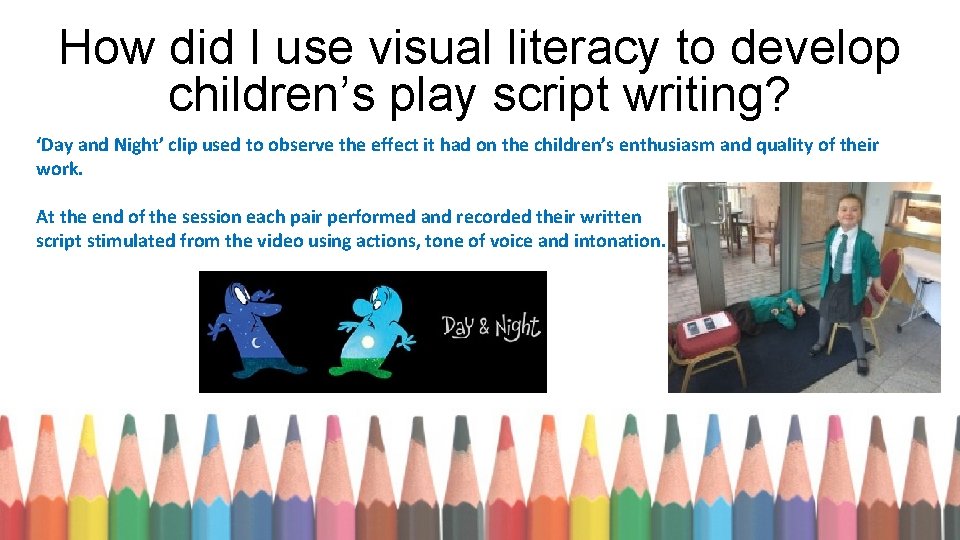
How did I use visual literacy to develop children’s play script writing? ‘Day and Night’ clip used to observe the effect it had on the children’s enthusiasm and quality of their work. At the end of the session each pair performed and recorded their written script stimulated from the video using actions, tone of voice and intonation.
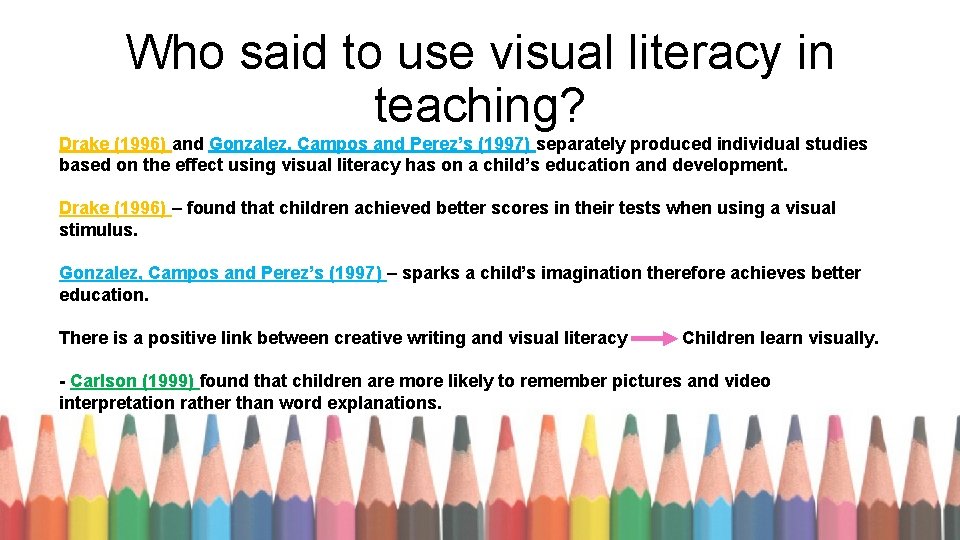
Who said to use visual literacy in teaching? Drake (1996) and Gonzalez, Campos and Perez’s (1997) separately produced individual studies based on the effect using visual literacy has on a child’s education and development. Drake (1996) – found that children achieved better scores in their tests when using a visual stimulus. Gonzalez, Campos and Perez’s (1997) – sparks a child’s imagination therefore achieves better education. There is a positive link between creative writing and visual literacy Children learn visually. - Carlson (1999) found that children are more likely to remember pictures and video interpretation rather than word explanations.
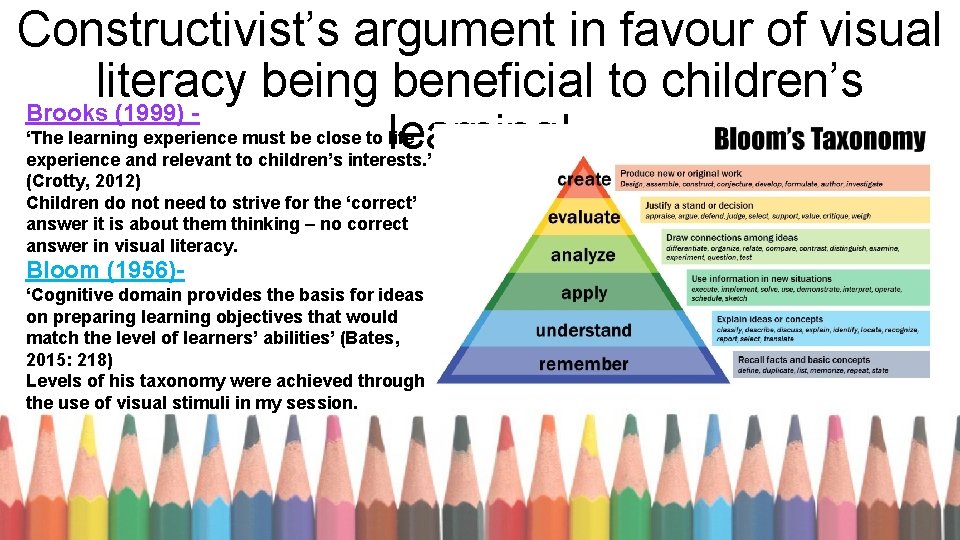
Constructivist’s argument in favour of visual literacy being beneficial to children’s Brooks (1999) learning! ‘The learning experience must be close to life experience and relevant to children’s interests. ’ (Crotty, 2012) Children do not need to strive for the ‘correct’ answer it is about them thinking – no correct answer in visual literacy. Bloom (1956)‘Cognitive domain provides the basis for ideas on preparing learning objectives that would match the level of learners’ abilities’ (Bates, 2015: 218) Levels of his taxonomy were achieved through the use of visual stimuli in my session.
How did this teaching approach work in relation to the children’s learning? - Engaged them as their attention was instantly grasped by the video. - Started to discuss what they thought the video was about without prompt to do so. - It sparked their imagination. THEREFORE… - The children’s work was of a high standard. - They were thinking on a creative level. - They were thoroughly engaged in their learning.
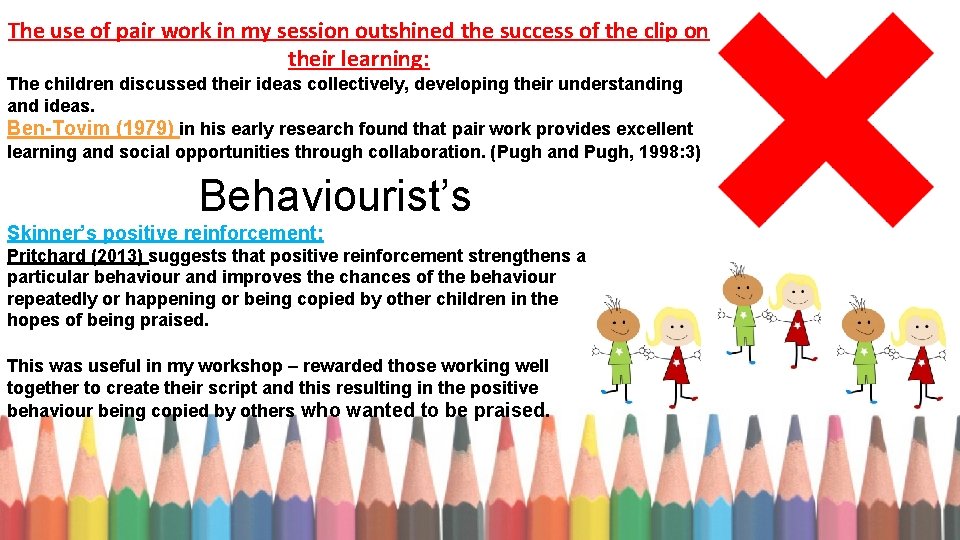
The use of pair work in my session outshined the success of the clip on their learning: The children discussed their ideas collectively, developing their understanding and ideas. Ben-Tovim (1979) in his early research found that pair work provides excellent learning and social opportunities through collaboration. (Pugh and Pugh, 1998: 3) Behaviourist’s Skinner’s positive reinforcement: Pritchard (2013) suggests that positive reinforcement strengthens a particular behaviour and improves the chances of the behaviour repeatedly or happening or being copied by other children in the hopes of being praised. This was useful in my workshop – rewarded those working well together to create their script and this resulting in the positive behaviour being copied by others who wanted to be praised.
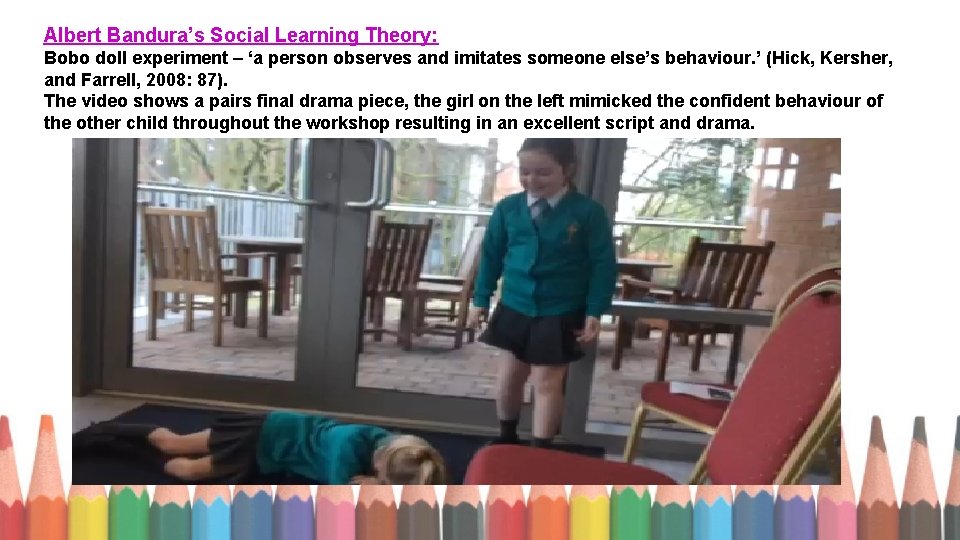
Albert Bandura’s Social Learning Theory: Bobo doll experiment – ‘a person observes and imitates someone else’s behaviour. ’ (Hick, Kersher, and Farrell, 2008: 87). The video shows a pairs final drama piece, the girl on the left mimicked the confident behaviour of the other child throughout the workshop resulting in an excellent script and drama.
What did I learn from the process? - Visual Literacy results in the children being more motivated and interested as there is a meaning behind their work. - The session becomes more memorable for the children as learning visually helps ‘create mental images to retain information’ (Bates, 2015: 120) ‘attract learner attention’ (Jenson, 2008: 55) HOWEVER… The effectiveness of pair work in my workshop outshined the effectiveness of visual literacy on the children’s learning. I would be obliged to use pair work more frequently in my teaching due to the success it achieved in my session. In the future I will try combining book talk with pair work as book talk enhances pair work, as it encourages discussion and I believe this way the children will grasp a high level of understanding of the book providing them with the knowledge needed to produce a creative writing piece on the book. Book talk would have given the children ‘the ability to talk about books; the confidence to offer ideas and then reshape them in the light of other contributions. It helps children to trust their own ideas and interpretations. ’ (Corbett, 2008)
References BATES, B. , 2015. Learning theories simplified: . . . And how to apply them to teaching. United Kingdom: SAGE Publications. BEGHETTO, R. A. and KAUFMAN, J. C. , eds. , 2010. Nurturing creativity in the classroom. Cambridge: Cambridge University Press. BRIMS, J. , ALLEN, S. , GORDON, P. , and WHALLEY, M. E. , 2011. How children learn 4 thinking on special educational needs and inclusion: 4. London: Practical Pre-School Books. CLARK, C. and DUGDALE, G. , 2010. Young people’s writing: Attitudes, behaviour and the role of technology [online]. Available from: http: //www. literacytrust. org. uk/assets/0000/0226/Writing_survey_2009. pdf[Accessed 8 Feb 2016]. CORBETT, P. and STRONG, J. , 2011. Talk for writing across the curriculum: How to teach non-fiction writing to 5 -12 year olds. Maidenhead: Open University Press. CROTTY , K. , 2012. Educational theory [online]. Available from: http: //www. waterfordwomenscentre. com/sites/default/files/Educational%20 Theory%20 Constructivism%20%20 by%2 0 Kate%20 Crotty_0. pdf[Accessed 2 Feb 2016]. DEPARTMENT FOR CHILDREN, SCHOOLS AND FAMILIES, 2008. Getting Going: generating, shaping and developing ideas in writing. London: The Stationery Office. DEPARTMENT FOR EDUCATION, 2014. National curriculum in England: English programmes of study: key stages 1 and 2. London: Department for Education.
DEPARTMENT FOR EDUCATION, 2012. What is the Research Evidence of Writing? [online]. Available from: https: //learningedgehill. ac. uk/bbcswebdav/pid-1553390 -dt-content-rid 7087604_1/courses/2015_QTA 002_MRG/What%20 is%20 the%20 research%20 evidence%20 on%20 writing%20 Df E%202012. pdf [Accessed 2 Feb 2016]. JENSEN, E. P. , 2008. Brain-based learning: The new paradigm of teaching. 2 nd ed. United States: Corwin Press. LAMBIRTH, A. , 2006. Planning creative literacy lessons (informing teaching). London: David Fulton Publishers. MALLETT, M. , 2015. A guided reader to early years and primary English: Creativity, principles and practice. United Kingdom: Taylor & Francis. MCLEOD, S. , 2016. Bandura - social learning theory [online]. Available from: http: //www. simplypsychology. org/bandura. html[Accessed 3 Feb 2016]. PALMER, S. , 2010. How to teach writing across the curriculum: Ages 6 -8 (writers’ workshop). 2 nd ed. New York: Routledge. PUGH, A. and PUGH, L. , 1998. Music in the early years. New York: Routledge Falmer. RICHARDS, R. G. , 2008. Making it stick: Memorable strategies to enhance learning [online]. Available from: http: //www. thekeytotorah. com/uploads/2/5/5/8/25587179/making_it_stick. pdf [Accessed 2 Feb 2016] WRAY, D. , 2006. Teaching literacy across the primary curriculum (achieving Qts, cross-curricular strand). Exeter: Learning Matters