
How Well Are We Adapting A tool to
- Slides: 14
‘How Well Are We Adapting’ A tool to measure climate change adaptation for local government Presentation by Fran Macdonald, Executive Officer, Western Alliance for Greenhouse Action (WAGA) to Goulburn Broken Greenhouse Alliance (GBGA) 23 May 2019
What is adaptation? IPCC “The process of adjustment to actual or expected climate and its effects. In human systems, adaptation seeks to moderate or avoid harm or exploit beneficial opportunities. In some natural systems, human intervention may facilitate adjustment to expected climate and its effects. ” IPCC, 2014: Annex II Glossary WAGA Climate Change Adaptation Strategy 〉 A process of continuous institutional learning, adjustment and transformation 〉 Decisions made to prepare for, and respond to, direct and indirect changing climate risks
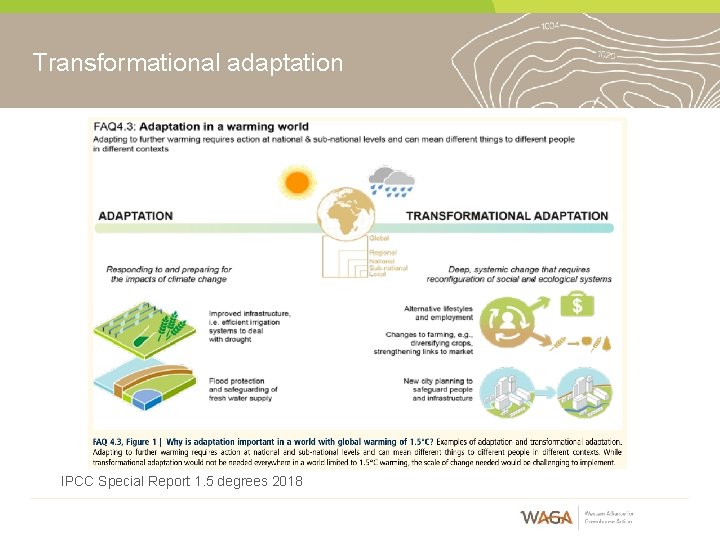
Transformational adaptation IPCC Special Report 1. 5 degrees 2018
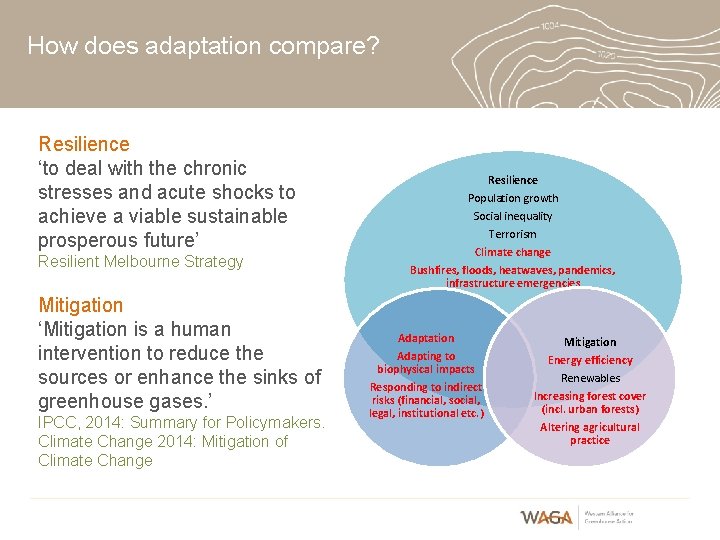
How does adaptation compare? Resilience ‘to deal with the chronic stresses and acute shocks to achieve a viable sustainable prosperous future’ Resilient Melbourne Strategy Mitigation ‘Mitigation is a human intervention to reduce the sources or enhance the sinks of greenhouse gases. ’ IPCC, 2014: Summary for Policymakers. Climate Change 2014: Mitigation of Climate Change Resilience Population growth Social inequality Terrorism Climate change Bushfires, floods, heatwaves, pandemics, infrastructure emergencies Adaptation Adapting to biophysical impacts Responding to indirect risks (financial, social, legal, institutional etc. ) Mitigation Energy efficiency Renewables Increasing forest cover (incl. urban forests) Altering agricultural practice
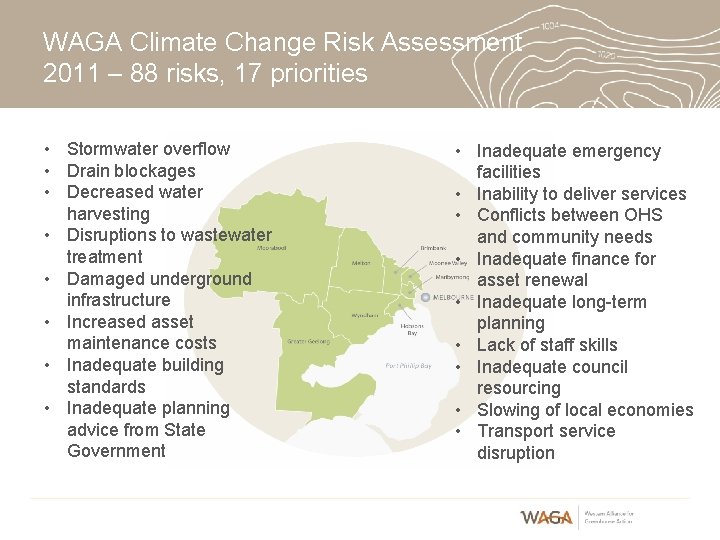
WAGA Climate Change Risk Assessment 2011 – 88 risks, 17 priorities • Stormwater overflow • Drain blockages • Decreased water harvesting • Disruptions to wastewater treatment • Damaged underground infrastructure • Increased asset maintenance costs • Inadequate building standards • Inadequate planning advice from State Government • Inadequate emergency facilities • Inability to deliver services • Conflicts between OHS and community needs • Inadequate finance for asset renewal • Inadequate long-term planning • Lack of staff skills • Inadequate council resourcing • Slowing of local economies • Transport service disruption
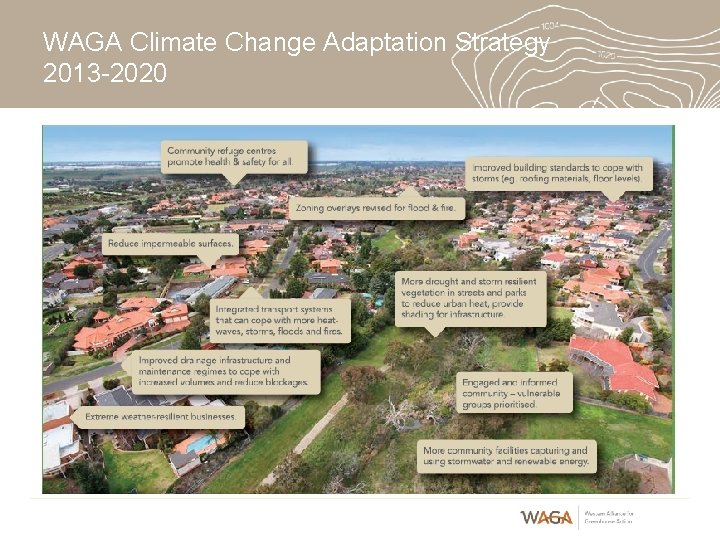
WAGA Climate Change Adaptation Strategy 2013 -2020
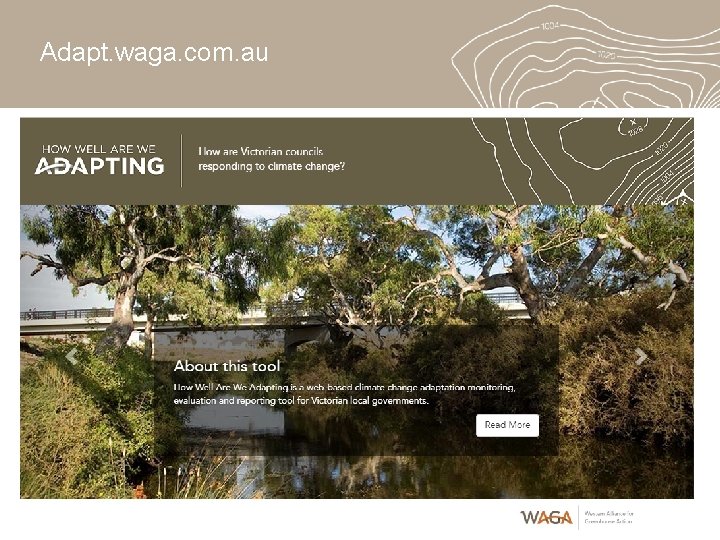
Adapt. waga. com. au
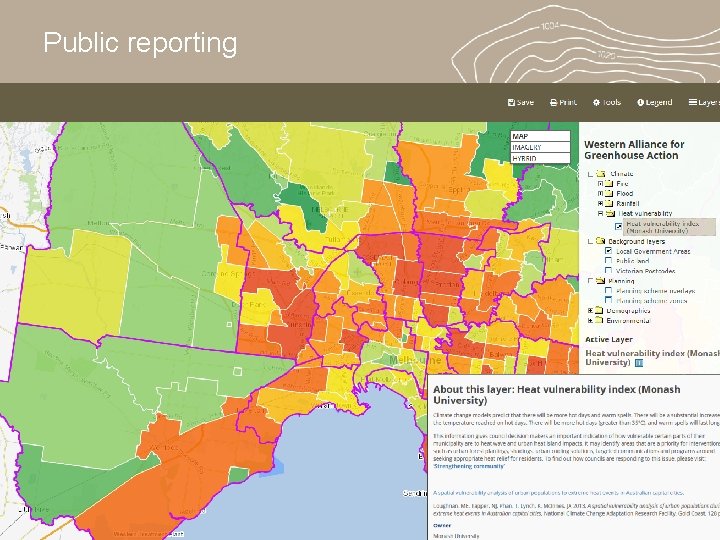
Public reporting Local climate map for councils
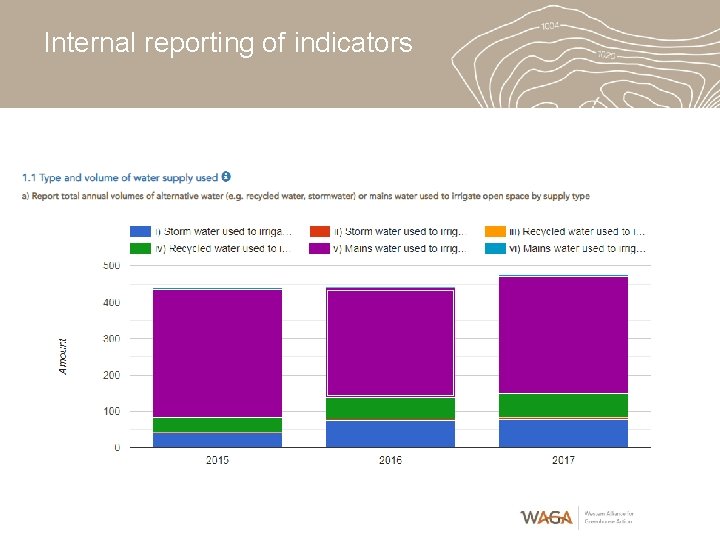
Internal reporting of indicators
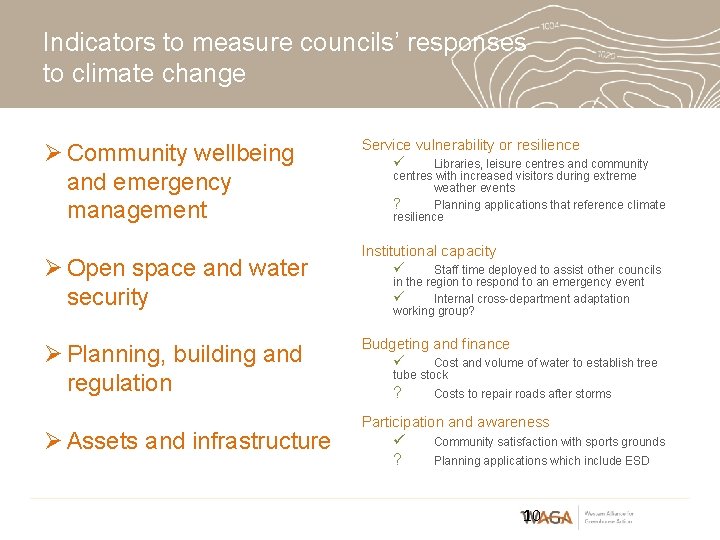
Indicators to measure councils’ responses to climate change Ø Community wellbeing and emergency management Ø Open space and water security Ø Planning, building and regulation Ø Assets and infrastructure Service vulnerability or resilience Libraries, leisure centres and community centres with increased visitors during extreme weather events ? Planning applications that reference climate resilience Institutional capacity Staff time deployed to assist other councils in the region to respond to an emergency event Internal cross-department adaptation working group? Budgeting and finance Cost and volume of water to establish tree tube stock ? Costs to repair roads after storms Participation and awareness ? Community satisfaction with sports grounds Planning applications which include ESD 10
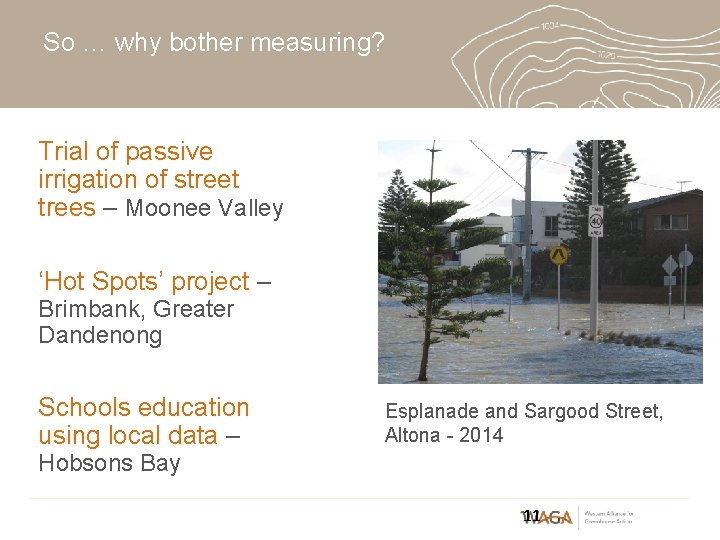
So … why bother measuring? Trial of passive irrigation of street trees – Moonee Valley ‘Hot Spots’ project – Brimbank, Greater Dandenong Schools education using local data – Esplanade and Sargood Street, Altona - 2014 Hobsons Bay 11
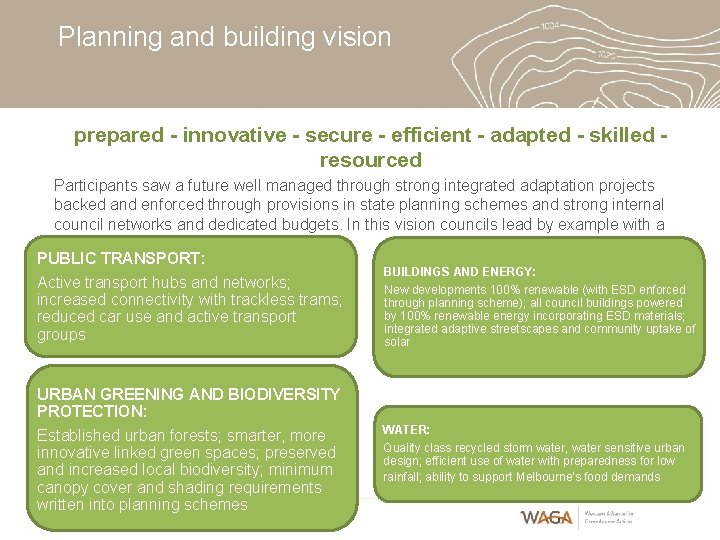
Planning and building vision prepared - innovative - secure - efficient - adapted - skilled resourced Participants saw a future well managed through strong integrated adaptation projects backed and enforced through provisions in state planning schemes and strong internal council networks and dedicated budgets. In this vision councils lead by example with a supportive community. PUBLIC TRANSPORT: BUILDINGS AND ENERGY: Active transport hubs and networks; New developments 100% renewable (with ESD enforced increased connectivity with trackless trams; through planning scheme); all council buildings powered by 100% renewable energy incorporating ESD materials; reduced car use and active transport integrated adaptive streetscapes and community uptake of groups solar URBAN GREENING AND BIODIVERSITY PROTECTION: Established urban forests; smarter, more innovative linked green spaces; preserved and increased local biodiversity; minimum canopy cover and shading requirements written into planning schemes WATER: Quality class recycled storm water, water sensitive urban design; efficient use of water with preparedness for low rainfall; ability to support Melbourne's food demands
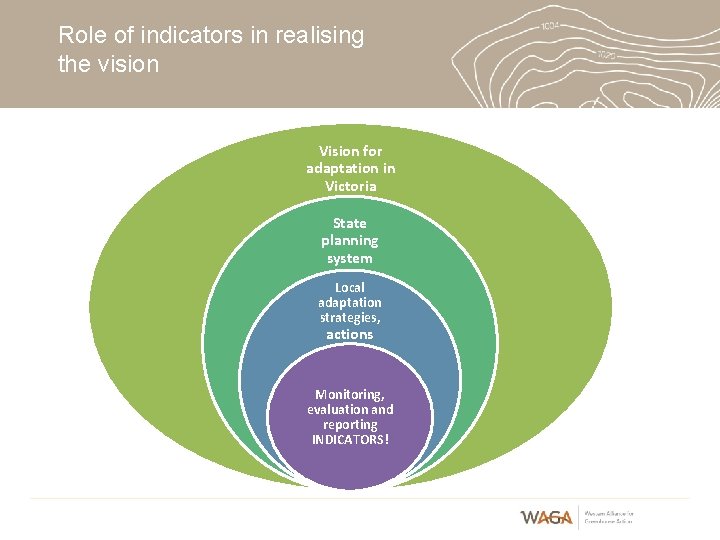
Role of indicators in realising the vision Vision for adaptation in Victoria State planning system Local adaptation strategies, actions Monitoring, evaluation and reporting INDICATORS!
How Well Are We Adapting website: adapt. waga. com. au Username: testuser or testadmin Password: waga#test 9 WAGA. com. au franm@brimbank. vic. gov. au, 9249 4864