
How was the Soviet Union governed and how
- Slides: 34
How was the Soviet Union governed and how did political authority change and develop 1945 - 1953? • Read extract 1 on p. 195 – what are the two contrasting views of post-war USSR? • • Define the term High Stalinism. • Produce a timeline to show Stalin’s later years from 1945 – 1953, using p. 195 – 198. • Record the key features of Political High Stalinism above the line and Cultural High Stalinism below the line. • How far were the later years a continuation of Stalinism pre-1941?
Homework To read , Animal Farm (1945) and/or 1984 (1949) by George Orwell. They are described as dystopian novels, written around the time of the end of WW 2/start of the Cold War, they are highly critical of Stalin and his regime. The first depicts a revolution where one elite is essentially replaced by another and the second heralds the idea of ‘Big Brother’, the all seeing, knowing leader of the Party. They are each referred to as an allegorical novella as they use a character, a scene, a place or an event to depict real-life issues to make them more comprehensible to people. They weren’t published straight away as Russia was still regarded as our ally when Orwell first wrote them.
The revival of Terror and the destruction of ‘supposed opposition’ High Stalinism was also characterised by a revival of Terror – why is that? Use p. 198 – 199 to produce a spider diagram that explains Stalin’s attitude to foreigners, the role of Beria, the work of the NKVD and the impact of the Cold War.
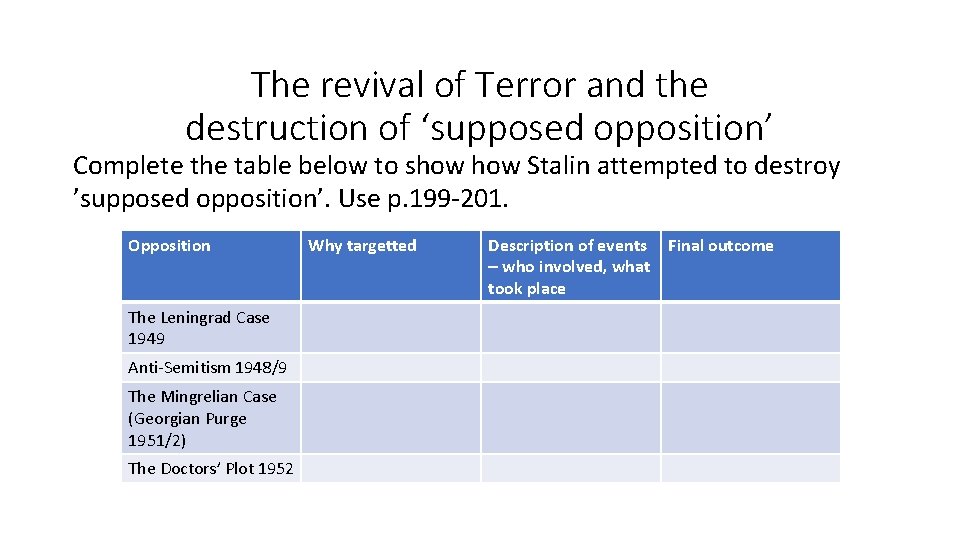
The revival of Terror and the destruction of ‘supposed opposition’ Complete the table below to show Stalin attempted to destroy ’supposed opposition’. Use p. 199 -201. Opposition The Leningrad Case 1949 Anti-Semitism 1948/9 The Mingrelian Case (Georgian Purge 1951/2) The Doctors’ Plot 1952 Why targetted Description of events – who involved, what took place Final outcome
The revival of Terror and the destruction of ‘supposed opposition’ 1. Why does Stalin’s paranoia appear to increase? 2. Was it justified?
How does Stalin’s ‘cult of personality’ evolve in the final years of his rule? Use the textbook p. 201 -202 and the extra handout p. 369 – 371 to record how the ‘cult of personality’ continues to evolve in Stalin’s later years. • How does this contribute to the period of High Stalinism?
What was the impact of Stalin’s death on Russia and its people? Using the handout p. 372 -373 – consider the impact of Stalin’s death. • What evidence is there that supports the view that Stalin was genuinely mourned by the people? • Continue reading to the end, use it to help you write a summary of the legacy Stalin leaves to Russia and its people. • Remember to consider any positives as well as the negatives. • Also, include the historical interpretations in your summary.
Khrushchev and reaction to Stalinism, 1953 1964 • Read extract 1 on p. 203. • Nettl contrasts Khrushchev and Stalin. Create a two-column chart and record the comparisons made between the two leaders. • Add any more comparisons as you work through the next few lessons. • Consider whether you agree with the comparisons and what evidence you could use to support or challenge them.
Khrushchev and reaction to Stalinism, 1953 - 1964 • Your task is to research the principal political players who were involved in the power struggle after Stalin’s death in 1953. Use the handout and p. 173, p. 203 – 205. • Make notes on the background and the key positions held by the following: • • • Nikita Khrushchev Georgii Malenkov Vyacheslav Molotov Lavrenty Beria Lazar Kaganovich Nicolai Bulganin
How and why was Khrushchev able to succeed Stalin? • Study the timeline on the handout. • Highlight what you consider to be the 10 most important events on this list. Explain why. • What 5 words would you use to describe Khrushchev from what you have learned about him so far? • Use the worksheet to record how Khrushchev was able to outmaneuver his rivals between 1953 -1958. • How was Khrushchev’s rise to power similar and different to Stalin’s rise to power? • Use the sheet ’Khrushchev the Man’ to complete questions 1 and 2 on the sources. • Was Khrushchev the right person to lead Russia after the death of Stalin?
Rise to power • Following Stalin’s death in March 1953, a collective leadership emerged (as had happened after Lenin’s death) – Malenkov (Soviet Premier) – Molotov (Foreign Secretary) – Bulganin (Deputy Premier) – Khrushchev (Party Secretary) • Many of the contenders for leader feared Beria would use his influence in the MVD (secret police) as a base for a power bid • Khrushchev was able to counter this with the Red Army as the Generals disliked Beria for his role in the purges of the 1930 s. • Khrushchev had distanced himself from the army purges and played a leading role in the Great Patriotic War.
• In June 1953, troops supporting Khrushchev surrounded Beria’s apartment, preventing MVD intervention. • Beria was then tried and shot • This was one of the last political shooting after Stalin’s bloodletting, a sign early on that Khrushchev represented a thaw in Soviet restrictions. • Malenkov argued that better relations with the outside world should be improved and embarked on a process of raising Soviet living standards, whilst neglecting heavy industry. • Malenkov won little support from these changes and did not have the strong personality Khrushchev possessed • Khrushchev was, as Party Secretary the leader and had far more influence politically than Malenkov
• Khrushchev weakened Malenkov’s position through criticism of government ministers and their policies. • He also travelled around Russia and heard the grievances of the localities, which no leader had done before. • By 1955 he had established a strong power base • In the same year, Malenkov resigned after successive falls in grain production caused by his routing of Russia’s finances into living conditions • He was replaced as Premier by Bulganin, who never rivalled Khrushchev’s power
• In 1956 Khrushchev felt able to launch a violent attack on Stalin’s character and record • All of the high ranking members had survived the oppressive years of Stalin’s regime and therefore found this attack hard to take • Opposition to Khrushchev then began to grow, particularly amongst those who had lost their positions after Khrushchev’s reorganisation of the party • Khrushchev was seen as a threat as he was removing jobs from those in the Communist Party. Plans were therefore made to remove him from power • After a visit abroad, one such attack came, during which it was claimed that Khrushchev had gone too far in his process of de-Stalinisation and was responsible for anti. Soviet revolts in Poland Hungary
• The Politburo voted by seven votes to four for his dismissal as party secretary, but Khrushchev would only accept the vote if it was backed by the Party Central Committee • Khrushchev had his supporters flown from all over Russia to Moscow to vote, which backed Khrushchev • Molotov and Malenkov were accused of forming an anti party group and resigned from their posts
• Khrushchev now took steps to stop the army from becoming a threat • He accused Marshall Zhukov of creating his own cult of the individual, he was then forced to retire and was replaced by Marshall Malinovsky • Only Bulganin stood in Khrushchev’s path to power. He was denounced as a supporter of the anti-Party group and resigned in March 1958 • Khrushchev was now in overall command of the Party and therefore Russia
What was the impact of the ‘Secret Speech’? • Read p. 205 -206 – what is Khrushchev’s attitude towards Stalin’s rule? • Read the extracts from the secret speech – ‘On the Cult of Personality and its Consequences’ of 1956, and make notes on the following; • The main criticisms of Stalin, support each of them with a quote. • The ways Khrushchev praises Stalin, support these with quotes. • Why Khrushchev and his colleagues fail to stand up to Stalin, support with quotes.
What was the impact of the ‘Secret Speech’? • The ‘secret speech’ or de-Stalinisation speech as it is also known led to a number of uprisings - see Closer Look p. 206. • What evidence is there that Khrushchev’s reforms were not going to be as far-reaching as initially thought? Use p. 206 and Extract 2 on p. 207.
How was the Soviet Union governed under Khrushchev and how did political authority change and develop? • How does the death of Stalin affect the balance of power? Where do we see a resurgence of political power under Khrushchev? (P. 207) • Define the policies of ‘democratisation’ and ‘decentralisation’ that Khrushchev introduced in 1957. • Compare the definition of democracy in Russia with what you understand democracy to mean. What do you notice? • A system of government by the whole population or all the eligible members of a state, typically through elected representatives ie ‘a system of parliamentary democracy’ • Versus… • An organisational system in which policy is decided centrally and binding on all members ie ‘democratic centralism’
How was the Soviet Union governed under Khrushchev and how did political authority change and develop • How does the introduction of ‘democratisation’ and ‘decentralisation’ undermine the political power of the Party? • How different was Khrushchev’s style of leadership from Stalin’s? Use your findings from this chapter to add to your comparison chart. • Use extract 3 on p. 208 and source B on the extra handout to answer: • How has Khrushchev been interpreted as a political leader? • How are they similar/different?
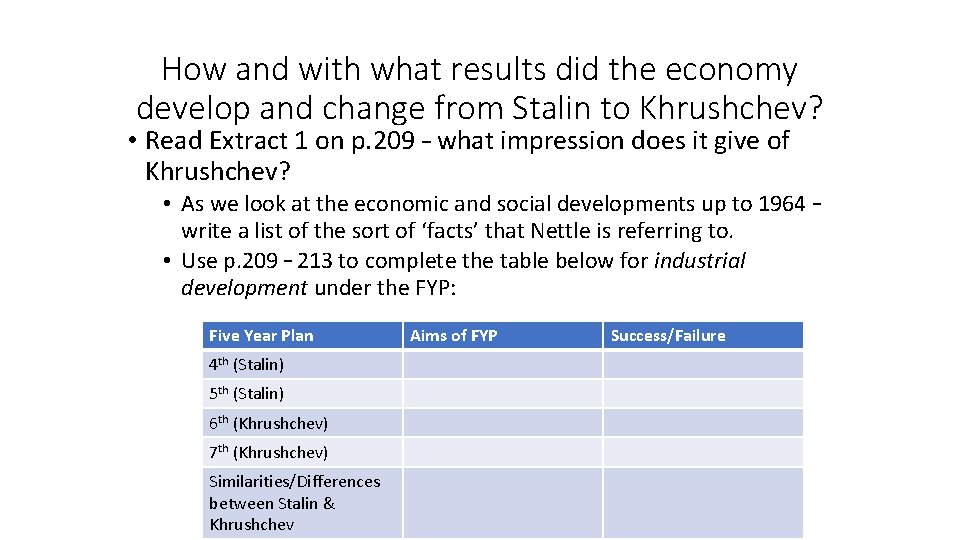
How and with what results did the economy develop and change from Stalin to Khrushchev? • Read Extract 1 on p. 209 – what impression does it give of Khrushchev? • As we look at the economic and social developments up to 1964 – write a list of the sort of ‘facts’ that Nettle is referring to. • Use p. 209 – 213 to complete the table below for industrial development under the FYP: Five Year Plan 4 th (Stalin) 5 th (Stalin) 6 th (Khrushchev) 7 th (Khrushchev) Similarities/Differences between Stalin & Khrushchev Aims of FYP Success/Failure
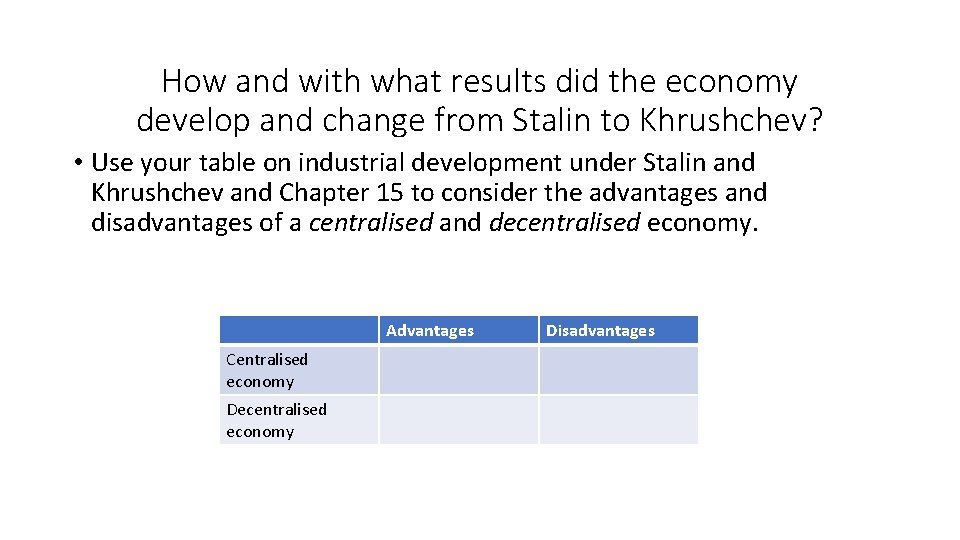
How and with what results did the economy develop and change from Stalin to Khrushchev? • Use your table on industrial development under Stalin and Khrushchev and Chapter 15 to consider the advantages and disadvantages of a centralised and decentralised economy. Advantages Centralised economy Decentralised economy Disadvantages
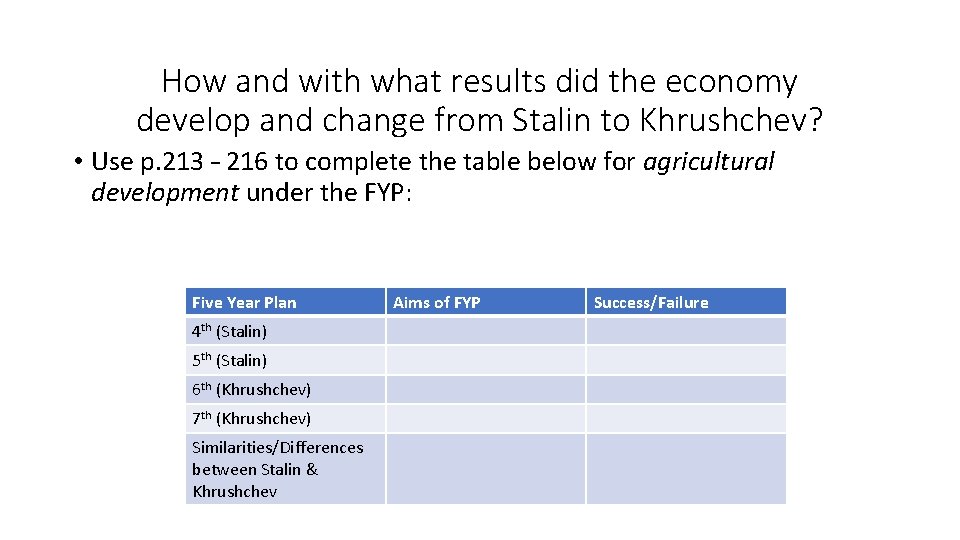
How and with what results did the economy develop and change from Stalin to Khrushchev? • Use p. 213 – 216 to complete the table below for agricultural development under the FYP: Five Year Plan 4 th (Stalin) 5 th (Stalin) 6 th (Khrushchev) 7 th (Khrushchev) Similarities/Differences between Stalin & Khrushchev Aims of FYP Success/Failure
To what extent did the economy change and stay the same between 1945 -1964? • Use your tables on industrial and agricultural development to produce a timeline of economic development from 1945 – 1964. • You could put examples of how industrial and agricultural policies change above the timeline and examples of how industrial and agricultural policies continue/stay the same below the timeline. • You could write/highlight industrial in one colour and agricultural another colour. • This would also be a good revision tool.
To what extent did the economy change and stay the same between 1945 -1964? • Answer the following using your timeline; • Which area saw the greater improvement in the years 1945 -1964: industry or agriculture? Explain. • What were the strengths and limitations of the changes introduced? Overall, how successful were the changes? Use the extra handout to add to help you identify these. • To what extent did things continue across the period? • Identify the historical interpretations from the handout?
What social and cultural change took place between 1945 -1964? • Use p. 216 – 217 Social change under Stalin 1945 – 1953, to help you describe the standard of living experienced by the workers and peasants of Russia by 1953. What problems did they face? • Use p. 217 – 218 Social change under Khrushchev 1953 – 1964, to complete the table. Use the Success/Failure column to help you write a comment on the overall impact of these changes on people’s lives. • You can add to this as we go through the rest of this chapter.
What social and cultural change took place between 1945 -1964? • Using p. 218 – sum up the quality of life and cultural change under Stalin, 1945 – 1953. • What do you think is meant by the ‘thaw’ which took place under Khrushchev as a result of de. Stalinisation? • Produce some illustrated notes, a spider diagram, a table on social and cultural change under Khrushchev. • Your research should consider what change took place and the degree of openness that was permitted in that area. Is all of the change positive? • Use p. 218 -220 and the extra handouts to help you.
Why did opposition develop and how effective was it? • Read extract 1, what is Crankshaw’s view of Khrushchev’s leadership? • How does Crankshaw explain the existence of suspicion and opposition in the Soviet Union in the time of Khrushchev? • How and why does Khrushchev face opposition from cultural dissidents?
Why did opposition develop and how effective was it? Research examples of the ways in which dissidents showed their opposition: • You will need to make notes on the activities of non conformist artists, writers, musicians and ballet dancers eg Mayakovsky Square poetry readings, dissident magazines. . . • As well as what the authorities did to try to put down the opposition. • Make sure you have definitions for the key terms such as Tamizdat, Samizdat…. • Include profiles of the key cultural dissidents in Russia at this time eg Vladimir Bukovsky, Joseph Brodsky, Rudolf Nureyev. • To what extent was there a ‘cultural thaw’ under Khrushchev?
Why did opposition develop within the Party and how effective was it? Khrushchev’s rise to power saw a struggle between those who believed in liberal reform eg Bulganin and hardline pro-Stalinists eg Molotov, Malenkov and Kaganovich. Read p. 224 and answer the following questions: 1. Why did the hardliners (the ‘anti-party group’) try to oust Khrushchev in 1957? 2. How did Khrushchev manage to hold on to power?
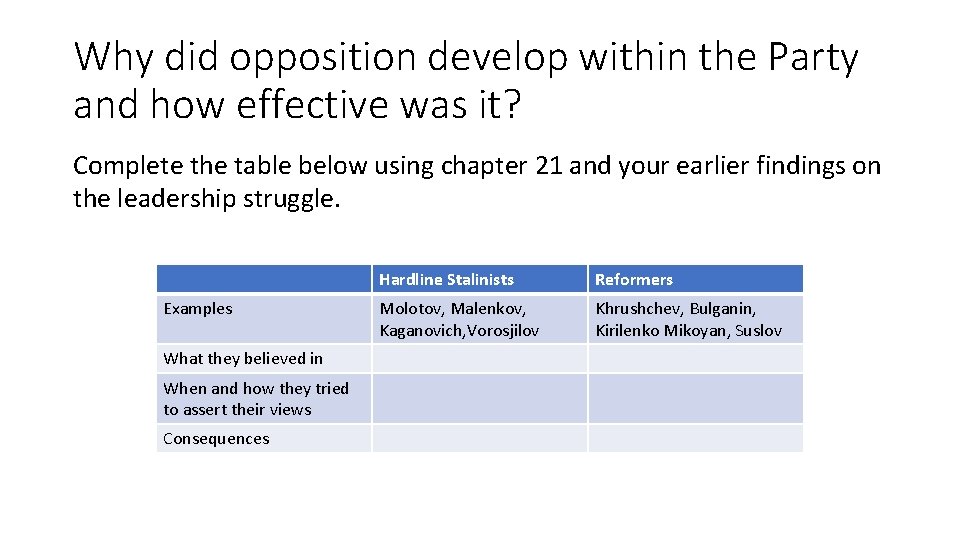
Why did opposition develop within the Party and how effective was it? Complete the table below using chapter 21 and your earlier findings on the leadership struggle. Examples What they believed in When and how they tried to assert their views Consequences Hardline Stalinists Reformers Molotov, Malenkov, Kaganovich, Vorosjilov Khrushchev, Bulganin, Kirilenko Mikoyan, Suslov
Why did opposition develop within the Party and how effective was it? • Using p. 224 – record the treatment of political opposition under Khrushchev. This could be presented as a flow chart, timeline…. • Read extract 2 on p. 225. • Summarise Robert Service’s view in one sentence. • Create a list of the type of activities that might fall under the heading of ‘non-compliance’. • Using p. 224 - 225 What degree of control did Khrushchev have over ordinary citizens and the prison population? • How much opposition was there (i) within the Party and (ii) within the state as a whole by 1964? • How does this compare and contrast with the degree of opposition to Stalin by 1953?
Why did Khrushchev fall from power in 1964? • Create an illustrated profile of Leonid Brezhnev using p. 225 and your own research. • What contribution did Brezhnev make to Khrushchev’s fall from power in 1964? • Use p. 225 – 226 to produce a diagram that shows all the long and short term reasons for Krushchev’s fall from power. • Read extract 3 on p. 227 – how many different types of ‘opponents’ to Khrushchev can you identify? • Write an obituary for Khrushchev, providing a balanced appraisal of his domestic contributions to the USSR 19531964.
What was the condition of the Soviet Union by 1964? • Read extract 1 on p. 228 – what were Khrushchev’s aims according to Crankshaw? • What is Crankshaw’s view of Khrushchev in terms of his leadership and his achievements? Final Summary Task You are going to record what the Political, Economic and Social condition of the Soviet Union is by the end of Khrushchev’s rule in 1964, using the grids to help you. You will need to look over your notes and/or the chapters in this section, from chapter 21 onwards. P. 228 -231 and the 3 extra handouts provide a good summary.