
How was the Amritsar Massacre a turning point
- Slides: 1
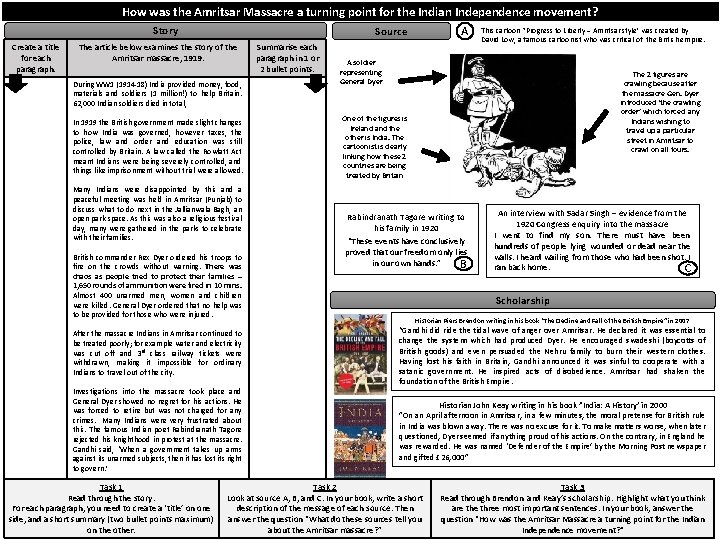
How was the Amritsar Massacre a turning point for the Indian Independence movement? Story Create a title for each paragraph. The article below examines the story of the Amritsar massacre, 1919. During WW 1 (1914 -18) India provided money, food, materials and soldiers (1 million!) to help Britain. 62, 000 Indian soldiers died in total, In 1919 the British government made slight changes to how India was governed, however taxes, the police, law and order and education was still controlled by Britain. A law called the Rowlatt Act meant Indians were being severely controlled, and things like imprisonment without trial were allowed. Many Indians were disappointed by this and a peaceful meeting was held in Amritsar (Punjab) to discuss what to do next in the Jallianwala Bagh, an open park space. As this was also a religious festival day, many were gathered in the parks to celebrate with their families. British commander Rex Dyer ordered his troops to fire on the crowds without warning. There was chaos as people tried to protect their families – 1, 650 rounds of ammunition were fired in 10 mins. Almost 400 unarmed men, women and children were killed. General Dyer ordered that no help was to be provided for those who were injured. After the massacre Indians in Amritsar continued to be treated poorly; for example water and electricity was cut off and 3 rd class railway tickets were withdrawn, making it impossible for ordinary Indians to travel out of the city. Investigations into the massacre took place and General Dyer showed no regret for his actions. He was forced to retire but was not charged for any crimes. Many Indians were very frustrated about this. The famous Indian poet Rabindranath Tagore rejected his knighthood in protest at the massacre. Gandhi said, ‘When a government takes up arms against its unarmed subjects, then it has lost its right to govern. ’ Task 1 Read through the story. For each paragraph, you need to create a ‘title’ on one side, and a short summary (two bullet points maximum) on the other. A Source Summarise each paragraph in 1 or 2 bullet points. This cartoon “Progress to Liberty – Amritsar style’ was created by David Low, a famous cartoonist who was critical of the British empire. A soldier representing General Dyer The 2 figures are crawling because after the massacre Gen. Dyer introduced ‘the crawling order’ which forced any Indians wishing to travel up a particular street in Amritsar to crawl on all fours. One of the figures is Ireland the other is India. The cartoonist is clearly linking how these 2 countries are being treated by Britain From Rabindranath Tagore writing to his family in 1920 “These events have conclusively proved that our freedom only lies in our own hands. ” B An interview with Sadar Singh – evidence from the 1920 Congress enquiry into the massacre I went to find my son. There must have been hundreds of people lying wounded or dead near the walls. I heard wailing from those who had been shot. I ran back home. C Scholarship Historian Piers Brendon writing in his book “The Decline and Fall of the British Empire” in 2007 “Gandhi did ride the tidal wave of anger over Amritsar. He declared it was essential to change the system which had produced Dyer. He encouraged swadeshi (boycotts of British goods) and even persuaded the Nehru family to burn their western clothes. Having lost his faith in Britain, Gandhi announced it was sinful to cooperate with a satanic government. He inspired acts of disobedience. Amritsar had shaken the foundation of the British Empire. Historian John Keay writing in his book ”India: A History’ in 2000 ”On an April afternoon in Amritsar, in a few minutes, the moral pretense for British rule in India was blown away. There was no excuse for it. To make matters worse, when later questioned, Dyer seemed if anything proud of his actions. On the contrary, in England he was rewarded. He was named ‘Defender of the Empire’ by the Morning Post newspaper and gifted £ 26, 000” Task 2 Look at source A, B, and C. In your book, write a short description of the message of each source. Then answer the question “What do these sources tell you about the Amritsar massacre? ” Task 3 Read through Brendon and Keay’s scholarship. Highlight what you think are three most important sentences. In your book, answer the question “How was the Amritsar Massacre a turning point for the Indian Independence movement? "