
How useful are sources A and B to
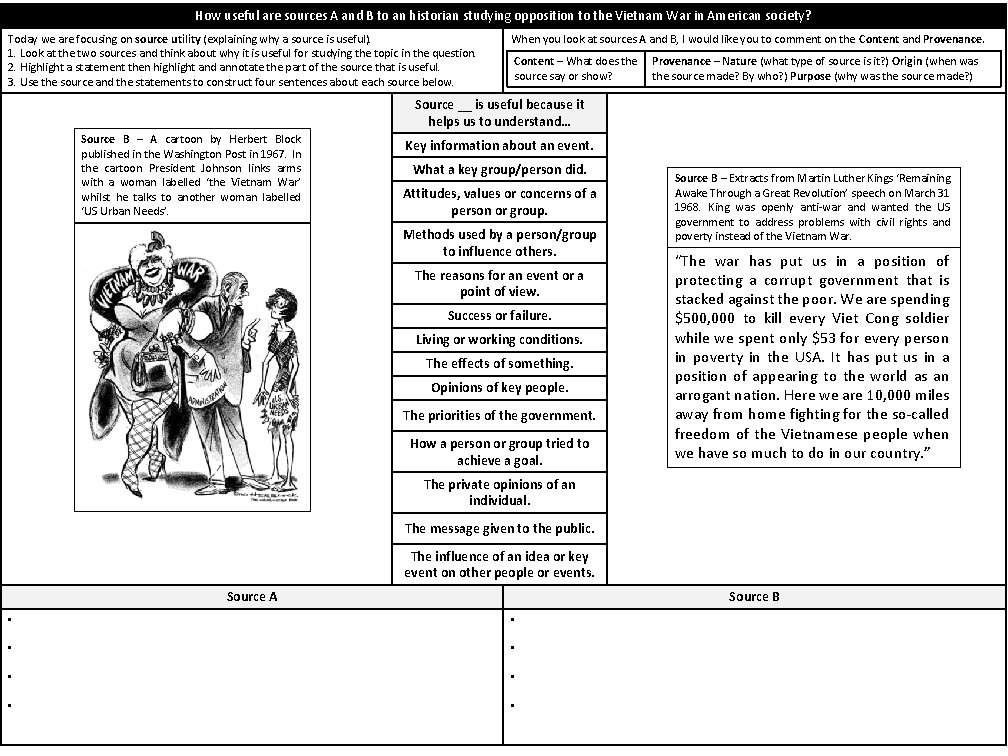
How useful are sources A and B to an historian studying opposition to the Vietnam War in American society? Today we are focusing on source utility (explaining why a source is useful). 1. Look at the two sources and think about why it is useful for studying the topic in the question. 2. Highlight a statement then highlight and annotate the part of the source that is useful. 3. Use the source and the statements to construct four sentences about each source below. When you look at sources A and B, I would like you to comment on the Content and Provenance. Content – What does the source say or show? Provenance – Nature (what type of source is it? ) Origin (when was the source made? By who? ) Purpose (why was the source made? ) Source __ is useful because it helps us to understand… Source B – A cartoon by Herbert Block published in the Washington Post in 1967. In the cartoon President Johnson links arms with a woman labelled ‘the Vietnam War’ whilst he talks to another woman labelled ‘US Urban Needs’. Key information about an event. What a key group/person did. Attitudes, values or concerns of a person or group. Methods used by a person/group to influence others. The reasons for an event or a point of view. Success or failure. Living or working conditions. The effects of something. Opinions of key people. The priorities of the government. How a person or group tried to achieve a goal. Source B – Extracts from Martin Luther Kings ‘Remaining Awake Through a Great Revolution’ speech on March 31 1968. King was openly anti-war and wanted the US government to address problems with civil rights and poverty instead of the Vietnam War. “The war has put us in a position of protecting a corrupt government that is stacked against the poor. We are spending $500, 000 to kill every Viet Cong soldier while we spent only $53 for every person in poverty in the USA. It has put us in a position of appearing to the world as an arrogant nation. Here we are 10, 000 miles away from home fighting for the so-called freedom of the Vietnamese people when we have so much to do in our country. ” The private opinions of an individual. The message given to the public. The influence of an idea or key event on other people or events. Source A Source B • •
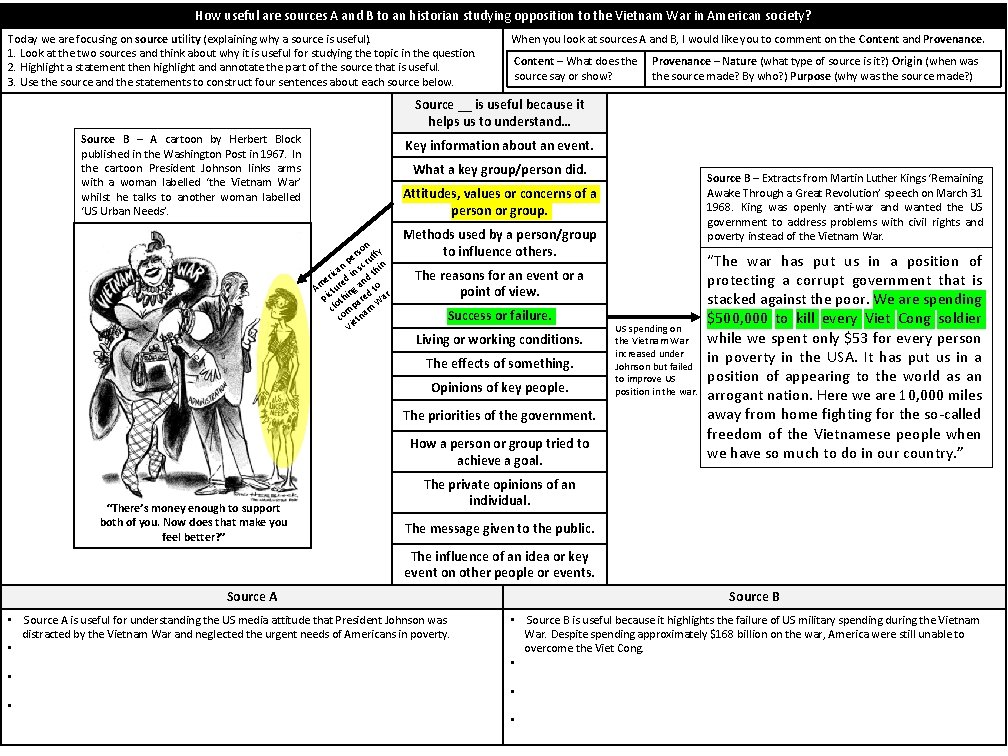
How useful are sources A and B to an historian studying opposition to the Vietnam War in American society? Today we are focusing on source utility (explaining why a source is useful). 1. Look at the two sources and think about why it is useful for studying the topic in the question. 2. Highlight a statement then highlight and annotate the part of the source that is useful. 3. Use the source and the statements to construct four sentences about each source below. When you look at sources A and B, I would like you to comment on the Content and Provenance. Content – What does the source say or show? Provenance – Nature (what type of source is it? ) Origin (when was the source made? By who? ) Purpose (why was the source made? ) Source __ is useful because it helps us to understand… Source B – A cartoon by Herbert Block published in the Washington Post in 1967. In the cartoon President Johnson links arms with a woman labelled ‘the Vietnam War’ whilst he talks to another woman labelled ‘US Urban Needs’. Key information about an event. What a key group/person did. Attitudes, values or concerns of a person or group. n rso uffy e n p scr in ica d in d th r e e n Am ctur ng a d to r. i i p oth are Wa cl mp am co etn Vi Methods used by a person/group to influence others. The reasons for an event or a point of view. Success or failure. Living or working conditions. The effects of something. Opinions of key people. The priorities of the government. How a person or group tried to achieve a goal. “There’s money enough to support both of you. Now does that make you feel better? ” Source B – Extracts from Martin Luther Kings ‘Remaining Awake Through a Great Revolution’ speech on March 31 1968. King was openly anti-war and wanted the US government to address problems with civil rights and poverty instead of the Vietnam War. US spending on the Vietnam War increased under Johnson but failed to improve US position in the war. “The war has put us in a position of protecting a corrupt government that is stacked against the poor. We are spending $500, 000 to kill every Viet Cong soldier while we spent only $53 for every person in poverty in the USA. It has put us in a position of appearing to the world as an arrogant nation. Here we are 10, 000 miles away from home fighting for the so-called freedom of the Vietnamese people when we have so much to do in our country. ” The private opinions of an individual. The message given to the public. The influence of an idea or key event on other people or events. Source A • Source A is useful for understanding the US media attitude that President Johnson was distracted by the Vietnam War and neglected the urgent needs of Americans in poverty. • Source B • Source B is useful because it highlights the failure of US military spending during the Vietnam War. Despite spending approximately $168 billion on the war, America were still unable to overcome the Viet Cong. • • •
- Slides: 2