
How unmanaged ES impacts can generate business risk
How unmanaged E&S impacts can generate business risk

Case 1: An example of good E&S risk mitigation by a Bank

Background • Client - medium sized fertilizer manufacturing company. • Location – near a major international watercourse, upstream from a national park • Financing request - long term loan facility for $10 mn. • Bank categorized the Client’s activities as high risk project and engaged an external consultant to assist with the E&S due diligence.

Findings and Outcome of the E&S Due Diligence Findings • Lack of management commitment, systems and capacity to address E&S impacts. • Actions to control and manage pollution and fix failings in the effluent holding ponds and other site infrastructure had not been implemented. • Management appeared to be underestimating the potential risks associated with poor effluent management. Outcome • The Bank makes repairs of infrastructure a condition precedent for disbursement of loan facility.
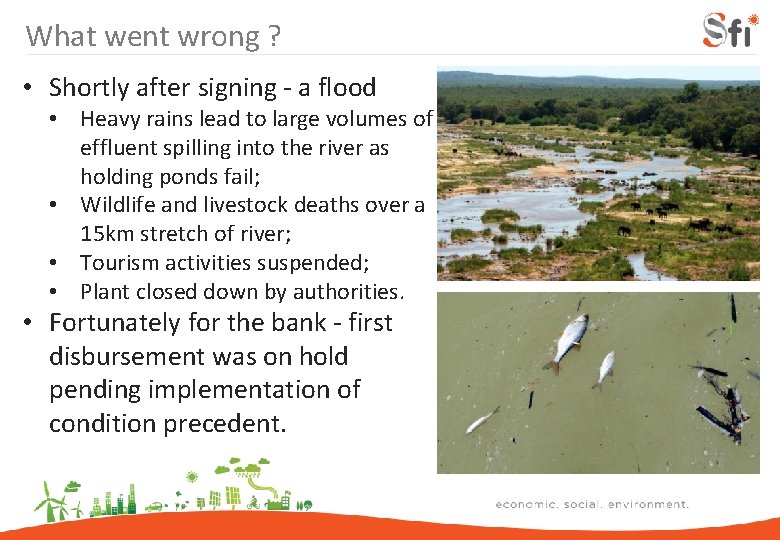
What went wrong ? • Shortly after signing - a flood • Heavy rains lead to large volumes of effluent spilling into the river as holding ponds fail; • Wildlife and livestock deaths over a 15 km stretch of river; • Tourism activities suspended; • Plant closed down by authorities. • Fortunately for the bank - first disbursement was on hold pending implementation of condition precedent.
Lessons Learned • The type of activity, size and location all have a bearing on likelihood and potential severity of E&S impacts. • Assessing a Client‘s commitment, capacity and track record to manage E&S impact is a critical part of the due diligence process. • The bank‘s ESMS correctly identified high risks associated with weaknesses in E&S management, in particular failure to address structural failures in effluent ponds. • The bank correctly made risk mitigation actions as conditions precedent to disbursement in the loan agreement.
Case 2: Importance of taking local communities into account
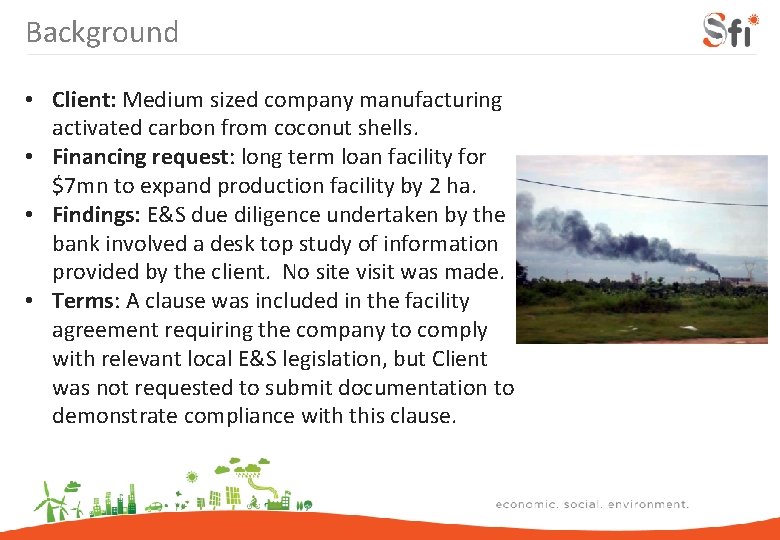
Background • Client: Medium sized company manufacturing activated carbon from coconut shells. • Financing request: long term loan facility for $7 mn to expand production facility by 2 ha. • Findings: E&S due diligence undertaken by the bank involved a desk top study of information provided by the client. No site visit was made. • Terms: A clause was included in the facility agreement requiring the company to comply with relevant local E&S legislation, but Client was not requested to submit documentation to demonstrate compliance with this clause.
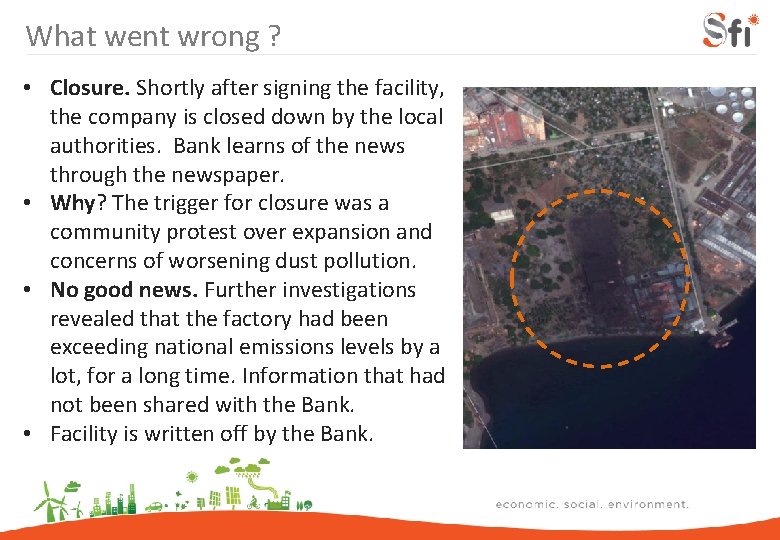
What went wrong ? • Closure. Shortly after signing the facility, the company is closed down by the local authorities. Bank learns of the news through the newspaper. • Why? The trigger for closure was a community protest over expansion and concerns of worsening dust pollution. • No good news. Further investigations revealed that the factory had been exceeding national emissions levels by a lot, for a long time. Information that had not been shared with the Bank. • Facility is written off by the Bank.
Lessons Learned • Do not rely on the client’s word. • Visit the site as often as possible, ideally with the help of a specialist. • Talk to other stakeholders, in particular those directly affected such as neighboring communities • Consider E&S issues as early in the process as possible to avoid cutting corners with the E&S due diligence. • Ask yourself “Would you and your family like to live next to the project you are financing? ” If not, you can probably count on community activism.
Case 3: Assess E&S risks beyond your project and financing perimeter
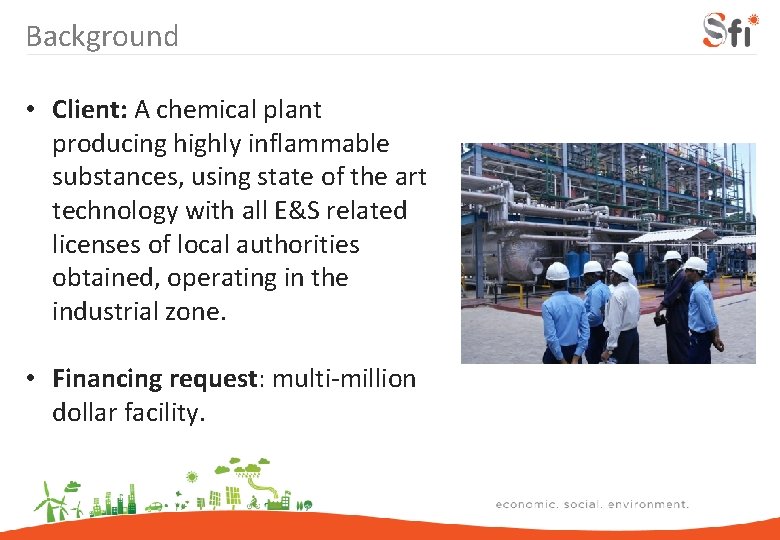
Background • Client: A chemical plant producing highly inflammable substances, using state of the art technology with all E&S related licenses of local authorities obtained, operating in the industrial zone. • Financing request: multi-million dollar facility.
Finding of Bank’s E&S due diligence • The E&SDD noted many overlooked risks that could increase the likelihood and severity of a potential accident, including: • Proximity of many informal vendors outside the company walls, preparing food on open fires only metres from petroleum intake; • Highly congested neighbourhoods and poor road infrastructure preventing an effective emergency response; • Inadequate emergency preparedness and response; no engagement with neighbouring entities or communities whatsoever. • The Bank requested the Client to • Develop a joint emergency response plan with neighbouring companies and vendors. • Move the vendors to a vacant space away from the perimeter wall. • Engage local authorities to improve the road infrastructure.
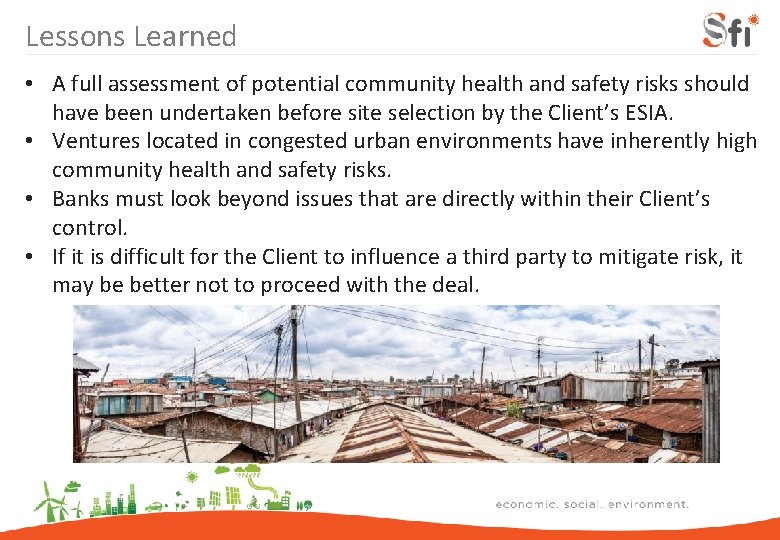
Lessons Learned • A full assessment of potential community health and safety risks should have been undertaken before site selection by the Client’s ESIA. • Ventures located in congested urban environments have inherently high community health and safety risks. • Banks must look beyond issues that are directly within their Client’s control. • If it is difficult for the Client to influence a third party to mitigate risk, it may be better not to proceed with the deal.
Lessons learnt from all the cases • Implementing E&S Management Systems in FIs pays in terms of avoided financial losses. • Banks must always ask Clients for demonstrable evidence of compliance. • If in doubt, involve specialists. • Banks should always conduct their own site visits. • E&S risk research must extend beyond the direct boundaries of the venture being financed. • Banks should be alert to poor management commitment and capacity.
- Slides: 15