
How to Write Qualitative Research CHAPTER 4 REVISING



- Slides: 38
How to Write Qualitative Research CHAPTER 4: REVISING IS THE SOUL OF PUTS THE SOUL IN WRITING
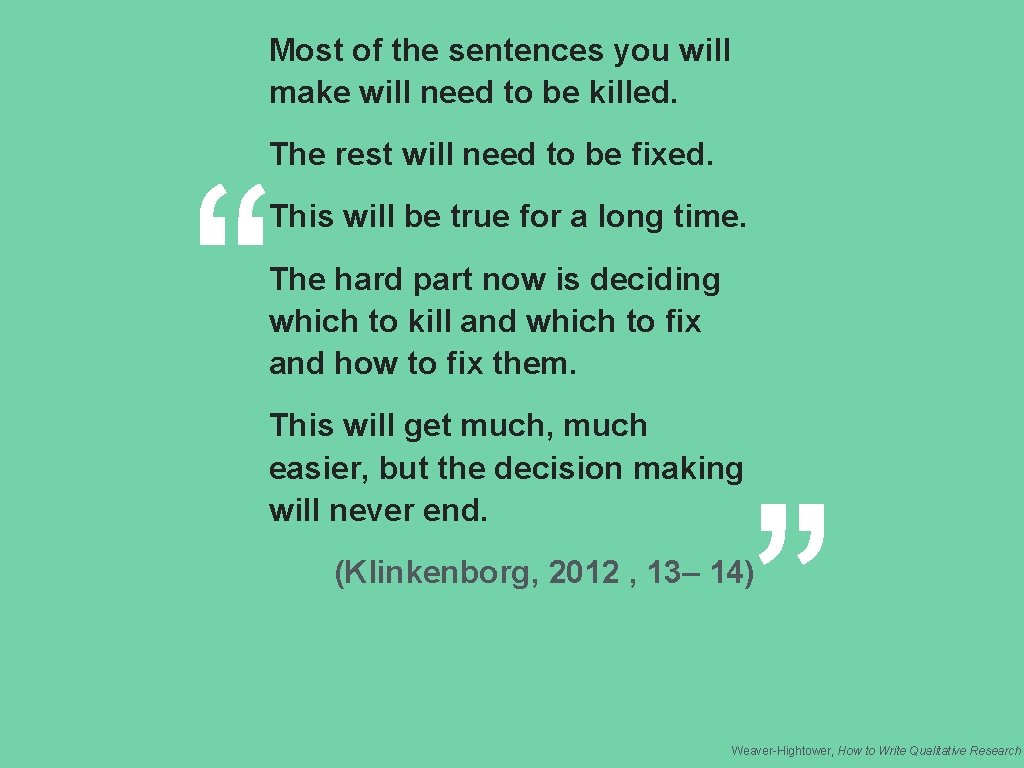
Most of the sentences you will make will need to be killed. The rest will need to be fixed. This will be true for a long time. The hard part now is deciding which to kill and which to fix and how to fix them. This will get much, much easier, but the decision making will never end. (Klinkenborg, 2012 , 13– 14) Weaver-Hightower, How to Write Qualitative Research
What incentives do we have as authors to make our writing clearer and more accessible? Weaver-Hightower, How to Write Qualitative Research
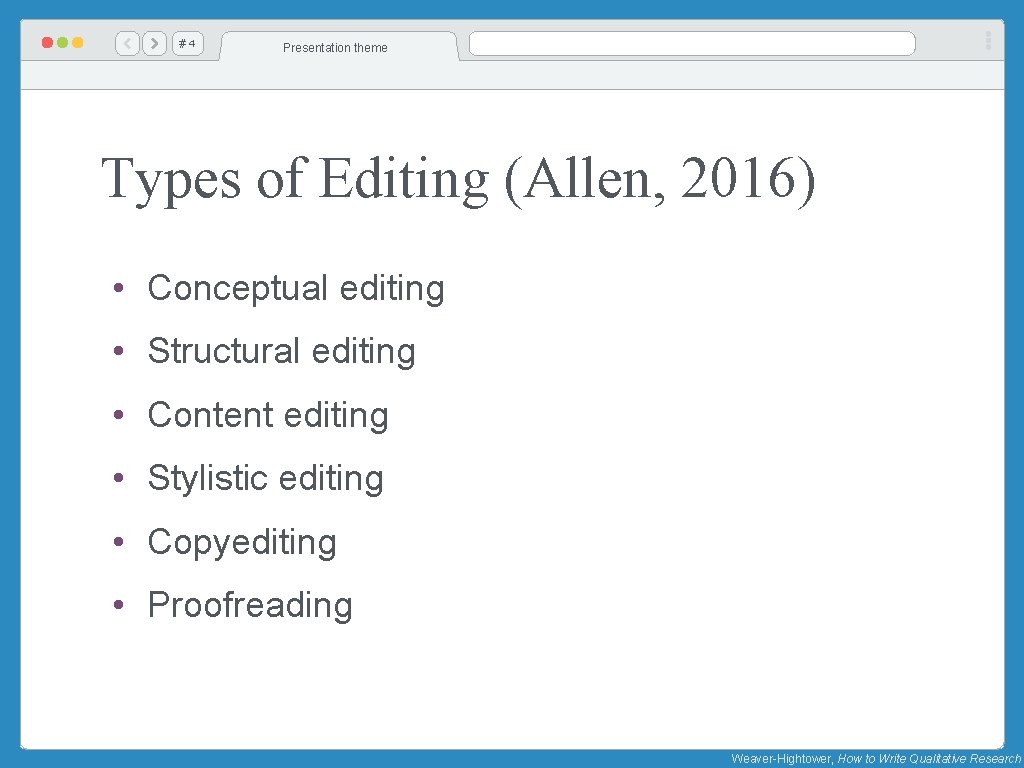
#4 Presentation theme Types of Editing (Allen, 2016) • Conceptual editing • Structural editing • Content editing • Stylistic editing • Copyediting • Proofreading Weaver-Hightower, How to Write Qualitative Research
Weaver-Hightower, How to Write Qualitative Research
1 SCRUTINIZE YOUR ETHICS • Anonymity • Fair and just in presentation • Consult disciplinary sources Weaver-Hightower, How to Write Qualitative Research
2 REWRITE TO BE VERBS AS ACTIVE • The world is an active place; your verbs should be active, too. • Passive ≠ Scientific • Save is for defining. Make the rest active. Weaver-Hightower, How to Write Qualitative Research
3 BREAK UP EXTRA-LONG SENTENCES AND PARAGRAPHS, INCLUDING QUOTATIONS • Long sentences and paragraphs test the mental stamina of readers. • CHUNK your ideas. • Interrogate any sentence over 30 words and any paragraph longer than a double-spaced page. • Watch out for long quotations, too. Trim them to just what you need. Weaver-Hightower, How to Write Qualitative Research
4 REDUCE “WORDY” PHRASES AND UNNECESSARY SYLLABLES • Don’t use two words where one will do. • Consider keeping a list of wordy phrases you use. • Watch out for redundancies • Substitute words with fewer syllables if they have the same meaning Weaver-Hightower, How to Write Qualitative Research
5 REDUCE PREPOSITIONAL PHRASES • Prepositions introduce relationships, so take care not to use too many all at once. • Fixes include: • replacing an of prepositional phrase by turning its object possessive • prepositions’ objects can sometimes be made into adjectives • move the object of the preposition to the sentence’s subject position • combine several into a single preposition Weaver-Hightower, How to Write Qualitative Research
6 REVISE PROBLEM USES OF IT, THIS, THAT, AND THERE • These words frequently pull other problematic writing characteristics “into their orbit, ” like prepositions, to be verbs, passive constructions, and abstract nouns • Be especially wary at the beginning of a clause or sentence • EASY fix: • Cut the “there is” (and others) as well as the pronouns that follow, like “that” or “who” • Make sure an identifiable subject and active verb remain Weaver-Hightower, How to Write Qualitative Research
7 REDUCE NON-INFORMATIVE ADJECTIVES AND ADVERBS • Find the adjectives and adverbs and ask whether they add any information that the words they modify don’t already imply Weaver-Hightower, How to Write Qualitative Research
8 LOOK FOR JARGON WORDS AND EXPLAIN THEM • If your grandmother would not understand a term, explain it. • Instead, • use a citation to a clear source • insert a synonym right after • include a short appositive or parenthetical with the definition • insert context clues that ensure understanding • immediately include an example, or • write a full, specific definition. Weaver-Hightower, How to Write Qualitative Research
9 FIND MORE PLACES FOR EXAMPLES, QUOTATIONS, AND METAPHORS • The more you illustrate points with real examples and illustrations, the more believable your points will be. Weaver-Hightower, How to Write Qualitative Research
10 SCRUTINIZE EVERY TRANSITION AND SIGNPOST • Make sure they are both present and work well. • For transitions, ask whether the relationship between the points makes sense and whether readers will find it clearly. • For signposts, eliminate unnecessary pointers. • Once you have the manuscript written, add in signposts to parts you wrote before you knew what you would say. Weaver-Hightower, How to Write Qualitative Research
11 LOOK FOR DEAD METAPHORS, AND EITHER REANIMATE OR BURY THEM • Metaphors are “dead” when they are so common that no one remembers they are metaphors anymore (e. g. , kick the bucket or beyond the pale) • Look for substitutes that still act like metaphors Weaver-Hightower, How to Write Qualitative Research
12 PROOFREAD QUOTATIONS FOR READABILITY AND NECESSITY • Punctuate and spell quotations from published texts as they were in the original, using “ [sic] ” whenever an unambiguous mistake appears in the original. • Punctuate and spell quotations from fieldnotes or interviews to make them maximally readable and/ or representative of the participants’ speech patterns. • Delete quotations that don’t add much to your argument. • Use ellipses to cut out portions of a quotation that are not relevant. Weaver-Hightower, How to Write Qualitative Research
13 ENSURE KEY TERMS ARE CONSISTENT, AND AVOID STRANGE ACRONYMS • Don’t worry about boring readers when it comes to key terms. • Be consistent in what you call your major concepts. • Words are easier to comprehend than acronyms are to remember. Weaver-Hightower, How to Write Qualitative Research
14 REVISE FOR VOICE, PACING, AND VARIATION • Consider the following sentence aspects: • Length • Complexity • Information Order • Originality Weaver-Hightower, How to Write Qualitative Research
15 QUALIFY GENERALIZATIONS, BUT NOT BY QUALIFYING THE VERBS • If you don’t know something with 100% precision, say so, either directly or by softening the claim’s directness. • Don’t weaken your verbs to do this, though. Weaver-Hightower, How to Write Qualitative Research
16 MANUALLY RUN THE GRAMMAR AND SPELLING CHECK Weaver-Hightower, How to Write Qualitative Research
17 RUN A PLAGIARISM CHECKER Weaver-Hightower, How to Write Qualitative Research
18 ENSURE NUMBERS ARE USED CORRECTLY • Usually, spell out numbers under ten. Use Arabic numerals for numbers 10 and above. • Lots of other rules are discipline specific. Weaver-Hightower, How to Write Qualitative Research
19 ASSIGN NUMBERS TO FIGURES AND TABLES • Often easiest to wait until the end so you don’t have to continually renumber. Weaver-Hightower, How to Write Qualitative Research
20 CHECK THAT ALL REFERENCES IN THE TEXT ARE IN THE BIBLIOGRAPHY AND VICE VERSA Weaver-Hightower, How to Write Qualitative Research
21 DOUBLE-CHECK FORMATTING AND REFERENCE STYLE Weaver-Hightower, How to Write Qualitative Research
OPTIONS FOR REVISING HELP Whiteboard meetings Peer writing-reading groups Peer review Weaver-Hightower, How to Write Qualitative Research
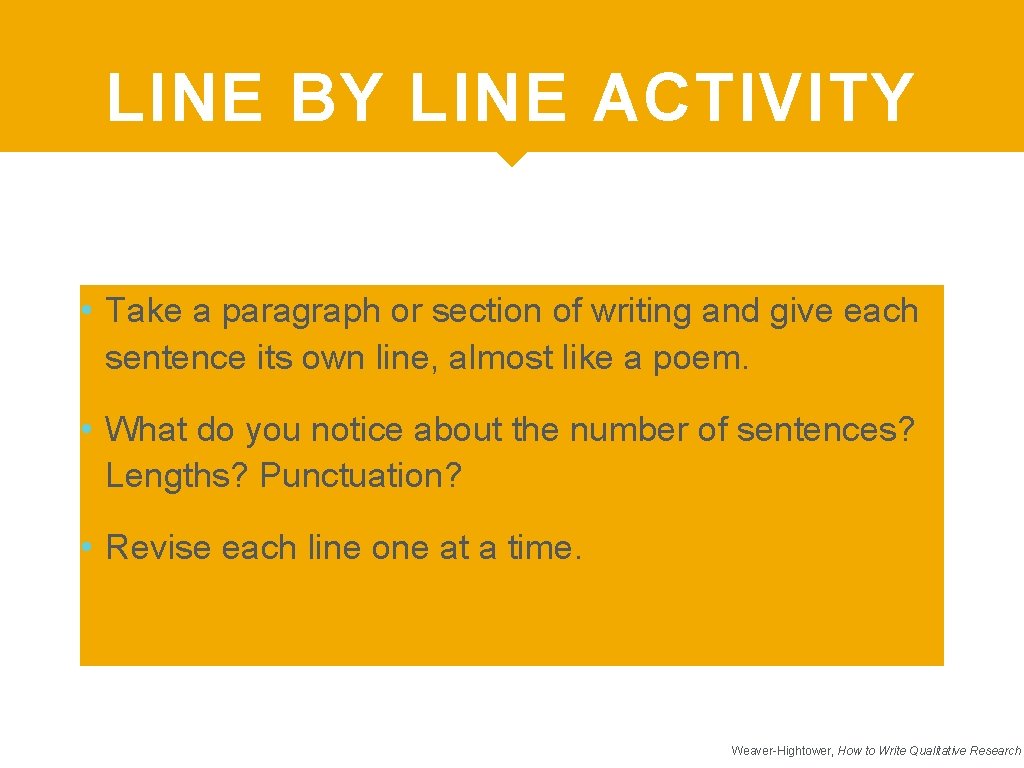
LINE BY LINE ACTIVITY • Take a paragraph or section of writing and give each sentence its own line, almost like a poem. • What do you notice about the number of sentences? Lengths? Punctuation? • Revise each line one at a time. Weaver-Hightower, How to Write Qualitative Research
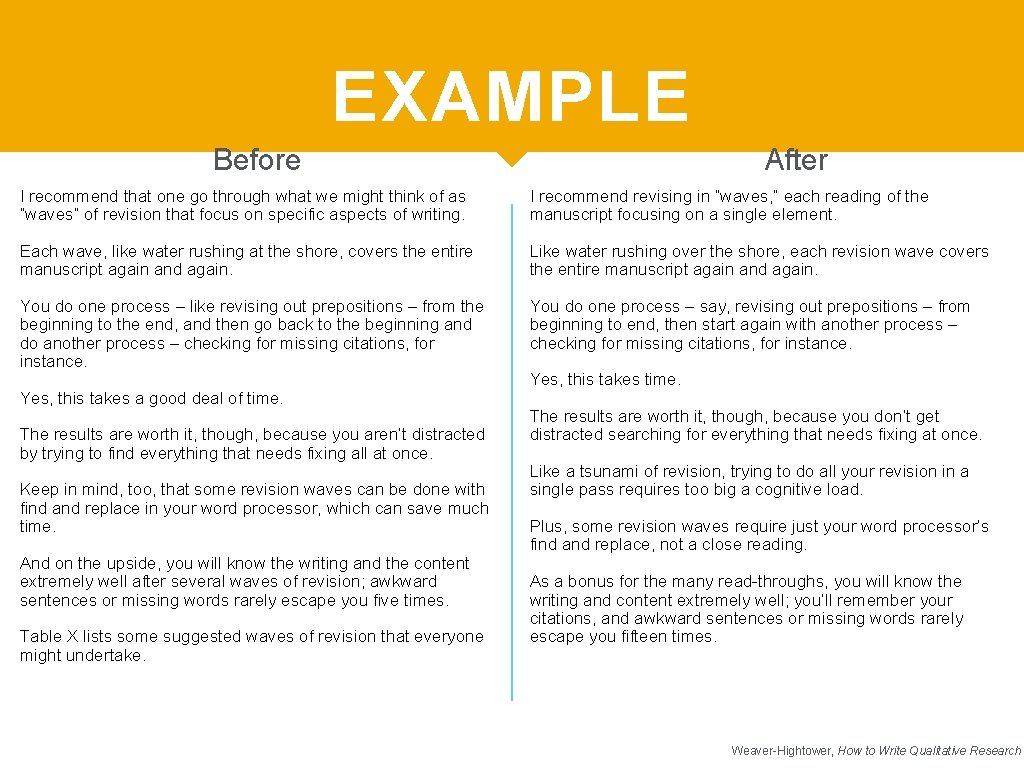
EXAMPLE Before After I recommend that one go through what we might think of as “waves” of revision that focus on specific aspects of writing. I recommend revising in “waves, ” each reading of the manuscript focusing on a single element. Each wave, like water rushing at the shore, covers the entire manuscript again and again. Like water rushing over the shore, each revision wave covers the entire manuscript again and again. You do one process – like revising out prepositions – from the beginning to the end, and then go back to the beginning and do another process – checking for missing citations, for instance. You do one process – say, revising out prepositions – from beginning to end, then start again with another process – checking for missing citations, for instance. Yes, this takes a good deal of time. The results are worth it, though, because you aren’t distracted by trying to find everything that needs fixing all at once. Keep in mind, too, that some revision waves can be done with find and replace in your word processor, which can save much time. And on the upside, you will know the writing and the content extremely well after several waves of revision; awkward sentences or missing words rarely escape you five times. Table X lists some suggested waves of revision that everyone might undertake. Yes, this takes time. The results are worth it, though, because you don’t get distracted searching for everything that needs fixing at once. Like a tsunami of revision, trying to do all your revision in a single pass requires too big a cognitive load. Plus, some revision waves require just your word processor’s find and replace, not a close reading. As a bonus for the many read-throughs, you will know the writing and content extremely well; you’ll remember your citations, and awkward sentences or missing words rarely escape you fifteen times. Weaver-Hightower, How to Write Qualitative Research
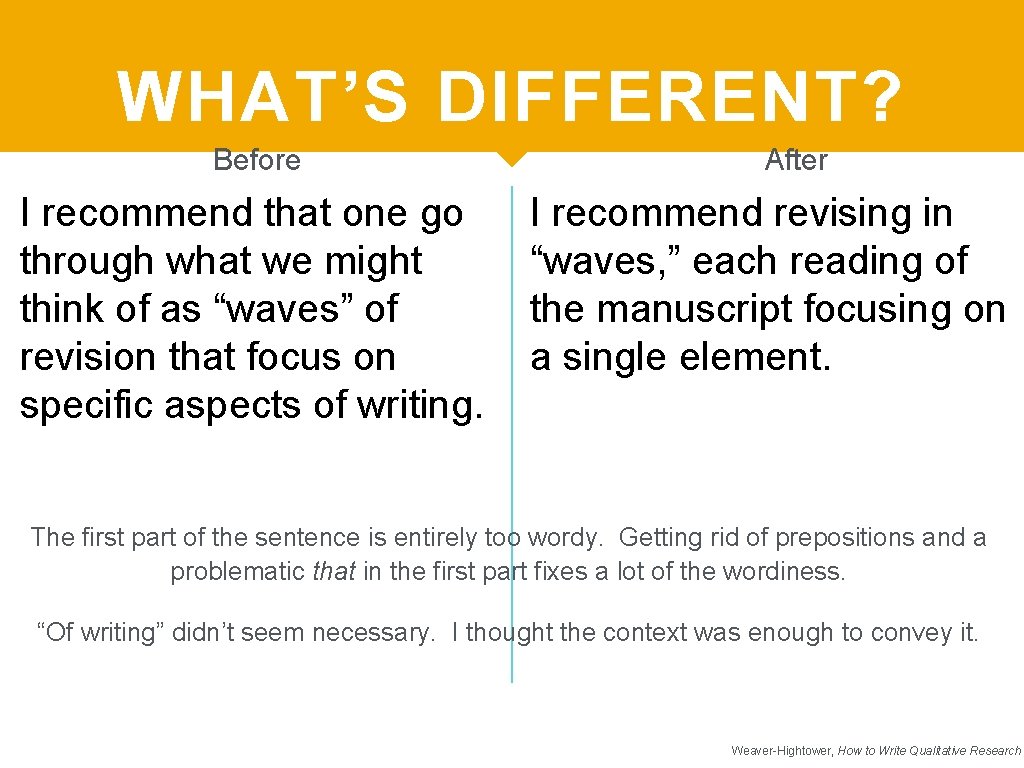
WHAT’S DIFFERENT? Before I recommend that one go through what we might think of as “waves” of revision that focus on specific aspects of writing. After I recommend revising in “waves, ” each reading of the manuscript focusing on a single element. The first part of the sentence is entirely too wordy. Getting rid of prepositions and a problematic that in the first part fixes a lot of the wordiness. “Of writing” didn’t seem necessary. I thought the context was enough to convey it. Weaver-Hightower, How to Write Qualitative Research
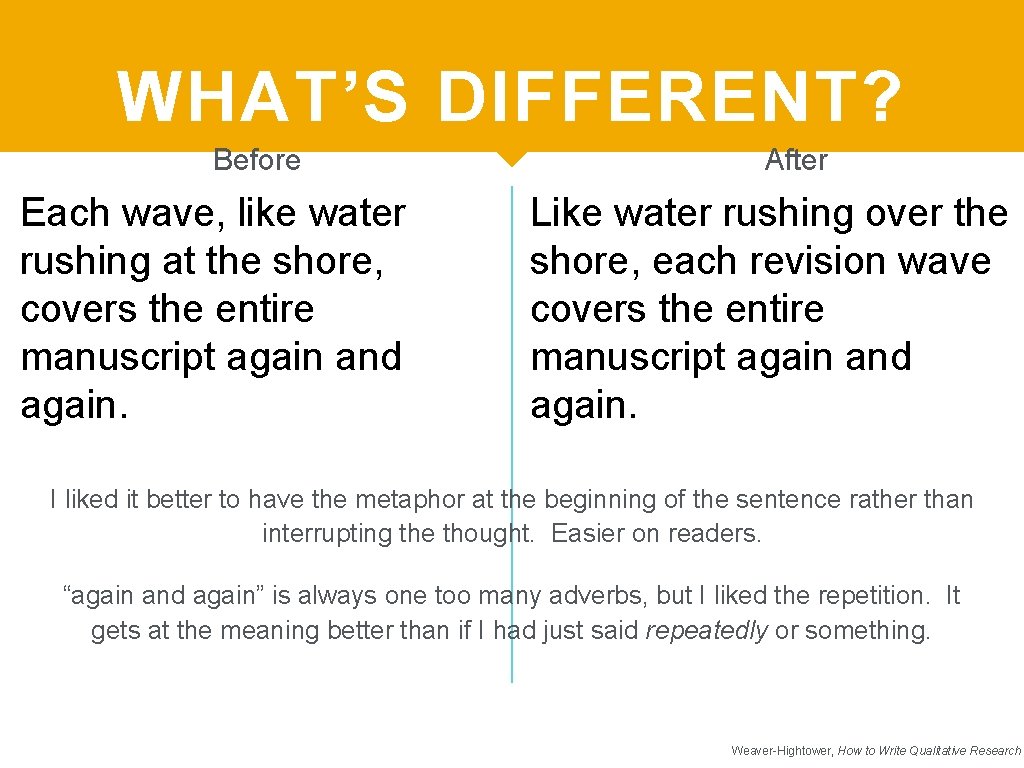
WHAT’S DIFFERENT? Before Each wave, like water rushing at the shore, covers the entire manuscript again and again. After Like water rushing over the shore, each revision wave covers the entire manuscript again and again. I liked it better to have the metaphor at the beginning of the sentence rather than interrupting the thought. Easier on readers. “again and again” is always one too many adverbs, but I liked the repetition. It gets at the meaning better than if I had just said repeatedly or something. Weaver-Hightower, How to Write Qualitative Research
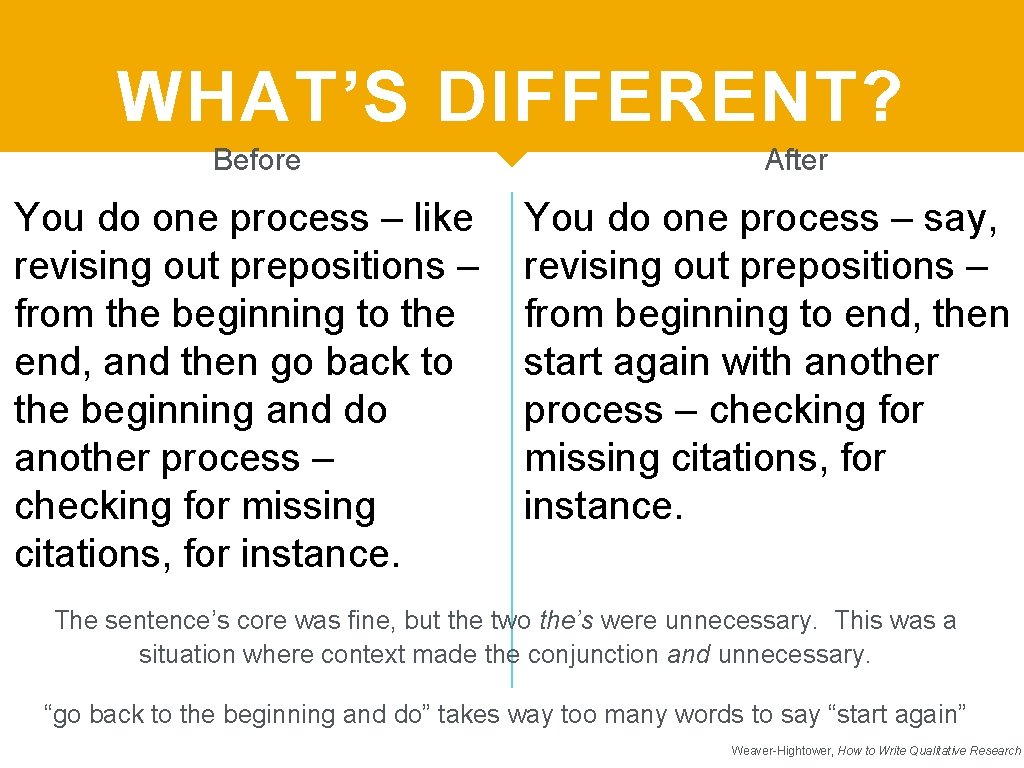
WHAT’S DIFFERENT? Before You do one process – like revising out prepositions – from the beginning to the end, and then go back to the beginning and do another process – checking for missing citations, for instance. After You do one process – say, revising out prepositions – from beginning to end, then start again with another process – checking for missing citations, for instance. The sentence’s core was fine, but the two the’s were unnecessary. This was a situation where context made the conjunction and unnecessary. “go back to the beginning and do” takes way too many words to say “start again” Weaver-Hightower, How to Write Qualitative Research
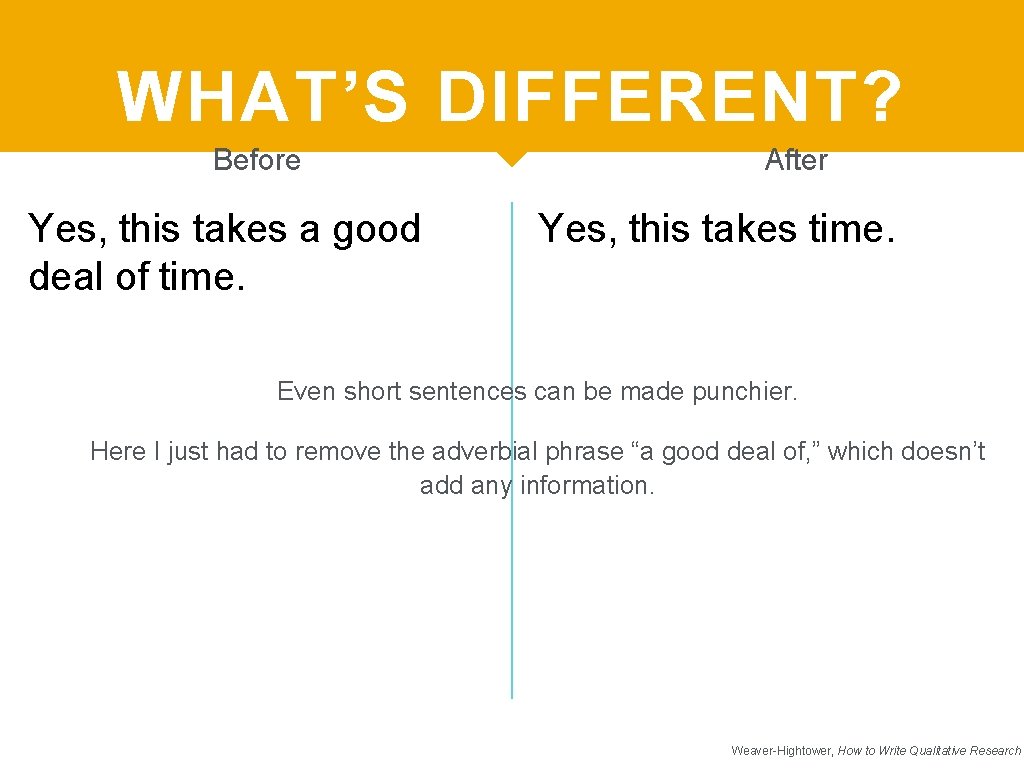
WHAT’S DIFFERENT? Before Yes, this takes a good deal of time. After Yes, this takes time. Even short sentences can be made punchier. Here I just had to remove the adverbial phrase “a good deal of, ” which doesn’t add any information. Weaver-Hightower, How to Write Qualitative Research
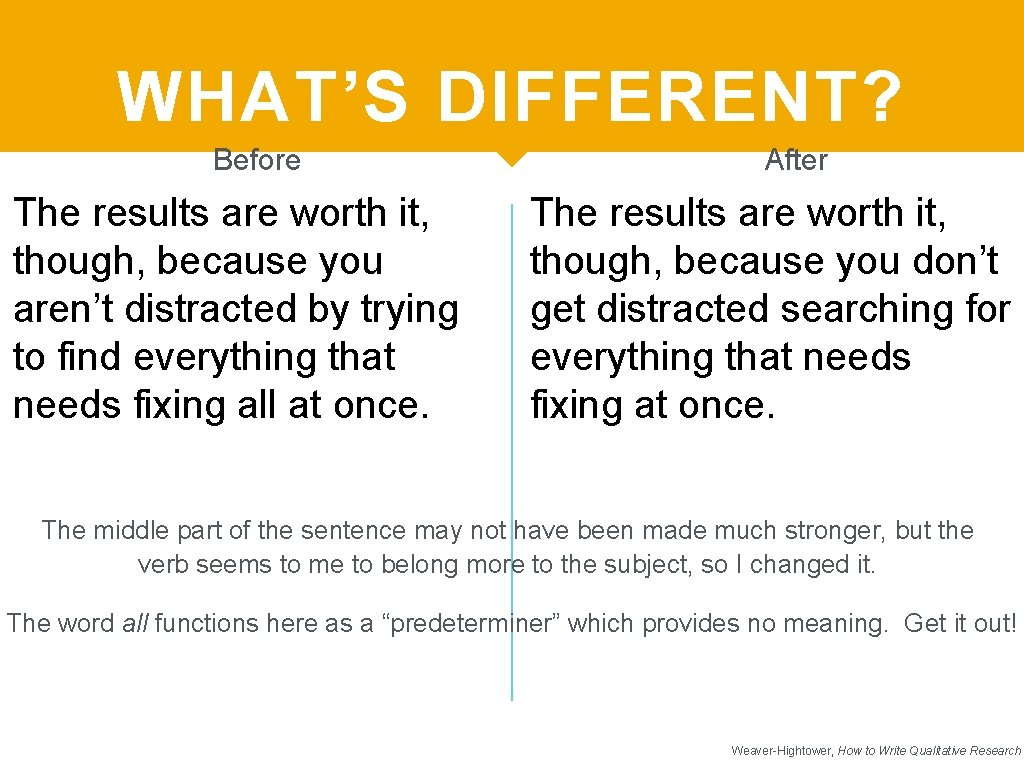
WHAT’S DIFFERENT? Before The results are worth it, though, because you aren’t distracted by trying to find everything that needs fixing all at once. After The results are worth it, though, because you don’t get distracted searching for everything that needs fixing at once. The middle part of the sentence may not have been made much stronger, but the verb seems to me to belong more to the subject, so I changed it. The word all functions here as a “predeterminer” which provides no meaning. Get it out! Weaver-Hightower, How to Write Qualitative Research
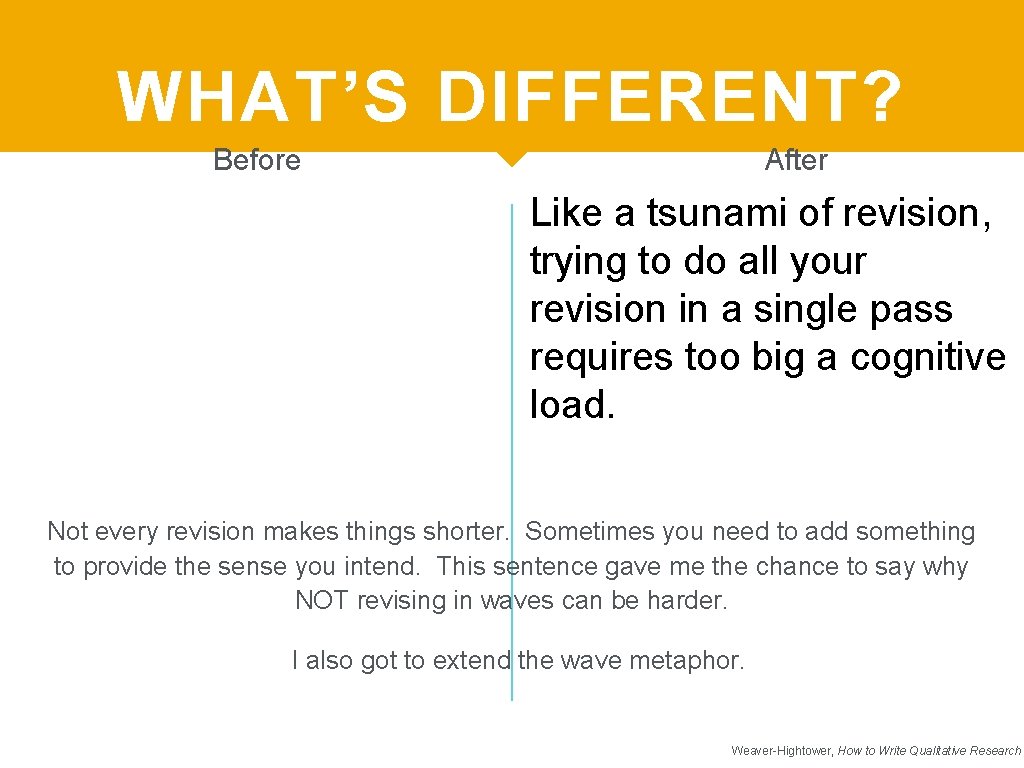
WHAT’S DIFFERENT? Before After Like a tsunami of revision, trying to do all your revision in a single pass requires too big a cognitive load. Not every revision makes things shorter. Sometimes you need to add something to provide the sense you intend. This sentence gave me the chance to say why NOT revising in waves can be harder. I also got to extend the wave metaphor. Weaver-Hightower, How to Write Qualitative Research
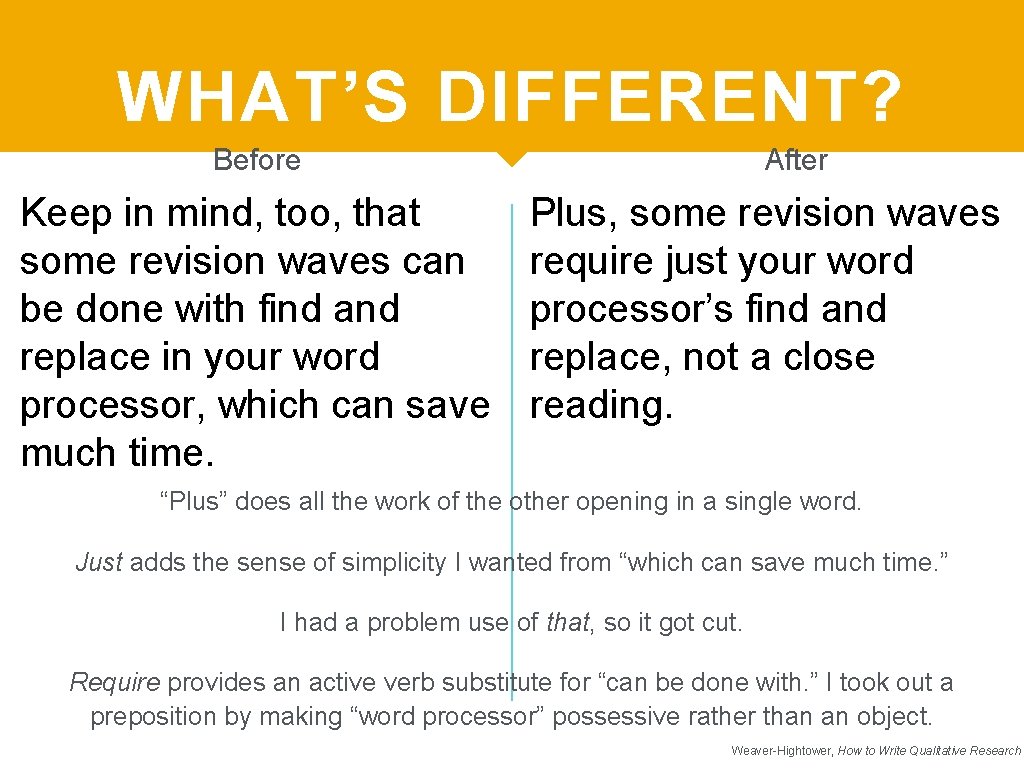
WHAT’S DIFFERENT? Before Keep in mind, too, that some revision waves can be done with find and replace in your word processor, which can save much time. After Plus, some revision waves require just your word processor’s find and replace, not a close reading. “Plus” does all the work of the other opening in a single word. Just adds the sense of simplicity I wanted from “which can save much time. ” I had a problem use of that, so it got cut. Require provides an active verb substitute for “can be done with. ” I took out a preposition by making “word processor” possessive rather than an object. Weaver-Hightower, How to Write Qualitative Research
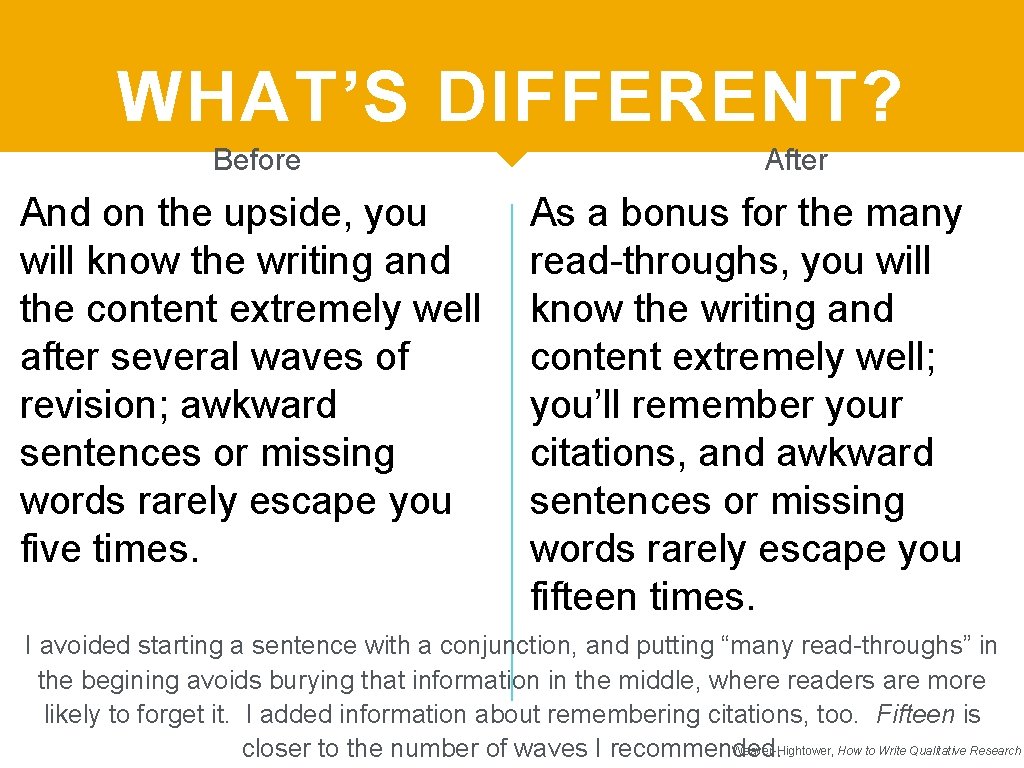
WHAT’S DIFFERENT? Before And on the upside, you will know the writing and the content extremely well after several waves of revision; awkward sentences or missing words rarely escape you five times. After As a bonus for the many read-throughs, you will know the writing and content extremely well; you’ll remember your citations, and awkward sentences or missing words rarely escape you fifteen times. I avoided starting a sentence with a conjunction, and putting “many read-throughs” in the begining avoids burying that information in the middle, where readers are more likely to forget it. I added information about remembering citations, too. Fifteen is Weaver-Hightower, How to Write Qualitative Research closer to the number of waves I recommended.
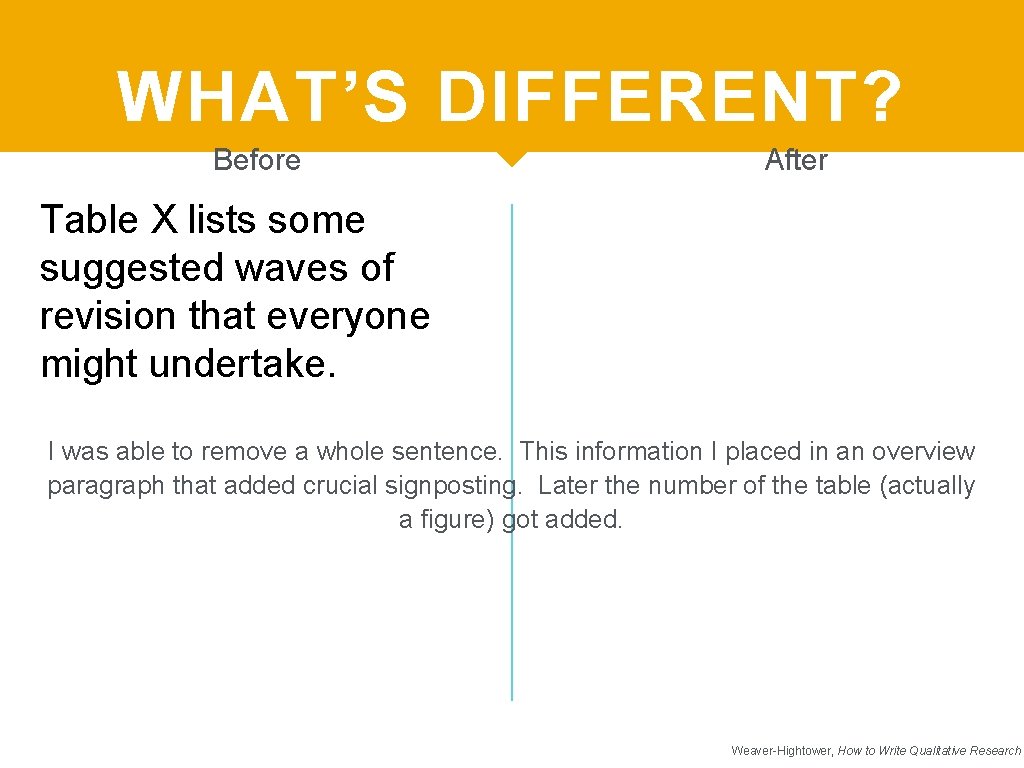
WHAT’S DIFFERENT? Before After Table X lists some suggested waves of revision that everyone might undertake. I was able to remove a whole sentence. This information I placed in an overview paragraph that added crucial signposting. Later the number of the table (actually a figure) got added. Weaver-Hightower, How to Write Qualitative Research