
How to Write an Outline 7 th Grade
- Slides: 13
How to Write an Outline 7 th Grade Language Arts
What is it? • An outline is a general plan of the material that is to be presented in a speech or a paper. • The outline shows the order of the topics and the importance of each as well as the relationship between the parts.
Order in an Outline • The most common order in outlines is to go from the general to the specific. – This means you begin with a general idea and then support it with specific examples.
Thesis Statement • All outlines should begin with a thesis statement. • The thesis sentence presents the central idea of the paper. • It must always be a complete, grammatical sentence, specific and brief, which expresses the point of view you are taking towards the subject.
Types of Outlines • The two main types of outlines are the topic outline and the sentence outline. – In the topic outline, the headings are given in single words or brief phrases. – In the sentence outline, all the heading are expressed in complete sentences.
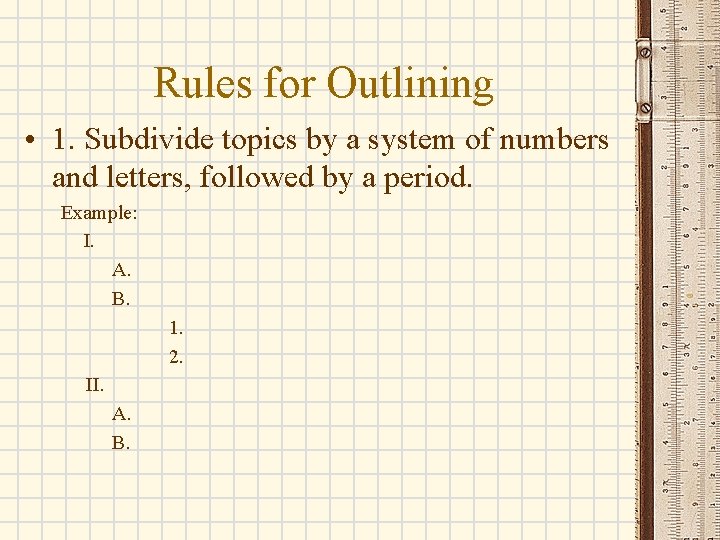
Rules for Outlining • 1. Subdivide topics by a system of numbers and letters, followed by a period. Example: I. A. B. 1. 2. II. A. B.
Rules for Outlining • 2. Each heading and subheading must have at least two parts. – For example, if there is a 1 under A, there must also be a 2.
Rules for Outlining • 3. Heading for parts of the paper such as, Introduction and Conclusion, should not be used. I. Introduction (incorrect)
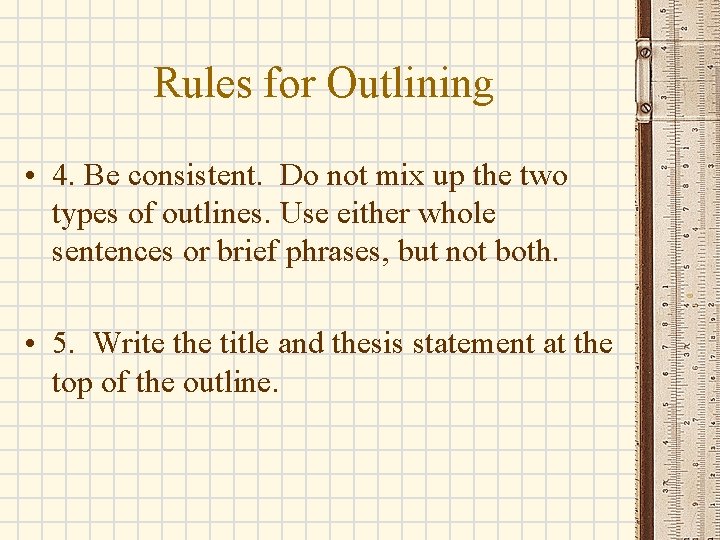
Rules for Outlining • 4. Be consistent. Do not mix up the two types of outlines. Use either whole sentences or brief phrases, but not both. • 5. Write the title and thesis statement at the top of the outline.
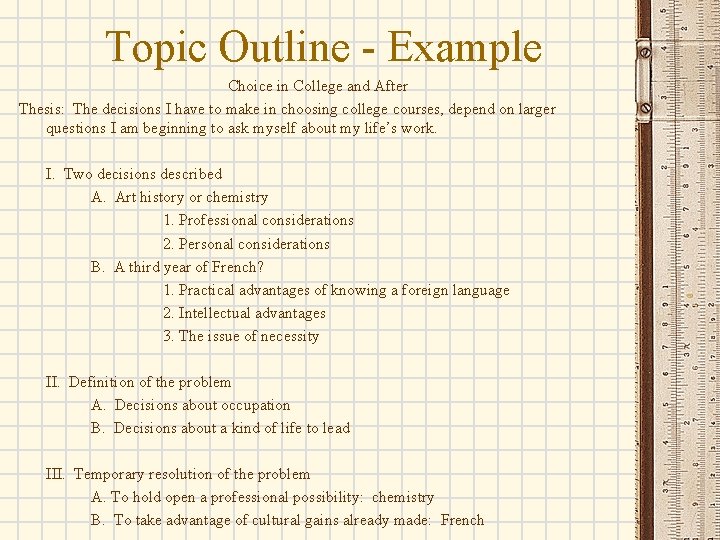
Topic Outline - Example Choice in College and After Thesis: The decisions I have to make in choosing college courses, depend on larger questions I am beginning to ask myself about my life’s work. I. Two decisions described A. Art history or chemistry 1. Professional considerations 2. Personal considerations B. A third year of French? 1. Practical advantages of knowing a foreign language 2. Intellectual advantages 3. The issue of necessity II. Definition of the problem A. Decisions about occupation B. Decisions about a kind of life to lead III. Temporary resolution of the problem A. To hold open a professional possibility: chemistry B. To take advantage of cultural gains already made: French
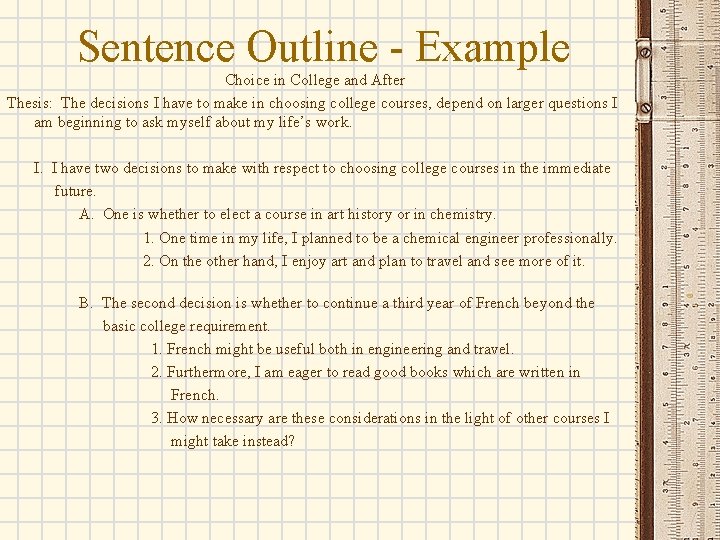
Sentence Outline - Example Choice in College and After Thesis: The decisions I have to make in choosing college courses, depend on larger questions I am beginning to ask myself about my life’s work. I. I have two decisions to make with respect to choosing college courses in the immediate future. A. One is whether to elect a course in art history or in chemistry. 1. One time in my life, I planned to be a chemical engineer professionally. 2. On the other hand, I enjoy art and plan to travel and see more of it. B. The second decision is whether to continue a third year of French beyond the basic college requirement. 1. French might be useful both in engineering and travel. 2. Furthermore, I am eager to read good books which are written in French. 3. How necessary are these considerations in the light of other courses I might take instead?
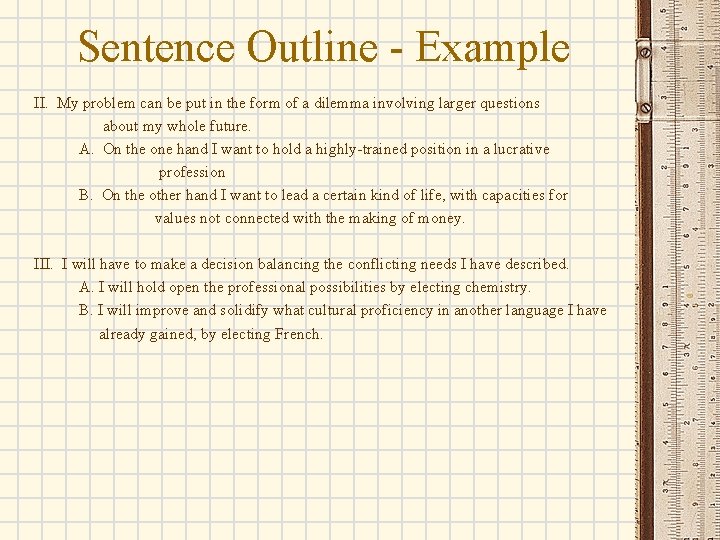
Sentence Outline - Example II. My problem can be put in the form of a dilemma involving larger questions about my whole future. A. On the one hand I want to hold a highly-trained position in a lucrative profession B. On the other hand I want to lead a certain kind of life, with capacities for values not connected with the making of money. III. I will have to make a decision balancing the conflicting needs I have described. A. I will hold open the professional possibilities by electing chemistry. B. I will improve and solidify what cultural proficiency in another language I have already gained, by electing French.
Review • Subdivide topics by a system of numbers and letters, followed by a period. • Each heading and subheading must have at least two parts. • Heading for parts of the paper such as, Introduction and Conclusion, should not be used. • Be consistent. Do not mix up the two types of outlines. Use either whole sentences or brief phrases, but not both.