
How to write an essay What is an

- Slides: 22
How to write an essay
What is an Essay? An essay is an extended, written response to a particular question that outlines the author’s position.
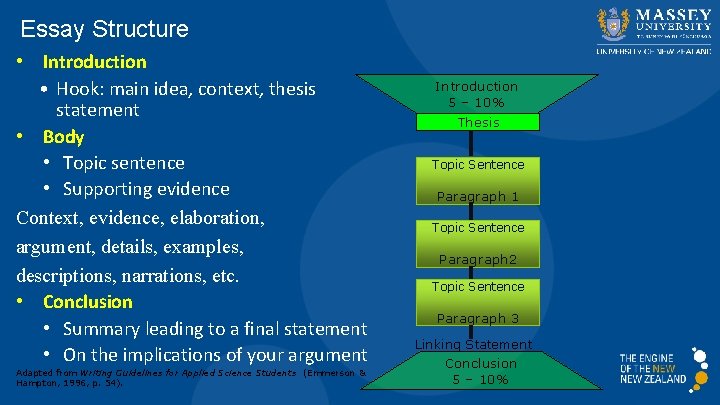
Essay Structure • Introduction • Hook: main idea, context, thesis statement • Body • Topic sentence • Supporting evidence Context, evidence, elaboration, argument, details, examples, descriptions, narrations, etc. • Conclusion • Summary leading to a final statement • On the implications of your argument Adapted from Writing Guidelines for Applied Science Students (Emmerson & Hampton, 1996, p. 54). Introduction 5 – 10% Thesis Topic Sentence Paragraph 1 Topic Sentence Paragraph 2 Topic Sentence Paragraph 3 Linking Statement Conclusion 5 – 10%
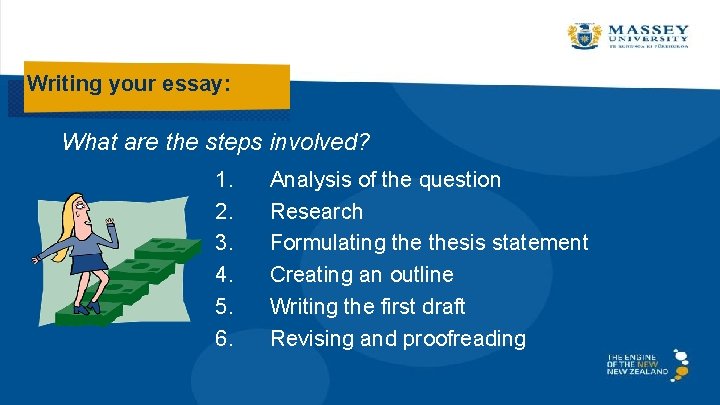
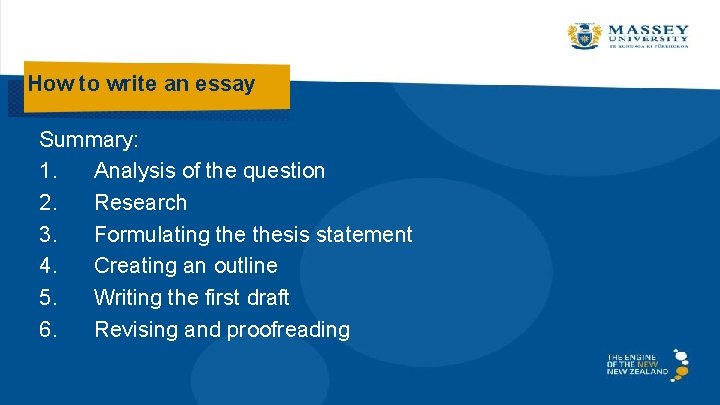
Writing your essay: What are the steps involved? 1. 2. 3. 4. 5. 6. Analysis of the question Research Formulating thesis statement Creating an outline Writing the first draft Revising and proofreading
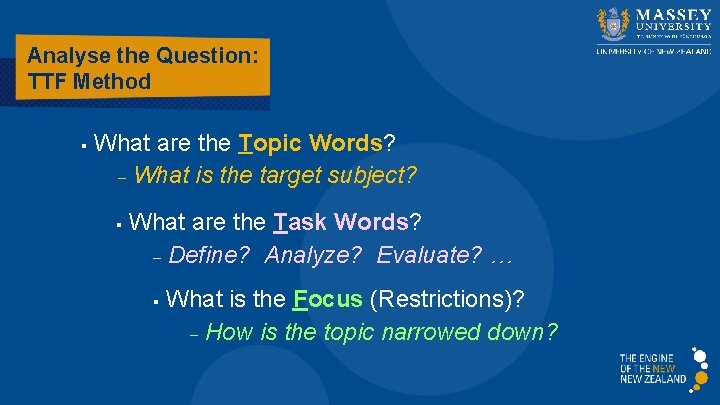
Analyse the Question: TTF Method § What are the Topic Words? – What is the target subject? § What are the Task Words? – Define? Analyze? Evaluate? … § What is the Focus (Restrictions)? – How is the topic narrowed down?
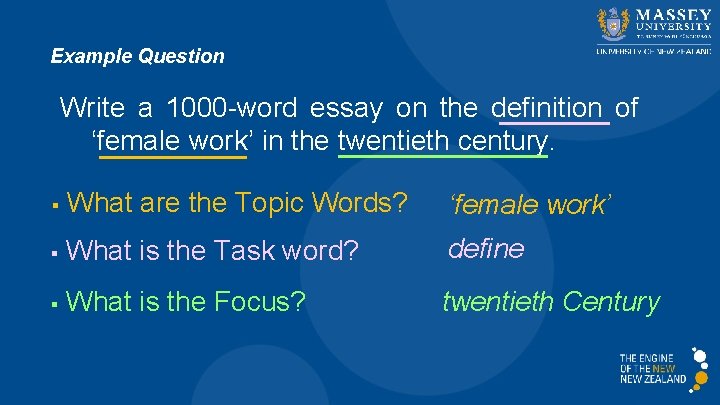
Example Question Write a 1000 -word essay on the definition of ‘female work’ in the twentieth century. § What are the Topic Words? ‘female work’ § What is the Task word? define § What is the Focus? twentieth Century
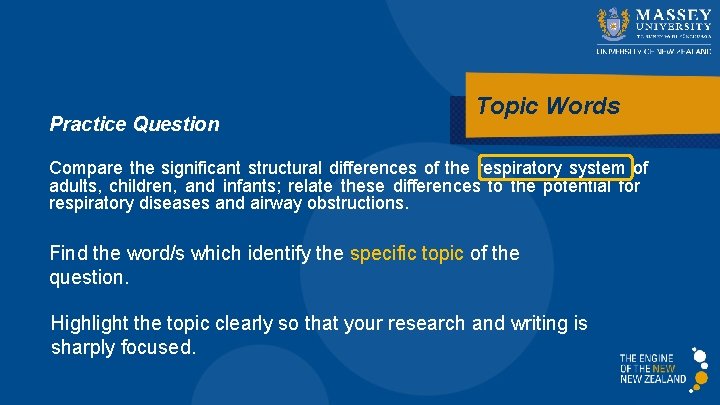
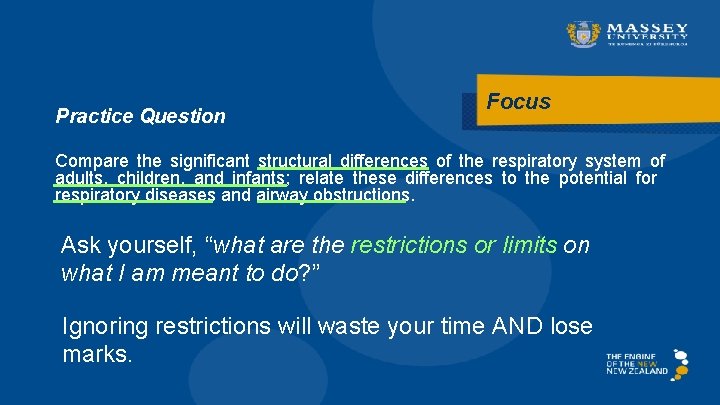
Practice Question Topic Words Compare the significant structural differences of the respiratory system of adults, children, and infants; relate these differences to the potential for respiratory diseases and airway obstructions. Find the word/s which identify the specific topic of the question. Highlight the topic clearly so that your research and writing is sharply focused.
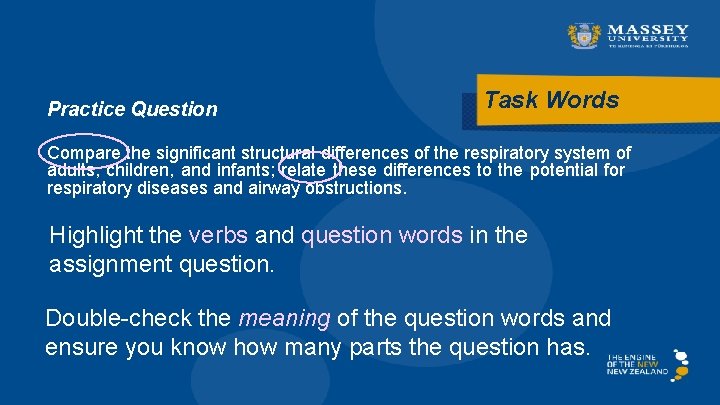
Practice Question Task Words Compare the significant structural differences of the respiratory system of adults, children, and infants; relate these differences to the potential for respiratory diseases and airway obstructions. Highlight the verbs and question words in the assignment question. Double-check the meaning of the question words and ensure you know how many parts the question has.
Practice Question Focus Compare the significant structural differences of the respiratory system of adults, children, and infants; relate these differences to the potential for respiratory diseases and airway obstructions. Ask yourself, “what are the restrictions or limits on what I am meant to do? ” Ignoring restrictions will waste your time AND lose marks.
Research the Topic First-Hand Investigation § Second-Hand Investigation – Course materials – Books – Journal articles – Appropriate internet sources §
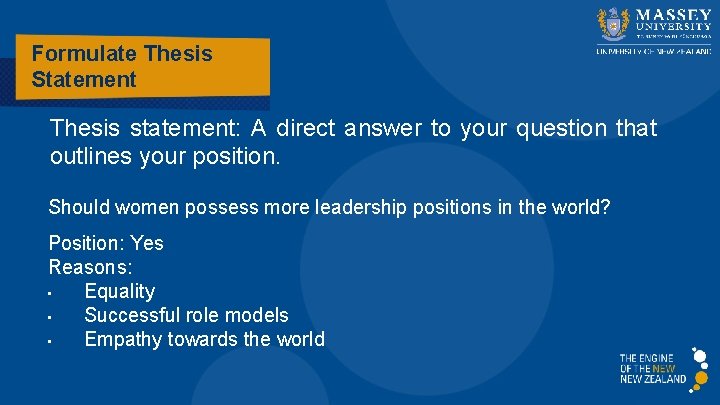
Formulate Thesis Statement Thesis statement: A direct answer to your question that outlines your position. Should women possess more leadership positions in the world? Position: Yes Reasons: • Equality • Successful role models • Empathy towards the world
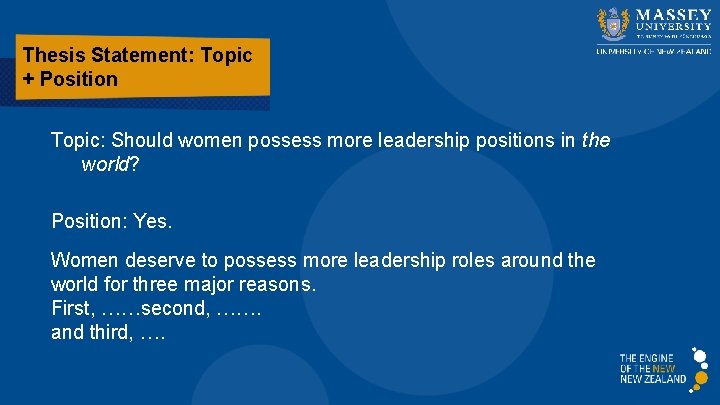
Thesis Statement: Topic + Position Topic: Should women possess more leadership positions in the world? Position: Yes. Women deserve to possess more leadership roles around the world for three major reasons. First, ……second, ……. and third, ….
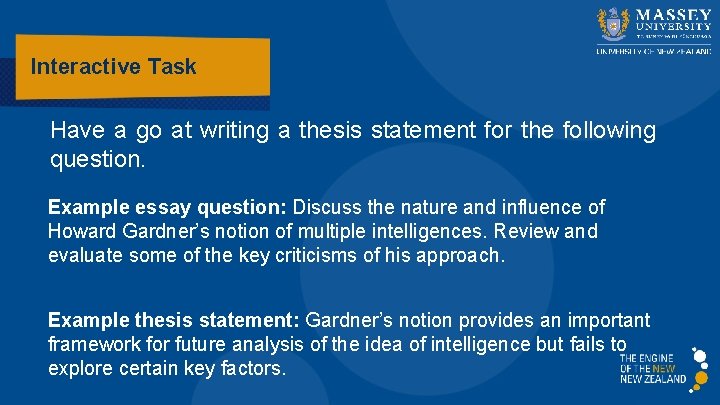
Interactive Task Have a go at writing a thesis statement for the following question. Example essay question: Discuss the nature and influence of Howard Gardner’s notion of multiple intelligences. Review and evaluate some of the key criticisms of his approach. Example thesis statement: Gardner’s notion provides an important framework for future analysis of the idea of intelligence but fails to explore certain key factors.
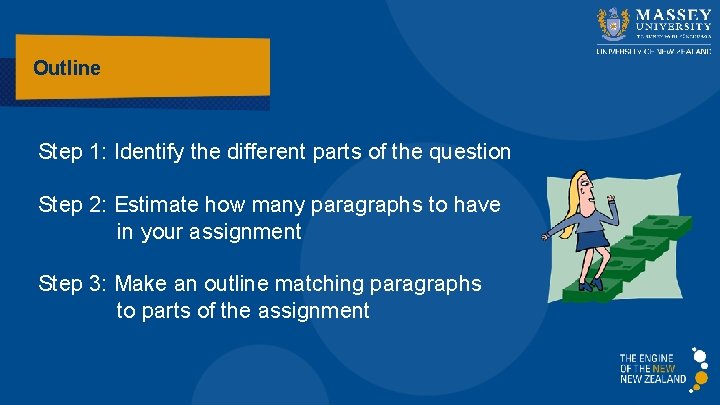
Outline Step 1: Identify the different parts of the question Step 2: Estimate how many paragraphs to have in your assignment Step 3: Make an outline matching paragraphs to parts of the assignment
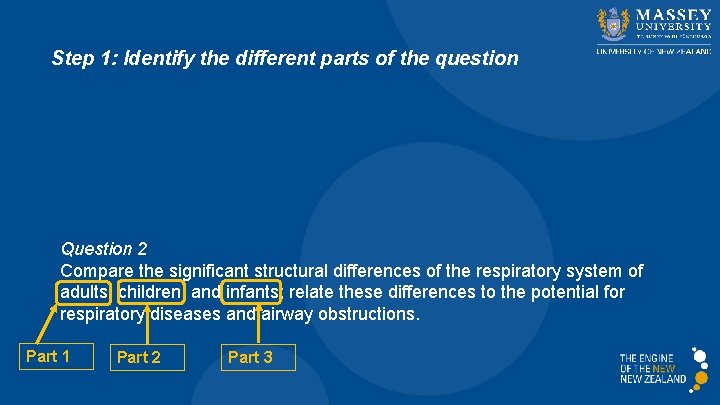
Step 1: Identify the different parts of the question Question 2 Compare the significant structural differences of the respiratory system of adults, children, and infants; relate these differences to the potential for respiratory diseases and airway obstructions. Part 1 Part 2 Part 3
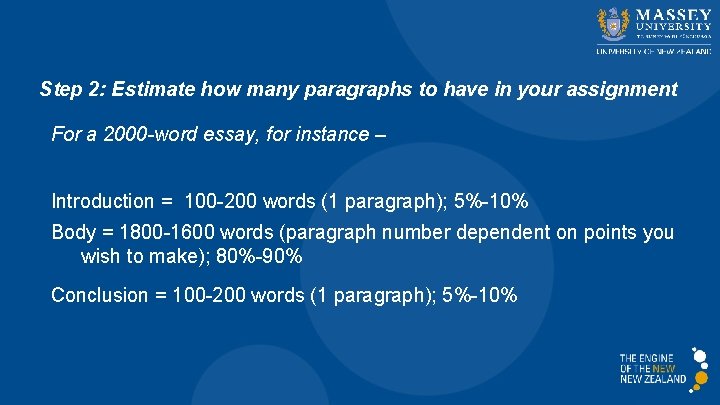
Step 2: Estimate how many paragraphs to have in your assignment For a 2000 -word essay, for instance – Introduction = 100 -200 words (1 paragraph); 5%-10% Body = 1800 -1600 words (paragraph number dependent on points you wish to make); 80%-90% Conclusion = 100 -200 words (1 paragraph); 5%-10%
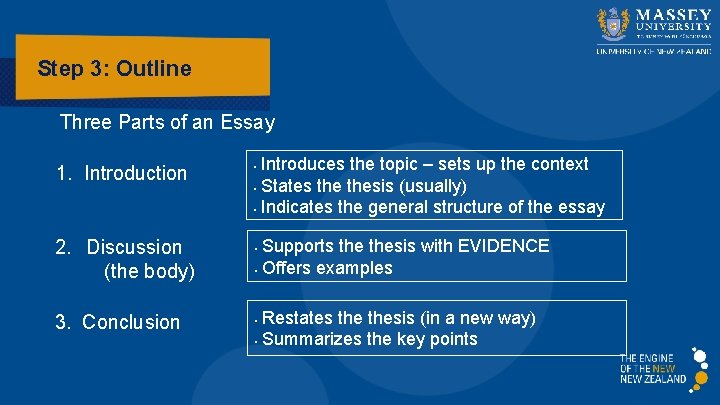
Step 3: Outline Three Parts of an Essay 1. Introduction 2. Discussion (the body) 3. Conclusion Introduces the topic – sets up the context • States thesis (usually) • Indicates the general structure of the essay • Supports thesis with EVIDENCE • Offers examples • Restates thesis (in a new way) • Summarizes the key points •
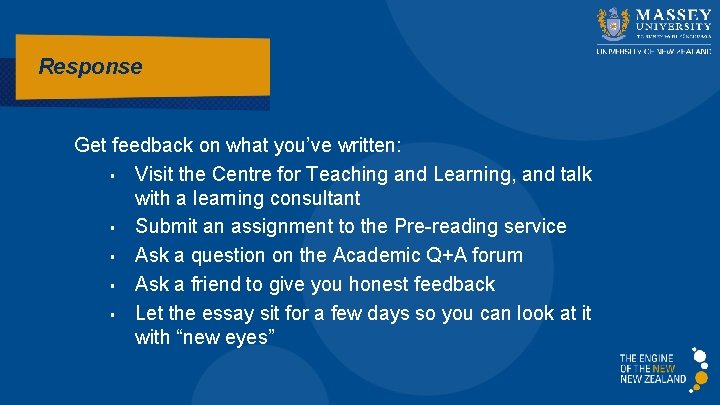
Response Get feedback on what you’ve written: § Visit the Centre for Teaching and Learning, and talk with a learning consultant § Submit an assignment to the Pre-reading service § Ask a question on the Academic Q+A forum § Ask a friend to give you honest feedback § Let the essay sit for a few days so you can look at it with “new eyes”
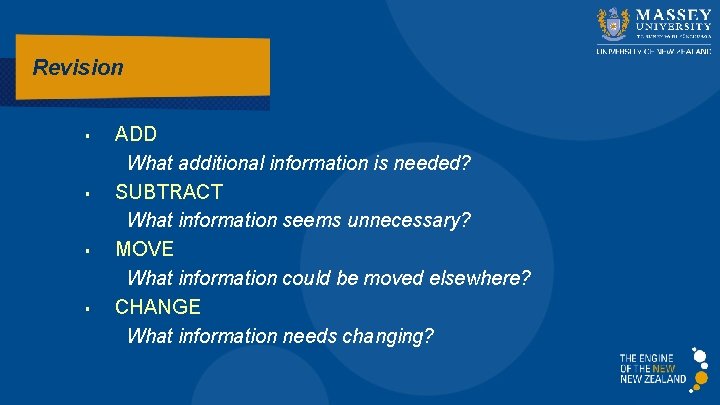
Revision § § ADD What additional information is needed? SUBTRACT What information seems unnecessary? MOVE What information could be moved elsewhere? CHANGE What information needs changing?
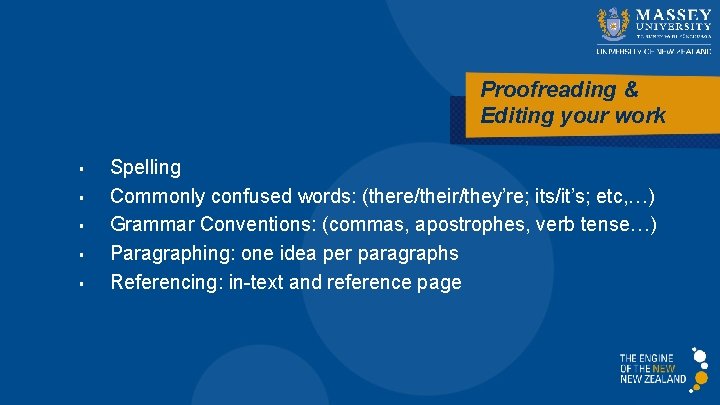
Proofreading & Editing your work § § § Spelling Commonly confused words: (there/their/they’re; its/it’s; etc, …) Grammar Conventions: (commas, apostrophes, verb tense…) Paragraphing: one idea per paragraphs Referencing: in-text and reference page
How to write an essay Summary: 1. Analysis of the question 2. Research 3. Formulating thesis statement 4. Creating an outline 5. Writing the first draft 6. Revising and proofreading
Questions?