
How To Write An Effective Argumentative Paper produced
- Slides: 30
How To Write An Effective Argumentative Paper produced by Mr. L’Ouverture Perkins copyright protected!
ARGUMENTATIVE VOCABULARY Claim – Your basic belief about a particular topic, issue, event, or idea
ARGUMENTATIVE VOCABULARY Counterclaim – A solid and reasonable argument that opposes or disagrees with your claim
ARGUMENTATIVE VOCABULARY Rebuttal – A written or verbal response to a counterclaim. The object of the rebuttal is to take into account the ideas presented in the counterclaim and explain why they aren’t persuasive enough, valid enough, or important enough to outweigh your own claim.
ARGUMENTATIVE VOCABULARY Support – Your specific facts or specific evidence used to support why your claim is true
ARGUMENTATIVE VOCABULARY Refute – Argue against a position or prove it to be wrong
ARGUMENTATIVE VOCABULARY Qualify – A “partly-agree” stance in which you agree (in part) with another person’s argument or position but also disagree with part of it.
ARGUMENTATIVE VOCABULARY Claim – Your basic belief about a particular topic, issue, event, or idea Counterclaim – A solid and reasonable argument that opposes or disagrees with your claim Rebuttal – A written or verbal response to a counterclaim. The object of the rebuttal is to take into account the ideas presented in the counterclaim and explain why they aren’t persuasive enough, valid enough, or important enough to outweigh your own claim. Support – Your specific facts or specific evidence used to support why your claim is true Refute – Argue against a position or prove it to be wrong Qualify – A “partly-agree” stance in which you agree (in part) with another person’s argument or position but also disagree with part of it.
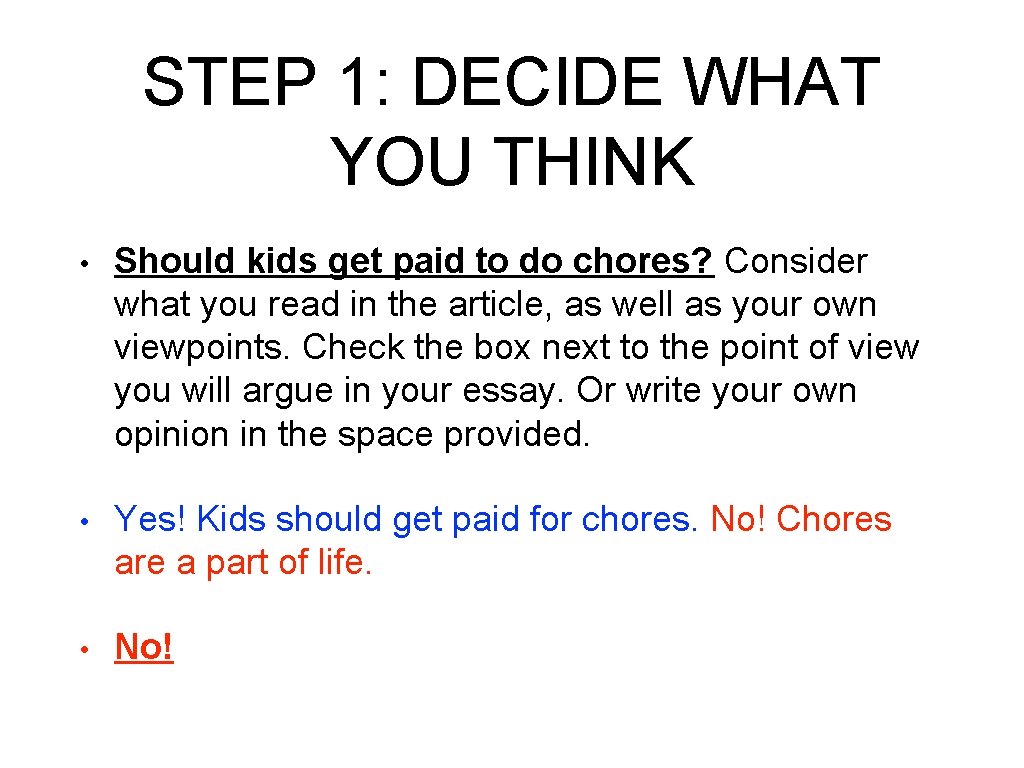
STEP 1: DECIDE WHAT YOU THINK • Should kids get paid to do chores? Consider what you read in the article, as well as your own viewpoints. Check the box next to the point of view you will argue in your essay. Or write your own opinion in the space provided. • Yes! Kids should get paid for chores. No! Chores are a part of life. • No!
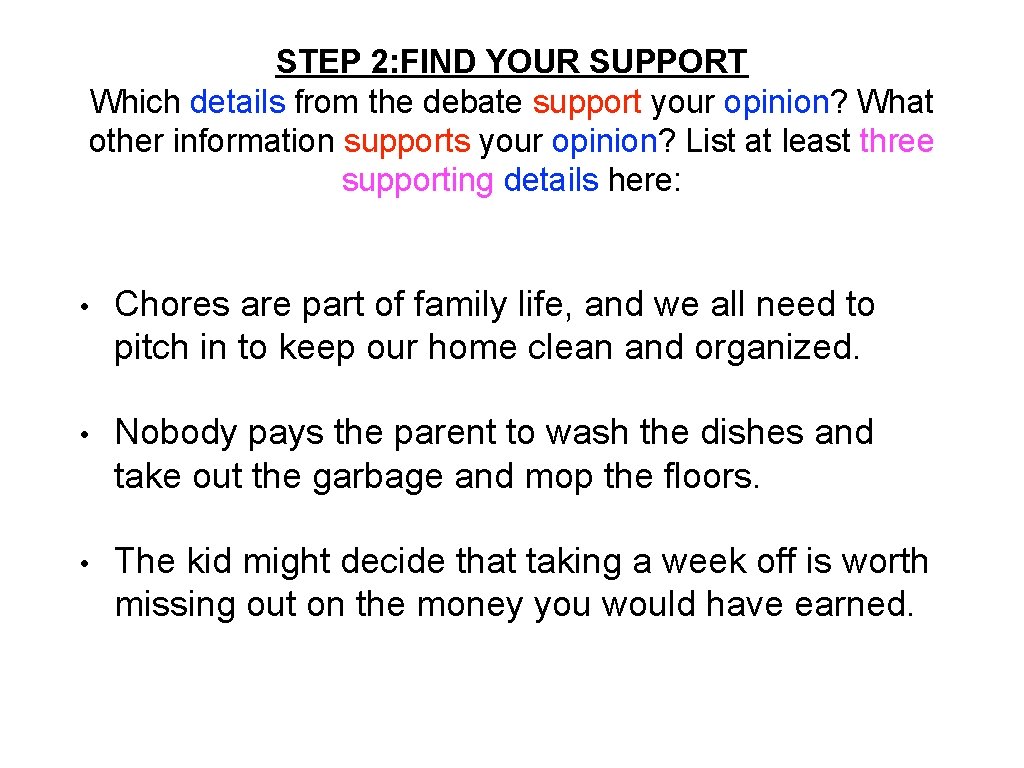
STEP 2: FIND YOUR SUPPORT Which details from the debate support your opinion? What other information supports your opinion? List at least three supporting details here: • Chores are part of family life, and we all need to pitch in to keep our home clean and organized. • Nobody pays the parent to wash the dishes and take out the garbage and mop the floors. • The kid might decide that taking a week off is worth missing out on the money you would have earned.
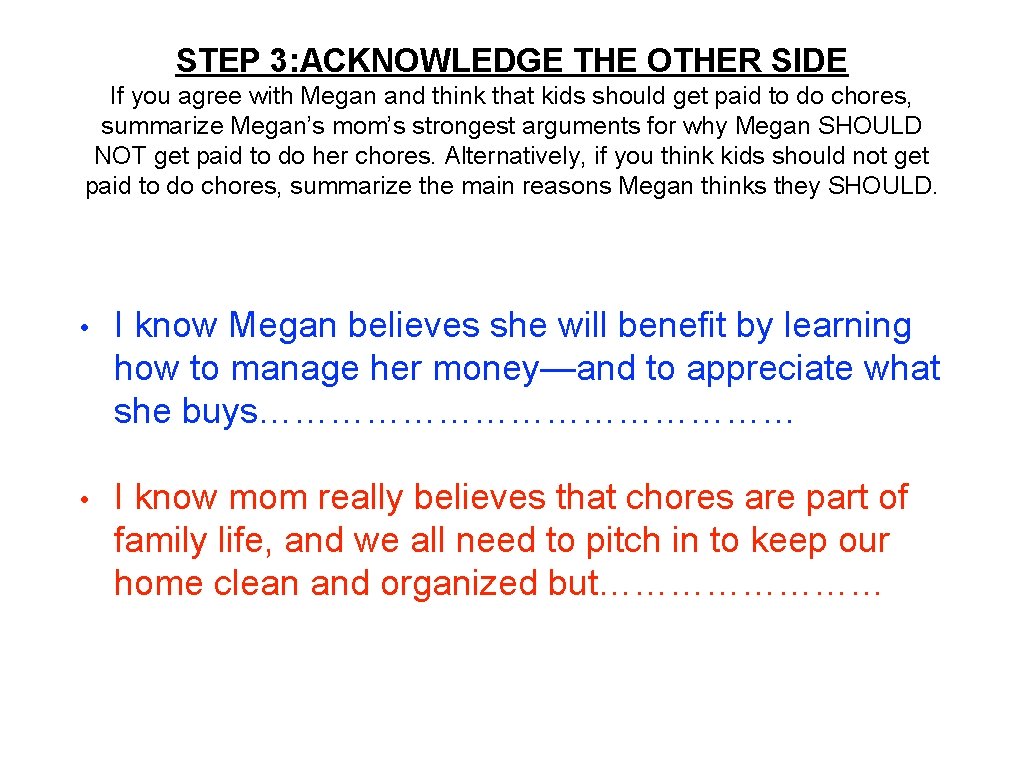
STEP 3: ACKNOWLEDGE THE OTHER SIDE If you agree with Megan and think that kids should get paid to do chores, summarize Megan’s mom’s strongest arguments for why Megan SHOULD NOT get paid to do her chores. Alternatively, if you think kids should not get paid to do chores, summarize the main reasons Megan thinks they SHOULD. • I know Megan believes she will benefit by learning how to manage her money—and to appreciate what she buys…………………… • I know mom really believes that chores are part of family life, and we all need to pitch in to keep our home clean and organized but…………
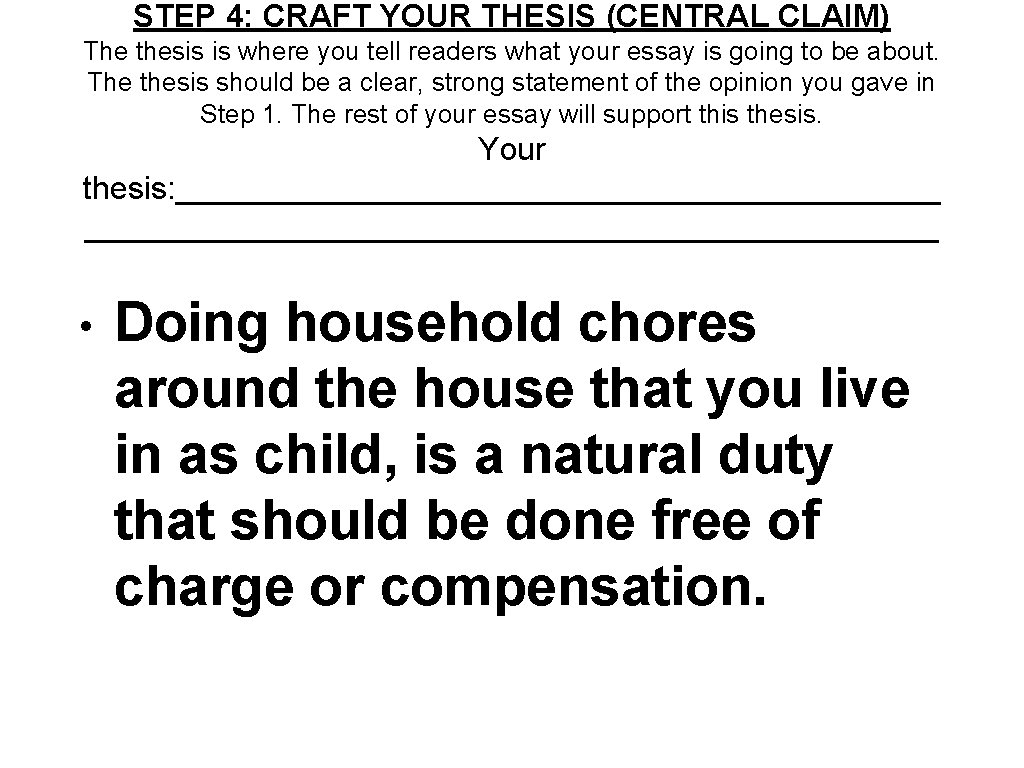
STEP 4: CRAFT YOUR THESIS (CENTRAL CLAIM) The thesis is where you tell readers what your essay is going to be about. The thesis should be a clear, strong statement of the opinion you gave in Step 1. The rest of your essay will support this thesis. Your thesis: ________________________________________________ • Doing household chores around the house that you live in as child, is a natural duty that should be done free of charge or compensation.
STEP 5: WRITE YOUR HOOK • The very beginning of your essay is called the hook because it “hooks” your readers’ attention. The hook should relate to the topic of your essay, but it can take many forms. It can be an anecdote (a very short story), a fact, a quote, or a rhetorical question (a question to which you don’t expect an answer). Choose one of the ideas below, or use your own idea, and write a hook on the lines provided (1 -3 sentences). • 1. ANECDOTE: Describe your personal experience with chores. Do you help your parents around the house? Do you ever get paid to do so? • 2. SURPRISING FACT: Find a fact that will raise your readers’ eyebrows. Several surprising facts are included in the article. You can also do some research to find one that is not included in the article. • 3. RHETORICAL QUESTION: Ask your readers a question that reflects your point of view about chores. One way you could structure your question is like this: “What’s wrong with a kid getting paid to _____? ”
• 1. ANECDOTE: Describe your personal experience with chores. Do you help your parents around the house? Do you ever get paid to do so? • Every Thursday I look forward to doing my weekly chores. I have to wash those dirty dishes that have tomato sauce on them from our Wednesday family pizza night. Ugh! Then, I have to do the laundry for my parents and siblings down in the basement. The hard part is separating the whites from the colors and remembering when to add the bleach. Last but not least, I have to take out the garbage because in our town the garbage man only comes on Friday and I don’t want to smell pizza for 7 more days. Then I wait as my mom comes home at midnight from her 3 rd job so that we can afford to have another pizza night next Wednesday.
• 2. SURPRISING FACT: Find a fact that will raise your readers’ eyebrows. Several surprising facts are included in the article. You can also do some research to find one that is not included in the article. • Hey Brandy, I was reading the newspaper and rancor an article about chores. According to this highly respected professor Marty Rossmann from the University of Minnesota, adults who did chores as children are 80% more likely to have good relationships with their families and to be successful in school and in their careers. They are also more self-sufficient and able to complete task in their daily lives. Oh and he didn’t mention anything about getting paid either.
• 3. RHETORICAL QUESTION: Ask your readers a question that reflects your point of view about chores. One way you could structure your question is like this: “What’s wrong with a kid getting paid to _____? ” • Why do you need money to be a helpful son or daughter to your parents?
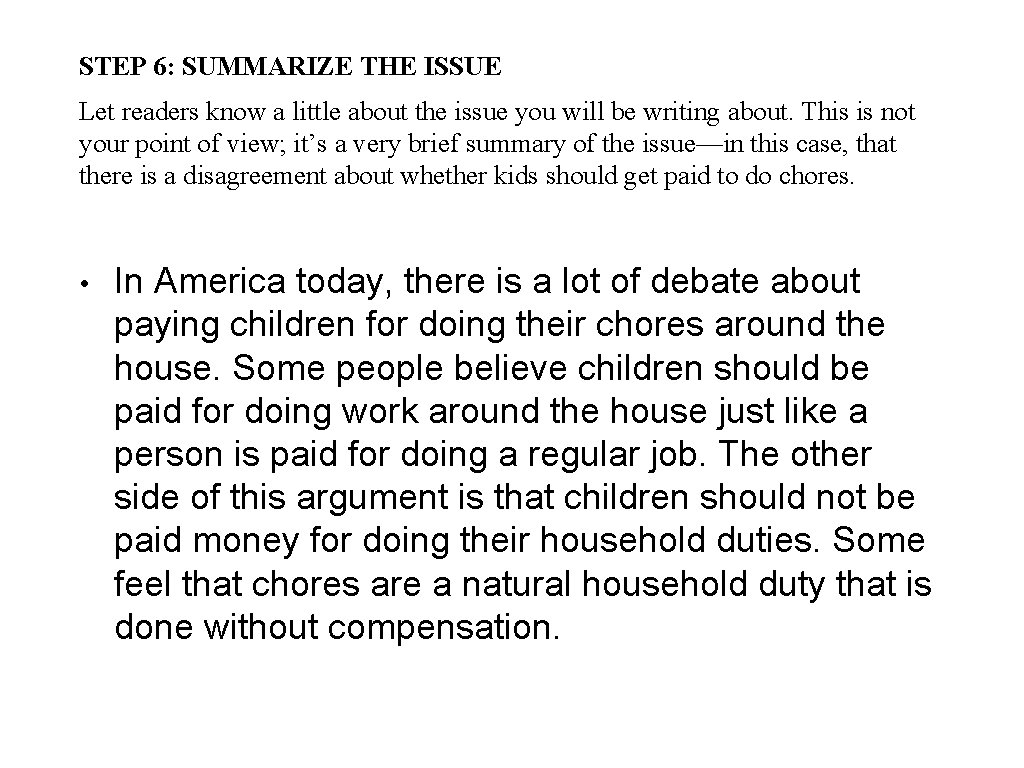
STEP 6: SUMMARIZE THE ISSUE Let readers know a little about the issue you will be writing about. This is not your point of view; it’s a very brief summary of the issue—in this case, that there is a disagreement about whether kids should get paid to do chores. • In America today, there is a lot of debate about paying children for doing their chores around the house. Some people believe children should be paid for doing work around the house just like a person is paid for doing a regular job. The other side of this argument is that children should not be paid money for doing their household duties. Some feel that chores are a natural household duty that is done without compensation.
STEP 7: START WRITING Now that you have the key ingredients for your essay, you are ready to start writing. On the next page, you’ll find guidelines for how to organize your ingredients, as well as hints about what else you’ll need to add.
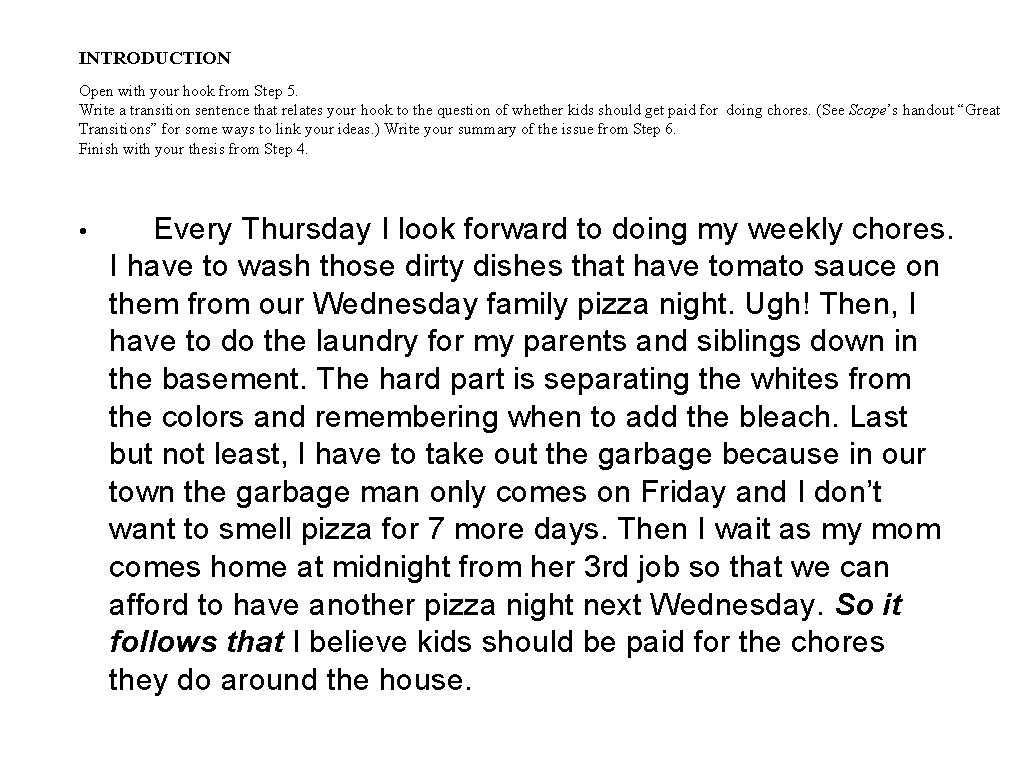
INTRODUCTION Open with your hook from Step 5. Write a transition sentence that relates your hook to the question of whether kids should get paid for doing chores. (See Scope’s handout “Great Transitions” for some ways to link your ideas. ) Write your summary of the issue from Step 6. Finish with your thesis from Step 4. • Every Thursday I look forward to doing my weekly chores. I have to wash those dirty dishes that have tomato sauce on them from our Wednesday family pizza night. Ugh! Then, I have to do the laundry for my parents and siblings down in the basement. The hard part is separating the whites from the colors and remembering when to add the bleach. Last but not least, I have to take out the garbage because in our town the garbage man only comes on Friday and I don’t want to smell pizza for 7 more days. Then I wait as my mom comes home at midnight from her 3 rd job so that we can afford to have another pizza night next Wednesday. So it follows that I believe kids should be paid for the chores they do around the house.
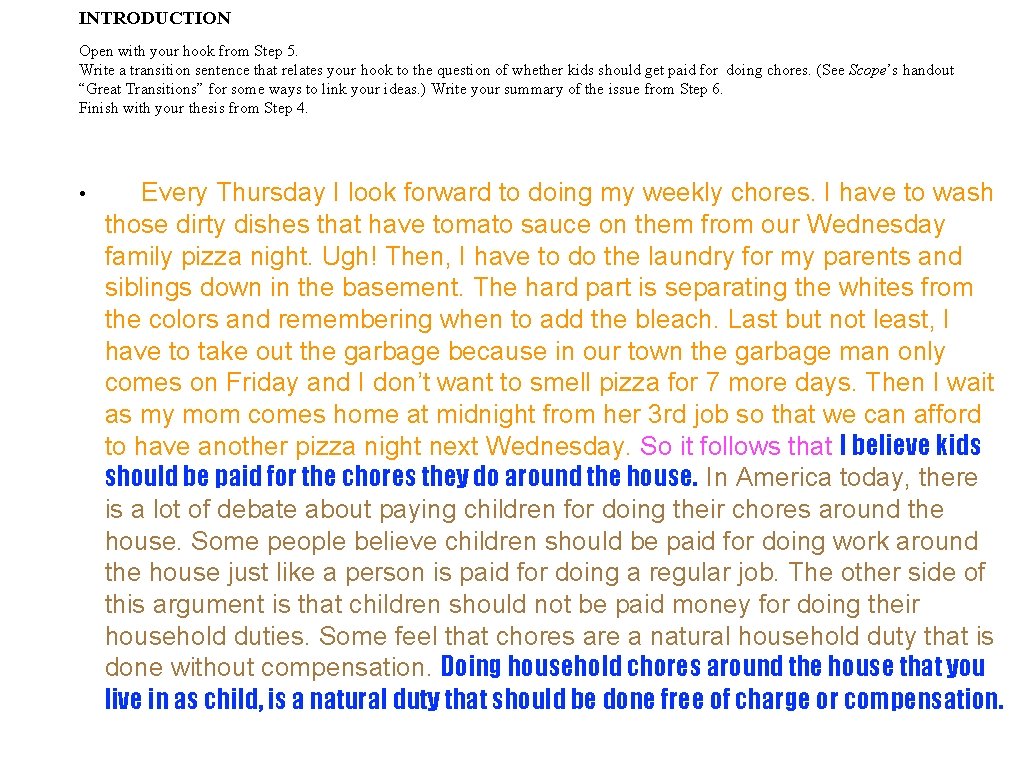
INTRODUCTION Open with your hook from Step 5. Write a transition sentence that relates your hook to the question of whether kids should get paid for doing chores. (See Scope’s handout “Great Transitions” for some ways to link your ideas. ) Write your summary of the issue from Step 6. Finish with your thesis from Step 4. • Every Thursday I look forward to doing my weekly chores. I have to wash those dirty dishes that have tomato sauce on them from our Wednesday family pizza night. Ugh! Then, I have to do the laundry for my parents and siblings down in the basement. The hard part is separating the whites from the colors and remembering when to add the bleach. Last but not least, I have to take out the garbage because in our town the garbage man only comes on Friday and I don’t want to smell pizza for 7 more days. Then I wait as my mom comes home at midnight from her 3 rd job so that we can afford to have another pizza night next Wednesday. So it follows that I believe kids should be paid for the chores they do around the house. In America today, there is a lot of debate about paying children for doing their chores around the house. Some people believe children should be paid for doing work around the house just like a person is paid for doing a regular job. The other side of this argument is that children should not be paid money for doing their household duties. Some feel that chores are a natural household duty that is done without compensation. Doing household chores around the house that you live in as child, is a natural duty that should be done free of charge or compensation.
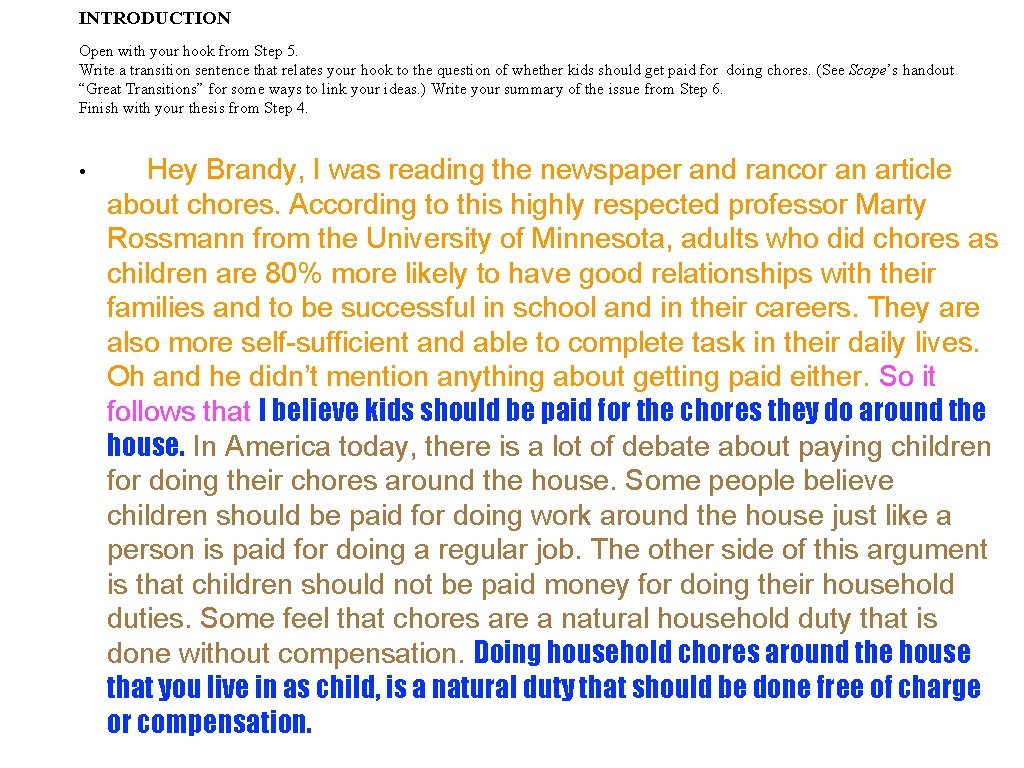
INTRODUCTION Open with your hook from Step 5. Write a transition sentence that relates your hook to the question of whether kids should get paid for doing chores. (See Scope’s handout “Great Transitions” for some ways to link your ideas. ) Write your summary of the issue from Step 6. Finish with your thesis from Step 4. • Hey Brandy, I was reading the newspaper and rancor an article about chores. According to this highly respected professor Marty Rossmann from the University of Minnesota, adults who did chores as children are 80% more likely to have good relationships with their families and to be successful in school and in their careers. They are also more self-sufficient and able to complete task in their daily lives. Oh and he didn’t mention anything about getting paid either. So it follows that I believe kids should be paid for the chores they do around the house. In America today, there is a lot of debate about paying children for doing their chores around the house. Some people believe children should be paid for doing work around the house just like a person is paid for doing a regular job. The other side of this argument is that children should not be paid money for doing their household duties. Some feel that chores are a natural household duty that is done without compensation. Doing household chores around the house that you live in as child, is a natural duty that should be done free of charge or compensation.
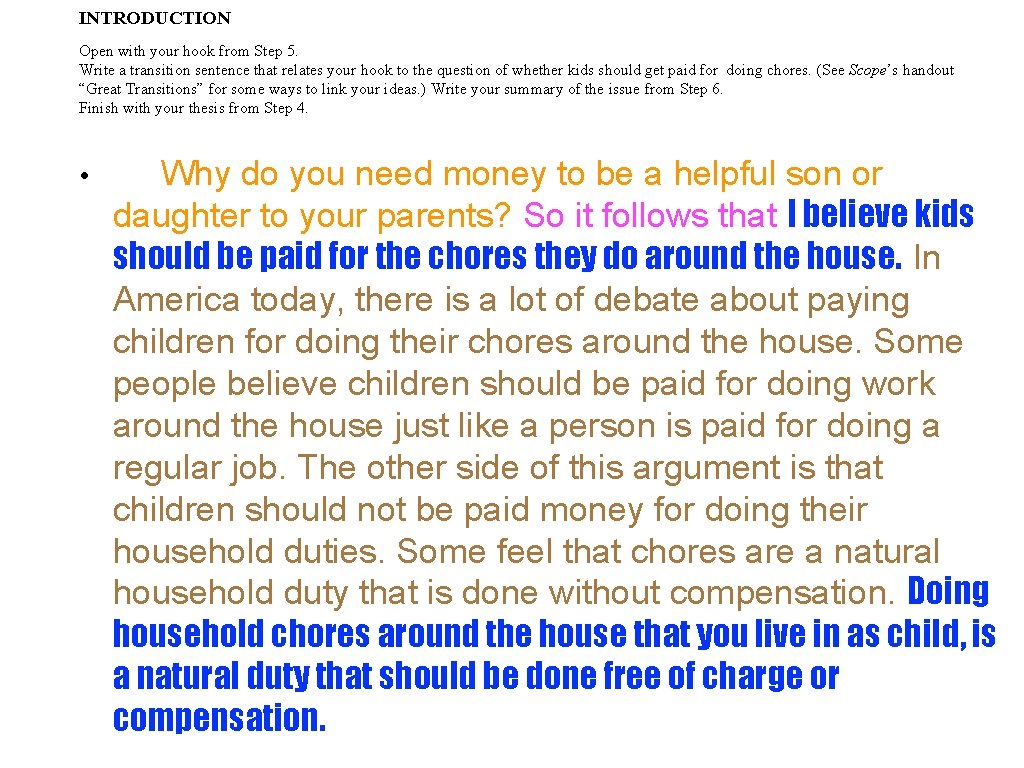
INTRODUCTION Open with your hook from Step 5. Write a transition sentence that relates your hook to the question of whether kids should get paid for doing chores. (See Scope’s handout “Great Transitions” for some ways to link your ideas. ) Write your summary of the issue from Step 6. Finish with your thesis from Step 4. • Why do you need money to be a helpful son or daughter to your parents? So it follows that I believe kids should be paid for the chores they do around the house. In America today, there is a lot of debate about paying children for doing their chores around the house. Some people believe children should be paid for doing work around the house just like a person is paid for doing a regular job. The other side of this argument is that children should not be paid money for doing their household duties. Some feel that chores are a natural household duty that is done without compensation. Doing household chores around the house that you live in as child, is a natural duty that should be done free of charge or compensation.
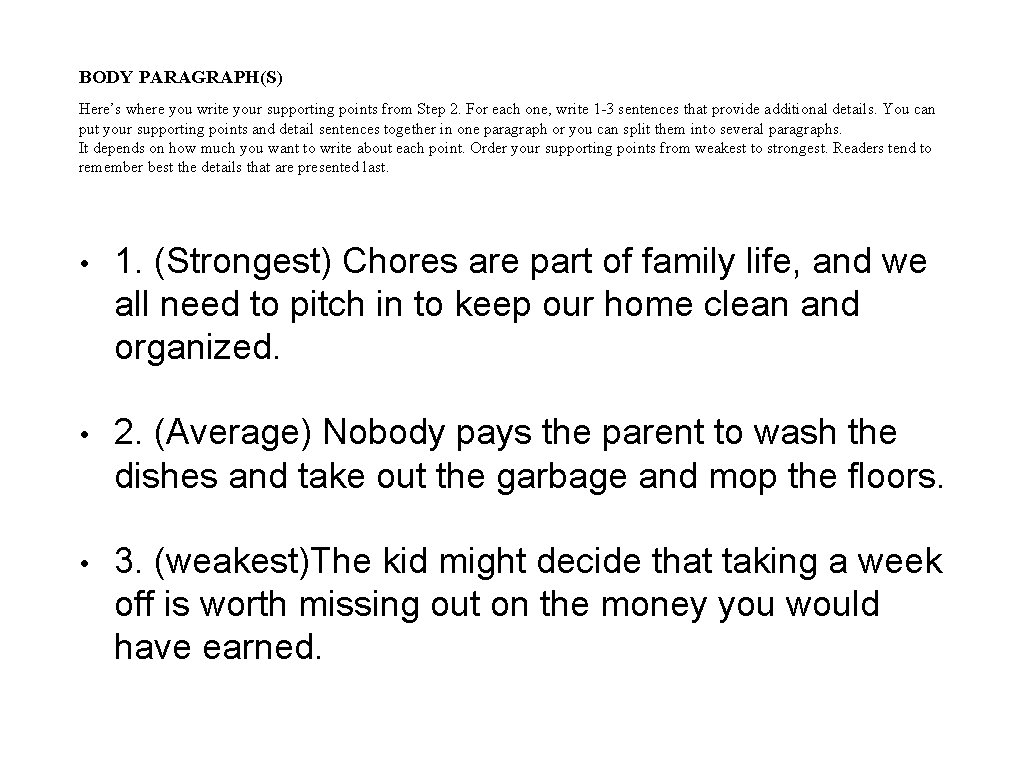
BODY PARAGRAPH(S) Here’s where you write your supporting points from Step 2. For each one, write 1 -3 sentences that provide additional details. You can put your supporting points and detail sentences together in one paragraph or you can split them into several paragraphs. It depends on how much you want to write about each point. Order your supporting points from weakest to strongest. Readers tend to remember best the details that are presented last. • 1. (Strongest) Chores are part of family life, and we all need to pitch in to keep our home clean and organized. • 2. (Average) Nobody pays the parent to wash the dishes and take out the garbage and mop the floors. • 3. (weakest)The kid might decide that taking a week off is worth missing out on the money you would have earned.
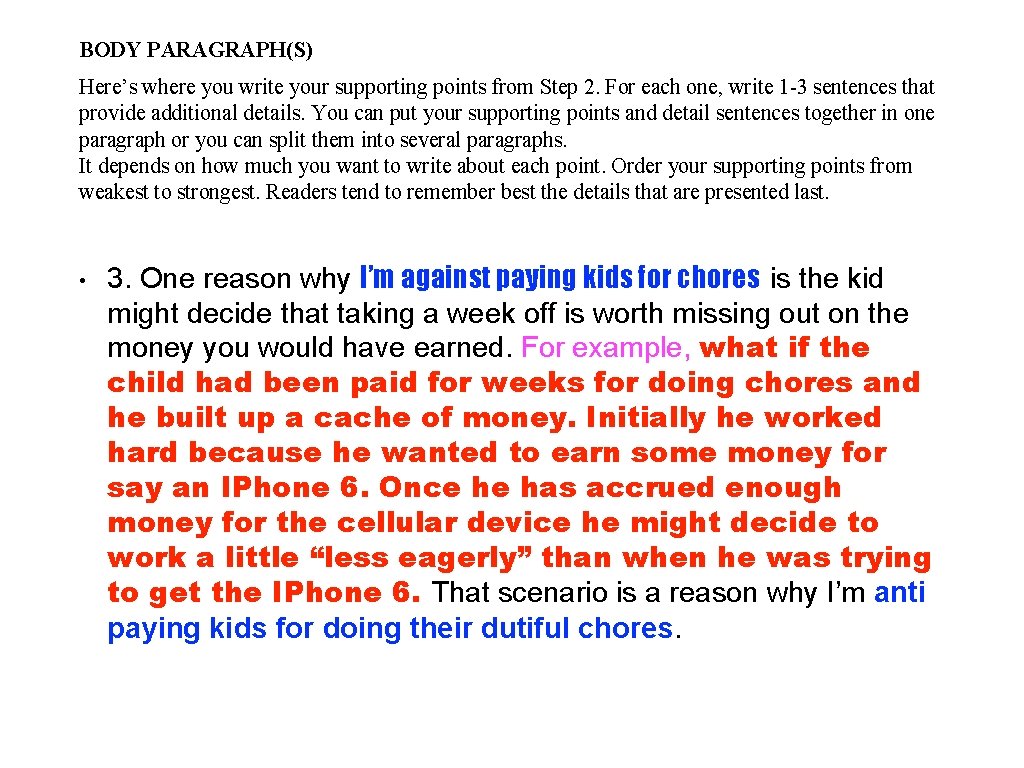
BODY PARAGRAPH(S) Here’s where you write your supporting points from Step 2. For each one, write 1 -3 sentences that provide additional details. You can put your supporting points and detail sentences together in one paragraph or you can split them into several paragraphs. It depends on how much you want to write about each point. Order your supporting points from weakest to strongest. Readers tend to remember best the details that are presented last. • 3. One reason why I’m against paying kids for chores is the kid might decide that taking a week off is worth missing out on the money you would have earned. For example, what if the child had been paid for weeks for doing chores and he built up a cache of money. Initially he worked hard because he wanted to earn some money for say an IPhone 6. Once he has accrued enough money for the cellular device he might decide to work a little “less eagerly” than when he was trying to get the IPhone 6. That scenario is a reason why I’m anti paying kids for doing their dutiful chores.
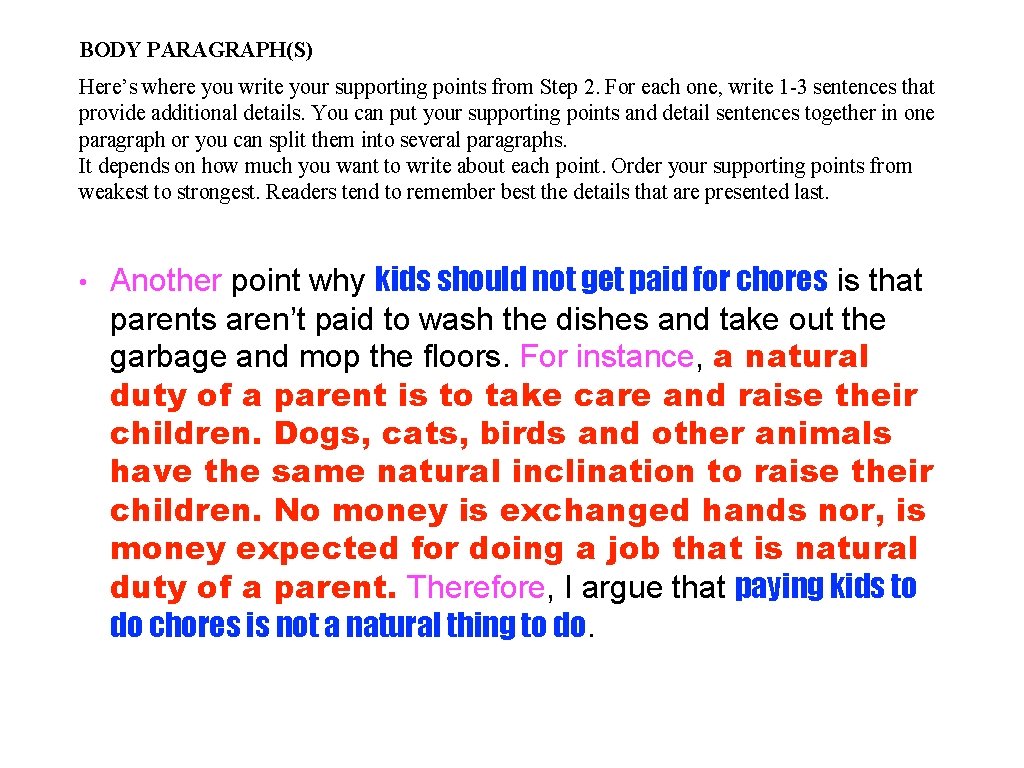
BODY PARAGRAPH(S) Here’s where you write your supporting points from Step 2. For each one, write 1 -3 sentences that provide additional details. You can put your supporting points and detail sentences together in one paragraph or you can split them into several paragraphs. It depends on how much you want to write about each point. Order your supporting points from weakest to strongest. Readers tend to remember best the details that are presented last. • Another point why kids should not get paid for chores is that parents aren’t paid to wash the dishes and take out the garbage and mop the floors. For instance, a natural duty of a parent is to take care and raise their children. Dogs, cats, birds and other animals have the same natural inclination to raise their children. No money is exchanged hands nor, is money expected for doing a job that is natural duty of a parent. Therefore, I argue that paying kids to do chores is not a natural thing to do.
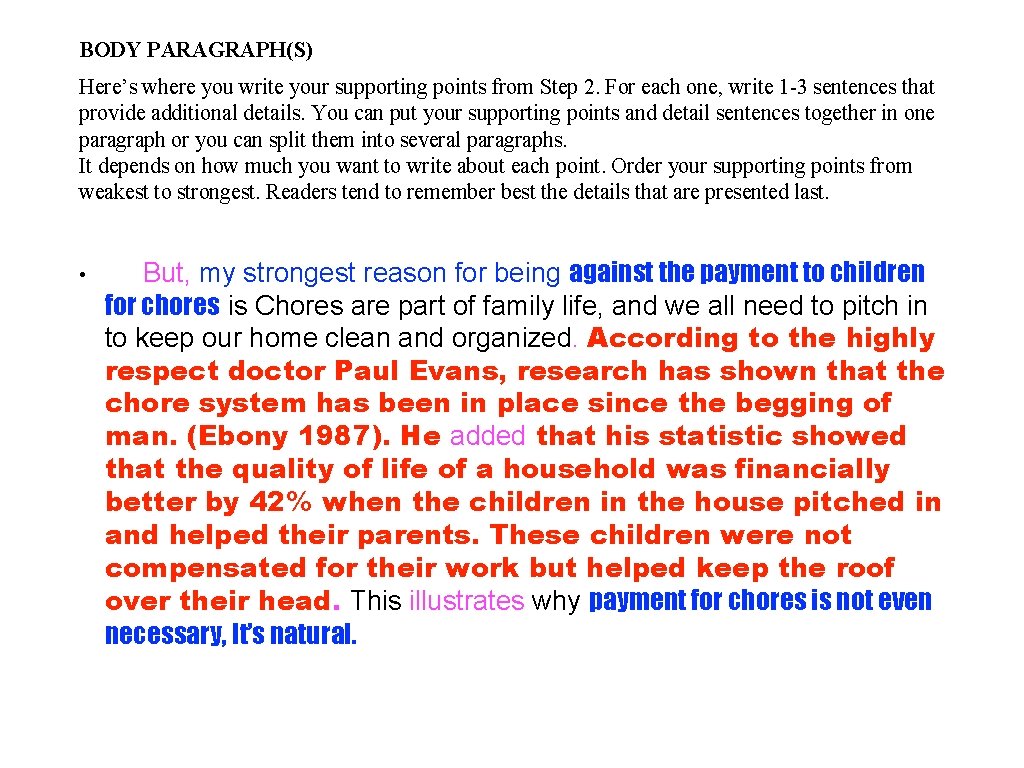
BODY PARAGRAPH(S) Here’s where you write your supporting points from Step 2. For each one, write 1 -3 sentences that provide additional details. You can put your supporting points and detail sentences together in one paragraph or you can split them into several paragraphs. It depends on how much you want to write about each point. Order your supporting points from weakest to strongest. Readers tend to remember best the details that are presented last. • But, my strongest reason for being against the payment to children for chores is Chores are part of family life, and we all need to pitch in to keep our home clean and organized. According to the highly respect doctor Paul Evans, research has shown that the chore system has been in place since the begging of man. (Ebony 1987). He added that his statistic showed that the quality of life of a household was financially better by 42% when the children in the house pitched in and helped their parents. These children were not compensated for their work but helped keep the roof over their head. This illustrates why payment for chores is not even necessary, It’s natural.
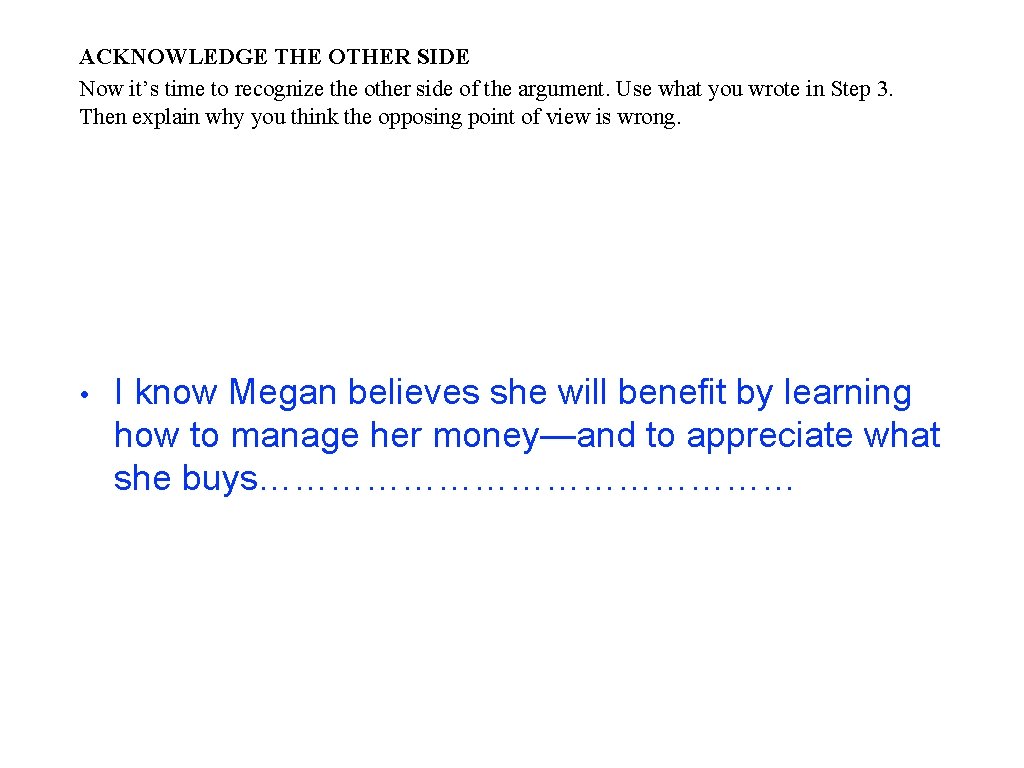
ACKNOWLEDGE THE OTHER SIDE Now it’s time to recognize the other side of the argument. Use what you wrote in Step 3. Then explain why you think the opposing point of view is wrong. • I know Megan believes she will benefit by learning how to manage her money—and to appreciate what she buys……………………
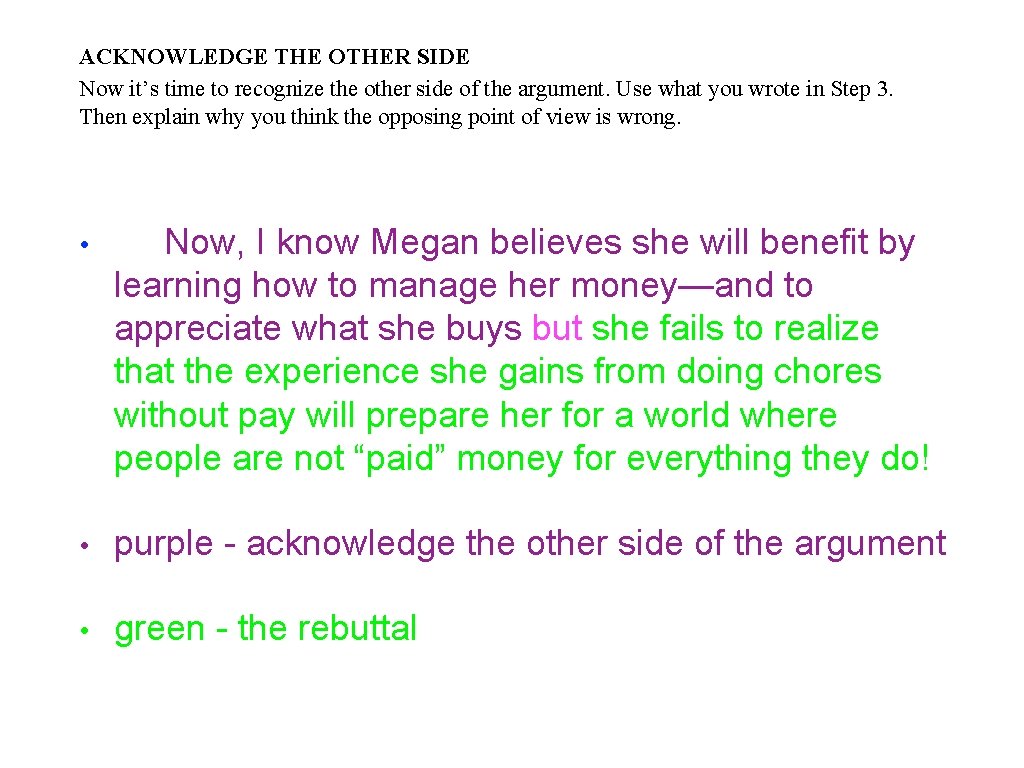
ACKNOWLEDGE THE OTHER SIDE Now it’s time to recognize the other side of the argument. Use what you wrote in Step 3. Then explain why you think the opposing point of view is wrong. • Now, I know Megan believes she will benefit by learning how to manage her money—and to appreciate what she buys but she fails to realize that the experience she gains from doing chores without pay will prepare her for a world where people are not “paid” money for everything they do! • purple - acknowledge the other side of the argument • green - the rebuttal
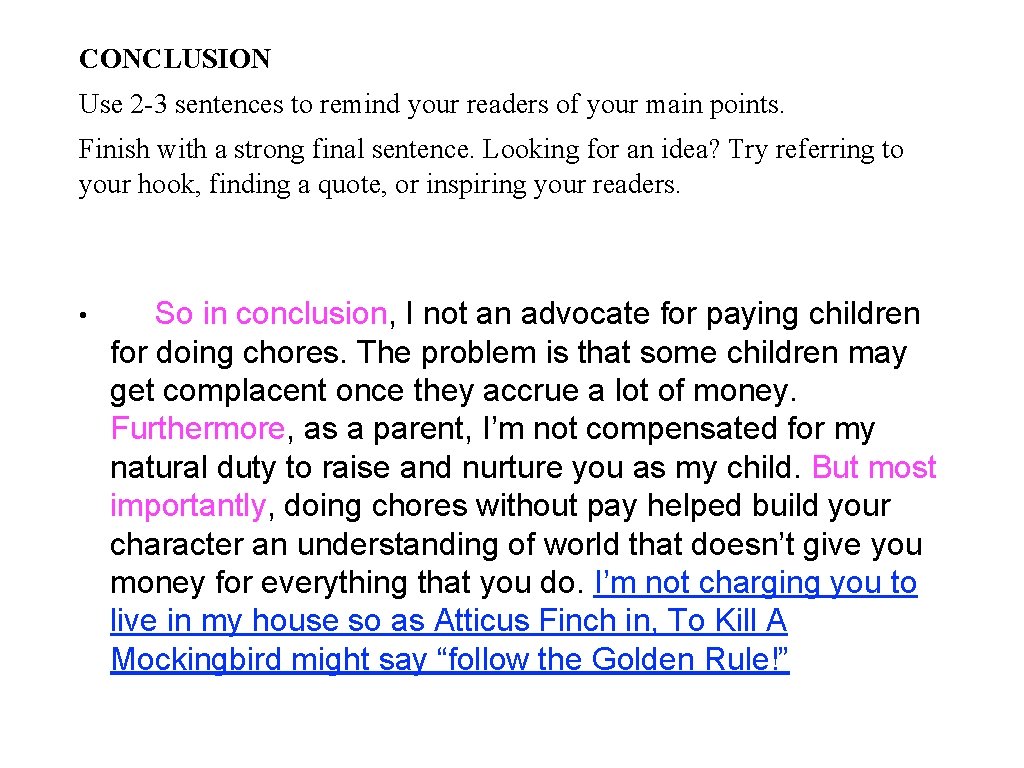
CONCLUSION Use 2 -3 sentences to remind your readers of your main points. Finish with a strong final sentence. Looking for an idea? Try referring to your hook, finding a quote, or inspiring your readers. • So in conclusion, I not an advocate for paying children for doing chores. The problem is that some children may get complacent once they accrue a lot of money. Furthermore, as a parent, I’m not compensated for my natural duty to raise and nurture you as my child. But most importantly, doing chores without pay helped build your character an understanding of world that doesn’t give you money for everything that you do. I’m not charging you to live in my house so as Atticus Finch in, To Kill A Mockingbird might say “follow the Golden Rule!”
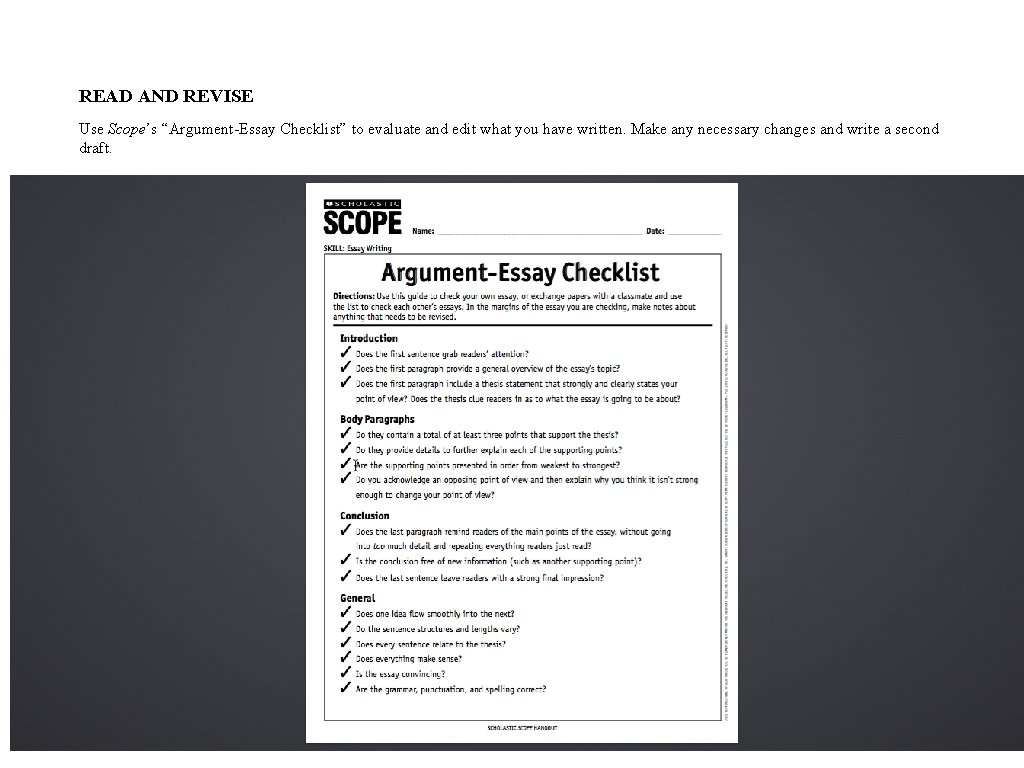
READ AND REVISE Use Scope’s “Argument-Essay Checklist” to evaluate and edit what you have written. Make any necessary changes and write a second draft.