
HOW TO WRITE AN EFFECTIVE ABSTRACT SO YOURE

HOW TO WRITE AN EFFECTIVE ABSTRACT (SO YOU’RE NOT LEFT OUT IN THE COLD) Deborah Mulligan 1
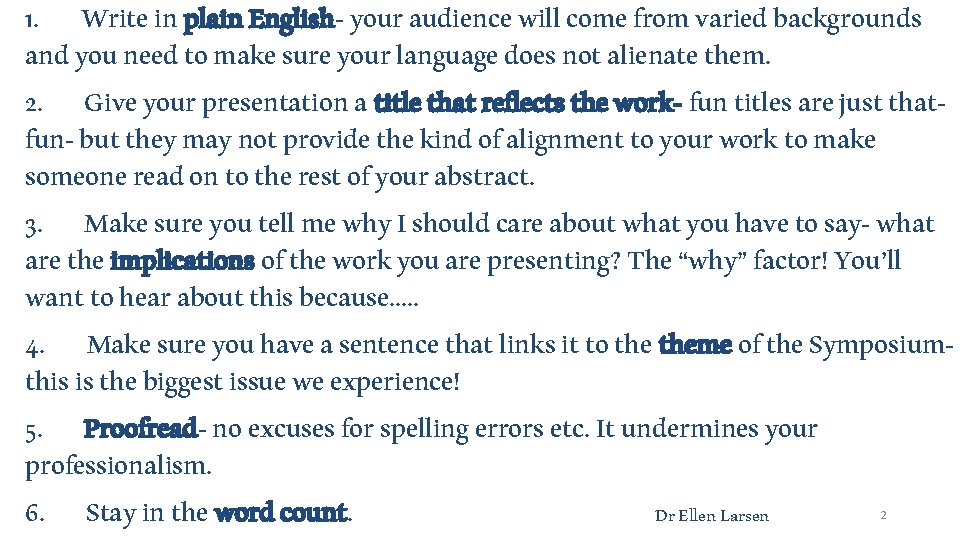
1. Write in plain English- your audience will come from varied backgrounds and you need to make sure your language does not alienate them. 2. Give your presentation a title that reflects the work- fun titles are just thatfun- but they may not provide the kind of alignment to your work to make someone read on to the rest of your abstract. 3. Make sure you tell me why I should care about what you have to say- what are the implications of the work you are presenting? The “why” factor! You’ll want to hear about this because…. . 4. Make sure you have a sentence that links it to theme of the Symposiumthis is the biggest issue we experience! 5. Proofread- no excuses for spelling errors etc. It undermines your professionalism. 6. Stay in the word count. Dr Ellen Larsen 2
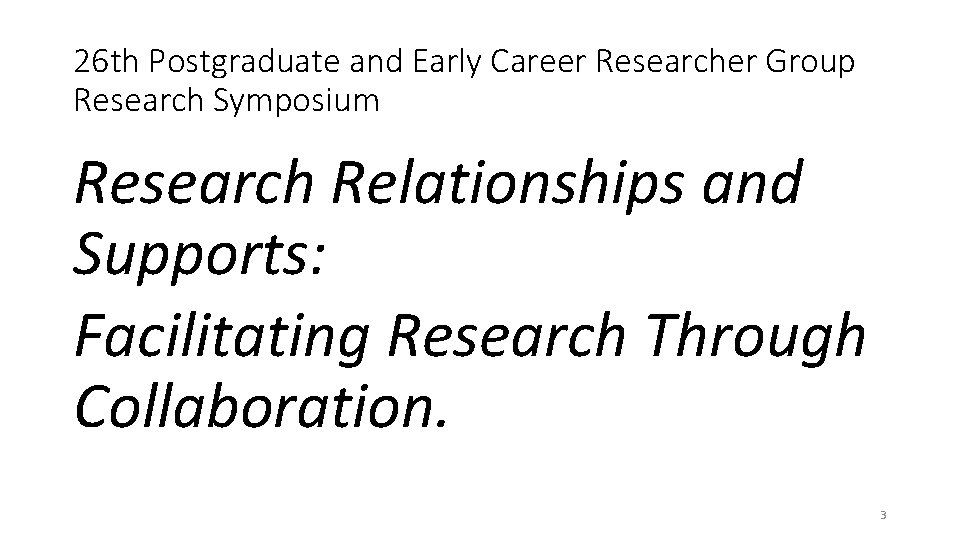
26 th Postgraduate and Early Career Researcher Group Research Symposium Research Relationships and Supports: Facilitating Research Through Collaboration. 3
Let’s unpack theme…. Research Relationships and Supports: Facilitating Research Through Collaboration. 4
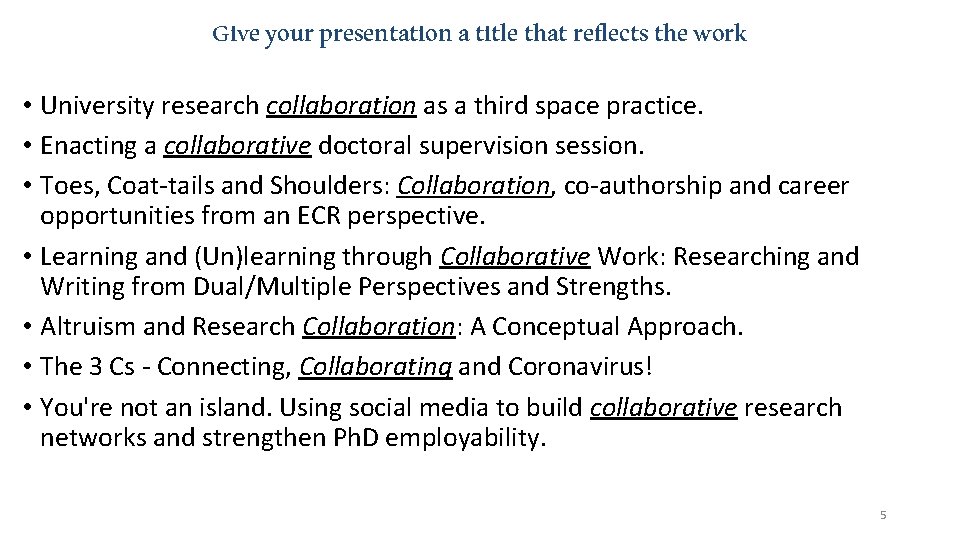
Give your presentation a title that reflects the work • University research collaboration as a third space practice. • Enacting a collaborative doctoral supervision session. • Toes, Coat-tails and Shoulders: Collaboration, co-authorship and career opportunities from an ECR perspective. • Learning and (Un)learning through Collaborative Work: Researching and Writing from Dual/Multiple Perspectives and Strengths. • Altruism and Research Collaboration: A Conceptual Approach. • The 3 Cs - Connecting, Collaborating and Coronavirus! • You're not an island. Using social media to build collaborative research networks and strengthen Ph. D employability. 5
The Power of Belief Collaborative endeavours, particularly in the context of thesis production, are highly complex. This presentation represents a personalised narrative account of a Ph. D candidate in transition from a traumatised and fractured personality to a more confident and competent higher degree student. Through an insider’s vantage point, I chronicle my journey to thesis completion and reflect on the impact of the power of belief in an emotional world gradually reignited through collaborative interaction. Several factors act as integral elements in the success of completion. Fulfilling relationships provide agency and authority for self-determination and educational growth. • plain English ✔ • title that reflects the work • Implications • Theme ✔ • Proofread ✔ • word count 6
Dr Death: Emotional Collaborations and the Power of Belief Collaborative endeavours, particularly in the context of thesis production, are highly complex. This presentation represents a personalised narrative account of a Ph. D candidate in transition from a traumatised and fractured personality to a more confident and competent higher degree student. Through an insider’s vantage point, I chronicle my journey to thesis completion and reflect on the impact of the power of belief in an emotional world where trust in humanity was extinguished and gradually reignited through collaborative interaction. “Beliefs create the maps that guide us toward our goals and give us the power to take action” (Robbins, n. d. ). Belief is a powerful force behind self-efficacy and self-esteem. Articles around the impact of belief in self and our ability to progress our scholarly undertakings abound in doctoral literature. However, lack of a positive self-identity skews our internal map of reality and it becomes a wild geography of self-doubt and self-loathing. This is all the more dislocating when the individual comes from a place of trauma. Positive collaborations with supervisors and other university staff, fellow candidates, fieldwork participants and family are an integral element in the success of Ph. D completion. Fulfilling relationships provide support for agency and authority for self-determination and educational growth. Reference Robbins, T. (n. d. ). Do your beliefs limit you? Mind & Meaning. Retrieved from https: //www. tonyrobbins. com/mind-meaning/do-your-beliefs-limit-you/ 7
• plain English ✔ • title that reflects the work✔Dr Death: Emotional Collaborations and the Power of Belief • Implications✔ Positive collaborations with supervisors and other university staff, fellow candidates, fieldwork participants and family are an integral element in the success of Ph. D completion. Fulfilling relationships provide agency and authority for selfdetermination and educational growth. Belief is a powerful force behind self-efficacy and self-esteem. Lack of a positive self-identity skews our internal map of reality and it becomes a wild geography of self-doubt and self-loathing. This is all the more dislocating when the individual comes from a place of trauma. • Theme ✔ Collaborative endeavours, particularly in the context of thesis production, are highly complex I chronicle my journey to thesis completion and reflect on the impact of the power of belief in an emotional world where trust in humanity was extinguished and gradually reignited through collaborative interaction. • Proofread ✔ • Word count✔ 8
1. Common ground- set the scene for the context of the topic so that everyone appreciates where the topic is situated. 2. Complication- identify the issue, the problem, the twist and make the complication compelling. 3. Care/ Concern- Make sure you tell me why I should care about what you have to say- what are the implications of the work you are presenting? The “why” factor! You’ll want to hear about this because…. . 4. Course of action- so what did you do to resolve or what do you plan to do to resolve the concern? In one sentence… 5. Contribution- How did you impact on the complication/ concern… or how do you plan to? ***Note that the 5 C’s may not work in every instance…but they really do work a treat in many cases!!! Dr Alice Brown 9
Some additional considerations…. • • References- short, 2 max Put your name at the top of it- easier for the reviewers And maybe the date? Chunk it so it’s not one big paragraph- easier to read, divides your main points- para 1 - intro to the topic- what can we expect para 2 - more specific- good place for a quote so you show that you’ve done some research para 3 - general overall comment- link with theme • Top and tail- what’s your hook? Is it in your title? What’s your final remarktry to revisit theme. • Invest in what you’ve got to say- believe in yourself and the importance/ credibility of your research- this will come out in your writing and then your presentation 10
11
- Slides: 11