
HOW TO WRITE A SUCCESSFUL DOCTORAL RESEARCH PROPOSAL



- Slides: 65
HOW TO WRITE A SUCCESSFUL DOCTORAL RESEARCH PROPOSAL: THE MAKERERE FORMAT By David Onen (Ph. D. ) EASHESD, College of Education and External Studies Makerere University A Paper Presented on 12 th June, 2014 at a Doctoral Colloquium at the College of Education & External Studies, Makerere University
Introduction… 2 Writing and submitting an acceptable research proposal is not easy. At Makerere University, the time for producing a dissertation proposal is “frustrating” for many doctoral students! But, a few students still write it in time: 1. How do those students write their proposals? 2. What do they write that others don’t? 3. What is a research proposal and how important is it in a study? 4. What are the elements of a proposal and what does he Makerere guideline say about ? Dr. D, proposal Onpen 12/17/2021
What is a Research Proposal? 3 The word ‘proposal’ literally means a suggestion put forward for consideration or discussion by others. Applied loosely, a proposal is a suggestion to resolve an identified research problem. Technically, a proposal is a written presentation of an intended research specifying the problem, the purpose, scope/objectives, methodology, references and the financial plan/budget (Mak. 2011; Amin, 2003). It is an overview of the intended research describing the proposed project: its design, financial requirements and its potential contribution to the existing body of knowledge Dr. D, Onen 12/17/2021 (Oso & Onen, 2009).
Role of a Research Proposal 4 1. 2. 3. 4. 5. Most researchers do not understand the value of research proposals. Yet, one’s research is only as good as his/her proposal. Wong (2002) points out that a research proposal is used to: Convince other people and the supervisor that the researcher has a worthwhile project to study. Demonstrate expertise in a particular area of study. Demonstrate one’s competency in his/her area of study. To produce a roadmap that the student will follow during his/her dissertation project; Help in making admissions or progression decisions on the Dr. D, Onen 12/17/2021 candidate.
Types of proposals 5 Broadly, research proposals can be categorized into: quantitative and qualitative proposals. A quantitative proposal describes an inquiry informed by the philosophy of logical positivism and one that seeks to understand the world in quantitative and numerical terms. While, a qualitative proposal is one which describes any inquiry that seeks to understand the world within the total context of what creates meaning out of people’s lived experiences (Amin, 2005). The writing of quantitative and qualitative proposals differs. Amin (2005) asserts that quantitative studies are theory-based. Meanwhile, qualitative proposals describe inquires which may not be grounded in any theory. Dr. D, Onen 12/17/2021
Fig. 1: Structure of a Research Proposal 6 Dr. D, Onen 12/17/2021
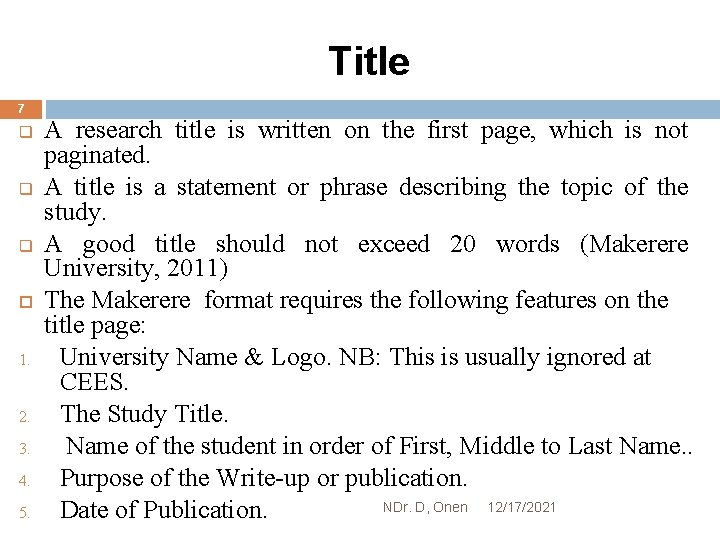
Title 7 q q q 1. 2. 3. 4. 5. A research title is written on the first page, which is not paginated. A title is a statement or phrase describing the topic of the study. A good title should not exceed 20 words (Makerere University, 2011) The Makerere format requires the following features on the title page: University Name & Logo. NB: This is usually ignored at CEES. The Study Title. Name of the student in order of First, Middle to Last Name. . Purpose of the Write-up or publication. NDr. D, Onen 12/17/2021 Date of Publication.
Fig. 2: General Outlook of the Title Page UNIVERSITY LOGO MAKERERE UNIVERSITY RESEARCH TOPIC EFFECT OF REMUNERATION ON MOTIVATION OF DIPLOMA TEACHERS IN PRIMARY SCHOOLS IN UGANDA BY-LINE i. AUTHOR(S) NAME(S) i. PREVIOUS QUALIFICATIONS DAVID MUSOKE BEd; MEd (Mak) A PROPOSAL SUBMITTED TO … IN PARTIAL FULFILLMENT OF THE REQUIREMENTS FOR THE DEGREE/DIPLOMA OF (---NAME OF THE DEGREE/DIPLOMA---) IN (---AREA OF SPECIALIZATION---) DATE OF SUBMISSION A PROPOSAL SUBMITTED TO THE DIRECTORATE OF RESEARCH AND GRADUATE TRAINING IN PARTIAL FULFILLMENT OF THE REQUIREMENTS FOR THE AWARD OF THE DEGREE OF PHILOSOPHY IN EDUCATION OF MAKERERE UNIVERSITY JANUARY 2014 8 Dr. D, Onen 12/17/2021
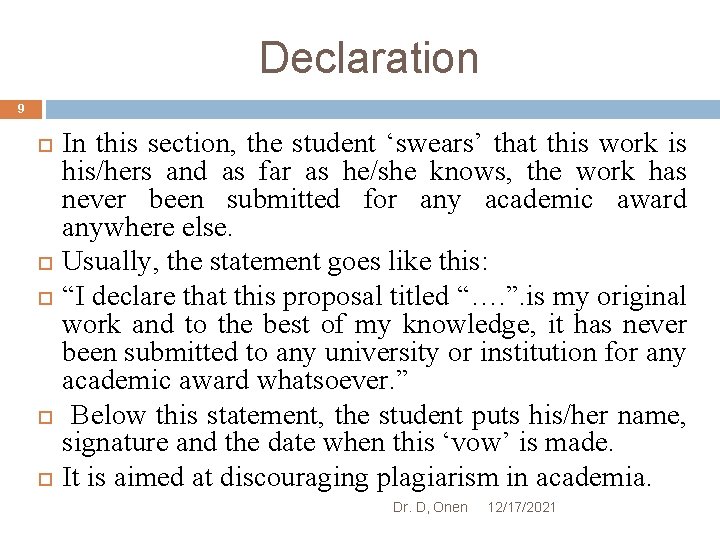
Declaration 9 In this section, the student ‘swears’ that this work is his/hers and as far as he/she knows, the work has never been submitted for any academic award anywhere else. Usually, the statement goes like this: “I declare that this proposal titled “…. ”. is my original work and to the best of my knowledge, it has never been submitted to any university or institution for any academic award whatsoever. ” Below this statement, the student puts his/her name, signature and the date when this ‘vow’ is made. It is aimed at discouraging plagiarism in academia. Dr. D, Onen 12/17/2021
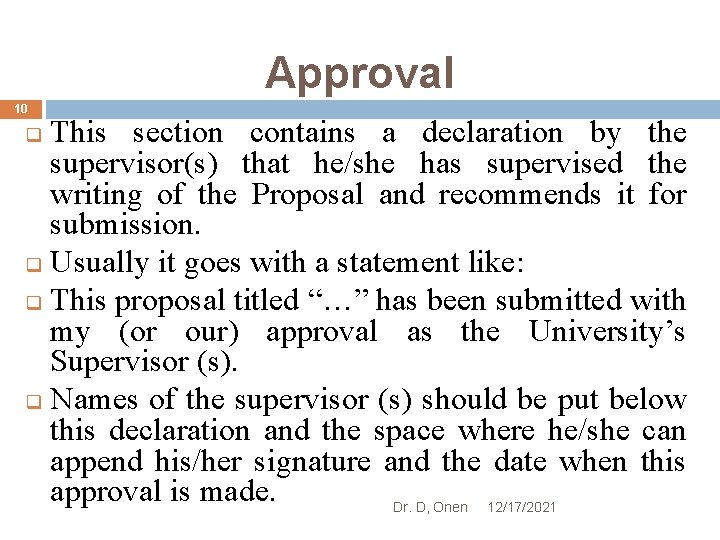
Approval 10 This section contains a declaration by the supervisor(s) that he/she has supervised the writing of the Proposal and recommends it for submission. q Usually it goes with a statement like: q This proposal titled “…” has been submitted with my (or our) approval as the University’s Supervisor (s). q Names of the supervisor (s) should be put below this declaration and the space where he/she can append his/her signature and the date when this approval is made. Dr. D, Onen 12/17/2021 q
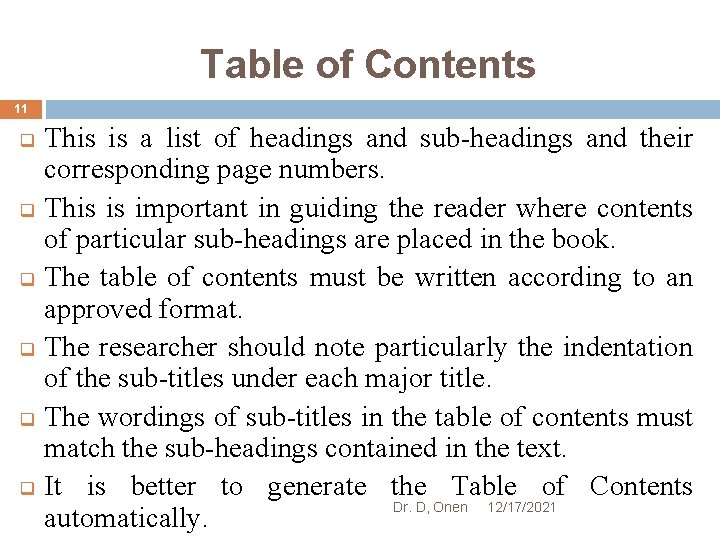
Table of Contents 11 q q q This is a list of headings and sub-headings and their corresponding page numbers. This is important in guiding the reader where contents of particular sub-headings are placed in the book. The table of contents must be written according to an approved format. The researcher should note particularly the indentation of the sub-titles under each major title. The wordings of sub-titles in the table of contents must match the sub-headings contained in the text. It is better to generate the Table of Contents Dr. D, Onen 12/17/2021 automatically.
List of Tables 12 This shows the list of tables in the Proposal and their corresponding pages. The titles of the tables must be clear and descriptive. They should be progressively and consistently numbered throughout the Proposal. Dr. D, Onen 12/17/2021
List of Figures 13 This shows caption of illustrations used in the Proposal and their corresponding pages. The same conditions as for list of tables described above should apply. Dr. D, Onen 12/17/2021
List of Abbreviations (or Acronyms) 14 In this section, the researcher presents the list of abbreviations or acronyms as used in the proposal. The title of the section should indicate so. This may include list of symbols and scientific terms that are used in the text. NOTE: Pagination of all the preliminary pages up to this point should be in Lowercase Roman Dr. D, Onen 12/17/2021 Numerals.
THE TEXT - CHAPTER ONE 15 The Chapter titled is INTRODUCTION Other Sub-titles in the Introduction Include: Introduction Background to the Study Statement of the Problem Purpose of the study Specific Objectives Research Questions/Hypotheses Scope of Study Significance of the Study Justification of the Study Dr. D, Onen 12/17/2021 The Conceptual Framework (Debatable)
Background to the Study 16 The background introduces the status, rationale and theoretical orientation of the study. It is provides evidence and conditions of the existing situation to make the reader feel the urgency of the problem. Cresswell (2003) suggests that the background should be introduced with a good ‘narrative hook’ – a set of statements relevant to theme being studied which attracts the reader to the work. A research background has four main dimensions: the historical, theoretical, conceptual and contextual dimensions. Dr. D, Onen 12/17/2021
17 In the introduction to Introduction The following are included: 1. An opening remark in which the researcher draws the attention of the reader to the importance of the issue(s) under investigation. 2. The researcher points out that what is prevailing in his/her area or context of research seems different with the ‘ideal or expected’ situation. In other words, the author creates and problem scenario. 3. The researcher points out what this study will address or focus on, and 4. The author alerts the reader of what this chapter will entail. q Cresswell (1994) calls these opening remarks a “narrative hook”. Dr. D, Onen 12/17/2021
The Historical Background 18 The first part of the historical background is ‘a narration of the history of the phenomenon under investigation’. Here, the researcher tells the reader what was the ‘conditions’ like in the past; what is it like today? In the second part, the writer reflects on the work of other researchers in this field. But, the efforts of previous scholars must be downplayed or criticized. The researcher can describe the history from a Dr. D, Onen perspective. 12/17/2021 global or regional to a contextual
The Theoretical Background 19 The second part of the background is theoretical background. In theoretical background, the researcher describes theory (or theories) on which the study will be based. It describes “any” discovered relationships between the variables in the study and theory to be used. The researcher should briefly describe theory (or theories) and justify how it relates to the variables under investigation. Dr. D, Onen 12/17/2021
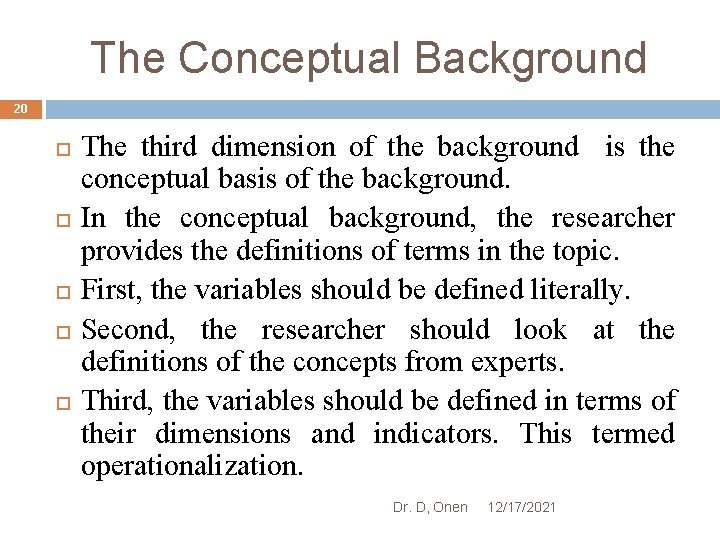
The Conceptual Background 20 The third dimension of the background is the conceptual basis of the background. In the conceptual background, the researcher provides the definitions of terms in the topic. First, the variables should be defined literally. Second, the researcher should look at the definitions of the concepts from experts. Third, the variables should be defined in terms of their dimensions and indicators. This termed operationalization. Dr. D, Onen 12/17/2021
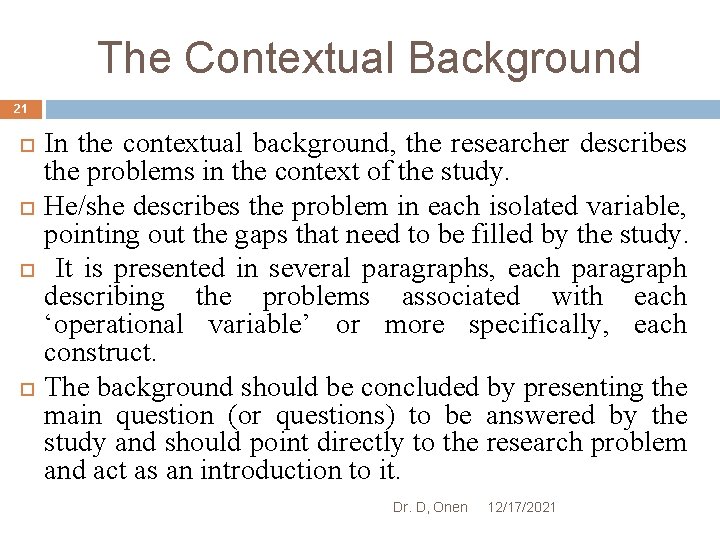
The Contextual Background 21 In the contextual background, the researcher describes the problems in the context of the study. He/she describes the problem in each isolated variable, pointing out the gaps that need to be filled by the study. It is presented in several paragraphs, each paragraph describing the problems associated with each ‘operational variable’ or more specifically, each construct. The background should be concluded by presenting the main question (or questions) to be answered by the study and should point directly to the research problem and act as an introduction to it. Dr. D, Onen 12/17/2021
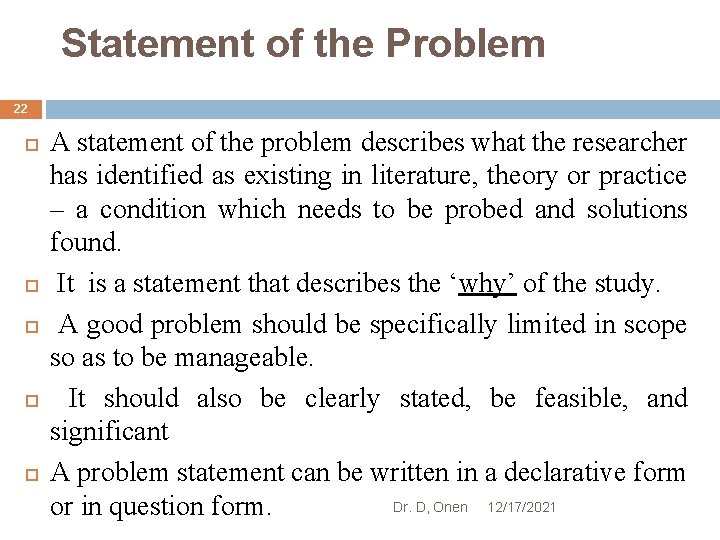
Statement of the Problem 22 A statement of the problem describes what the researcher has identified as existing in literature, theory or practice – a condition which needs to be probed and solutions found. It is a statement that describes the ‘why’ of the study. A good problem should be specifically limited in scope so as to be manageable. It should also be clearly stated, be feasible, and significant A problem statement can be written in a declarative form Dr. D, Onen 12/17/2021 or in question form.
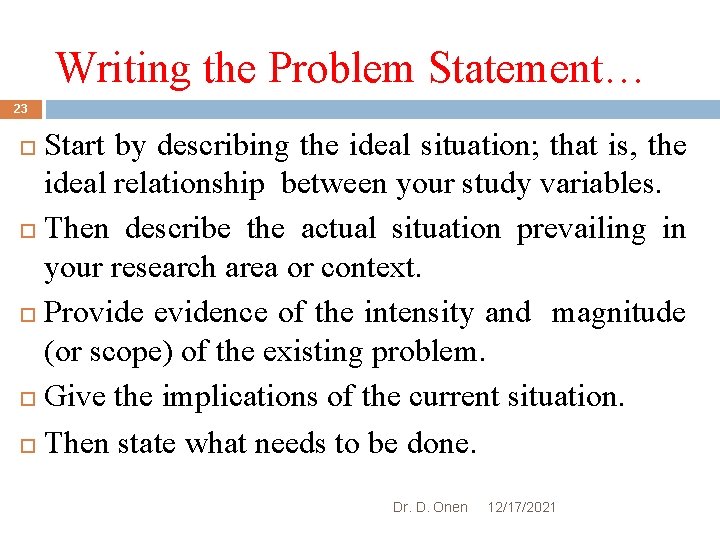
Writing the Problem Statement… 23 Start by describing the ideal situation; that is, the ideal relationship between your study variables. Then describe the actual situation prevailing in your research area or context. Provide evidence of the intensity and magnitude (or scope) of the existing problem. Give the implications of the current situation. Then state what needs to be done. Dr. D. Onen 12/17/2021
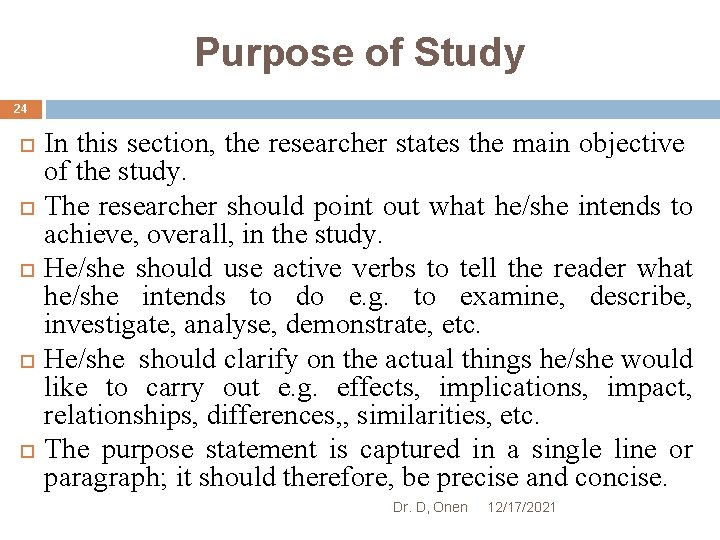
Purpose of Study 24 In this section, the researcher states the main objective of the study. The researcher should point out what he/she intends to achieve, overall, in the study. He/she should use active verbs to tell the reader what he/she intends to do e. g. to examine, describe, investigate, analyse, demonstrate, etc. He/she should clarify on the actual things he/she would like to carry out e. g. effects, implications, impact, relationships, differences, , similarities, etc. The purpose statement is captured in a single line or paragraph; it should therefore, be precise and concise. Dr. D, Onen 12/17/2021
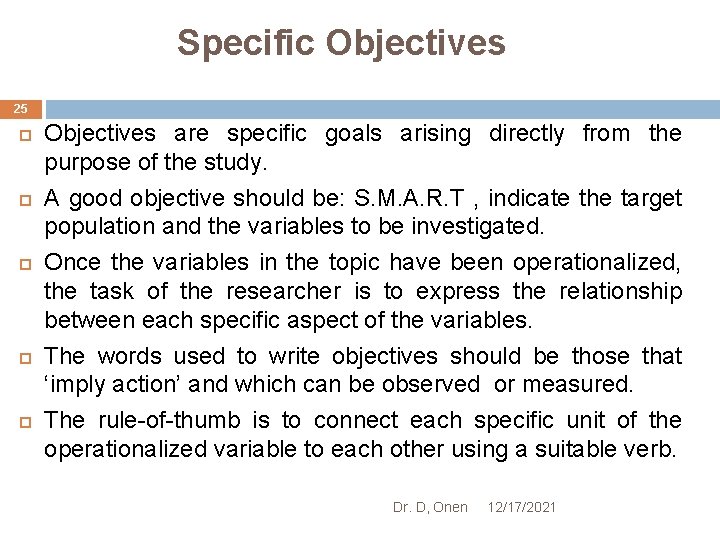
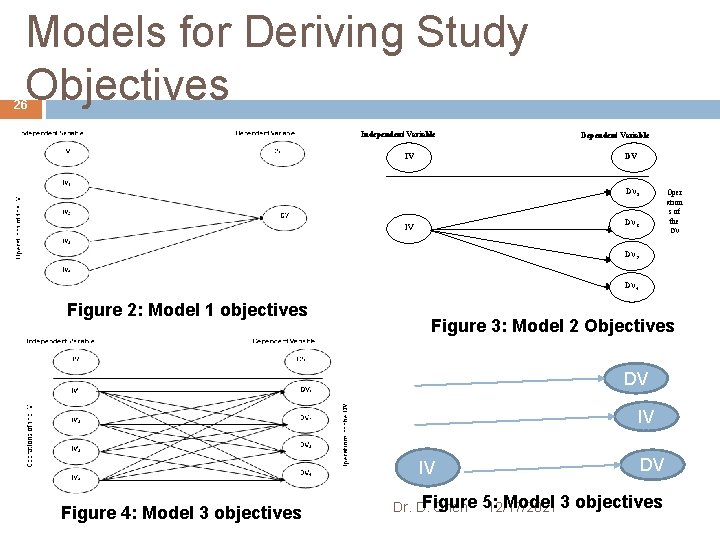
Specific Objectives 25 Objectives are specific goals arising directly from the purpose of the study. A good objective should be: S. M. A. R. T , indicate the target population and the variables to be investigated. Once the variables in the topic have been operationalized, the task of the researcher is to express the relationship between each specific aspect of the variables. The words used to write objectives should be those that ‘imply action’ and which can be observed or measured. The rule-of-thumb is to connect each specific unit of the operationalized variable to each other using a suitable verb. Dr. D, Onen 12/17/2021
Models for Deriving Study Objectives 26 Independent Variable IV Dependent Variable DV DV 1 Oper ation s of the DV DV 2 IV DV 3 DV 4 Figure 2: Model 1 objectives Figure 3: Model 2 Objectives DV IV IV Figure 4: Model 3 objectives Figure Model 3 Dr. D. Onen 5: 12/17/2021 DV objectives
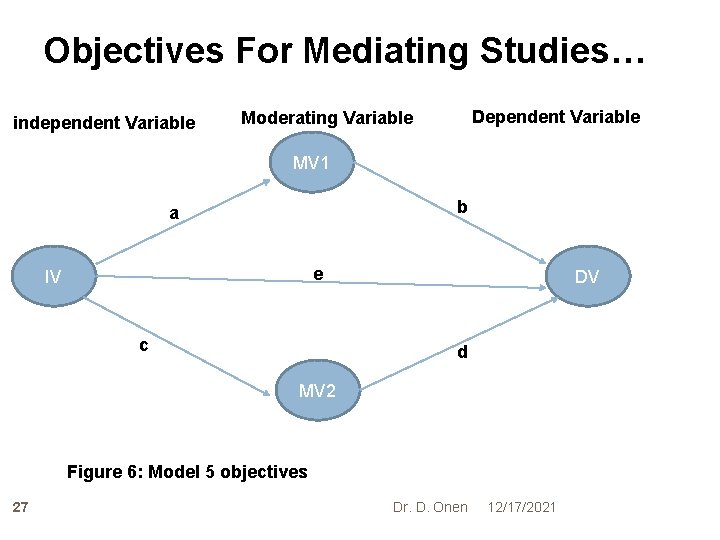
Objectives For Mediating Studies… independent Variable Dependent Variable Moderating Variable MV 1 b a e IV c DV d MV 2 Figure 6: Model 5 objectives 27 Dr. D. Onen 12/17/2021
Research Questions/Hypotheses 28 q q q Questions and hypotheses are usually used alternately i. e. If questions are posed, hypotheses should not be stated at the same time. A researcher uses questions when he/she is not sure of the possible solutions to the research problem. To write research questions, a researcher restates each objective in question form, being careful to: Avoid questions that require Yes/No answers. Ensure that questions are systematically and logically consistent. Ensure that all variables in the objectives are included in the question. Dr. D, Onen 12/17/2021
Research Hypotheses 29 q q q q A hypothesis is a proposal about a solution to a problem: an “intelligent” or an “educated” guess to solve a problem. They are declarative statements on the relationships between two or more variables on the nature of some phenomenon. They form the elements for testing to enable the researcher make an opinion about certain phenomenon being investigated. A well-stated hypothesis should be testable, clear and precise. It should also indicate both the IV & DV. Hypothesis may be stated in either null form (Ho) or in alternative (or directional) form (HA). A Null Hypothesis states that there is no relationship between the variables being studied. Meanwhile, a directional (alternative) hypothesis states the D, Onen 12/17/2021. relationship between the variables Dr. being investigated
Scope of Study 30 q 1. 2. 3. 4. In this section of the Proposal, the researcher describes the width and breadth of the study in terms of: Geographical coverage (physical area covered by the study) Sample coverage (the part or whole of the population the study covers) Content coverage (the dimensions of the variables the study looks at) Time coverage (the time period covered by the study) Dr. D, Onen 12/17/2021
Significance of Study 31 v v 1. 2. 3. In this section, the researcher describes the relevance of the study in terms of its academic contributions and practical use that might be made of the findings. It is always stated as a suggestion or intended expectation from the study. The researcher should identify the potential parties and how they may benefit from the study. These parties are often: Policy-makers - depending on the area of research Practitioners - those who participate in the activities under investigation Dr. D, Onen 12/17/2021 Scholars – fellow researchers and academicians
Justification of the Study 32 In the section for justification, the researcher provides arguments to defend the need for the study. q Some of such arguments include: 1. That what is being investigated is important/critical/topical. 2. That the area being investigated has ‘knowledge gaps’ that need to be filled. 3. The study intends to justify the applicability of a certain theory in a given field. 4. The study will be of use to different stakeholders. Dr. D, Onen 12/17/2021 q
The Conceptual Framework 33 q q q q A Conceptual Framework is a scheme of concepts (or variables) which the researcher will operationalize in order to achieve set objectives. It is a schematic (or a diagrammatic) presentation of theory. In developing a conceptual framework, a researcher should: Place the IVs on the left and DVs) on the right separated by EVs Use one-way arrow leading from each determining variable to each variable dependent on it. One-way arrow suggests the presence of a hypothesis about causality. Use curved double-headed arrows to show unanalysed correlations between variables. Dr. D, Onen 12/17/2021
CHAPTER 2 - LITERATURE REVIEW 34 This is Chapter Two of the research Proposal. q It starts with an introduction. q In the Introduction, the researcher prepares the reader’s mind for what he/she can expect to find in the whole Chapter. q The researcher should endeavour to make the Introduction appealing to draw the reader’s interest on the entire Chapter. q Dr. D, Onen 12/17/2021
CHAPTER 2 - LITERATURE REVIEW 35 After the Introduction, the researcher presents the Theoretical Framework or Theoretical Review. q A Theoretical Framework is an examination of the existing or self-formulated theories in relation to the research objectives. q It refers to a set of interrelated variables, definitions and propositions that present a systematic view of a phenomenon being investigated. Dr. D, Onen 12/17/2021
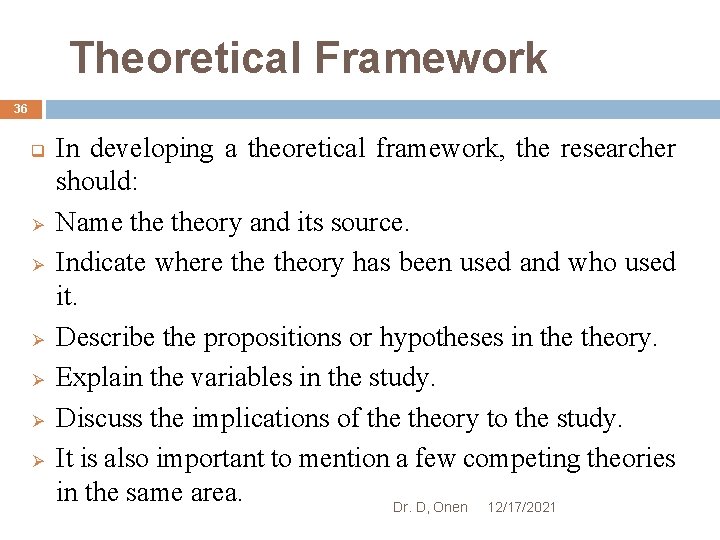
Theoretical Framework 36 q Ø Ø Ø In developing a theoretical framework, the researcher should: Name theory and its source. Indicate where theory has been used and who used it. Describe the propositions or hypotheses in theory. Explain the variables in the study. Discuss the implications of theory to the study. It is also important to mention a few competing theories in the same area. Dr. D, Onen 12/17/2021
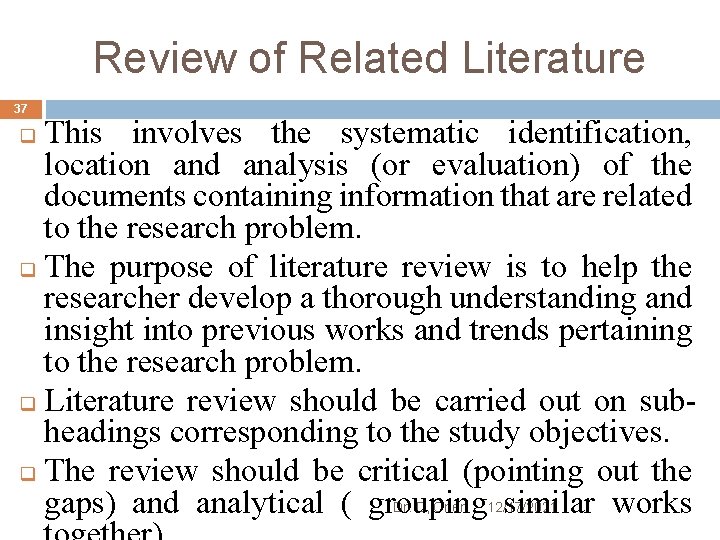
Review of Related Literature 37 This involves the systematic identification, location and analysis (or evaluation) of the documents containing information that are related to the research problem. q The purpose of literature review is to help the researcher develop a thorough understanding and insight into previous works and trends pertaining to the research problem. q Literature review should be carried out on subheadings corresponding to the study objectives. q The review should be critical (pointing out the Dr. D, Onen 12/17/2021 gaps) and analytical ( grouping similar works q
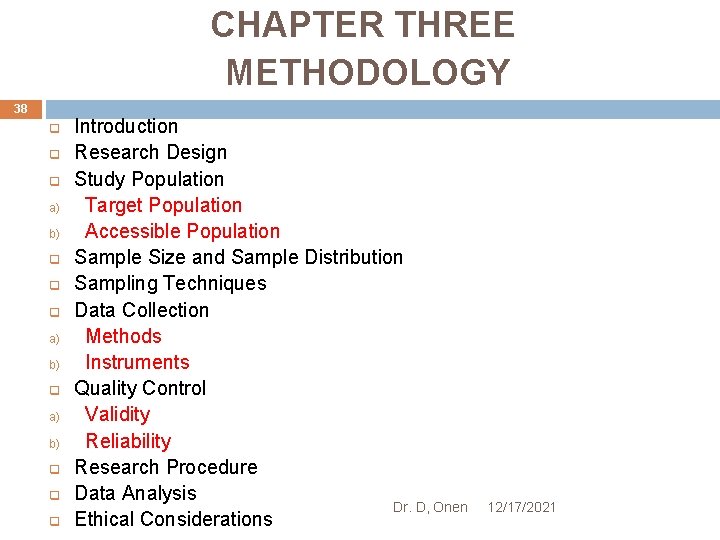
CHAPTER THREE METHODOLOGY 38 q q q a) b) q q q Introduction Research Design Study Population Target Population Accessible Population Sample Size and Sample Distribution Sampling Techniques Data Collection Methods Instruments Quality Control Validity Reliability Research Procedure Data Analysis Dr. D, Onen Ethical Considerations 12/17/2021
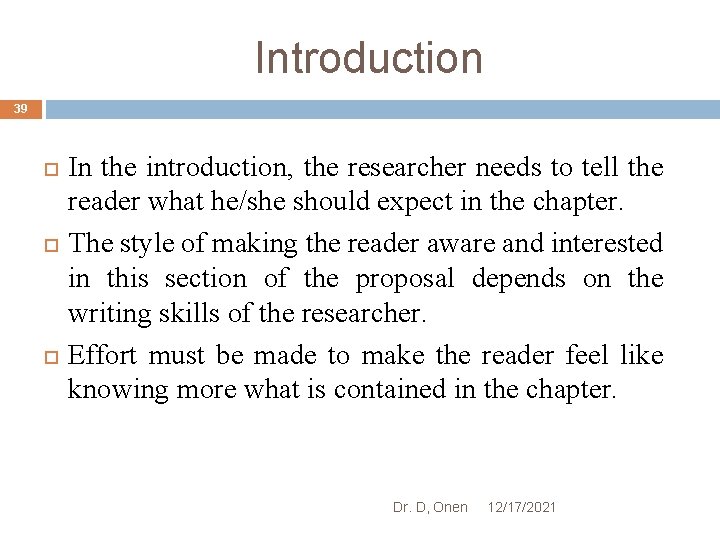
Introduction 39 In the introduction, the researcher needs to tell the reader what he/she should expect in the chapter. The style of making the reader aware and interested in this section of the proposal depends on the writing skills of the researcher. Effort must be made to make the reader feel like knowing more what is contained in the chapter. Dr. D, Onen 12/17/2021
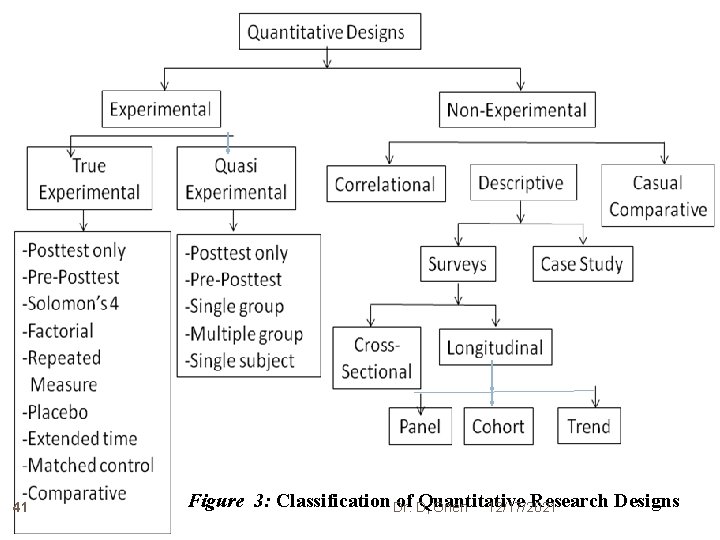
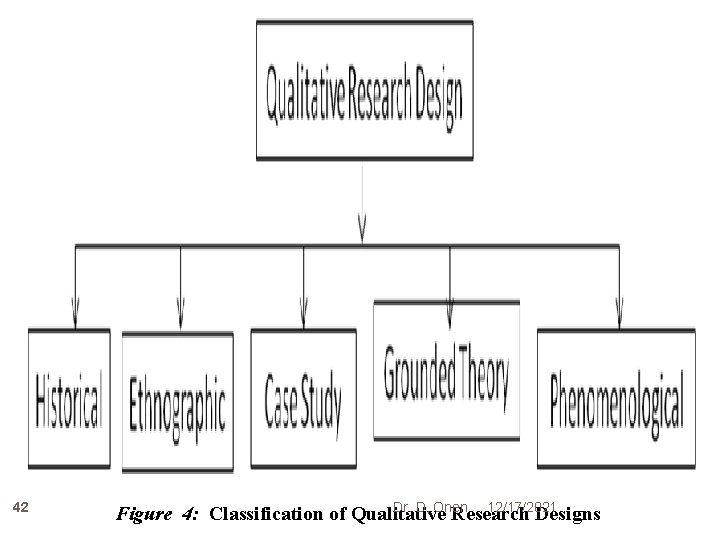
Research Design 40 q q q q In this section, the researcher describes the nature of the pattern ( or framework) the research intends to follow. This is termed the research design. The design is the plan or strategy for conducting the research. Broadly, research designs are divided into: qualitative & quantitative designs. However, within these broad classifications, there are specific designs categorized according to particular criteria. The researcher should describe the specific research design, rather than the paradigm. Before choosing a design, a researcher should consider the purpose/objectives/hypotheses/questions of the study. Dr. D, Onen 12/17/2021
41 Figure 3: Classification Dr. of D, Quantitative Research Designs Onen 12/17/2021
42 Dr. D, Onen 12/17/2021 Figure 4: Classification of Qualitative Research Designs
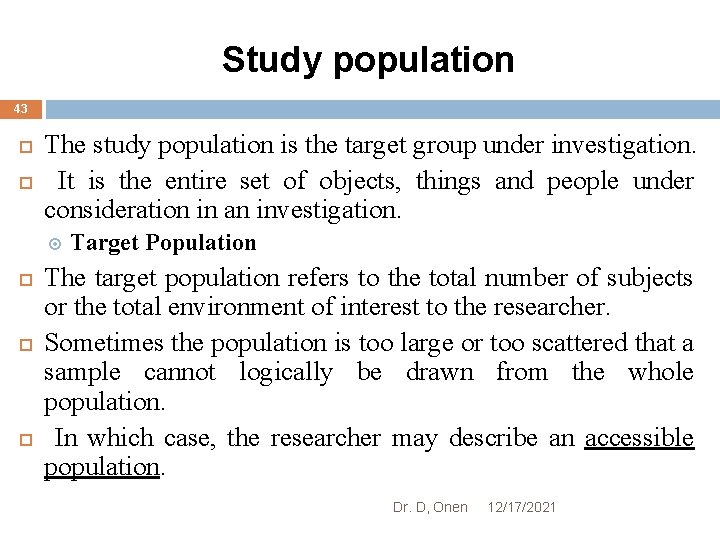
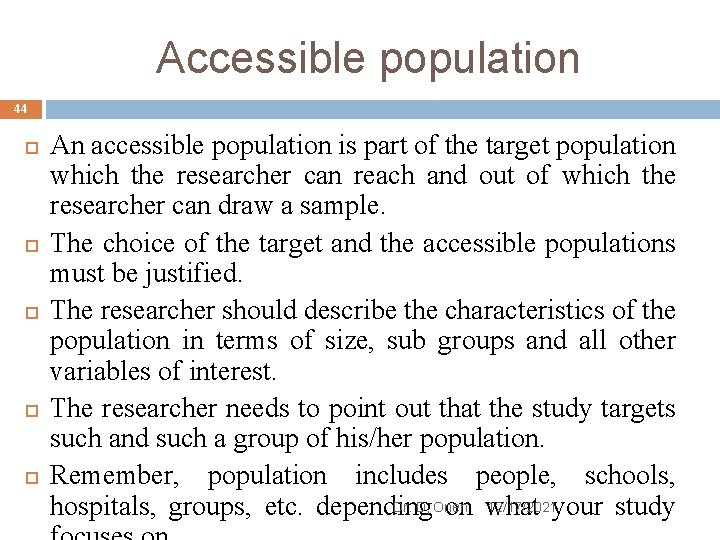
Study population 43 The study population is the target group under investigation. It is the entire set of objects, things and people under consideration in an investigation. Target Population The target population refers to the total number of subjects or the total environment of interest to the researcher. Sometimes the population is too large or too scattered that a sample cannot logically be drawn from the whole population. In which case, the researcher may describe an accessible population. Dr. D, Onen 12/17/2021
Accessible population 44 An accessible population is part of the target population which the researcher can reach and out of which the researcher can draw a sample. The choice of the target and the accessible populations must be justified. The researcher should describe the characteristics of the population in terms of size, sub groups and all other variables of interest. The researcher needs to point out that the study targets such and such a group of his/her population. Remember, population includes people, schools, Dr. D, Onen 12/17/2021 your study hospitals, groups, etc. depending on what
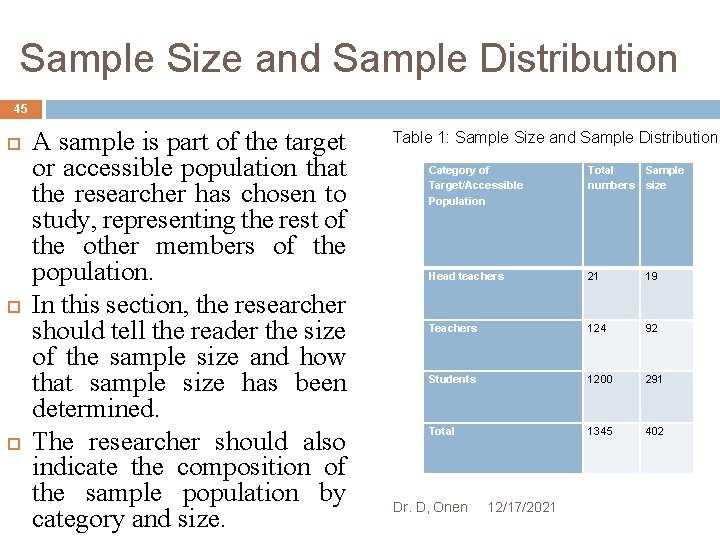
Sample Size and Sample Distribution 45 A sample is part of the target or accessible population that the researcher has chosen to study, representing the rest of the other members of the population. In this section, the researcher should tell the reader the size of the sample size and how that sample size has been determined. The researcher should also indicate the composition of the sample population by category and size. Table 1: Sample Size and Sample Distribution Category of Target/Accessible Population Total Sample numbers size Head teachers 21 19 Teachers 124 92 Students 1200 291 Total 1345 402 Dr. D, Onen 12/17/2021
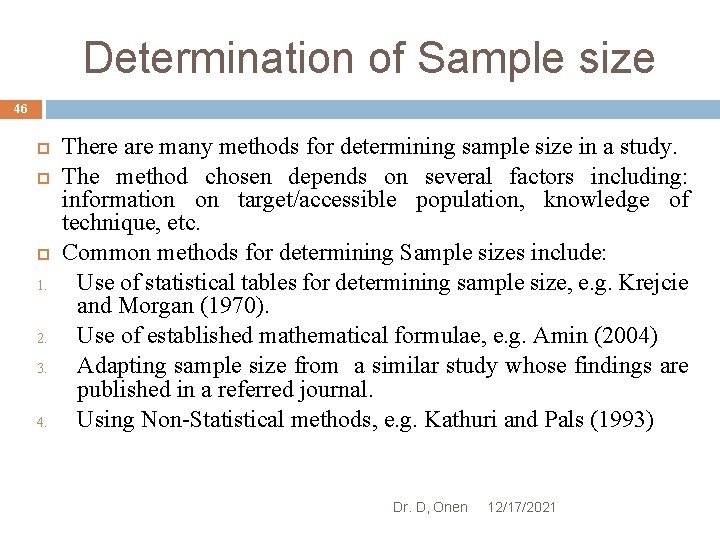
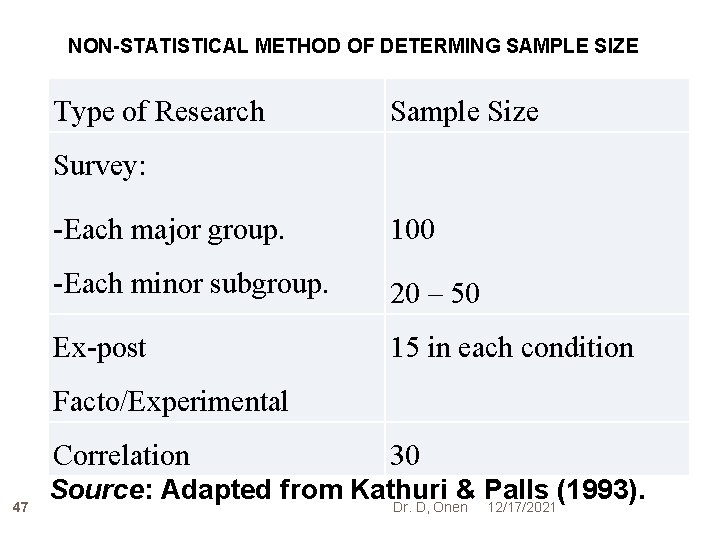
Determination of Sample size 46 1. 2. 3. 4. There are many methods for determining sample size in a study. The method chosen depends on several factors including: information on target/accessible population, knowledge of technique, etc. Common methods for determining Sample sizes include: Use of statistical tables for determining sample size, e. g. Krejcie and Morgan (1970). Use of established mathematical formulae, e. g. Amin (2004) Adapting sample size from a similar study whose findings are published in a referred journal. Using Non-Statistical methods, e. g. Kathuri and Pals (1993) Dr. D, Onen 12/17/2021
NON-STATISTICAL METHOD OF DETERMING SAMPLE SIZE Type of Research Sample Size Survey: -Each major group. 100 -Each minor subgroup. 20 – 50 Ex-post 15 in each condition Facto/Experimental Correlation 47 30 Source: Adapted from Kathuri & Palls (1993). Dr. D, Onen 12/17/2021
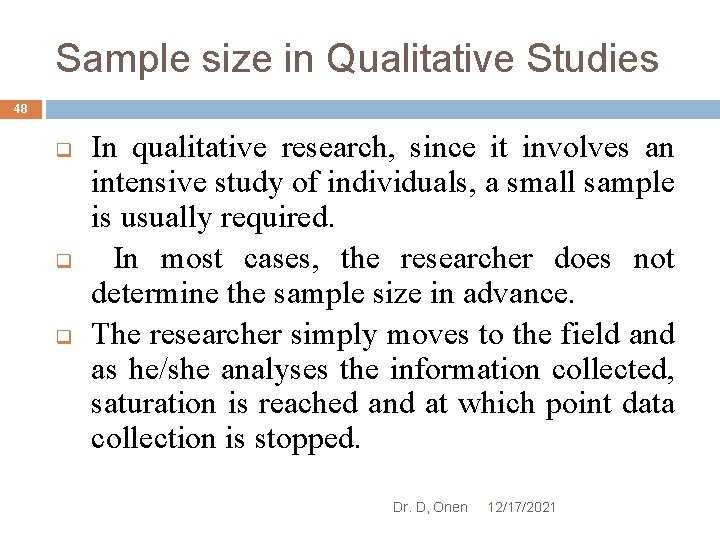
Sample size in Qualitative Studies 48 q q q In qualitative research, since it involves an intensive study of individuals, a small sample is usually required. In most cases, the researcher does not determine the sample size in advance. The researcher simply moves to the field and as he/she analyses the information collected, saturation is reached and at which point data collection is stopped. Dr. D, Onen 12/17/2021
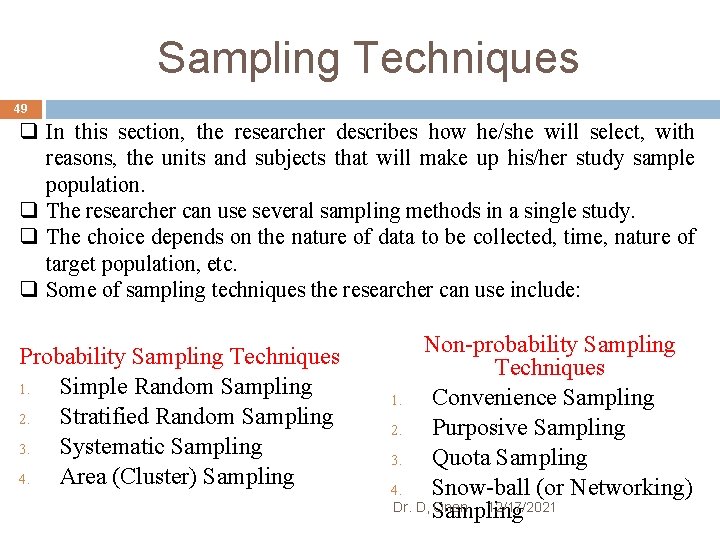
Sampling Techniques 49 q In this section, the researcher describes how he/she will select, with reasons, the units and subjects that will make up his/her study sample population. q The researcher can use several sampling methods in a single study. q The choice depends on the nature of data to be collected, time, nature of target population, etc. q Some of sampling techniques the researcher can use include: Probability Sampling Techniques 1. Simple Random Sampling 2. Stratified Random Sampling 3. Systematic Sampling 4. Area (Cluster) Sampling Non-probability Sampling Techniques 1. Convenience Sampling 2. Purposive Sampling 3. Quota Sampling 4. Snow-ball (or Networking) Dr. D, Sampling Onen 12/17/2021
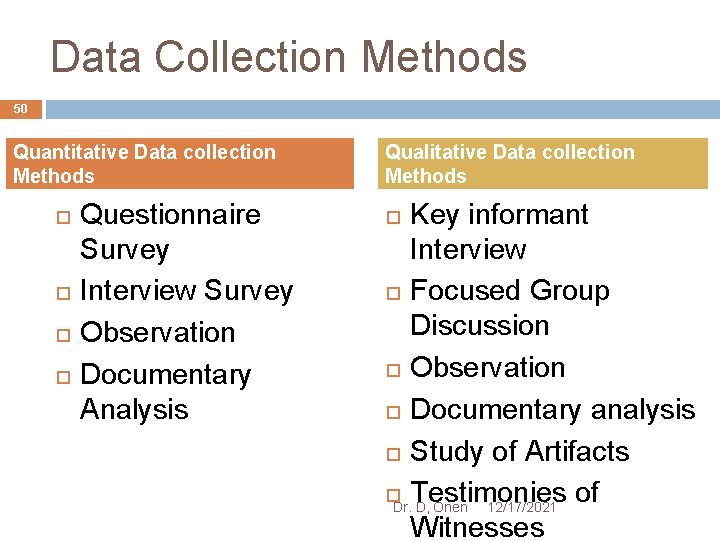
Data Collection Methods 50 Quantitative Data collection Methods Questionnaire Survey Interview Survey Observation Documentary Analysis Qualitative Data collection Methods Key informant Interview Focused Group Discussion Observation Documentary analysis Study of Artifacts Testimonies of Dr. D, Onen 12/17/2021 Witnesses
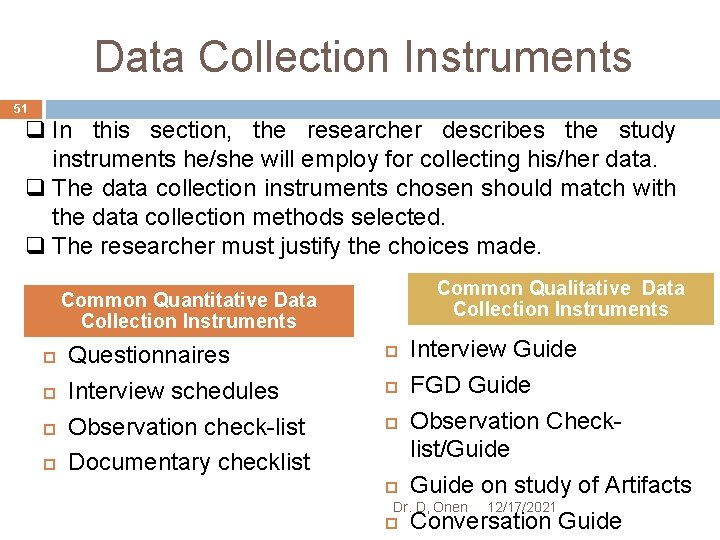
Data Collection Instruments 51 q In this section, the researcher describes the study instruments he/she will employ for collecting his/her data. q The data collection instruments chosen should match with the data collection methods selected. q The researcher must justify the choices made. Common Qualitative Data Collection Instruments Common Quantitative Data Collection Instruments Questionnaires Interview schedules Observation check-list Documentary checklist Interview Guide FGD Guide Observation Checklist/Guide on study of Artifacts Dr. D, Onen 12/17/2021 Conversation Guide
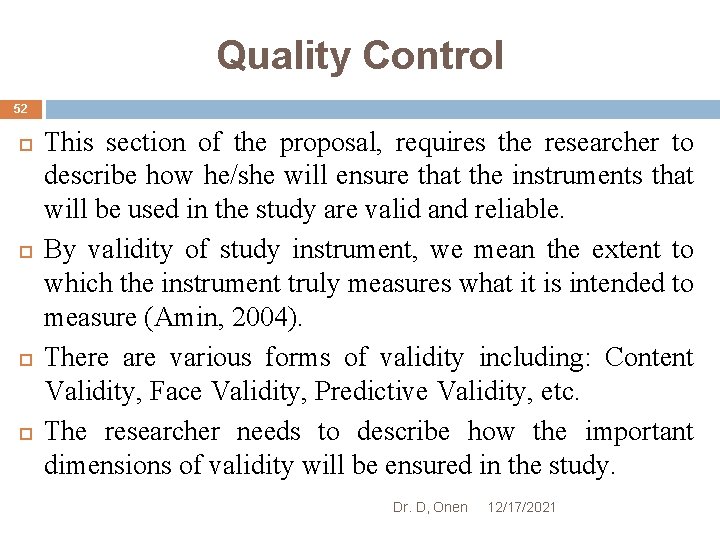
Quality Control 52 This section of the proposal, requires the researcher to describe how he/she will ensure that the instruments that will be used in the study are valid and reliable. By validity of study instrument, we mean the extent to which the instrument truly measures what it is intended to measure (Amin, 2004). There are various forms of validity including: Content Validity, Face Validity, Predictive Validity, etc. The researcher needs to describe how the important dimensions of validity will be ensured in the study. Dr. D, Onen 12/17/2021
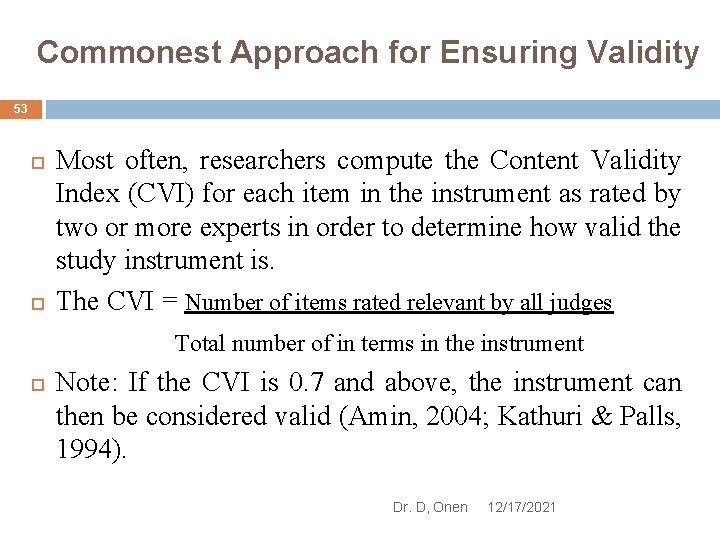
Commonest Approach for Ensuring Validity 53 Most often, researchers compute the Content Validity Index (CVI) for each item in the instrument as rated by two or more experts in order to determine how valid the study instrument is. The CVI = Number of items rated relevant by all judges Total number of in terms in the instrument Note: If the CVI is 0. 7 and above, the instrument can then be considered valid (Amin, 2004; Kathuri & Palls, 1994). Dr. D, Onen 12/17/2021
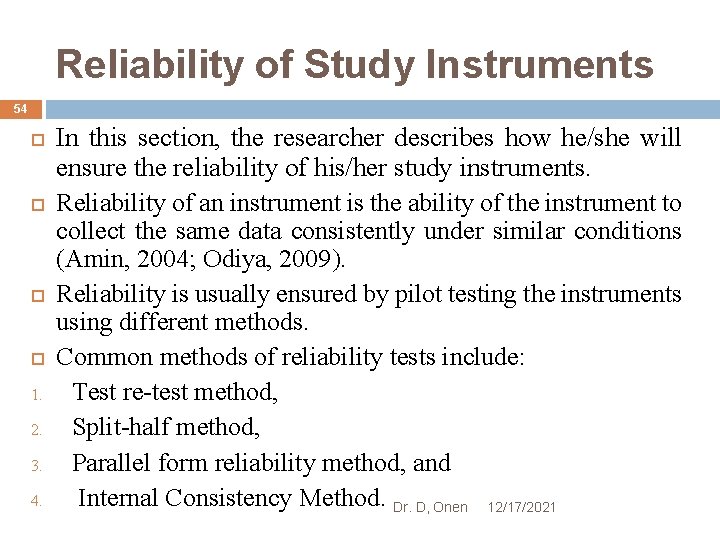
Reliability of Study Instruments 54 1. 2. 3. 4. In this section, the researcher describes how he/she will ensure the reliability of his/her study instruments. Reliability of an instrument is the ability of the instrument to collect the same data consistently under similar conditions (Amin, 2004; Odiya, 2009). Reliability is usually ensured by pilot testing the instruments using different methods. Common methods of reliability tests include: Test re-test method, Split-half method, Parallel form reliability method, and Internal Consistency Method. Dr. D, Onen 12/17/2021
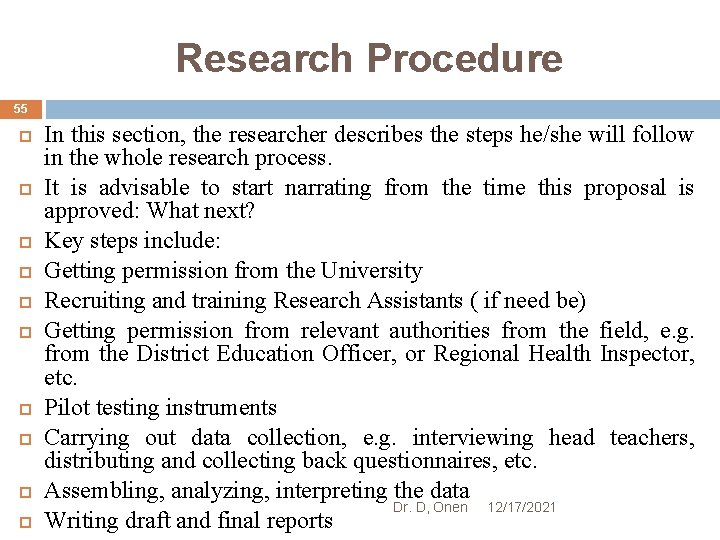
Research Procedure 55 In this section, the researcher describes the steps he/she will follow in the whole research process. It is advisable to start narrating from the time this proposal is approved: What next? Key steps include: Getting permission from the University Recruiting and training Research Assistants ( if need be) Getting permission from relevant authorities from the field, e. g. from the District Education Officer, or Regional Health Inspector, etc. Pilot testing instruments Carrying out data collection, e. g. interviewing head teachers, distributing and collecting back questionnaires, etc. Assembling, analyzing, interpreting the data Dr. D, Onen 12/17/2021 Writing draft and final reports
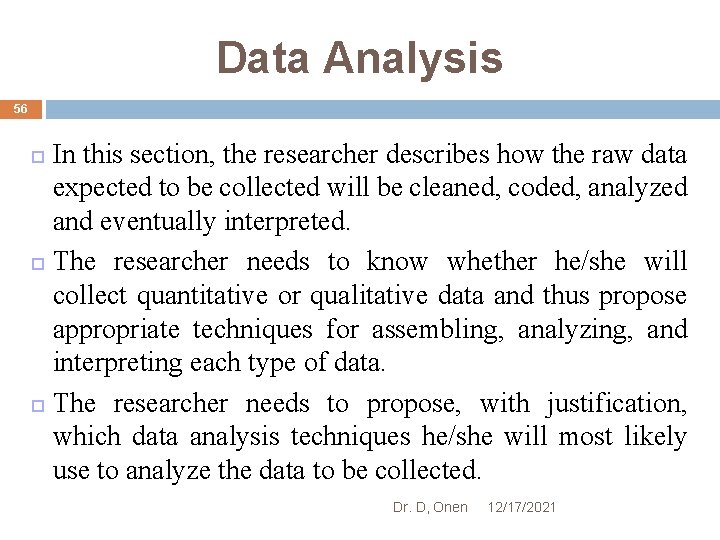
Data Analysis 56 In this section, the researcher describes how the raw data expected to be collected will be cleaned, coded, analyzed and eventually interpreted. The researcher needs to know whether he/she will collect quantitative or qualitative data and thus propose appropriate techniques for assembling, analyzing, and interpreting each type of data. The researcher needs to propose, with justification, which data analysis techniques he/she will most likely use to analyze the data to be collected. Dr. D, Onen 12/17/2021
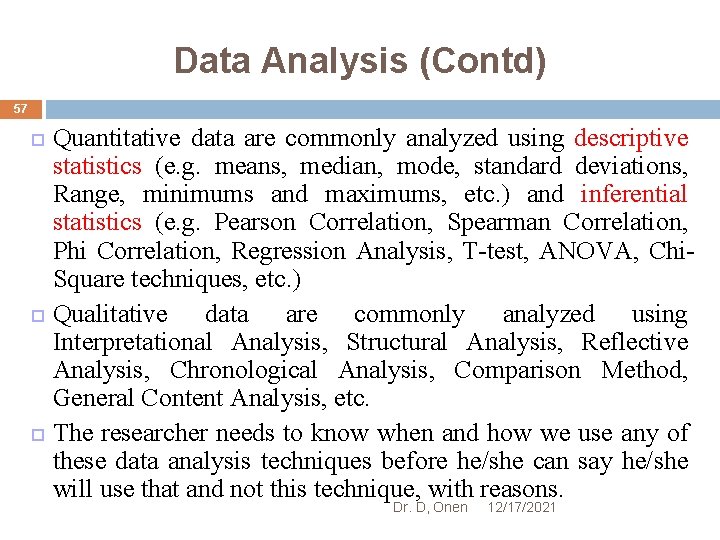
Data Analysis (Contd) 57 Quantitative data are commonly analyzed using descriptive statistics (e. g. means, median, mode, standard deviations, Range, minimums and maximums, etc. ) and inferential statistics (e. g. Pearson Correlation, Spearman Correlation, Phi Correlation, Regression Analysis, T-test, ANOVA, Chi. Square techniques, etc. ) Qualitative data are commonly analyzed using Interpretational Analysis, Structural Analysis, Reflective Analysis, Chronological Analysis, Comparison Method, General Content Analysis, etc. The researcher needs to know when and how we use any of these data analysis techniques before he/she can say he/she will use that and not this technique, with reasons. Dr. D, Onen 12/17/2021
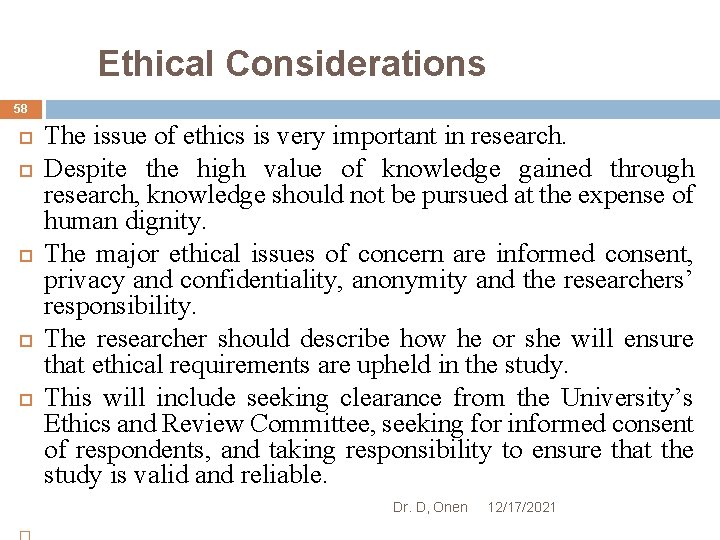
Ethical Considerations 58 The issue of ethics is very important in research. Despite the high value of knowledge gained through research, knowledge should not be pursued at the expense of human dignity. The major ethical issues of concern are informed consent, privacy and confidentiality, anonymity and the researchers’ responsibility. The researcher should describe how he or she will ensure that ethical requirements are upheld in the study. This will include seeking clearance from the University’s Ethics and Review Committee, seeking for informed consent of respondents, and taking responsibility to ensure that the study is valid and reliable. Dr. D, Onen 12/17/2021
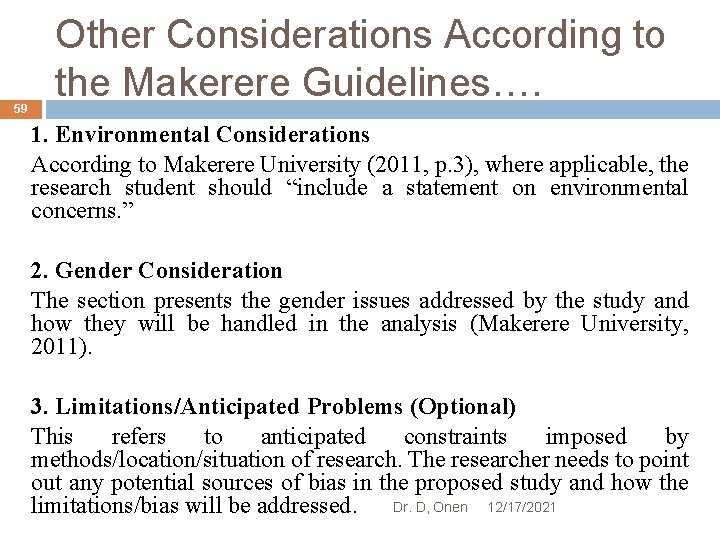
59 Other Considerations According to the Makerere Guidelines…. 1. Environmental Considerations According to Makerere University (2011, p. 3), where applicable, the research student should “include a statement on environmental concerns. ” 2. Gender Consideration The section presents the gender issues addressed by the study and how they will be handled in the analysis (Makerere University, 2011). 3. Limitations/Anticipated Problems (Optional) This refers to anticipated constraints imposed by methods/location/situation of research. The researcher needs to point out any potential sources of bias in the proposed study and how the limitations/bias will be addressed. Dr. D, Onen 12/17/2021
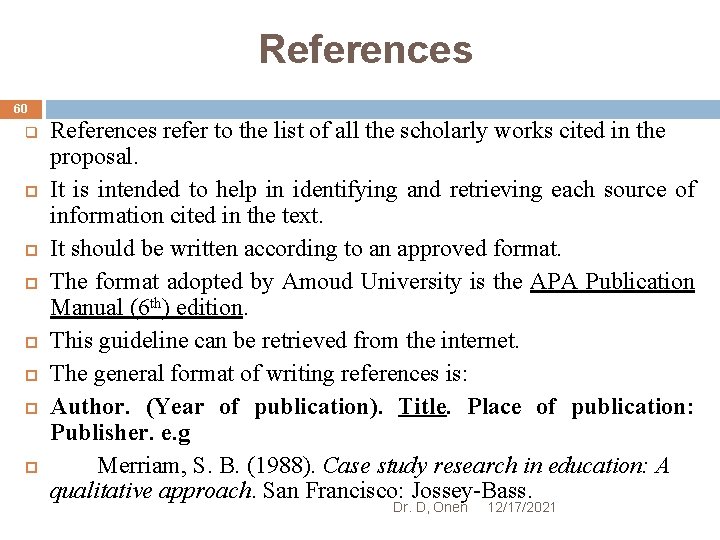
References 60 q References refer to the list of all the scholarly works cited in the proposal. It is intended to help in identifying and retrieving each source of information cited in the text. It should be written according to an approved format. The format adopted by Amoud University is the APA Publication Manual (6 th) edition. This guideline can be retrieved from the internet. The general format of writing references is: Author. (Year of publication). Title. Place of publication: Publisher. e. g Merriam, S. B. (1988). Case study research in education: A qualitative approach. San Francisco: Jossey-Bass. Dr. D, Onen 12/17/2021
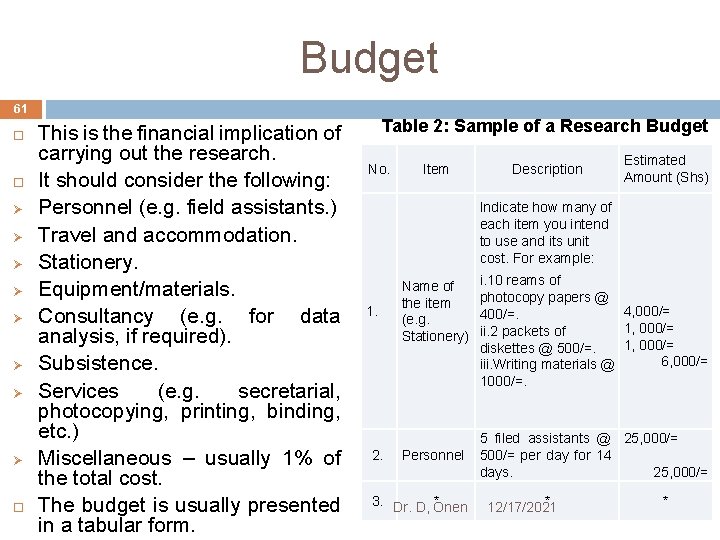
Budget 61 Ø Ø Ø Ø This is the financial implication of carrying out the research. It should consider the following: Personnel (e. g. field assistants. ) Travel and accommodation. Stationery. Equipment/materials. Consultancy (e. g. for data analysis, if required). Subsistence. Services (e. g. secretarial, photocopying, printing, binding, etc. ) Miscellaneous – usually 1% of the total cost. The budget is usually presented in a tabular form. Table 2: Sample of a Research Budget No. Item Description Estimated Amount (Shs) Indicate how many of each item you intend to use and its unit cost. For example: 1. 2. Name of the item (e. g. Stationery) Personnel 3. Dr. D, Onen * i. 10 reams of photocopy papers @ 4, 000/= 400/=. 1, 000/= ii. 2 packets of 1, 000/= diskettes @ 500/=. 6, 000/= iii. Writing materials @ 1000/=. 5 filed assistants @ 25, 000/= 500/= per day for 14 days. 25, 000/= * 12/17/2021 *
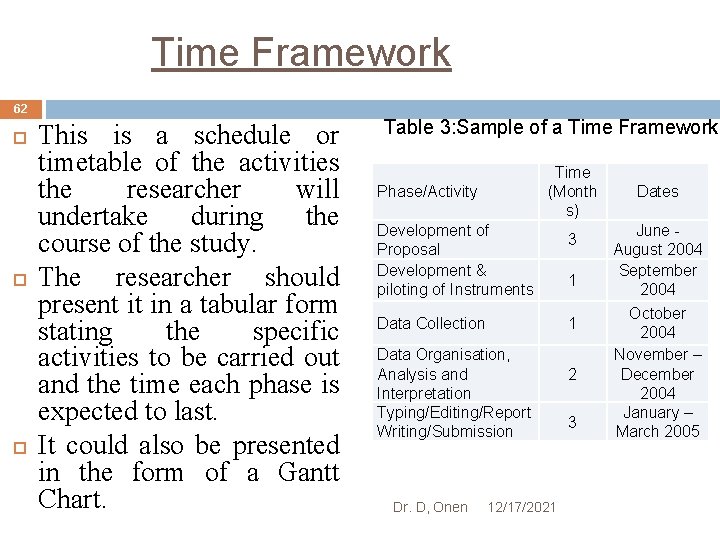
Time Framework 62 This is a schedule or timetable of the activities the researcher will undertake during the course of the study. The researcher should present it in a tabular form stating the specific activities to be carried out and the time each phase is expected to last. It could also be presented in the form of a Gantt Chart. Table 3: Sample of a Time Framework Time (Month s) Phase/Activity Development of Proposal Development & piloting of Instruments Data Collection 1 1 Data Organisation, Analysis and Interpretation Typing/Editing/Report Writing/Submission Dr. D, Onen 3 12/17/2021 2 3 Dates June August 2004 September 2004 October 2004 November – December 2004 January – March 2005
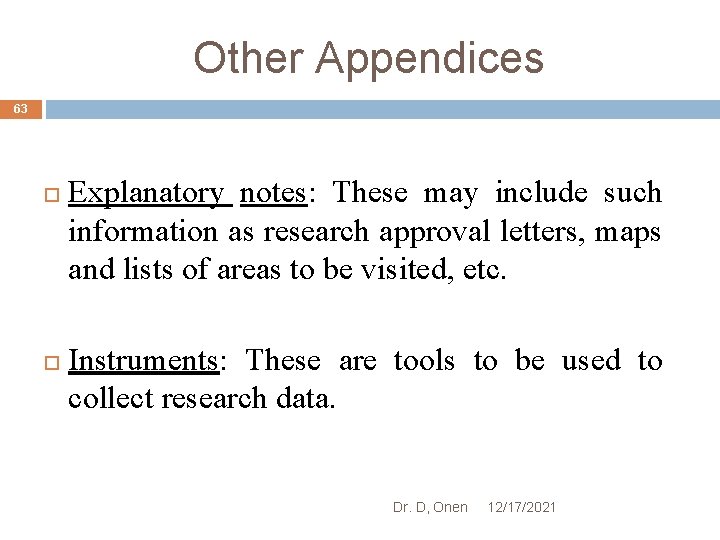
Other Appendices 63 Explanatory notes: These may include such information as research approval letters, maps and lists of areas to be visited, etc. Instruments: These are tools to be used to collect research data. Dr. D, Onen 12/17/2021
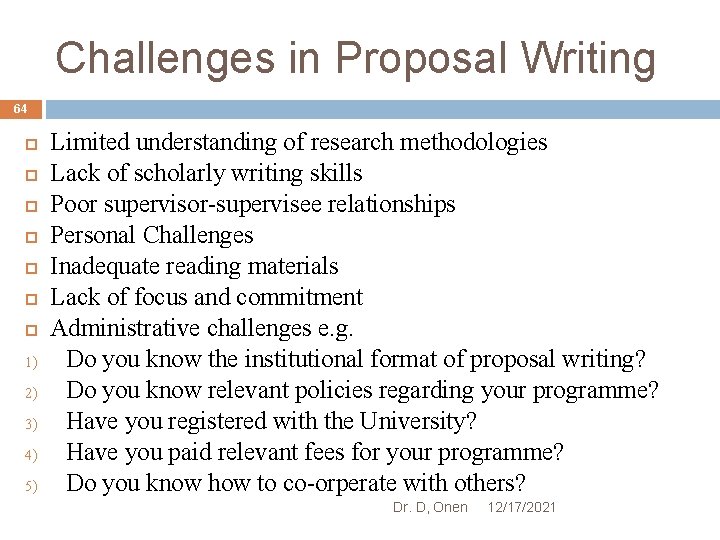
Challenges in Proposal Writing 64 1) 2) 3) 4) 5) Limited understanding of research methodologies Lack of scholarly writing skills Poor supervisor-supervisee relationships Personal Challenges Inadequate reading materials Lack of focus and commitment Administrative challenges e. g. Do you know the institutional format of proposal writing? Do you know relevant policies regarding your programme? Have you registered with the University? Have you paid relevant fees for your programme? Do you know how to co-orperate with others? Dr. D, Onen 12/17/2021
Thank you for your attention! Any questions or comments ? 65 Dr. D, Onen 12/17/2021